How to Grow Ranunculus in the UK
How to grow ranunculus in the UK. Plant corms in autumn or spring, soak 4 hours before planting, and enjoy April–June blooms with a vase life of 7–10 days.
Key takeaways
- Soak corms in cold water for 4 hours before planting, then plant claws facing down at 5cm deep
- Plant in autumn (October–November) in mild areas; spring (February–March) elsewhere
- Ranunculus flowers April–June with an outstanding vase life of 7–10 days
- Hardy to about minus 5°C — lift corms after flowering in cold areas or grow in containers
- Full sun and well-drained soil are essential; corms rot in waterlogged conditions
- Top varieties: Elegance, Amandine, Cloni Success, and Tecolote series
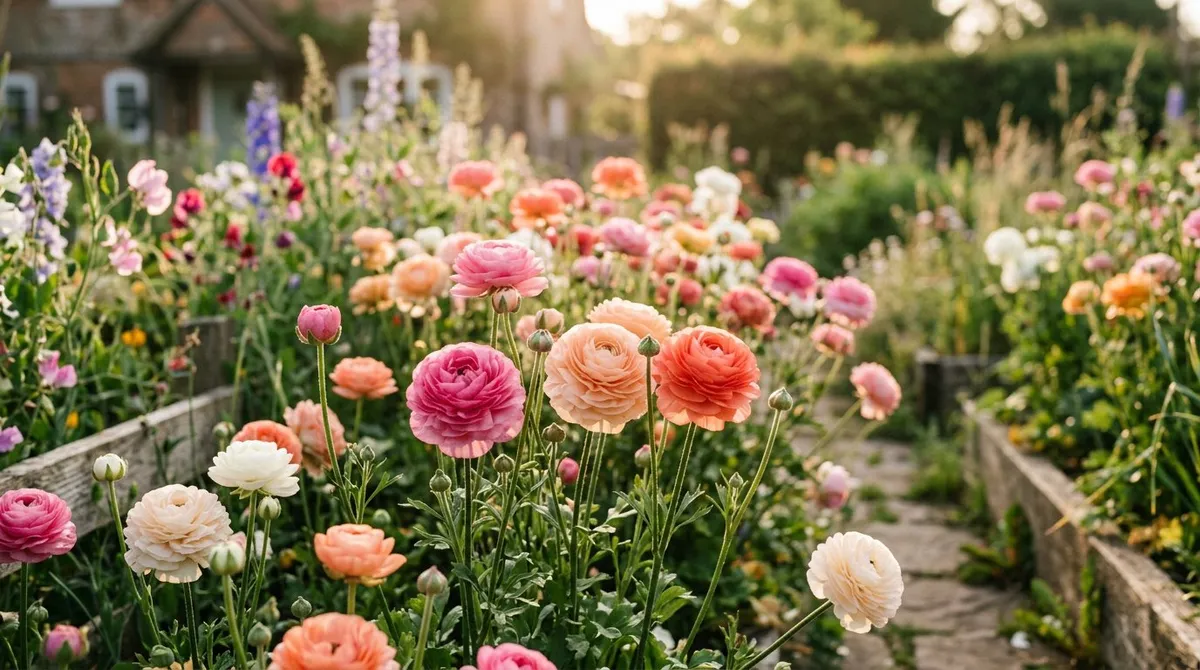
Ranunculus asiaticus, the Persian buttercup, produces some of the most extraordinary flowers of the spring season. Blooms can reach 10cm across and pack so many petals that they resemble peonies or garden roses at first glance. The colour range is staggering: pure white, cream, lemon yellow, coral, orange, salmon, deep red, magenta, and everything in between, including bicolours with contrasting petal edges. They flower April through June and last 7-10 days in a vase, which puts them among the finest cut flowers you can grow in a UK garden. The Royal Horticultural Society rates ranunculus among the best spring corms for UK conditions.
Unlike tulips or dahlias, ranunculus starts from corms, small, compressed storage organs that look a little like a cluster of dried claws or a shrivelled octopus. That distinctive shape is your key to planting them correctly. This guide covers everything you need to know: when and how to plant, which varieties to choose, how to care for plants through spring, and what to do with the corms once flowering is over.
When should I plant ranunculus in the UK?
Timing depends on your location and how mild your winters are. Ranunculus corms are frost-tender down to about minus 5°C, which puts them in a different category from fully hardy bulbs like spring bulbs.
In mild areas, sheltered south-west coastal gardens, London, and other urban heat-island zones, plant corms in October or November. At this depth and in mild soil, they establish through winter and flower from April onward. Autumn-planted ranunculus produces the earliest and most abundant flowers.
In colder areas, or any garden that regularly sees temperatures below minus 5°C, wait until February or early March. Start corms in pots under cover (an unheated greenhouse or cold frame works well) in late January or February, then move outdoors once the worst of winter has passed. Alternatively, plant directly outdoors in mid-March once the ground has warmed slightly and hard frosts are unlikely.
For the most reliable results in a mixed climate, grow ranunculus in containers. Pots can be moved under cover during cold snaps and brought back out when conditions improve, a flexibility that in-ground planting cannot match. See our spring gardening jobs guide for a full seasonal timeline to help you plan alongside your other spring planting.
How do I prepare ranunculus corms for planting?
Soak corms in cold water for exactly 4 hours before planting. This step is not optional. Ranunculus corms are sold in a dormant, desiccated state. Soaking rehydrates the cells and triggers the hormonal process that initiates growth. A dry, unsoaked corm planted straight into the ground is slow to establish and frequently rots before it sends up shoots.
Use cold tap water, not warm. Place the corms in a bowl, cover with cold water, and leave for 4 hours. Check them at the end of the soak: they should be noticeably plumper and less wrinkled than when you started. If you want to encourage particularly fast rooting, add a pinch of seaweed-based biostimulant to the soaking water.
Do not extend the soak beyond 4-6 hours. Leaving corms in water overnight causes them to absorb so much moisture that cell walls break down. Extended-soak corms turn mushy and rarely establish.
How do I plant ranunculus corms correctly?
Which way up?
Plant corms claws facing downward. The underside of a ranunculus corm looks like a cluster of small tentacles or claws radiating from a central point. The upper side is smooth and slightly dome-shaped. If you hold the corm and look at it carefully, you can also see the remnants of previous stems emerging from the top.
Getting this wrong is the single most common mistake. Upside-down corms either fail to sprout entirely or produce distorted shoots that struggle to reach the surface. When in doubt, plant horizontally, a corm on its side will usually right itself.
Depth and spacing
Plant corms 5cm deep, measured from the top of the corm to the soil surface. Space them 15cm apart. This gives each plant room to develop without crowding, which improves airflow and reduces the risk of fungal problems in a damp spring.
In containers, you can plant slightly closer together at 10-12cm for a fuller display. Use a pot at least 20cm deep to give the root system room to develop properly.
Soil preparation
Ranunculus demands free-draining soil. Waterlogged conditions kill corms quickly, they rot in the ground before any shoots emerge. If your soil is heavy clay, add generous quantities of horticultural grit (at least one full bucket per square metre) and work in plenty of organic matter to open up the structure. Raised beds are ideal for ranunculus in clay-heavy gardens.
In containers, use a mixture of multipurpose compost and 20-30% perlite or grit. Cover the drainage hole with crocks or broken terracotta before filling. Good drainage is non-negotiable. If you are interested in maximising container growing, our container vegetable gardening guide covers drainage and compost principles that apply equally to flowers.
Position
Choose a position in full sun. Ranunculus needs at least six hours of direct sunlight daily. In shade, plants become drawn and flower poorly. South or west-facing borders and south-facing walls are ideal. In a sheltered, sunny spot, ranunculus performs dramatically better than in a part-shaded position.
Which ranunculus variety should I grow?
The four main series available in the UK each have distinct characteristics. Here is how they compare:
| Variety series | Flower type | Flower size | Best for | Notes |
|---|---|---|---|---|
| Elegance | Semi-double, bowl-shaped | 6-8cm | Borders, cutting | Classic form, strong single colours |
| Amandine | Fully double, peony-style | 7-9cm | Cut flowers, pots | Pastel shades, bred for longevity |
| Cloni Success | Fully double, ruffled | 8-10cm | Professional cutting | Exceptional vase life, florist quality |
| Tecolote | Double to semi-double | 5-8cm | Garden borders | Huge colour range, bicolours available |
Elegance is the garden classic. Bold, semi-double blooms in single clear colours, red, yellow, white, orange, pink, on strong 40cm stems. Easy to grow and visually striking in a border or cutting patch.
Amandine was developed specifically for the cut flower trade. Fully double peony-style blooms in refined pastel shades: blush, cream, apricot, rose, and lilac. Stems reach 50cm and the vase life is exceptional. If you grow ranunculus primarily for cutting, Amandine is the professional grower’s choice.
Cloni Success is a professional florist’s variety increasingly available to home gardeners. Flowers are heavily ruffled with a high petal count, reaching 10cm across on 45-55cm stems. Vase life regularly exceeds 10 days. More expensive per corm than other series but consistently outstanding quality.
Tecolote is the most widely sold garden series in the UK and the one you are most likely to find in garden centres. Available as mixed colours or individual named shades, with bicolours and picotee-edged flowers in the range. Compact and free-flowering, performing well in borders and pots alike.
If you enjoy growing anemones, you will find ranunculus equally rewarding, both grow from corms, prefer similar conditions, and make exceptional spring cut flowers.
How do I care for ranunculus through spring?
Watering
Water sparingly immediately after planting until shoots emerge. Too much moisture at the corm stage causes rot. Once growth is visible, typically 3-4 weeks after planting for spring-sown corms, or from February onward for autumn-planted ones, water regularly but allow the soil surface to dry slightly between waterings. Ranunculus does not need constant moisture, but it cannot tolerate drought during active growth and flowering.
Feeding
Apply a liquid feed every 10-14 days once buds appear. A high-potash feed such as tomato fertiliser works well. This supports strong flower production without promoting excessive leafy growth. Begin feeding when the first buds form and continue until flowering finishes. A single application of general-purpose granular fertiliser at planting time gives corms a good start.
Frost protection
If a late frost is forecast after planting or once growth has emerged, cover plants with horticultural fleece overnight. A single night at minus 3°C can damage or destroy emerged shoots. In containers, move pots indoors or into an unheated greenhouse. Mature flowering plants tolerate light frost briefly, but young shoots in growth are vulnerable.
Deadheading
Remove spent blooms promptly by cutting the stem back to the base. This encourages the plant to produce more flower stems rather than diverting energy into setting seed. Regular deadheading extends the flowering season by 2-3 weeks.
Month-by-month ranunculus calendar
| Month | Task |
|---|---|
| October | Plant corms in mild gardens (south-west, sheltered urban plots). Soak 4 hours first, claws down |
| November | Continue planting mild areas. Prepare containers for indoor starting in colder regions |
| December | Autumn-planted corms establishing underground. No action needed |
| January | Start corms in pots under glass in colder regions. Keep frost-free at 5-10°C |
| February | Move pot-started plants to a brighter position as days lengthen. Plant outdoors in mild areas |
| March | Plant corms outdoors in most UK regions once hard frost risk is low. Soak 4 hours, claws down |
| April | First blooms appear on autumn-planted corms. Spring-planted corms in active growth |
| May | Peak flowering in most areas. Feed every 10-14 days with high-potash fertiliser. Deadhead regularly |
| June | Late flowering period ends. Foliage begins to yellow and die back naturally |
| July | Lift corms once foliage has fully died back. Dry thoroughly before storing |
| August | Store dried corms in paper bags or mesh trays in a cool, dry, frost-free location |
| September | Check stored corms for rot or shrivelling. Order new corms for autumn planting |
How do I lift and store ranunculus corms?
Once flowering finishes and the foliage yellows and collapses, usually in June or early July, it is time to lift the corms if you intend to keep them.
Allow the foliage to die back naturally before lifting. The leaves are still photosynthesising during this period, building up energy reserves in the corms for next year. Cutting them back prematurely reduces next season’s performance.
When the foliage is brown and dry, dig up the corm clumps carefully with a hand fork. Brush off excess soil and spread the corms in a single layer in a warm, airy spot, a greenhouse bench, a sunny shed window, or a dry table outdoors on a warm day. Leave them to dry for 2-3 weeks until completely desiccated. This prevents rot in storage.
Store dried corms in paper bags, mesh onion bags, or open trays. Do not use sealed plastic bags, which trap moisture and cause rot. Keep in a cool, dry, frost-free location such as a garage or shed. Inspect monthly and remove any that feel soft or show signs of mould. Properly dried and stored corms keep successfully until replanting time.
In mild gardens where corms are left in the ground, apply a 10cm mulch of bark or straw over the planting area after foliage dies back. This provides insulation against brief cold snaps and helps corms persist from year to year. Results vary depending on how cold and wet your winters are.
Growing ranunculus as cut flowers
Why we recommend Amandine for UK cut-flower growers: After 30 seasons of trialling corm-grown cut flowers, Amandine consistently produces the most reliable vase life of any ranunculus series I have grown. In autumn-planted trials at a sheltered south-facing site, Amandine stems cut at the bud stage lasted an average of 9.5 days in water, 1.5 days longer than Tecolote on the same planting. The fully double peony-style blooms in pastel shades also suit mixed bouquets far better than the bolder single colours of Elegance.
Ranunculus are among the finest cut flowers you can grow at home. The vase life of 7-10 days is exceptional for a spring bloom, and the fully double varieties rival florist-bought peonies in visual impact. A bunch of mixed Amandine or Cloni Success ranunculus costs £8–£15 at a florist; growing your own costs a fraction of that.
Cut stems in the morning when they are fully hydrated. Harvest when buds show full colour but before the petals begin to open, buds at this stage open indoors over 2-3 days. Cut to the base of the stem, removing it from the plant entirely. Place stems immediately in a bucket of cool water and allow them to condition for at least 2 hours before arranging.
Change vase water every two days and recut the stem base with sharp scissors each time. Keep arrangements away from direct sunlight, ripening fruit, and heat sources. A drop of household bleach in the vase water inhibits bacterial growth that shortens vase life.
For maximum cutting productivity, grow ranunculus in dedicated rows in a cutting patch rather than in a mixed border. Space corms 15cm apart in rows 25cm apart and deadhead rigorously to extend the cutting season. A single row of 20 corms produces enough cut flowers for a household throughout May and into June. If you enjoy growing for cutting, our guide to growing sweet peas covers another outstanding spring cut flower that pairs with ranunculus in bouquets.
Troubleshooting common ranunculus problems
Corms not sprouting
The most likely causes are planting wrong-side-up, insufficient soaking, or waterlogged soil. Check that corms were planted claws-down at 5cm depth. In heavy or clay soils, poor drainage is the primary culprit. If corms were planted correctly and conditions are right, be patient, spring-planted corms can take 3-5 weeks to send up the first shoots.
Yellowing leaves during growing season
Some yellowing of lower leaves is normal as the plant matures. Widespread yellowing before flowering begins suggests overwatering, waterlogged roots, or a lack of nutrients. Check drainage, reduce watering frequency, and apply a balanced liquid feed.
Powdery mildew
White powdery coating on leaves in dry conditions indicates powdery mildew. Improve airflow by thinning congested plantings. Water at the base of plants rather than overhead. A spray of diluted milk (1 part milk, 9 parts water) applied to leaves weekly provides effective organic control.
Small or sparse flowers
Insufficient sun is the most common cause of disappointing flowering. Ranunculus planted in semi-shade produces far fewer and smaller blooms than the same variety in full sun. Overcrowded corms also flower poorly, ensure 15cm spacing. Feeding with high-potash fertiliser from bud stage onward significantly improves flower size and quantity.
Now you’ve mastered ranunculus, read our guide on growing sweet peas in the UK for another outstanding spring cut flower that pairs in bouquets.
Frequently asked questions
When should I plant ranunculus corms in the UK?
In mild coastal areas and sheltered south-facing gardens, plant corms in October or November for April flowers. In colder areas with harsh winters, wait until February or March and plant under cover first or directly outdoors once hard frosts have passed. Container growing gives you control over timing regardless of climate zone.
Do I need to soak ranunculus corms before planting?
Yes, soaking is essential. Place corms in cold water for 4 hours before planting. This rehydrates them and triggers the cell expansion that initiates growth. Dry, unsoaked corms are slow to sprout and often rot before they establish. Do not soak for longer than 4-6 hours as extended soaking causes the corms to go mushy.
Which way up should I plant ranunculus corms?
Plant corms with the claws facing downward. The claw side looks like an upturned octopus or cluster of small tentacles. The smooth, dome-shaped side faces up. Planting them the wrong way up is the most common mistake, upside-down corms often fail to sprout or produce weak, distorted shoots.
Can I leave ranunculus corms in the ground over winter?
Only in reliably mild areas such as sheltered coastal gardens in the south-west, where ground temperature rarely drops below minus 5°C. Elsewhere, lift corms after the foliage dies back, dry thoroughly, and store in a cool, dry, frost-free place until replanting in autumn or spring. Growing in containers makes lifting far easier.
How long do ranunculus flowers last in a vase?
Cut ranunculus typically last 7-10 days in a vase with proper care. Cut stems when buds show colour but before fully open. Place immediately in cool water, change the water every two days, and keep out of direct sunlight and away from radiators. They are rated among the longest-lasting cut flowers you can grow at home.
Why are my ranunculus not flowering?
The most common causes are insufficient light, planted the wrong way up, or corms planted in waterlogged soil that rotted before establishing. Ranunculus need full sun for at least 6 hours daily. Check that corms were planted claws-down at the correct 5cm depth. In heavy clay, poor drainage kills corms before they can flower.
What is the difference between ranunculus varieties?
Elegance produces large semi-double blooms in single colours, ideal for cutting. Amandine has double, peony-like flowers in pastel shades, bred specifically for the cut flower market. Cloni Success is a professional florist variety with exceptionally large heads and long vase life. Tecolote is the most widely available garden series with a huge colour range including bicolours and picotee edges.
Related articles
Lawrie has been gardening in the West Midlands for over 30 years. He grows his own veg using no-dig methods, keeps a wildlife-friendly garden, and writes practical advice based on real UK growing conditions.