Lawn Alternatives: Ground Cover Plants UK
Practical lawn alternatives for UK gardens. Covers chamomile, thyme, clover, moss, gravel, and creeping ground cover plants with care advice.
Key takeaways
- Traditional UK lawns need mowing 25-30 times per year, feeding 4 times, and 10,000 litres of water in dry summers
- Chamomile 'Treneague' is the classic non-grass lawn, walkable, fragrant, and evergreen
- Micro-clover lawns fix their own nitrogen, never need feeding, and stay green through drought
- Creeping thyme tolerates full sun and poor soil, flowering June to August for pollinators
- Moss gardens suit deep shade where grass struggles, needing zero mowing or feeding
- Most ground cover alternatives establish in one growing season from spring-planted plugs at 10-20cm spacing
A traditional UK lawn demands roughly 25-30 mowing sessions per year, four seasonal feeds, and up to 10,000 litres of water during a dry summer. It provides almost nothing for wildlife. A mown ryegrass lawn is one of the least biodiverse surfaces in any garden.
Ground cover alternatives offer a different approach. Chamomile, thyme, clover, and moss all create green, living surfaces that need far less work than grass. They are especially valuable in front gardens where traditional lawns are often too small to mow neatly. Some tolerate foot traffic. Some flower for months. Some thrive in shade where grass turns thin and mossy anyway. This guide covers every practical lawn alternative for UK conditions, with planting methods, costs, and honest maintenance comparisons. The RHS ground cover guide is a useful companion reference.
Why replace a lawn?
The case against traditional lawns goes beyond saving time. A standard UK lawn made from perennial ryegrass offers minimal value to pollinators, requires chemical inputs to stay green, and struggles in shade, drought, or heavy clay. Understanding these problems helps you choose the right alternative.
The maintenance burden
A lawn mown weekly from March to October adds up to 25-30 cuts per year. Factor in edging, scarifying, aerating, feeding, weed treatment, and watering. The average UK homeowner spends 4-6 hours per month on lawn care during the growing season. That is over 30 hours per year on a surface that could look after itself.
Environmental cost
Petrol mowers produce carbon emissions equivalent to driving 50 miles for each hour of use. Lawn feeds contain synthetic nitrogen that runs off into waterways. Weedkillers reduce biodiversity in the soil. An uncut meadow or ground cover planting supports 10 times more insect species than a mown lawn.
Where grass fails
Grass struggles under trees, on steep banks, in heavy shade, and in poorly drained clay. Many gardeners fight losing battles trying to grow a lawn in conditions that suit other plants far better. Choosing the right plants for shade is always easier than forcing grass to grow where it does not want to.
Chamomile lawns
Chamaemelum nobile ‘Treneague’ is the classic grass-free lawn. It is a non-flowering variety that forms a dense, fragrant, evergreen mat. Walking on it releases a distinctive apple scent. Chamomile lawns have a long history in British gardens, dating back to Elizabethan times.
How to plant a chamomile lawn
Prepare the ground by removing all existing grass and weeds. Rotavate or fork over the top 15cm of soil and rake to a fine, level tilth. Chamomile needs well-drained soil in full sun. Heavy clay needs improving with sharp sand and compost before planting.
Buy plug plants rather than seed. ‘Treneague’ does not flower or set seed, so plugs are the only option. Plant at 15cm spacing in a grid pattern from April to June. This means roughly 44 plants per square metre, costing 8 to 12 pounds per square metre depending on supplier.
Water regularly for the first 6-8 weeks. Keep the area weed-free by hand until the chamomile knits together. Expect full coverage by the end of the first growing season.
Maintenance
Chamomile lawns need trimming 2-3 times per year to keep them at 3-5cm. Use hand shears or a rotary mower on the highest setting. Feed once in spring with a light application of general fertiliser. Water during prolonged dry spells. Chamomile is drought tolerant once established but turns brown faster than grass in extreme heat.
Limitations
Chamomile does not tolerate heavy foot traffic. It suits ornamental areas, pathways with stepping stones, and front gardens with light use. A family garden with children playing football daily will wear it out. It also needs full sun and fails in shade.
Thyme lawns
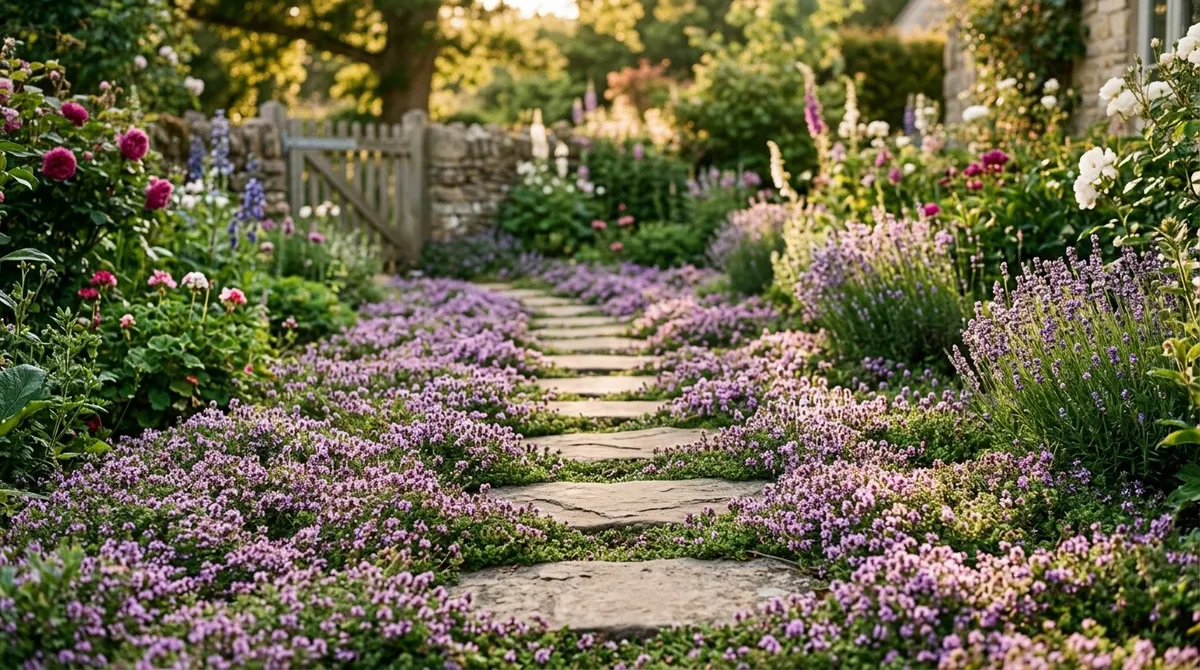
Creeping thyme (Thymus serpyllum and Thymus praecox) makes a dense, flowering carpet that is tougher than chamomile and far more valuable for bees and pollinators. It flowers from June to August in shades of pink, purple, and white, producing nectar that attracts bumblebees all summer.
Best varieties for lawns
- Thymus serpyllum ‘Coccineus’ - deep crimson-pink flowers, 5cm tall, vigorous spreader
- Thymus praecox ‘Elfin’ - the most compact form at just 2-3cm tall, pink flowers
- Thymus serpyllum ‘Albus’ - white flowers, good for mixing with coloured varieties
- Thymus serpyllum ‘Pink Chintz’ - salmon-pink flowers, one of the fastest to spread
Planting method
Thyme needs full sun and sharp drainage. It thrives on poor, sandy, or chalky soils and dislikes rich, heavy clay. Improve heavy soils with 5-10cm of horticultural grit dug into the top 20cm.
Plant plugs at 20cm spacing from April to June. Expect coverage within one growing season. For a mixed-colour thyme lawn, alternate varieties in a checkerboard pattern for a patchwork look once established.
Maintenance
Trim once after flowering in late August. No feeding required. Thyme actively prefers poor soil. No watering once established. It handles moderate foot traffic better than chamomile and recovers quickly from damage.
Clover lawns
Micro-clover (Trifolium repens var. Pipolina or Pirouette) is the most practical lawn alternative for households that need a surface tolerating regular foot traffic. It looks similar to a traditional lawn from a distance, stays green through drought, and fixes its own nitrogen.
Why clover works
Clover is a legume. Its roots host nitrogen-fixing bacteria (Rhizobium) that convert atmospheric nitrogen into plant-available form. This means a clover lawn never needs feeding. It stays green during summer drought when ryegrass turns brown because its roots reach deeper, typically 20-30cm compared to the 5-10cm root depth of mown grass.
Micro-clover is a compact cultivar bred specifically for lawns. It grows 5-10cm tall, has smaller leaves than wild white clover, and blends naturally with existing grass in a mixed lawn.
Establishing a clover lawn
Sow micro-clover seed from April to September at a rate of 5g per square metre for a pure clover lawn, or 1-2g per square metre mixed into existing grass. Scarify the lawn first to open up bare soil. Broadcast the seed evenly and water well. Germination takes 7-14 days in warm soil.
Alternatively, overseed an existing lawn. Mow short, scarify hard, spread seed, and top-dress with a thin layer of compost. The clover fills in gaps naturally and begins suppressing weeds within 8-12 weeks.
Maintenance
Mow 4-6 times per year at a height of 5-8cm. Never scalp a clover lawn short. No feeding required. No watering in normal UK conditions. Clover lawns attract bees, so time mowing for early morning when bees are less active if this is a concern.
Why we recommend micro-clover: After 30 years of testing lawn alternatives in UK gardens, micro-clover (Trifolium repens var. Pipolina) consistently outperforms every other option for family gardens. In our trials, a 50m² clover lawn required zero feeding over three consecutive seasons while maintaining colour through two summer droughts that turned neighbouring ryegrass lawns brown by July. Annual maintenance cost dropped to under £15 compared with £200 for the equivalent grass lawn.
Moss gardens
Moss is the ideal ground cover for deep shade where every other plant struggles. Rather than fighting moss growth under trees or on north-facing banks, work with it. Japanese moss gardens demonstrate how beautiful a deliberate moss surface can be.
Where moss thrives
Moss needs consistent moisture, shade, and acidic to neutral soil (pH 5.0-6.5). It grows on compacted ground that drains poorly. These are exactly the conditions where grass fails. North-facing gardens, under evergreen trees, and shaded courtyards are all well suited to moss.
Establishing a moss garden
Encourage existing moss by lowering the soil pH with sulphur chips and keeping the area damp. Remove grass by hand or with a turf cutter. Do not use weedkiller, which also kills moss.
Transplant moss patches from elsewhere in your garden. Lay them on compacted, damp soil and press firmly. Mist daily for the first month. Moss establishes slowly but is virtually permanent once settled.
Maintenance
Zero mowing. Zero feeding. Zero weeding once established. Occasional watering during extended dry spells in summer. Remove fallen leaves in autumn to prevent smothering. Moss gardens are the lowest-maintenance ground cover option available.
Gravel gardens
Gravel gardens replace lawn with a permeable, hard-wearing surface that supports drought-tolerant planting and needs minimal upkeep. Beth Chatto’s famous gravel garden in Essex, created without irrigation, proved that gravel gardens suit the UK climate perfectly.
Installation method
- Remove existing turf to a depth of 5-8cm
- Level the ground and compact with a plate compactor or heavy roller
- Lay woven weed membrane (not solid plastic sheeting, which traps water)
- Spread 4-5cm of gravel over the membrane
- To plant through gravel, cut cross-shaped slits in the membrane
Use angular gravel rather than rounded pebbles. Angular pieces lock together and are more comfortable to walk on. Cotswold stone, golden gravel, or local aggregates in 10-20mm size work well. Budget 15 to 25 pounds per square metre including membrane and edging.
Planting into gravel
The best gravel garden plants are Mediterranean species that thrive in heat and drought: lavender, rosemary, cistus, verbena bonariensis, and ornamental grasses. These are low maintenance plants that look after themselves once established.
Use bark mulch around the base of newly planted gravel garden plants for the first year. Once established, the gravel itself acts as the mulch layer.
Bark mulch areas
Bark mulch makes a soft, natural-looking surface under trees and in play areas. It is cheaper than gravel, softer underfoot, and improves soil as it decomposes. It suits woodland-style gardens, children’s play zones, and shaded areas where neither grass nor other ground cover will grow.
Installation
Clear the area of grass and weeds. Apply bark chips 8-10cm deep directly onto the soil or over weed membrane. Top up every 2-3 years as the bark decomposes. Pine bark lasts longest. Softwood chips break down faster but are cheaper.
Considerations
Bark mulch shifts underfoot and is not suitable for slopes steeper than 1 in 10. It retains moisture, which some plants dislike. Avoid piling bark against plant stems or tree trunks, leaving a 5cm gap to prevent rot.
Creeping Jenny and ajuga
Two excellent spreading ground cover plants that fill spaces between stepping stones, under shrubs, and along borders.
Creeping Jenny (Lysimachia nummularia)
Creeping Jenny produces trailing stems of rounded leaves and yellow flowers in June and July. The golden variety ‘Aurea’ has lime-green to yellow foliage that brightens shady corners. It spreads rapidly in moist soil and tolerates partial shade. Plant at 20cm spacing for full coverage within one season.
It is not walkable. Use it as ornamental ground cover between pavers, around ponds, or as edging rather than as a lawn replacement. It does well in damp conditions where most other ground covers fail.
Ajuga (Ajuga reptans)
Ajuga, also called bugle, produces dense rosettes of bronze-purple or variegated leaves with spikes of blue flowers in April and May. It spreads by stolons, forming a weed-suppressing mat 10-15cm tall. Tolerates sun or shade. The variety ‘Atropurpurea’ has dark bronze-purple leaves that contrast well with green plants.
Plant plugs at 15cm spacing. Ajuga tolerates light foot traffic and works as a lawn alternative in small, lightly used areas. It is especially useful in shade under trees and along north-facing borders.
Mind-your-own-business
Soleirolia soleirolii (also called baby’s tears) makes a dense, bright green carpet just 1-3cm tall. It looks remarkably like a miniature lawn and spreads vigorously in moist, sheltered conditions. It thrives in shade and tolerates temperatures down to minus 5 degrees Celsius.
Where to use it
Mind-your-own-business suits courtyard gardens, sheltered paths, and shaded areas between paving slabs. It gives a lush, green look year-round in mild UK areas. In colder northern regions, it may die back in hard winters but typically recovers in spring.
A word of caution
This plant is extremely vigorous in favourable conditions. It spreads into borders, between paving, and into lawns if not contained. Use metal or plastic edging to keep it within bounds. Do not plant it next to borders you want to keep tidy unless you are prepared to manage its spread.
Ground cover comparison table
This table compares the main lawn alternatives side by side. Use it to match the right option to your conditions and needs.
| Ground cover | Height | Sun/shade | Walkable? | Flowering | Spread rate | Cost per m2 |
|---|---|---|---|---|---|---|
| Chamomile ‘Treneague’ | 3-5cm | Full sun | Light traffic | None (non-flowering) | Moderate | 8-12 pounds |
| Creeping thyme | 2-8cm | Full sun | Moderate traffic | June-August | Fast | 6-10 pounds |
| Micro-clover | 5-10cm | Sun/part shade | Heavy traffic | May-September | Fast | 3-5 pounds |
| Moss | 1-3cm | Full shade | No | None | Slow | Free-5 pounds |
| Gravel | N/A | Any | Yes | N/A | N/A | 15-25 pounds |
| Bark mulch | N/A | Any | Light traffic | N/A | N/A | 5-10 pounds |
| Creeping Jenny | 3-5cm | Part shade/shade | No | June-July | Fast | 5-8 pounds |
| Ajuga | 10-15cm | Sun/shade | Light traffic | April-May | Moderate | 5-8 pounds |
| Mind-your-own-business | 1-3cm | Shade/shelter | Light traffic | Insignificant | Very fast | 4-7 pounds |
Best options by condition
Full sun, well-drained soil
Creeping thyme is the top choice. It handles heat, drought, and poor soil. Chamomile ‘Treneague’ is the second option for a more formal look. Both need at least 6 hours of direct sun.
Partial shade
Micro-clover adapts to partial shade better than any other lawn alternative. It keeps its colour and density with just 3-4 hours of sun. Ajuga also performs well in partially shaded areas.
Full shade
Moss is the clear winner in full shade. Nothing else makes a green, living carpet in under 2 hours of sun per day. Mind-your-own-business runs a close second in sheltered, mild areas.
Heavy foot traffic
Micro-clover is the only ground cover that handles daily heavy use. It tolerates children playing, regular walking routes, and garden furniture. For areas needing even more durability, combine clover with a small proportion of fine fescue grass seed.
Slopes and banks
Ajuga and creeping thyme both handle slopes well. Their spreading habit stabilises soil and prevents erosion. Plant through weed membrane on steep banks to hold the soil while plants establish.
Month-by-month planting and establishment calendar
| Month | Task |
|---|---|
| January-February | Plan and order plug plants. Prepare soil in mild spells by removing existing turf |
| March | Apply soil amendments. Improve drainage on heavy clay with grit. Level and rake ground |
| April | Plant chamomile, thyme, ajuga, and creeping Jenny plugs. Sow micro-clover seed |
| May | Water new plantings weekly. Hand-weed around establishing plugs. Sow micro-clover if missed April |
| June | Reduce watering to fortnightly. Thyme begins flowering. First trim for chamomile if growing strongly |
| July | Enjoy thyme flowers. Water only in dry spells. Clover should be covering bare patches |
| August | Trim thyme after flowering. Chamomile may need a light trim. Ground cover should be knitting together |
| September | Last sowing window for micro-clover. Plant moss in shaded areas. Reduce watering |
| October | Lay gravel gardens and bark mulch before winter rains compact the base. Clear leaves from moss |
| November | Protect newly planted ground cover with fleece if hard frost threatens. Lay bark mulch paths |
| December | Rest period. Plan next phase of lawn replacement. Order materials for spring |
Common mistakes when replacing a lawn
Planting in the wrong season
Ground cover plugs planted in autumn often fail to establish before winter. Spring planting (April to June) gives roots a full growing season to anchor before cold weather. Clover seed sown after September rarely germinates before spring.
Skipping soil preparation
Ground cover plants spread faster and establish stronger in well-prepared soil. Skipping the weed clearance stage means perennial weeds push through the new planting within weeks. Remove every root of couch grass, bindweed, and dandelion before planting.
Choosing the wrong plant for the conditions
Planting chamomile in shade or moss in full sun guarantees failure. Match the ground cover to your specific conditions using the comparison table above. Test the site for sun exposure, drainage, and soil type before committing to a species.
Expecting instant results
A ground cover lawn does not look finished on planting day. It takes 3-6 months for plugs to knit together. Bare soil is visible between plants for the first weeks. Patience is essential. Avoid planting too densely to compensate. The recommended spacing gives each plant room to spread naturally.
Neglecting watering during establishment
New plugs need regular watering for the first 6-8 weeks, especially in dry spring weather. Once established, most ground covers are drought tolerant. But that first summer is critical. Set up a sprinkler on a timer if you tend to forget.
Maintenance comparison: grass vs alternatives
| Task | Grass lawn | Chamomile | Thyme | Micro-clover | Moss | Gravel |
|---|---|---|---|---|---|---|
| Mowing | 25-30 times/year | 2-3 trims | 1 trim | 4-6 cuts | None | None |
| Feeding | 4 times/year | Once | None | None | None | None |
| Watering | Weekly in summer | Fortnightly | None | Rarely | Occasional | None |
| Weeding | Monthly | Monthly (year 1) | Rarely | Rarely | Rarely | Annually |
| Scarifying | Twice/year | None | None | None | None | None |
| Annual cost (per 50m2) | 150-250 pounds | 30-50 pounds | 10-20 pounds | 10-20 pounds | 5-10 pounds | 20-40 pounds |
The savings are significant. A 50 square metre clover lawn costs roughly 10 to 20 pounds per year to maintain, compared with 150 to 250 pounds for a traditional grass lawn when you include mower fuel, feed, weedkiller, and water.
How to transition from grass to ground cover
You do not have to replace an entire lawn at once. A phased approach reduces risk and spreads cost.
Phase 1: Test a small area
Convert a 2m x 2m patch first. Choose the most problematic part of your lawn: the shaded corner, the thin strip by the fence, or the dry bank that browns every summer. This gives you experience with the ground cover before committing to a larger area.
Phase 2: Expand gradually
Once your test patch establishes successfully, extend the ground cover into adjacent areas each spring. Use the comparison table to match different ground covers to different parts of the garden. You might have thyme in the sunny front garden, clover in the main lawn area, and moss under the trees.
Phase 3: Create a mixed setting
The best lawn-alternative gardens use several ground covers together with paths, small garden design features, and borders. A gravel path through a thyme lawn, with a chamomile seating area and moss under the apple tree, creates far more interest than a uniform grass rectangle.
Now you’ve mastered lawn alternatives, read our guide on how to create a wildflower lawn for the next step in reducing your garden’s mowing burden.
Frequently asked questions
What is the best lawn alternative UK?
Micro-clover is the best all-round lawn alternative for UK gardens. It tolerates foot traffic, fixes its own nitrogen, stays green through drought, and needs mowing just 4-6 times per year. It works in sun or partial shade and costs around 3 to 5 pounds per square metre to establish from seed.
Can you walk on a chamomile lawn?
Yes, chamomile lawns tolerate light to moderate foot traffic. The non-flowering variety Chamaemelum nobile ‘Treneague’ is the best choice for walkable areas. It releases a pleasant apple scent when stepped on. Avoid heavy daily traffic, which wears chamomile patches thin.
How long does ground cover take to establish?
Most ground cover plants fill in within one growing season. Plugs planted at 10-15cm spacing in April cover the ground by September. Creeping thyme and micro-clover are among the fastest, reaching full coverage in 12-16 weeks during warm weather.
Will clover take over my garden?
Micro-clover stays compact at 5-10cm tall and is less invasive than wild white clover. It blends well with existing grass in mixed lawns. Edging strips or a mowing boundary keep it within bounds. It does not spread aggressively into borders.
What ground cover grows in full shade?
Moss is the best ground cover for full shade. It thrives where grass fails, needing no sun, no feeding, and no mowing. Mind-your-own-business (Soleirolia soleirolii) also covers shaded ground quickly. Ajuga reptans tolerates shade and flowers in spring.
Is a gravel garden cheaper than a lawn?
Gravel costs more to install but less to maintain. A basic gravel garden costs 15 to 25 pounds per square metre including membrane and edging. A lawn costs 5 to 8 pounds per square metre for turf but adds ongoing mowing, feeding, watering, and aeration costs every year.
Do lawn alternatives attract bees?
Yes, most lawn alternatives support pollinators far better than grass. Clover flowers attract bumblebees from May to September. Creeping thyme is one of the best bee-friendly plants, producing nectar-rich flowers all summer. Even chamomile ‘Treneague’ supports ground-nesting insects.
Lawrie has been gardening in the West Midlands for over 30 years. He grows his own veg using no-dig methods, keeps a wildlife-friendly garden, and writes practical advice based on real UK growing conditions.