Ornamental Grasses for UK Gardens
Guide to the best ornamental grasses for UK gardens. Covers tall, medium, and low varieties with planting, dividing, and cutting back advice.
Key takeaways
- Tall grasses like Miscanthus sinensis and Stipa gigantea reach 1.8-2.5m and make striking focal points or natural screens
- Stipa tenuissima (60cm) is the most popular medium grass, self-seeding freely in gravel gardens and borders
- Cut deciduous grasses hard to 10cm above ground in late February before new growth appears
- Divide established clumps every 3-4 years in mid-spring to maintain vigour and prevent bare centres
- Evergreen grasses like Festuca glauca need combing, not cutting — pull out dead blades by hand in spring
- Most ornamental grasses need free-draining soil and full sun, making them ideal for dry, south-facing borders
- Grasses provide winter structure when left standing through autumn and winter with frost-covered seed heads
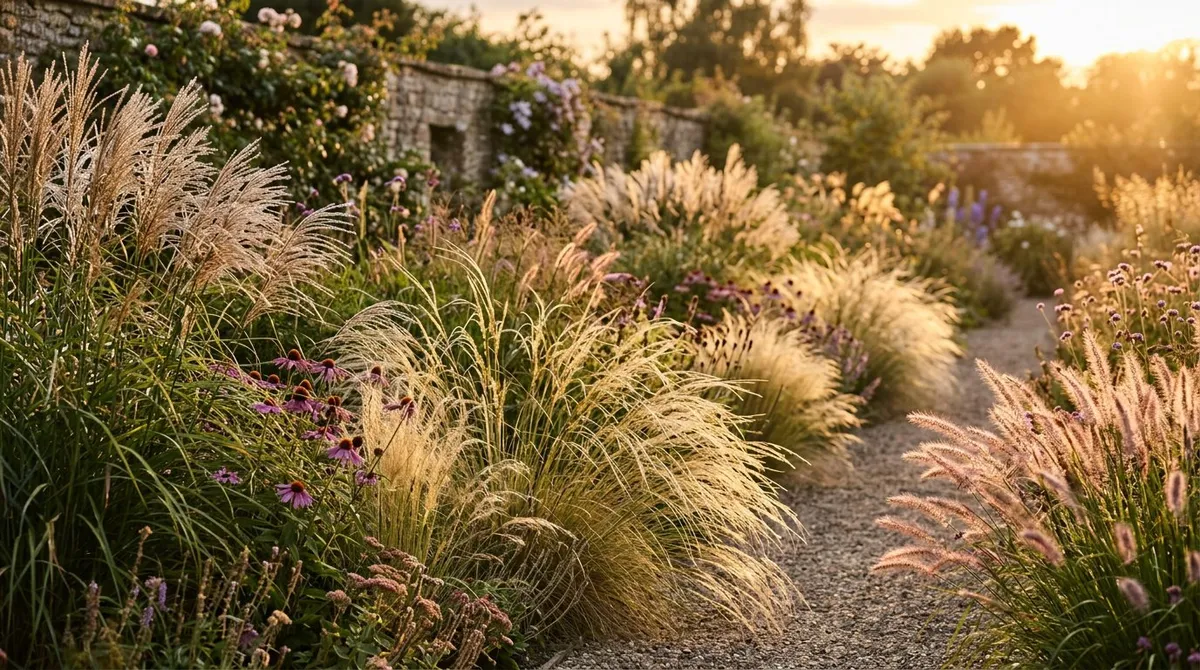
Ornamental grasses change a garden with movement, sound, and year-round structure. A single clump of Stipa gigantea catches the evening light and turns an ordinary border into something memorable. There are grasses for every situation, from 2.5m Miscanthus screens to 15cm Festuca edging along a path.
Grasses ask very little. Most need free-draining soil, full sun, and an annual cut back. They shrug off drought, ignore poor soil, and rarely suffer pests or diseases. This guide covers the best ornamental grasses by size, how to plant and care for them, and when to divide and cut back established clumps. If you are working with dry conditions, our guide to drought-tolerant plants covers more options.
Tall grasses (1.5m and above)
Tall ornamental grasses make bold architectural statements. They work as centre pieces, natural screens, and backdrop planting behind lower perennials. Plant them where they catch low sunlight for the best effect.
Miscanthus sinensis is the king of tall grasses. The species reaches 2-2.5m with arching leaves and silky flower plumes from September onwards. ‘Malepartus’ has deep red-bronze plumes that fade to silver. ‘Gracillimus’ (Maiden Grass) has the finest leaves at just 5mm wide, creating an elegant, narrow fountain shape. ‘Morning Light’ has white-edged foliage that glows in shade. All forms are fully hardy to -20C and form dense, non-spreading clumps.
Stipa gigantea (Golden Oats) is one of the most dramatic grasses for UK gardens. It sends up 1.8-2m flower stems from a low, evergreen base. The oat-like flowers open purple-green in June and ripen to golden yellow, lasting well into winter. Unlike Miscanthus, it is semi-evergreen and never needs a hard cut back. Just remove old flower stems in spring. It works as a see-through screen in a cottage garden planting scheme.
Calamagrostis x acutiflora ‘Karl Foerster’ is the most upright grass available. The stiff, vertical stems reach 1.5-1.8m and never flop, even in heavy rain. Flower plumes appear in June, earlier than most grasses, and turn from pinky-bronze to golden buff by autumn. Its narrow, columnar habit takes up very little ground space, making it well suited to tight borders and repeated planting along paths.
Gardener’s tip: Plant tall Miscanthus at least 1m from a fence or wall. They need air circulation to stay healthy, and the root clump expands to 1m across within 3-4 years. Trying to squeeze one into a narrow gap only leads to problems.
Medium grasses (50cm to 1.5m)
Medium grasses are the workhorses of the border. They fill gaps between perennials, soften hard edges, and add movement to static planting.
Stipa tenuissima (Mexican Feather Grass) is arguably the most popular ornamental grass in the UK. At 50-60cm tall, it forms a dense tuft of hair-fine leaves that sways in the lightest breeze. The pale green flower heads appear in June and age to straw-gold. It self-seeds generously, which is a bonus in gravel gardens but can be a nuisance elsewhere. Deadhead before seeds ripen if spread concerns you.
Pennisetum alopecuroides (Fountain Grass) produces bottlebrush flower spikes from August to October. ‘Hameln’ is the most reliable UK cultivar at 60-80cm, with soft, pinky-brown spikes that catch dew on autumn mornings. It needs a warm, sheltered spot in colder northern gardens. Borderline hardy below -10C, so avoid exposed sites in Scotland and northern England.
Molinia caerulea (Purple Moor Grass) is native to British moorland and thrives in damp, acidic soil where other grasses sulk. Subsp. arundinacea ‘Transparent’ reaches 1.5m with delicate, see-through flower panicles on wiry stems. ‘Edith Dudszus’ is more compact at 1m with dark purple stems. Both colour brilliantly in autumn before dropping their foliage cleanly, leaving neat basal tufts through winter.
Deschampsia cespitosa (Tufted Hair Grass) is one of the few grasses that thrives in shade. It tolerates heavy clay, damp conditions, and positions under trees where most grasses fail. The cloud-like flower panicles appear in June on 1m stems. ‘Goldtau’ and ‘Bronzeschleier’ are the best named forms. A useful grass for shady garden areas.
Low grasses (under 50cm)
Low grasses work as ground cover, path edging, and container plants. Their compact size suits small gardens and front borders.
Festuca glauca (Blue Fescue) forms tight, steely-blue domes just 25cm tall and 25cm wide. ‘Elijah Blue’ and ‘Intense Blue’ have the strongest colour. It needs sharp drainage and full sun. In heavy clay it rots quickly. Plant in gravel, raised beds, or containers for best results. Individual plants are short-lived (3-5 years) but are cheaply replaced from divisions or seed.
Hakonechloa macra (Japanese Forest Grass) is the finest grass for shade. The cascading, bamboo-like foliage reaches 35-40cm and turns from fresh green to rich amber in autumn. ‘Aureola’ has golden-yellow variegated leaves that light up dark corners. It is slow to establish but forms a striking ground-cover carpet after 3-4 years. Needs moist, humus-rich soil and shelter from drying winds.
Carex oshimensis ‘Evergold’ is technically a sedge, not a grass, but fills the same role in the garden. The arching, cream-and-green striped leaves stay bright all year. At 30cm tall, it works in containers, under shrubs, and as edging. Fully hardy and tolerant of shade. One of the best low-maintenance plants available.
Ornamental grass comparison table
| Grass | Height | Spread | Flowers | Deciduous/Evergreen | Best use |
|---|---|---|---|---|---|
| Miscanthus sinensis ‘Malepartus’ | 2-2.5m | 1-1.2m | Red-bronze plumes, Sep-Oct | Deciduous | Centre piece, screen |
| Stipa gigantea | 1.8-2m stems | 60-75cm base | Golden oat-like, Jun-Jul | Semi-evergreen | See-through screen |
| Calamagrostis ‘Karl Foerster’ | 1.5-1.8m | 50-60cm | Pink-bronze, Jun | Deciduous | Vertical accent, borders |
| Stipa tenuissima | 50-60cm | 30-40cm | Pale green to straw, Jun | Deciduous | Gravel gardens, massed |
| Pennisetum ‘Hameln’ | 60-80cm | 50-60cm | Pink-brown bottlebrush, Aug-Oct | Deciduous | Warm borders, pots |
| Molinia ‘Transparent’ | 1.2-1.5m | 60cm | Airy purple, Aug-Sep | Deciduous | Damp borders, natural planting |
| Deschampsia cespitosa | 80cm-1m | 50-60cm | Cloud-like panicles, Jun | Semi-evergreen | Shade, clay, woodland |
| Festuca glauca ‘Elijah Blue’ | 25cm | 25cm | Blue-grey spikes, Jun | Evergreen | Edging, gravel, containers |
| Hakonechloa macra ‘Aureola’ | 35-40cm | 40-50cm | Insignificant | Deciduous | Shade, containers, ground cover |
| Carex oshimensis ‘Evergold’ | 30cm | 35cm | Brown spikes, insignificant | Evergreen | Edging, shade, containers |
How to plant ornamental grasses
Most ornamental grasses establish best when planted in spring (April to May), once the soil has warmed and risk of hard frost has passed. Spring planting gives the root system an entire growing season to anchor before winter. Autumn planting works for hardy types like Miscanthus and Calamagrostis, but avoid it for borderline-hardy Pennisetum.
Choose a spot in full sun with free-draining soil. Most grasses rot in waterlogged ground over winter. Dig a hole twice the width of the pot and the same depth. Set the crown level with the soil surface. Do not bury it. Backfill, firm gently, and water well. Mulch with gravel rather than bark, especially around drought-tolerant species like Stipa and Festuca.
Space grasses according to their mature spread. Miscanthus needs 1m between plants. Calamagrostis looks best at 50cm spacing in a row. Stipa tenuissima planted at 30cm centres fills in within one season. Group odd numbers (3, 5, 7) for naturalistic planting. Even a budget garden scheme benefits from a bold drift of a single grass variety.
How to cut back ornamental grasses
Timing matters. Cut deciduous grasses too early and you lose months of winter structure. Cut too late and you damage emerging new growth. The window is narrow.
Leave deciduous grasses standing through autumn and winter. Frost-covered seed heads look beautiful on cold mornings, and the stems shelter overwintering insects. In late February or early March, cut the entire clump to 10-15cm above ground using hand shears or a hedge trimmer. Do this before the new green shoots push up more than a few centimetres. If you cut into new growth, you shear off the tips and the grass looks ragged for weeks.
Tie large Miscanthus clumps with string before cutting. This bundles the stems and makes cleanup far easier. Cut across the tied bundle, then carry the whole lot to the compost heap or green waste bin.
Evergreen grasses like Festuca, Carex, and Stipa gigantea should never be cut hard to the ground. Instead, comb through them with gloved hands or a spring-tine rake in March. Pull out dead, brown blades and leave the green growth intact. This keeps them looking tidy without the shock of a hard cut.
Gardener’s tip: Wear long sleeves and gloves when cutting back large grasses. The leaf edges are sharp enough to cause paper-cut-style slashes across your forearms. Miscanthus is the worst offender.
How to divide ornamental grasses
Grasses grow outward from the centre. After 3-5 years, the middle of the clump dies, leaving a ring of growth around a bare core. Dividing rejuvenates the plant and gives you free new plants.
Divide in mid-spring (April to May) when new growth is 10-15cm tall. This timing gives divisions the whole growing season to re-establish. Never divide in autumn or winter, as freshly split roots are vulnerable to cold, wet soil.
Lift the entire clump with a garden fork. For large Miscanthus, you may need two forks and a strong helper. Shake or wash off excess soil. Split into sections using two back-to-back forks levered apart, or cut through the root mass with a sharp spade or old bread knife. Each division should have a fist-sized portion of roots and several shoots.
Discard the dead centre. Replant the outer divisions at the same depth, water thoroughly, and mulch. Divisions from vigorous grasses like Calamagrostis and Miscanthus reach full display size within two seasons.
Designing with ornamental grasses
Grasses pair naturally with flat-headed perennials like Sedum, Echinacea, Achillea, and Verbena bonariensis. The contrast between the vertical, linear grass blades and the horizontal flower heads creates the tension that makes naturalistic planting schemes work.
Plant tall grasses at the back of borders, but also try them in the middle. Stipa gigantea’s see-through quality lets you place it in the centre of a bed without blocking the view. Repeated blocks of Calamagrostis ‘Karl Foerster’ along a path create rhythm and structure even in small garden designs.
For a naturalistic prairie effect, plant grasses and perennials in a 60:40 ratio. This mirrors the balance found in natural grasslands and gives year-round interest. The grasses provide the matrix, the perennials provide the colour.
Grasses also work brilliantly in containers. Hakonechloa ‘Aureola’ in a tall pot beside a front door is elegant year-round. Pennisetum ‘Hameln’ in a terracotta pot on a sunny patio flowers from August to October. Use loam-based compost for stability and feed monthly through the growing season.
The RHS ornamental grasses guide is an excellent resource for identifying varieties and checking hardiness ratings before buying.
Common problems with ornamental grasses
Why we recommend Calamagrostis x acutiflora ‘Karl Foerster’ as the first ornamental grass for a UK garden: After 30 years of planting grasses in a wide range of UK sites, this is the one variety I recommend without hesitation. Its stiff vertical stems never flop even in the wettest British summer, it flowers six weeks earlier than most grasses (from June), and a single plant in a 50cm column of space gives more structural impact than a mixed border twice its width. In my own garden it has survived seven consecutive winters without protection, including the -14C snap of December 2022.
Flopping and collapsing is the most frequent complaint. It usually means the soil is too rich or the position too shaded. Grasses evolved in lean, open habitats. Rich garden soil produces soft growth that cannot support itself. Avoid feeding grasses in borders. If flopping persists, switch to a stiffer species like Calamagrostis ‘Karl Foerster’.
Brown centres in established clumps signal the need to divide. This is natural ageing, not disease. Lift and split the clump in spring, replant the outer portions, and discard the dead middle.
Winter losses affect borderline-hardy grasses like Pennisetum alopecuroides in exposed gardens. Improve drainage by adding grit to the planting hole. Avoid cutting back in autumn, as the old stems channel rainwater away from the crown. In very cold areas, mulch the base with a thick layer of bark over winter.
Rust occasionally appears on Miscanthus leaves as orange-brown pustules. It rarely causes serious damage. Remove badly affected leaves and improve air circulation. Chemical treatment is seldom necessary.
Grasses are among the most climate-resilient plants you can grow, tolerating heat, drought, and temperature extremes that would kill many traditional border perennials.
Now you’ve mastered ornamental grasses, read our guide on drought-tolerant plants for the next step in building a low-maintenance UK border.
Frequently asked questions
When should I cut back ornamental grasses in the UK?
Cut deciduous grasses in late February or early March. Leave them standing through winter for structure and to shelter overwintering insects and small birds. Cut to 10-15cm above ground level using shears or a hedge trimmer before new green growth exceeds 5cm. Evergreen grasses like Festuca glauca and Carex should never be cut hard. Comb through them with gloved hands to remove dead blades, keeping all green foliage intact.
Can ornamental grasses grow in shade?
Most ornamental grasses prefer full sun and perform poorly in shade. Three species are reliable shade performers: Hakonechloa macra thrives in deep shade under trees, Deschampsia cespitosa tolerates partial shade and heavy clay, and Luzula nivea (Snowy Woodrush) handles dry shade. Grasses grown in shade tend to produce more foliage and fewer flowers, and they may lean toward the light rather than forming neat, upright clumps.
How do I stop ornamental grasses spreading?
Choose clump-forming species and avoid rhizomatous spreaders. Miscanthus, Calamagrostis, Stipa gigantea, and Festuca glauca all stay in tight clumps and never run. Stipa tenuissima self-seeds freely and can pop up in cracks and gravel if not deadheaded. Remove flower heads before seeds ripen in late summer. Never plant Phalaris arundinacea (Ribbon Grass) or Glyceria maxima in borders, as both spread aggressively and are almost impossible to remove once established.
Are ornamental grasses hardy in the UK?
Most ornamental grasses are fully hardy across all UK regions. Miscanthus sinensis, Calamagrostis, Molinia, Deschampsia, Festuca, and Stipa gigantea tolerate sustained temperatures below -15C. Pennisetum alopecuroides is borderline hardy and may not survive harsh winters north of the Midlands without excellent drainage and a sheltered position. Pennisetum setaceum is tender and should be treated as an annual or overwintered under glass.
How do I divide ornamental grasses?
Divide in mid-spring when new growth is 10-15cm tall. Lift the clump with a garden fork and split it using two back-to-back forks or a sharp spade. Each division needs a fist-sized root portion with several shoots. Discard the dead centre and replant outer sections at the original depth. Water thoroughly and mulch. Spring division gives roots the full growing season to establish before winter. Never divide in autumn, as wet winter soil rots freshly cut roots.
Which ornamental grasses are evergreen?
Festuca glauca, Carex oshimensis, Carex testacea, and Luzula nivea keep their foliage year-round. Stipa gigantea is semi-evergreen, retaining its basal tuft through winter while the tall flower stems die back. Evergreen grasses provide winter interest without the bare gap that deciduous types leave from March until May. They need only a spring comb-through rather than a hard cut to ground level.
Do ornamental grasses need feeding?
Ornamental grasses rarely need feeding in open ground. Most perform best in lean, unfertilised soil. Rich conditions produce lush, floppy growth that collapses in summer rain. Grasses in containers are the exception. Feed pot-grown grasses monthly from April to August with a balanced liquid fertiliser. Use loam-based compost rather than multi-purpose, as it provides more stable nutrition and better drainage.
What is the best ornamental grass for a small garden?
Festuca glauca at 25cm tall is the best choice for the smallest spaces. It forms a neat dome of blue-grey foliage that works as edging, in gravel, or in pots. For more height and movement, Stipa tenuissima at 60cm adds graceful texture without bulk. Calamagrostis ‘Karl Foerster’ gives vertical drama at 1.5m but occupies only 50cm of ground space, making it surprisingly effective in narrow borders and tight corners.
Lawrie has been gardening in the West Midlands for over 30 years. He grows his own veg using no-dig methods, keeps a wildlife-friendly garden, and writes practical advice based on real UK growing conditions.