Pet-Safe Garden Plants: 30 UK Choices
Pet-safe garden plants for UK gardens. Covers 30 flowers, shrubs, herbs, climbers, and ground cover plants verified safe for dogs and cats.
Key takeaways
- All 30 plants listed are verified non-toxic to both dogs and cats by the Dogs Trust and ASPCA
- Common toxic plants to remove include lilies, foxgloves, daffodils, and rhododendrons
- Roses, sunflowers, and snapdragons are among the safest and showiest pet-friendly flowers
- Rosemary, thyme, basil, sage, coriander, and dill are all safe for pets to brush against or nibble
- The RSPCA receives over 1,200 plant-poisoning calls per year, most involving lilies and daffodils
- Virginia creeper berries can cause mild stomach upset despite the plant being listed as non-toxic
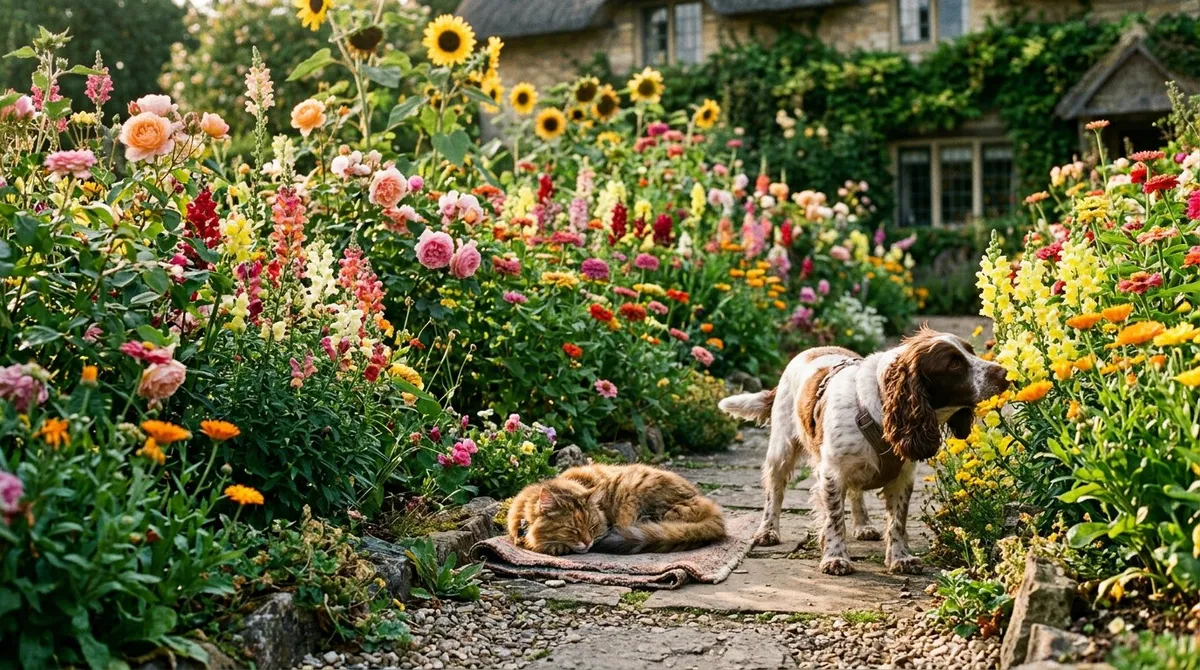
Over 50% of UK households own a pet. Dogs and cats spend hours in the garden, digging, chewing, and brushing against plants. Many popular garden plants are toxic to them. Lilies can kill a cat within 48 hours. Yew berries can be fatal to a dog in under an hour. The RSPCA handles over 1,200 plant-poisoning calls every year.
The good news is that hundreds of beautiful garden plants are completely safe. This guide covers 30 of the best, organised by type: flowers, shrubs, herbs, climbers, and ground cover. Every plant listed has been checked against the Dogs Trust poisonous plants database and the ASPCA toxic plant list. For more on keeping dogs safe outdoors, see our guide to creating a dog-friendly garden.
Pet-safe flowers for UK gardens
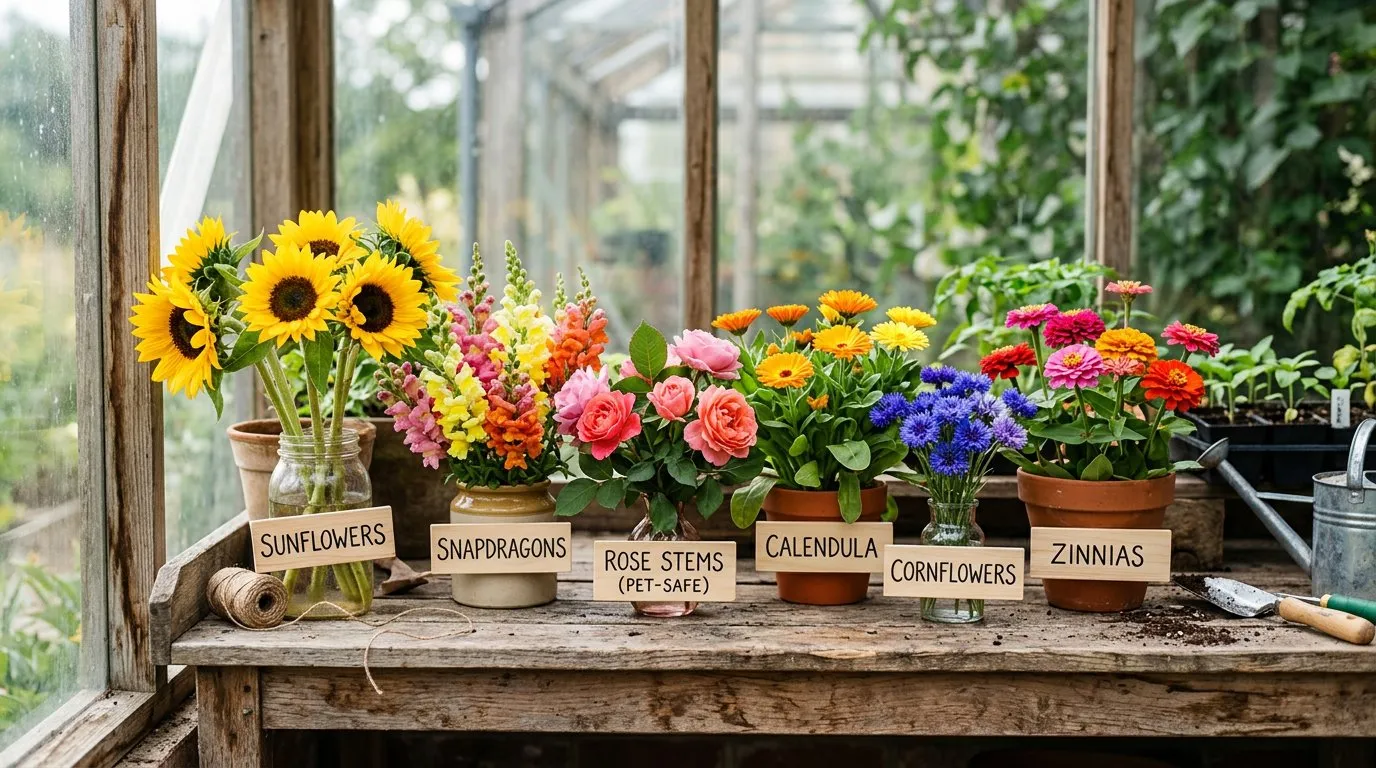 All of these flowers are safe for dogs and cats. Sunflowers, snapdragons, roses, calendula and cornflowers.
Flowers bring colour and pollinators without posing any risk to dogs or cats. These 10 species are all verified non-toxic and thrive in British conditions.
Sunflowers (Helianthus annuus)
Sunflowers are completely safe for dogs and cats. Every part of the plant is non-toxic, including the seeds, petals, and leaves. They grow 60cm to 3m tall depending on variety. ‘Dwarf Sunshine’ reaches just 60cm for containers. ‘Russian Giant’ hits 3m in rich soil. Sow seeds directly outdoors in April or May, 2cm deep. They need full sun and flower from July to September. Children and pets both love them. For full growing instructions, see our guide on how to grow sunflowers.
Snapdragons (Antirrhinum majus)
Snapdragons are non-toxic to all pets and produce dense flower spikes from June to October. They grow 20-90cm tall depending on variety. Dwarf types suit containers and border edges. Tall varieties work well at the back of beds. Sow under cover in March or buy plug plants in May. They prefer full sun and well-drained soil. Deadhead regularly to keep them flowering through autumn. Hardy in most UK regions.
Roses (Rosa species)
Roses are safe for dogs and cats. Petals, leaves, and rose hips are all non-toxic. The only risk is thorns scratching a curious nose or paw. Choose thornless climbing varieties like ‘Zephirine Drouhin’ (pink, fragrant, 3m) for areas where pets play. Shrub roses like ‘Bonica’ (60cm) work well for low borders. Roses grow in most UK soils and flower from June to October with regular deadheading. Read our full guide on how to grow roses for pruning and care advice.
Calendula (Calendula officinalis)
Pot marigolds are entirely safe for pets. They self-seed freely, providing orange and yellow flowers from May to November. Height: 30-50cm. Sow direct in March or April. They tolerate poor soil and partial shade, though they flower best in full sun. Calendula also attracts hoverflies, which eat aphids. A genuinely useful plant for any garden. Do not confuse with African or French marigolds (Tagetes), which can cause mild skin irritation.
Cornflower (Centaurea cyanus)
Cornflowers are non-toxic and produce vivid blue flowers from June to August. Height: 30-90cm. They grow in any well-drained soil in full sun. Direct sow in autumn for earlier, stronger plants, or in spring for summer flowers. Cornflowers are excellent bee-friendly garden plants and attract butterflies too. ‘Blue Ball’ is the classic variety. ‘Black Ball’ offers deep maroon flowers for a more unusual display.
Zinnia (Zinnia elegans)
Zinnias are safe for all pets and produce bold, bright blooms from July to October. Height: 20-90cm depending on variety. They need full sun and warm, sheltered positions. Sow indoors in April, transplant after the last frost in late May. Zinnias dislike cold, wet conditions. In southern England they thrive; in the north, grow in containers that can be moved to shelter. Deadhead to prolong flowering. The ‘Profusion’ series handles cooler UK summers better than traditional varieties.
Aster (Aster novi-belgii)
Michaelmas daisies provide pet-safe autumn colour when most flowers have finished. Height: 30-120cm. They flower from August to October in shades of purple, pink, and white. Plant in full sun or light shade in moist, well-drained soil. Divide clumps every 3 years to maintain vigour. ‘Little Carlow’ (90cm) is one of the best UK garden varieties, with mildew resistance and masses of small blue flowers. Asters are late-season pollinator magnets.
Echinacea (Echinacea purpurea)
Coneflowers are safe for dogs and cats and flower from July to September. Height: 60-100cm. They prefer full sun and well-drained soil. Once established, echinacea is drought tolerant and needs no watering. The distinctive cone-shaped seed heads look good through winter and feed goldfinches. ‘Magnus’ (deep pink) and ‘White Swan’ are reliable UK performers. Echinacea works well in drought-tolerant planting schemes alongside ornamental grasses and sedums.
Dahlia (Dahlia species)
Dahlias are non-toxic to dogs and cats. They produce flowers from July until the first frosts, in every colour except true blue. Height: 30cm (bedding types) to 150cm (dinner plate varieties). Plant tubers 10-15cm deep in April or May. Lift tubers in November and store frost-free, or mulch deeply in milder areas. Dahlias need full sun and rich, moist soil. Slug protection is essential in the first weeks after planting. ‘Bishop of Llandaff’ (dark foliage, red flowers, 90cm) is a garden classic.
Fuchsia (Fuchsia species)
Fuchsias are safe for all pets. The berries are edible for humans too, though bland. Height: 30cm (trailing basket types) to 2m (hardy shrub varieties). Hardy fuchsias like ‘Mrs Popple’ survive UK winters outdoors. Tender varieties need lifting or moving to a frost-free spot. Fuchsias prefer partial shade and moist soil. They flower from June to October, attracting hoverflies and bees. In mild coastal areas, fuchsia hedges reach 2m and flower for five months straight.
Pet-safe shrubs for structure
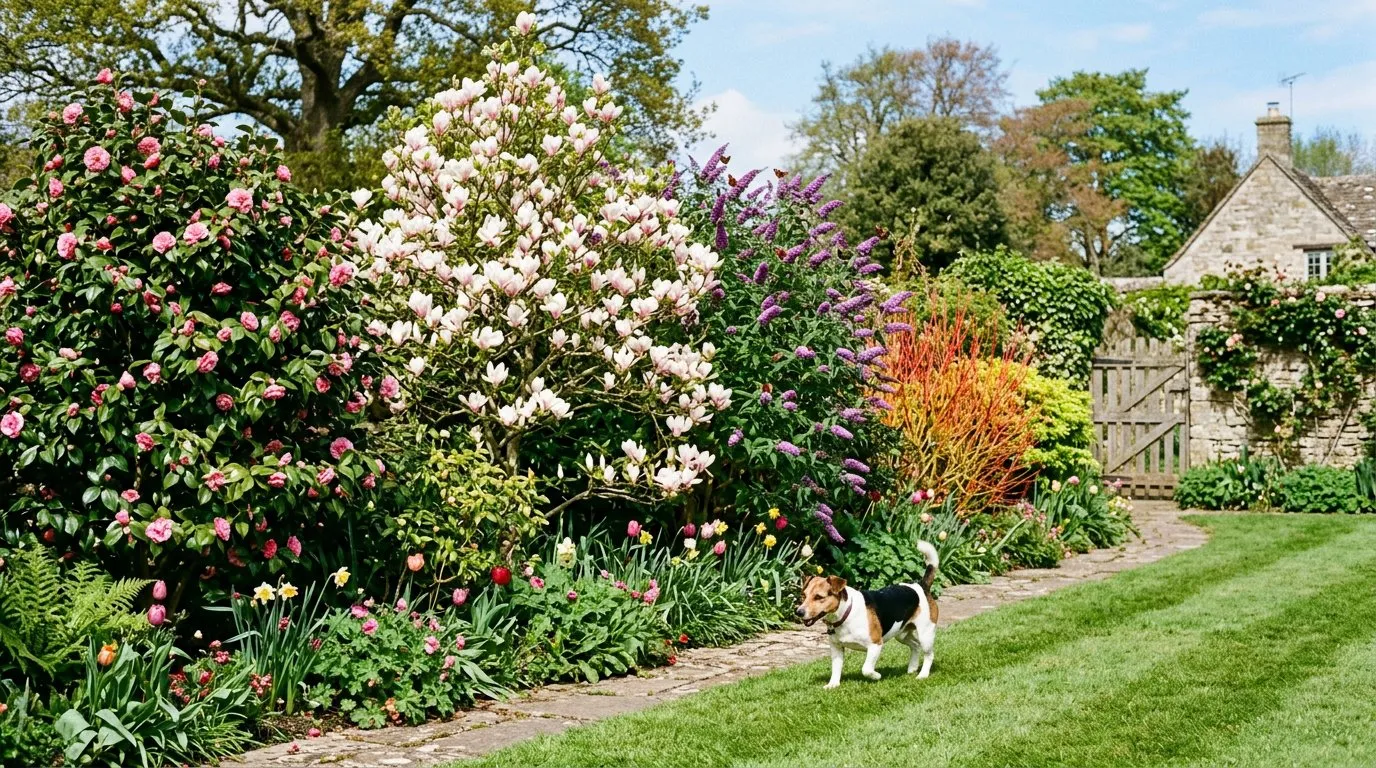 Pet-safe shrubs like camellia, magnolia and buddleia provide year-round structure.
Shrubs provide year-round structure, privacy, and seasonal interest. These six species are safe for homes with dogs and cats.
Camellia (Camellia japonica)
Camellias are non-toxic to dogs and cats. They produce striking flowers from January to April, a period when little else blooms. Height: 2-5m depending on variety. They need acid soil (pH 5.5-6.5), partial shade, and shelter from cold east winds. ‘Donation’ (pink, semi-double) and ‘Adolphe Audusson’ (red) are popular UK choices. Camellias work well in containers using ericaceous compost. They are evergreen, providing year-round structure. Water with rainwater if your tap water is hard.
Magnolia (Magnolia species)
Magnolias are safe for pets. Their flowers are among the most spectacular in any UK garden. Magnolia stellata reaches 3m and suits smaller gardens with its white, star-shaped spring flowers. M. x soulangeana grows to 6m with large pink-and-white goblets in April. Both need moisture-retentive soil and shelter from late frosts, which can brown the flowers. Plant in a west-facing position for the best frost protection. Magnolias dislike root disturbance, so plant young and leave undisturbed.
Buddleia (Buddleja davidii)
Butterfly bush is non-toxic to all pets and is one of the best wildlife shrubs available. Height: 2-4m. It flowers from July to September, attracting butterflies, bees, and moths. ‘Black Knight’ (deep purple) and ‘White Profusion’ are reliable varieties. Buddleia grows in almost any soil, including rubble and poor ground. Hard prune to 30cm in March for the best flower display. Without pruning it becomes leggy and sparse. Self-seeds freely, so remove seed heads in autumn if you want to control spread.
Hawthorn (Crataegus monogyna)
Hawthorn is safe for dogs and cats. The berries, flowers, and leaves are all non-toxic (the berries are edible, used in hedgerow jelly). Height: 3-8m as a tree, 1-3m as a clipped hedge. White blossom appears in May, followed by red berries (haws) from September. Hawthorn hedges support over 300 insect species and provide nesting sites for birds. It grows in any soil, tolerates exposed sites, and handles hard pruning. One of the toughest native plants available.
Dogwood (Cornus sanguinea / Cornus alba)
Dogwood is non-toxic to pets and provides vivid winter stem colour. Cornus alba ‘Sibirica’ has bright red stems from November to March. C. sericea ‘Flaviramea’ offers lime-green stems. Height: 2-3m. Cut all stems to 15cm in March for the brightest colour the following winter. Dogwood tolerates wet soil and partial shade, making it useful for difficult spots. White flower clusters appear in June, followed by small berries in autumn that birds eat readily.
Viburnum (Viburnum tinus / Viburnum opulus)
Viburnum species are safe for pets. Viburnum tinus is evergreen, flowering from November to March with pink-budded white flowers. Height: 2-3m. V. opulus (guelder rose) is deciduous, with white lacecap flowers in May and translucent red berries in autumn. Both grow in sun or shade and tolerate most soils. V. tinus makes an excellent hedge and provides winter flowers when pollinators are desperate for food. ‘Eve Price’ is the best compact variety for smaller gardens.
Pet-safe herbs you can grow
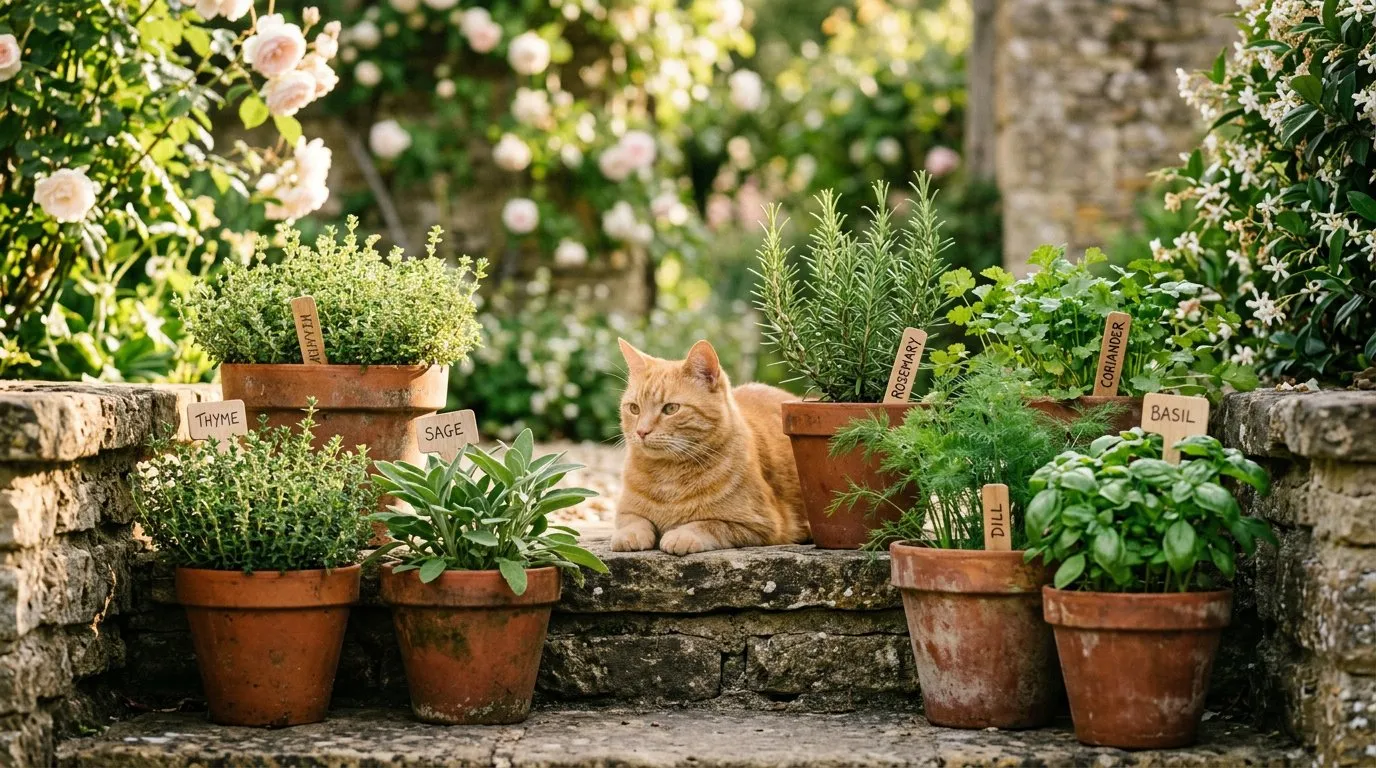 Safe herbs in pots. Rosemary, thyme, basil and sage are all non-toxic to cats and dogs.
Herbs are practical and safe. These six species are non-toxic to dogs and cats, even if they nibble the leaves. Grow them near the kitchen door for cooking and near pet areas without worry. For full planting guidance, see our guide on how to grow herbs.
Rosemary (Salvia rosmarinus)
Rosemary is completely safe for dogs and cats. It grows into a bushy evergreen shrub, 60-150cm tall. Blue flowers appear from March to May, attracting early bees. It needs full sun and well-drained soil. Rosemary tolerates drought once established and grows well in containers. ‘Miss Jessopp’s Upright’ is the best variety for cooking. Prostrate forms cascade over walls and raised beds. Replace plants every 5-7 years as they become woody. For growing tips, see our guide on how to grow lavender, which covers similar Mediterranean plants.
Thyme (Thymus vulgaris)
Thyme is non-toxic to all pets. Common thyme grows 15-30cm tall and forms a compact, aromatic mound. Flowers from May to July in shades of pink and purple. It needs full sun and very well-drained soil. Add grit to heavy clay before planting. Thyme is ideal for path edges, gaps in paving, and containers. Trim after flowering to keep plants compact. Replace every 4 years as plants become leggy. Lemon thyme (T. citriodorus) is equally safe and smells outstanding.
Basil (Ocimum basilicum)
Basil is safe for dogs and cats. It is a tender annual in the UK, growing 20-45cm tall. Sow indoors from March and keep above 15C at all times. Move outdoors only after the last frost in late May. Basil needs full sun, warm shelter, and consistent moisture. Pinch out growing tips regularly to prevent flowering and promote bushy growth. ‘Genovese’ is the standard culinary variety. ‘Purple Ruffles’ adds colour to borders and containers. Harvest frequently for the best flavour.
Sage (Salvia officinalis)
Sage is non-toxic to pets and forms a beautiful silver-leaved shrub, 40-60cm tall. Purple-blue flower spikes appear in June. Sage needs full sun and well-drained soil. It handles drought well once established. ‘Purpurascens’ (purple sage) and ‘Icterina’ (gold-variegated) add foliage colour to borders. Sage becomes woody after 3-4 years. Take softwood cuttings in June to ensure replacements. The flowers are excellent for bees.
Coriander (Coriandrum sativum)
Coriander is safe for all pets. It is a fast-growing annual, 30-60cm tall, that bolts quickly in hot weather. Sow direct every 3 weeks from April to August for a continuous supply. Choose ‘Leisure’ or ‘Calypso’ for slower bolting. Coriander prefers partial shade in summer and moist, fertile soil. Once it flowers, the seeds (used as a spice) develop within 3 weeks. The white flowers attract hoverflies and beneficial insects. Let some plants self-seed for next year.
Dill (Anethum graveolens)
Dill is non-toxic to dogs and cats. Height: 60-90cm. It produces feathery green foliage and flat yellow flower heads from June to August. Sow direct in April, 1cm deep in rows. Dill dislikes being transplanted. It needs full sun and shelter from wind, as tall stems topple easily. Support with twiggy sticks. Both leaves and seeds are used in cooking. Dill self-seeds readily if you leave the flower heads to mature. The flowers are a magnet for hoverflies and small bees.
Pet-safe climbers for walls and fences
Climbers cover vertical surfaces, adding height, privacy, and wildlife habitat. These four species are safe for gardens with pets.
Jasmine (Jasminum officinale)
True jasmine is non-toxic to dogs and cats. It produces intensely fragrant white flowers from June to September. Height: 5-10m. Plant against a sunny, sheltered wall for the strongest scent. Jasmine is semi-evergreen in mild areas and deciduous in colder spots. Tie new growth to supports as it does not self-cling. Prune after flowering, removing flowered stems and thinning congested growth. Do not confuse with star jasmine (Trachelospermum), which is a different plant and also non-toxic.
Honeysuckle (Lonicera periclymenum)
Native honeysuckle is safe for pets. The berries are mildly toxic if eaten in large quantities, but the plant itself is not a poisoning risk. Height: 4-7m. Sweetly scented flowers appear from June to September, attracting moths and bees. ‘Graham Thomas’ (cream-yellow) and ‘Belgica’ (pink-cream) are reliable varieties. Honeysuckle grows in sun or partial shade and tolerates most soils. It looks excellent scrambling through hedgerows and over arches. Prune in late winter, cutting back flowered shoots.
Climbing roses (Rosa species)
Climbing roses are non-toxic to all pets. Like shrub roses, the only hazard is thorns. Choose thornless varieties near pet paths. ‘Climbing Iceberg’ (white, 3m), ‘New Dawn’ (pale pink, 3m), and ‘Compassion’ (apricot-pink, 3m) are all reliable UK choices. Plant 30cm from the base of a wall or fence, leaning the plant toward the support. Fan out stems horizontally for maximum flower production. Feed in March and July. Fan stems horizontally along wires for the best coverage and heaviest flowering.
Virginia creeper (Parthenocissus quinquefolia)
Virginia creeper is listed as non-toxic to dogs and cats by the ASPCA. However, the berries contain oxalic acid and can cause mild stomach upset if eaten in quantity. The foliage is safe. Height: 10-15m. Self-clinging, it covers walls and fences rapidly with minimal support. Spectacular autumn colour: green leaves turn vivid red and orange in September and October. Grows in any soil, sun or shade. Cut back from windows, gutters, and rooflines annually. Vigorous once established, so give it a large wall.
Pet-safe ground cover plants
Ground cover fills gaps, suppresses weeds, and reduces bare soil that dogs dig. These four species create low, dense carpets that tolerate some foot traffic.
Ajuga (Ajuga reptans)
Bugle is non-toxic to pets and forms dense, spreading mats 10-15cm tall. Blue flower spikes appear in April and May. ‘Burgundy Glow’ has variegated pink, cream, and green foliage. ‘Atropurpurea’ has deep bronze leaves. Ajuga grows in partial shade to full sun and tolerates most soils, including clay. It spreads by runners, covering 60cm per year. Useful under shrubs and in borders where it suppresses weeds effectively. Cut back flower stems after flowering for tidier growth.
Creeping thyme (Thymus serpyllum)
Creeping thyme is safe for all pets. It forms a mat just 2-5cm tall, making it ideal for gaps in paving, path edges, and areas where dogs run. Tiny pink or purple flowers appear from June to August, attracting bees. It releases a pleasant scent when walked on. Needs full sun and sharp drainage. Well suited to sunny, well-drained spots where grass struggles. ‘Coccineus’ (crimson flowers) and ‘Albus’ (white) are popular varieties. Mow once after flowering to keep growth tight.
Chamomile (Chamaemelum nobile)
Chamomile is non-toxic to dogs and cats. The non-flowering variety ‘Treneague’ makes a fragrant, walkable lawn alternative, 5-10cm tall. Flowering chamomile reaches 15-30cm. Both need full sun and well-drained soil. Chamomile lawns suit small areas (under 4 square metres) as they need hand weeding and cannot handle heavy traffic. Plant plugs 10cm apart in spring. The apple-scented foliage releases fragrance when pets lie on it. A luxury touch for a small pet-safe garden.
Lesser periwinkle (Vinca minor)
Lesser periwinkle is safe for pets. It forms dense, evergreen ground cover 10-20cm tall, with blue, purple, or white flowers from March to May. It tolerates deep shade, dry soil, and root competition under trees. Spreads steadily by trailing stems. ‘Bowles’s Variety’ (violet-blue) is the best garden form. Unlike greater periwinkle (V. major), it stays compact and does not become invasive. Excellent under shade-loving plants where it suppresses weeds year-round.
Complete pet-safe plants comparison table
This table summarises all 30 plants with key growing information.
| Plant | Type | Height | Flowers | Sun/shade | Safe for |
|---|---|---|---|---|---|
| Sunflower | Annual | 60cm-3m | Jul-Sep | Full sun | Dogs, cats |
| Snapdragon | Annual/short perennial | 20-90cm | Jun-Oct | Full sun | Dogs, cats |
| Rose | Shrub/climber | 60cm-3m | Jun-Oct | Full sun | Dogs, cats |
| Calendula | Annual | 30-50cm | May-Nov | Sun/part shade | Dogs, cats |
| Cornflower | Annual | 30-90cm | Jun-Aug | Full sun | Dogs, cats |
| Zinnia | Annual | 20-90cm | Jul-Oct | Full sun | Dogs, cats |
| Aster | Perennial | 30-120cm | Aug-Oct | Sun/light shade | Dogs, cats |
| Echinacea | Perennial | 60-100cm | Jul-Sep | Full sun | Dogs, cats |
| Dahlia | Tuber | 30-150cm | Jul-Nov | Full sun | Dogs, cats |
| Fuchsia | Shrub | 30cm-2m | Jun-Oct | Part shade | Dogs, cats |
| Camellia | Evergreen shrub | 2-5m | Jan-Apr | Part shade | Dogs, cats |
| Magnolia | Tree/shrub | 3-6m | Mar-May | Sun/part shade | Dogs, cats |
| Buddleia | Shrub | 2-4m | Jul-Sep | Full sun | Dogs, cats |
| Hawthorn | Tree/hedge | 1-8m | May | Sun/part shade | Dogs, cats |
| Dogwood | Shrub | 2-3m | Jun | Sun/part shade | Dogs, cats |
| Viburnum | Shrub | 2-3m | Nov-Mar/May | Sun/shade | Dogs, cats |
| Rosemary | Evergreen herb | 60-150cm | Mar-May | Full sun | Dogs, cats |
| Thyme | Herb | 15-30cm | May-Jul | Full sun | Dogs, cats |
| Basil | Tender annual | 20-45cm | Jul-Sep | Full sun | Dogs, cats |
| Sage | Herb/sub-shrub | 40-60cm | Jun | Full sun | Dogs, cats |
| Coriander | Annual herb | 30-60cm | Jun-Aug | Sun/part shade | Dogs, cats |
| Dill | Annual herb | 60-90cm | Jun-Aug | Full sun | Dogs, cats |
| Jasmine | Climber | 5-10m | Jun-Sep | Full sun | Dogs, cats |
| Honeysuckle | Climber | 4-7m | Jun-Sep | Sun/part shade | Dogs, cats |
| Climbing rose | Climber | 3-5m | Jun-Oct | Full sun | Dogs, cats |
| Virginia creeper | Climber | 10-15m | N/A (foliage) | Sun/shade | Dogs, cats |
| Ajuga | Ground cover | 10-15cm | Apr-May | Part shade/sun | Dogs, cats |
| Creeping thyme | Ground cover | 2-5cm | Jun-Aug | Full sun | Dogs, cats |
| Chamomile | Ground cover | 5-30cm | Jun-Aug | Full sun | Dogs, cats |
| Lesser periwinkle | Ground cover | 10-20cm | Mar-May | Shade/part shade | Dogs, cats |
Plants often wrongly thought to be toxic
Several popular garden plants have a reputation for being dangerous to pets that is either exaggerated or entirely wrong. This creates unnecessary anxiety and limits plant choices. Here are the most common myths.
Roses are not poisonous
Some pet owners avoid roses because of the thorns. Thorns can cause scratches, but roses contain no toxic compounds. Petals are used in cooking and rose hip syrup is a traditional remedy. The entire plant is safe. Train climbing varieties away from dog runs if scratches are a concern.
Sunflowers are completely safe
Sunflowers appear on some unreliable online toxic-plant lists. There is no evidence that any part of a sunflower harms dogs or cats. Seeds, petals, stems, and leaves are all non-toxic. Sunflower seeds are actually used in some commercial dog foods. Ignore lists that claim otherwise.
Buddleia is not harmful
Buddleia sometimes appears alongside warnings about garden shrubs. It is non-toxic to dogs and cats. The butterfly bush is safe to plant in any pet garden. The worst that happens is a dog chewing a stem and spitting it out because it tastes bitter.
The lavender confusion
Lavender sits in a grey area. The essential oil is toxic to cats in concentrated form. The actual plant growing in a garden is a very low risk. A cat brushing past lavender or a dog lying next to it will not be harmed. Eating large amounts of lavender foliage can cause mild stomach upset. If you want zero risk, swap lavender for rosemary, which gives a similar look with no toxicity concerns at all. For a full list of what to avoid, see our guide to plants toxic to cats.
Virginia creeper leaves vs berries
The foliage of Virginia creeper is non-toxic. The berries contain oxalic acid, which causes mouth irritation and stomach upset if eaten. In practice, dogs rarely eat the berries because they taste foul. The plant is generally safe, but if your dog eats everything in sight, prune off berry clusters in autumn.
Where to buy pet-safe plants in the UK
Finding pet-safe plants is straightforward. Most garden centres and online nurseries stock all 30 species in this guide. The challenge is knowing which are safe, not finding them.
Garden centres
All major UK garden centres (Dobbies, Hillier, local independents) stock roses, snapdragons, sunflowers, herbs, and the shrubs listed here. Plants are rarely labelled as pet-safe. Bring this guide on your phone or screenshot the comparison table above. Staff will not always know which plants are toxic to pets, so rely on verified databases rather than advice at the till.
Online nurseries
Crocus (crocus.co.uk) sells all 30 species and allows filtering by growing conditions. Thompson and Morgan stock seeds for all the annuals and herbs. Gardening Express offers mature shrubs and climbers. All three deliver nationwide. Search by Latin name for accuracy.
The Dogs Trust database
Before buying any plant not on this list, check the Dogs Trust poisonous plants database (linked in the introduction above). It is the most reliable UK-specific resource. The ASPCA database (US-based) is also thorough but includes plants not commonly grown here.
Growing from seed
Many pet-safe plants are cheap and easy from seed. Sunflowers, calendula, cornflowers, zinnias, and all six herbs grow readily from direct-sown seed. A packet costs 80p-2.50 and produces dozens of plants. This is the most economical way to fill a pet-safe garden. See our cottage garden planting plan for layout ideas using many of these species.
Common mistakes with pet-safe gardening
Why we recommend creeping thyme as the single best ground cover for a pet garden: After 30 years of designing gardens for households with dogs, creeping thyme (Thymus serpyllum) is the one plant I recommend above all others for paved and path areas. It handles light foot traffic from dogs weighing up to 25kg without die-back, releases a pleasant fragrance when stepped on, flowers from June to August attracting bees, and is completely non-toxic. In a trial strip between paving slabs on a sunny south-facing path, ‘Coccineus’ established full cover within one growing season from 9cm plug plants at 15cm spacing.
Assuming all parts of a safe plant are safe
Most plants listed here are safe in their entirety. Virginia creeper is the exception: leaves safe, berries mildly toxic. Always check whether flowers, leaves, stems, roots, and berries are all listed as non-toxic. Some plants have safe foliage but toxic seeds.
Confusing similar plant names
Pot marigold (Calendula) is safe. French marigold (Tagetes) causes mild skin irritation. True jasmine (Jasminum) is safe. Carolina jasmine (Gelsemium) is highly toxic. Always use the Latin name when buying plants to avoid confusion.
Ignoring compost and fertiliser toxicity
Many pet owners focus on plant toxicity but overlook what goes on the soil. Cocoa shell mulch is toxic to dogs (it contains theobromine, the same compound in chocolate). Blood, fish, and bone fertiliser smells irresistible to dogs and causes vomiting if eaten. Use pet-safe alternatives: leaf mould, bark mulch, and seaweed-based feeds.
Not checking new purchases
Garden centres sell mixed containers and hanging baskets that may combine safe and toxic plants. A basket of petunias (safe) may include trailing ivy (mildly toxic) or lobelia (toxic if eaten in quantity). Check every plant in a mixed container before bringing it home.
Relying on outdated or unreliable lists
Online pet-toxicity lists vary wildly in accuracy. Some list plants as toxic based on a single anecdotal report. Others miss genuinely dangerous species. Stick to the Dogs Trust database, the ASPCA list, and the RHS guidance on potentially harmful plants. Cross-reference at least two sources before planting anything not on this guide. Our dedicated toxic plant guides cover the most dangerous species for dogs and cats in detail.
How to design a pet-safe border
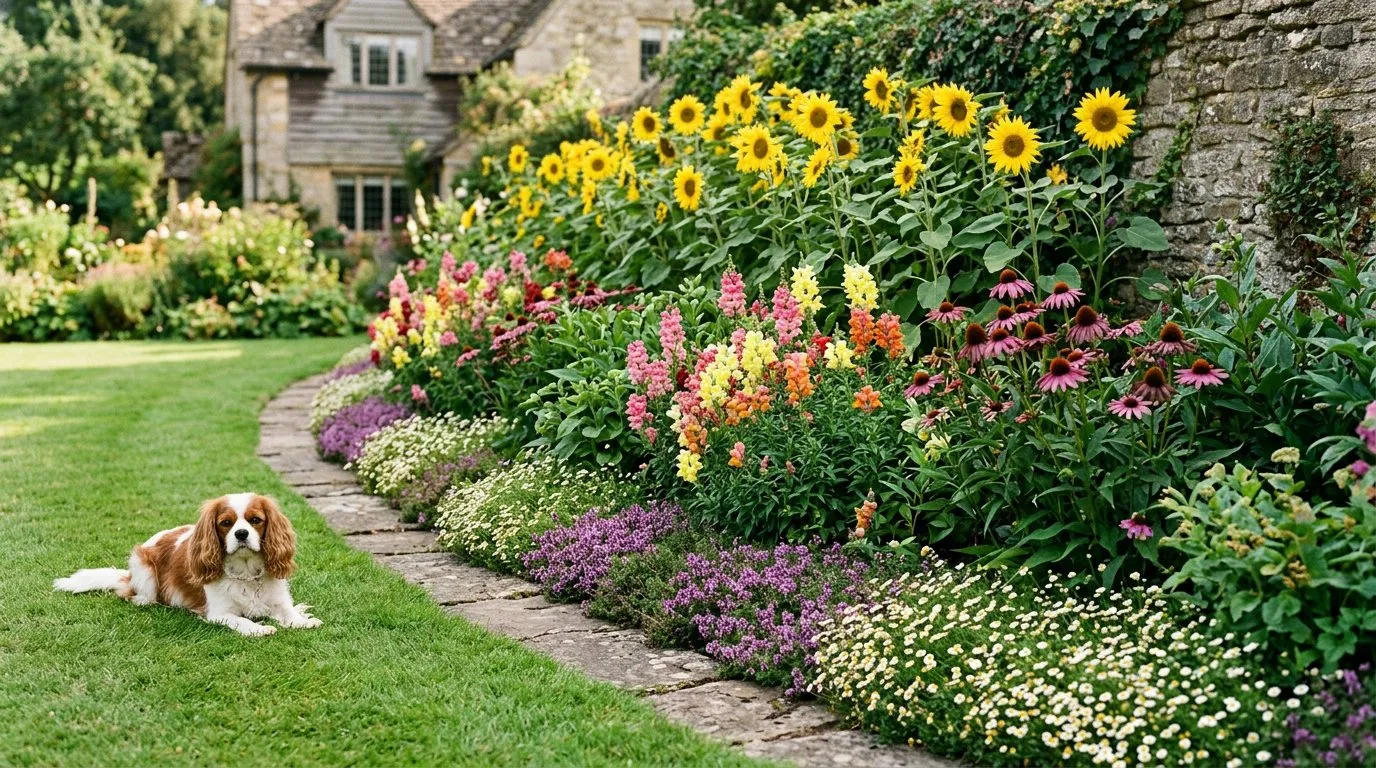 A layered pet-safe border: tall sunflowers at the back, mid-height snapdragons, low creeping thyme at the front.
Creating a dedicated pet-safe planting area does not mean sacrificing beauty. Combine plants from each category in this guide for year-round colour and interest.
Spring: Camellia, magnolia, lesser periwinkle, ajuga. These provide flowers from January to May.
Summer: Sunflowers, snapdragons, roses, calendula, cornflowers, zinnias, echinacea, dahlias, fuchsias, buddleia, jasmine, honeysuckle. Peak colour from June to September.
Autumn: Asters, dahlias (until first frost), rosemary, viburnum tinus (starts flowering November). Late-season interest through to December.
Winter: Camellia, viburnum tinus, dogwood stems, evergreen rosemary, evergreen lesser periwinkle. Structure and colour even in January.
For a fully dog-proof lawn alongside your pet-safe borders, use hard-wearing grass seed mixes designed for heavy foot traffic. If cats are digging in your borders, see our guide to cat-proofing your garden.
Gardener’s tip: Plant herbs along path edges where pets walk. Rosemary and thyme release scent when brushed against, making the garden smell wonderful while being completely safe. Creeping thyme between paving slabs handles light foot traffic and fills the air with fragrance on warm evenings.
Now you’ve built your pet-safe planting list, read our guide on creating a dog-friendly garden for the next step in designing a garden that works for both pets and people.
Frequently asked questions
Are roses safe for dogs and cats?
Yes, roses are non-toxic to both dogs and cats. The petals, leaves, and hips are all safe. Thorns can scratch mouths and paws, so consider thornless varieties like Rosa ‘Zephirine Drouhin’ near paths where pets walk frequently.
Which common garden plants are toxic to dogs?
Lilies, foxgloves, daffodils, and rhododendrons are all toxic. Yew is the most dangerous, with every part lethal to dogs. Laburnum seeds, autumn crocus bulbs, and oleander also cause serious poisoning. See our full list of plants toxic to dogs.
Is lavender safe for dogs?
Lavender is mildly toxic to dogs if eaten in quantity. Small amounts cause stomach upset, not serious harm. It is not on the high-risk list, but it is not fully pet-safe either. Rosemary is a safer aromatic alternative that provides a similar look and growth habit.
Are sunflowers poisonous to cats?
No, sunflowers are completely safe for cats. All parts of the plant, including seeds, petals, and stems, are non-toxic. They are one of the safest flowering plants you can grow in a garden with cats.
Can dogs eat herbs from the garden?
Rosemary, thyme, basil, sage, and dill are all safe for dogs. Small nibbles cause no harm. Avoid letting dogs eat large quantities of any plant, as bulk vegetation can cause vomiting regardless of toxicity.
What ground cover is safe for dogs?
Creeping thyme is the safest ground cover for dogs. It tolerates light foot traffic, releases a pleasant scent when stepped on, and is completely non-toxic. Chamomile and ajuga are also safe alternatives.
Are hydrangeas poisonous to pets?
Yes, hydrangeas are mildly toxic to dogs and cats. The leaves and flower buds contain cyanogenic glycosides. Symptoms include vomiting and diarrhoea. They are rarely fatal but should be avoided in gardens where pets chew plants.
Where can I buy pet-safe plants in the UK?
Most UK garden centres stock pet-safe plants without labelling them as such. Online nurseries like Crocus, Thompson and Morgan, and Gardening Express sell all the species in this guide. Check the Dogs Trust database before buying unfamiliar plants.
Lawrie has been gardening in the West Midlands for over 30 years. He grows his own veg using no-dig methods, keeps a wildlife-friendly garden, and writes practical advice based on real UK growing conditions.