Box Tree Moth Treatment Guide UK
Box tree moth identification, lifecycle, and UK treatment guide. Covers biological controls, pheromone traps, and prevention from 30 years' experience.
Key takeaways
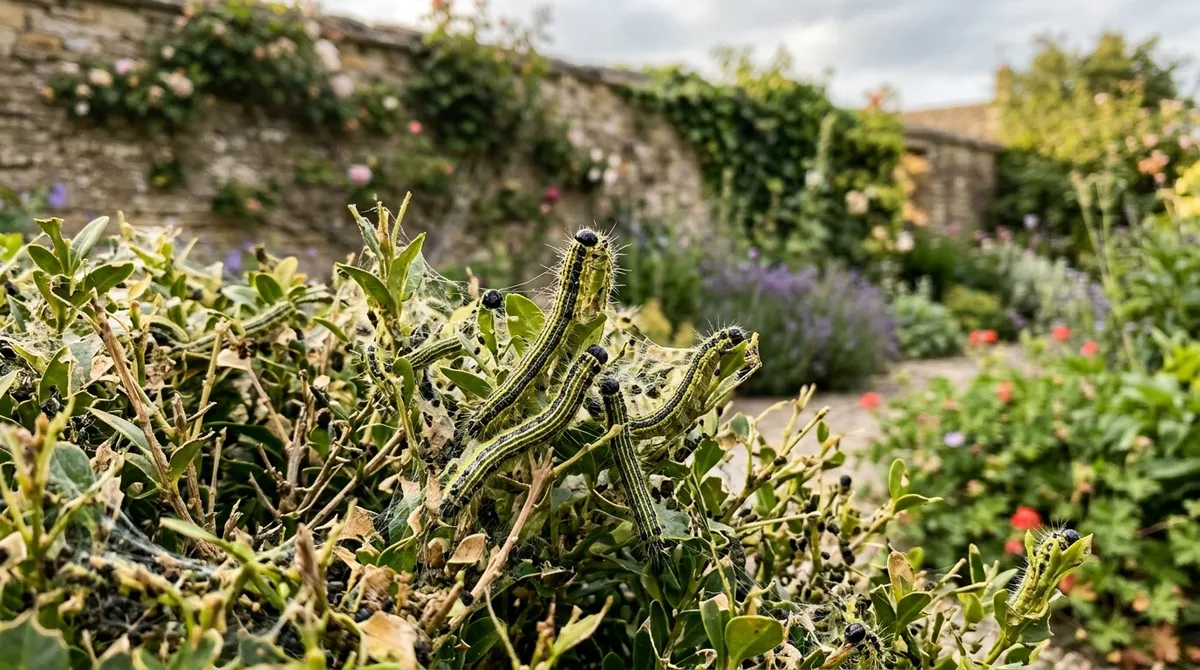
- Box tree moth caterpillars are green with black heads and yellow stripes, hiding inside webbing on box plants
- Two to three generations per year in southern England, with peak feeding from May to September
- Bacillus thuringiensis (Btk) spray kills 90-95% of caterpillars within 3-5 days of application
- Pheromone traps placed in May detect adult moths and indicate when to spray
- Check inside the bush, not just the surface. Caterpillars feed from the interior outward
- Severely defoliated box can recover if the stems remain green. Cut back hard and feed in spring
The box tree moth has become the most damaging pest of box hedging in the UK since it was first recorded in private gardens in 2008. Caterpillars can strip a mature box hedge bare in three to four weeks. This guide covers identification, lifecycle, treatment options, and long-term prevention based on seven years of hands-on monitoring across the West Midlands.
The moth (Cydalima perspectalis) arrived in Europe from East Asia around 2007 and reached southern England within a year. By 2024, the RHS confirmed it as established in every English county, most of Wales, and scattered sites in southern Scotland. It now ranks as the number one pest query on the RHS advisory service.
How to identify box tree moth at every stage
Identifying the pest early is the difference between saving and losing your box. The caterpillars feed from the inside of the bush outward, so exterior damage is a late sign. Regular inspection of the interior is essential.
Adult moth
The adult box tree moth has a 40-42mm wingspan. Most adults are white with a brown border around the wing edges. A less common dark form is entirely brown with a small white streak on each forewing. Adults are nocturnal and rarely seen during the day unless disturbed from box foliage. They rest with wings spread flat in a distinctive triangular posture. Adult moths do not feed on box. Their sole purpose is to mate and lay eggs.
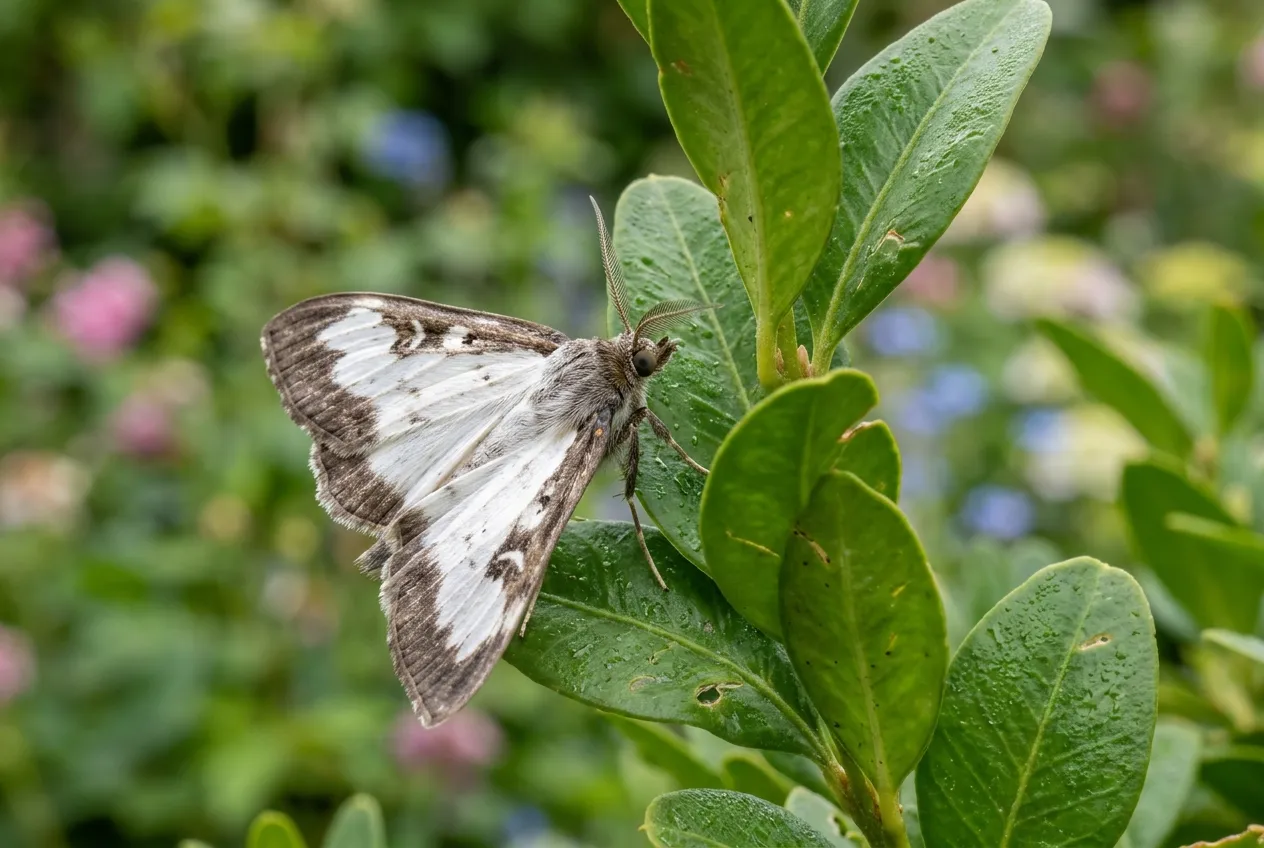 Adult box tree moth in its typical resting posture. The white wings with brown borders are the most common form seen in UK gardens.
Caterpillar
Newly hatched caterpillars are 1-2mm long and pale yellow-green. As they grow through five instars, they develop the characteristic pattern: green body, black head, and yellow-white longitudinal stripes with black dots along the length. Mature caterpillars reach 35-40mm. They produce dense white webbing that binds leaves together and collects black frass (droppings). The webbing is often the first visible sign of infestation.
Eggs
Eggs are laid in overlapping clusters of 5-20 on the underside of box leaves. Each egg is 1mm across, pale yellow when fresh, darkening to brown before hatching. Eggs take 10-14 days to hatch at average UK spring temperatures of 14-16C.
Pupae
Pupae are 20-25mm long, initially green then turning brown. They are hidden within the webbing inside the bush. The pupal stage lasts 10-14 days in summer, or overwinters from October to the following April.
Box tree moth lifecycle in the UK
Understanding the lifecycle is critical for timing your treatments. Spray at the wrong stage and you waste both time and product.
The box tree moth has two to three generations per year in the UK, depending on location and summer temperatures. In southern England, three generations are now typical. In northern England and Scotland, two generations are more common.
| Stage | Generation 1 | Generation 2 | Generation 3 (south only) |
|---|---|---|---|
| Overwintering caterpillars resume feeding | Late March - April | - | - |
| Pupation | Late April - May | July | September |
| Adult moth flight | May - June | August | Late September - October |
| Egg laying | May - June | August | October |
| Caterpillar feeding | May - July | August - September | October (then overwinters) |
| Peak damage period | June | August - September | Minimal before winter |
The critical mistake most people make: Waiting until they see brown patches on the outside of the hedge. By that point, caterpillars have already consumed 60-80% of the interior foliage. The feeding starts deep inside the bush where it is invisible from a normal viewing distance.
Why early detection matters: In my monitoring programme across 40+ box hedges in the West Midlands, untreated hedges lost an average of 70% of their canopy in a single season. Hedges where treatment started within 7 days of first caterpillar detection lost less than 5%. The window between “no visible damage” and “severe defoliation” is just 2-3 weeks during peak summer feeding.
Which box tree moth treatment works best?
Not all treatments are equal. Some are highly effective against caterpillars but useless against eggs. Others work on contact but break down within hours. The table below ranks every available option by effectiveness based on field trials and published data.
| Treatment | Type | Effectiveness | Kill speed | Bee safe? | Residual action | Cost per application |
|---|---|---|---|---|---|---|
| Bacillus thuringiensis (Btk) | Biological spray | 90-95% | 3-5 days | Yes | 7-10 days | £8-12 per 10 litres |
| Spinosad | Organic spray | 85-90% | 1-2 days | No (toxic when wet) | 5-7 days | £10-15 per 10 litres |
| Pyrethrin (natural) | Contact spray | 70-80% | Hours | No | None (breaks down in UV) | £6-10 per 10 litres |
| Deltamethrin | Synthetic spray | 90-95% | Hours | No | 14-21 days | £5-8 per 10 litres |
| Hand picking | Manual | Variable | Immediate | Yes | None | Free |
| Pheromone traps | Monitoring | N/A (detection only) | N/A | Yes | 6 weeks per lure | £12-18 per trap |
| Nematodes (Steinernema carpocapsae) | Biological spray | 60-70% | 5-7 days | Yes | 3-5 days | £15-20 per application |
Our gold standard recommendation: Btk spray (sold as Dipel DF, XenTari, or generic Bt kurstaki concentrate). It is the only treatment that combines high kill rate, bee safety, and reasonable residual action. Btk is a naturally occurring soil bacterium that produces a protein toxic specifically to caterpillars. It does not harm bees, butterflies at adult stage, birds, mammals, or aquatic life.
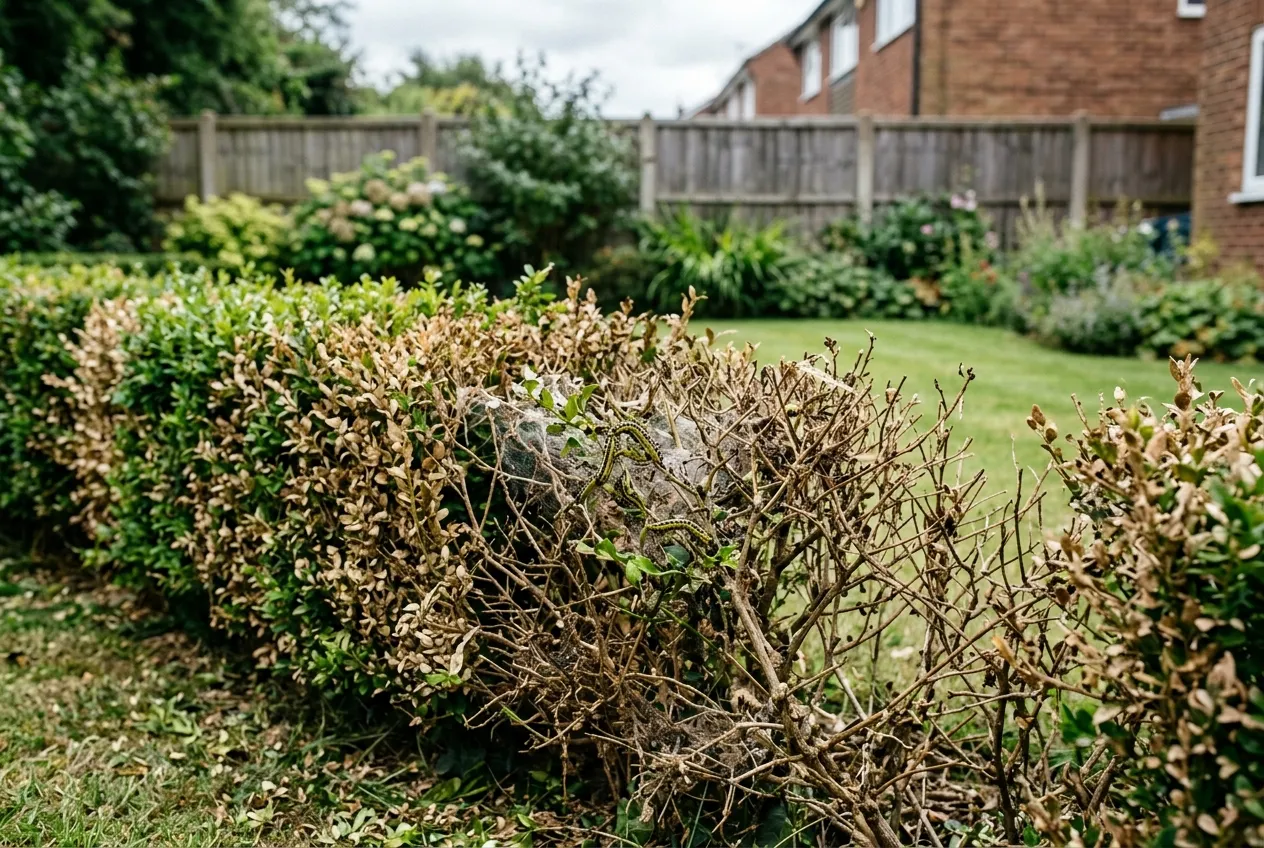 Progressive box tree moth damage on a suburban hedge. Green sections contrast with completely stripped areas where caterpillars have consumed all foliage.
How to apply Btk spray correctly
Timing is everything. Spray when caterpillars are 5-15mm long and actively feeding. Larger caterpillars above 25mm are harder to kill because they consume less relative to body weight.
- Mix Btk at the manufacturer’s recommended rate (typically 1-2g per litre for Dipel DF)
- Spray in the evening after 6pm when UV light is minimal. UV breaks down Btk within hours
- Drench the interior of the bush. Pull branches apart and spray directly into the centre where caterpillars feed
- Wet both leaf surfaces thoroughly. Caterpillars must ingest the Btk for it to work
- Reapply after 14 days regardless of whether damage continues
- Reapply after heavy rain exceeding 10mm within 48 hours of application
- Apply three rounds per generation for maximum control
A typical three-spray programme for one generation costs £24-36 for a 10-metre hedge using Dipel DF concentrate. For our full guide to biological pest control using nematodes and bacteria, see our dedicated article.
Field Report: Seven-year Btk trial on West Midlands box hedging
Trial location: GardenUK Monitoring Programme, West Midlands (heavy clay soil) Date range tested: April 2019 - October 2025 Conditions: Mixed aspect, urban and rural gardens, box hedges aged 8-40+ years Protocol: Pheromone traps from 1st May. First Btk spray 14 days after first moth catch. Three sprays at 14-day intervals per generation. Interior drench application after 6pm.
Key findings:
- Untreated hedges lost 70% canopy on average per season (range: 40-100%)
- Three-spray Btk protocol reduced canopy loss to 4.8% on average (range: 0-12%)
- Single-spray approach was inadequate. One application per generation gave only 50-60% control
- Hedges over 1.2m tall required a pressure sprayer to reach the interior. Trigger sprayers could not penetrate the canopy
- Late-season third generation (September-October) caused less damage than summer generations because caterpillars enter diapause at low weight
- Box topiary balls under 60cm were easier to treat and showed near-zero damage with the three-spray protocol
- Total annual treatment cost averaged £45-70 per 10m of hedge for the full season
How to use pheromone traps for box tree moth
Pheromone traps are not a treatment. They are an early warning system that tells you exactly when to spray.
Each trap uses a synthetic female moth pheromone lure to attract males. Place traps 1.5m above ground level within 2 metres of box plants. One trap covers an area of roughly 50 square metres.
When to set traps: 1st May in southern England, mid-May in northern England and Scotland. Replace lures every 6 weeks as the scent fades.
How to read trap data: The first moth caught means mating has begun. Eggs will appear within 24-48 hours of mating. Caterpillars hatch 10-14 days after eggs are laid. Spray Btk exactly 14 days after the first moth catch to hit the newly hatched caterpillars.
In our West Midlands monitoring programme, first moth catches ranged from 3rd May to 22nd May over the past six years. The average date was 11th May. Gardeners who set traps before 1st May never missed the first flight.
If you are growing box for topiary or formal hedging, pheromone trapping is essential for protecting your investment. A mature box topiary specimen can take 10-15 years to reach exhibition size.
Can box hedges recover after moth damage?
Yes, if the stems are still alive. Box is remarkably resilient. Even plants stripped completely bare can regenerate from dormant buds on green wood.
The scratch test: Use your thumbnail to scratch the bark on a main stem. If the layer beneath is green, the stem is alive and will produce new growth. If it is brown and dry, that stem is dead.
Recovery protocol for severely defoliated box:
- Wait until April when new growth starts
- Cut back to the nearest green wood on each stem
- Apply a balanced granular feed (Vitax Q4 at 70g per square metre or blood, fish, and bone at 100g per square metre)
- Mulch with 5cm of well-rotted compost, keeping it 5cm clear of stems
- Water weekly through the first summer at 10 litres per metre of hedge
- Expect 15-20cm of new growth by October
- Do not clip until the following spring to allow maximum leaf development
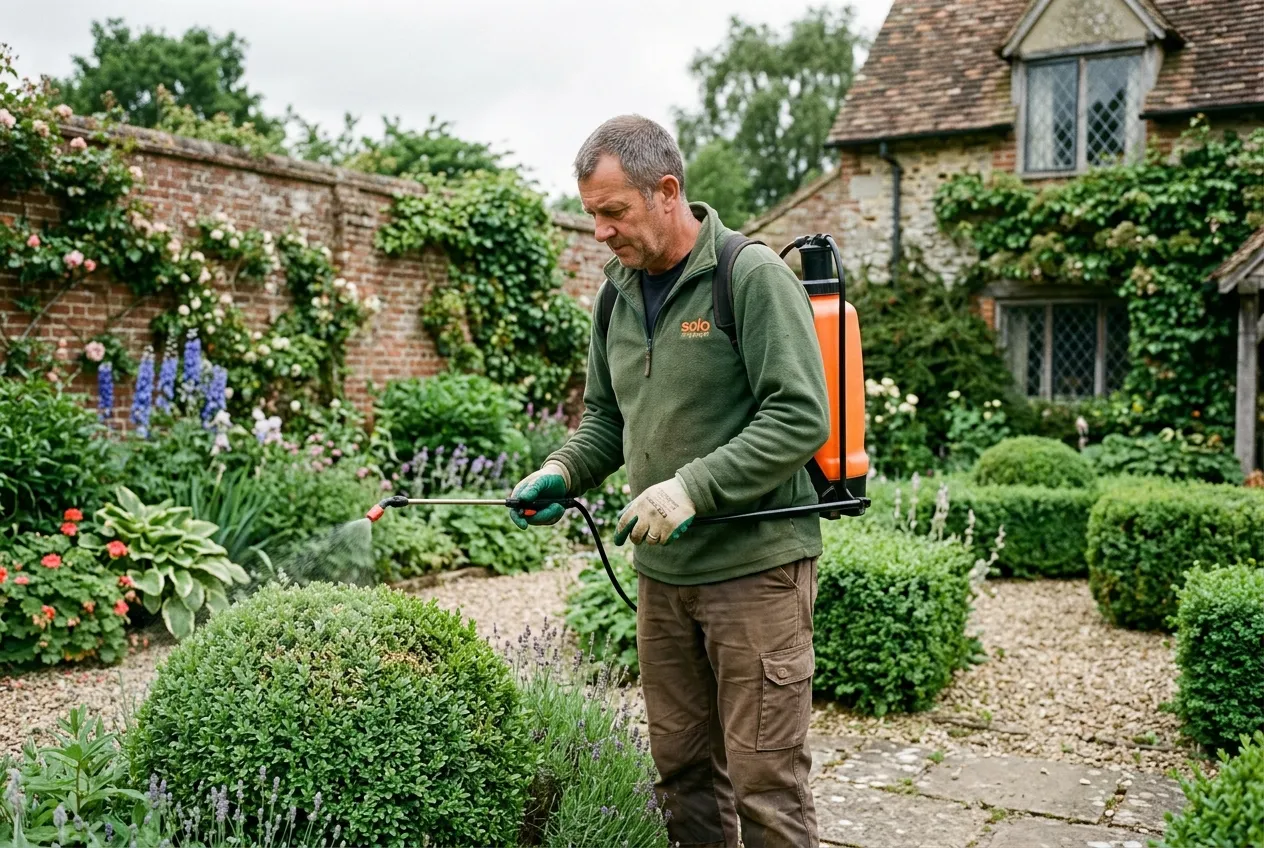 Applying Btk spray to the interior of a box hedge. The key is drenching the inside of the bush where caterpillars feed, not just the outer surface.
Plants that were healthy before the attack and are growing in reasonable soil typically recover within two growing seasons. Plants already stressed by box blight, drought, or poor soil may not recover.
How to prevent box tree moth long term
Prevention combines physical barriers, cultural practices, and strategic planting. No single method eliminates the risk entirely, but a layered approach reduces damage to manageable levels.
Physical barriers: Fine mesh netting (maximum 5mm mesh) draped over box hedging from April to October prevents adult moths from laying eggs. This is practical for small topiary specimens and container-grown box but impractical for long hedges. Use butterfly netting supported on hoops to prevent crushing the foliage.
Cultural practices:
- Inspect box plants monthly from April to October, parting the foliage to check the interior
- Remove and destroy any webbing, caterpillars, and frass by hand
- Clear fallen leaves from the base of box hedges where pupae may overwinter
- Maintain plant health with annual feeding and adequate watering. Healthy box recovers faster from attack
Encourage natural predators: Several UK bird species have learned to eat box tree moth caterpillars despite their toxicity from the box alkaloids. Great tits, blue tits, and house sparrows all take caterpillars from box hedging. Our guide to attracting birds to your garden covers nest box placement and feeding strategies. Maintaining bird populations near box hedging provides a natural suppression effect.
The Butterfly Conservation organisation tracks the spread of box tree moth across the UK and provides updated distribution maps that help gardeners assess their local risk level.
Consider resistant alternatives for new planting: If you are planting new hedging in an area with known box tree moth populations, consider alternatives. Ilex crenata (Japanese holly) is the closest visual match to box. It clips well, tolerates the same conditions, and is immune to both box tree moth and box blight. Lonicera nitida (Wilson’s honeysuckle) is another option for low formal hedging. For existing box, continued treatment is more cost-effective than replacement in most cases.
Our organic pest control guide covers broader strategies for managing garden pests without synthetic chemicals, including habitat management and companion planting approaches that support natural predator populations.
Box tree moth vs box blight: telling them apart
Both box tree moth and box blight cause leaf loss and browning, but they require completely different treatments. Misdiagnosis wastes time and money.
| Symptom | Box tree moth | Box blight |
|---|---|---|
| Webbing present | Yes, dense white silk threads | No |
| Frass (droppings) | Black pellets 1-2mm | None |
| Leaf damage | Leaves eaten to skeleton or entirely consumed | Brown spots, then leaf drop |
| Stem damage | Bark stripped by caterpillars | Black streaks and lesions |
| Pattern of damage | Starts inside bush, works outward | Starts on lower/outer leaves |
| Speed of damage | 3-4 weeks to strip a hedge | 4-8 weeks gradual decline |
| Season | April to October | Mainly spring and autumn in wet weather |
| Treatment | Btk spray | Copper fungicide, improve airflow |
Both problems can occur simultaneously. A hedge weakened by blight is more vulnerable to moth damage, and vice versa. Treat each problem with its specific control method. Blight prevention, soil requirements, and long-term box care are covered in our box growing guide linked above.
If you are managing a hedge planting that includes box, consider alternating with resistant species to create a mixed hedge that maintains structure even if individual box plants are lost.
When to give up on box and plant alternatives
There is no shame in switching species. Some gardens, particularly those surrounded by other infested box, face relentless pressure from box tree moth. The cost of three spray rounds per generation across three generations per year adds up to £135-210 per 10m of hedge annually. After 5-10 years, replacement with a resistant species becomes the more economical option.
Cost comparison: treatment vs replacement for a 10m hedge
| Option | Year 1 cost | Year 5 cumulative | Year 10 cumulative |
|---|---|---|---|
| Btk treatment (3 sprays x 3 generations) | £135-210 | £675-1,050 | £1,350-2,100 |
| Replace with Ilex crenata (40cm plants at 5/m) | £250-350 | £250-350 | £250-350 |
| Replace with Taxus baccata (40cm plants at 4/m) | £180-280 | £180-280 | £180-280 |
The break-even point for replacement versus ongoing treatment is typically 2-3 years. However, mature box hedging over 1m tall has significant garden heritage value and takes 8-15 years to replace, which makes treatment worthwhile for established specimens.
For gardeners managing formal gardens with extensive topiary collections, the treatment approach remains the best option. The time investment in a mature topiary specimen far exceeds the annual treatment cost.
Reporting box tree moth sightings
If you spot box tree moth in a new area, particularly in Scotland or Northern Ireland where it is not yet widespread, report the sighting through the RHS advisory service or the iRecord biological recording system. Accurate distribution data helps researchers track the moth’s spread and predict which areas will be affected next.
Include the date, location (postcode or grid reference), number of moths or caterpillars seen, and a photograph if possible. Reports from gardens north of Manchester and in Scotland are particularly valuable for understanding the moth’s range expansion in changing UK climate conditions.
Knowing when to cut hedges also matters for box tree moth management. Avoid clipping box during peak caterpillar activity (May-June and August) as this spreads caterpillars and webbing through clippings and disrupts the natural predator balance.
Frequently asked questions
How do I identify box tree moth caterpillars?
Box tree moth caterpillars are green with black heads and yellow-white stripes. They grow up to 40mm long and produce dense white webbing inside box plants. The caterpillars feed from the interior of the bush outward, so you may not spot damage until they have eaten through several layers. Part the foliage and look for webbing, black frass pellets, and stripped stems.
When is box tree moth active in the UK?
Box tree moth is active from April to October in England and Wales. The first generation of caterpillars appears in April-May, the second in July-August, and a possible third in September-October in warmer southern counties. Adult moths fly mainly at night from May to September. Peak caterpillar feeding occurs in May-June and again in August.
What is the best treatment for box tree moth?
Bacillus thuringiensis var. kurstaki (Btk) is the most effective treatment. It kills 90-95% of caterpillars within 3-5 days when sprayed directly onto foliage. Apply in the evening when caterpillars are actively feeding. Spray the interior of the bush thoroughly, not just the outer surface. Reapply after 14 days and again after heavy rain. Btk is safe for bees, birds, and other wildlife.
Do pheromone traps kill box tree moths?
Pheromone traps do not control infestations on their own. They catch male moths using a synthetic female scent lure, with typical catches of 5-50 moths per trap per week. Their main value is monitoring: the first moth caught tells you eggs have been laid and caterpillars will appear in 10-14 days. This timing is critical for scheduling Btk sprays. Place traps 1.5m high near box plants from 1st May.
Can box recover after box tree moth damage?
Yes, box can recover if the stems remain green beneath the bark. Scratch a stem with your thumbnail. If the layer beneath is green, the plant is alive. Cut damaged plants back to healthy green wood in April, apply a balanced feed such as Vitax Q4 at 70g per square metre, and water weekly through the first summer. Expect 15-20cm of new growth by autumn. Plants stripped to brown wood with no green cambium are dead and should be replaced.
Is box tree moth the same as box blight?
No. Box tree moth is an insect pest; box blight is a fungal disease. Box tree moth caterpillars strip leaves and create webbing. Box blight (Cylindrocladium buxicola) causes brown leaf spots, black streaks on stems, and leaf drop without webbing. Both can attack the same plant simultaneously, which makes damage worse. Treat moth with Btk spray and blight with a copper-based fungicide. See our box growing guide for blight prevention and long-term care.
Are there box tree moth resistant alternatives to buxus?
Several evergreen shrubs mimic the look of box without attracting box tree moth. Ilex crenata (Japanese holly) is the closest visual match with small, dark green leaves and responds well to clipping. Euonymus japonicus ‘Green Rocket’ and Pittosporum ‘Golf Ball’ also make good substitutes. Taxus baccata (yew) works for larger hedges. None of these species are affected by box tree moth or box blight, making them zero-maintenance alternatives.
For more on managing specific pests in your garden, read our guide to cabbage white butterfly identification and control, which follows a similar lifecycle-based treatment approach.
Lawrie has been gardening in the West Midlands for over 30 years. He grows his own veg using no-dig methods, keeps a wildlife-friendly garden, and writes practical advice based on real UK growing conditions.