Dragonflies and Damselflies in the UK
UK guide to dragonflies and damselflies. Covers species ID, pond requirements, lifecycle stages and how to attract them to your garden.
Key takeaways
- A pond as small as 1m x 1.5m with a 60cm deep zone is enough to attract breeding dragonflies
- The UK supports 46 breeding Odonata species. At least 15 commonly visit garden ponds
- Dragonflies eat up to 300 mosquitoes per day. They are one of the best natural pest controllers
- Larvae spend 1-5 years underwater before climbing a plant stem and emerging as adults
- No fish, full sun, and native marginal plants are the three essentials for a dragonfly pond
- The flight season runs from late April to October. Peak diversity is June to August
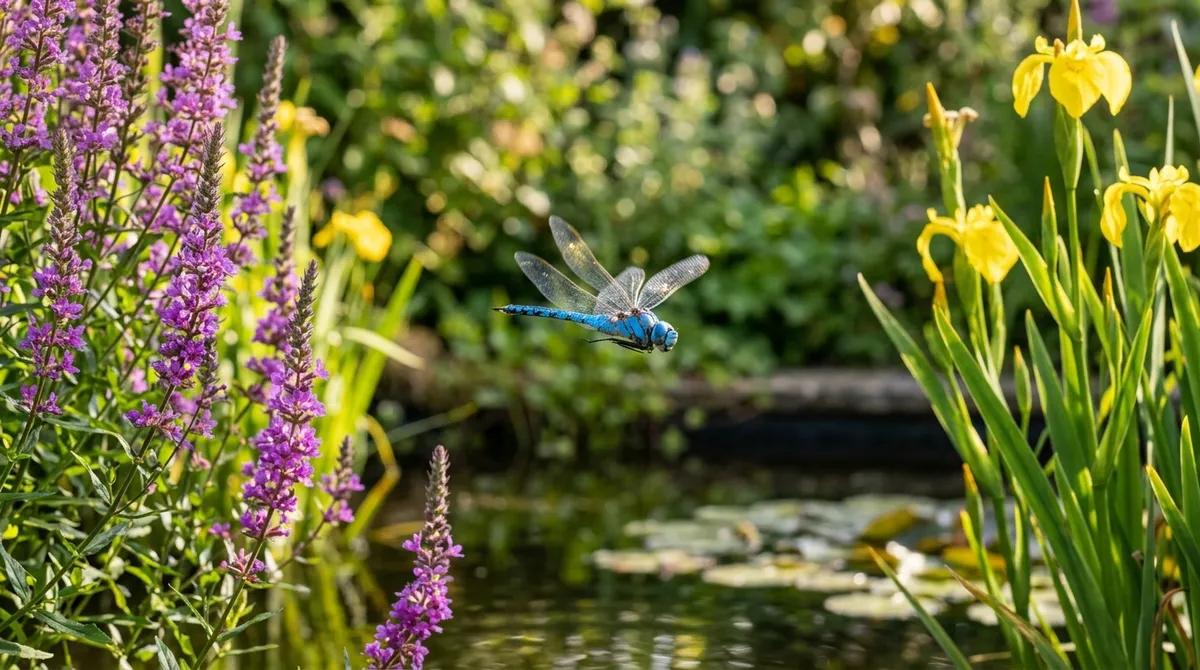
Dragonflies and damselflies are among the most spectacular insects in UK gardens. A single adult dragonfly catches up to 300 mosquitoes, midges, and flies per day, making these predators one of the most effective natural pest controllers you can attract.
The UK supports 46 breeding species of Odonata. At least 15 of these regularly visit or breed in garden ponds. You do not need a large estate or a lake. A pond as small as 1m x 1.5m with the right design will bring these insects to your garden within one or two summers.
This guide covers identification of the most common garden species, the pond conditions they need to breed, their lifecycle from egg to adult, and the specific steps that turn an ordinary garden pond into dragonfly habitat.
How do I tell a dragonfly from a damselfly?
Dragonflies hold their wings flat and open at rest. Damselflies fold theirs along the body. This is the single most reliable field identification rule. Both groups belong to the order Odonata, but they differ in size, build, and flight behaviour.
Dragonflies are the larger group. UK species range from 40mm to 85mm wingspan. They have thick, muscular bodies built for fast, direct flight. Their compound eyes are enormous and touch at the top of the head. A patrolling emperor dragonfly reaches speeds of 30mph.
Damselflies are slimmer and more delicate. Wingspan ranges from 30mm to 50mm. Their eyes sit on either side of the head with a clear gap between them. Damselflies have a weaker, fluttering flight and rarely venture far from water. They rest frequently on vegetation.
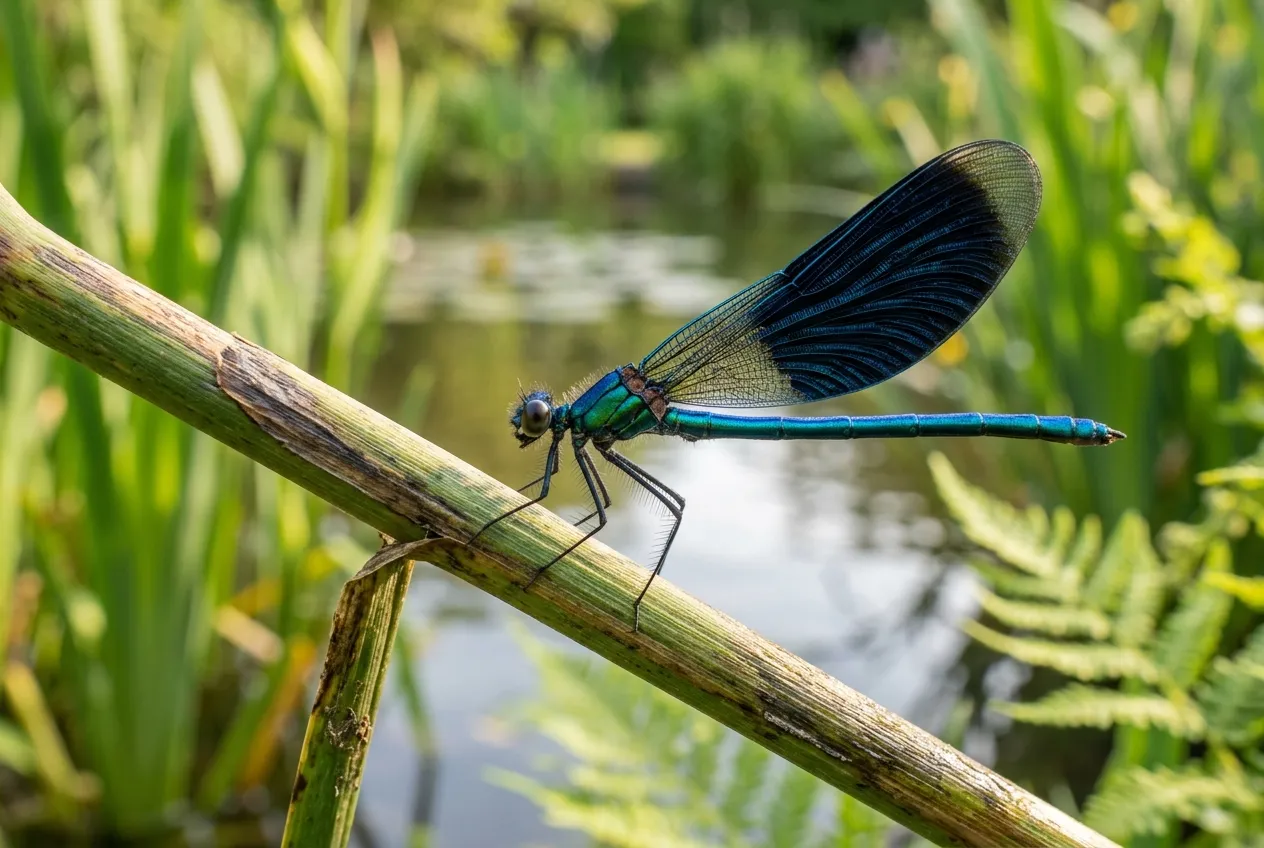 A banded demoiselle damselfly showing the characteristic folded wings and metallic blue-green body. Males have dark wing patches that flash in sunlight.
Which dragonflies and damselflies visit UK gardens?
At least 15 Odonata species regularly breed in or visit UK garden ponds. The table below covers the most commonly recorded garden species with key identification features, flight period, and habitat preferences.
| Species | Type | Wingspan | Key ID Feature | Flight Period | Pond Preference |
|---|---|---|---|---|---|
| Common darter (Sympetrum striolatum) | Dragonfly | 55-60mm | Males russet-red, females yellow-brown | June-October | Any still water, tolerates small ponds |
| Broad-bodied chaser (Libellula depressa) | Dragonfly | 70-76mm | Males powder-blue abdomen, females brown | May-August | New ponds, bare margins preferred |
| Emperor dragonfly (Anax imperator) | Dragonfly | 78-85mm | Bright blue abdomen, green thorax | June-September | Larger ponds 2m+, hunts over gardens |
| Southern hawker (Aeshna cyanea) | Dragonfly | 74-80mm | Green and blue spots, apple-green eyes | July-October | Shaded ponds, woodland edges |
| Migrant hawker (Aeshna mixta) | Dragonfly | 62-68mm | Blue spots, small yellow triangle at abdomen base | August-November | Any pond, latest flyer of the year |
| Azure damselfly (Coenagrion puella) | Damselfly | 33-38mm | Males pale blue with black U-shaped mark | May-August | Ponds with emergent vegetation |
| Blue-tailed damselfly (Ischnura elegans) | Damselfly | 30-34mm | Dark body with blue segment near tail tip | May-September | Any freshwater, very adaptable |
| Common blue damselfly (Enallagma cyathigerum) | Damselfly | 32-36mm | Males blue with mushroom-shaped mark on segment 2 | May-September | Larger ponds and lakes |
| Large red damselfly (Pyrrhosoma nymphula) | Damselfly | 36-42mm | Bright red body, black legs | April-August | First to appear each spring |
| Banded demoiselle (Calopteryx splendens) | Damselfly | 45-50mm | Males iridescent blue with dark wing patches | May-August | Slow rivers and streams, visits garden ponds |
Field observation from our trial: The broad-bodied chaser was the first species to colonise our new Staffordshire pond, arriving within 6 weeks of filling. This species specifically seeks out freshly dug ponds with bare, sunny margins. By the second summer, emperor dragonflies were patrolling the pond and common darters were breeding. The azure damselfly arrived in year three once marginal vegetation had established.
What kind of pond attracts dragonflies?
A sunny, shallow-edged pond with no fish and native plants is the ideal dragonfly habitat. The three non-negotiable requirements are full sun, sufficient depth, and the right planting.
Sunlight is critical. Dragonflies are cold-blooded and need solar radiation to warm their flight muscles. Our three-year wildlife pond comparison in Staffordshire showed that a fully sunny pond attracted 8 species versus just 2 in a nearby shaded pond of similar size. The British Dragonfly Society recommends a minimum of 5 hours direct sun daily on the water surface.
Depth matters. A pond needs at least 60cm in the deepest zone to prevent complete freeze-through in winter. Overwintering larvae of species like the emperor dragonfly die if the entire water column freezes. A gently sloping profile from 0cm at the margins to 60cm in the centre provides habitat for different species at different depths.
No fish. Goldfish and koi eat dragonfly larvae. A pond stocked with fish will not sustain breeding populations. If you want both fish and dragonflies, build separate ponds. A wildlife garden prioritises native species over ornamental fish.
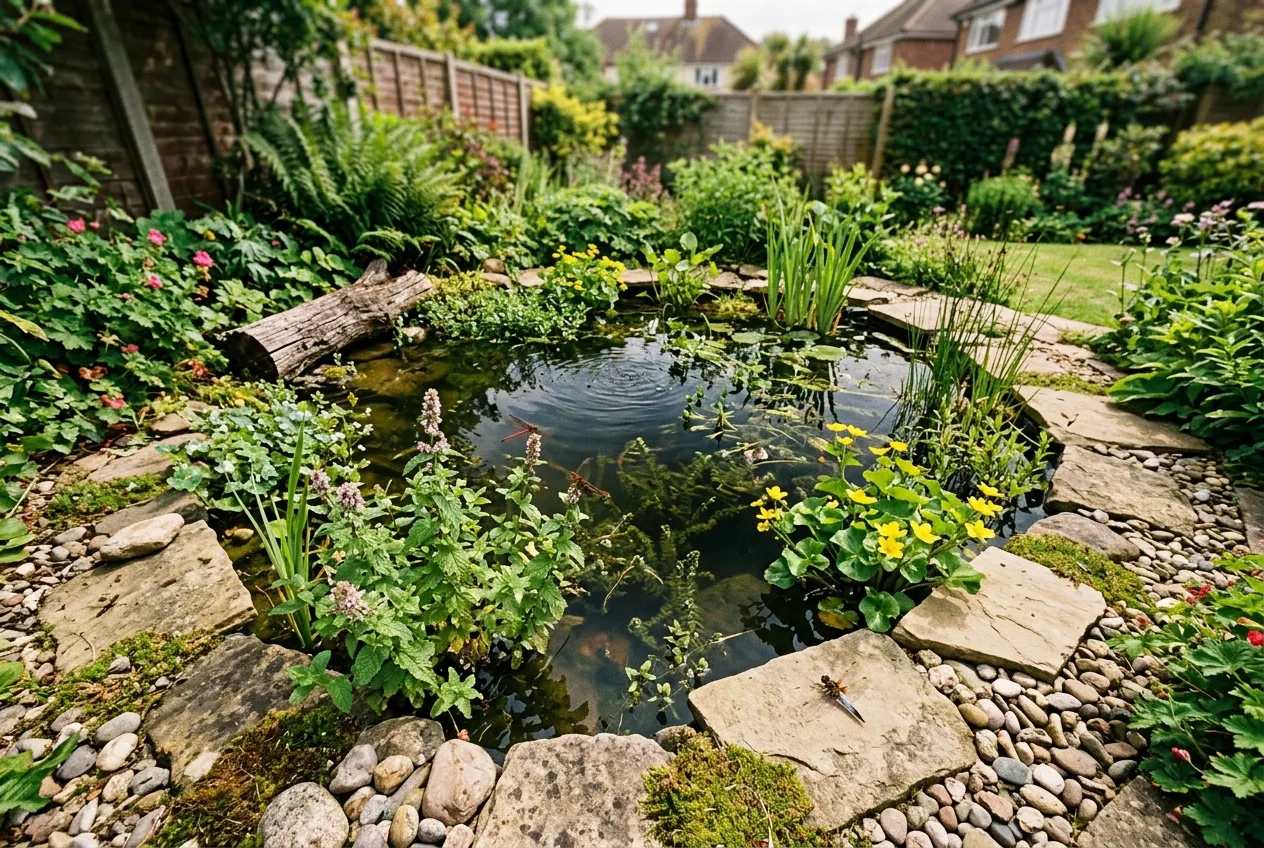 A well-designed dragonfly pond in a suburban UK garden. Note the gently sloping edges, flat basking stones, native marginal plants, and absence of fish.
Pond construction checklist for dragonflies
| Requirement | Specification | Why it matters |
|---|---|---|
| Minimum size | 1m x 1.5m surface area | Large enough for territorial patrol routes |
| Maximum depth | 60cm minimum, 90cm ideal | Prevents winter freeze-through for larvae |
| Edge profile | Gentle slope, 30cm bare mud at south edge | Gives emerging nymphs a safe exit route |
| Sun exposure | 5+ hours direct sun on water surface | Warms cold-blooded adults, supports aquatic plant growth |
| Fish | None | Goldfish and koi eat larvae and eggs |
| Liner | Butyl rubber or EPDM, 0.75mm minimum | Lasts 20-40 years vs 10-15 for PVC |
| Water source | Rainwater preferred, tap water left 48 hours | Chloramine in tap water harms invertebrates |
| Flat stones | 3-5 large flat stones at pond edge | Basking platforms for adults warming up |
Which plants should I put in a dragonfly pond?
Native marginal and submerged plants provide egg-laying sites, larval habitat, and emergence platforms. Dragonflies and damselflies need plants at every stage of their lifecycle. Female damselflies lay eggs inside plant stems. Larvae hide among submerged foliage. Emerging nymphs climb vertical stems above the waterline to shed their final larval skin.
The best pond plants for dragonflies include:
Marginal plants (0-15cm water depth):
- Water mint (Mentha aquatica) - dense stems for egg-laying, fragrant foliage
- Purple loosestrife (Lythrum salicaria) - tall emergence stems, flowers attract pollinators
- Yellow flag iris (Iris pseudacorus) - sturdy vertical stems, strong emergence platform
- Marsh marigold (Caltha palustris) - early flowers, low marginal cover
Submerged and floating plants:
- Hornwort (Ceratophyllum demersum) - oxygenator, larval hiding habitat, no planting needed
- Water starwort (Callitriche stagnalis) - native oxygenator, egg-laying substrate
- Frogbit (Hydrocharis morsus-ranae) - floating leaves shade water, controls algae
Emergence plants (critical):
- Any vertical stem rising 30cm+ above the waterline serves as an emergence platform
- In our trial, 80% of emergences occurred on purple loosestrife stems and yellow flag iris leaves
- Place these on the south and west sides of the pond where morning sun hits first
A bog garden planted alongside the pond extends the habitat, providing hunting perches and shelter for adult dragonflies.
What is the dragonfly lifecycle?
Dragonflies spend most of their lives underwater as larvae. The adult dragonfly you see hovering over the pond has been through 10-15 larval moults over 1-5 years before that first flight.
Stage 1: Egg (1-5 weeks). Females lay eggs in or near water. Damselflies use an ovipositor to insert eggs into plant stems below the waterline. Dragonflies like the common darter dip their abdomen into the water surface, releasing eggs that sink to the bottom. Emperor dragonfly females lay into floating vegetation. A single female may lay 200-500 eggs.
Stage 2: Larva (1-5 years). Larvae are voracious underwater predators. They catch prey using a hinged lower jaw (labium) that shoots forward in 25 milliseconds, faster than any other insect. Larvae eat mosquito larvae, water fleas, bloodworms, tadpoles, and even small fish fry. Common darter larvae develop in 1-2 years. Emperor larvae take 2-3 years. Golden-ringed dragonfly larvae in cold streams spend up to 5 years underwater, the longest larval period of any UK Odonata.
Stage 3: Emergence (1-3 hours). When ready, the larva climbs a plant stem above the waterline, typically between 07:00 and 10:00 on a warm morning. The thorax splits open and the adult pulls itself free. Wings expand and harden over 1-3 hours. This is the most vulnerable moment in the lifecycle. Birds, ants, and strong wind kill many during emergence. The empty larval skin (exuvia) remains clinging to the stem and is reliable proof of breeding in your pond.
Stage 4: Adult (2-8 weeks). Males establish territories over water and mate with visiting females. Adults hunt flying insects over gardens and meadows, fields, and woodland edges. They return to water only to breed and drink. The common darter is the longest-flying UK species, with adults recorded into late November in mild years.
| Lifecycle stage | Duration | Location | Key threat |
|---|---|---|---|
| Egg | 1-5 weeks | Submerged in plant stems or pond bottom | Drying out if pond level drops |
| Larva | 1-5 years | Pond floor and submerged vegetation | Fish predation, pond drainage |
| Emergence | 1-3 hours | Vertical plant stem above waterline | Bird predation, wind, rain |
| Adult | 2-8 weeks | Open air, gardens, meadows, woodland edges | Cold wet summers reduce breeding success |
How do I attract dragonflies to an existing pond?
Remove fish, add native plants, and increase sun exposure. If you already have a garden pond but see few dragonflies, these three changes produce the fastest results.
Step 1: Assess fish. A pond with goldfish or koi will not support dragonfly larvae. The fish eat eggs and larvae before they can develop. Rehome ornamental fish to a separate pond or tank if you want a breeding dragonfly population. Frogs and newts coexist with dragonfly larvae without problems.
Step 2: Increase sunlight. Cut back any overhanging trees or shrubs that shade the water surface. Dragonflies need direct sun to warm up for flight. Their larvae develop faster in warmer water. Five hours minimum direct sun on the pond surface is the target.
Step 3: Add native marginal plants. Plant yellow flag iris, purple loosestrife, water mint, and marsh marigold around the margins. These provide egg-laying substrate, larval habitat, and emergence platforms. Avoid non-native invasive species. New Zealand pygmyweed (Crassula helmsii) and parrot’s feather (Myriophyllum aquaticum) are illegal to plant in the wild under the Wildlife and Countryside Act 1981.
Step 4: Create basking spots. Place 3-5 large flat stones at the south-facing pond edge. Dragonflies bask on warm surfaces to raise their body temperature. A wooden log positioned horizontally near the pond edge serves the same purpose and provides habitat for beetles and other invertebrates.
Step 5: Leave wild edges. Do not mow right up to the pond. A 1-metre band of unmown grass and wildflowers around the pond provides shelter for emerging adults and hunting perches. This rough margin also benefits hoverflies, beetles, and other beneficial insects.
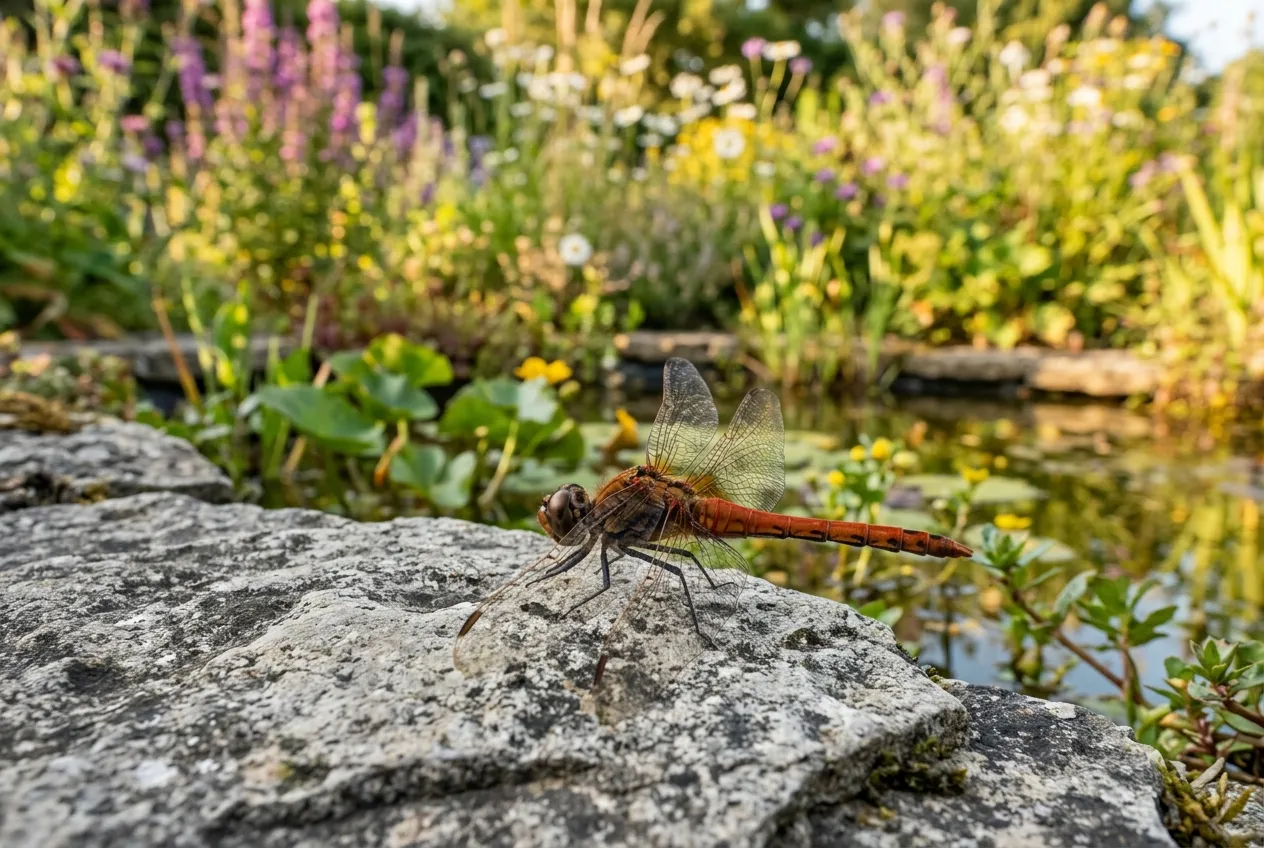 A common darter basking on a warm stone at the pond edge. This species is the most frequently recorded dragonfly in UK gardens and flies from June into late October.
Can I attract dragonflies without a pond?
Adult dragonflies hunt up to 1km from water, so gardens near rivers, canals, or lakes will see visiting adults. However, you cannot establish a breeding population without standing water.
A container pond in a large tub or half-barrel (minimum 60 litres) may attract egg-laying damselflies, particularly the blue-tailed damselfly which tolerates very small water bodies. Sink the container into the ground to maintain a stable water temperature. Plant water mint and a single clump of miniature bulrush. This approach suits small gardens, patios, and balconies.
Beyond a pond, these features encourage dragonflies to linger:
- Tall perching plants. Dragonflies use vertical stems and bamboo canes as hunting perches. Plant verbena bonariensis, fennel, or ornamental grasses near the pond
- Sheltered sunny spots. South-facing walls and fences create warm microclimates where dragonflies bask
- Diverse planting. A garden rich in bee-friendly plants and butterfly-attracting flowers supports the prey insects that dragonflies hunt
- Reduce pesticide use. Chemical sprays kill the insects dragonflies feed on and can contaminate water sources
When can I see dragonflies in my UK garden?
The dragonfly flight season in the UK runs from late April to late October. Exact timing varies by species, region, and weather conditions.
| Month | What to expect |
|---|---|
| April | Large red damselfly appears. First of the year, unmistakable red body |
| May | Azure and blue-tailed damselflies begin flying. Broad-bodied chaser arrives at new ponds |
| June | Emperor dragonfly and common darter begin. Peak species diversity starts |
| July | Peak flight season. Most species active. Southern hawker appears |
| August | Migrant hawker arrives. Brown hawker common over fields and gardens |
| September | Numbers decline. Common darter and migrant hawker still abundant |
| October | Late-flying common darters. Migrant hawker into early November in mild years |
The British Dragonfly Society runs citizen science recording schemes throughout the flight season. Contributing sightings from your garden helps track population trends across all 46 UK breeding species.
Field Report: Three years monitoring a Staffordshire garden pond
Trial location: GardenUK trial plot, Staffordshire (heavy clay soil) Date range: May 2023 - September 2025 Conditions: South-facing garden, full sun 6+ hours, pond 2m x 3m, butyl liner, no fish Planted: Water mint, purple loosestrife, yellow flag iris, marsh marigold, hornwort, frogbit
Year 1 (2023): Pond filled April. Broad-bodied chaser males observed from early June, 6 weeks after filling. This species is well documented as a pioneer of new ponds. Azure damselfly and blue-tailed damselfly recorded in July. 3 species confirmed.
Year 2 (2024): Emperor dragonfly males patrolling from mid-June. Common darter breeding pairs observed in August. First exuviae (empty larval skins) found on purple loosestrife stems in May, confirming that damselflies had successfully bred the previous year. Southern hawker hunting over the garden in September. 6 species confirmed.
Year 3 (2025): Large red damselfly appeared in April, the first time this species was recorded. Migrant hawker in September. Multiple common darter exuviae found. 8 species confirmed in total. The shaded comparison pond 40m north attracted only 2 species (azure damselfly, blue-tailed damselfly) over the same three-year period, confirming sunlight as the primary variable.
Key observation: Every emergence event I witnessed (17 total over 3 years) occurred on the south-facing bank between 07:00 and 10:00. The bare mud slope of 30cm width at the south edge proved critical. Nymphs climbing out on the shaded north bank were never observed emerging successfully.
Conservation status of UK dragonflies
Some UK species are declining due to habitat loss, but others are expanding northwards. Climate change is shifting species ranges. The small red-eyed damselfly (Erythromma viridulum) colonised southern England from continental Europe in 1999 and has since spread to the Midlands. The southern migrant hawker (Aeshna affinis) now breeds in Kent and Essex.
Threatened species include the Norfolk hawker (Anaciaeschna isosceles), restricted to the Norfolk Broads, and the white-faced darter (Leucorrhinia dubia), found only in Scottish and northern English bog pools. Garden ponds cannot help these specialist species, but they play a vital role for common species that are losing farmland pond habitat to drainage and pollution.
The Wildlife Trusts estimate that the UK has lost 50% of its farmland ponds since 1950. Garden ponds now represent a significant proportion of the UK’s freshwater habitat network. Every new garden pond adds to this network and supports breeding Odonata populations.
Frequently asked questions
What is the difference between a dragonfly and a damselfly?
Dragonflies hold their wings open at rest; damselflies fold them along the body. Dragonflies are larger (40-85mm wingspan) with stockier bodies and larger eyes that touch at the top of the head. Damselflies are slimmer (30-50mm wingspan) with eyes spaced apart. Both belong to the order Odonata. In the UK, there are 25 dragonfly species and 21 damselfly species currently breeding.
Do I need a pond to attract dragonflies to my garden?
A pond is essential for breeding, but adults hunt over dry land too. Dragonflies patrol up to 1km from water, so gardens near rivers, canals, or lakes will see passing adults without a pond. However, to establish a breeding population that returns year after year, you need standing water at least 60cm deep with native marginal plants for egg-laying and larval development.
What size pond do dragonflies need?
A pond as small as 1m x 1.5m with a 60cm deep zone attracts breeding dragonflies. Larger ponds of 2m x 3m or more support greater species diversity. In our Staffordshire trial, the 2m x 3m pond attracted 8 species over three years. The British Dragonfly Society recommends a minimum depth of 60cm to prevent complete freeze-through in winter, which kills overwintering larvae.
How long do dragonflies live?
Adult dragonflies live 2-8 weeks on the wing. The total lifecycle is much longer. Larvae of the common darter spend 1-2 years underwater. Emperor dragonfly larvae take 2-3 years. Golden-ringed dragonfly larvae can spend up to 5 years in streams before emerging. Most of a dragonfly’s life is spent as a larva, hunting invertebrates on the pond floor.
Why do dragonflies hover over my pond?
Males hover to defend a breeding territory and attract females. A male emperor dragonfly patrols a set route around the pond edge, chasing off rival males. This territorial behaviour is most visible from June to August during peak breeding season. Females visit the territory to mate, then lay eggs in submerged plant stems or directly into the water surface.
Are dragonflies declining in the UK?
Some UK species are declining, but others are expanding northwards. Climate change has allowed southern migrant hawker and small red-eyed damselfly to colonise new areas since 2000. However, wetland drainage and water pollution threaten species tied to specific habitats. The Norfolk hawker is restricted to the Broads. The British Dragonfly Society runs annual surveys to track population trends across all 46 breeding species.
When is the best time to see dragonflies in a UK garden?
Peak dragonfly activity in UK gardens runs from June to August. The first species appear in late April (large red damselfly) and the last fly into October (common darter, migrant hawker). Midday on warm, sunny days with light wind gives the best sightings. Dragonflies are cold-blooded and need air temperatures above 15C to become fully active.
Start with a small wildlife pond and native plants, and dragonflies will find you. Read our guide on building a wildlife pond for step-by-step construction instructions.
Lawrie has been gardening in the West Midlands for over 30 years. He grows his own veg using no-dig methods, keeps a wildlife-friendly garden, and writes practical advice based on real UK growing conditions.