Key takeaways
- Yellow rattle (Rhinanthus minor) is non-negotiable. It parasitises grass roots, suppressing vigorous grasses by 40-60% and giving wildflowers a chance
- Soil fertility is the enemy. High-nitrogen soil grows tall grass that smothers wildflowers — strip topsoil or grow off fertility for 2 years before sowing
- Autumn sowing (mid-August to mid-September) doubles establishment rates compared to spring on UK soils — cold stratifies seed and autumn rain settles it in
- A traditional meadow needs one annual cut in late July to September, with arisings raked off — never mulch-mowed back into the sward
- Plug planting beats seed for adding species into existing rough grass, costing £1-£3 per plug but giving instant established plants
- First proper flowering year is year 2, full meadow look year 3. Year 1 is mostly grasses and annual weeds — do not abandon early
The British wildflower meadow used to cover roughly 7 million acres of countryside. Today it covers under 1 percent of that. The collapse happened in living memory, and most of the species we associate with wildflower meadows — ox-eye daisies, yellow rattle, common knapweed, ribwort plantain, betony — became scarce because the meadows themselves vanished.
Garden meadows are a small but real way to put habitat back. Get it right and a 50-square-metre meadow on a former lawn supports more invertebrate species than the entire surrounding street’s gardens combined. But meadow making is not lawn-care-with-flowers. Skimp on the prep and you end up with a tangle of coarse grass, sycamore seedlings, and creeping thistle. A meadow that works takes three years from sowing to mature display. It hinges on yellow rattle and low fertility soil, and on one careful cut a year. That cut is the bit most new gardeners get wrong.
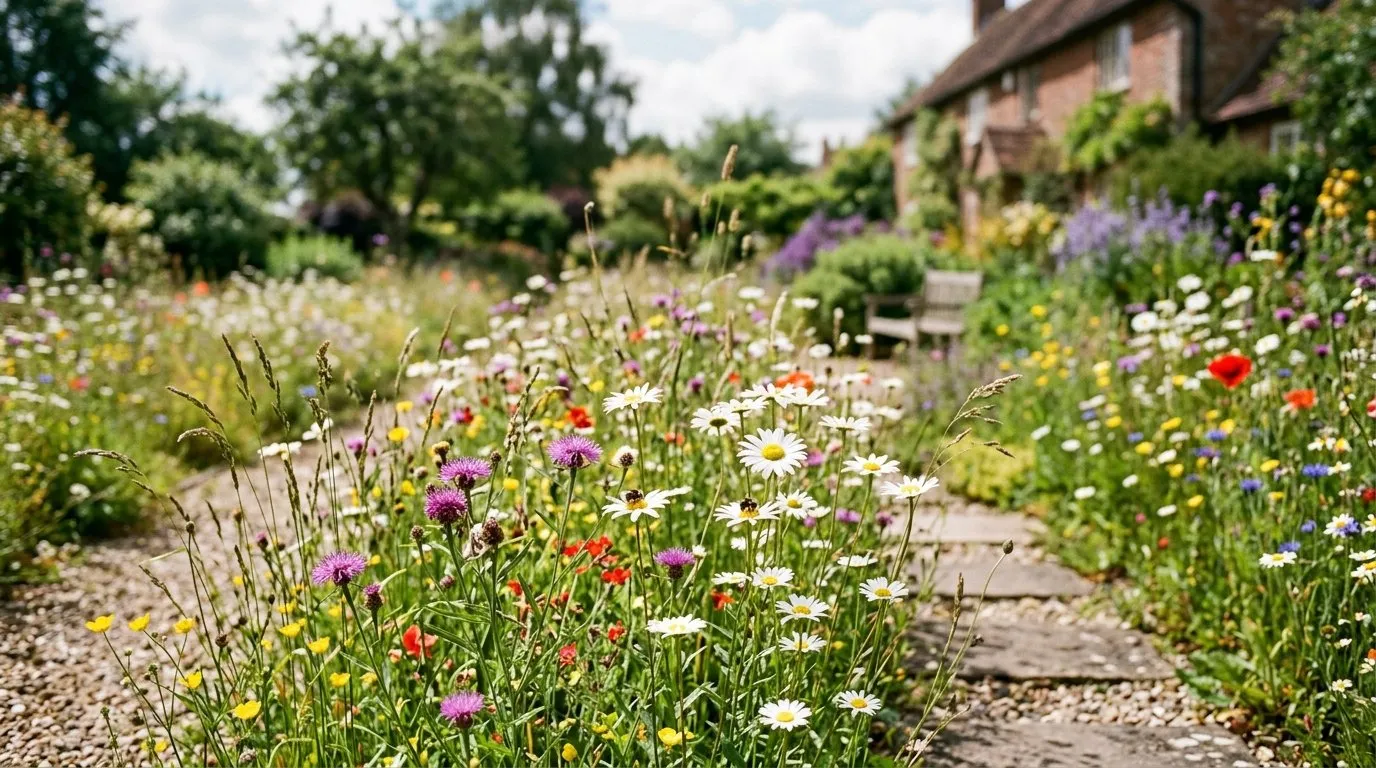 A four-year-old meadow on former lawn, mid-June. The yellow rattle has done its work and the grass has thinned to leave room for ox-eye daisies, knapweed, and red clover.
What is a UK wildflower meadow?
A traditional UK wildflower meadow is a permanent perennial grassland dominated by fine native grasses with 20-30 percent wildflower cover. It is not a cornfield-style annual flower display sown for one summer, nor a small “mini meadow” patch tucked into a border. The mature meadow contains 30-60 native species, supports several hundred invertebrate species, and persists for decades with only one annual cut.
Three things separate a real meadow from a flowery patch of grass:
- Low fertility soil. Native wildflowers evolved on poor grassland. High nitrogen soil grows tall coarse grass that overshadows them.
- Yellow rattle (Rhinanthus minor). A native annual hemiparasite that suppresses grass roots, opening gaps for wildflowers. Without it, grass dominates every meadow within 3 years.
- The annual cut and removal. One cut per year in late summer with arisings carted off — never mulch-mowed back into the sward.
Plantlife, the UK charity behind the No Mow May campaign, puts the loss at 97% of British wildflower meadows since 1930. A garden meadow is about the easiest way for most people to claw a fragment of that habitat back.
This guide is distinct from our mini meadow wildflower area piece (smaller footprint, more decorative) and the wildflower lawn approach (mowable spring meadow). A traditional meadow is bigger (20+ square metres), perennial, and cut once a year.
How to make a wildflower meadow from an existing lawn
Step 1 — Reduce soil fertility (year before sowing)
Years of feeding leave lawn topsoil loaded with nitrogen and phosphorus. That suits grass, which then outcompetes the wildflowers and starves them out. Three ways to bring the fertility down:
- Cut and remove for 12 months — mow weekly through one growing season and remove every clipping. Slow but free.
- Strip topsoil — remove the top 50-100mm of turf and topsoil, exposing subsoil. Fast and effective but requires skip hire (£200-£400).
- Cover crop method — sow yellow mustard or buckwheat for 12 months and cut without composting back. Reduces fertility while suppressing perennial weeds.
Step 2 — Prepare the seedbed (mid-July to mid-August)
In the year you plan to sow:
- Mow the lawn to 5cm in mid-July
- Scarify hard with a powered scarifier or stiff hand rake — aim to expose 50% bare soil
- Remove all arisings and any moss
- Roll lightly with a garden roller to firm the soil
- Wait 2-3 weeks for any disturbed weed seed to germinate, then hoe off
The end state should look half lawn, half bare earth. This is where the new seed will germinate.
Step 3 — Sow yellow rattle first (early September)
Yellow rattle is the keystone species. Sow it before any other wildflower seed because it needs to establish first to suppress grass.
- Sow at 1-3 grams per square metre
- Mix with sand at a 1:5 ratio for even distribution
- Broadcast by hand
- Tread or roll lightly to firm into soil contact
- Sow no later than mid-September — later sowings rarely germinate
Seed must be from the current year. Yellow rattle seed loses viability within 12 months of harvest. Buy from specialist meadow seed suppliers like Emorsgate Seeds, Naturescape, or Habitat Aid — never from generic packet seed sources.
Step 4 — Sow the main wildflower mix (autumn or following spring)
Choose a mix matched to your soil:
| Soil type | Suitable mix | Key species |
|---|---|---|
| Heavy clay | Clay loam meadow mix | Ox-eye daisy, knapweed, ribwort plantain, meadow buttercup, red clover, yellow rattle |
| Sandy/free-draining | Light sandy soil mix | Lady’s bedstraw, harebell, viper’s bugloss, kidney vetch, yellow rattle |
| Chalk/limestone | Calcareous grassland mix | Greater knapweed, field scabious, salad burnet, common bird’s-foot trefoil, yellow rattle |
| Damp/lowland | Wet meadow mix | Meadowsweet, ragged robin, devil’s-bit scabious, marsh marigold, yellow rattle |
Sow at 4-5 grams per square metre. Broadcast by hand, mix with sand for even distribution, tread or roll. Do not cover seed — most native wildflowers need light to germinate.
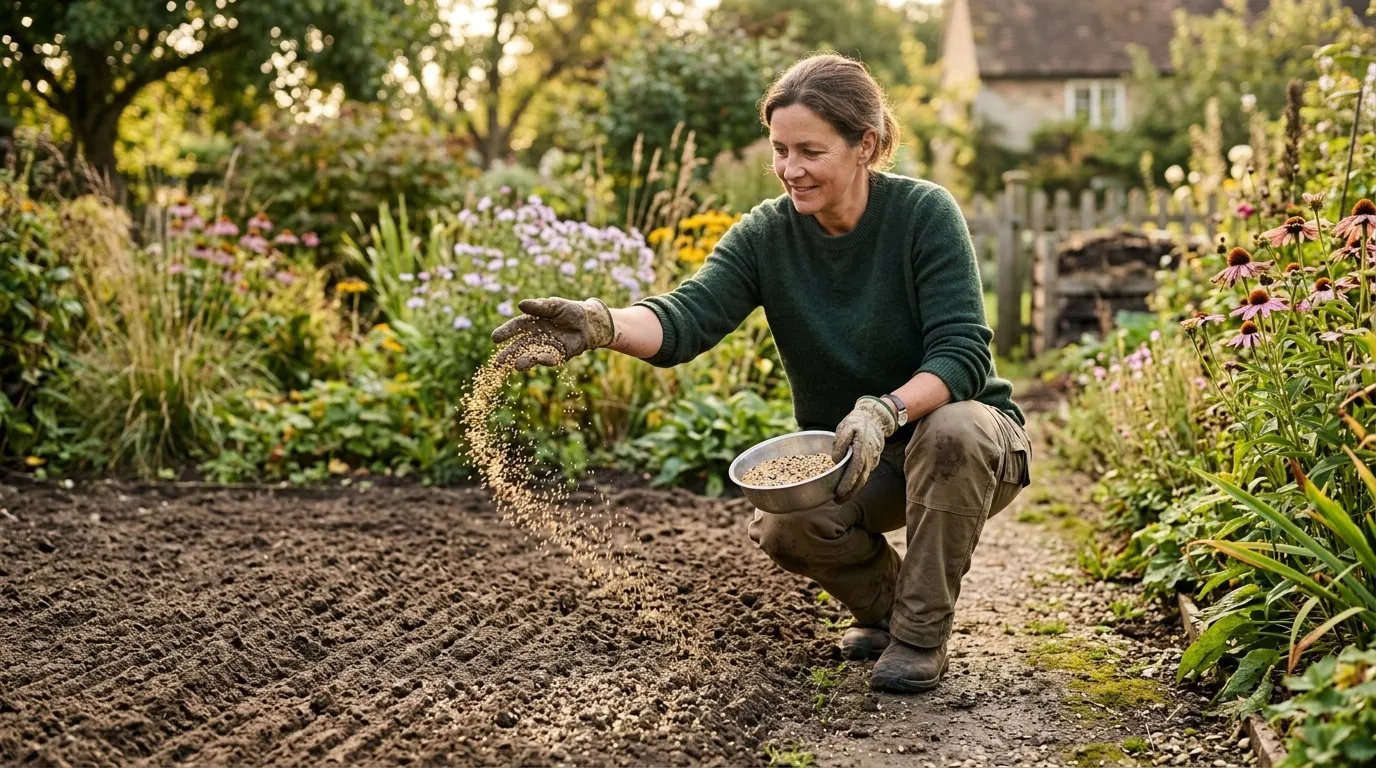 Yellow rattle being sown in early September. Mix with sand at 1:5 ratio for even distribution and tread or roll to firm into the soil — never cover, it needs light to germinate.
Plug planting: the alternative method
Seed is cheap but slow to get going. Plugs cost more but give you established plants straight away. For most UK gardens you want a bit of both.
Plug planting:
- Buy 9cm or 5cm wildflower plugs from specialist nurseries (£1.20-£3 each)
- Plant directly into existing rough grass in spring (March-May) or autumn (September-October)
- 4-9 plugs per square metre for visible impact
- Roots establish through grass thatch where seed cannot
When plugs beat seed:
- Heavy clay where seed germination is unreliable
- Existing rough grass that cannot be stripped
- Adding species to an established meadow that lacks diversity
- Replacing failed sowings in patches
How to maintain a wildflower meadow
Once it’s established, the cut-and-remove cycle is all there is to do. Do it properly and the meadow gets better year on year.
The annual cut:
- Time: late July to mid-September depending on species (cut after yellow rattle has dropped seed in late July)
- Method: scythe, brush cutter, or strimmer at 8-10cm height
- Never use a rotary lawnmower at full depth — it destroys the lower vegetation structure
- Leave arisings on the meadow for 3-7 days to allow seed to drop
- Then rake or fork off completely — every clipping must leave the meadow
The reason for removing arisings is fertility. Composting clippings back into the sward returns nitrogen, which feeds grass at the expense of wildflowers.
A second cut in autumn (October-November) is optional. It tidies the meadow for winter and reduces vole habitat. Many traditional meadows do well with one cut only — judge based on growth.
For broader gardening tasks alongside meadow management, see our autumn gardening jobs and composting guides — the meadow arisings are good compost feedstock.
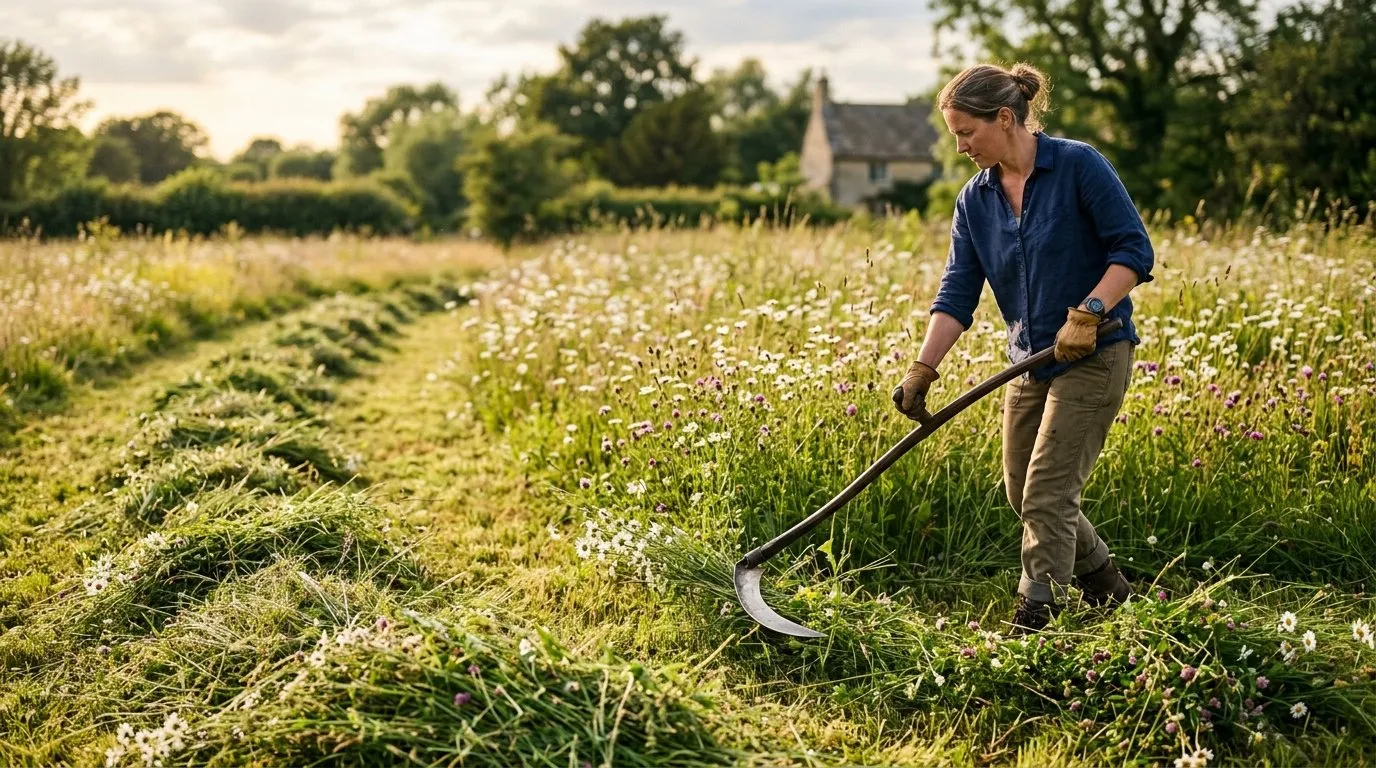 Scything in late July, just after yellow rattle has dropped seed. Arisings stay on the surface for a week to drop more seed, then rake off completely — leaving them composts the meadow back into a lawn.
What plants grow in a UK wildflower meadow?
Grasses (the meadow matrix — 70-80% cover)
| Species | Height | Notes |
|---|---|---|
| Sheep’s fescue (Festuca ovina) | 30cm | Fine, clump-forming, drought-tolerant |
| Common bent (Agrostis capillaris) | 50cm | Soft, gives meadow movement |
| Crested dog’s-tail (Cynosurus cristatus) | 40cm | Reliable, supports grasshoppers |
| Sweet vernal grass (Anthoxanthum odoratum) | 30cm | Source of meadow hay scent |
| Yorkshire fog (Holcus lanatus) | 50cm | Hosts wild bumblebee nests |
Wildflowers (20-30% cover when mature)
| Species | Flowers | Bloom time | Notes |
|---|---|---|---|
| Yellow rattle (Rhinanthus minor) | Yellow | May-July | Annual, parasitic on grass — non-negotiable |
| Ox-eye daisy (Leucanthemum vulgare) | White-yellow | May-September | The signature meadow flower |
| Common knapweed (Centaurea nigra) | Purple | June-September | Bumblebee magnet |
| Ribwort plantain (Plantago lanceolata) | Brown spike | April-October | Sustains specialist moth species |
| Red clover (Trifolium pratense) | Pink-red | May-September | Nitrogen-fixer, bumblebee favourite |
| Self-heal (Prunella vulgaris) | Purple | June-October | Low-growing, fills gaps |
| Bird’s-foot trefoil (Lotus corniculatus) | Yellow | May-August | Common blue butterfly food plant |
| Meadow buttercup (Ranunculus acris) | Yellow | April-July | Tall, traditional cottage meadow species |
| Meadowsweet (Filipendula ulmaria) | Cream | June-September | For damp meadows only |
| Field scabious (Knautia arvensis) | Lilac | June-September | Long flowering, hoverfly favourite |
What wildlife uses a wildflower meadow?
Pollinators:
- 12-15 bumblebee species recorded annually (out of 24 UK species)
- Solitary bees: leafcutter, mining, mason
- Hoverflies: marmalade, drone fly, narcissus fly
- Butterflies: common blue, meadow brown, gatekeeper, small skipper
Other invertebrates:
- Grasshoppers (Common Field, Meadow)
- Crickets (Roesel’s Bush-cricket on warmer sites)
- Moth species — typically 50-100 per meadow once established
- Beetles, including dung beetles and ground beetles
Vertebrates:
- Voles, shrews, hedgehogs (autumn-cut meadows leave winter shelter)
- Slow worms and grass snakes in southern England
- Birds — meadow pipits, linnets, finches feeding on seed
Common wildflower meadow problems and solutions
Year 1 looks weedy and disappointing
This is normal. Year 1 is dominated by annual cornfield species in the seed mix (cornflower, corn marigold, corn poppy) plus disturbed-soil weeds (groundsel, fat hen, chickweed). Year 2 the perennials emerge. Year 3 yellow rattle is fully established and the meadow looks coherent.
Do not rotavate or re-sow if year 1 looks rough. Hand-pull docks and creeping thistle if they appear. Otherwise wait.
Grass dominates and wildflowers fail
Three causes:
- Soil too fertile. Continue to cut-and-remove — fertility falls over 2-3 seasons.
- Yellow rattle absent or failed. Re-sow each September for 3 years until it establishes.
- Wrong seed mix for soil type. A clay meadow mix on free-draining sand will fail. Match mix to site.
Docks, thistles, and nettles take over
Perennial weeds favour disturbed soil and high fertility. Hand-pull docks (Rumex obtusifolius) annually before they seed. Cut creeping thistle (Cirsium arvense) repeatedly through the season. Assess common ragwort separately because its safe-removal rules depend on nearby grazing. Nettles can remain at meadow edges but should be pulled from the main sward.
Meadow goes to coarse grasses (cock’s-foot, false oat-grass)
Indicates fertility is still too high or yellow rattle never established. Strip topsoil from problem patches and re-sow.
Yellow rattle germinates poorly
Three causes: seed too old (must be under 12 months), sown too late (must be by mid-September), or inadequate soil contact (always tread or roll after sowing).
Annual cut left too long without removing
If clippings sit on the meadow for more than 7-10 days they begin to mat and smother seedlings. Always rake off within a week.
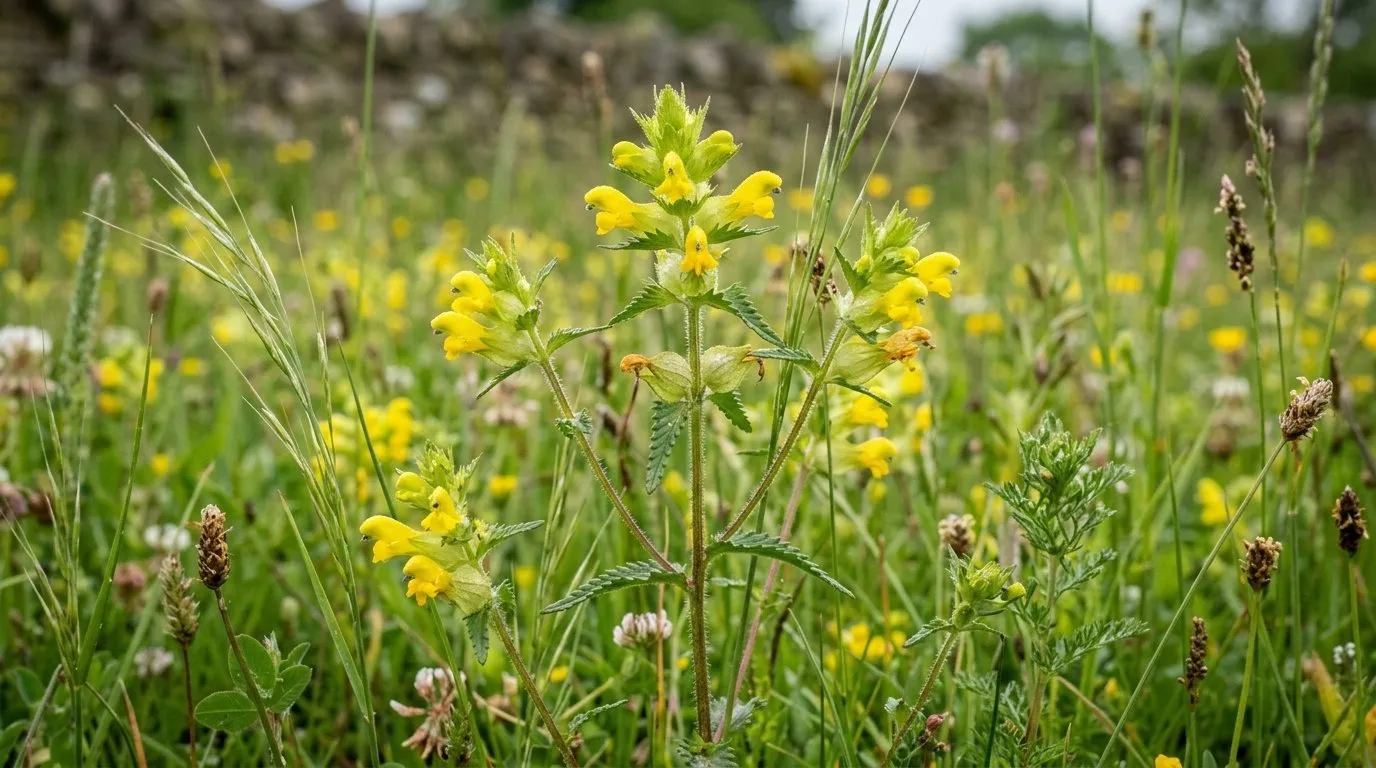 Yellow rattle in full flower in late May. The yellow lipped flowers and inflated calyx are unmistakable, and the surrounding grass is visibly shorter and thinner where it has parasitised roots.
Wildflower meadow maintenance calendar
| Month | Task | Time per 50m² |
|---|---|---|
| January-February | Plan species additions. Order plugs and seed | 30 min planning |
| March | Plant wildflower plugs. Fork out perennial weeds | 2-3 hours |
| April | First flowers (cuckoo flower, primrose). Hand-pull docks | 30 min |
| May | Yellow rattle in flower. Knapweed and ox-eye daisy emerge | None |
| June-July | Peak flowering. Photograph for records. Note bare patches | None |
| Late July-Aug | Annual cut after yellow rattle drops seed. Leave arisings 3-7 days, then rake off | 4-6 hours |
| September | Sow yellow rattle and any new wildflower seed | 1-2 hours |
| October | Optional second cut. Plant autumn plugs | 2-3 hours |
| November-December | Leave standing for wildlife shelter | None |
Total annual time: 12-18 hours per 50m². For comparison, the same area as a fertilised lawn requires roughly 25-35 hours of mowing per year.
How to size and site a wildflower meadow
Minimum size for a meaningful meadow: 20m². Below this, edge effects from surrounding lawn and fertilised soil dominate and species struggle to establish.
Best sites:
- South or west-facing for warmth and sun
- Open position away from tree drip lines
- Naturally low fertility (sandy or rocky areas, old paths, gravelly verges)
- Adjacent to existing rough grass or hedgerow for species recruitment
Avoid:
- Heavily shaded areas (woodland edge planting is different)
- Recently fed or fertilised lawn (strip topsoil first)
- Compacted ground without preparation
- Wet ground that holds standing water in winter (dig a bog garden instead — see how to create a bog garden)
Sample garden layouts:
| Garden size | Suggested meadow | Companion features |
|---|---|---|
| Small (50m²) | 10-15m² mini meadow | Wildlife pond, native hedge |
| Medium (200m²) | 30-50m² traditional meadow | Pond, hedge, log pile |
| Large (500m²+) | 100m²+ meadow with mown paths | Multiple meadow types, orchard, pond, hedge network |
Where to source UK wildflower seed and plugs
Reliable UK suppliers for native wildflower seed and plugs:
- Emorsgate Seeds — UK provenance native seed mixes, the standard reference
- Habitat Aid — strong on yellow rattle and meadow mixes by soil type
- Naturescape — wide species range, plug plants and seed
- Wildflower Turf — established meadow turf rolls (£8-£15/m², instant meadow but expensive)
- Pictorial Meadows — cornfield-style annual mixes (different product, useful for year 1 colour while perennials establish)
Avoid generic garden centre seed packets labelled “wildflower mix” — these often contain non-native species and lack yellow rattle. Always check seed mix species lists before buying.
Frequently asked questions
How do you make a wildflower meadow from an existing lawn?
You make a wildflower meadow from a lawn by cutting it to 5cm in late July, scarifying hard to expose at least 50% bare soil, sowing yellow rattle (3g per square metre) in early September, then sowing a wildflower mix the same autumn or following March. Do not feed, do not overseed with grass. Cut once a year in late summer with arisings raked off. First proper meadow look appears in year 2-3. Soil fertility reduction is the biggest factor in success.
Why does my wildflower meadow have so much grass?
Too much grass means soil fertility is too high or yellow rattle never established. Yellow rattle parasitises grass roots and suppresses vigorous species by 40-60% — without it, grass dominates every meadow. Sow yellow rattle in early September each year for 3 consecutive years until established. To reduce fertility, cut and remove arisings every time you mow, never leave clippings on the surface. On previously fertilised lawns, expect 2-3 years before grass thins to manageable density.
When should I sow wildflower seed in the UK?
Mid-August to mid-September is the best UK sowing window. Autumn-sown wildflower seed gives 60-80% establishment rates compared to 30-40% for spring sowing. The reason is twofold: many native wildflower seeds need cold stratification (winter chilling) to germinate, and autumn rainfall settles seed into soil contact better than spring drought. March sowing works for cornfield annual mixes but fails for perennial meadow species. Yellow rattle must be sown by mid-September — sown later it will not germinate.
Do I need to remove grass before sowing wildflowers?
Yes, you need at least 50% bare soil for new seed to establish. On an existing lawn, mow to 5cm in July, then scarify hard with a powered scarifier or stiff rake to remove the thatch and tear up roots. Aim to expose half the soil. Seed scattered onto unprepared turf has near-zero germination because grass crowds out emerging seedlings within days. Plug planting works in undisturbed turf because plugs already have established roots.
What is yellow rattle and why is it essential?
Yellow rattle (Rhinanthus minor) is a native annual hemiparasite that attaches to grass roots and steals water and nutrients. It reduces grass vigour by 40-60%, opening gaps for wildflower species. Sow in early September at 1-3 grams per square metre directly into the meadow. Seed must be fresh (under 12 months old) and needs cold winter stratification. After the first year, yellow rattle self-seeds reliably as long as you cut after seed has dropped in late July or August.
How often should I cut a wildflower meadow?
Cut once a year in late July to September. Use a scythe, brush cutter, or strimmer set high (not a rotary mower at full depth). Leave the arisings on the surface for 3-7 days to allow seed to drop, then rake off completely. Never leave cuttings to compost back into the sward — that re-fertilises the soil and grass dominates. Some traditional meadows benefit from a second cut in autumn, but one cut is enough for most UK gardens.
Can I make a wildflower meadow on clay soil?
Yes, traditional UK meadows often grow best on clay because clay locks nutrients away from rapid grass growth. The single adjustment is timing: clay sown in autumn becomes waterlogged and seed rots. Sow on clay in early September only when the soil is workable and not saturated. Plug planting outperforms seed on heavy clay because plug roots establish through cracks. Expect slightly slower establishment (4 years instead of 3) but the eventual meadow is just as rich.
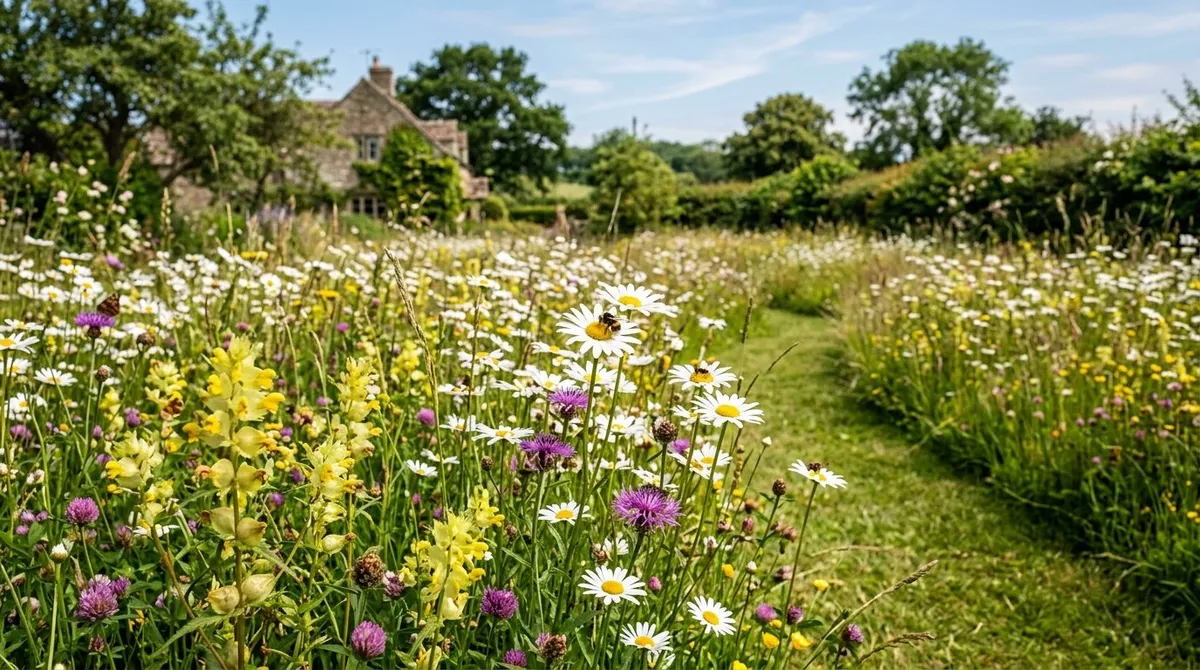
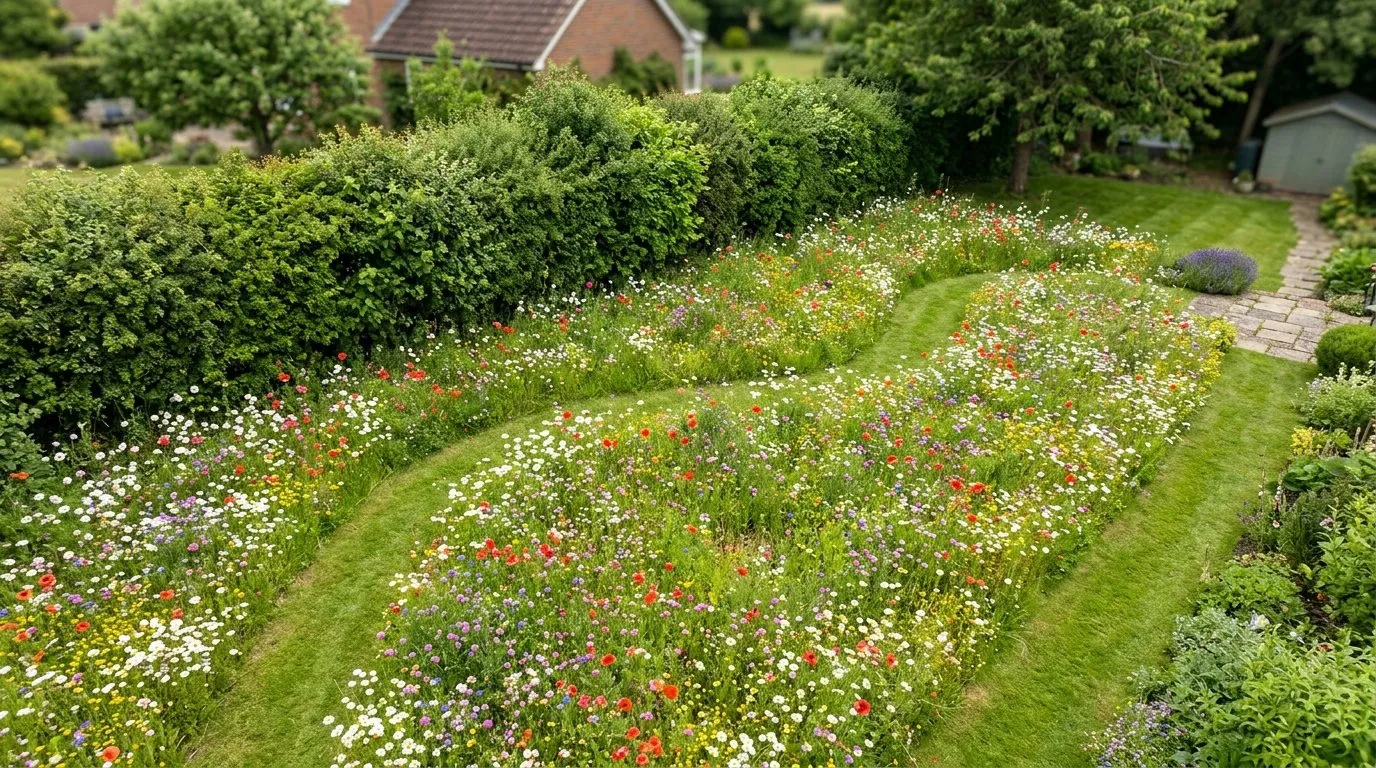 A 50m² meadow with mown grass paths through it. Paths give access for the annual cut and frame the meadow visually — and they stay short while the surrounding meadow grows for the wildlife.
Sources: Plantlife — meadow making | Magnificent Meadows Partnership
Our team produces practical UK gardening guidance from source research, contributor records and established horticultural practice. Editorial standards are overseen by Matt W.