Key takeaways
- Cut once a year between mid-July and mid-September at 8cm height, never lower
- August beats June in 4 years out of 5 because earlier cuts remove unset seed and set back yellow rattle
- A brushcutter with a 3-tooth metal blade clears 60 sq m in 45 minutes, a scythe takes 90 minutes but leaves cleaner regrowth
- Leave arisings on the surface for 5-7 days to drop seed, then rake off within 10 days or risk smothering regrowth
- Year-1 meadows need 3-4 short cuts at 5cm to suppress annual weeds, not the single late-summer cut used on established meadows
- Skip the cut entirely and grass cover doubles in 2 years, wildflower count halves by year 3
This guide covers the cut window, the August versus June question, tool choice (scythe versus brushcutter versus strimmer versus flail versus rotary), the rake-and-remove technique, year-1 versus established meadow regimes, recovery from a missed cut, and a month-by-month calendar. All from a 60 square metre meadow on heavy Staffordshire clay running since 2022. If you have not yet built your meadow, start with our companion guide on how to make a wildflower meadow from a lawn which covers establishment.
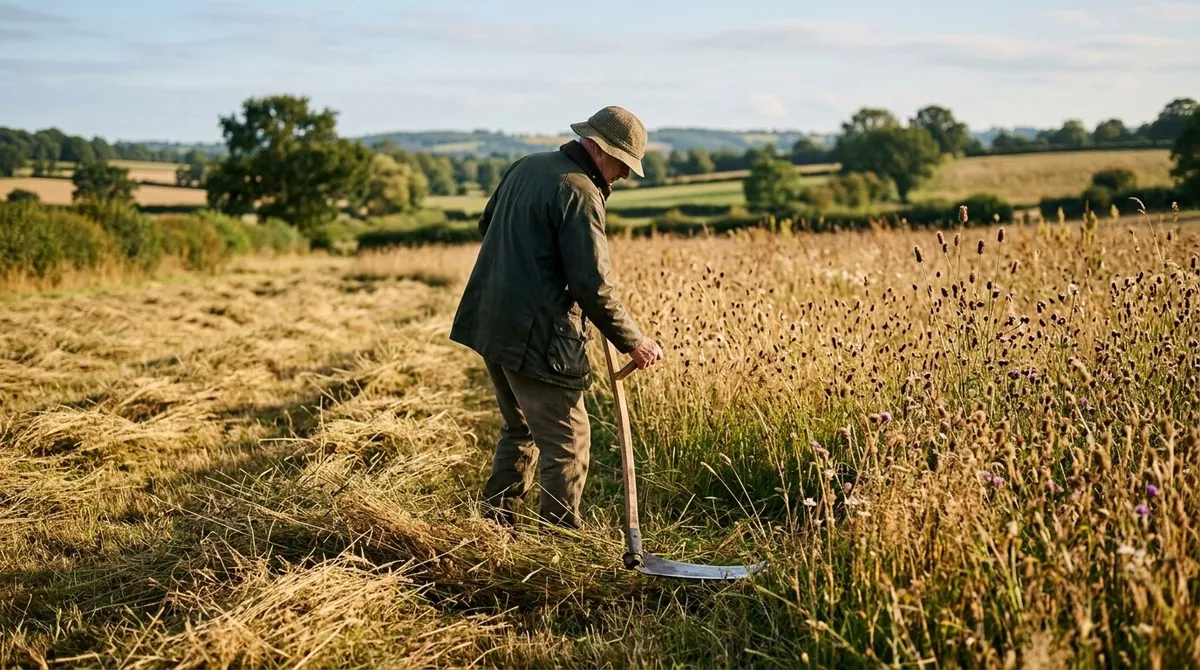
 A 60 square metre Staffordshire meadow in mid-cut, 18 August. Yellow rattle has dropped seed, knapweed seed heads have set, and the brushcutter is leaving 8cm stubble. The arisings will sit for 6 days then be raked off.
When should you cut a wildflower meadow in the UK?
Cut a UK wildflower meadow once a year between mid-July and mid-September. The exact week within that window matters more than most people realise. The right week aligns with three biological events on your specific plot: yellow rattle dropping seed, your main wildflower species setting seed, and the meadow being dry enough to handle a sustained cut without flattening the regrowth.
For most UK gardens with established yellow rattle, the safest single date is the third week of August. Yellow rattle has dropped by then, knapweed and field scabious are setting, and the soil is firm enough to walk on without compacting. The window stretches earlier in southern counties (Devon, Hampshire, Sussex) where the season runs 10-14 days ahead, and later in Scotland and northern England where it can run 14 days behind.
Cutting earlier than mid-July almost always loses yellow rattle. The seeds need to swell and dry inside the inflated calyx, then drop or be shaken free. A cut on 28 June removes most of the rattle before the seed sets. Cutting later than mid-September runs into the autumn weather window where wet stems flatten under their own weight and dry days for raking become rare.
The “ear test” for cut timing
Walk the meadow and shake a handful of yellow rattle stems. If you hear seeds rattling in the dry calyx, it is time to cut. If the calyx is still green and inflated but silent, wait two weeks. This is the most reliable single indicator across UK conditions.
Why August beats June (most years)
The “cut in late June after the spring flowering” advice has been doing the rounds online for at least 15 years. It is not entirely wrong, but it applies to a specific kind of meadow that very few garden owners actually have. For a typical UK garden meadow built on a former lawn, August is correct.
The June cut is for traditional hay meadows managed for livestock fodder, where the priority is high-protein grass cut before it sets seed and the wildflowers are a secondary concern. These meadows have been cut on the same date for centuries, the yellow rattle has adapted to set seed earlier, and the cuts are mechanical with horse-drawn or tractor mowers that can handle 5 acres in a morning.
The August cut is for wildlife and species-rich gardens. It lets yellow rattle drop seed (typically late July to mid-August in central England), allows knapweed and field scabious to set, and gives ground-nesting bumblebee colonies time to mature. Plantlife and the Magnificent Meadows Partnership both recommend July-September as the cut window for wildlife meadows.
The collapse of yellow rattle after the June 2022 cut took two years to recover. The August cuts maintained the population without intervention. Bumblebee species count tracked the same pattern because rattle suppresses grass and opens the floral structure that supports late-summer foragers.
When the June cut is correct
There is one scenario where late June is the right cut: a year-1 meadow with no yellow rattle established and dominated by coarse grasses. The June cut here is a fertility-stripping tool, removing nitrogen-rich grass before it sets seed. Once rattle establishes (year 2 or 3), switch to August.
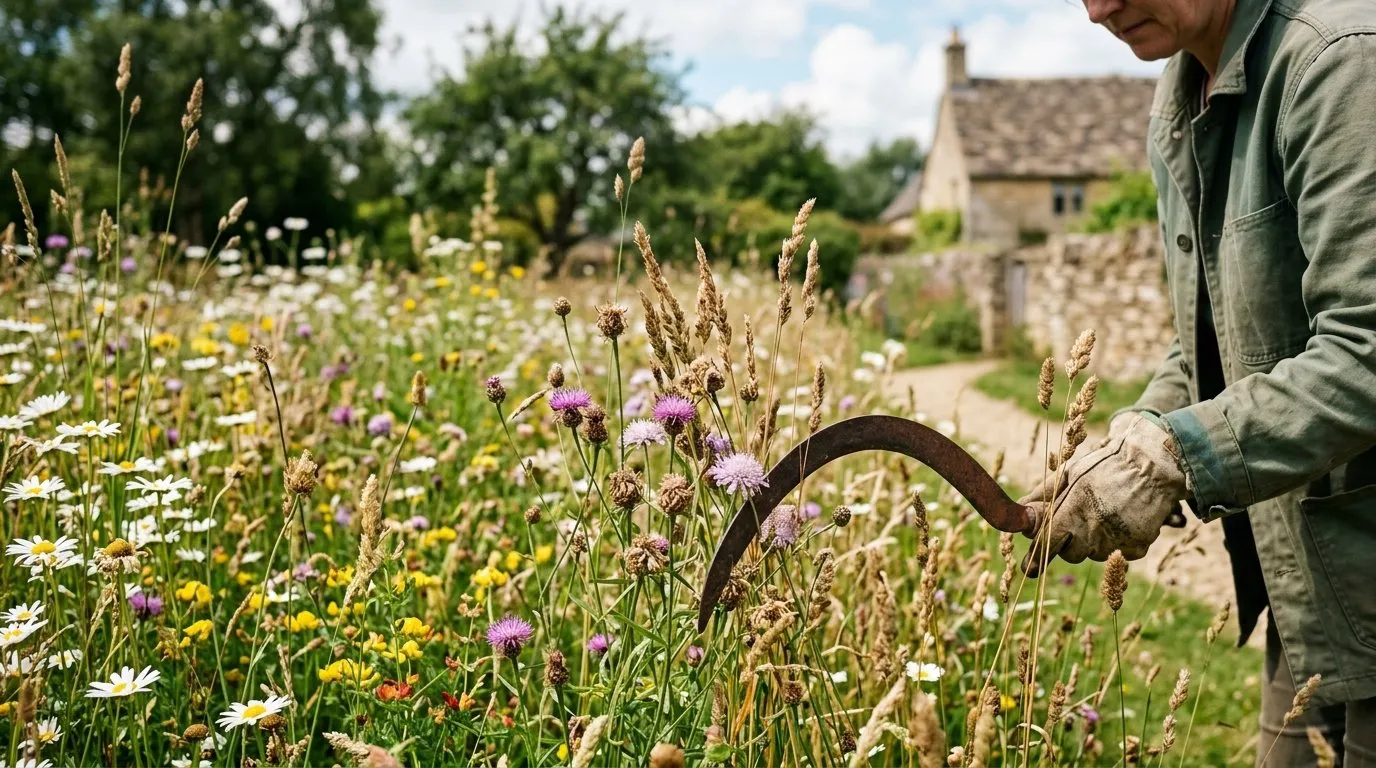
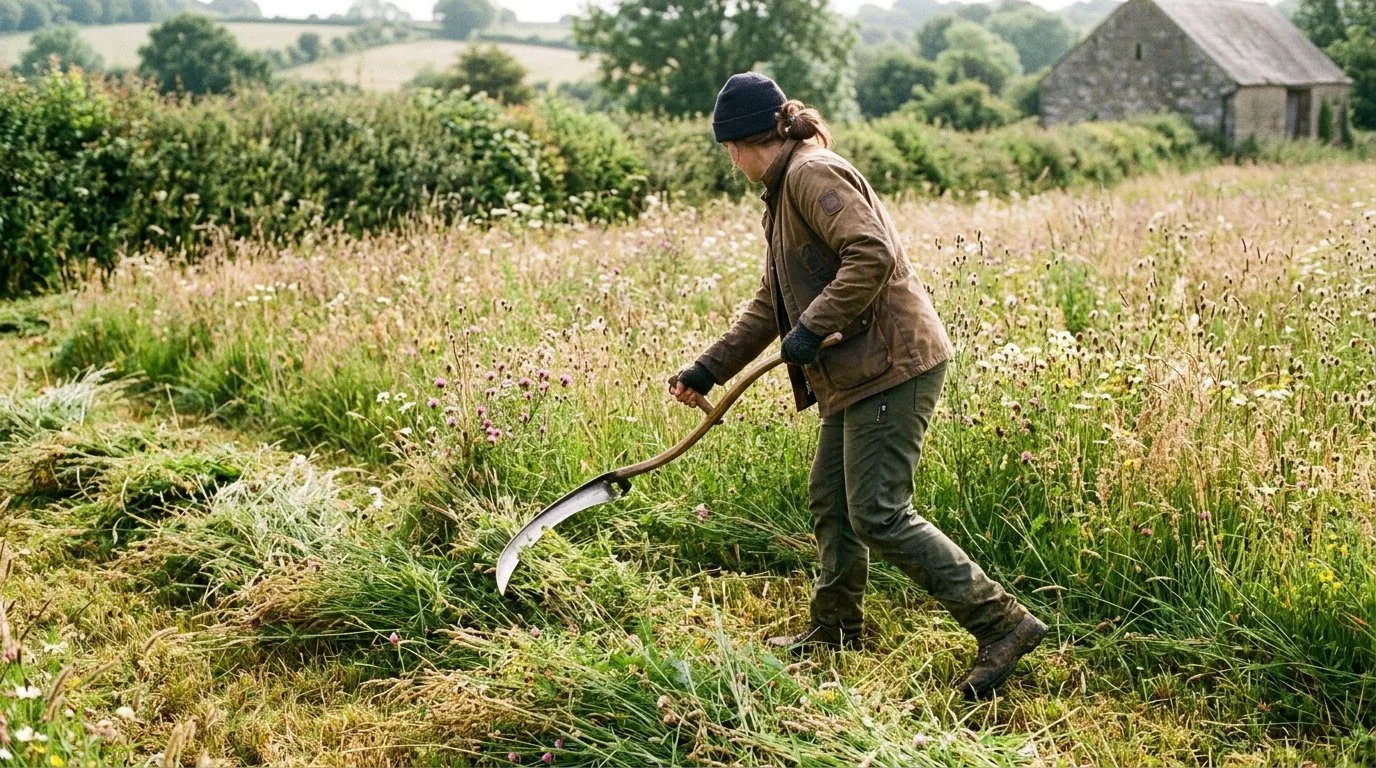 A traditional Austrian scythe in mid-swing. Scything is silent, kinder to ground-nesting wildlife, and leaves the cleanest regrowth. The trade-off is time: 90 minutes for 60 square metres versus 45 minutes with a brushcutter.
Tool comparison: scythe vs brushcutter vs strimmer vs flail vs rotary
No single tool is right for every meadow. The choice depends on size, ground condition, your physical fitness, and how much noise the neighbours will tolerate. Below is the ranked comparison from 4 years of running each tool through the same Staffordshire meadow.
| Tool | Effectiveness | Cut quality | Speed (60m²) | Noise | Cost (UK 2026) | Role |
|---|---|---|---|---|---|---|
| Scythe (Austrian) | 95% | Cleanest, no chopping | 90 min | Silent | £140-£220 (snath + blade) | Gold standard for wildlife meadows |
| Brushcutter (3-tooth blade) | 90% | Good, slight chop | 45 min | 95dB | £180-£500 petrol | Best practical choice for most gardens |
| Strimmer (nylon cord) | 60% | Poor, plastic shed | 70 min | 92dB | £80-£200 petrol/battery | Light growth only, last resort |
| Pedestrian flail mower | 95% | Chops fine, ideal | 30 min | 90dB | £900+ purchase, £80/day hire | Large meadows, 200m²+ |
| Rotary lawnmower (high) | 40% | Scalps and smothers | 60 min | 88dB | Already own | Avoid if possible, only on light grass |
The brushcutter with a 3-tooth metal blade is the practical winner for most UK gardens between 30 and 200 square metres. The scythe is technically superior on every metric except speed and learning curve. Below 30 square metres the time difference disappears and the scythe becomes the obvious choice.
The brushcutter has one weakness compared to a scythe: it chops stems into shorter fragments, which makes raking arisings slightly harder and means seed dispersal is less even. For a small meadow (under 30 square metres) the scythe is worth the extra time. Above that, the brushcutter is the right answer.
Scything: silent, slow, satisfying
A traditional Austrian scythe (lightweight curved snath, replaceable blade) is the gold standard for wildlife meadows. The cut is clean, ground-nesting birds and insects have time to escape the slow blade, and there is no engine noise. Suppliers in the UK: The Scythe Shop (Somerset), Simon Fairlie’s Scythe Association of Britain, and Schroeckenfux (Austrian manufacturer, sold via UK dealers).
The catch is the learning curve. A new scyther takes 4-5 hours of practice before the technique flows. The blade needs peening (cold-shaping the edge with a hammer) every 4-5 hours of cutting and honing every 5 minutes during work. For a single garden meadow it is worth learning. For someone planning to use it once a year, the brushcutter route is more pragmatic.
Strimmers: not really meadow tools
Most domestic strimmers use nylon cord. The cord shreds rather than slices, struggles with anything over 6mm, and sheds microplastic into the meadow. If you already own a strimmer, you can usually replace the trimmer head with a 3-tooth blade attachment (check the gearbox supports it) and convert it to a brushcutter. Without that conversion, a strimmer is a poor meadow tool.
Flail mowers: for the larger meadow
A pedestrian flail mower chops the cut into fine fragments, leaves an even stubble, and clears 200 square metres in an hour. They are too expensive for most gardens (£900+ to buy) but UK plant hire firms (Speedy Hire, HSS, Brandon Hire Station) rent them at £60-£100 a day. Worth the cost on meadows above 200 square metres or where the cut is being done as a one-off rescue.
Rotary mowers: avoid
A rotary lawnmower at full depth scalps a meadow at 25-40mm. That kills perennial wildflower rosettes and stresses slow-growing grasses. Some petrol mowers can be raised to 80mm but the cut quality on tall growth is poor and the discharge clogs constantly. Use a rotary mower only on light spring growth in a year-1 meadow, never on the main August cut.
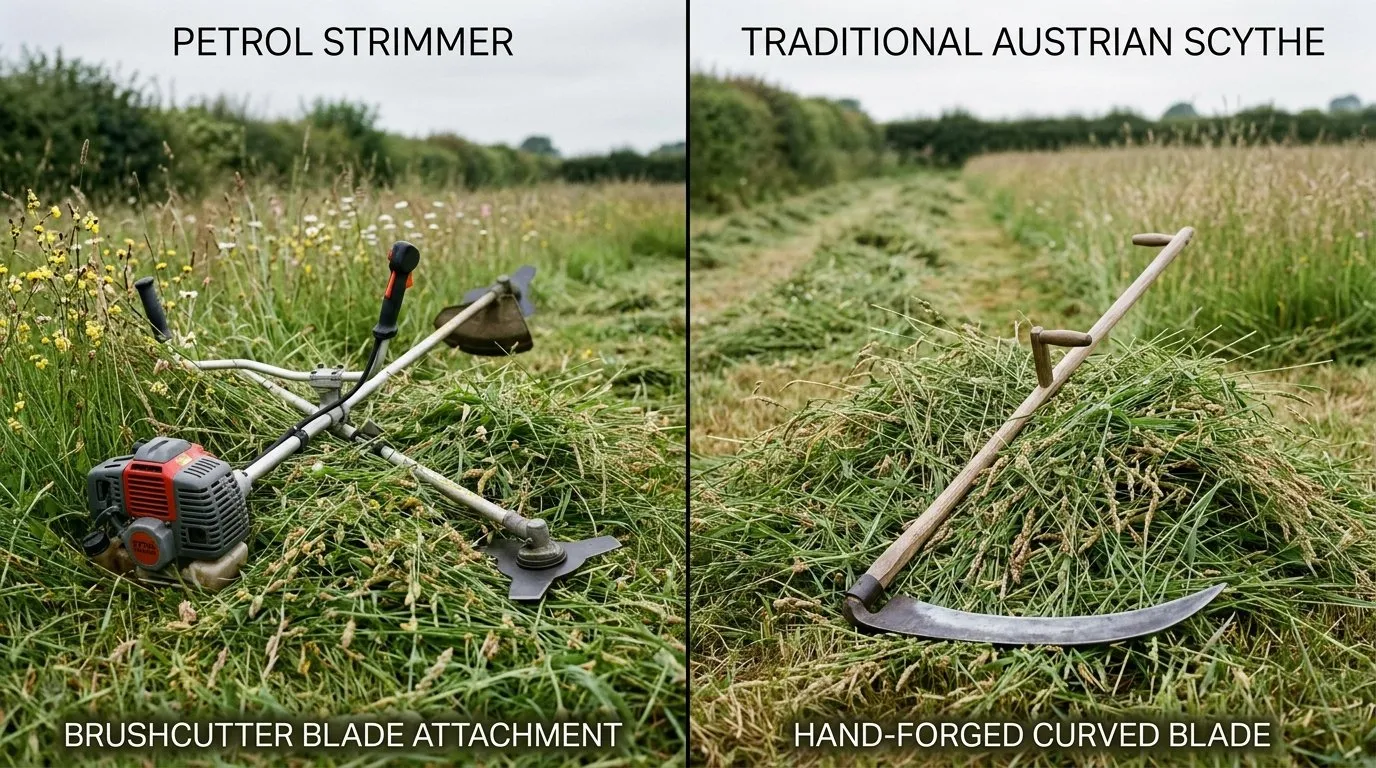 Brushcutter (left) and Austrian scythe (right) after the 2025 August cut. The brushcutter is faster, the scythe is kinder to ground-nesting invertebrates. Both clear stems heavier than nylon cord can handle.
How to cut a wildflower meadow: the technique
Step 1 - Time the cut
Walk the meadow in mid-August. Shake yellow rattle stems for the seed-rattle test. Check knapweed and field scabious seed heads (papery and brown means set, green means wait). Pick a dry day with no rain forecast for 48 hours.
Step 2 - Set the cutting height to 8cm
Mark the height on the brushcutter shaft or scythe blade with masking tape so you can keep it consistent. Aim for 8cm above the soil. Anything lower kills the rosette growth that drives next year’s display.
Step 3 - Cut in strips
Work in 1-1.5m wide strips so you can step over the cut and not trample the windrow. With a brushcutter, swing in slow side-to-side arcs, working backwards. With a scythe, swing left to right with the blade angled into the cut, stepping forward between swings.
Step 4 - Leave arisings for 5-7 days
The cut grass and seed heads need time to drop seed back into the meadow. Leave the windrows on the surface for 5-7 days in dry weather. If rain is forecast, rake off after 3-4 days because wet arisings start to mat and rot.
Step 5 - Rake off completely
Use a wooden hay rake or a heavy spring-tine rake. Pull the arisings into piles and remove. Council green waste, a hot compost heap, or burning are all valid. Never compost cold and never spread back as mulch on the same meadow. Removing the arisings is the entire point of the cut: it strips fertility, which is the master variable that decides whether grass or wildflowers dominate.
Step 6 - Rake debris off within 10 days
If arisings sit longer than 10 days they begin to mat, smother regrowth, and re-fertilise the soil as they break down. The 5-7 day target gives you a 3-day buffer. Past 10 days you start to lose the benefit of the cut.
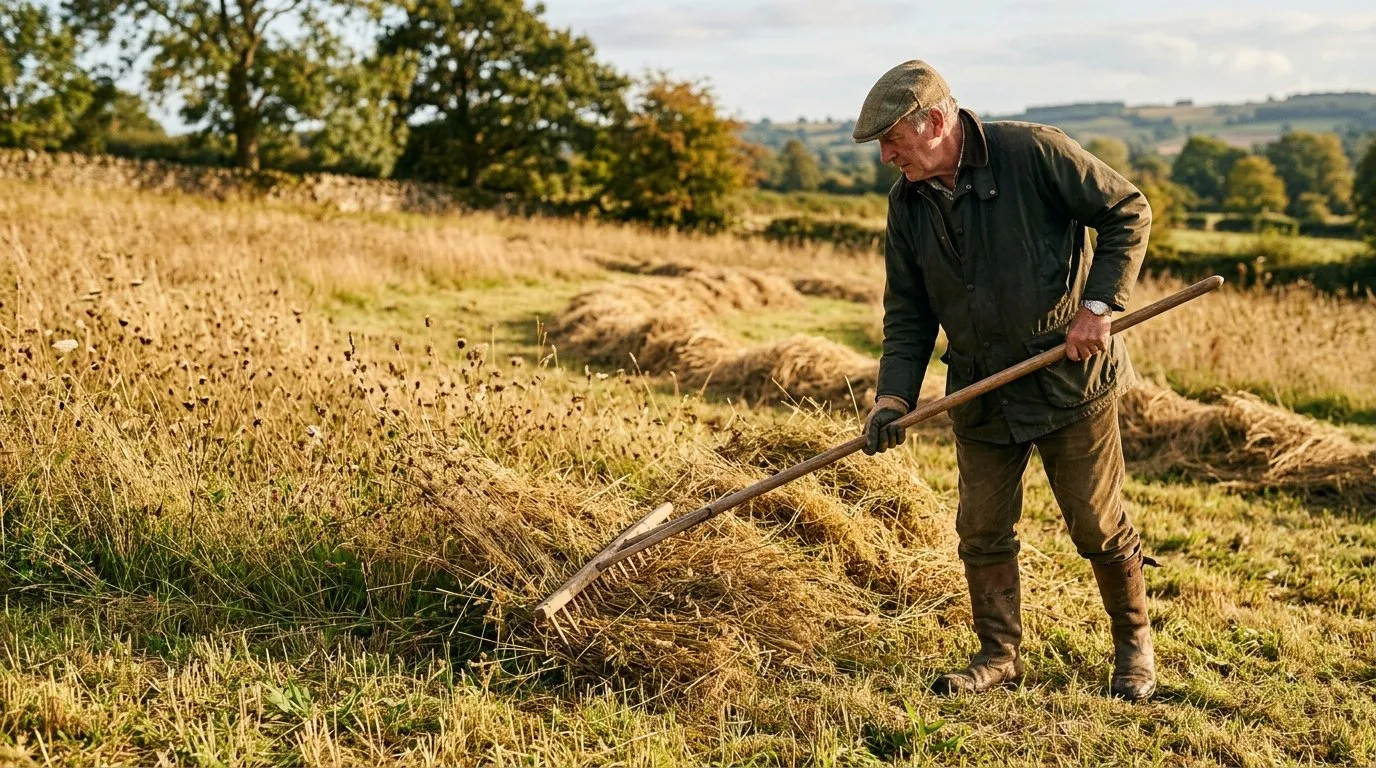 Raking arisings off after 6 days drying. Leaving the cut on the meadow longer than 10 days starts to mat and smother regrowth. The pile goes to council green waste, never back as mulch.
Year-1 cutting versus established meadow management
A year-1 meadow needs the opposite regime to an established one. Most meadow failures come from someone applying the once-a-year August cut to a year-1 plot, where it lets annual weeds set seed and crowds out perennial wildflower rosettes that have not yet established.
Year 1: the establishment regime
In the first growing season after sowing, the meadow is dominated by:
- Cornfield annuals from the seed mix (cornflower, corn marigold, corn poppy, corn cockle)
- Disturbed-soil weeds (fat hen, groundsel, chickweed, redshank)
- Perennial wildflower rosettes sitting low and out of sight
- Yellow rattle seedlings germinating in spring after winter stratification
The annuals will flower and die in year 1. The disturbed-soil weeds will set seed if left. The rosettes need light at ground level. The right regime is short, frequent cuts.
Year 1 cutting schedule:
| Cut | Approximate date | Height | Why |
|---|---|---|---|
| First cut | Mid-May | 5cm | Knock back annual weeds before seed set |
| Second cut | Late June | 5cm | Stop fat hen and groundsel seeding |
| Third cut | Mid-August | 8cm | Switch to standard cut, allow rattle to drop seed |
| Fourth cut (optional) | Mid-October | 8cm | Tidy for winter, only if growth is heavy |
Always rake off and remove every cut. The point is fertility reduction plus annual weed suppression while perennial rosettes establish underneath. From year 2 onwards, switch to the single August cut.
Established meadow: the maintenance regime
From year 2 onwards (or year 3 on heavy clay), the meadow has:
- A perennial wildflower matrix (ox-eye daisy, knapweed, ribwort plantain, self-heal, bird’s-foot trefoil)
- Established yellow rattle that self-seeds
- Native fine grasses (sheep’s fescue, common bent, crested dog’s-tail)
- Dropping coarse grass cover under rattle pressure
The single August cut at 8cm is the correct regime. Add a short October second cut only if regrowth has run away, which usually means soil fertility is still falling and the meadow is in transition.
Common cutting mistakes and how to fix them
Mistake 1: cutting too early
The most common error. A cut in late June or early July removes yellow rattle seed before it sets. Two consecutive early cuts can wipe rattle out completely. Fix: wait until the rattle rattle test passes (mid-August in most UK gardens). If rattle is already lost, re-sow in early September at 3g per square metre.
Mistake 2: cutting too short
A rotary mower at 25mm scalps the meadow. Perennial rosettes (self-heal, plantain) lose their crown growth and slow-growing grasses are killed. Fix: cut at 8cm, never lower. If you have already scalped, re-seed bare patches in September with the original mix.
Mistake 3: leaving arisings
Mulch-mowing the cut back into the meadow returns nitrogen and feeds grass at the expense of wildflowers. Within 2 seasons, grass cover doubles and wildflower count halves. Fix: rake off every cut within 10 days. No exceptions.
Mistake 4: cutting in wet weather
A wet cut compacts the soil, leaves slimy arisings that smother regrowth, and stresses the underlying rosettes. Fix: wait for 48 hours of dry forecast. If the August window slips into wet weather, push to early September. Cutting late beats cutting wet.
Mistake 5: skipping the cut
Skipping a single year usually has no lasting effect. Two consecutive missed cuts double grass cover and start to lose wildflower diversity. Three consecutive missed cuts revert the meadow to rough grass. Fix: if you missed August, cut in October. If you missed two years, cut in late February as a reset, then cut again in August the same year.
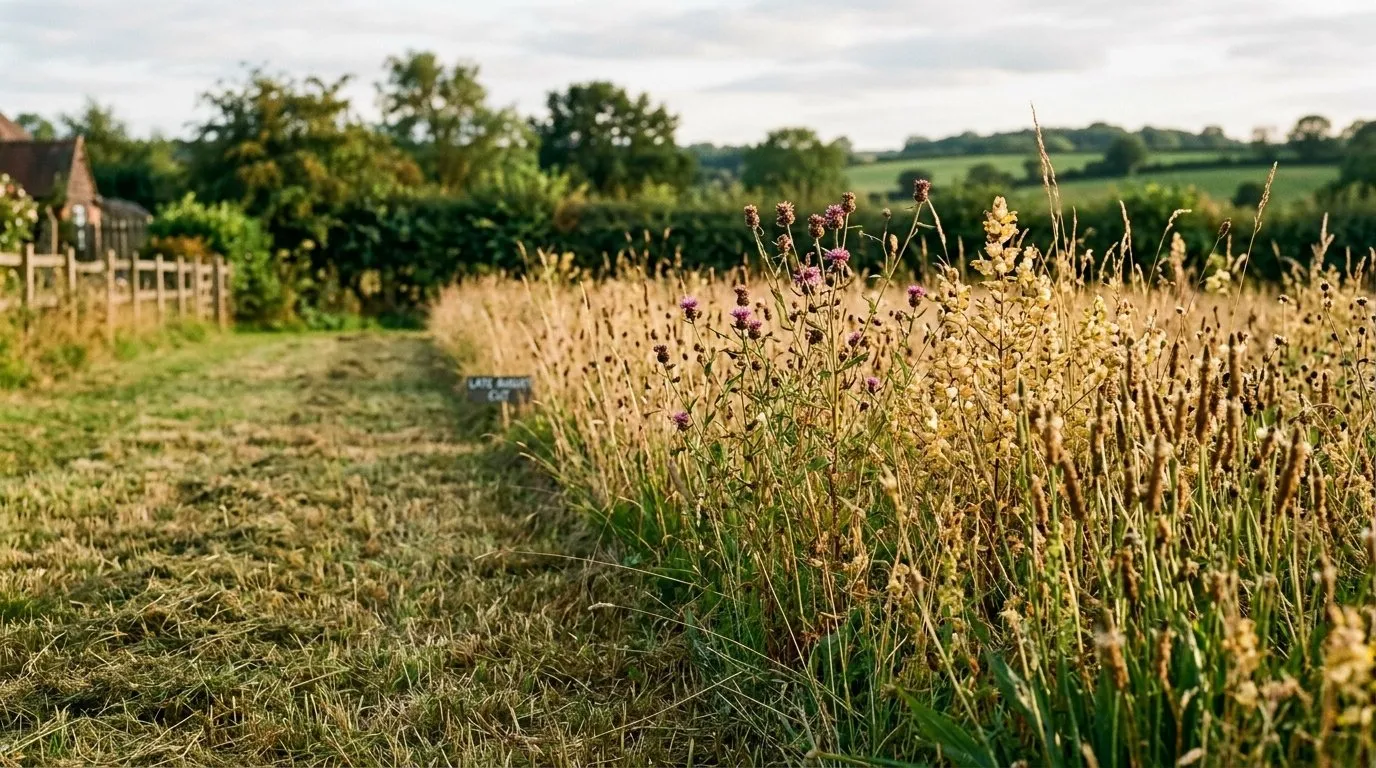 The right cut window. Half of the meadow cut on 18 August at 8cm stubble, half still standing with yellow rattle, knapweed, and ribwort plantain seed heads ripe and ready. The standing half will be cut after the windrow on the left has been raked off.
Wildflower meadow cutting calendar
The full annual cycle. Times are for central England. Adjust 7-14 days earlier in southern counties and 7-14 days later in Scotland and northern England.
| Month | Task | Established meadow | Year-1 meadow |
|---|---|---|---|
| January | Plan additions, order plug plants and yellow rattle for autumn | None | None |
| February | Optional reset cut at 8cm if regrowth is heavy from a missed year | None unless reset needed | None |
| March | Plant wildflower plugs into bare patches | 1-2 hours plug planting | Plug planting if filling gaps |
| April | First flowers (cuckoo flower, primrose, bugle). Hand-pull docks before they seed | 30 min weeding | None |
| May | Yellow rattle in flower. Knapweed and ox-eye daisy emerging | None | First cut at 5cm, rake off |
| June | Peak flowering. Photograph for records. Note bare patches to fill in autumn | None | Second cut at 5cm if weeds heavy |
| Mid-July | Yellow rattle starts to drop seed. Begin the rattle test on dry stems | None | Watch for rattle |
| Late July - mid-August | Main cut window opens for early sites (Devon, Hampshire) | Cut if rattle has set in southern counties | Third cut, switch to 8cm height |
| Mid-August - early September | Main cut window for central and northern England | Annual cut at 8cm, rake after 5-7 days | Standard August cut |
| Mid-September | Sow yellow rattle. Re-seed bare patches with the original wildflower mix | Yellow rattle sowing only | Yellow rattle sowing if not already |
| October | Optional short tidy cut at 8cm. Plant autumn plugs | Optional second cut | Optional fourth cut at 8cm |
| November | Leave standing for wildlife shelter and seed heads for finches | None | None |
| December | Standing seed heads provide winter food for goldfinches and linnets | None | None |
Total annual time on a 60 square metre meadow: 8-12 hours including plug planting, weeding, the cut, and raking. A standard fertilised lawn the same size needs 25-30 hours of mowing per year.
Recovering from a missed cut
A meadow left uncut for one year is still a meadow. A meadow left uncut for two years is a meadow in trouble. Three years and it is rough grass with a few wildflower survivors.
After one missed year
Cut in late October at 8cm. Rake off. Continue the standard August cut next year. Yellow rattle may be reduced because seed has not been freed from the calyx, so re-sow at 1g per square metre in early September.
After two missed years
The grass matrix has thickened and wildflower rosettes are shaded out. Cut in late February before regrowth starts, at 5cm rather than 8cm. Rake off thoroughly. Cut again in mid-July at 5cm. Rake off. Re-sow yellow rattle in early September at 3g per square metre. Resume the standard August cut from year 3.
After three or more missed years
Treat as a lapsed meadow needing reset. Strip the top 30mm of vegetation and thatch in March. Re-prepare the seedbed (scarify, expose 50% bare soil, roll). Re-sow yellow rattle and the wildflower mix in September. The underlying species seed bank usually returns faster than starting from scratch.
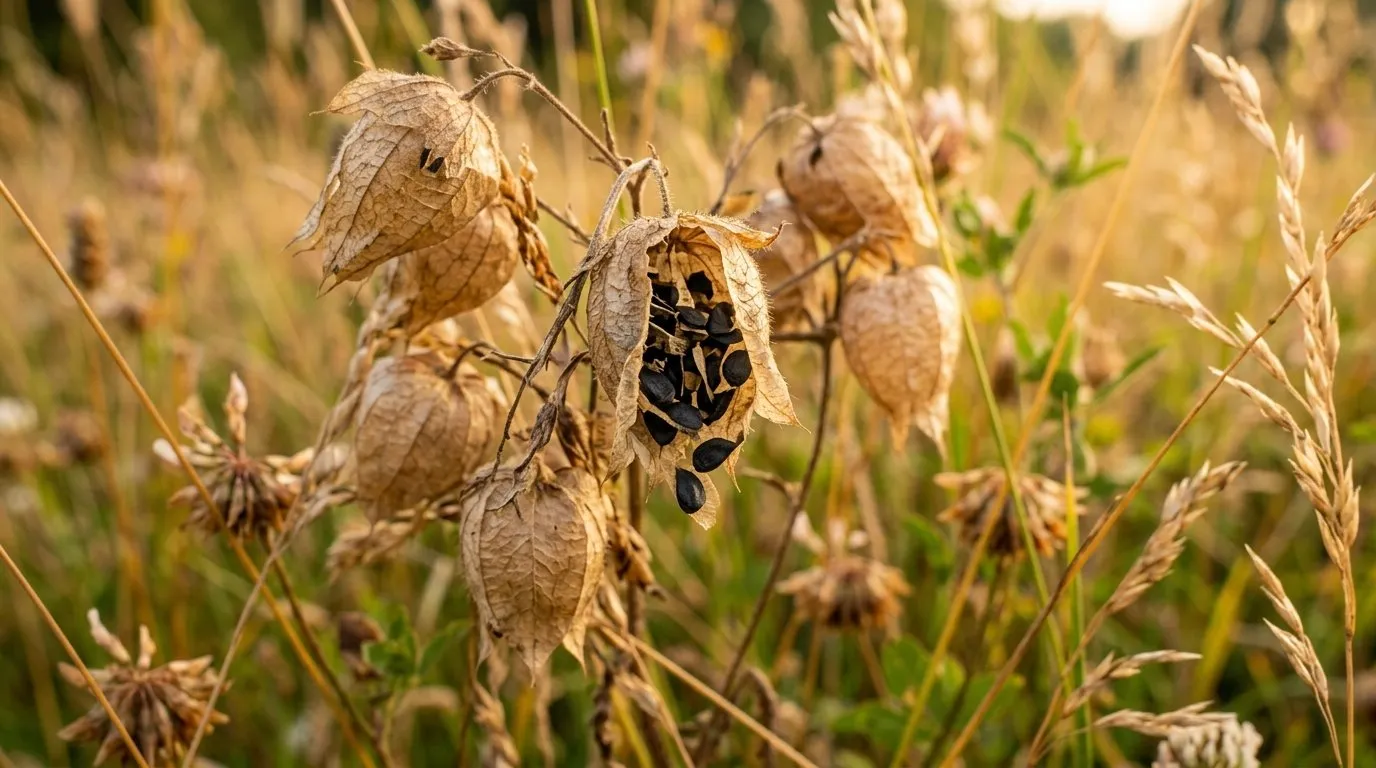 Yellow rattle seed heads on 28 July. The papery inflated calyx is brown and dry, the black seeds inside rattle audibly when shaken. This is the signal to cut within 14 days.
Wildlife considerations during the cut
A meadow cut is a major disturbance for everything living in it. The species below benefit from specific timing and technique adjustments. The Bumblebee Conservation Trust publishes detailed guidance on managing meadows for pollinators which aligns with the timings here.
Ground-nesting bumblebees
Several UK bumblebee species (Bombus pratorum, Bombus lapidarius, Bombus pascuorum) nest in meadow tussocks at ground level. A late August cut allows colonies to mature and produce next year’s queens before disturbance. A June cut destroys mid-season colonies. Adjustment: if you must cut earlier, leave a 1-2 metre uncut margin around any visible nest hole.
Slow worms and grass snakes
Slow worms and grass snakes shelter in tussocks and warm under cut grass. A scythe gives them time to move. A brushcutter at full speed does not. Adjustment: walk the meadow once before cutting to flush reptiles. Cut in the early morning when temperatures are below 14C and reptiles are sluggish enough to move predictably away.
Ground-nesting birds
Skylarks, meadow pipits, and yellowhammers nest in meadows from April to July. The August cut window avoids active nests in most years. Adjustment: never cut between mid-April and mid-July if the meadow is large enough to host a nest (over 200 square metres). On smaller plots, ground-nesting birds rarely use the meadow because they need open sightlines.
Invertebrates broadly
Leaving a 10-20% uncut margin in the corners or along one edge gives invertebrates a refuge. Rotate the uncut area each year so the entire meadow gets cut on a 5-year cycle. This is standard practice in conservation-grade meadow management. Uncut margins also let late umbellifers such as wild carrot stand into autumn, when their concave seedheads shelter overwintering insects.
Choosing the right tool for your meadow size
| Meadow size | Recommended tool | Backup option | Time per cut |
|---|---|---|---|
| Under 20m² | Hand shears or a small scythe | Powered hedge trimmer at 8cm | 30-60 min |
| 20-100m² | Brushcutter with 3-tooth blade | Austrian scythe | 30-90 min |
| 100-300m² | Brushcutter with 3-tooth blade | Hired pedestrian flail | 1-2 hours |
| Over 300m² | Pedestrian flail mower (own or hire) | Brushcutter with multiple battery sets | 2-4 hours |
For most UK gardens, the meadow falls into the 20-100 square metre range and the brushcutter answer holds. Above 300 square metres, the time investment for hand tools becomes impractical and a flail mower (purchased or hired) becomes the right answer.
Where to source UK meadow tools and seed
Reliable UK suppliers for meadow management:
- The Scythe Shop (Somerset) - Austrian scythes, blades, peening kits, training courses
- Simon Fairlie / Scythe Association of Britain - traditional scythes and instruction
- Stihl UK dealers - brushcutters, blades, parts (Forest Garden Machinery, Mowdirect)
- Speedy Hire / HSS / Brandon Hire - flail mower hire from £60-£100 per day
- Emorsgate Seeds - native UK provenance yellow rattle and meadow mixes
- Habitat Aid - yellow rattle by soil type, plug plants
- Naturescape - wildflower plugs and seed
Avoid generic “wildflower mix” packets from supermarkets and DIY chains. They often include non-native species and rarely contain yellow rattle.
Frequently asked questions
When should I cut my wildflower meadow in the UK?
Cut a UK wildflower meadow between mid-July and mid-September. Late August is the safest single date for most gardens. Wait until yellow rattle has dropped seed (you can hear the seeds rattle in the dry calyx). Cut at 8cm height. Leave arisings for 5-7 days, then rake off completely. Cutting earlier than mid-July risks removing unset seed.
Should I cut my wildflower meadow in June or August?
August beats June in most UK gardens. Yellow rattle drops seed between late July and mid-August, so a June cut removes the next generation. The only reason to cut in late June is to strip fertility from a year-1 meadow that lacks rattle and is dominated by coarse grasses. For an established meadow with rattle, August is correct.
How short should I cut a wildflower meadow?
Cut at 8cm height, never lower than 5cm. Cutting too short kills perennial wildflower rosettes (self-heal, ribwort plantain, bird’s-foot trefoil) and damages slow-growing grasses. A rotary lawnmower at full depth scalps the meadow. A brushcutter or scythe set 8cm above the soil leaves enough rosette and basal foliage for next year.
Do I need to remove the cut grass from a wildflower meadow?
Yes, every clipping must leave the meadow within 10 days. Leaving arisings to compost back returns nitrogen and phosphorus, which feeds grass at the expense of wildflowers. Leave the cut on the surface for 5-7 days so seed drops, then rake or fork off into windrows and remove. Council green waste or a hot compost heap both work.
What is the best tool for cutting a wildflower meadow?
A petrol brushcutter with a 3-tooth metal blade is the practical choice for most UK gardens. It clears 60 square metres in 45 minutes and handles tough stems a strimmer cord cannot. A scythe leaves cleaner regrowth and is silent but takes twice as long and needs sharpening every 5 minutes. Avoid rotary lawnmowers, which scalp at full depth.
Can I use a strimmer on a wildflower meadow?
A strimmer with nylon cord works on light meadow growth but struggles with thick stems and sheds plastic into the meadow. A brushcutter (same machine, metal blade attachment) is far more effective. If you only own a strimmer, set it high (8cm), work in short passes, and replace the cord head with a 3-tooth metal blade before the cut.
How do I look after a year-1 wildflower meadow?
A year-1 meadow needs 3-4 short cuts at 5cm height between April and September to suppress annual weeds. This is the opposite regime to an established meadow. The cuts knock back fat hen, groundsel, and chickweed while perennial wildflower rosettes sit below the blade. Switch to the standard once-a-year August cut from year 2 onwards.
What happens if I miss the wildflower meadow cut?
Skipping a single year usually has no lasting effect, but two consecutive missed cuts double grass cover. Coarse grasses (cock’s-foot, false oat-grass) take over and shade out wildflower rosettes. If you miss the August window, cut in October before stems collapse. If you miss two years, cut in late February the third year and treat as a reset.
Now you know when to cut your meadow, see our companion guide on how to make a wildflower meadow from a lawn for establishment, no mow May lawns for the spring approach, and bumble bee species of the UK to identify the pollinators your meadow now supports.
Sources: Plantlife - meadow management | Magnificent Meadows Partnership | Bumblebee Conservation Trust
Our team produces practical UK gardening guidance from source research, contributor records and established horticultural practice. Editorial standards are overseen by Matt W.