Key takeaways
- No licence is needed to keep bees in the UK, but all hives must be registered free on BeeBase (National Bee Unit)
- Startup costs for one hive with full equipment range from £500 to £800 including bees
- National hive is the UK standard, used by 80% of beekeepers, with the widest parts and equipment availability
- First-year colonies rarely produce surplus honey — expect your first meaningful harvest in year two
- Varroa destructor mite must be treated every August or the colony will die within 2-3 years
- BBKA local association membership provides a mentor, which is the single most valuable resource for beginners
Beekeeping in the UK has surged in popularity over the past decade. The British Beekeepers’ Association (BBKA) now has over 30,000 members, and urban beekeeping in particular has grown rapidly. Keeping bees is legal everywhere in the UK with no licence required. A single hive in a suburban garden can produce 10-30kg of honey per year once established.
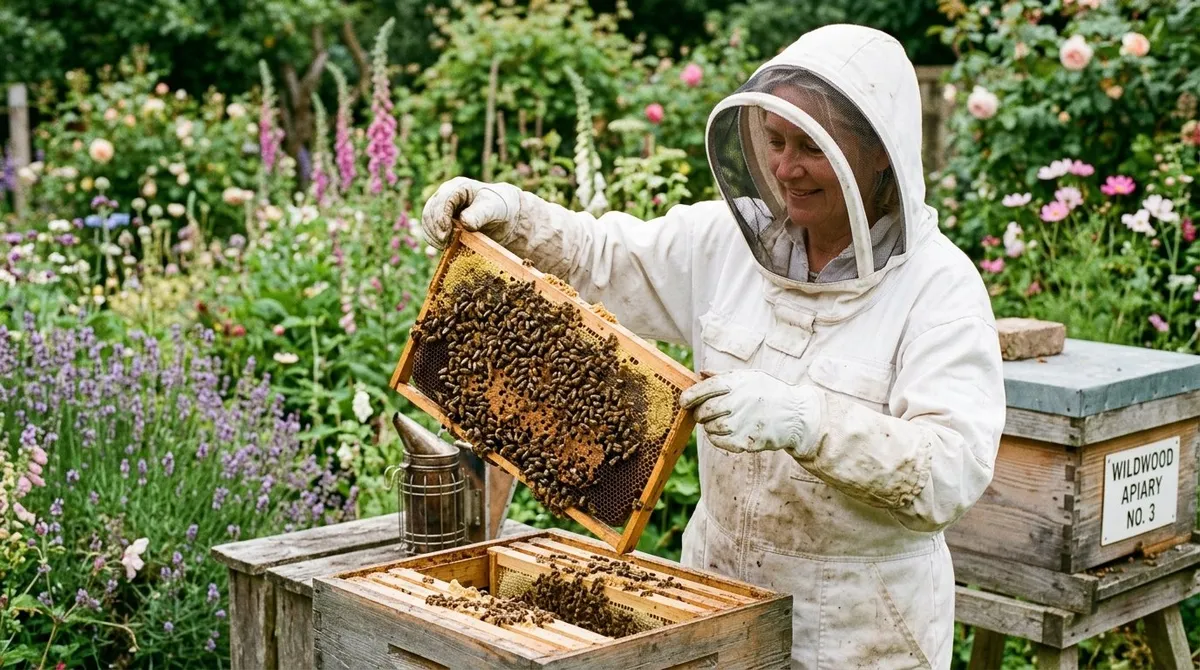
Starting costs are modest compared to many hobbies. A complete setup with one hive, a colony of bees, protective clothing, and tools costs £500-£800. The time commitment is manageable: weekly inspections of 15-20 minutes from April to August, plus occasional tasks through winter. But beekeeping demands consistent attention. A colony left unchecked for 3 weeks in May will almost certainly swarm.
Do I need permission or a licence to keep bees in the UK?
No licence, permit, or planning permission is required to keep honey bees anywhere in the UK. You can legally place a hive in your back garden, on a rooftop, on an allotment, or in a field without any formal authorisation.
You must register your hive location on BeeBase, the National Bee Unit’s free online database. Registration is mandatory and takes 10 minutes. It serves two purposes: it allows bee inspectors to notify you if a notifiable disease (American foulbrood or European foulbrood) is detected within 3km of your apiary, and it enables the NBU to map disease patterns nationally.
There are no legal restrictions on the number of hives you can keep. However, practical limits exist. A suburban garden typically supports 1-3 hives without nuisance issues. More than that increases the density of flight paths and the risk of neighbours being stung.
Check your property deeds and any lease or tenancy agreement. Some housing covenants prohibit keeping livestock or animals, which may include bees. Allotment tenancy agreements often mention bees specifically, some allow them, others do not.
There is no legal obligation to tell your neighbours, but it is strongly advisable. A 2-metre barrier (fence, hedge, or trellis) in front of the hive entrance forces bees to fly above head height immediately after leaving the hive. This single measure prevents most neighbour complaints.
How much does beekeeping cost to start?
A complete beginner setup costs £500-£800 for one hive, a colony of bees, protective clothing, and basic tools. Here is the breakdown:
| Item | Cost range | Notes |
|---|---|---|
| National hive (assembled) | £200-£350 | Cedar costs more but pine is identical functionally |
| Nucleus colony (5-frame nuc) | £150-£250 | Buy local, collected in person, May-June |
| Bee suit (full body) | £40-£80 | Ventilated suits are cooler but more expensive |
| Gloves (leather) | £10-£20 | Nitrile disposables preferred by experienced keepers |
| Smoker | £15-£30 | Stainless steel, medium size |
| Hive tool | £5-£10 | J-type is the most versatile |
| Bee brush | £5-£8 | Soft bristle, gentle on bees |
| Feeder (rapid type) | £10-£15 | For autumn feeding |
| Varroa treatment | £10-£25 | Annual cost for one hive |
| Total (one hive) | £445-£788 |
Annual running costs after the first year are modest: £50-£100 per hive for sugar syrup (autumn feeding), varroa treatment, replacement frames, and occasional repairs. A second hive adds £200-£350 for the hive body and £150-£250 for bees.
The most expensive mistake beginners make is buying premium cedar hives and unnecessary accessories before they know whether they enjoy beekeeping. Start with a basic pine National hive. It works identically to cedar and costs £100-£150 less.
Which hive type should a UK beginner choose?
The National hive is the clear choice for UK beginners. Used by roughly 80% of British beekeepers, it is the de facto standard. Parts are interchangeable between manufacturers. Your mentor will almost certainly use one. Second-hand National equipment is readily available.
Four hive types are common in the UK:
| Hive type | Internal volume | UK popularity | Cost (new) | Best for |
|---|---|---|---|---|
| National | 36 litres (brood box) | ~80% | £200-£350 | Beginners, most UK beekeepers |
| WBC | 36 litres (brood box) | ~5% | £350-£500 | Those wanting the classic look |
| Langstroth | 42 litres (brood box) | ~10% | £200-£350 | Commercial-scale beekeeping |
| Top Bar | Variable | ~3% | £100-£200 (DIY) | Natural beekeeping enthusiasts |
The National hive uses British Standard frames (14” x 8.5” brood). It is compact enough for a garden but large enough for productive colonies. A brood box plus one or two supers handles a typical UK colony through the season.
The WBC (William Broughton Carr) is the iconic double-walled hive with the classic pagoda shape. It uses the same internal frames as the National but costs significantly more due to the outer casing. The double wall provides better insulation, but a wrapped National achieves similar results at lower cost.
The Langstroth is the world standard and dominates commercial beekeeping globally. Its larger brood box suits prolific bee strains. UK parts availability has improved but is still behind the National. Some experienced keepers prefer Langstroth for honey production.
The Top Bar hive uses bars instead of frames, allowing bees to build natural comb without foundation. Honey harvesting destroys the comb, so yields are lower. It appeals to beekeepers focused on bee welfare over honey production.
Where should I put my beehive?
Position the hive with the entrance facing south or south-east, sheltered from prevailing wind, and with a clear flight path at least 3 metres long. Morning sun on the hive entrance gets bees flying earlier in the day, extending their foraging time.
Avoid placing hives directly next to paths, gates, or boundary fences where people pass regularly. Bees establish a flight path from the entrance and anything in that line gets buzzed. The 2-metre barrier rule is critical: a fence, hedge, or building in front of the entrance forces bees to rise above head height before crossing your garden.
In urban and suburban settings, a south-facing garden corner, screened by a trellis or fence, works well. On an allotment, position the hive with the entrance facing away from other plot holders’ working areas.
Provide a water source within 5 metres of the hive. Bees need water year-round for cooling the hive and diluting honey for larval food. A shallow tray with pebbles (so bees can land without drowning) works well. Without a nearby water source, bees will find their own, which often means a neighbour’s bird bath or paddling pool.
Access matters too. You need to stand behind or to the side of the hive during inspections. Leave at least 1 metre of clear space on the side you will work from. A firm, level base of paving slabs or concrete blocks keeps the hive stable and off damp ground.
What do I need to know about the beekeeping season?
The active season runs from April to August with weekly inspections. Outside this window, bees manage themselves and you should disturb them as little as possible.
Spring (March-April)
The colony rebuilds its population after winter. The queen increases her laying rate as days lengthen and temperatures rise. Check stores in early March, a light hive needs emergency feeding with fondant. Your first full inspection happens when daytime temperature consistently exceeds 14C, typically mid-April in the Midlands.
Swarm season (May-June)
This is the most demanding period. Strong colonies prepare to swarm by raising new queen cells. Inspect every 7 days without fail. If you see sealed queen cells and miss the date, the colony swarms within days and you lose half your bees. Swarm prevention requires understanding and is the main reason beginners need a mentor.
The BBKA publishes detailed swarm management guidance. Your local association will teach you the practical techniques during your first season.
Summer (July-August)
Honey flow peaks with summer wildflowers, garden plants, and any nearby crops like oilseed rape. Add supers as needed when the current super is 75% full. Honey is harvested from late July to mid-August in most UK regions.
Autumn (August-September)
After the honey harvest, treat for varroa mite immediately. Feed the colony with 2:1 sugar syrup (2kg sugar to 1 litre water) to replace the honey you removed. The colony needs 15-20kg of stored food to survive winter. Reduce the entrance to prevent robbing by wasps and other colonies.
Winter (October-March)
Leave the colony alone. Do not open the hive. Check the weight by hefting (lifting one side gently) monthly. A very light hive in January may need fondant placed directly above the cluster. Clear dead bees from the entrance after cold snaps. That is all.
Will I get honey in the first year?
Most first-year colonies from a nucleus produce little or no surplus honey. A nucleus colony arrives in May or June with 5 frames of bees and brood. The colony spends the first season building up its population, drawing out new comb on the remaining frames, and storing enough honey and pollen for winter.
Taking honey from a first-year colony is risky. The bees need approximately 15-20kg of stores to survive winter. A new colony may barely achieve this by autumn without supplementary feeding, let alone produce surplus for harvesting.
In our Staffordshire apiary, our first nuc (started June 2022) produced zero surplus honey in year one. We fed 8kg of sugar syrup in September to ensure adequate winter stores. In year two, the same colony produced 14kg of surplus honey from the same location. By year three, with the colony fully established, it produced 22kg.
Set your expectations accordingly. Beekeeping is a long-term pursuit. The reward comes in year two and beyond. Focus the first year on learning colony management, recognising healthy brood patterns, and building your confidence with inspections.
What diseases and pests affect UK honey bees?
Varroa destructor mite is the most serious threat to every UK honey bee colony. It arrived in the UK in 1992 and is now present in every hive. The mite feeds on bee brood and transmits deformed wing virus, chronic bee paralysis virus, and other pathogens. Untreated colonies die within 2-3 years.
Varroa mite management
Monitor varroa levels monthly using a drop board (mesh floor insert). Count the natural mite drop over 7 days. More than 1 mite per day in summer indicates a growing problem. More than 10 per day requires immediate treatment.
Treat with an approved varroacide in August after the honey harvest. Common treatments include Apiguard (thymol gel), MAQS (formic acid strips), and Apivar (amitraz strips). Follow the manufacturer’s instructions exactly. Treatment timing is critical, August treatment protects the winter bees that the colony depends on for survival.
Oxalic acid treatment in December or January targets mites on adult bees during the broodless winter period. It is applied as a trickle or vapour. This is a secondary treatment, not a replacement for the main August treatment.
Notifiable diseases
Two diseases are notifiable in the UK, meaning you must report them to the National Bee Unit:
- American foulbrood (AFB): Bacterial disease that kills larvae. Infected colonies must be destroyed by burning. Ropy, foul-smelling dead larvae in sealed cells are diagnostic.
- European foulbrood (EFB): Bacterial disease of younger larvae. Less severe than AFB. Some colonies can be treated with shook swarm. Twisted, discoloured larvae in open cells are the key sign.
Both are uncommon but serious. The NBU provides free inspections if you report suspected cases. BeeBase registration ensures you are alerted to nearby outbreaks.
| Disease/pest | Threat level | Symptoms | Action required |
|---|---|---|---|
| Varroa mite | Universal, every hive | Deformed wings, weakened colony | Treat August + December |
| American foulbrood | Rare but devastating | Ropy brown larvae, foul smell | Notifiable, destroy colony |
| European foulbrood | Uncommon | Twisted larvae, sour smell | Notifiable, may be treatable |
| Nosema | Common in spring | Dysentery on hive front | Replace old comb, good husbandry |
| Chalkbrood | Common, minor | White mummified larvae at entrance | Usually self-resolving |
| Wax moth | Moderate | Tunnels and webbing in stored comb | Store supers properly |
| Asian hornet | Emerging (south England) | Hawking at hive entrance | Report to NBU immediately |
Why should I join a local beekeeping association?
Joining your local BBKA branch before buying any equipment is the single most important step for a beginner beekeeper. The British Beekeepers’ Association has branches in every county. Membership typically costs £30-£50 per year and includes third-party liability insurance for beekeepers, access to a mentor, and regular meetings.
The mentoring programme is the most valuable benefit. Your assigned mentor will accompany you during your first season’s inspections, teach you to handle bees safely, identify diseases, and manage swarming. No book, video, or online course replaces having an experienced beekeeper standing beside you at the hive.
Most associations run beginner courses in January to March. A typical course is 6-8 sessions covering theory, followed by practical sessions at the association’s teaching apiary from April. The cost is usually £60-£120 and includes the BBKA beginner’s manual.
Local associations also provide a swarm collection service. As a new beekeeper, you can register to collect swarms in your area, a free source of bees if you are prepared for the unpredictability. Some associations sell nucleus colonies from their own stock at competitive prices.
In our Staffordshire branch, 85% of beginners who have a mentor are still keeping bees after 3 years. Among those who start without mentoring, retention drops to under 40%. The social network, practical support, and emergency advice line that come with association membership make the difference between success and failure.
How do bees benefit my garden?
A single honey bee colony visits 2-4 million flowers per day, dramatically improving pollination of fruit and vegetables within a 3-mile radius. Having a hive in your garden is the most effective way to guarantee good pollination of fruit trees, soft fruit, and vegetable crops.
Specific crops that benefit measurably from honey bee pollination include apples, pears, plums, cherries, strawberries, raspberries, runner beans, broad beans, courgettes, and squash. Yields of runner beans increase by 40-60% with adequate bee pollination compared to wind-only pollination.
Honey bees also complement the work of wild bees, bumblebees, and solitary bees already present in your garden. Different bee species visit different flowers and are active at different temperatures. Honey bees fly at 12C and above. Some bumblebee species fly at 6C. Together, they provide pollination coverage across a wider range of conditions.
The relationship between beekeeping and gardening is mutually beneficial. A well-planted garden feeds your bees. Your bees pollinate your garden. Growing bee-friendly plants alongside keeping a hive makes a productive cycle that improves both honey yields and garden harvests. Nectar-rich perennials like agastache extend the forage season; see our guide on how to grow agastache.
Frequently asked questions
Do I need a licence to keep bees in the UK?
No licence or permit is needed to keep bees anywhere in the UK. You must register your hive location on BeeBase, the National Bee Unit’s free online database. Registration is straightforward and takes 10 minutes. It allows bee inspectors to contact you if a notifiable disease like American foulbrood is detected nearby. There are no legal restrictions on keeping bees in residential gardens.
How much does it cost to start beekeeping?
A complete beginner setup with one hive, bees, suit, and tools costs £500-£800. The hive itself costs £200-£350 assembled or £120-£200 flat-pack. A nucleus colony of bees costs £150-£250. A bee suit costs £40-£80. A smoker, hive tool, and brush cost £30-£50. Annual running costs are £50-£100 for feed, treatments, and replacements.
What type of beehive should a UK beginner use?
The National hive is the best choice for UK beginners. It is used by 80% of British beekeepers. Parts and equipment are widely available and interchangeable between manufacturers. Hive dimensions suit UK bee strains. Local BBKA mentors will almost certainly use National hives, making hands-on learning straightforward.
Will I get honey in the first year?
Most first-year colonies produce little or no surplus honey. A new colony from a nucleus needs the first season to build up population, draw out comb, and store enough honey for its own winter survival. Taking honey in year one weakens the colony. Expect your first meaningful harvest of 10-15kg in year two if the colony winters successfully.
How often do I need to inspect the hive?
Inspect every 7-9 days from April to August during the active season. Each inspection takes 15-20 minutes per hive. You are checking for the queen or fresh eggs, healthy brood pattern, signs of disease, space for the queen to lay, and swarm preparations. From September to March, leave the hive alone except for occasional weight checks and varroa treatment.
What is varroa mite and why does it matter?
Varroa destructor is a parasitic mite that feeds on honey bee brood and transmits deadly viruses. Every UK hive has varroa mites. Untreated colonies die within 2-3 years. Treat in August after the honey harvest using an approved varroacide. Oxalic acid in December targets mites on adult bees during the broodless period. Mite monitoring throughout the season guides treatment timing.
Do I need permission from neighbours to keep bees?
No legal requirement exists to inform neighbours, but it is strongly advised. Face hive entrances away from paths, boundaries, and neighbours’ gardens. A 2-metre fence or hedge forces bees to fly above head height immediately. Keep water on your property so bees do not visit neighbours’ pools or bird baths. Most beekeepers find that a jar of honey annually maintains good relations.
Our team produces practical UK gardening guidance from source research, contributor records and established horticultural practice. Editorial standards are overseen by Matt W.