Cutting Garden Layout: Design and Plans
Cutting garden layout plans for UK plots. Bed sizes, row spacing, seasonal succession, and design templates from 9 years of growing experience.
Key takeaways
- Beds no wider than 1.2m: you must reach the centre from one side without stepping on the soil
- Row spacing: 30-40cm for annuals, 60cm for dahlias and sunflowers — narrow rows mean bent stems
- Run rows north to south so both sides of every bed get equal sun throughout the day
- Tall plants (dahlias, sunflowers) at the north end of each bed to avoid shading shorter crops
- A 3m x 4m layout produces 25-30 bouquets per season from 8-10 varieties
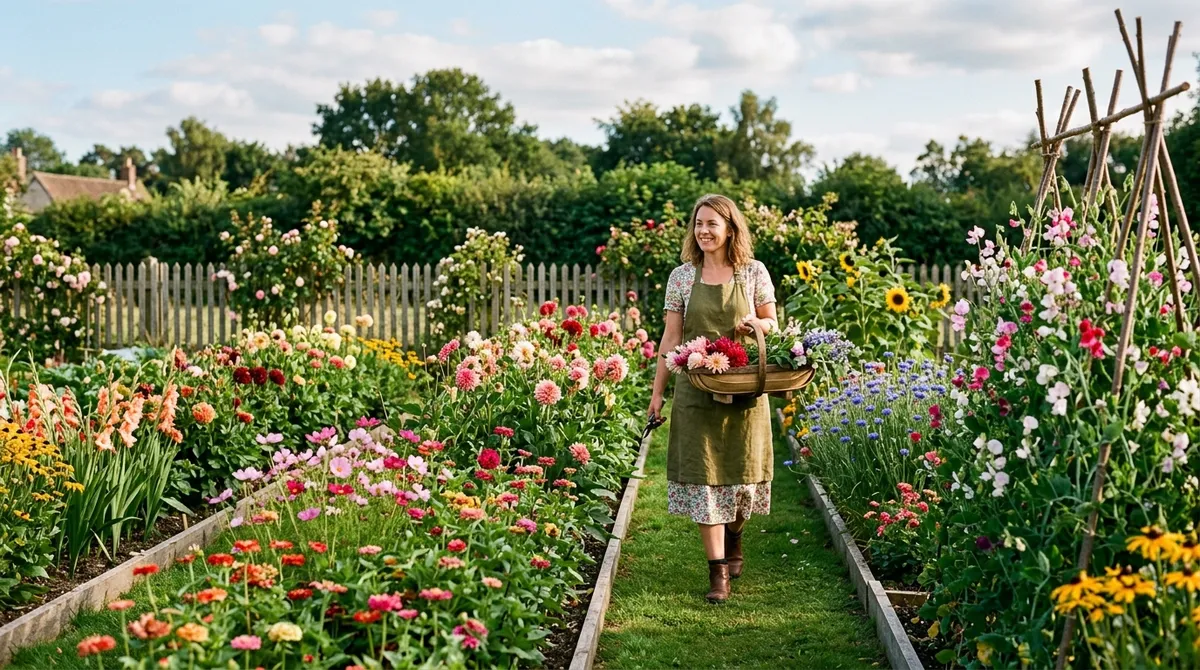
A cutting garden layout that works starts with one principle: every part of the bed must be reachable without stepping on the soil, and every stem must be reachable without damaging its neighbours. Getting the structure right — bed width, row spacing, orientation, and the arrangement of tall and short varieties — determines the quality and quantity of what you cut.
This guide focuses specifically on the design and planning of cutting garden layouts for UK conditions. For a broader introduction to setting up a cutting garden from scratch, see our companion article on how to create a cutting garden in the UK. Here the focus is on the spatial planning: how to lay out beds for different garden sizes, how to space rows, how to sequence seasonal blocks, and how to adapt the layout as the season progresses.
What is the best layout for a cutting garden?
The most productive cutting garden layout is parallel rows in rectangular beds, running north to south, with paths of at least 45cm between every bed. This is not a matter of aesthetics — it is the layout that produces the best stems for cutting because it maximises light, air circulation, and ease of harvest.
Beds should be no wider than 1.2m so you can reach the centre from one side without stepping on the soil. Compacted soil from foot traffic is the single biggest cause of short, weak stems in an otherwise well-fed cutting garden. The ground has to stay loose so roots can travel deep and access water. One full season of regular foot traffic can reduce the rooting depth of your cosmos and dahlias by 30-40%.
Paths need to be at least 45cm wide between beds, not the 30cm that many gardeners start with. When plants are at full height in July and August, the foliage spreads 20-30cm beyond the row. A 30cm path disappears completely. A 45cm path remains navigable at all times and lets you harvest without breaking stems.
How do I choose the right plot size for my cutting garden?
The right size depends entirely on how many bouquets you want to cut and how much time you can give to the garden each week. A larger cutting garden does not automatically produce more — a poorly maintained large plot quickly becomes overwhelmed by weeds and self-seeding plants that compete with your cut flowers.
| Plot size | Area | Varieties | Bouquets per season | Weekly harvest time |
|---|---|---|---|---|
| 2m x 3m | 6 sq m | 5-6 | 12-15 | 1-2 hours |
| 3m x 4m | 12 sq m | 8-10 | 25-30 | 2-3 hours |
| 3m x 6m | 18 sq m | 14-18 | 35-45 | 3-5 hours |
| 4m x 6m | 24 sq m | 20-24 | 50-60+ | 5-7 hours |
Start with the 3m x 4m layout if you are setting up your first cutting garden. It produces enough variety for weekly arrangements, it is manageable in 2-3 hours per week during peak season, and it can be extended as your confidence grows. The 3m x 6m layout is the right size if you want to grow for events, market stalls, or regular gifts as well as your own home.
See our guide to growing cut flowers in the UK for variety selection once you have your layout fixed.
How do I lay out a 3m x 4m cutting garden?
The 3m x 4m layout is the most versatile cutting garden size for UK gardens. It fits into the corner of most medium-sized plots, works as a dedicated separate area, or can be integrated into a kitchen garden design. Here is the bed and row plan I have used successfully for seven seasons.
The bed structure: One central bed of 1.2m x 4m, with two narrower flanking beds of 0.6m x 4m along the sides if space allows, or a single 1.2m x 4m central bed with paths on both sides. For a standalone cutting garden, a single 1.2m-wide bed with access paths on both sides is the simplest and most productive option.
Row plan for a 1.2m x 4m bed:
| Row | Width | Crop | Plant spacing | Position |
|---|---|---|---|---|
| 1 (north end) | 60cm | Dahlias | 45-60cm between plants | Tallest at back |
| 2 | 40cm | Sunflowers or larkspur | 20-30cm between plants | Second tallest |
| 3 | 40cm | Cosmos | 30cm between plants | Mid-height |
| 4 | 40cm | Sweet peas on netting | 15cm between plants | Mid-height |
| 5 | 30cm | Zinnias | 25-30cm between plants | Mid-height |
| 6 | 30cm | Ammi or scabious | 20-25cm between plants | Shorter fillers |
| 7 | 30cm | Cornflowers or stocks | 20cm between plants | Front border |
| 8 (south end) | 30cm | Foliage: eucalyptus or rosemary | 30-45cm between plants | Shortest at front |
This arrangement — tallest plants north, shortest south — means no row shades another throughout the day. Total bed area: 4.8 sq m of productive growing space.
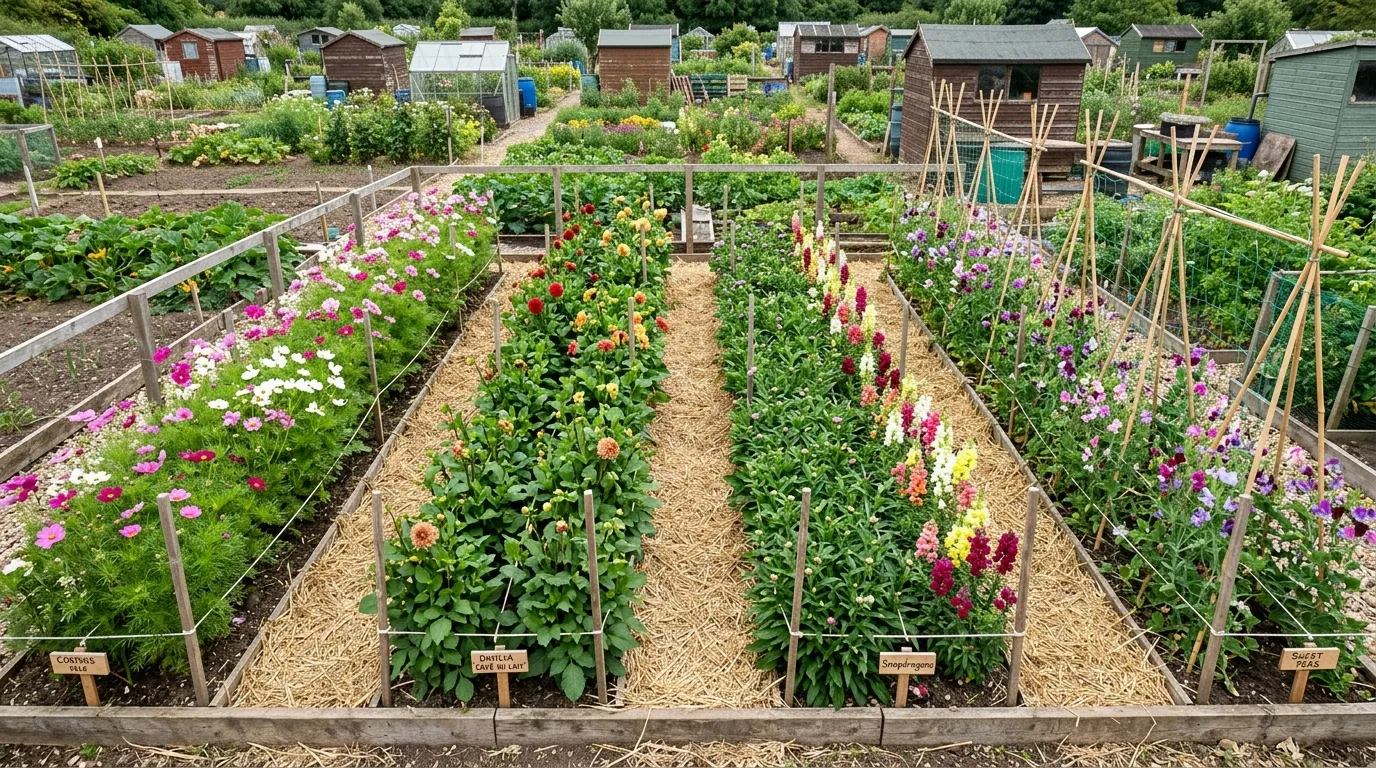
North-to-south rows in a 3m x 4m cutting garden. Dahlias at the back, cosmos mid-section, zinnias and ammi towards the front path.
What is the best layout plan for a small cutting garden?
A small cutting garden of 2m x 3m needs a tighter, more strategic approach to variety and spacing. With only 6 sq m you cannot afford to give space to low-yielding plants.
Key principles for small cutting gardens:
- Prioritise cut-and-come-again annuals over single-stem plants. Cosmos, sweet peas, and zinnias produce 10-20 stems per plant over the season. A single sunflower produces one stem. In a small plot, every plant must work hard.
- Use vertical space. Fix a post-and-wire framework or 1.8m net at one end of the bed for sweet peas, which produce 20-30 stems per plant from a 15cm ground footprint.
- Grow 3-4 varieties well rather than 8 varieties squeezed in. A single 3m row of cosmos fills a small bed with 40-50 stems per season and still leaves room for a row of sweet peas and a row of zinnias.
Small plot row plan (2m x 3m bed):
| Row | Width | Crop | Expected yield |
|---|---|---|---|
| 1 (north) | 60cm | Dahlias x 3 plants | 30-40 stems Jul-Oct |
| 2 | 40cm | Sweet peas on netting (1m) | 40-60 stems Jun-Sep |
| 3 | 40cm | Cosmos (6 plants) | 50-70 stems Jun-Oct |
| 4 | 30cm | Zinnias (6 plants) | 30-50 stems Jul-Oct |
| 5 (south) | 30cm | Foliage: rosemary or mint | Year-round fillers |
This layout produces enough for a weekly kitchen table arrangement from June to October in a space smaller than most garden sheds.
For more on how to choose the best hardy annuals to fill these rows, see our guide to the best hardy annual flowers for cutting from seed in the UK.
How do I plan seasonal succession in my cutting garden layout?
Dividing your cutting garden into three seasonal blocks is the single most effective structural decision you can make. Rather than sowing all your annuals in one go and having a single peak in July and August, a three-block layout staggers the season from April through to November.
The three-block layout:
- Block 1: Spring (March-May harvest). Allocate one-third of your bed space to spring bulbs and hardy biennials — tulips, narcissi, anemones, ranunculus, wallflowers, and sweet williams. These go in the ground in September-November and produce your first stems from March. This block is empty from June onward and becomes a succession sowing zone for late annuals.
- Block 2: Summer (June-August harvest). The largest block: sweet peas, cosmos, larkspur, snapdragons, cornflowers, stocks, ammi, and scabious. Sow indoors from February to April and plant out after the last frost. Succession sow every 3 weeks for a rolling harvest rather than one glut.
- Block 3: Late summer and autumn (August-November harvest). Dahlias, zinnias, asters, chrysanthemums, and ornamental grasses. These require the most space per plant but produce the longest stems and the best late-season value.
| Block | Season | Key plants | Sow/plant | First cut |
|---|---|---|---|---|
| Spring | Mar-May | Tulips, narcissi, anemones, ranunculus | Sep-Nov (bulbs/corms) | March |
| Summer | Jun-Aug | Sweet peas, cosmos, larkspur, snapdragons | Feb-Apr (indoors) | June |
| Late/autumn | Aug-Nov | Dahlias, zinnias, asters, chrysanthemums | May (tubers/plants) | August |
Our succession planting guide covers the technique for both flowers and vegetables, including how to keep a succession sowing schedule without missing windows.
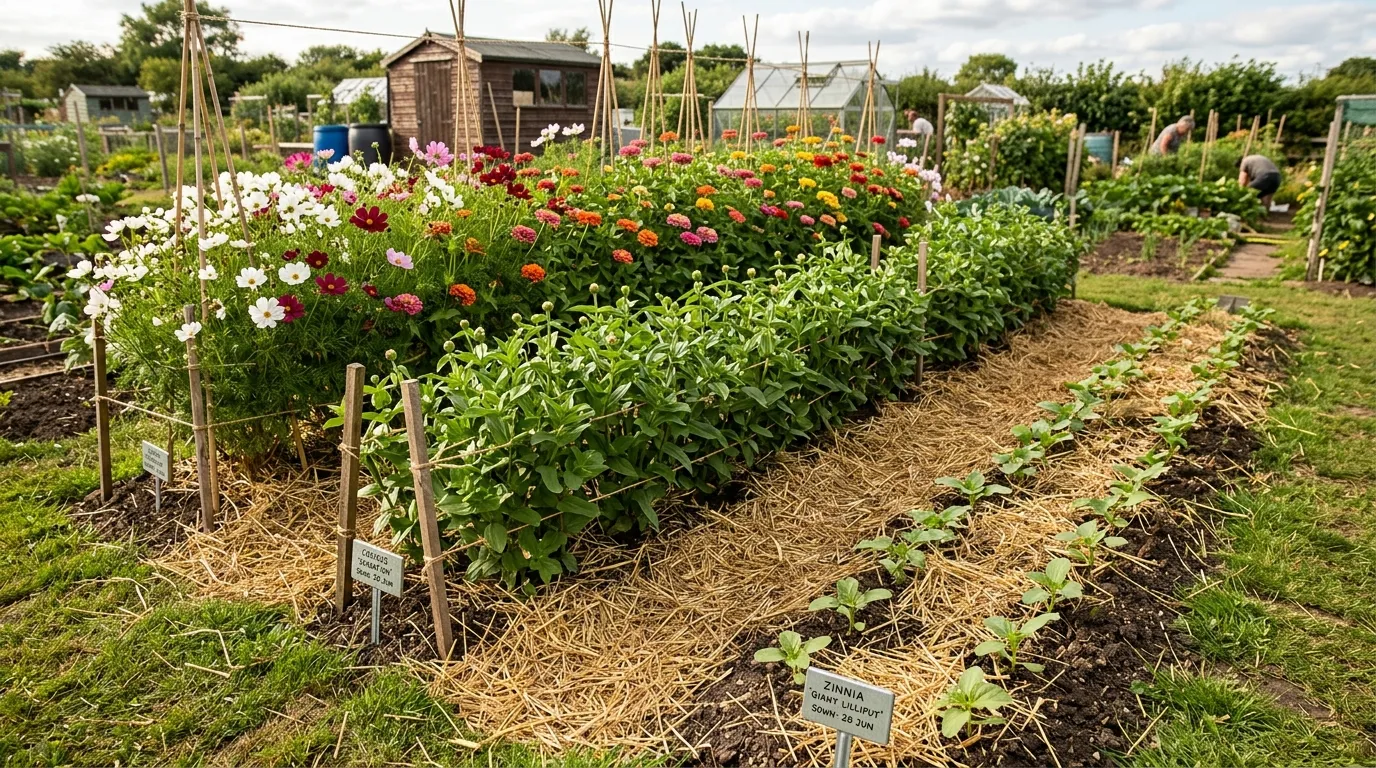
Three-block layout: spring bulbs and biennials at the far end, summer annuals in the middle, and late-season dahlias and zinnias nearest the path.
What is the monthly cutting garden planting calendar?
This calendar combines sowing, planting, and harvest tasks for a full cutting garden layout. Following it turns a single-peak plot into one that produces from March through November.
| Month | Sow indoors | Sow/plant outdoors | Harvest |
|---|---|---|---|
| January | Order seeds. Start chitting dahlia tubers | — | Dried seedheads, hellebores |
| February | Sweet peas, snapdragons, stocks | — | Hellebores, pussy willow |
| March | Cosmos, zinnias, scabious | Direct: larkspur, ammi, cornflowers | Narcissi, anemones |
| April | Sunflowers, asters | Plant ranunculus corms outdoors | Tulips, narcissi, wallflowers |
| May | Last cosmos sowing | Plant dahlias after last frost. Plant out half-hardy annuals | Tulips, ranunculus, early sweet williams |
| June | — | Succession sow cosmos every 3 weeks | Sweet peas, larkspur, ammi, cornflowers, snapdragons |
| July | — | Last direct sowing of zinnias | Sweet peas, dahlias (early), cosmos, sunflowers, larkspur, stocks |
| August | — | Sow hardy annuals for next spring | Peak: dahlias, cosmos, zinnias, asters, snapdragons |
| September | — | Plant spring bulbs: tulips, narcissi, anemones | Dahlias, cosmos, late sweet peas, chrysanthemums |
| October | — | Plant ranunculus corms. Lift dahlia tubers after first frost | Chrysanthemums, asters, late dahlias, ornamental grasses |
| November | — | Last tulip planting. Mulch beds 5cm deep | Late chrysanthemums, dried seedheads |
| December | Plan next season. Order new varieties | — | Hellebores, holly, dried grasses |
For the full variety-by-variety sowing calendar, see our flower planting calendar for UK gardens.
How do I build support structures into my cutting garden layout?
Support structures need to be part of the layout plan from day one, not retrofitted after plants start flopping. Adding canes and string once cosmos has reached 80cm risks breaking stems and disturbing roots.
Horizontal netting: The most efficient support system for a cutting garden. Install galvanised mesh or Hortonova netting horizontally at 30cm and 60cm heights above the bed, stretched between corner posts sunk 60cm into the ground. Plants grow up through the netting grid, which keeps stems vertical and straight. This system works particularly well for larkspur, snapdragons, stocks, and dahlias, all of which produce their best stems when supported from below rather than tied to individual canes.
Post-and-wire for sweet peas: Two posts at each end of the row with wires at 30cm, 60cm, 90cm, and 120cm heights. Sweet peas grip wire more reliably than netting and produce straighter, longer stems when they climb upward rather than weaving through mesh. Space the posts 1.5-2m apart and use 2mm galvanised wire at each height.
Individual staking for dahlias: Each dahlia plant needs a 1.2-1.5m bamboo cane placed at planting time. Tie the main stem loosely with soft twine at 30cm intervals as the plant grows. Dahlias with unsupported stems produce bent necks — the junction between stem and flower head kinks as the heavy bloom weighs it down. Support prevents this and doubles the usable stem length.
How do I plan a large cutting garden layout?
A 3m x 6m or 4m x 6m cutting garden allows enough space for a full rotation of 20+ varieties across all seasons. At this scale, the layout needs more structure: separate zones by season, defined main paths, and a dedicated area for perennials and shrub foliage that stays in place year after year.
Large cutting garden layout template (3m x 6m):
| Zone | Dimensions | Contents |
|---|---|---|
| Permanent foliage strip | 0.6m x 6m (north side) | Eucalyptus, pittosporum, rosemary, bronze fennel — never moved |
| Spring bulb beds | 1.2m x 2m | Tulips, narcissi, ranunculus, anemones — planted Sep-Nov |
| Summer annual beds | 1.2m x 3m | Sweet peas, cosmos, larkspur, cornflowers, snapdragons, ammi |
| Late season beds | 1.2m x 3m | Dahlias, zinnias, asters, chrysanthemums |
| Main access path | 0.6m x 6m | Central gravel path, wheelbarrow access |
| Side paths | 0.45m x 6m | Harvest paths either side of the main beds |
The permanent foliage strip at the north side — eucalyptus coppiced hard each March, rosemary, and bronze fennel — provides fillers for arrangements without ever needing to be cleared and replanted. This strip saves 30 minutes of replanting work per season and provides stems all year round.
For ideas on integrating a cutting garden into a wider decorative scheme, see our article on raised bed garden design ideas and the cottage garden planting plan which shows how cutting flowers work alongside ornamental borders.
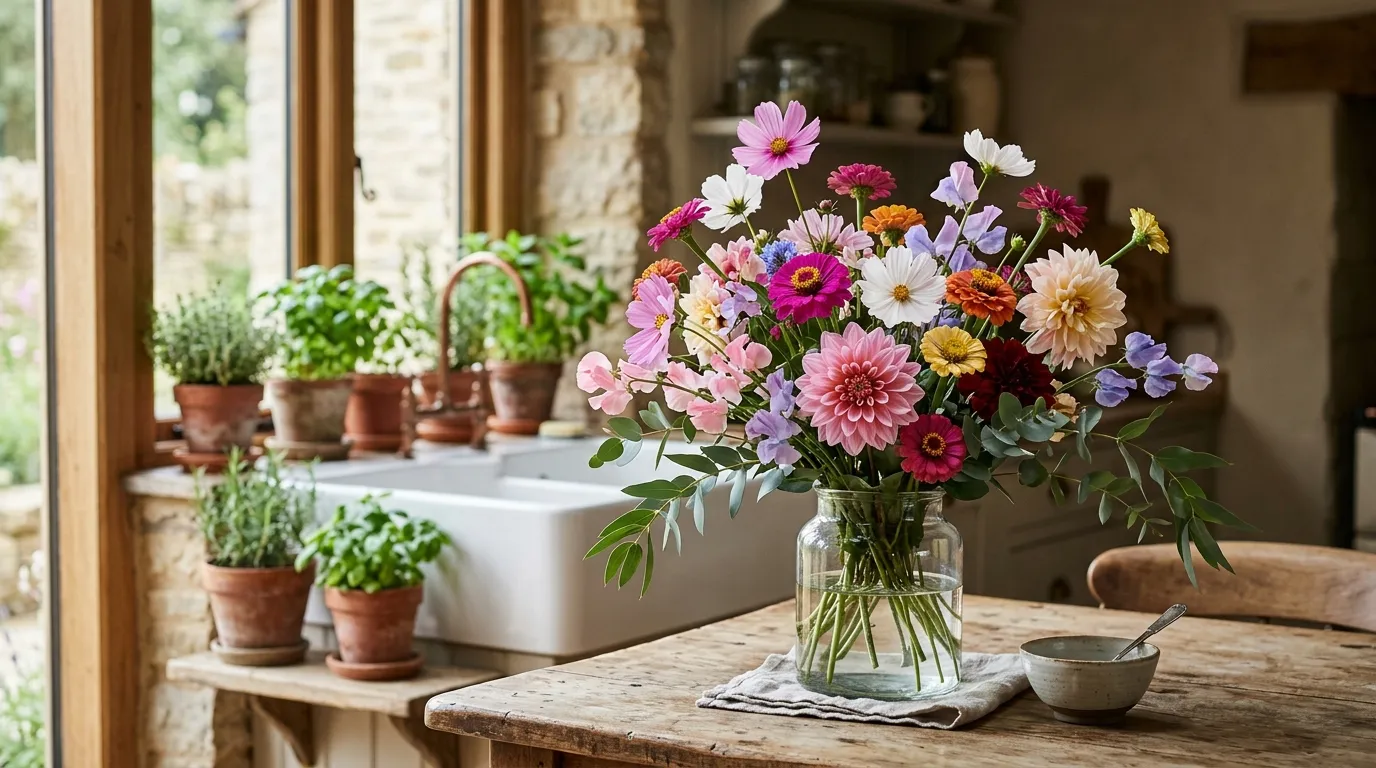
Harvesting from a well-planned 3m x 6m cutting garden in August — dahlias, cosmos, zinnias and larkspur in one morning’s picking.
What path materials work best in a cutting garden?
Path materials in a cutting garden take more punishment than in most garden areas. You are walking through them multiple times a week during harvest, often with wet soil on your boots, and the paths need to drain freely so they do not become waterlogged after heavy rain.
Gravel over landscape fabric is the most practical choice: it drains freely, suppresses weeds, and gives reliable grip in wet weather. Use 20mm pea gravel at 50mm depth. The landscape fabric underneath stops gravel mixing with the soil and prevents weeds pushing through. Cost: roughly £3-5 per square metre. Lasts 8-10 years before needing a top-up.
Bark chippings are cheaper and easier to lay but break down within 2-3 years and need replacing. They also become slippery in wet weather, which is a hazard when carrying armfuls of stems. Suitable for low-traffic side paths but not the main access route.
Mown grass looks good in summer and costs nothing, but becomes waterlogged and muddy after rain. In a UK cutting garden where you are harvesting in all weathers from April to November, a grass path is impractical as a primary access route.
Lawrie’s top tip: the row spacing mistake that weakens stems
Most cutting flower guides say 25-30cm between plants. In my first four seasons I followed this and spent every August puzzled by cosmos plants barely 90cm tall producing spindly, weak-necked stems. The problem was not the soil or the variety — it was that I was measuring the space between plants but ignoring the row spacing. My rows were 25cm apart. The plants were touching by midsummer, reducing air circulation and forcing vertical competition that produced lots of height but thin, hollow stems.
When I moved to 40cm row spacing for cosmos and 50cm for zinnias, average stem length increased from 65cm to 85cm and stem diameter increased by roughly 30%. Wider rows meant each plant could expand laterally before going vertical, building a stronger structure. Give your rows more space than you think they need in spring, when the seedlings look lost in the gaps. By July you will fill every centimetre.
The RHS cutting flower guidance confirms that good air circulation between rows is one of the key factors in preventing fungal problems like botrytis on sweet peas and cosmos — another reason to err on the side of wider row spacing.
How do I integrate a cutting garden into an existing garden?
Not every garden has a dedicated cutting garden zone. Most UK gardeners work with limited space and need to integrate cutting flowers into an existing layout without a complete redesign.
Dedicated beds within a mixed garden. Carve out one or two beds of 1.2m x 2-3m within an existing border or kitchen garden for cutting flowers. Keep these beds separate from decorative planting so you can harvest freely without ruining the view. Label them clearly so visiting gardeners — or forgetful helpers — know these plants are for cutting, not for display.
Sweet peas on existing structures. A sweet pea framework on an existing fence, trellis, or arch provides 40-60 cutting stems per season from a footprint of just 2-3m of linear fence. This is the single best cutting flower addition for a garden with no dedicated cutting space.
Dahlias in containers. Three or four large containers (30-40cm diameter, 35cm+ depth) planted with one dahlia tuber each — positioned on a paved area, terrace, or alongside a path — produce 15-25 stems per plant across the season. For spacing and container requirements, see our guide to sowing seeds indoors which covers starting dahlias and annuals under cover before the season begins.
Frequently asked questions
Full FAQ answers are provided in the frontmatter above and rendered by the site’s FAQ component with FAQPage JSON-LD schema.
Related reading
- How to create a cutting garden in the UK — the companion guide covering variety selection, soil preparation and first-year setup
- How to grow cut flowers in the UK — species-by-species growing guide for the best UK cutting flowers
- Succession planting guide for UK gardens — how to stagger sowings for continuous harvests across the full season
- Flower planting calendar for UK gardens — month-by-month sowing, planting and harvest schedule for cutting flowers
- Raised bed garden design ideas — how to design and build permanent raised beds for a cutting garden
Lawrie has been gardening in the West Midlands for over 30 years. He grows his own veg using no-dig methods, keeps a wildlife-friendly garden, and writes practical advice based on real UK growing conditions.