Key takeaways
- Sea kale (Crambe maritima) is the standout edimental — silver foliage, scented white flowers, edible shoots, and 20-year lifespan from one planting
- Globe artichokes deliver architectural 1.5m foliage, purple thistle flowers for pollinators, and harvestable buds — the most productive ornamental shrub equivalent
- Ornamental kale (Brassica oleracea acephala) holds purple, pink, and white rosettes from October to April when little else looks alive
- Rainbow chard adds red, yellow, pink, and orange stems to summer borders — both decorative and a cut-and-come-again crop
- Edible flowers (nasturtium, calendula, borage, viola) add colour to borders and salads with no separate vegetable plot needed
- Most edimentals are pollinator magnets — bees and hoverflies love artichoke, borage, sea kale, and chive flowers
Edimentals do two jobs at once. They hold their own in an ornamental border and they give you something worth eating. The list covers a lot of the toughest, prettiest, most bee-friendly plants going: sea kale, globe artichoke, ornamental kale, rainbow chard, perennial kale, samphire, edible flowers, and culinary herbs trained as ornamentals. Most are perennial, most ask for less attention than the average herbaceous perennial, and most repay you with a useful side-harvest.
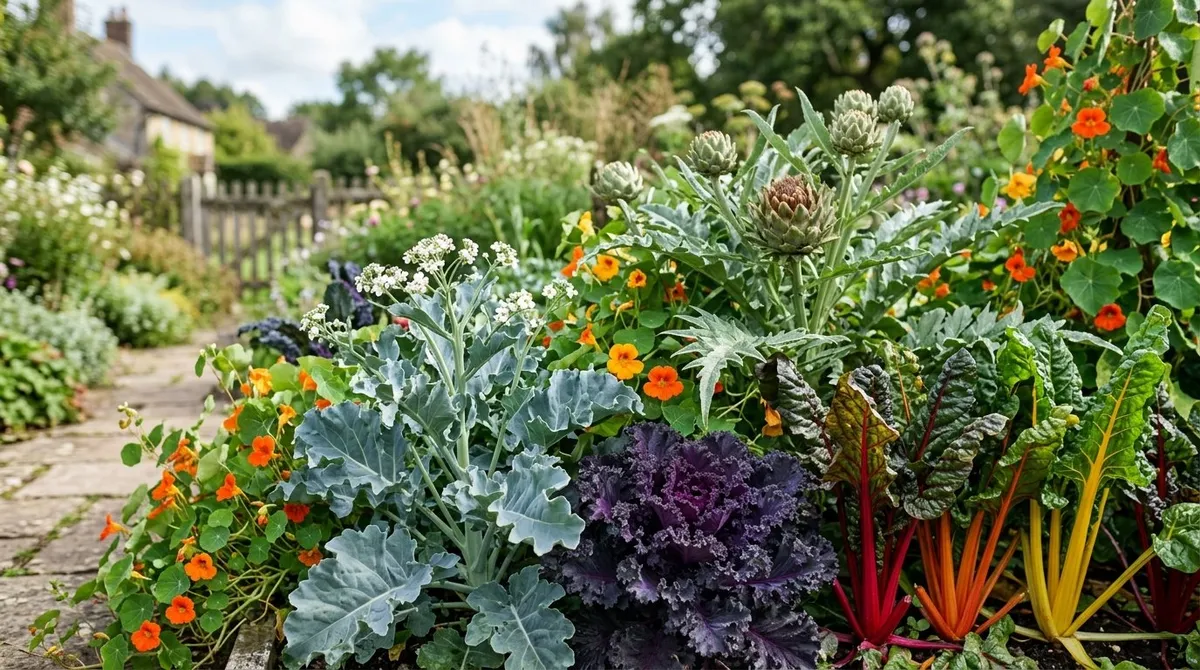
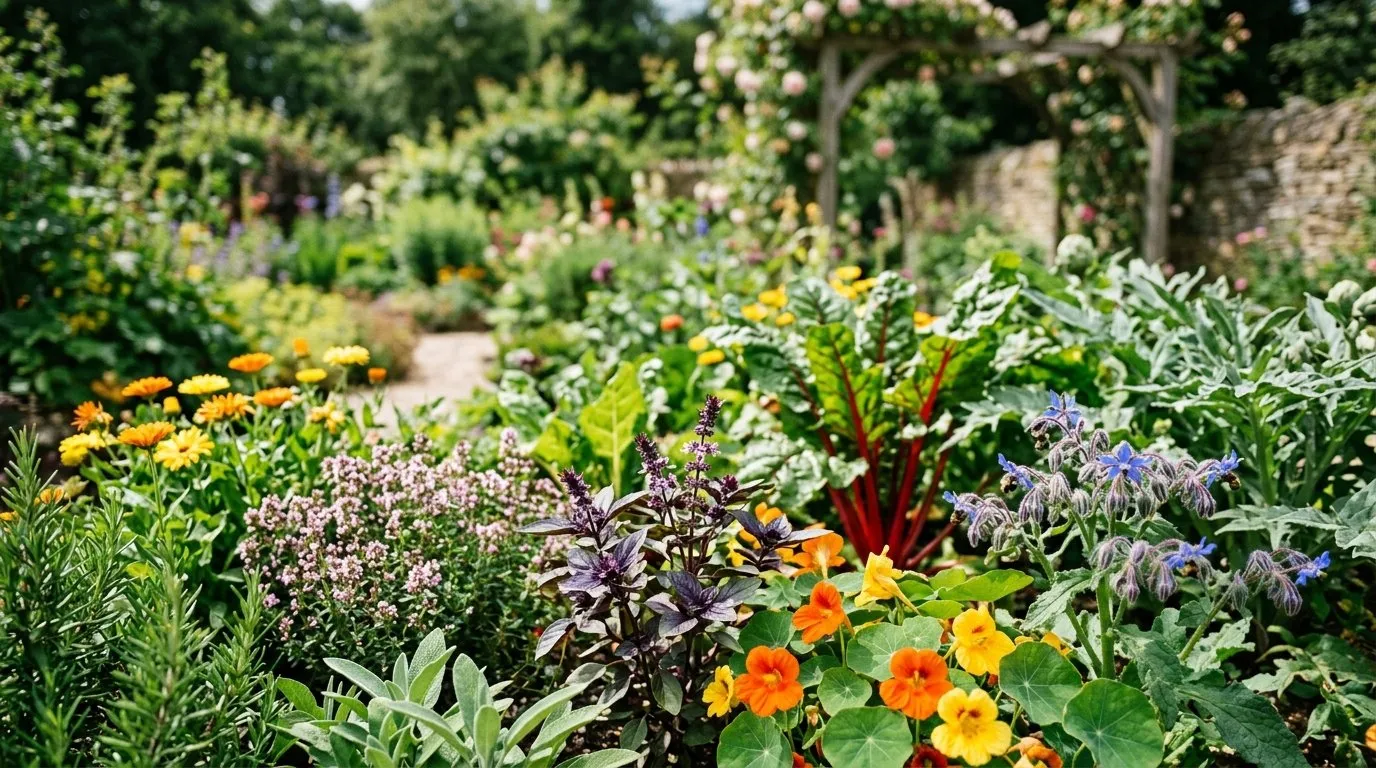 A 4 by 1.5 metre edimental border in late August. Globe artichokes and bronze fennel give vertical structure, rainbow chard fills middle layer, ornamental kale takes over autumn. All edible.
What does edimental mean?
An edimental is a plant that combines genuine ornamental value with genuine edibility. The term was coined by Norwegian-based gardener Stephen Barstow in the 2010s and has filtered into mainstream UK garden writing over the past five years. By 2026 the RHS, Garden Design Journal, and Ideal Home have all flagged edimentals as a defining trend, alongside related concepts like the potager garden.
Three things distinguish an edimental from a vegetable that happens to look pretty:
- Year-round structural value. A row of cabbages is functional but not ornamental. A globe artichoke fills its border position from March through January.
- Garden-worthy form. Silver foliage, dramatic flowers, architectural shape, or bold colour — not just productive.
- Genuine harvest. Not a single salad leaf in spring; a meaningful supply through the season.
Three things have pushed edimentals up the agenda for 2026. Gardens keep getting smaller, with the average new-build plot now under 50 square metres, so there is rarely room for a separate flower bed and a separate veg patch. People worry more about where their food comes from after a few years of supermarket gaps and price spikes. And the low-input crowd (no-dig, perennial borders, naturalistic planting) has landed on plants that give more back for less fuss.
The 12 best edimentals for UK gardens
1. Sea kale (Crambe maritima)
How to use: Plant 1-3 specimens as a structural anchor in a sunny border. Cover crowns with a 30cm pot in February to blanch shoots — harvest 4-6 weeks later. Leaves taste like cabbage; flowers like honey.
2. Globe artichoke (Cynara cardunculus var. scolymus)
Architectural 1.5m perennial with silver-grey divided foliage and giant purple thistle flowers in July. The unopened flower buds are the artichokes — pick at golf-ball size, before petals separate. Hardy across most of the UK if mulched in winter. The flowers, if left, attract 6-10 bumblebee species.
How to use: Plant 1-2 specimens at the back of a sunny border. Allows the dramatic foliage to dominate from March-October. See our globe artichoke growing guide for full cultivation detail.
3. Rainbow chard (Beta vulgaris subsp. cicla)
Annual or short-lived perennial with bold red, yellow, pink, white, and orange stems against deep green leaves. Cut-and-come-again — pick outer stems weekly from May to October. A handful of plants feeds a household through summer. See our full Swiss chard guide.
How to use: Use as middle-border colour, particularly with silver foliage plants like artemisia or with deep purple heuchera. Sow direct in April or in cell trays for plug planting.
4. Ornamental kale (Brassica oleracea acephala)
Frilled, ruffled, or feathered leaves in purple, pink, white, and green forming dense rosettes 30-60cm wide. Most varieties intensify colour with cold from October onwards — peak display December-March. Edible but tougher than culinary kale.
How to use: Plant in autumn (September-October) to peak with frosts. Brilliant in winter container schemes alongside heuchera and pansies. Strip and use leaves for kale chips or stir-fries.
5. Perennial kale ‘Daubenton’ (Brassica oleracea var. ramosa)
A semi-shrubby perennial kale producing edible leaves year-round for 5+ years from one planting. Reaches 90cm tall and equally wide. Variegated forms (‘Daubenton Variegated’) add white-streaked leaves for ornamental effect.
How to use: Plant from cuttings (it rarely sets seed) in March or September. Pick leaves continuously — harvesting keeps plants compact. Combine with companion planting of nasturtium beneath to deter cabbage white butterflies.
6. Samphire (Salicornia europaea or Crithmum maritimum)
Two species: marsh samphire (annual) and rock samphire (perennial). Both have succulent, jointed green stems with a salty, fresh flavour. Marsh samphire grows on coastal mudflats; rock samphire on cliff rocks. In gardens, grow in pots or raised beds with sandy soil.
How to use: Container-grown rock samphire works well by a sunny patio. Pick young stems in summer for steaming or pickling. Tolerates salt better than any other UK edimental.
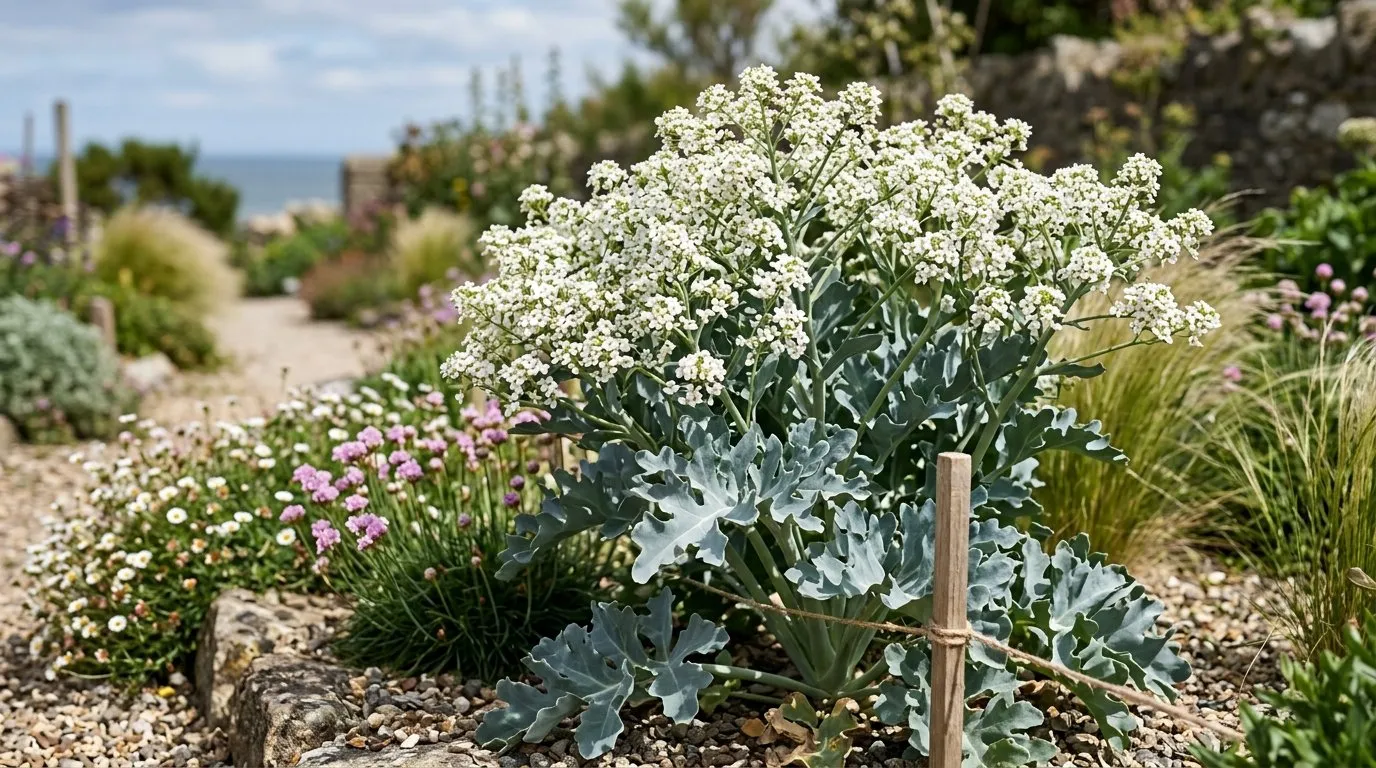 Sea kale in early June. Silver foliage from March, honey-scented flowers in May-June, edible blanched shoots in spring — and it lives 20+ years from one planting.
7. Bronze fennel (Foeniculum vulgare ‘Purpureum’)
Tall (1.5-2m) feathery bronze foliage with yellow umbel flowers in July. Aromatic seeds, edible foliage, and pollinator-magnet flowers. Perennial in mild gardens, treated as an annual on heavy clay.
How to use: Tall border background with rich foliage colour. Combines particularly well with rudbeckia and helenium. Pick fennel fronds for fish dishes; harvest seeds in autumn.
8. Sorrel (Rumex acetosa or Rumex scutatus)
Lemon-flavoured leafy perennial reaching 30-60cm. Buckler-leaved sorrel (R. scutatus) has more decorative shield-shaped leaves. Cool-season crop; harvest spring and autumn, dies back in summer heat. See our sorrel growing guide.
How to use: Edge of mixed border in moisture-retentive soil. Underplant taller perennials. Refreshes salads and cooked dishes from April onwards.
9. Chives and ornamental alliums (Allium spp.)
Chives (A. schoenoprasum) — purple drumstick flowers in May, edible green stems all year. Garlic chives (A. tuberosum) — white starbursts in August, garlic-flavoured leaves. Larger ornamental alliums (A. cristophii, A. ‘Globemaster’) produce dramatic flowerheads.
How to use: Front of border, pots, or under roses. Chive flowers float on summer salads. All alliums attract bees and deter aphids near roses.
10. Borage (Borago officinalis)
Annual reaching 60-90cm with bristly grey-green foliage and brilliant blue star flowers June-September. Self-seeds reliably. Flowers refill nectar every 2 minutes — the most productive bee plant in UK gardens. See our borage growing guide.
How to use: Scatter seeds in any sunny gap; let it self-seed thereafter. Flowers freeze into ice cubes for summer drinks; cucumber-flavoured leaves in salads.
11. Nasturtium (Tropaeolum majus)
Trailing annual with round leaves and orange-yellow-red flowers June-October. Both leaves and flowers edible with peppery flavour. Climbs through borders, trails over walls, fills gaps in pots. Full guide at nasturtiums in UK gardens.
How to use: Plant under fruit trees, around vegetable beds (deters whitefly), or as edge softeners. Pickled flower buds make a UK alternative to capers.
12. Calendula or pot marigold (Calendula officinalis)
Annual or short-lived perennial with orange-yellow flat daisy flowers. Edible petals add colour to salads and rice dishes. Long flowering season from May-November in mild years. Self-seeds reliably.
How to use: Front of mixed border. Cottage garden classic. Pollinator favourite. Pick petals for salads — they keep their colour when dried.
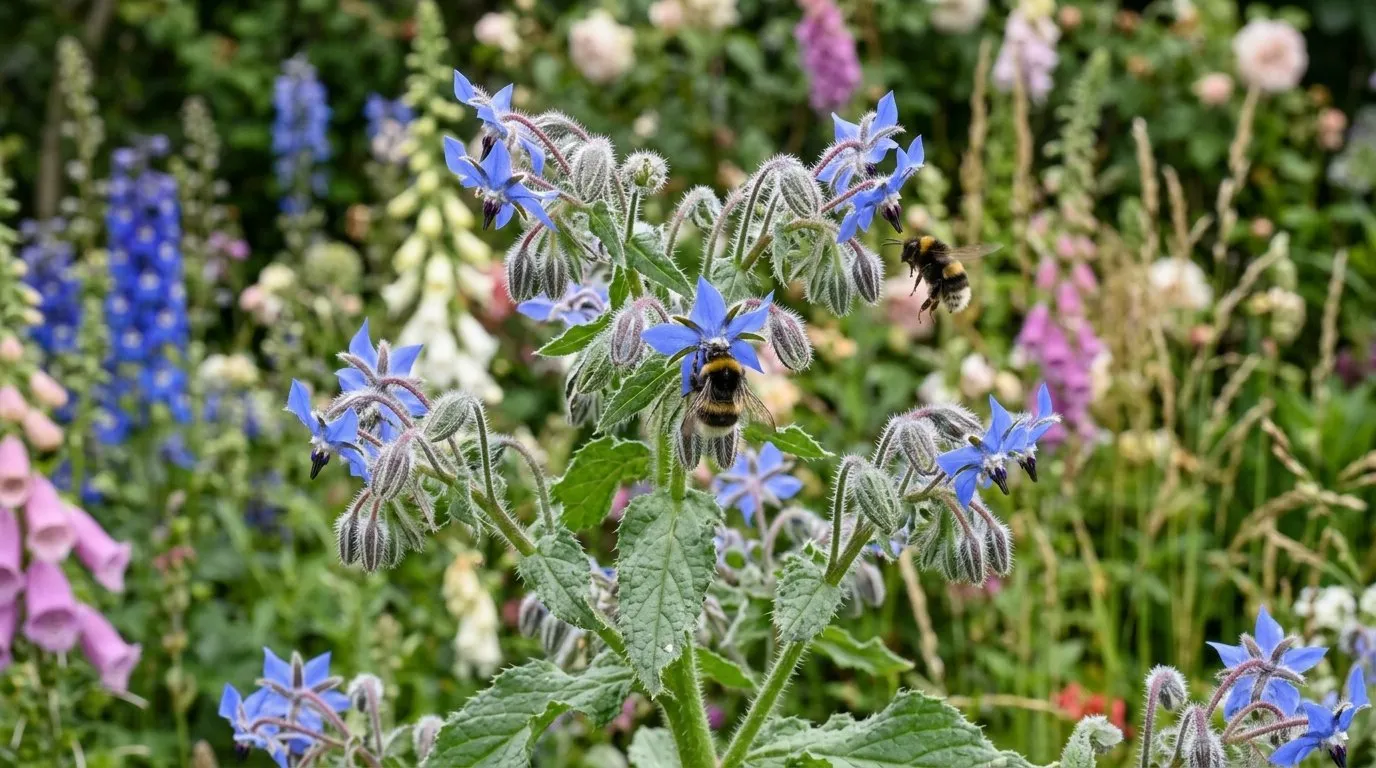 Borage in mid-July. Each flower refills with nectar every two minutes — the most productive bee plant in the UK garden — and the blue stars freeze beautifully into ice cubes for summer drinks.
How to design an edimental border
Design an edimental border the way you would any ornamental one. You want a few structural anchors, some middle-layer plants repeated through the bed, something to soften the edges, and plants that take their turn across the seasons.
A simple 2 x 3 metre starter border
For a small UK garden, this 6 square metre layout combines six species with year-round interest:
| Position | Plant | Role | Quantity |
|---|---|---|---|
| Back centre | Globe artichoke | Architectural anchor | 1 |
| Back left/right | Bronze fennel | Vertical accent | 2 |
| Middle | Rainbow chard | Colour and harvest | 5 |
| Middle | Perennial kale ‘Daubenton’ | Year-round structure | 1 |
| Front | Chives | Edge softener | 6 |
| Self-seeded throughout | Calendula, borage, nasturtium | Annual fillers | scattered |
This combination provides cuts and pickings from April (chives) through November (kale), with flowers from May (chives, sea kale) through October (calendula, nasturtium), and structural interest year-round.
A 4 x 2 metre showpiece border
For a medium garden, this 8 square metre layout adds depth and drama:
- Back: 1 globe artichoke + 1 sea kale + 2 bronze fennel
- Middle: 5 rainbow chard + 2 perennial kale + 3 sorrel
- Front: chives, calendula, nasturtium edges
- Annual fillers: borage and ornamental kale (autumn-spring rotation)
Total 12+ species with no two in flower or harvest at the same time.
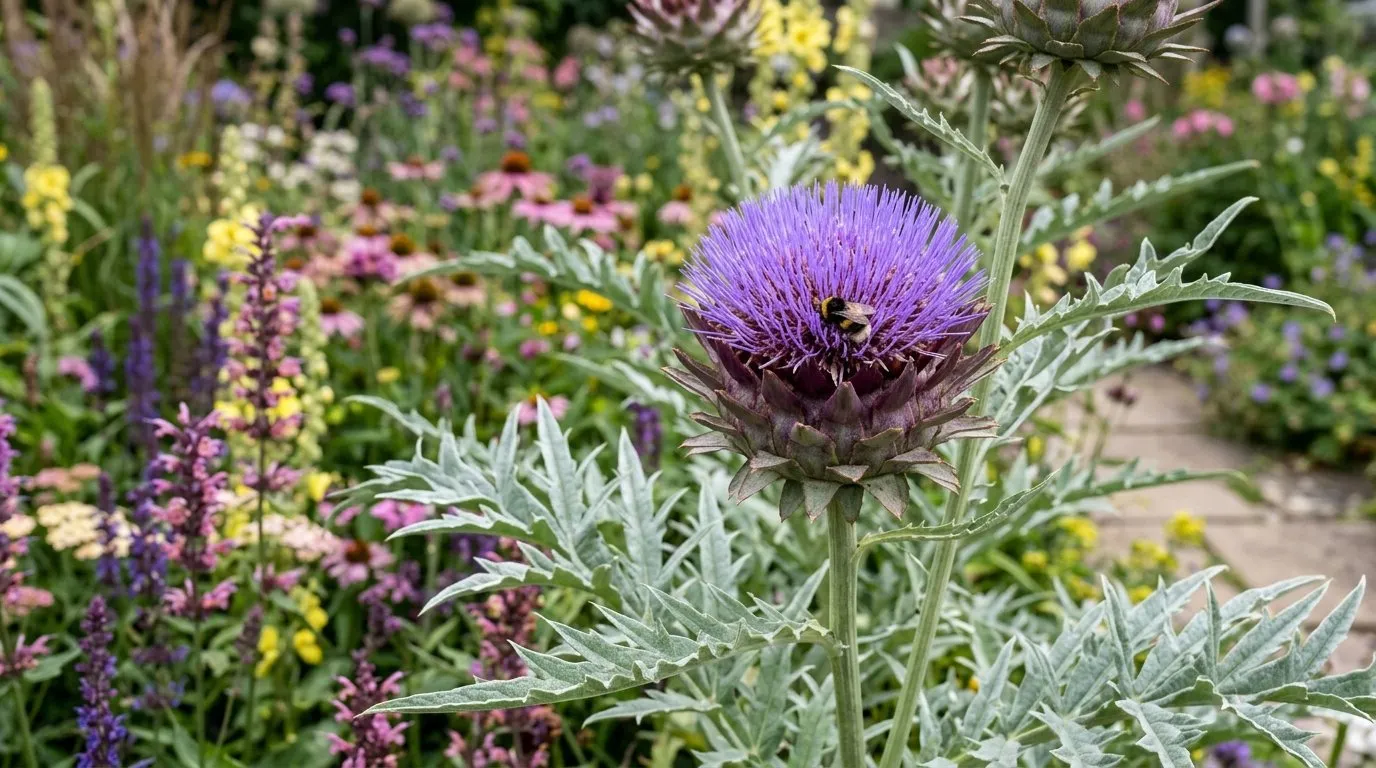 Globe artichoke in late July. The unopened buds are the artichokes; left to flower, the purple thistles attract 6-10 bumblebee species through high summer.
How edimentals compare to a separate vegetable plot
Whether edimentals are worth it really comes down to what you want out of the garden. The table below sets three approaches side by side across 5 square metres.
| Approach | Annual harvest | Hours per year | Season of interest | Pollinator value |
|---|---|---|---|---|
| Separate vegetable plot | 12-20kg | 50-80 | June-October | Moderate (depending on flowers) |
| Edimental border | 4-8kg | 15-25 | Year-round | High (8/12 species are bee magnets) |
| Pure ornamental border | 0kg | 25-40 | March-October | Variable |
You give up some harvest weight, but in return you get a border that looks good all year, takes far less work, and feeds more pollinators. That suits anyone who wants some decoration and a real harvest, but has no appetite for keeping a flower bed and a veg patch going separately.
When to plant edimentals in the UK
Different edimentals have different planting windows. Use this calendar:
| Plant | Best planting window | Method |
|---|---|---|
| Sea kale | October-March | Bare-root crowns or containerised |
| Globe artichoke | October-November or March-April | Bare-root or container |
| Ornamental kale | August-September | Plug plants or modules |
| Perennial kale ‘Daubenton’ | March or September | Cuttings (rarely sets seed) |
| Rainbow chard | March-September | Direct sow or modules |
| Bronze fennel | March-April | Direct sow or transplants |
| Sorrel | March-April or September | Direct sow or division |
| Chives, garlic chives | March-October | Container plants or division |
| Borage | March-June | Direct sow; self-seeds after |
| Nasturtium | April-June | Direct sow |
| Calendula | March-May or August-September | Direct sow |
| Samphire | April-May | Container in coastal-style mix |
Maintenance: less than you’d think
An edimental border is less work than a pure flower border or a pure veg patch. The reason is simple: the harvesting is the maintenance.
Spring (March-April):
- Cut back perennial sea kale to ground level
- Mulch globe artichokes with garden compost
- Sow rainbow chard, sorrel, bronze fennel
- Take cuttings of perennial kale for new plants
Summer (June-August):
- Harvest chard weekly (cut outer leaves)
- Pick artichoke buds before they open
- Deadhead borage and calendula to prolong flowering (or leave for self-seeding)
- Pick sorrel before flowering bolts the leaves bitter
Autumn (September-October):
- Plant ornamental kale modules
- Cut globe artichoke flower stems after seed forms
- Sow next year’s calendula and borage
- Mulch all crowns with 50mm garden compost
Winter (November-February):
- Harvest ornamental kale, perennial kale, leeks
- Plan border layout for spring
- Order seed and bare-root stock
Total annual hours per 5 square metre border: 15-25. For comparison, a vegetable plot of the same size needs 50-80 hours and a complex herbaceous border 25-40 hours.
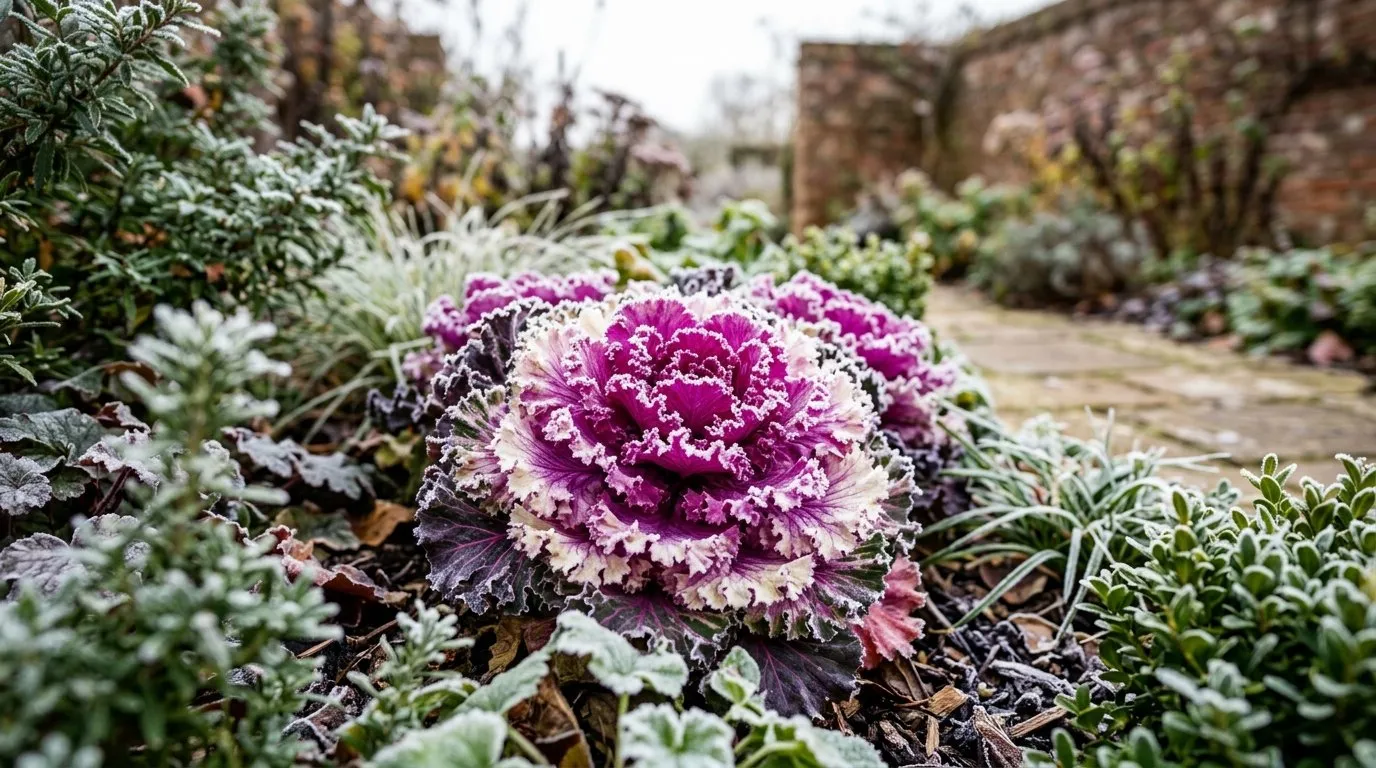 Ornamental kale in December, frost-dusted. Cold weather intensifies the colour from green-tinged to deep purple-and-white. The leaves are edible if a little tougher than culinary kale.
Common edimental mistakes
Treating the border like a vegetable plot
There is no crop rotation here, no dedicated beds, no digging the ground over every year. Plant them like perennials and treat harvesting as just another bit of border upkeep.
Over-feeding
Most edimentals (especially sea kale, samphire, bronze fennel) prefer poor to moderate soil. Heavy nitrogen produces lush leaves, soft growth, and pest susceptibility. Mulch with garden compost annually; do not feed chemically.
Failing to harvest enough
Crops that are not picked stop producing. Pick chard weekly, cut artichokes at golf-ball size, harvest sorrel before flowering. Skipping harvests reduces both yield and ornamental value.
Choosing wrong species for site
Sea kale fails in heavy wet clay. Samphire fails away from sandy/coastal conditions. Match the plant to the site rather than amending soil to suit the plant.
Treating ornamental kale as edible
The ornamental forms are tougher and less palatable than culinary varieties. Use them ornamentally; eat them in stir-fries or chips after a few seasons of garden display.
Where to source UK edimentals
Most major edimentals are increasingly stocked at ordinary UK garden centres as the trend grows. For unusual species and named cultivars:
- Specialist seed: Real Seeds (perennial kales, unusual chard), Garden Organic Heritage Seed Library (heritage edimentals), Seedaholic
- Plug plants: Rocket Gardens (vegetable plugs), Naturescape (edible flower plugs), Sarah Raven (designed edimentals)
- Specialist nurseries: Edulis Plants (perennial vegetables), Backyard Larder (perennial kales and shrubs), Olive Tree Garden Centre (Mediterranean herbs)
- General garden centres: ornamental kale, chard, herbs, edible flowers stocked seasonally
Costs: bare-root sea kale crowns £4-£6, globe artichoke plants £6-£12, perennial kale cuttings £4-£8, ornamental kale plugs £1-£3 each, seed packets £2-£4.
Frequently asked questions
What does edimental mean in gardening?
Edimental describes a plant that is both edible and ornamental. The term combines edible plus ornamental and was popularised by gardener Stephen Barstow in the 2010s. Common UK edimentals include sea kale, globe artichoke, rainbow chard, ornamental kale, perennial kale, sorrel, and herbs like fennel, chive, and rosemary. Edimentals work in mixed borders rather than separate vegetable plots, blurring the line between flower garden and kitchen garden.
Which edimentals work in small UK gardens?
For small UK gardens under 100 square metres, focus on compact edimentals that earn their space. Best choices include rainbow chard (cut-and-come-again all summer), perennial kale ‘Daubenton’ (5-year shrub-like crop), strawberries as ground cover, edible flowers (nasturtium, calendula, viola) for salads and borders, and one structural plant like a globe artichoke. Pots work for samphire, herbs, and dwarf chard varieties. A 2 by 3 metre bed supports 6-8 edimentals with 4-season interest.
Are edimentals as productive as a vegetable plot?
No, edimentals produce roughly 30-50% the harvest weight of a dedicated vegetable plot of the same size. The trade-off is dramatic reduction in maintenance time, year-round visual appeal, and supplementary food rather than meal-replacement crops. A 5 square metre edimental border yields 4-8 kilograms of usable produce per year. The same area as a vegetable plot yields 12-20 kilograms but demands 5x the seasonal attention. Edimentals suit gardeners who want both ornament and a meaningful but not staple harvest.
When should I plant edimentals in the UK?
Plant most edimentals in autumn (October-November) or early spring (March-April). Sea kale, globe artichokes, and perennial kales establish best from autumn-planted bare-root stock or container plants. Rainbow chard, lettuce, and edible flowers sow in March-April for summer harvest. Hardy perennial herbs (chives, sage, rosemary) plant any time the ground is workable. Avoid planting in summer drought or winter waterlogging. Mulch all new plantings with garden compost.
Do edimentals need different soil to vegetables?
Most edimentals tolerate poorer soil than typical vegetables. Sea kale evolved on shingle beaches and prefers free-draining low-fertility ground. Globe artichokes need moderate fertility. Rainbow chard and perennial kales appreciate rich soil but tolerate average conditions. The main requirement across most edimentals is good drainage — winter waterlogging kills more than any other factor. Heavy clay benefits from raised beds or grit incorporation. Avoid heavy nitrogen feeding, which produces lush leaves at the expense of structure.
Are edimentals pollinator-friendly?
Yes, most edimentals are excellent for UK pollinators. Globe artichoke flowers attract 6-10 bumblebee species. Borage flowers refill nectar every two minutes — the most productive bee plant in the UK. Sea kale has scented white panicles that draw hoverflies and solitary bees. Chive, sage, and fennel flowers feed early and late season pollinators. The combination of edibility plus pollinator value is why edimentals appear so often in modern wildlife garden design.
Which edimental gives the most year-round interest?
Globe artichoke gives the most consistent year-round interest of any UK edimental. Silver-grey architectural foliage emerges in March, reaches 1.5 metres by June, sends up purple thistle flowers in July, holds dramatic seedheads through autumn, and the basal foliage remains as winter structure until the cycle restarts. Sea kale is a close second with spring shoots, summer flowers, blue-green summer foliage, and bronze autumn colour. Both plants justify their space in any 2026 ornamental border.
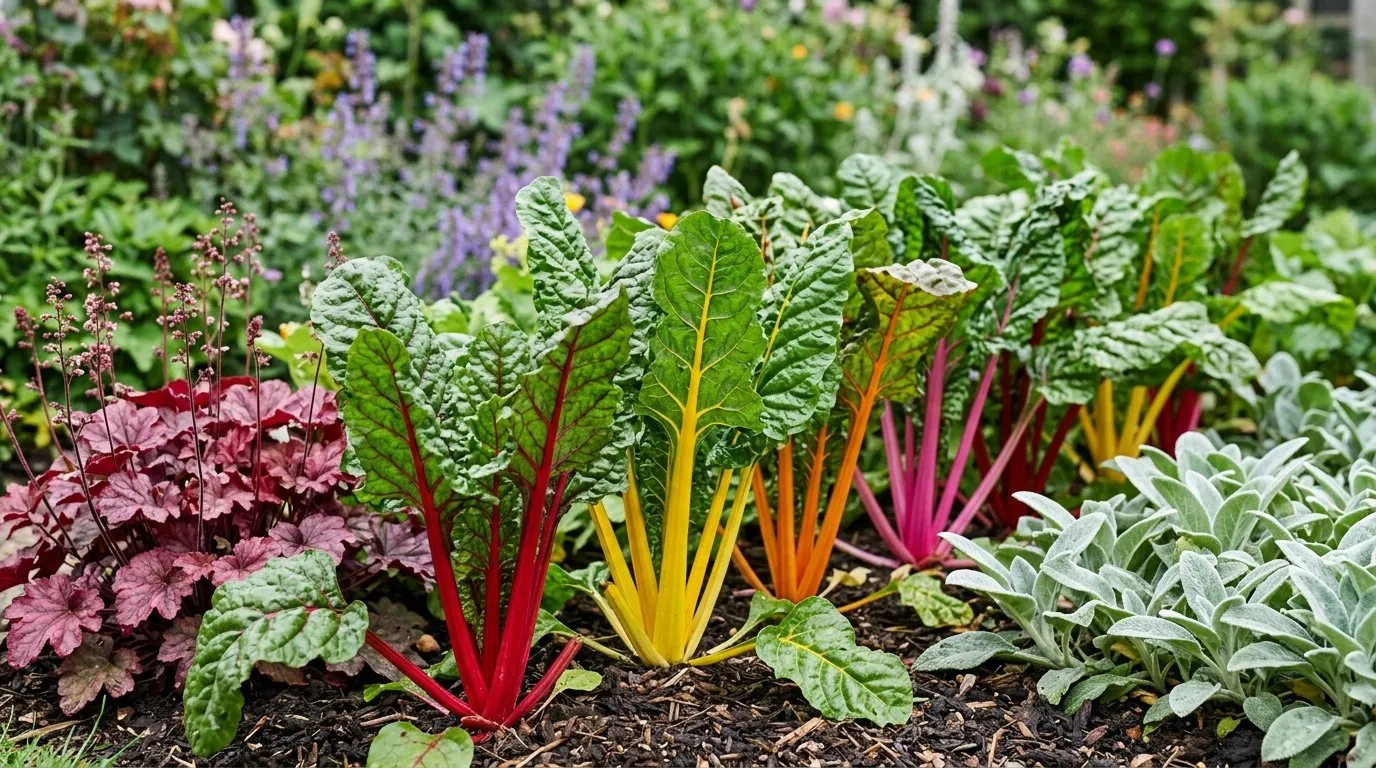 Rainbow chard among heuchera and silver foliage in mid-July. Cut outer stems weekly and the plant keeps producing through to October.
Sources: Royal Horticultural Society | Edible Flowers Database — UK Garden Trust
Our team produces practical UK gardening guidance from source research, contributor records and established horticultural practice. Editorial standards are overseen by Matt W.