Key takeaways
- Common sorrel is a UK native perennial producing sharp, lemony leaves from March to November
- French sorrel has a milder flavour and smaller shield-shaped leaves suited to raw salads
- Sow direct March to May or start in pots — sorrel germinates in 7-14 days at 10-20C
- Tolerates partial shade better than most salad crops, making it ideal for north-facing beds
- Remove flower stems as they appear to extend leaf production by 6-8 weeks
- Contains oxalic acid — eat in moderation, especially raw, and avoid if prone to kidney stones
Sorrel is one of those plants that experienced kitchen gardeners swear by and everyone else overlooks. It produces sharp, lemony leaves from early spring right through to late autumn. It asks for almost nothing in return. No staking, no feeding regime, no complicated pest control. Plant it once and harvest for years.
Two species matter for UK growers. Common sorrel (Rumex acetosa) is a British native wildflower found in grasslands across every county. French sorrel (Rumex scutatus) is a smaller, more refined plant from southern Europe that has been grown in British kitchen gardens since at least the sixteenth century. Both are fully hardy, genuinely perennial, and absurdly productive for the space they occupy.
What is the difference between common and French sorrel?
The two species look different, taste different, and suit different kitchen uses. Choosing the right one, or growing both, makes the most of what sorrel offers.
Common sorrel produces large, arrow-shaped leaves on upright stems reaching 60-90cm tall. The flavour is intense. Sharp, acidic, and unmistakably lemony. Young leaves are tender enough for salads, but the real strength of common sorrel is cooking. Sorrel soup, sorrel sauce with fish, and sorrel stirred into risotto all rely on that bold acidity.
French sorrel stays compact at 30-40cm with smaller, shield-shaped leaves. The flavour is gentler. Still lemony, but softer and less mouth-puckering. French sorrel is the better choice for raw salads, sandwiches, and garnishes. It also tolerates drier soils and hotter positions than common sorrel.
| Feature | Common Sorrel (R. acetosa) | French Sorrel (R. scutatus) |
|---|---|---|
| Height | 60-90cm | 30-40cm |
| Leaf shape | Arrow-shaped, large | Shield-shaped, small |
| Flavour | Intense, sharp, acidic | Mild, gentle, lemony |
| Best use | Cooking: soups, sauces, wilted | Raw: salads, sandwiches, garnish |
| Soil preference | Moist, fertile, clay tolerant | Drier, lighter, well-drained |
| Sun tolerance | Partial shade preferred | Full sun to partial shade |
| Bolting tendency | Bolts freely from June | Bolts less readily |
| Spread habit | Clump-forming, some self-seeding | Low spreading, ground cover |
| Native to UK | Yes, wild in all counties | No, southern European origin |
| Oxalic acid level | Higher | Lower |
For most kitchen gardens, growing both makes sense. Common sorrel for the cooking pot and French sorrel for the salad bowl. If you only have room for one, your cooking habits decide. If you grow lettuce and other salad leaves already, French sorrel adds a flavour dimension nothing else provides.
How do I sow and plant sorrel?
Sorrel is straightforward to establish from seed. It germinates reliably and grows quickly enough to produce harvestable leaves within 8-10 weeks of sowing.
Sowing direct outdoors
Sow from March to May once the soil has warmed above 10C. Create shallow drills 1cm deep and 30cm apart. Scatter seed thinly along the drill and cover lightly. Water gently and keep the soil moist until seedlings emerge in 7-14 days. Thin common sorrel seedlings to 30cm apart and French sorrel to 20cm.
Direct sowing works best on lighter soils that do not cap over. On heavy clay, starting in pots gives better results. If you are working with difficult soil, our guide to improving clay soil covers the techniques that make direct sowing more reliable on heavier ground.
Starting in pots
Sow 3-4 seeds per 9cm pot filled with multipurpose compost. Keep at 15-20C on a windowsill or in an unheated greenhouse. Thin to the strongest seedling once true leaves appear. Harden off for a week before planting out in final positions from late April onwards.
Pot-raised plants establish faster and avoid the slug damage that often wipes out direct-sown seedlings. This matters on allotments and in gardens where slugs are a persistent problem.
Buying plants
Garden centres occasionally stock sorrel, usually French sorrel, in the herb section. One or two plants of each type are enough for most households. A single common sorrel plant produces more leaves than one family can use in a week during peak season.
Where should I plant sorrel in the garden?
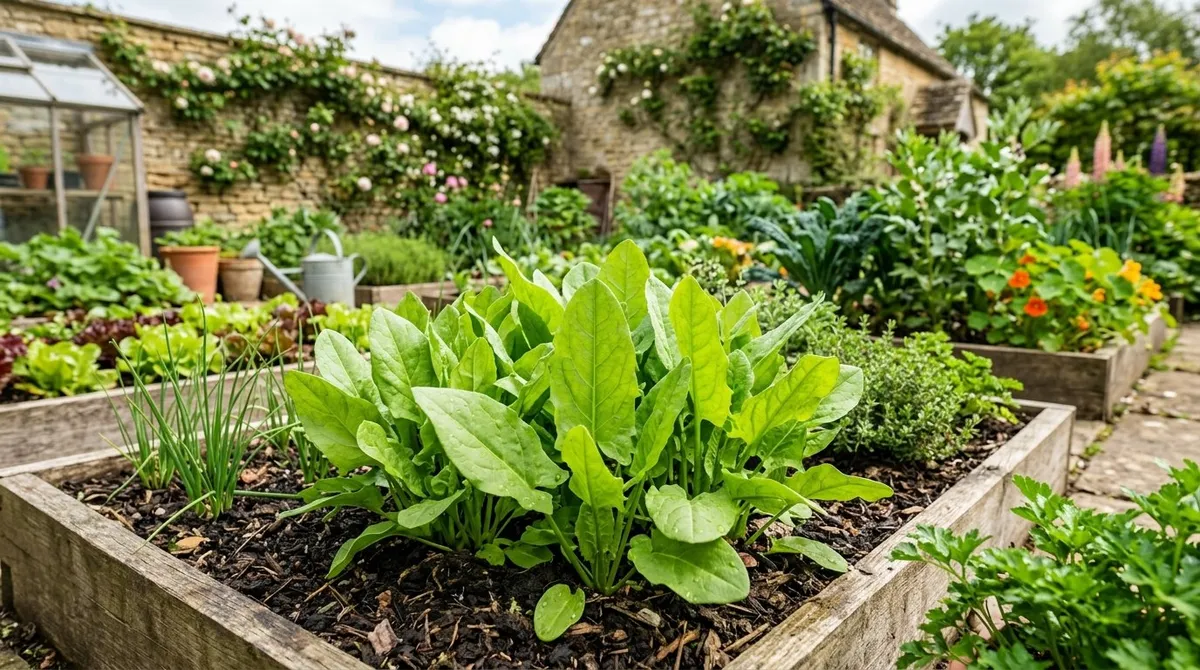
Sorrel is unusually flexible about its position. Unlike most salad crops, it performs well in partial shade and even tolerates full shade with reduced but still useful yields.
Light requirements
Full sun produces the largest leaves and heaviest crops. Partial shade (3-4 hours of direct sun) is nearly as productive and has a significant advantage. Shaded plants bolt later in summer, extending the harvesting window by several weeks. Full shade produces smaller leaves but remains worthwhile. Position sorrel where nothing else productive will grow, under fruit trees, against a north-facing fence, or in the shadow of taller crops, and it still delivers.
This shade tolerance makes sorrel an excellent companion for taller vegetables. Plant it between rows of runner beans or beneath the canopy of broad beans and it fills ground that would otherwise sit empty.
Soil requirements
Common sorrel prefers moist, fertile soil and thrives on clay. French sorrel prefers lighter, well-drained ground. Both tolerate a wide pH range from 5.5 to 7.5. Neither needs rich soil to produce well. On very poor ground, a single application of garden compost at planting is enough.
Avoid waterlogged sites. Sorrel tolerates heavy soil but not standing water. If drainage is poor, grow in raised beds or mound the planting area slightly.
Spacing and placement
Space common sorrel 30cm apart in rows 40cm apart. Space French sorrel 20cm apart in rows 30cm apart. Both work well in herb gardens alongside perennial herbs like chives, thyme, and lovage. French sorrel also makes attractive edging along paths and raised beds.
How do I care for sorrel through the year?
Sorrel is a low-maintenance crop once established. The main tasks are watering during dry spells, removing flower stems, and replacing plants every few years.
Watering
Keep soil consistently moist during the main growing season from April to September. Sorrel wilts visibly in drought, and stressed plants bolt faster. A weekly soak during dry weather is usually enough. Mulching with compost or leaf mould reduces the need for supplementary watering.
Feeding
Sorrel needs no regular feeding on reasonable soil. A top dressing of garden compost each autumn provides enough nutrients for the following year. Avoid high-nitrogen feeds. They produce soft, floppy growth that lacks the characteristic tartness.
Removing flower stems
This is the single most important maintenance task. Common sorrel sends up flower stems from late May, and French sorrel follows in June. Left to flower, the leaves turn bitter, tough, and sparse within a week. Snap or cut flower stems at the base as soon as they appear. Check plants every 3-4 days during the peak bolting period of June and July.
Allowing one or two plants to flower in late summer provides seed for the following year if you want to expand your patch. The tall, rust-coloured seed heads of common sorrel are also quite ornamental. Just keep them separate from your cropping plants.
Winter care
Sorrel dies back to ground level in late autumn. Cut away the dead foliage and apply a 5cm mulch of leaf mould or compost over the crowns. This protects against frost heave on clay soils and feeds the soil for next year. New growth emerges in February or early March, weeks before most other salad crops are ready.
When and how do I harvest sorrel?
Harvesting correctly keeps plants productive throughout their long season. Take too much at once and recovery slows. Take too little and leaves age past their best on the plant.
Timing
First harvest is possible 8-10 weeks after spring sowing. For established plants, picking begins in March when new leaves reach 10-15cm long. The season runs through to November in mild years. Peak flavour and tenderness fall between April and June before the summer heat intensifies the acidity.
Method
Pick individual outer leaves by snapping the stem cleanly at the base. Leave the central growing point and at least half the foliage intact. Never strip a plant bare. For common sorrel, the youngest leaves near the centre are the mildest and most tender. For French sorrel, all leaves are mild enough to eat raw.
Cut-and-come-again harvesting also works. Use scissors to cut all leaves 3-4cm above the crown, and the plant regrows within 2-3 weeks. This method works best for French sorrel, which recovers faster than common sorrel.
Yield
A single established common sorrel plant produces around 500g of leaves per year. Five plants provide a generous weekly supply for a household of four throughout the season. French sorrel yields less by weight due to its smaller leaf size, but 3-4 plants still supply ample salad leaves.
What can I cook with sorrel?
Sorrel’s sharp acidity brings a brightness to cooking that no other leaf matches. It has been a staple of French and Eastern European kitchens for centuries. British cooks are only now rediscovering what was once a common cottage garden crop.
Classic sorrel soup
The simplest and most famous use. Wilt a large handful of common sorrel leaves in butter, add potato stock, simmer for 15 minutes, and blend. The vivid green colour fades to a mossy khaki during cooking, which is normal. Season with salt, pepper, and a swirl of cream. Serves two as a starter. The flavour is tangy, warming, and unlike any other soup.
Sorrel sauce for fish
Melt butter, add finely shredded sorrel leaves, and stir until wilted. Add a splash of cream and reduce gently. This classic French sauce pairs with salmon, trout, and mackerel. The acidity cuts through the richness of oily fish the way lemon does, but with more depth. It also works with poached eggs and grilled chicken.
Raw in salads
French sorrel leaves add a lemony sharpness to mixed salads without needing lemon juice or vinegar in the dressing. Tear the small leaves and mix with lettuce, rocket, and spinach. Young common sorrel leaves also work raw but are more assertive. Use sparingly or balance with sweeter leaves like lamb’s lettuce.
Other uses
Stir wilted sorrel into risotto, fold into omelettes, blend into green mayonnaise, or use as a tangy filling for savoury pastries. In Eastern European cooking, sorrel appears in cold summer soups, pie fillings, and as a wrapping for rice dishes. The Royal Horticultural Society lists sorrel among its recommended perennial vegetables for UK gardens.
Does sorrel contain oxalic acid?
Yes. All Rumex species contain oxalic acid, the same compound found in rhubarb leaves, spinach, and beetroot greens. Understanding the levels and managing intake means you can enjoy sorrel safely.
How much oxalic acid is in sorrel?
Common sorrel contains roughly 300-700mg of oxalic acid per 100g of fresh leaves. French sorrel contains less, typically 200-400mg per 100g. For comparison, spinach contains 400-900mg per 100g and rhubarb leaves contain 500-1000mg per 100g.
Who should limit intake?
People with a history of kidney stones (especially calcium oxalate stones), gout, or rheumatoid arthritis should eat sorrel sparingly or avoid it. For everyone else, moderate consumption of a few leaves per day in salads or a bowl of sorrel soup once or twice a week is perfectly safe, as confirmed by Garden Organic.
Does cooking reduce oxalic acid?
Yes. Boiling and discarding the cooking water removes 30-50% of the oxalic acid. Wilting in butter or cream (the classic preparation) retains more acid but also provides calcium, which binds with oxalic acid and reduces absorption. Pairing sorrel with dairy is both traditional and sensible.
How do I propagate and replace sorrel plants?
Sorrel plants crop well for 4-5 years before declining. Division and self-seeding provide easy replacements without buying new seed.
Division
Lift established clumps in early spring (March) or autumn (September-October). Pull apart the outer sections with healthy roots and discard the tough, woody centre. Replant divisions immediately at the same depth and water well. Each division establishes quickly and reaches full production the same season.
Self-seeding
Plants allowed to flower and set seed self-sow readily. Common sorrel can be moderately invasive through self-seeding on lighter soils. Remove unwanted seedlings as they appear, or hoe them off while small. French sorrel self-seeds less aggressively.
Seed saving
Allow one or two flower stems to mature fully until the seeds turn brown and papery in late summer. Cut the stems and shake the seeds into a paper bag. Store in a cool, dry place. Viability lasts 2-3 years. This is a useful approach if you want to expand a patch or share with other allotment holders.
Common problems growing sorrel
Sorrel is remarkably trouble-free. Pests and diseases rarely cause serious damage, and most problems relate to management rather than external threats.
Bolting
The most common complaint. Sorrel bolts in response to heat, drought stress, and long days. Regular flower stem removal, consistent watering, and partial shade all reduce bolting. French sorrel bolts less than common sorrel.
Slug damage
Young seedlings are vulnerable to slug attack, particularly on heavy soils. Protect with beer traps, copper tape, or nematode biological controls. Established plants are rarely troubled by slugs because the oxalic acid in the leaves makes them unpalatable.
Sorrel leaf beetle
The green dock beetle (Gastrophysa viridula) occasionally feeds on sorrel leaves, creating small holes. Damage is usually cosmetic rather than harmful. Pick off beetles by hand if numbers are high. The beetle is actually an attractive metallic green insect and an interesting part of the garden ecosystem.
Rust
Orange-brown pustules on the underside of leaves indicate rust fungus. Remove and destroy affected leaves. Improve air circulation by spacing plants properly. Rust is more common in damp, still conditions. It rarely kills the plant but reduces leaf quality.
Frequently asked questions
Is sorrel easy to grow in the UK?
Yes, sorrel is one of the easiest perennial vegetables for UK gardens. It tolerates clay soil, partial shade, cold winters, and neglect. Common sorrel is native to British grasslands and grows wild across every county. Sow seed in spring, keep the ground moist until germination, and harvest leaves within 8-10 weeks. Plants return year after year without replanting.
What is the difference between common sorrel and French sorrel?
Common sorrel has large, arrow-shaped leaves with an intense lemony tang. French sorrel has smaller, shield-shaped leaves with a milder flavour. Common sorrel (Rumex acetosa) grows taller at 60-90cm and is better for cooking. French sorrel (Rumex scutatus) stays compact at 30-40cm and is better for raw salads. Both are fully hardy perennials in all UK regions.
Can I grow sorrel in shade?
When should I sow sorrel seeds?
Sow sorrel seeds from March to May, either direct or in pots. Scatter seed thinly on the surface of moist compost and press lightly. Do not cover deeply as seeds need some light. Germination takes 7-14 days at soil temperatures of 10-20C. Thin seedlings to 30cm apart for common sorrel or 20cm for French sorrel.
Is sorrel safe to eat in large quantities?
Eat sorrel in moderation due to its oxalic acid content. Oxalic acid is present in all Rumex species and can irritate the digestive system in large amounts. People with kidney stones or gout should limit intake. Cooking reduces oxalic acid levels significantly. Small amounts in salads, soups, and sauces are perfectly safe for most adults.
How do I stop sorrel from going to seed?
Remove flower stems as soon as they appear, typically from late May onwards. Snap or cut the stem at the base before it reaches full height. This redirects the plant’s energy into leaf production and extends the cropping season by 6-8 weeks. Check plants every few days during the main bolting period of June and July.
Can I harvest sorrel in winter?
Our team produces practical UK gardening guidance from source research, contributor records and established horticultural practice. Editorial standards are overseen by Matt W.