White Garden Planting Scheme UK
White garden planting scheme: design an all-white border with seasonal plant combinations, foliage, structure, and Sissinghurst principles.
Key takeaways
- A Sissinghurst-inspired white border needs 18-22 species across 4 seasonal waves to avoid gaps
- Silver foliage (Stachys, Artemisia) and lime-green foliage (Alchemilla) anchor white flowers between flushes
- Moon gardens use evening-visible whites: Philadelphus, white nicotiana, Rosa 'Iceberg', white jasmine — scent intensifies after 7pm
- Never mix warm whites (cream, ivory) with cool whites (pure, blue-tinged) in the same sightline — one looks dirty
- Box or lavender hedging as enclosure gives white planting the dark surround that makes it luminous rather than flat
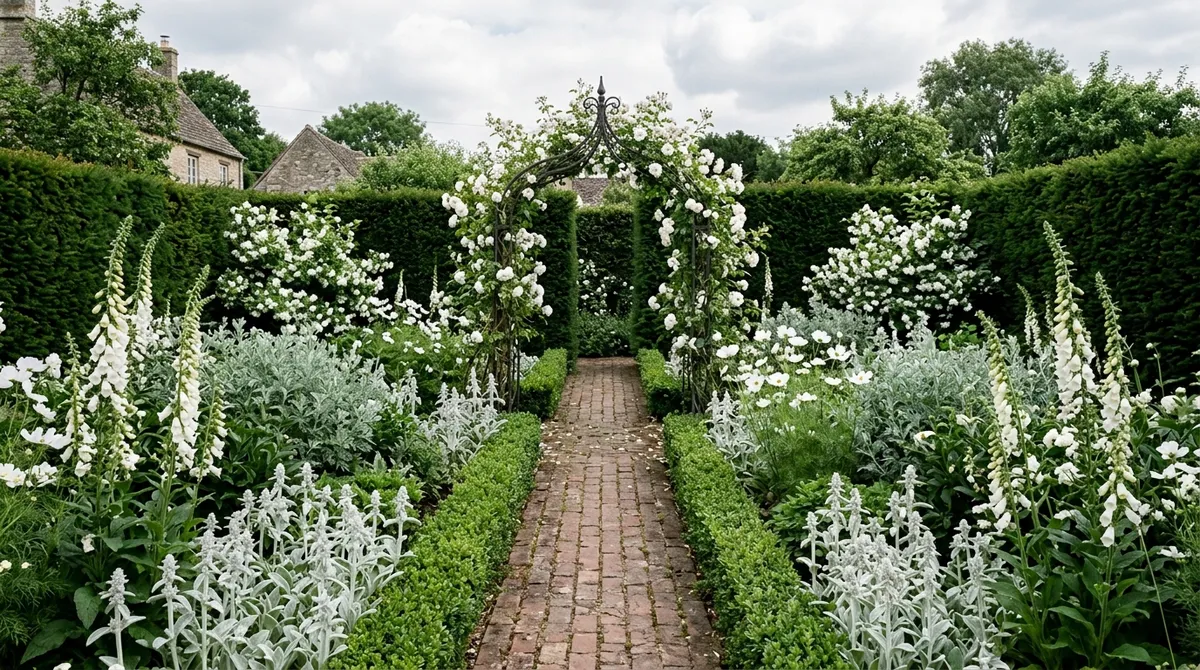
A white garden planting scheme is the most disciplined form of colour gardening — you have one colour register to work with, and everything depends on form, foliage, and seasonal structure. Done well, it is arrestingly beautiful. Done without planning, it looks flat by July.
I have spent six years refining a white border on heavy West Midlands clay, redesigning it twice after honest failures. What follows is not a list of white plants — for that, see the companion white flowers guide. This is the design brief: how to structure a scheme, layer the seasons, choose supporting foliage, and understand what made Sissinghurst’s White Garden work when so many imitations do not.
The Sissinghurst model: what actually made it work
Vita Sackville-West planted the White Garden at Sissinghurst Castle in Kent in 1949. The National Trust maintains it today and it remains the most influential white planting scheme in Britain. Almost every white garden created since draws from its principles, consciously or not.
The scheme’s success is not about the plants alone. It is about six structural decisions that most imitations miss:
1. Enclosure. The White Garden is enclosed by yew hedging and walls. The dark surround makes white flowers luminous rather than washed out. An open white border set against a pale fence looks flat. An enclosed white border against dark hedging glows.
2. Scale. The Sissinghurst White Garden measures roughly 12m x 18m with internal box-edged beds. It has room for 60+ species across distinct zones. A domestic interpretation needs a minimum of 4m x 6m to achieve the layered effect. A narrow white strip planting never works.
3. Foliage dominance. Grey and silver foliage plants (Artemisia, Senecio, Stachys) occupy roughly 40% of the planting area. They are not gaps between flowers — they are the structure. The flowers punctuate a silver-grey base, not the other way around.
4. Species diversity across plant families. The scheme mixes roses, climbers, shrubs, perennials, biennials, bulbs, and annuals. A white border built from a single plant family (all roses, all perennials) looks thin because every plant flowers at the same time and gaps appear together.
5. Vertical structure. Rosa mulliganii on the central iron frame provides height to 6m. Most domestic white gardens underprovide for vertical structure. Climbers, tall shrubs, and back-of-border perennials (delphiniums, white foxgloves at 1.5-2m) are non-negotiable.
6. Seasonal relay. Spring flowers finish before summer flowers begin — there is no single white plant that covers all seasons. The scheme must be planned as a sequential relay, with each plant handing the main role to the next.
The RHS white garden planting guide covers the history and plant associations of white planting in depth.
Designing the white border from scratch
Aspect and enclosure
White gardens perform best facing south or west. A south-facing aspect maximises flowering duration and keeps the border warm for evening viewing. West-facing is ideal for moon gardens — you look towards the setting sun with the white planting lit from the front until 9pm in summer.
Enclosure is the single most important structural decision. Options:
- Yew hedge — the Sissinghurst solution. Dark, dense, clips to a hard edge. Takes 7-10 years to establish. Provides the best backdrop.
- Beech hedge — faster than yew, holds copper-brown leaves through winter (gives a warm backdrop rather than dark). Fully effective by year 4-5.
- Box hedging — use for internal bed edging within the white garden, not the outer enclosure. Box blight risk is high in UK gardens; use Ilex crenata or Euonymus as alternatives.
- Dark-painted fence or wall — a fence painted in dark green (Farrow & Ball Mizzle, Railings, or similar) creates the same backdrop effect much faster. Not traditional, but highly effective.
Border depth and dimensions
A white border needs a minimum of 2m depth for three planting layers. Less than 2m, you cannot achieve the front-to-back gradation of height that gives the scheme depth.
For the full Sissinghurst effect — enclosure, central focal point, multiple beds — a minimum of 4m x 6m is required. In smaller gardens, a 2m x 4m single-sided border against a dark fence is the most effective compromise.
Do not create a white border less than 1.5m deep. It will look like a strip and fail structurally regardless of the plants chosen.
The central focal point
Every successful white garden has a structural centrepiece: a rose arch, a topiary specimen, a birdbath, or an obelisk with a climbing rose. This gives the eye somewhere to rest and creates a visual anchor when the flower display is transitional between seasons.
For a domestic white garden, a single metal or wooden arch planted with Rosa ‘Wedding Day’ (or, in smaller gardens, Rosa ‘Iceberg Climbing’) provides the vertical structure without dominating the space.
White garden planting: the four seasonal waves
A white planting scheme must be planned as four distinct waves, each handed off to the next. If any wave is missing, the border goes blank for weeks.
Wave 1: Winter and early spring (January to March)
The winter wave provides scent and structure when the rest of the border is dormant. It does not need to be spectacular — but it must exist.
Key plants:
| Plant | Type | Height | Flowers | Notes |
|---|---|---|---|---|
| Sarcococca confusa | Evergreen shrub | 1-2m | January-February | Vanilla fragrance, shade-tolerant |
| Helleborus niger ‘Josef Lemper’ | Perennial | 30cm | December-February | Upward-facing flowers, most visible variety |
| Helleborus x hybridus (white) | Perennial | 40cm | February-March | Clump-forming, long-lived |
| Snowdrops (Galanthus nivalis) | Bulb | 7-10cm | January-February | Naturalise in grass or under shrubs |
| Narcissus ‘Thalia’ | Bulb | 35-40cm | April | Plant throughout scheme at 15cm spacing |
Plant Sarcococca beside an entrance, path, or gate where its January fragrance can be encountered daily. Snowdrops belong under deciduous shrubs and trees where they receive winter light but summer shade.
Wave 2: Late spring (April to June)
The spring wave is the most generous: bulbs, blossom, and early perennials produce the year’s greatest flower concentration.
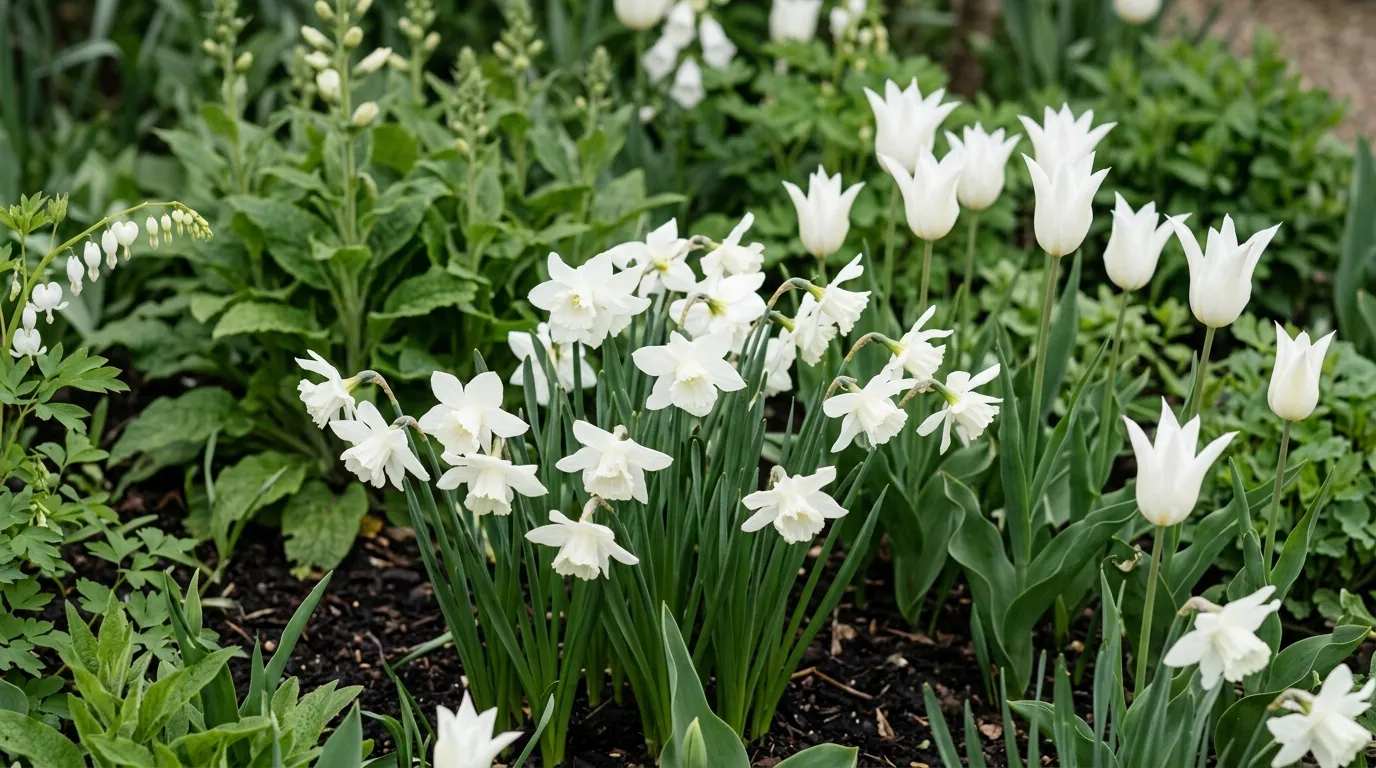 White spring wave: Narcissus ‘Thalia’ and Tulip ‘White Triumphator’ before summer perennials take over. Underplant throughout the border at 15cm spacing.
Key plants:
| Plant | Type | Height | Flowers | Notes |
|---|---|---|---|---|
| Narcissus ‘Thalia’ | Bulb | 35-40cm | April | Double-flowered white daffodil, naturalises |
| Tulip ‘White Triumphator’ | Bulb | 65-70cm | Late April-May | Elegant lily-flowered form |
| Allium ‘Mount Everest’ | Bulb | 80-90cm | May-June | White globe heads, architectural |
| Camassia leichtlinii ‘Alba’ | Bulb | 60-90cm | May-June | White star flowers, moist soil |
| Aquilegia vulgaris var. alba | Perennial | 60-90cm | May-June | Self-seeds freely, biennial behaviour |
| White foxgloves (Digitalis purpurea f. albiflora) | Biennial | 1.2-1.5m | June | Self-seeds; scatter seed each autumn |
| Allium hollandicum ‘Mount Blanc’ | Bulb | 60-80cm | May | Smaller white allium for mid-border |
Underplant the entire scheme with Narcissus ‘Thalia’ bulbs at 15cm spacing. They cost very little, occupy no permanent space, and provide the first concentrated white flush before anything else is moving.
Wave 3: Summer core (June to August)
The summer wave is the main event. This is when the full scheme should be reading at full intensity: roses, Philadelphus, foxgloves, delphiniums, and the foliage plants that hold it together.
Key plants:
| Plant | Type | Height | Flowers | Notes |
|---|---|---|---|---|
| Rosa ‘Iceberg’ | Shrub rose | 1.2m | June-November | Most reliable white rose for UK schemes |
| Rosa ‘Winchester Cathedral’ | Shrub rose | 1.2m | June-October | Myrrh fragrance, repeat-flowering |
| Rosa ‘Wedding Day’ (climbing) | Climber | 5-6m | June-July | Cream-white clusters, once-flowering |
| Philadelphus ‘Belle Etoile’ | Shrub | 1.5-2m | June-July | Strongest fragrance of any white shrub |
| Philadelphus ‘Virginal’ | Shrub | 2-3m | June-July | Double flowers, taller form |
| Delphinium ‘Galahad’ | Perennial | 1.5-1.8m | June-July | White spires, stake in May |
| Phlox paniculata ‘White Admiral’ | Perennial | 1m | July-September | Fragrant, repeat-flowering |
| Nicotiana alata (white) | Annual | 60-90cm | June-October | Intensely fragrant in evenings |
| Cosmos bipinnatus ‘Purity’ | Annual | 90cm | June-October | Airy white flowers, long season |
The Philadelphus requires particular attention in design terms. It is large, needs space (allow 2m across), and flowers only in June-July. But its fragrance — sweet, orange-blossom, carrying 10m on a warm evening — is irreplaceable in any white garden. Do not sacrifice it for a tidier scheme.
Wave 4: Late summer and autumn (August to October)
Without a fourth wave, the white garden falls dark in late summer at precisely the time when evenings are warm enough to be outside. Japanese anemones are the key plant here.
Key plants:
| Plant | Type | Height | Flowers | Notes |
|---|---|---|---|---|
| Anemone x hybrida ‘Honorine Jobert’ | Perennial | 1-1.2m | August-October | Single white flowers, spreads freely |
| Hydrangea paniculata ‘Limelight’ | Shrub | 2m | July-September | Cream-white cones, goes pink in autumn |
| Hydrangea arborescens ‘Annabelle’ | Shrub | 1.5m | July-September | Large white globes, lime-green with age |
| Anemanthele lessonana | Grass | 60cm | Foliage year-round | Warm-tinted grass, catches light in autumn |
| Gaura lindheimeri ‘Whirling Butterflies’ | Perennial | 60-90cm | June-October | Airy white flowers, long season |
| White asters (Symphyotrichum ‘White Swan’) | Perennial | 60-80cm | September-October | Needs dividing every 2-3 years |
Japanese anemones need to be managed. They spread by underground runners and can be invasive in good soil. Plant them at the back of the border or in a contained bed. Once they are settled, their August-to-October flowering covers the period when almost nothing else in a white scheme is at its peak.
The foliage framework: carrying the scheme between waves
The biggest design failure in domestic white gardens is treating foliage as an afterthought. White flowers without contrasting foliage disappear. Silver, lime-green, dark green, and white-variegated foliage are the permanent architecture of a white scheme.
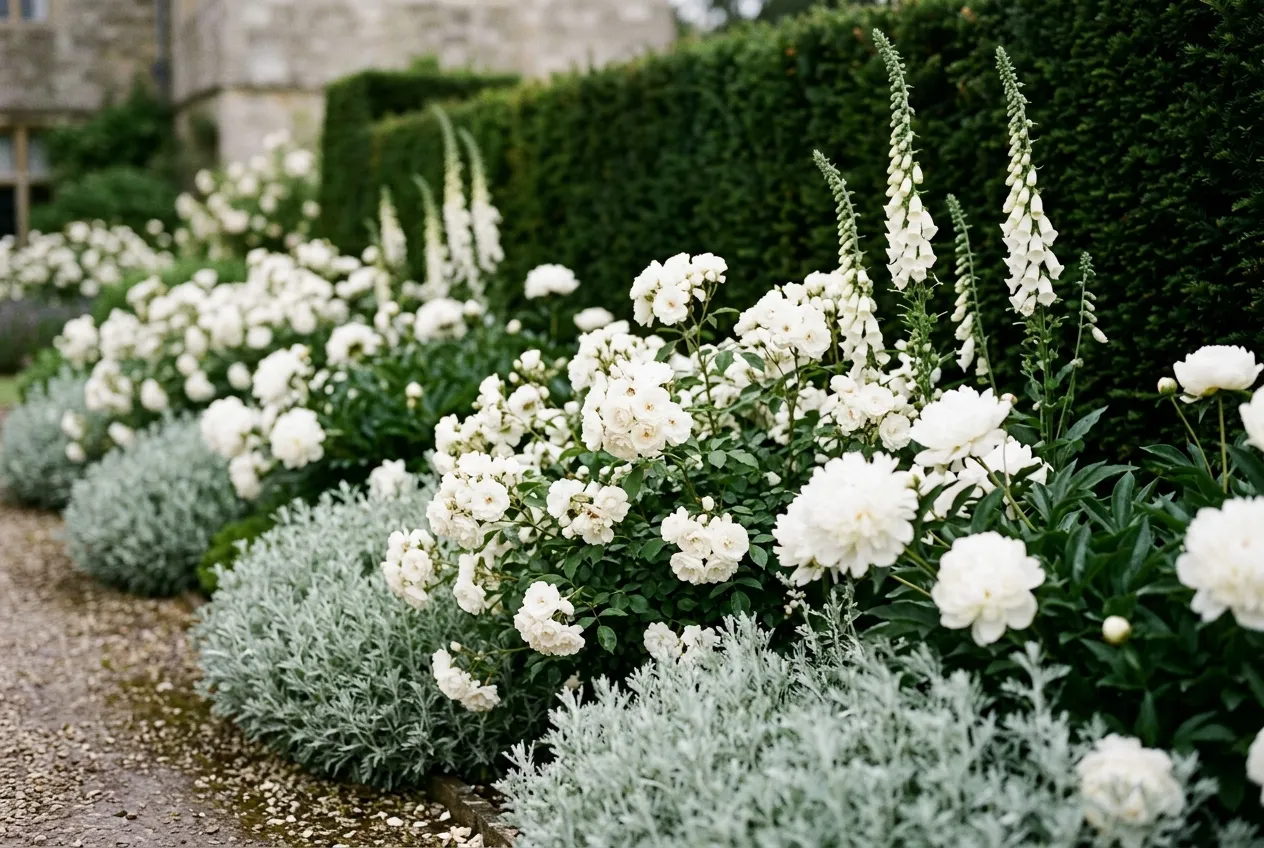 The summer core: silver Stachys and Artemisia foliage anchors white roses and Philadelphus. Without the silver framework the scheme reads as flat and patchy.
Silver foliage plants
Stachys byzantina (lamb’s ears) is the most important foliage plant in any white garden. Its silver-felted leaves, 15-20cm long, form dense mats 30cm high. Plant at the front edge of the border, one plant per 50cm of run. It spreads steadily, suppresses weeds, and visually unifies the scheme from April to October. The flower stems (pinky-purple) should be cut off as they appear to maintain the foliage effect.
Artemisia ‘Powis Castle’ provides silver mid-border fill to 80cm. Feathery, intensely silver foliage. It is semi-evergreen and retains silver-grey structure through winter. Cut back hard in April to prevent woodiness.
Convolvulus cneorum — a compact silver shrub (50-60cm) with white funnel flowers in May to June. Needs good drainage; ideal for the front of a sun-facing border.
Lime-green and chartreuse foliage
Alchemilla mollis (lady’s mantle) is the essential foil for white flowers. Its chartreuse-yellow flower sprays in June-July make any white alongside it appear colder and purer by contrast. Plant at the border front. Cut back hard after flowering for a second flush of fresh foliage. It self-seeds and may need managing.
Euphorbia characias wulfenii — structural, upright, grey-green leaves, lime-yellow flower heads March to May. 1m tall. Long-lived and drought-tolerant. The lime-green flowers create the chartreuse contrast in spring before Alchemilla takes over in summer.
Dark green and black foliage
Dark foliage creates the maximum contrast with white flowers.
Ophiopogon planiscapus ‘Nigrescens’ (black mondo grass) — 15-20cm, near-black strap leaves, evergreen. Use at the front edge alongside Stachys for a high-contrast pairing. White cosmos alongside black mondo is one of the most striking plant combinations available in UK gardens.
Prunus lusitanica (Portuguese laurel) — if space allows, a clipped Portuguese laurel hedge provides a very dark, glossy-leaved backdrop. Responds well to clipping and is more disease-resistant than common laurel.
Plant combinations by position
A white planting scheme fails if any section is designed in isolation. The table below shows tested plant combinations by border position and season.
| Border position | Spring combination | Summer combination | Autumn combination |
|---|---|---|---|
| Back (1.5-2m+) | White foxgloves + Camassia ‘Alba’ | Delphinium ‘Galahad’ + Rosa ‘Wedding Day’ (arch) | Anemone ‘Honorine Jobert’ + white aster |
| Middle (60-100cm) | Allium ‘Mount Everest’ + Aquilegia alba | Rosa ‘Iceberg’ + Phlox ‘White Admiral’ | Gaura ‘Whirling Butterflies’ + Hydrangea ‘Annabelle’ |
| Front (under 45cm) | Narcissus ‘Thalia’ + emerging Stachys | Stachys byzantina + Alchemilla mollis + white cosmos | Stachys + Anemanthele lessonana |
| Structural anchor | White-variegated Cornus ‘Elegantissima’ | Philadelphus ‘Belle Etoile’ (corner or centre) | Hydrangea paniculata ‘Limelight’ |
| Climbers | — | Rosa ‘Winchester Cathedral’ on obelisk | White jasmine (Jasminum officinale) |
The two pairings that do the most work across the longest season:
-
Stachys byzantina + Rosa ‘Iceberg’ — silver foliage with pure white floribunda roses. The Iceberg flowers June to November. The Stachys is present April to October. Together they give six months of the silver-and-white combination that is the core visual language of the style.
-
Alchemilla mollis + any white rose — the chartreuse-yellow Alchemilla flowers make white roses appear visually colder and more luminous. It is the best foil combination in British horticulture. Alchemilla self-seeds freely; you will never need to replant it.
The moon garden variation
A moon garden is a specific interpretation of the white planting scheme designed for evening visibility. White and silver plants reflect whatever ambient light is available — moonlight, low sunset, or garden lighting — and remain visible well after dark-coloured plants disappear into the background.
A west-facing moon garden in the UK is visible from approximately 7pm onwards from May to August. A south-facing site works from June to August when sunset is late enough.
Moon garden plant selection priorities:
-
Evening fragrance. Scent intensifies as temperatures fall in the evening. Philadelphus, white jasmine (Jasminum officinale, July to August), white nicotiana, and white sweet peas all release fragrance most powerfully in the evening. At least one intensely fragrant plant is essential.
-
Pale flower form. Single, flat, or upward-facing flowers catch more light than tubular or downward-facing forms. Rosa ‘Iceberg’ (flat flowers), white cosmos (flat, single), and white nicotiana (upward-facing trumpets) all perform well in low light.
-
Silver foliage quantity. In a moon garden, increase the silver foliage component to 50-60% of the planting area. Stachys, Artemisia, Convolvulus cneorum, and Lychnis coronaria ‘Alba’ all glow in low light.
-
Seed to garden lighting. For more ideas on extending evening viewing, our garden lighting guide covers low-voltage LED border lighting that enhances moon garden effects.
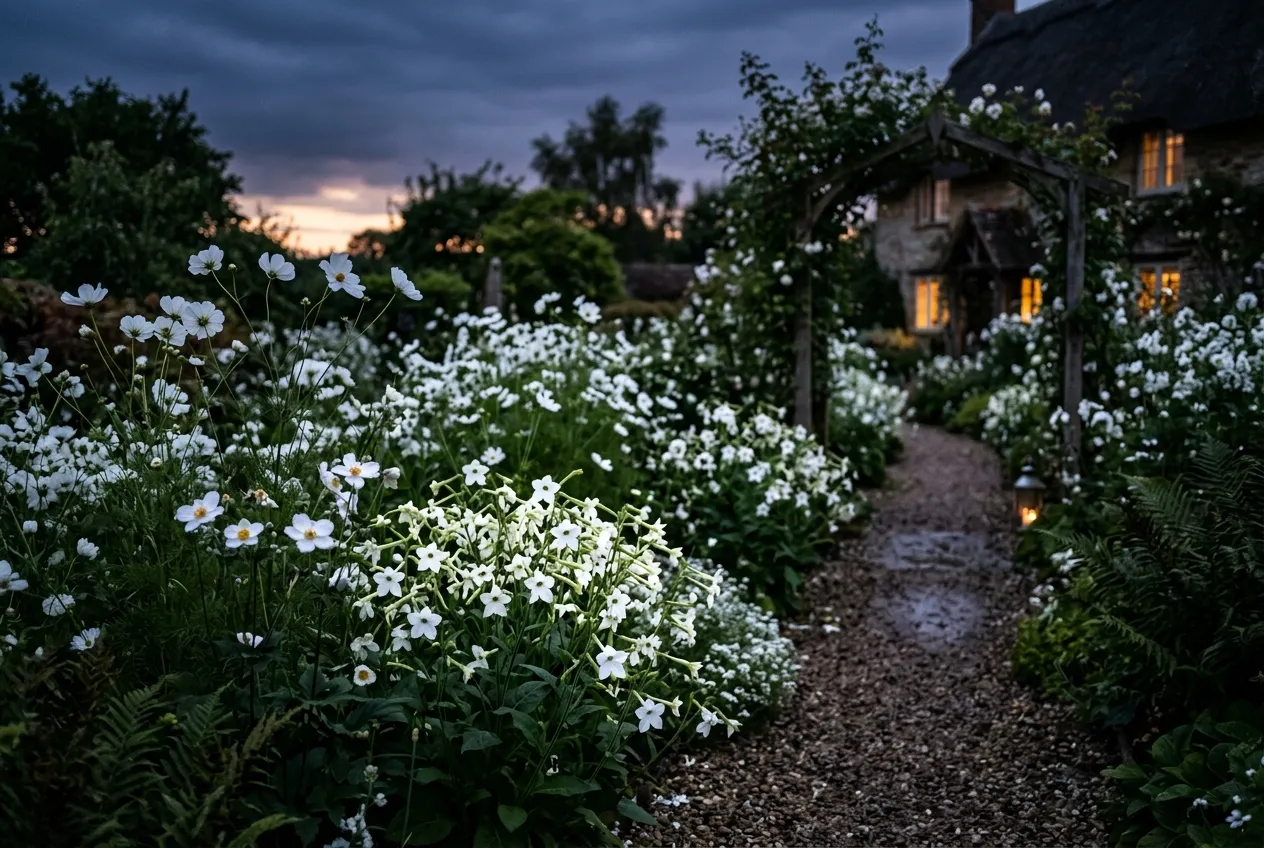 Moon garden effect: white nicotiana, Rosa ‘Iceberg’, and Stachys byzantina catch the last light in a west-facing border at 8:30pm in July. Plant silver foliage at 50-60% of the scheme to maximise the effect.
White garden design mistakes to avoid
Mixing warm and cool whites
Creamy white (Philadelphus ‘Belle Etoile’) placed directly next to pure white (Rosa ‘Iceberg’) makes the creamy white look dirty. This is the most common white garden failure. The solution is to plan your scheme around one white register — all warm (cream, ivory, blush-white) or all cool (pure white, blue-tinged white) — and keep them separated if you want both in the same garden. In a small garden, choose one register and stick to it.
Warm whites: Philadelphus, Rosa ‘Gentle Hermione’, Paeonia ‘Duchesse de Nemours’, white cosmos (slightly warm).
Cool whites: Rosa ‘Iceberg’, Delphinium ‘Galahad’, white nicotiana, Cosmos ‘Purity’.
No enclosure
An open white border against a pale painted fence, a light sky, or a light-coloured wall reads as flat. The white plants disappear into the background. Dark enclosure — yew, box, beech, or dark-painted fence — is not decorative detail; it is the optical mechanism that makes the scheme work.
Too few foliage plants
A white garden with only white flowers and standard green foliage loses its identity between flowering waves. Without Stachys, Artemisia, and Alchemilla, the scheme reads as a border with some white flowers in it — not a white garden scheme. Invest in the silver and lime-green foliage plants first.
Ignoring height
Most domestic white borders are too flat. Without back-of-border height (delphiniums, foxgloves, tall roses, climbing roses on a structure), the eye has nowhere to travel. A minimum of 1.8-2m height somewhere in the scheme is required for visual impact.
Forgetting the link to adjacent planting
A white garden that ends sharply at a border edge can look stranded. Consider how you will transition from white to the rest of the garden. A grey-leaved lavender hedge or Stachys edging that bleeds into the adjacent area is more comfortable than a hard line. For ideas on designing the wider garden, our how to design a garden from scratch guide covers site analysis, proportion, and transitions.
Extending the scheme: white in the wider garden
A white planting scheme does not need to be confined to a single enclosed garden room. White can be used as a unifying thread through a larger design.
White as a connector between garden zones. Rosa ‘Iceberg’ or Japanese anemone ‘Honorine Jobert’ repeated at intervals through a mixed border reads as a white thread that links otherwise separate colour groups. The white de-clutters the scheme by resetting the eye between colour blocks.
White with blue and purple. A white border placed adjacent to a blue-purple border (lavender, catmint, delphiniums, agapanthus) creates the most effective two-colour contrast in British garden design. The white makes the blue appear bluer. Plant combinations in borders are covered in depth in our best plant combinations guide.
White with silver and green only (the monochrome scheme). The strictest interpretation: no colours except white, silver, and green. This requires the most discipline and the best foliage selection. The reward is a scheme that reads as complete and coherent in a way that few mixed-colour borders achieve. If you want to explore this direction further, our hydrangea growing guide covers H. paniculata and H. arborescens varieties that provide white-and-green flowers from July to October.
White with ornamental grasses. Grasses (Stipa gigantea, Anemanthele lessonana, Molinia ‘Poul Petersen’) provide movement and translucency that static white flowers lack. Backlit by low sun, white grass seed heads and white flowers together create the best late-season effect in a white scheme.
Frequently asked questions
How do I design a white garden planting scheme?
Start with a dark enclosure (yew, box, or beech hedge) and a central focal point. Plan four seasonal layers: winter (Sarcococca, hellebores), spring bulbs (Narcissus ‘Thalia’, white tulips), summer core (roses, Philadelphus, foxgloves, delphiniums), and autumn extenders (Japanese anemones, white cosmos). Add silver and green foliage throughout to carry the white theme between flowering waves. A 4m x 6m border needs 18-22 species to avoid visible gaps.
What plants did Vita Sackville-West use at Sissinghurst?
Rosa mulliganii on the central iron frame, white foxgloves, Artemisia, Stachys, Philadelphus, and white alliums form the Sissinghurst core. The National Trust maintains the garden today with over 60 species. The key structural decision was grey and silver foliage as a dominant backdrop, with white flowers as punctuation rather than the entire scheme. Most imitations fail by inverting this ratio.
What is a moon garden and how do I plant one?
A moon garden uses white-flowered and silver-leaved plants that remain visible in low light after sunset. Plant white Philadelphus, Rosa ‘Iceberg’, white nicotiana, white cosmos, Stachys byzantina, and Artemisia ‘Powis Castle’ in a west-facing position. In UK summer, a moon garden remains visible until 9-10pm from June to August. Include intensely fragrant whites (white jasmine, Philadelphus) — scent amplifies the evening experience as temperatures fall.
How many plants do I need for a white garden border?
A 4m x 6m white border needs 80-110 plants across 18-22 species. This breaks down as: 3-5 structural shrubs (roses, Philadelphus), 40-50 perennials in groups of 3-5, 100+ spring bulbs underplanted throughout, 5-7 silver foliage plants per metre of front edge, and 2-3 climbers for vertical structure. Spacing: 45-60cm for large perennials, 30-40cm for smaller ones. Plant in groups of 3, 5, or 7 — odd numbers look natural.
What are the best white roses for a planting scheme?
Rosa ‘Iceberg’ (floribunda, 1.2m, flowers June to November) is the most versatile white rose for UK planting schemes. For climbing height, Rosa ‘Wedding Day’ (6m) and Rosa mulliganii (the Sissinghurst classic) both produce masses of small white flowers in June-July. For scent in a shrub rose, Rosa ‘Winchester Cathedral’ (1.2m, strong myrrh fragrance) is the best performer. Our rose growing guide covers pruning and care for all these varieties in detail.
Can I create a white garden in shade?
White gardens work well in partial shade. Replace sun-loving roses and lavender with Sarcococca confusa (winter, fragrant), white hellebores (February to March), lily of the valley (April to May), white astilbe ‘Bridal Veil’ (June to August), and Japanese anemone ‘Honorine Jobert’ (August to October). White flowers are more luminous in shade — they reflect available light and appear to glow against dark foliage. See our shrubs for shade guide for structural white-flowering options.
What foliage plants work best in a white garden scheme?
Stachys byzantina (lamb’s ears, 30cm, silver) and Artemisia ‘Powis Castle’ (80cm, silver) provide the silver ground cover that is the backbone of any white scheme. Alchemilla mollis provides chartreuse-green flowers that make white appear colder by contrast — the best foil combination in British horticulture. For height, Cornus alba ‘Elegantissima’ (2m, white-margined leaves, red winter stems) extends the white theme year-round. Combine with ornamental grasses for movement and texture.
Related reading
- Best white flowers for UK gardens — companion article listing 30+ white-flowering species by season with heights, soil needs, and hardiness data
- Cottage garden planting plan — the planting style that most naturally incorporates a white scheme
- Best plant combinations for UK borders — how white planting connects to wider mixed border design
- How to design a garden from scratch — site analysis, proportion, and structure before choosing a planting scheme
- Garden lighting ideas for outdoor spaces — extending the moon garden effect after sunset
Lawrie has been gardening in the West Midlands for over 30 years. He grows his own veg using no-dig methods, keeps a wildlife-friendly garden, and writes practical advice based on real UK growing conditions.