Best White Flowers for UK Gardens
Best white flowers for UK gardens by season. 30+ tested varieties with heights, flowering months, shade tolerance, and design tips from 10 years.
Key takeaways
- White flowers work in every UK month — snowdrops in January through Japanese anemones in October
- Sissinghurst's White Garden (1949) used 60+ white-flowering species including Rosa mulliganii and Philadelphus to create depth through form variation
- White flowers in shade perform best with Sarcococca, hellebores, lily of the valley, and white astilbe — all tolerate north-facing aspects
- Moon gardens planted with white and silver-leaved plants glow in low light from 7pm onwards in UK summer evenings
- White-variegated foliage (Cornus 'Elegantissima', Euonymus 'Emerald Gaiety') extends the white theme year-round without relying on flowers
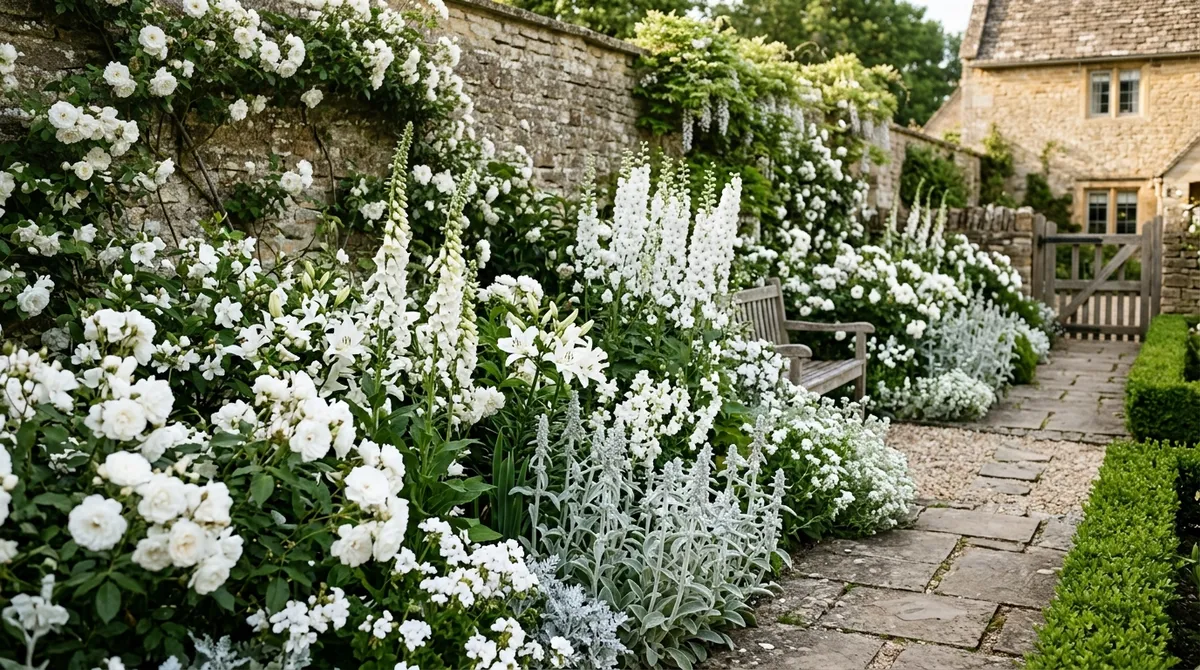
White flowers are the most versatile planting choice in UK gardens, working across every season, soil type, and light condition from full sun to deep shade. A single well-planted white border delivers interest from January snowdrops through to October anemones — ten months of continuous flowering without repeating the same variety twice.
I have grown over 30 white-flowering species on heavy West Midlands clay since 2016. This guide covers the best performers by season, the design principles behind great white gardens, and the practical data — heights, spreads, soil needs, hardiness ratings — that makes planning straightforward.
Why white flowers work so well in UK gardens
White is not a single colour. Brilliant white (Rosa ‘Iceberg’), creamy white (Philadelphus ‘Belle Etoile’), and blush-white (Anemone x hybrida ‘Honorine Jobert’) each carry a different visual weight. Understanding this is the first step to using white well.
White flowers reflect light rather than absorbing it, which makes pale planting schemes appear larger than they are. In small UK gardens — the average rear garden measures 12m x 8m — this matters. A white border anchored with green foliage and silver-leaved plants reads as spacious even in a restricted plot.
White also acts as a visual separator between competing colours. Planted as a buffer between orange crocosmia and pink roses, white stops a border from looking cluttered. It resets the eye between colour blocks. The RHS white garden planting guide covers the design principles in detail.
For design reference, no white garden is more influential than the one at Sissinghurst Castle in Kent. Vita Sackville-West planted the famous White Garden in 1949, and the National Trust’s Sissinghurst continues to maintain it as one of the most visited gardens in the UK. Its influence on white planting design for British gardens is immense.
Winter white flowers: January to February
White flowers in winter are not just a bonus — they are among the most affecting plants in the gardening year. Against bare soil and empty borders, a clump of snowdrops stops you in your tracks.
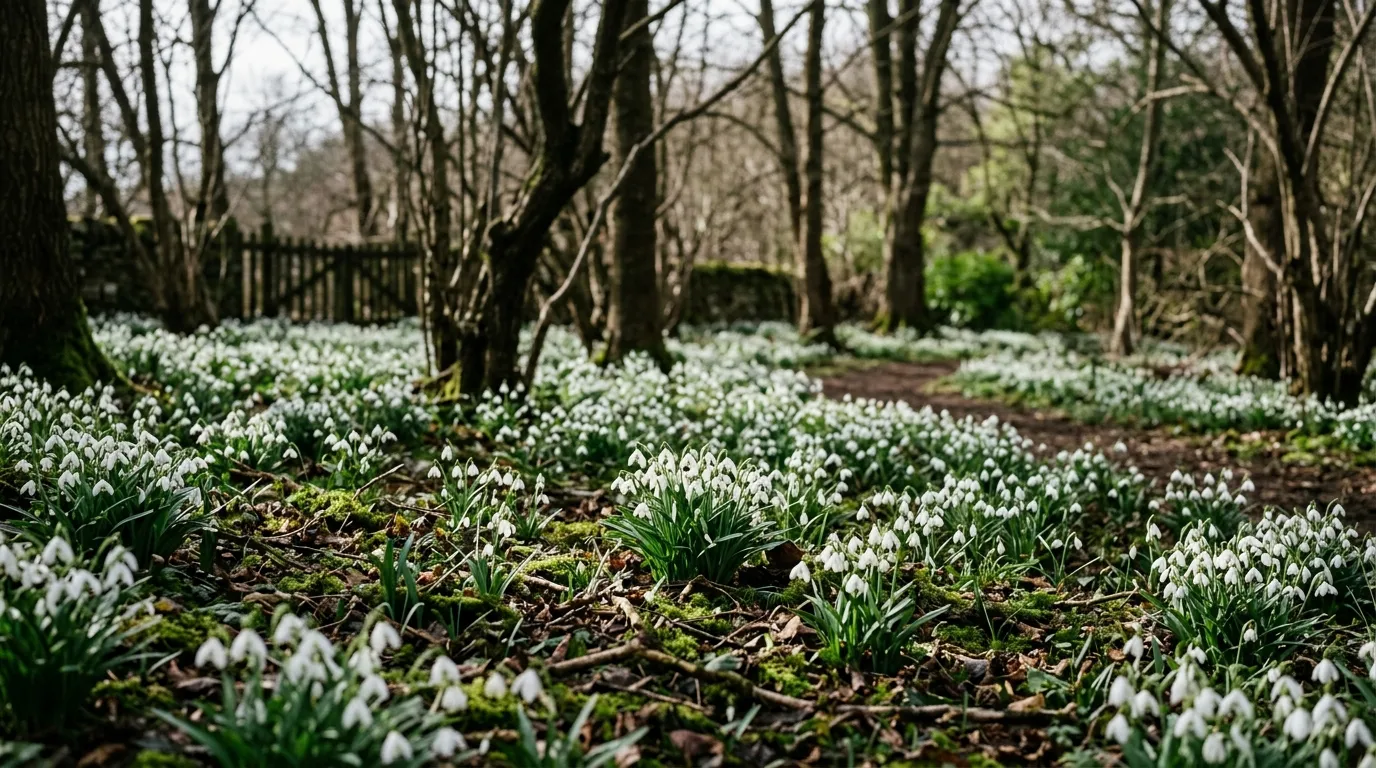
Snowdrops naturalised under deciduous trees. They multiply freely and provide the first white flowers from January.
Snowdrops (Galanthus nivalis)
Snowdrops are the UK’s first white flower of the year, opening in January in mild areas and February in colder gardens. The common snowdrop (Galanthus nivalis) reaches 7-10cm with pendant white bells marked with a green horseshoe on the inner tepals. Double forms like ‘Flore Pleno’ are showier but identical in behaviour.
Plant snowdrops “in the green” (immediately after flowering, with leaves still attached) for the best establishment. Dry bulbs sold in August rarely perform well. They naturalise readily in grass or under deciduous trees on moisture-retentive, alkaline to neutral soil. Our full snowdrops growing guide covers the in-the-green planting method in detail.
Height: 7-10cm. Spread: 4-6cm (clump-forming). Flowers: January to February. Soil: Moisture-retentive, pH 6.5-7.5. Hardiness: H7 (-20C).
Christmas rose (Helleborus niger)
Helleborus niger produces white saucer-shaped flowers from December to February. Unlike other hellebores, the Christmas rose holds its flowers above the foliage rather than nodding downward, making them far more visible. ‘Josef Lemper’ is the most reliable variety for outdoor conditions, reaching 30cm with flowers that last 8-10 weeks.
Hellebores thrive in partial to full shade on alkaline, moisture-retentive soil. They dislike acid conditions and struggle below pH 6.0. Plant in September into improved soil (add garden compost to open up heavy clay) and do not disturb once established. White hellebore hybrids also flower in February to March.
Height: 20-30cm. Spread: 30-45cm. Flowers: December to February. Soil: Alkaline, moisture-retentive, pH 6.5-8.0. Hardiness: H7 (-20C).
Sarcococca confusa (Sweet box)
Sarcococca confusa is the hidden gem of winter white flowering. The flowers are tiny — white pin-head clusters along the stems — but the vanilla fragrance carries several metres in still winter air. It flowers from January to February, reaches 1-2m, and grows in full shade on any soil. It is the best fragrant white-flowering evergreen shrub for UK gardens.
Plant Sarcococca under trees, alongside a path, or next to a back door where the winter scent can be enjoyed without going into the garden. It requires zero maintenance once established. The dark green glossy leaves provide year-round structure, and red-black berries follow the flowers.
Height: 1-2m. Spread: 1m. Flowers: January to February. Soil: Any, pH 5.5-8.0. Hardiness: H5 (-15C).
Spring white flowers: March to May
Spring brings the most concentrated flush of white flowers in the UK garden calendar. Bulbs, shrubs, and perennials compete for attention across just three months.
Narcissus ‘Thalia’
Narcissus ‘Thalia’ is the finest white daffodil for UK gardens. Two nodding milk-white flowers per stem, each with a flared reflexed perianth and a small white cup. It reaches 35-40cm, flowers in April, and holds better in wind than large-cupped whites. Unlike many daffodils, ‘Thalia’ naturalises vigorously in grass.
Plant bulbs 10cm deep in September to November in full sun to partial shade. They tolerate a wide range of soils including clay, though good drainage improves longevity. Leave foliage to die back naturally — six weeks after flowering — to rebuild bulb energy.
Height: 35-40cm. Spread: 10cm. Flowers: April. Soil: Any, pH 6.0-7.5. Hardiness: H7 (-20C).
Lily of the valley (Convallaria majalis)
Lily of the valley produces arching stems of small white bell flowers in April and May with one of the most recognisable fragrances in horticulture. It grows 15-20cm tall and spreads by underground rhizomes to form dense ground-covering colonies, ideal under trees and in shady spots where little else grows well.
Plant pips (rhizome sections) in September to October, 5cm deep and 10-15cm apart. Lily of the valley thrives on moisture-retentive, slightly acid soil in partial to full shade. It is toxic to humans, cats, dogs, and horses — all parts contain cardiac glycosides. Keep away from grazing animals and wash hands after handling. Our shade plants guide includes more ground-covering options for similar conditions.
Height: 15-20cm. Spread: Spreading (colony-forming). Flowers: April to May. Soil: Moisture-retentive, slightly acid, pH 5.5-6.5. Hardiness: H7 (-20C). Toxicity: Highly toxic to humans, cats, dogs, horses.
Tulip ‘White Triumphator’
Tulip ‘White Triumphator’ is a lily-flowered tulip with long, pointed petals that flare elegantly at the tips. Pure white with no markings, reaching 65-70cm, it flowers in late April to early May. Lily-flowered tulips are the most elegant form for cutting and for planting alongside cottage garden perennials.
Plant bulbs 15-20cm deep in November on well-drained soil in full sun. In UK clay gardens, add grit to the planting hole to prevent rotting. Lift bulbs in June after the foliage dies back, dry them, and store in a cool dry place for replanting in November. Our growing roses guide covers companion planting with tulips.
Height: 65-70cm. Spread: 10cm. Flowers: Late April to May. Soil: Well-drained, pH 6.0-7.5. Hardiness: H6 (-20C planted deep).
Cherry blossom (Prunus)
White cherry blossom transforms gardens in March to April. For smaller UK gardens, Prunus ‘Tai-Haku’ (Great White Cherry) is the outstanding choice: large single white flowers 5cm across, bronze-red young foliage, and a mature spread of 8-10m. On restricted plots, Prunus incisa ‘The Bride’ reaches only 3m and is covered in white blossom in March.
Cherry blossom is fleeting — two to three weeks — but unmatched in spring impact. Plant in full sun on well-drained soil. All ornamental cherries produce their best display in their first decade. Prune in summer (not winter) to reduce risk of silver leaf fungal infection.
Summer white flowers: June to August
Summer delivers the widest range of white-flowering plants in the UK — from climbing roses covering a house wall to annual cosmos filling gaps in a border. This is the season to build a genuinely theatrical white planting scheme.
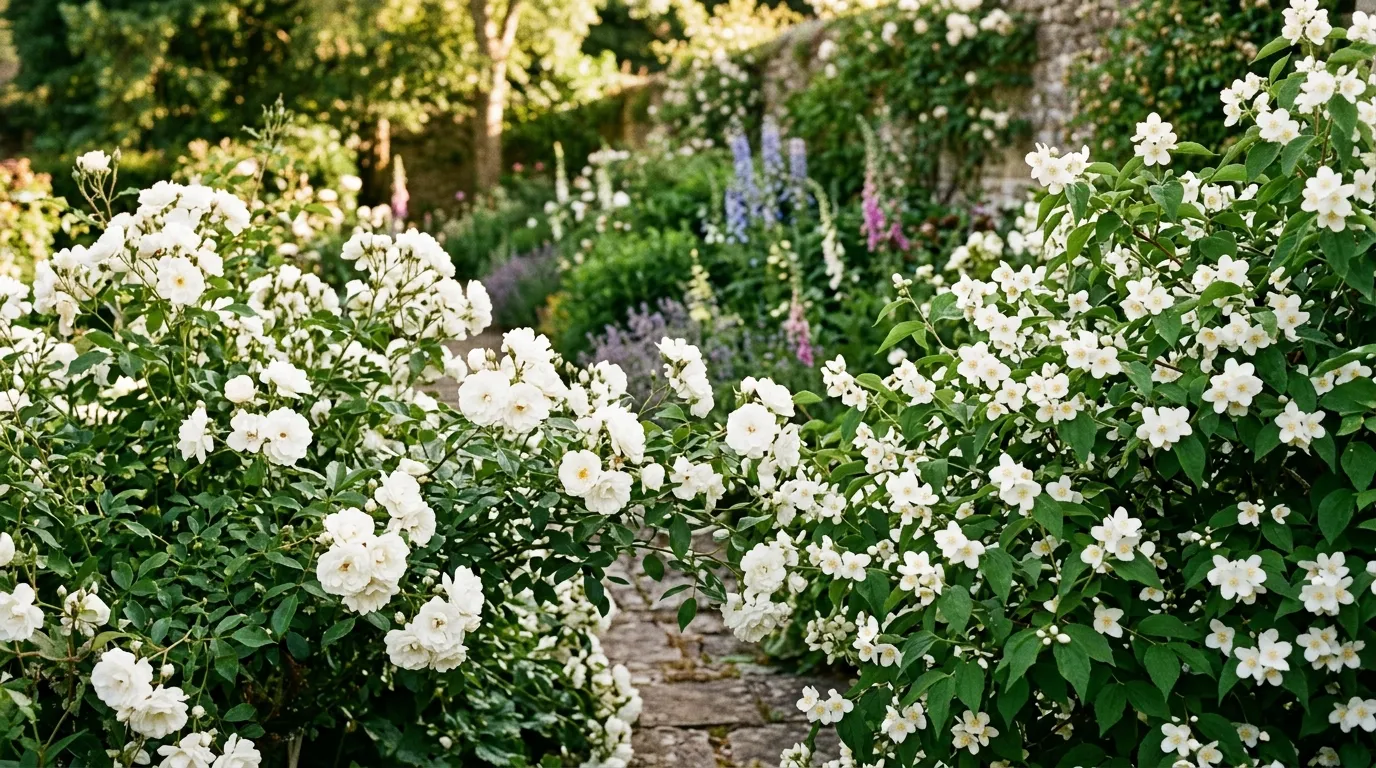
Iceberg roses and Philadelphus Belle Etoile together in June. Two of the most reliable white-flowering shrubs for UK gardens.
Rosa ‘Iceberg’ (Floribunda rose)
Rosa ‘Iceberg’ is the most planted white rose in the UK for good reason. Clusters of pure white flowers appear continuously from June to November. It reaches 1.2-1.5m as a bush or 2.5-3m as a climbing form (‘Climbing Iceberg’), handles clay soil better than most roses, and resists blackspot far more effectively than older white varieties. For details on planting, pruning, and feeding, see our complete guide to growing roses.
Height: 1.2-1.5m (bush); 2.5-3m (climber). Flowers: June to November. Hardiness: H6 (-20C).
Rosa ‘Winchester Cathedral’
Rosa ‘Winchester Cathedral’ is an English Shrub rose from David Austin, producing cupped, quartered rosette flowers of pure white with a strong myrrh fragrance. It reaches 1.2m by 1.2m and repeat-flowers from June to October. Winchester Cathedral is one of the most reliably fragrant white roses available — the scent carries 3-4m in still summer air.
Philadelphus ‘Belle Etoile’ (Mock orange)
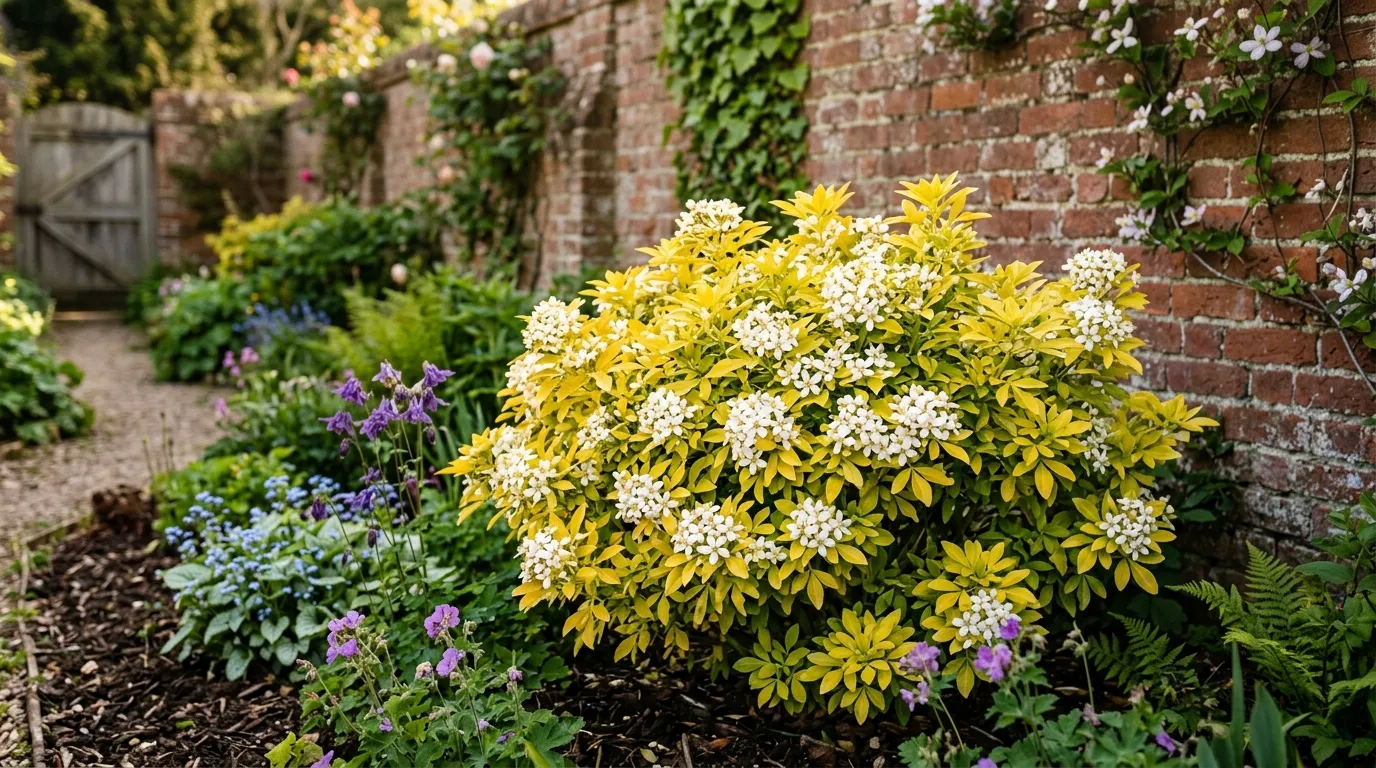
Philadelphus is the fragrant white-flowering shrub of the British summer. ‘Belle Etoile’ reaches 1.5-2m with single white flowers carrying a maroon blotch at the base and a heavy sweet fragrance that fills the garden in June. It grows on any soil, tolerates chalk and clay equally, and needs only light pruning after flowering to maintain shape.
Plant Philadelphus in full sun for the best flowering (it will grow in partial shade with fewer flowers). Cut one third of the oldest stems to the base immediately after flowering to encourage vigorous new growth that will flower the following year. For fragrant companion planting, our scented plants guide covers complementary varieties.
Height: 1.5-2m. Spread: 2m. Flowers: June to July. Soil: Any, pH 5.5-8.0. Hardiness: H7 (-20C).
White jasmine (Jasminum officinale)
White jasmine is a vigorous climbing shrub with clusters of small white star-shaped flowers from June to September carrying an intense sweet fragrance. It grows 6-10m and covers a fence, wall, or pergola in 4-5 years. The semi-evergreen foliage holds through mild UK winters. Our full jasmine growing guide covers training, pruning, and overwintering.
Height: 6-10m (climber). Flowers: June to September. Hardiness: H4 (-10C). Soil: Well-drained, pH 6.0-7.5.
White hydrangeas
Hydrangea paniculata ‘Limelight’ is the most popular white-flowering hydrangea for UK gardens. Large conical flower heads open lime-white in July, fade to cream, then take on pink tones in September. It reaches 2m by 2m on most soils and tolerates heavy clay. Hydrangea arborescens ‘Annabelle’ produces round heads of pure white flowers up to 30cm across on more compact 1.5m plants — excellent for cutting and drying.
For white mophead forms, Hydrangea macrophylla ‘Madame Emile Mouillere’ produces pure white lacecap-style flowers regardless of soil pH (unlike blue varieties that change colour on alkaline soil). Our hydrangea growing guide covers pruning schedules for all three types.
White delphiniums
White delphiniums are the most dramatic of the summer white flowers. The Pacific Giant series produces 1.5-1.8m spikes of pure white or creamy white in June and July. ‘Galahad’ (pure white) and ‘Guinevere’ (white with a purple eye) are the best-known UK varieties. Cut spent spikes to the base for a second shorter flush in September.
Delphiniums need full sun, rich soil, and staking from 60cm height. They are short-lived on heavy clay (3-5 years) but the effect of a full row of white spikes is unrivalled. Our delphinium growing guide covers the staking and slug control methods that make the difference between success and failure.
White foxgloves (Digitalis purpurea ‘Alba’)
White foxgloves are a biennial that self-seeds prolifically. Sow seed in June for flowering the following June. The pure white form ‘Alba’ reaches 1.2-1.5m and looks most effective planted at the back of borders or at the woodland edge. The flowers are tubular, densely packed on the spike, and faintly spotted inside.
White foxgloves tolerate partial shade, making them unusually versatile for a tall plant. All parts are highly toxic. They self-seed freely on disturbed ground — once established in a garden, you will never need to buy plants again.
White cosmos (Cosmos bipinnatus ‘Purity’)
White cosmos is the best annual filler for white planting schemes. Sow direct from May, and plants flower from July to the first frost, reaching 80-100cm. The flowers are simple open discs with a yellow centre — exactly the shape that looks best against complex rose or shrub flowers. Cosmos ‘Purity’ is the pure white standard variety; ‘Cupcakes White’ has double flowers.
Sow direct into the border from May to June. Cosmos needs no feeding — rich soil produces leaves over flowers. Deadhead weekly to prolong flowering until October.
Gaura (Oenothera lindheimeri ‘Whirling Butterflies’)
Gaura ‘Whirling Butterflies’ produces wiry stems covered in small white butterfly-shaped flowers from June to October. The airy, dancing habit makes it an excellent gap-filler between heavier-textured plants. It reaches 90cm but the sparse foliage means it never dominates. Plant in full sun on well-drained soil — it will not survive UK winters in waterlogged clay.
Autumn white flowers: September to October
Autumn white flowers carry the garden through the September-October gap when summer perennials fade but winter interest has not yet arrived.
Japanese anemone ‘Honorine Jobert’
Anemone x hybrida ‘Honorine Jobert’ is the supreme white autumn-flowering perennial. Single pure white flowers with a central boss of yellow stamens appear on tall wiry stems from August to October, reaching 1-1.2m. It held the RHS Award of Garden Merit since 1993 — one of the most consistently recommended plants in British horticulture.
Japanese anemones spread steadily by underground rhizomes and form impressive colonies over 5-10 years. They thrive in partial shade on moisture-retentive clay, making them ideal for the difficult north-facing borders where most summer plants fail. For our full cultivation notes see the Japanese anemone section of our perennial guide.
Height: 1-1.2m. Spread: 60cm+ (spreading). Flowers: August to October. Soil: Moisture-retentive, pH 5.5-7.5. Hardiness: H7 (-20C).
White flowers by season: comparison table
This table summarises all the key varieties by season to help you plan a succession that runs from January to October.
| Variety | Type | Season | Height | Sun | Clay Tolerance | Fragrant |
|---|---|---|---|---|---|---|
| Snowdrop | Bulb | Jan-Feb | 10cm | Part shade | Yes | No |
| Sarcococca confusa | Shrub | Jan-Feb | 1-2m | Full shade | Yes | Yes (vanilla) |
| Helleborus niger | Perennial | Dec-Feb | 30cm | Shade | Yes | No |
| Narcissus ‘Thalia’ | Bulb | April | 38cm | Sun/part | Yes | Light |
| Lily of the valley | Perennial | Apr-May | 18cm | Full shade | Yes | Yes (intense) |
| Tulip ‘White Triumphator’ | Bulb | Apr-May | 68cm | Full sun | No (needs grit) | No |
| Cherry blossom | Tree | Mar-Apr | 3-10m | Full sun | Yes | Light |
| Rosa ‘Iceberg’ | Shrub | Jun-Nov | 1.5m | Full sun | Moderate | Light |
| Rosa ‘Winchester Cathedral’ | Shrub | Jun-Oct | 1.2m | Full sun | Moderate | Yes (myrrh) |
| Philadelphus ‘Belle Etoile’ | Shrub | Jun-Jul | 2m | Sun/part | Yes | Yes (intense) |
| White jasmine | Climber | Jun-Sep | 8m | Sun/part | Yes | Yes (intense) |
| Hydrangea paniculata ‘Limelight’ | Shrub | Jul-Sep | 2m | Sun/part | Yes | No |
| White delphinium ‘Galahad’ | Perennial | Jun-Jul | 1.7m | Full sun | Moderate | No |
| White foxglove | Biennial | Jun-Jul | 1.4m | Part shade | Yes | No |
| White cosmos | Annual | Jul-Oct | 90cm | Full sun | No | No |
| Gaura ‘Whirling Butterflies’ | Perennial | Jun-Oct | 90cm | Full sun | No | No |
| Japanese anemone ‘Honorine Jobert’ | Perennial | Aug-Oct | 1.1m | Part shade | Yes | No |
Designing with white flowers: Sissinghurst principles
The Sissinghurst White Garden, conceived by Vita Sackville-West and Harold Nicolson in 1949, established the design language that most white gardens now follow. Understanding its six core principles lets you apply them to any British garden.
1. Grey and silver foliage as the backbone. White flowers alone, without foliage contrast, look cold and flat. Vita Sackville-West used Stachys byzantina (lamb’s ears), Artemisia ‘Powis Castle’, and Anaphalis margaritacea as the recurring silver thread through the planting. These plants also extend the “white” effect on days when few flowers are open.
2. Contrasting flower forms. The Sissinghurst White Garden mixes spires (white delphiniums, white foxgloves), globes (white alliums, white roses in ball form), flat heads (Achillea ‘The Pearl’, white elder flowers), and pendants (snowdrops, white wisteria). Form contrast within a single colour palette is what gives white planting its sophistication.
3. Height variation from ground to 3m+. Ground-covering Alchemilla mollis (chartreuse-yellow, which reads as white-adjacent in a white scheme) through mid-border roses to Rosa mulliganii climbing 8-10m over the central pergola. Without this vertical range, even the best white planting feels flat.
4. Structural enclosure. Box hedging around the perimeter of the White Garden frames the planting and makes white flowers “pop” against a dark green background. In smaller British gardens, a low yew or box hedge, or even a dark fence, performs the same function.
5. Repeat planting of anchor varieties. Three or five plants of the same white variety, repeated through the border, create rhythm. Planting one plant of twenty different whites creates a chaotic, catalogue-page effect. Repeat the key varieties (Rosa ‘Iceberg’, Philadelphus, white alliums) in groups of three minimum.
6. Evening viewing in mind. White flowers retain their pale luminosity in low light when other colours disappear. Vita Sackville-West reportedly planned the White Garden to be walked through after dinner in summer. This is the moon garden principle applied to a full garden room.
Moon gardens: white and silver at dusk
A moon garden is any planting scheme designed to be effective after 7pm. In a UK summer, this covers the hours between dinner and dusk — roughly June to August.
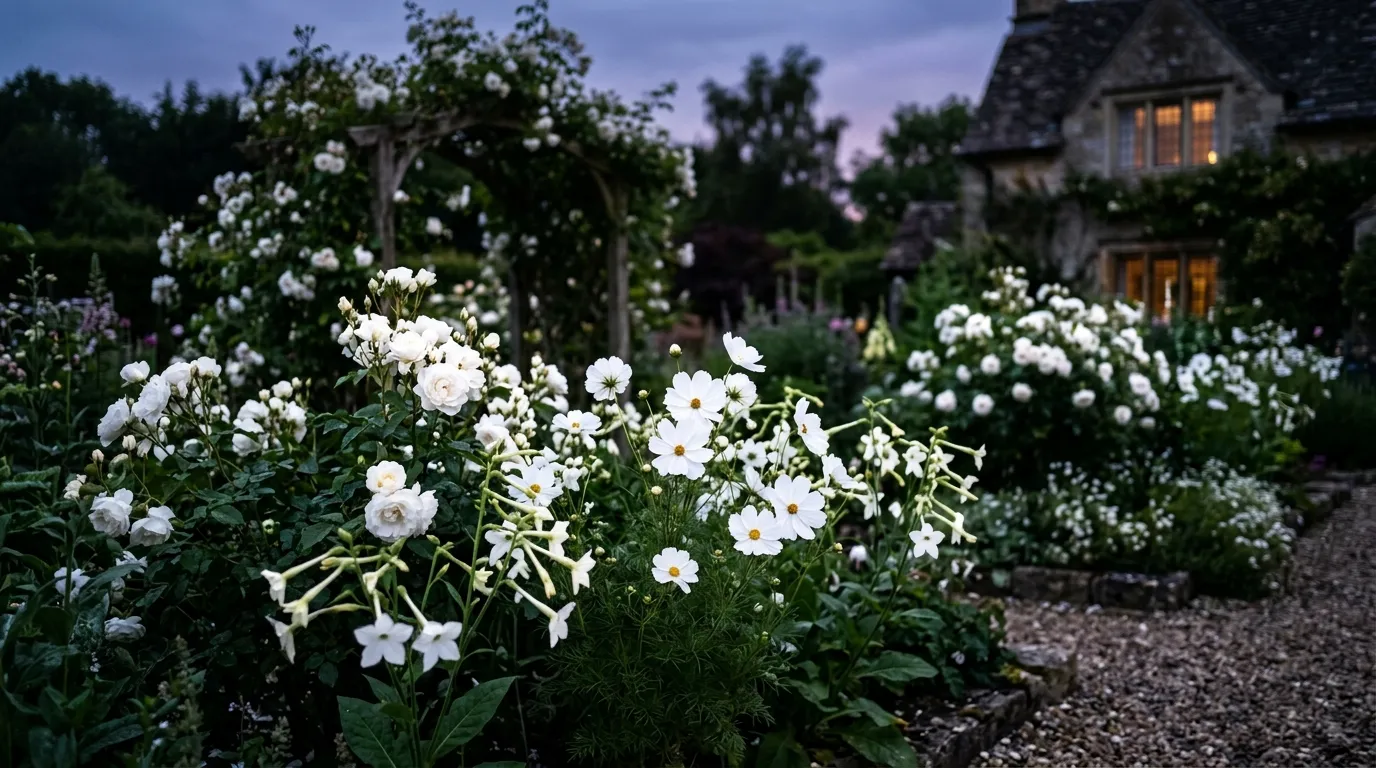
White flowers glow in evening light, making them ideal for gardens used mainly after work. A south-facing corner catches the last light.
The most effective moon garden plants combine white flowers with silver or pale grey foliage. The list of reliably performant combinations for UK conditions:
- Stachys byzantina (lamb’s ears) — silver-felted ground cover, 30cm, full sun, any soil
- Artemisia ‘Powis Castle’ — silver filigree mound, 60cm, full sun, well-drained
- Convolvulus cneorum — silver-leaved with white funnel flowers, 60cm, full sun, well-drained
- White nicotiana (Nicotiana alata ‘Grandiflora’) — annual, 70cm, scented in the evening
- White Phlox paniculata ‘Mount Fuji’ — 80cm perennial, intensely fragrant, July to August
For maximum evening effect, include at least two fragrant whites. Scent intensifies in still summer air after 7pm as temperatures cool. Philadelphus, white jasmine, and white nicotiana together create a sensory experience that no daytime border can match.
White flowers in shade
North-facing borders and areas under tree canopies are often dismissed as problem spots. White flowers are the best tool for making them work. White reflects available light better than any other colour, making shaded areas feel brighter and more spacious.
The best white-flowering shade plants for UK conditions:
| Plant | Depth of Shade | Season | Height | Notes |
|---|---|---|---|---|
| Sarcococca confusa | Full shade | Jan-Feb | 1m | Fragrant, evergreen |
| Helleborus niger | Partial to full | Dec-Feb | 30cm | Prefers alkaline |
| Galanthus (snowdrops) | Partial shade | Jan-Feb | 10cm | Naturalises under trees |
| Lily of the valley | Partial to full | Apr-May | 18cm | Ground cover, toxic |
| White astilbe ‘Bridal Veil’ | Partial shade | Jun-Aug | 80cm | Needs moisture |
| White foxglove | Partial shade | Jun-Jul | 1.4m | Biennial, self-seeds |
| Japanese anemone ‘Honorine Jobert’ | Partial shade | Aug-Oct | 1.1m | Best late-season shade plant |
For a full shady border with year-round interest, our best plants for shade guide covers ferns, hostas, and ground-covering perennials that support a white scheme through the spring and summer months.
White-variegated foliage: extending the white theme year-round
White flowers are seasonal. White-variegated foliage extends the theme into every month, including the winter months when almost nothing is in flower.
The most effective white-variegated shrubs and perennials for UK gardens:
- Cornus alba ‘Elegantissima’ — white-margined leaves, red stems in winter, 2m, full sun to partial shade, any soil. The red winter stems become part of the white scheme against snow or frost.
- Euonymus fortunei ‘Emerald Gaiety’ — white-edged evergreen leaves tinged pink in winter, 60cm ground cover or wall climber, any aspect, any soil. Tolerates full shade.
- Hosta ‘Francee’ — white-margined leaves, 50cm, partial to full shade, moist soil. One of the most slug-resistant white-edged hostas.
- Phalaris arundinacea ‘Picta’ (Gardener’s garters) — white-striped grass, 60-90cm, spreads vigorously on moist soil.
- Pulmonaria ‘Sissinghurst White’ — white flowers March to April, spotted white-on-green leaves year-round, 30cm, full shade, clay.
White-variegated plants are particularly effective at the front of borders where the foliage carries the white scheme during the months between one flowering peak and the next. For more ideas on combining shrubs and perennials, see our best flowering shrubs guide.
Combining white with green and silver
A white garden that is only white looks clinical. The classic pairings that prevent this:
White + lime green: Rosa ‘Iceberg’ with Alchemilla mollis. The chartreuse-yellow of Alchemilla reads as a warm foil that makes the white roses appear colder and purer by contrast. One of the best garden combinations in British horticulture.
White + silver: White Philadelphus with Stachys byzantina and Artemisia ‘Powis Castle’. Silver foliage amplifies the white without competing with it. The moon garden effect works in daylight too.
White + dark green: White foxgloves against a yew hedge. Dark backgrounds make white flowers luminous. The same principle explains why white roses photographed against dark foliage look better than the same roses against blue sky.
White + black or near-black: White cosmos alongside Ophiopogon planiscapus ‘Nigrescens’ (black mondo grass). The maximum contrast available in a garden colour scheme — stark but highly effective in a modern garden design.
Common white flower design mistakes to avoid
Mixing warm and cool whites. Creamy white Philadelphus beside pure white Rosa ‘Iceberg’ makes the Philadelphus look dirty. Plan your white scheme around one white register — all warm (cream, ivory, blush) or all cool (pure, blue-tinged) — and keep them separate if you want both.
Planting only one species. A border of nothing but white roses is a photocopied effect. The Sissinghurst White Garden works because it mixes 60+ species. Aim for a minimum of five different plant families in any white scheme.
Ignoring winter. A white garden without snowdrops, Sarcococca, and white hellebores has a four-month gap from November to February. These three plants require almost no effort and extend the season by a third.
No fragrance. White flowers without fragrance miss the most powerful sensory element available. Always include at least one intensely fragrant white — Philadelphus, white jasmine, lily of the valley, Rosa ‘Winchester Cathedral’ — in any white scheme.
Forgetting foliage. White flowers without contrasting foliage disappear. Silver, dark green, chartreuse, and white-variegated foliage are all essential supporting cast for a white planting scheme. Without them, white flowers float detached from their context.
For a complementary colour palette guide, see our article on best purple, pink and blue flowers for UK gardens — the contrast between these and a white-themed area is one of the most effective garden design tools available.
Frequently asked questions
Related reading
- Best scented plants for UK gardens — fragrant companions for a white planting scheme
- Best plants for shade — white-friendly shade perennials and ground covers
- How to grow snowdrops — the first white flowers of the year
- How to grow roses UK — cultivation guide covering white rose varieties in detail
- Best flowering shrubs UK — structural white-flowering shrubs for year-round framework
Lawrie has been gardening in the West Midlands for over 30 years. He grows his own veg using no-dig methods, keeps a wildlife-friendly garden, and writes practical advice based on real UK growing conditions.