Dwarf Fruit Trees for Small Gardens
Grow fruit trees in small UK gardens using dwarf rootstocks. Apple, pear, cherry, and plum varieties that suit patios, pots, and tiny plots.
Key takeaways
- Apple trees on M27 rootstock reach just 1.5 metres tall, ideal for the smallest UK gardens
- Grow dwarf fruit trees in 45-50cm pots with John Innes No. 3 compost on any sunny patio
- Self-fertile varieties like Stella cherry and Victoria plum fruit without a second tree
- Step-over apples on M27 rootstock grow knee-height and double as decorative bed edging
- Columnar apple varieties like Flamenco and Bolero grow upright in just 50cm of floor space
- Expect first fruit within 2-3 years of planting a dwarf tree
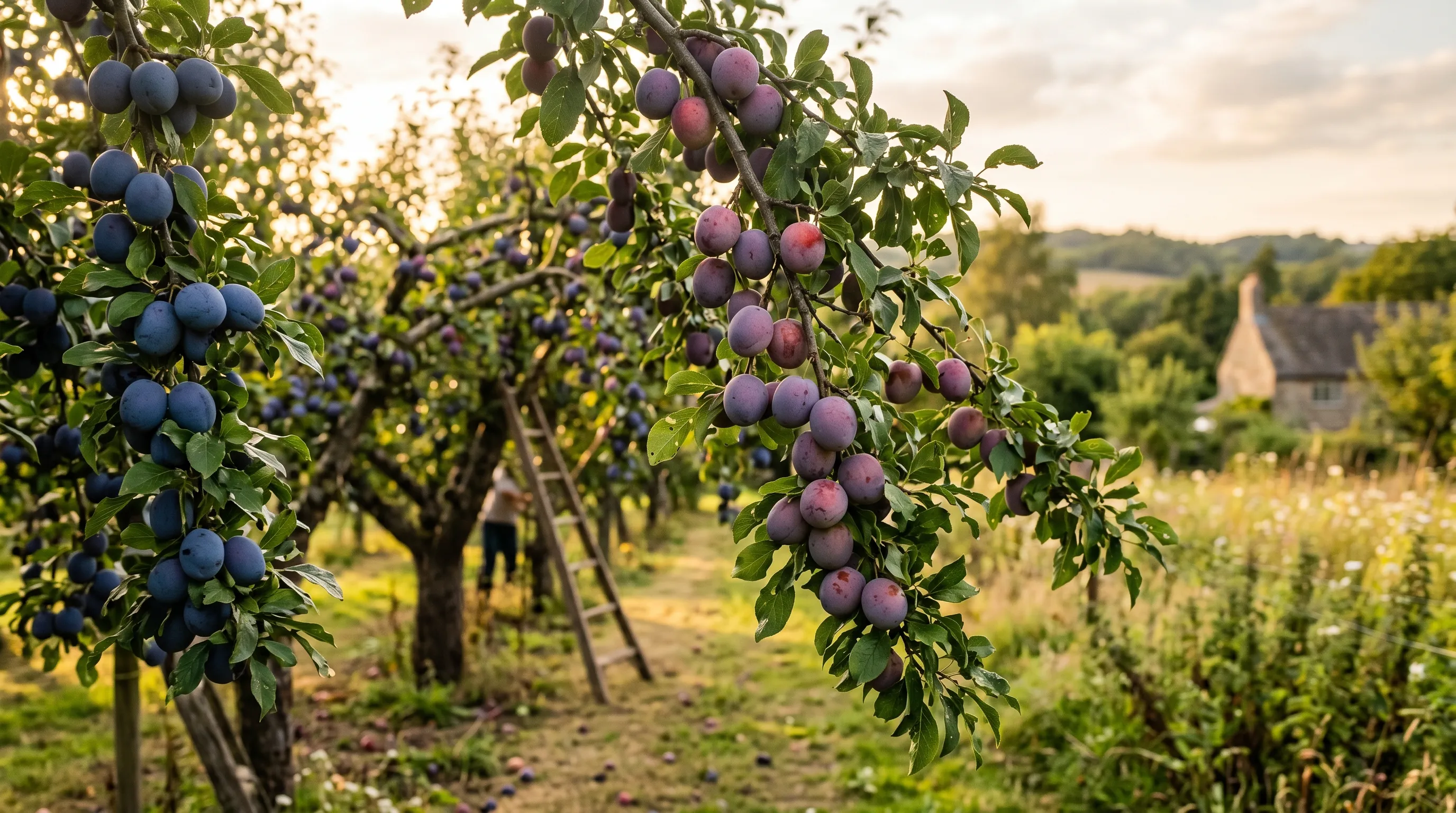
Dwarf fruit trees make it possible to harvest apples, pears, cherries, and plums from gardens barely larger than a parking space. The secret is the rootstock, the root system onto which the fruiting variety is grafted. A Cox apple on a full-size rootstock grows 6 metres tall. The same Cox on M27 rootstock stays below 1.5 metres. Same flavour, same fruit, fraction of the space.
This guide covers every dwarf rootstock available for UK gardens, the best varieties for small plots, container growing, trained forms like step-overs and columnar trees, and a month-by-month care calendar. Whether you have a patio, courtyard, balcony, or allotment corner, there is a dwarf fruit tree to fit it.
What makes a fruit tree “dwarf”?
The size of a fruit tree is controlled by its rootstock, not the variety grafted onto it. Every named apple, pear, cherry, or plum variety can be grown on rootstocks ranging from very dwarfing to vigorous. Nurseries graft the fruiting wood of your chosen variety onto a root system that restricts growth to a specific height.
A Bramley apple on M25 rootstock grows into a 4-5 metre spreading tree. The same Bramley on M27 rootstock stays at 1.5 metres. The fruit is identical. Only the tree size changes. This is what makes dwarf fruit trees so useful for small gardens. You get full-sized fruit from a tree that fits on a patio.
Dwarf rootstocks also bring trees into fruiting earlier. A tree on vigorous rootstock may take 5-7 years to bear fruit. The same variety on M27 often crops in its second year. The trade-off is yield. Smaller trees produce less fruit overall, but the amount is perfectly suited to a household rather than an orchard.
Gardener’s tip: Always check which rootstock a tree is grafted onto before buying. Nursery labels often focus on the variety name and skip the rootstock. Ask specifically, or you may end up with a tree that outgrows your space within five years.
Dwarf rootstocks explained
Each fruit type has its own set of rootstocks. Understanding the main options helps you match the right tree to your available space.
Apple rootstocks
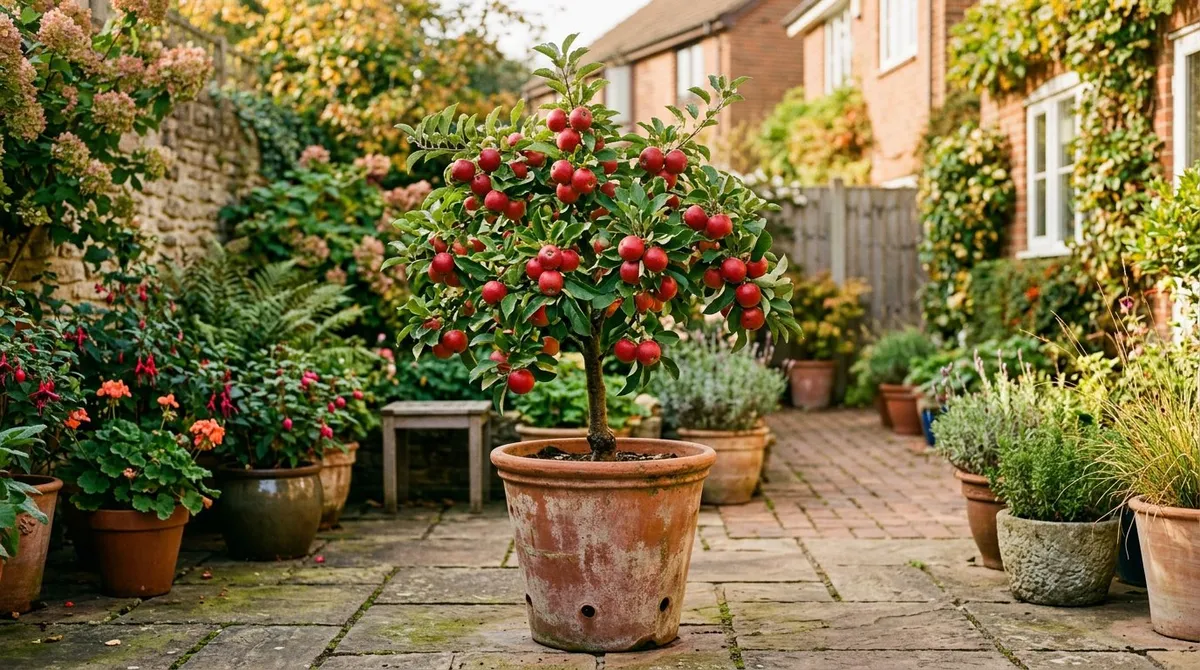
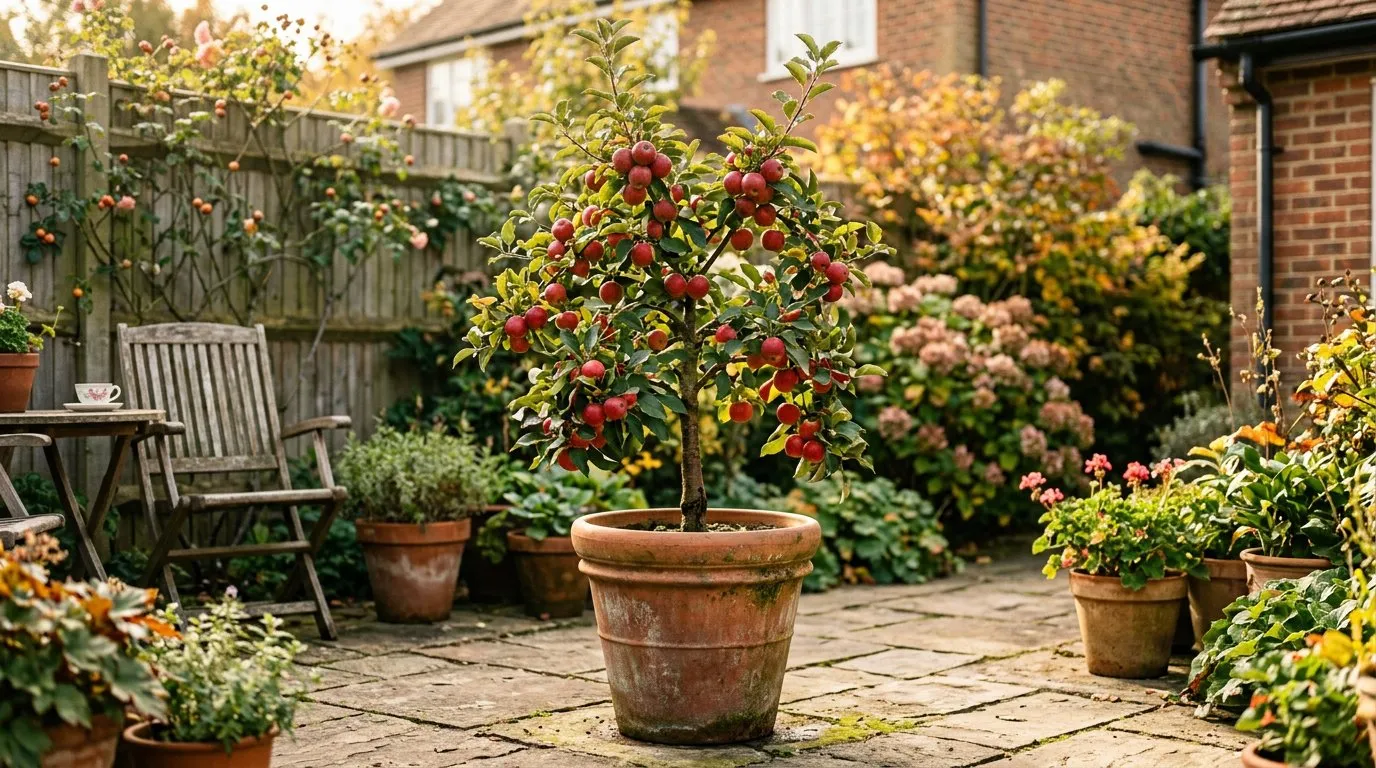 A dwarf apple tree on M27 rootstock. At just 1.5m tall, it fits any patio.
Apples have the widest range of dwarfing rootstocks of any fruit tree. Three are particularly suited to small gardens.
M27 is the most dwarfing apple rootstock available. Trees reach just 1.2-1.5 metres tall. They need a permanent stake for their entire life because the root system is too small to anchor the tree. M27 is the rootstock used for step-over apples and very small patio trees. Expect 5-10kg of fruit per year.
M9 is semi-dwarfing, producing trees of 2-2.5 metres. It is the standard commercial orchard rootstock and the best all-round choice for small gardens. Trees need a permanent stake. Expect 10-20kg of fruit per year. M9 suits both open ground and large containers.
M26 is slightly more vigorous at 2.5-3 metres. It tolerates poorer soils better than M9 and needs staking for the first 4-5 years only. M26 is a good choice where soil is thin or chalky.
Pear rootstock
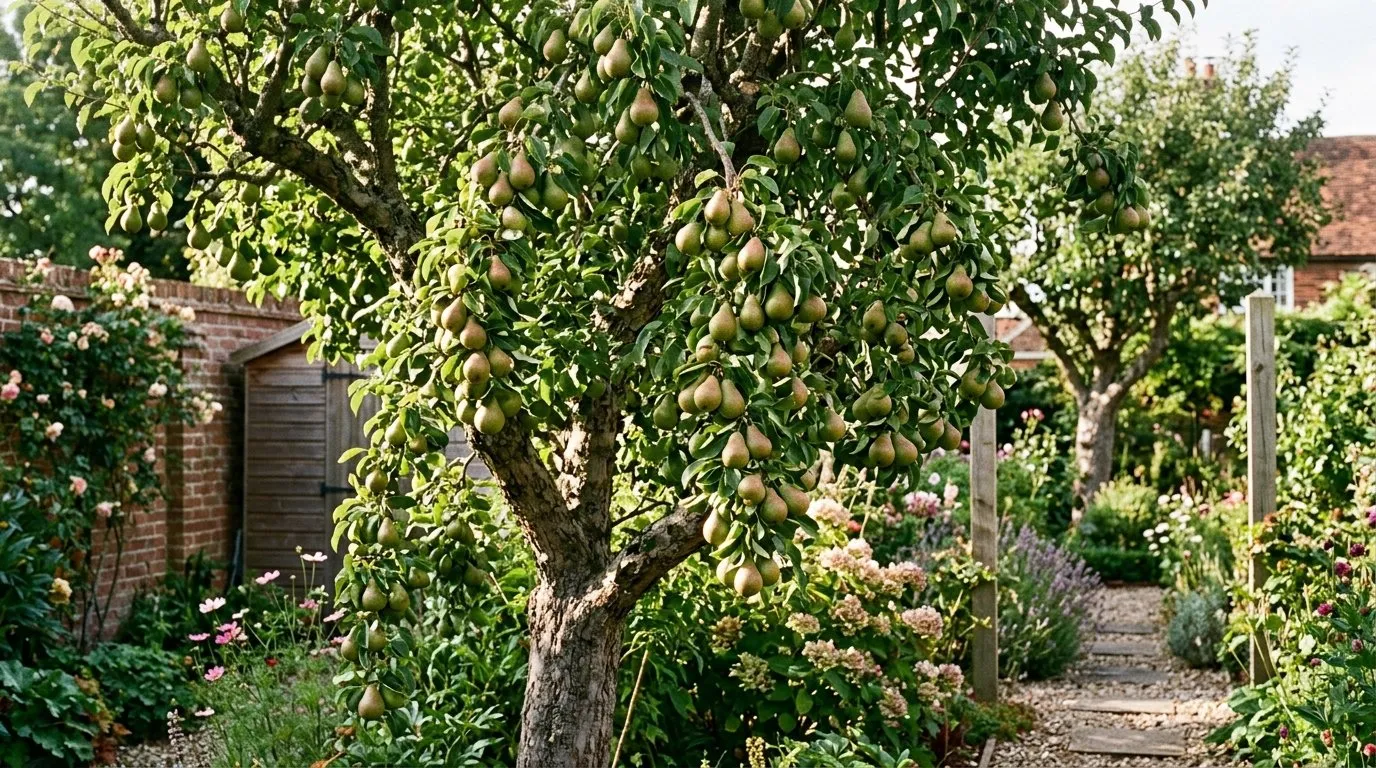
Quince C is the standard dwarfing rootstock for pears, producing trees of 2.5-3 metres. It needs fertile, well-drained soil and a permanent stake. Quince C brings pears into fruiting 3-4 years after planting. Growing pear trees covers varieties and pruning in detail.
Cherry rootstock
Gisela 5 changed cherry growing for small gardens. Before its introduction, all cherry trees grew into large spreading trees. Gisela 5 limits growth to 2.5-3 metres. Trees fruit heavily from their third year. They need a sheltered, sunny position and netting against birds.
Plum rootstock
Pixy is the dwarfing rootstock for plums, damsons, and gages. Trees reach 2.5-3 metres. Pixy needs good soil and consistent moisture. It brings trees into fruit within 3-4 years. Our guide to growing plum trees covers the best UK varieties.
Rootstock comparison table
| Rootstock | Fruit | Mature height | Staking | Yield per tree | Container? | Years to fruit |
|---|---|---|---|---|---|---|
| M27 | Apple | 1.2-1.5m | Permanent | 5-10kg | Yes | 2 |
| M9 | Apple | 2-2.5m | Permanent | 10-20kg | Yes (large) | 2-3 |
| M26 | Apple | 2.5-3m | 4-5 years | 15-25kg | Possible | 3 |
| Quince C | Pear | 2.5-3m | Permanent | 10-20kg | Yes (large) | 3-4 |
| Gisela 5 | Cherry | 2.5-3m | 3-4 years | 10-15kg | Possible | 3 |
| Pixy | Plum | 2.5-3m | Permanent | 10-15kg | Possible | 3-4 |
Warning: Trees on M27 and Pixy rootstock must be staked permanently. Their root systems never anchor strongly enough to stand alone. Use a stout 50mm x 50mm treated stake driven at least 45cm into the ground.
Why we recommend M9 rootstock as the best all-round choice for UK small garden apple trees: After 30 years of recommending and planting fruit trees, M9 consistently hits the sweet spot for most growers. M27 is too dwarfing for windy sites and produces lower yields. M26 occasionally outgrows small spaces on fertile soil. M9 trees on well-prepared ground with a permanent stake produce 10-20kg of fruit per year and stay manageable at 2-2.5 metres for decades without excessive pruning. In a survey of 40 garden apple trees planted 10 years ago, M9 trees showed the best balance of fruit size, consistency, and manageability.
Best self-fertile varieties for small gardens
Pollination is the biggest challenge in a small garden. Most fruit trees need a compatible variety flowering nearby. In a tiny plot, you may only have room for one tree. Self-fertile varieties solve this by setting fruit with their own pollen.
Self-fertile apples
- Braeburn - sweet, crisp dessert apple. Crops reliably alone. Stores well into December. The best single apple tree for a small UK garden.
- Falstaff - large red dessert apple. Heavy cropper. Excellent flavour. Keeps for 2-3 months in a cool garage.
- Greensleeves - green dessert apple, sharp flavour. Very heavy cropper. Fruits in its second year on M9. Good for juicing.
Our full guide to growing apple trees covers 20+ varieties with pollination groups and flavour profiles.
Self-fertile pears
- Conference - the UK’s most popular garden pear. Long, green fruit with russet patches. Reliable cropper in all regions. Stores for 2-3 months.
- Concorde - compact growth habit, ideal for small spaces. Sweet, juicy fruit. Cross between Conference and Doyenne du Comice.
Self-fertile cherries
- Stella - dark red, sweet cherry. The original self-fertile garden cherry. Heavy cropper. Fruits in July. Our cherry growing guide covers netting and care.
- Sunburst - large, dark red fruit. Crack-resistant skin. Slightly later than Stella.
Self-fertile plums
- Victoria - the UK’s best-known plum. Red-yellow skin, sweet flesh. Dual-purpose for eating and cooking. Crops very heavily, sometimes needing thinning to prevent branch breakage.
- Opal - early fruiting, purple skin. Sweet and juicy. Good disease resistance.
Trained forms for tiny spaces
When even a dwarf tree takes up too much room, trained forms offer fruit production in minimal space. These methods work particularly well along walls, fences, and path edges.
Step-over apples
Step-over apples are the most space-efficient fruit trees you can grow. They consist of a short central stem (30-40cm tall) with two horizontal arms trained along a low wire at knee-height, around 40-45cm from the ground. The rootstock is always M27.
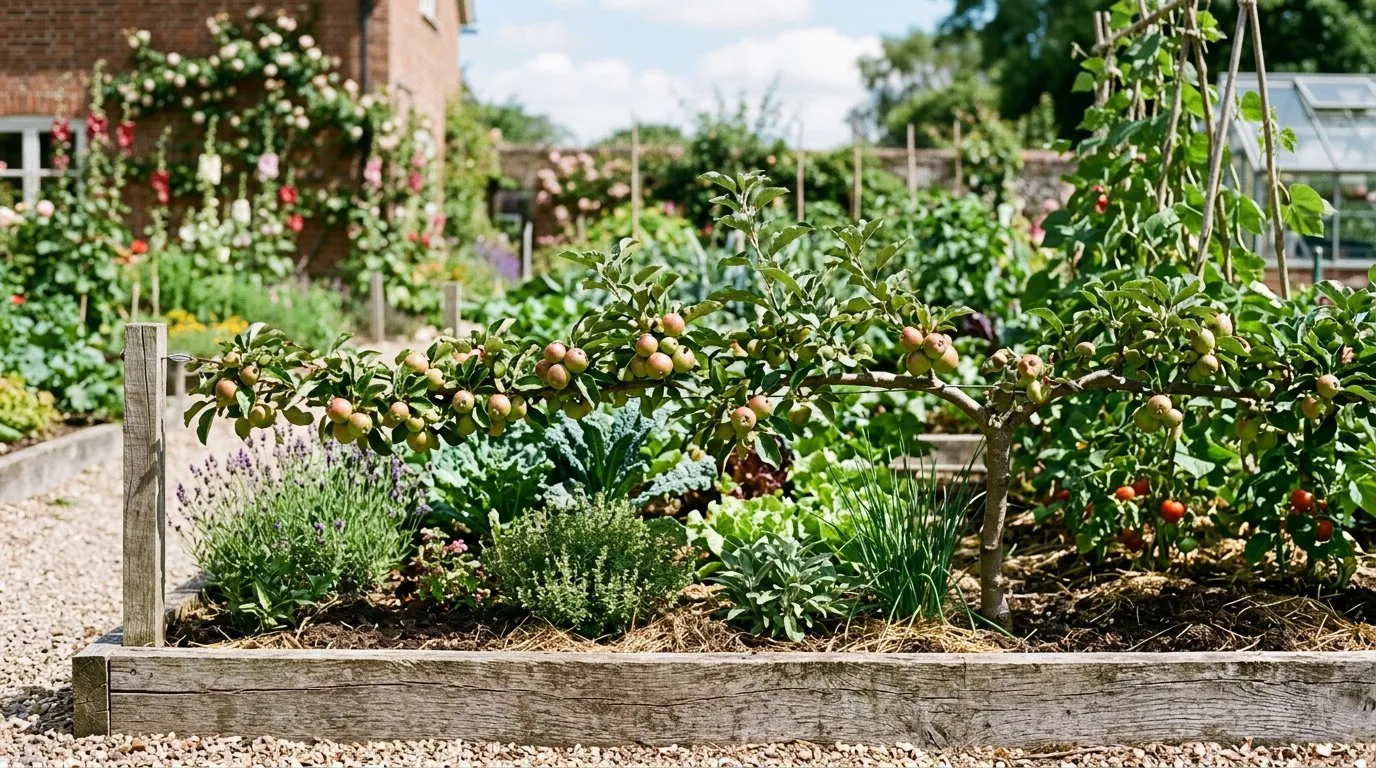 A step-over apple trained at knee height. Decorative bed edging that produces fruit.
Step-overs serve a dual purpose. They produce fruit and act as decorative edging along paths, raised beds, and borders. A single step-over spans about 2 metres. Plant several in a row for a productive, attractive border. Prune each August by cutting new side shoots back to three leaves.
Columnar and ballerina apples
Columnar apples grow as a single upright stem with short fruiting spurs along their length. They take up just 50cm of ground space, making them ideal for balconies and narrow passages. The main varieties are:
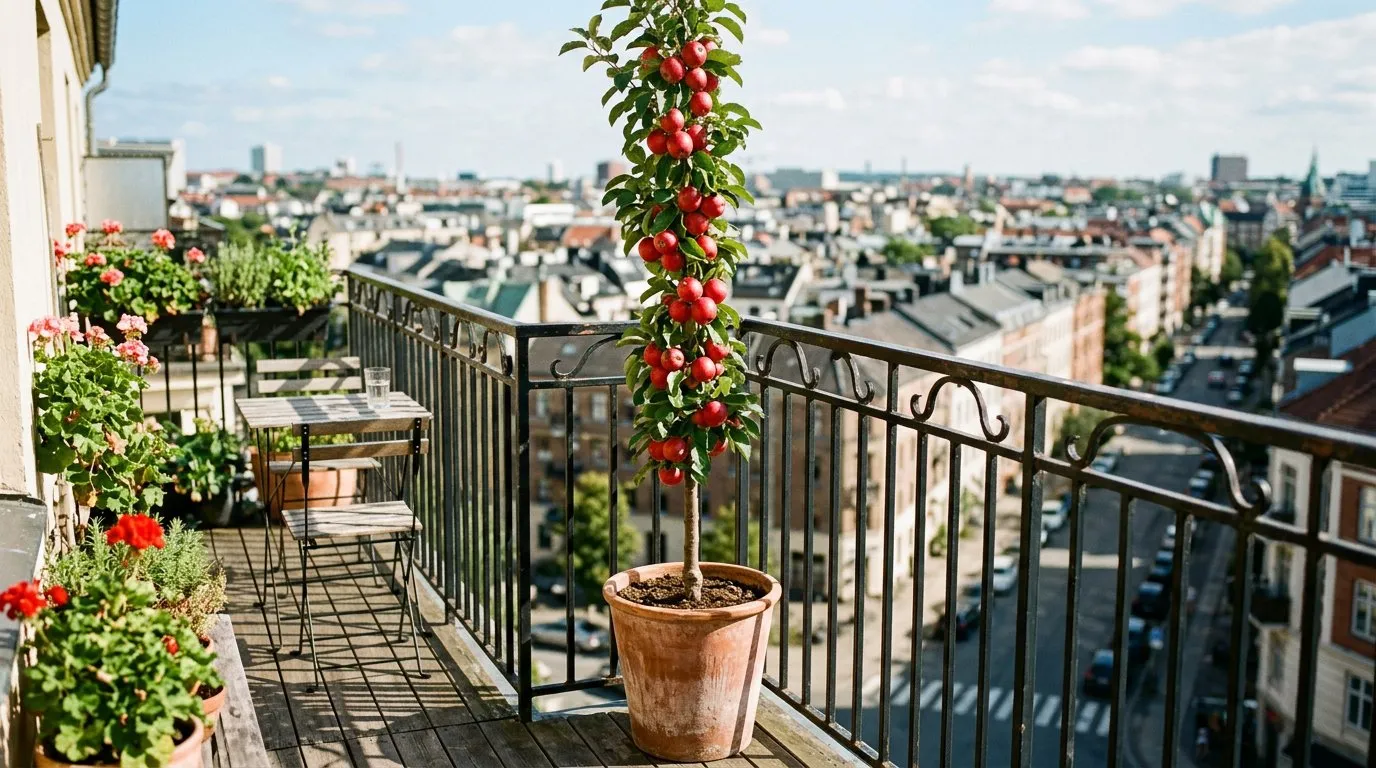 A columnar apple tree on a balcony. The slim upright form needs no pruning.
- Flamenco - red dessert apple, crisp and sweet. The most popular columnar variety.
- Bolero - green dessert apple, sharp flavour. Good for cooking.
- Waltz - red, medium sweet. Very ornamental blossom.
- Polka - red-green, good flavour. Compact growth.
These varieties grow 2-3 metres tall but spread less than 60cm wide. Grow them in 40cm pots or plant in a narrow border against a wall.
Minarette trees
Minarette trees are single-stem trained trees sold by specialist nurseries. Unlike columnar varieties (which are genetically columnar), minarettes are standard varieties pruned to a single vertical leader. They need annual pruning to maintain the single-stem form. They grow 2-2.5 metres tall and 30-50cm wide.
Espalier and fan training
Training fruit trees as espaliers produces flat trees that grow against walls and fences. A dwarf espalier on M9 or M26 rootstock covers a 3-metre section of wall. Fan-trained cherries and plums on Gisela 5 and Pixy rootstocks are equally productive. Both forms make picking and netting straightforward.
Growing dwarf fruit trees in containers
Container growing opens fruit tree growing to anyone with a sunny patio, balcony, or courtyard. Dwarf rootstocks are essential. A tree on vigorous rootstock will outgrow any pot within two seasons.
Choosing the right pot
Use a pot at least 45-50cm wide and deep. Smaller pots dry out too fast and restrict root growth. Heavy materials like terracotta, stone, or thick plastic are better than lightweight pots that blow over in wind. Ensure at least one drainage hole in the base.
Place crocks or broken pot pieces over the drainage hole. Add a 5cm layer of gravel for extra drainage. This stops waterlogging, which kills fruit tree roots faster than any pest or disease.
Compost for containers
John Innes No. 3 is the best compost for container fruit trees. It is loam-based, heavy enough to anchor the pot, and holds nutrients longer than peat-free multipurpose compost. Top the surface with bark mulch to reduce moisture loss. For more on growing fruit in containers, see our dedicated guide.
Watering and feeding
Container fruit trees need daily watering from April to September in warm weather. The limited compost volume dries out fast. Water thoroughly until it runs from the drainage holes.
Feed fortnightly with high-potash liquid fertiliser (tomato feed works well) from bud burst in April through to September. Switch to a balanced feed in early spring. Stop feeding by October so the tree can harden off for winter.
Winter repotting
Every 2-3 years, repot container fruit trees during the dormant season (November to February). Lift the tree, shake off old compost, trim any circling roots, and replant in fresh John Innes No. 3. If the tree has reached its maximum pot size, root-prune by slicing 3-4cm from the root ball edges before repotting in the same container.
Gardener’s tip: Stand container fruit trees on pot feet or bricks. This lifts the pot off the ground, improves drainage, and prevents the base sitting in a puddle of water. Waterlogging in winter kills more container fruit trees than frost.
Family trees for maximum variety
Family trees have 2-3 different varieties grafted onto a single rootstock. An apple family tree might carry Braeburn, Cox, and Discovery on one M26 rootstock. This solves two problems at once. You get variety from a single tree, and the different varieties pollinate each other.
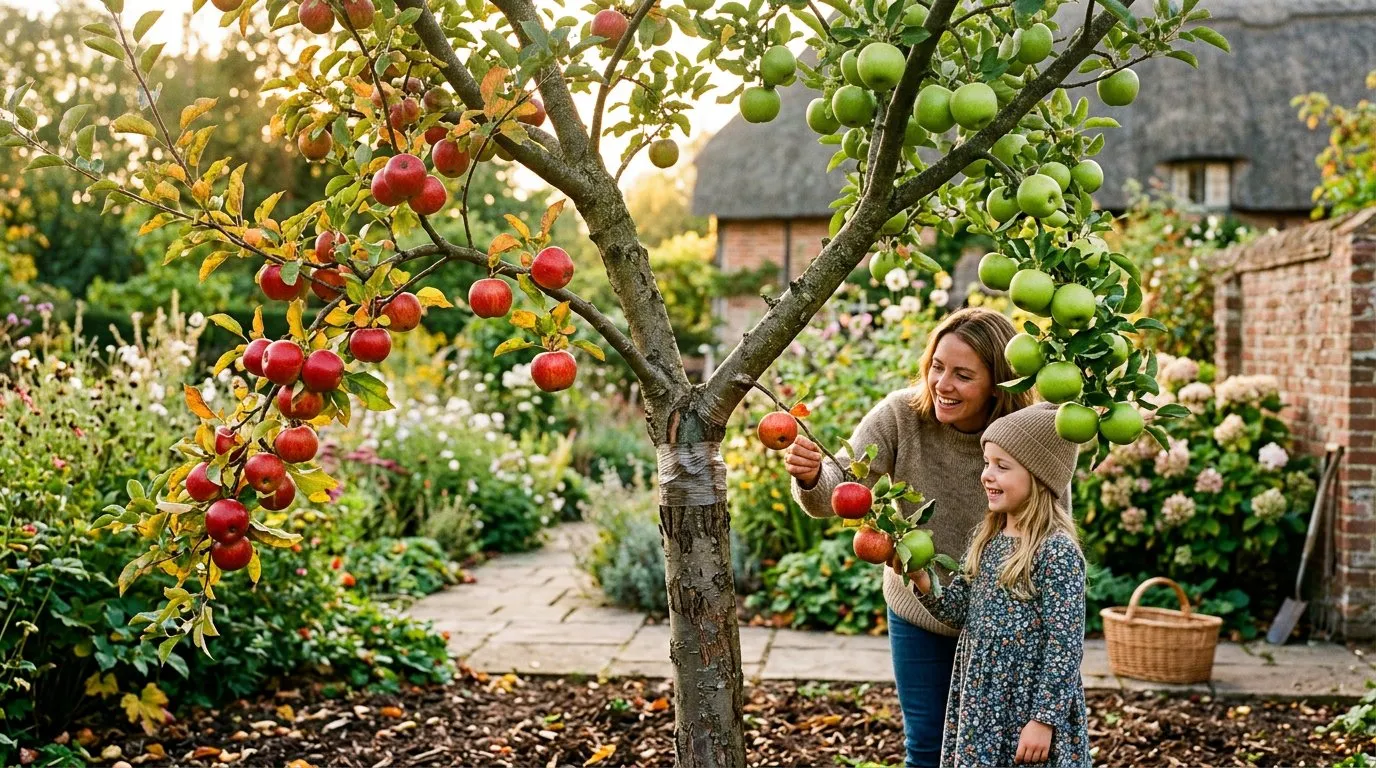 A family tree with two apple varieties on one rootstock. Solves the pollination problem.
Family trees work on any dwarf rootstock. They are widely available from UK nurseries for apples, pears, and plums. A family apple tree on M9 grows to 2.5 metres and produces three types of apple from one planting position.
The varieties are chosen to flower at similar times for cross-pollination. Expect slightly lower yields per variety than a single-variety tree, but higher total variety from the same footprint. Family trees suit gardens where there is room for only one tree and the grower wants pollination certainty.
Month-by-month care calendar
| Month | Task |
|---|---|
| January | Prune apple and pear trees on dry days. Order bare-root trees from nurseries. Check stakes and ties. |
| February | Complete any pruning before buds break. Apply a balanced granular fertiliser around the base. Mulch with well-rotted compost. |
| March | Plant bare-root trees before the end of the month. Check for aphids on emerging buds. Begin fortnightly liquid feeding for container trees. |
| April | Watch for late frost on blossom. Cover trees with fleece on frosty nights. Thin congested fruit clusters after petal fall. Water containers daily. |
| May | Thin fruit to one per cluster for apples and pears. Net cherry trees against birds. Water and feed regularly. Check ties are not cutting into bark. |
| June | Summer-prune trained forms (espaliers, step-overs, fans). Monitor for woolly aphid and sawfly. Pick early cherries. Continue feeding containers. |
| July | Harvest early apples and cherries. Support heavily laden branches with props. Continue daily watering for pots. Summer-prune columnar trees. |
| August | Harvest mid-season apples, pears, and plums. Prune plum and cherry trees (prune stone fruit in summer to avoid silver leaf disease). Check what to harvest this month. |
| September | Pick late-season apples and pears. Store sound fruit in a cool, dark place. Stop feeding container trees. |
| October | Collect fallen fruit and dispose of any showing brown rot. Clean up leaf litter. Order bare-root trees for November delivery. |
| November | Plant bare-root trees. Check stakes. Apply winter tree wash to control overwintering pest eggs. Move container trees to a sheltered position. |
| December | Continue planting bare-root trees in mild spells. Inspect stored fruit and discard any showing rot. Check ties and supports. |
Common mistakes with dwarf fruit trees
Planting too deep
The graft union (the bulge where the variety meets the rootstock) must sit above soil level. If buried, the fruiting variety sends out its own roots and the dwarfing effect is lost. Plant with the graft union 10cm above the surface. Check it has not sunk after the first winter.
Forgetting to stake
Dwarf rootstocks produce small root systems. Trees on M27, M9, and Pixy blow over in strong winds without a stake. Use a permanent stake for M27 and Pixy. Drive it into the planting hole before the tree goes in. Tie the tree to the stake with a proper rubber tree tie, not wire or string. Check ties twice a year.
Skipping summer pruning
Dwarf fruit trees need summer pruning in July and August to keep them compact and productive. Cut new shoots back to three leaves above the basal cluster. Without summer pruning, trained forms lose their shape within a season. Winter pruning alone is not enough.
Using the wrong compost in containers
Standard multipurpose compost is too light for fruit trees. It dries out fast, collapses within one season, and provides no weight to anchor the tree. Use John Innes No. 3 for all container fruit trees. It is heavier, holds moisture better, and retains nutrients longer.
Choosing non-self-fertile varieties without a partner
A beautiful fruit tree that never produces fruit is almost always a pollination problem. If you have room for only one tree, choose a self-fertile variety from the list above. Check pollination groups before buying if you plan to grow two trees together. If your space allows only one tree, our tips on small garden design cover how to fit productive plants into tight layouts.
Where to grow dwarf fruit trees in the UK
Dwarf fruit trees suit almost any outdoor space across the UK. The key requirement is 6 hours of direct sunlight during the growing season (April to September).
Patios and courtyards are ideal for container-grown trees. Place pots against a south or west-facing wall for extra warmth and wind shelter. The wall radiates stored heat overnight, protecting blossom from late frost.
Balconies work for columnar apples and small container trees on M27 rootstock. Check the weight limit of your balcony before adding large pots. A 50cm pot filled with John Innes No. 3 weighs 25-30kg when watered.
Allotments benefit from dwarf trees planted along plot edges. Step-overs make productive path borders that do not shade neighbouring plots. The Royal Horticultural Society’s fruit growing advice covers site selection and soil preparation in further detail.
Front gardens suit fan-trained or espalier trees against house walls. They look architectural, take up no ground space, and produce fruit in a position most gardeners waste on empty wall. Even a north-facing wall suits a Morello cherry on Gisela 5 for cooking.
For gardeners growing other crops in limited space, our container vegetable gardening guide covers pots and raised beds for vegetables alongside fruit trees. Our guide to growing fig trees covers another excellent wall-trained option for sheltered UK spots.
Now you have chosen your rootstock and variety, read our full guide on growing apple trees for the pruning, feeding, and pest management advice to get the best from your tree year after year.
Frequently asked questions
How tall do dwarf fruit trees grow?
Most reach 1.5 to 3 metres tall. Apple trees on M27 rootstock stay around 1.5m. Those on M9 reach 2.5m. Pear on Quince C, cherry on Gisela 5, and plum on Pixy all grow to 2.5-3m. The rootstock controls the final height, not the variety grafted onto it.
Can I grow a dwarf fruit tree in a pot?
Yes, all dwarf rootstocks suit containers. Use a pot at least 45cm wide and deep. Fill with John Innes No. 3 compost for weight and nutrient retention. Water daily in summer and feed fortnightly with high-potash liquid fertiliser from April to September.
Do dwarf fruit trees need a pollination partner?
Self-fertile varieties do not need a partner. Braeburn and Falstaff apples, Conference pear, Stella cherry, and Victoria plum all set fruit alone. Other varieties need a compatible tree flowering at the same time within 15-20 metres.
How long before a dwarf fruit tree produces fruit?
Most crop within 2-3 years of planting. Trees on M27 rootstock often fruit in their second year. Container-grown trees from nurseries sometimes arrive with flower buds already formed. Remove flowers in the first spring to help roots establish.
What is a step-over apple tree?
A step-over is a single-tier espalier on M27 rootstock. It grows knee-height, around 40-45cm. Two horizontal arms extend from a short central stem. Step-overs work as productive edging along paths and raised beds.
When should I plant a dwarf fruit tree?
Plant bare-root trees from November to March. This is the dormant season when roots establish without stress. Container-grown trees can go in at any time, but autumn and winter planting gives the best results. Avoid planting in frozen or waterlogged soil.
How much fruit does a dwarf tree produce?
A dwarf apple on M27 yields 5-10kg per year. Trees on M9 produce 10-20kg. A single Victoria plum on Pixy gives 10-15kg in a good season. That is enough for fresh eating, baking, and preserving for a small household.
Lawrie has been gardening in the West Midlands for over 30 years. He grows his own veg using no-dig methods, keeps a wildlife-friendly garden, and writes practical advice based on real UK growing conditions.