How to Grow Grape Vines in the UK
UK guide to growing grape vines outdoors and under glass. Covers best varieties, planting, pruning, training wires, and harvesting grapes in UK gardens.
Key takeaways
- Plant bare-root vines between November and March against a south-facing wall with horizontal wires spaced 30cm apart
- Hardy outdoor varieties like Boskoop Glory, Seyval Blanc, and Regent crop reliably across most of England and Wales
- Prune hard in December or January using the rod-and-spur system for dessert grapes or Guyot for wine grapes
- Summer pruning is essential: pinch laterals back to 5-6 leaves and sub-laterals to 1 leaf after a fruit truss
- Thin bunches and individual berries in June for larger, sweeter dessert grapes
- Vines are self-fertile, fruit from year three, and live for 50 years or more with annual pruning
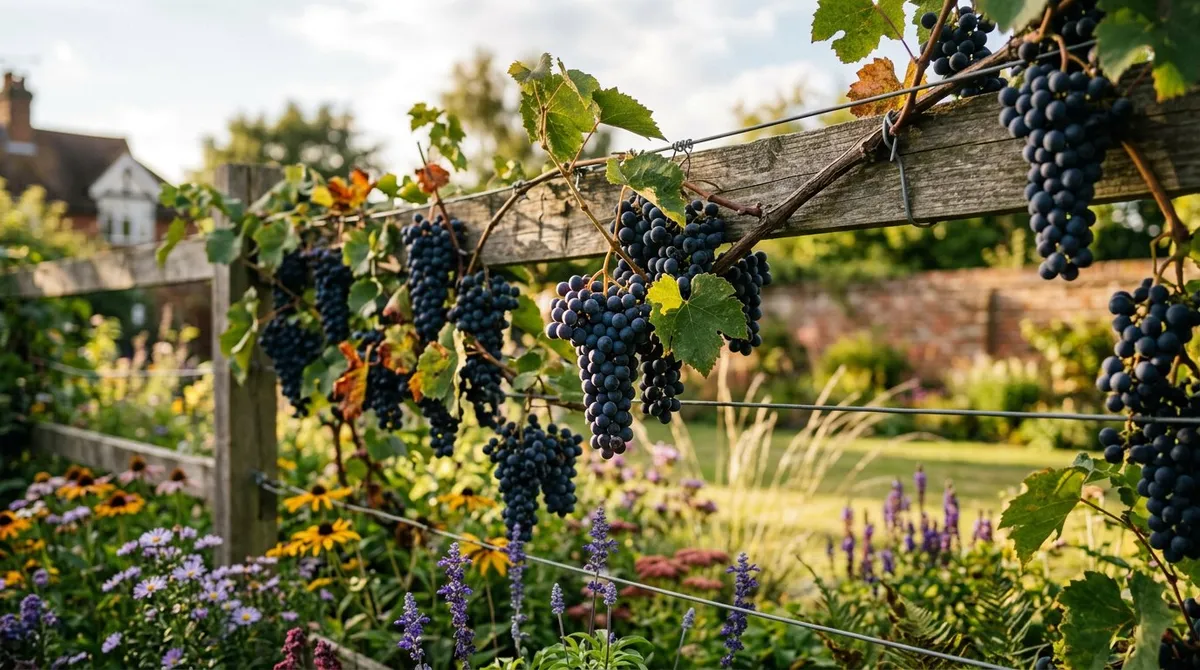
Grape vines are among the longest-lived and most rewarding fruit plants for UK gardens. A single vine planted against a warm wall this winter will produce bunches of sweet dessert grapes or crisp wine grapes within three years. With proper pruning, that same vine will still be cropping half a century from now. The UK wine industry has grown to over 900 vineyards, and the same warming climate that fuels commercial planting makes garden grape growing more reliable than ever.
This guide covers everything from choosing the right variety to the annual pruning cycle that keeps a vine productive for decades. If you are already growing fruit, our guides to fig trees and apple trees cover other long-lived crops suited to south-facing walls.
What type of grapes can I grow in the UK?
UK grape growing splits into two distinct categories: outdoor varieties bred for the British climate, and greenhouse varieties that need the extra warmth of glass to ripen properly. Within outdoor varieties, you also choose between dessert grapes for eating fresh and wine grapes for pressing.
Outdoor dessert grapes
Dessert grapes are bred for sweetness, large berry size, and thin skins. They are the grapes you eat straight from the vine. In the UK, dessert varieties need a warm, sheltered spot to build enough sugar. A south-facing wall or fence is almost essential outside the south-east.
Boskoop Glory is the most reliable outdoor dessert grape for UK gardens. It produces large bunches of blue-black grapes with a sweet, muscat-like flavour. It ripens in September, even in average summers. The vine is vigorous and disease-resistant, making it the best choice for beginners.
Muscat Bleu produces aromatic, deep blue grapes with an intense muscat flavour. It ripens in early October and tolerates cooler conditions than many dessert types. The berries are medium-sized with a slight bloom. It is a Swiss-bred variety selected specifically for northern European climates.
Outdoor wine grapes
The UK wine boom proves that British conditions suit wine grape production. Seyval Blanc is the backbone of English wine, producing crisp, citrusy white wine. It ripens early, resists disease, and crops heavily. If you want to make wine from your garden vine, Seyval Blanc is the safest starting point.
Regent produces a surprisingly good red wine for a northern climate. The berries are small and dark with high sugar and tannin levels. It has excellent resistance to both powdery and downy mildew, reducing the need for spraying. Solaris and Phoenix are two more white wine varieties bred in Germany for cool climates. Both ripen very early and resist fungal diseases.
Greenhouse varieties
Under glass, you can grow the classic dessert grapes that never ripen fully outdoors in Britain. Black Hamburg is the traditional greenhouse grape, producing enormous bunches of sweet, juicy black grapes from August. It has been grown in British greenhouses since the Victorian era. Muscat of Alexandria needs even more warmth but produces the finest-flavoured white dessert grapes of any variety. Both require a heated or well-insulated greenhouse in all but the warmest parts of southern England.
Best grape vine varieties for UK gardens
Choosing the right variety determines whether you get ripe fruit or hard green bullets. This table compares the six most reliable outdoor varieties and two greenhouse classics.
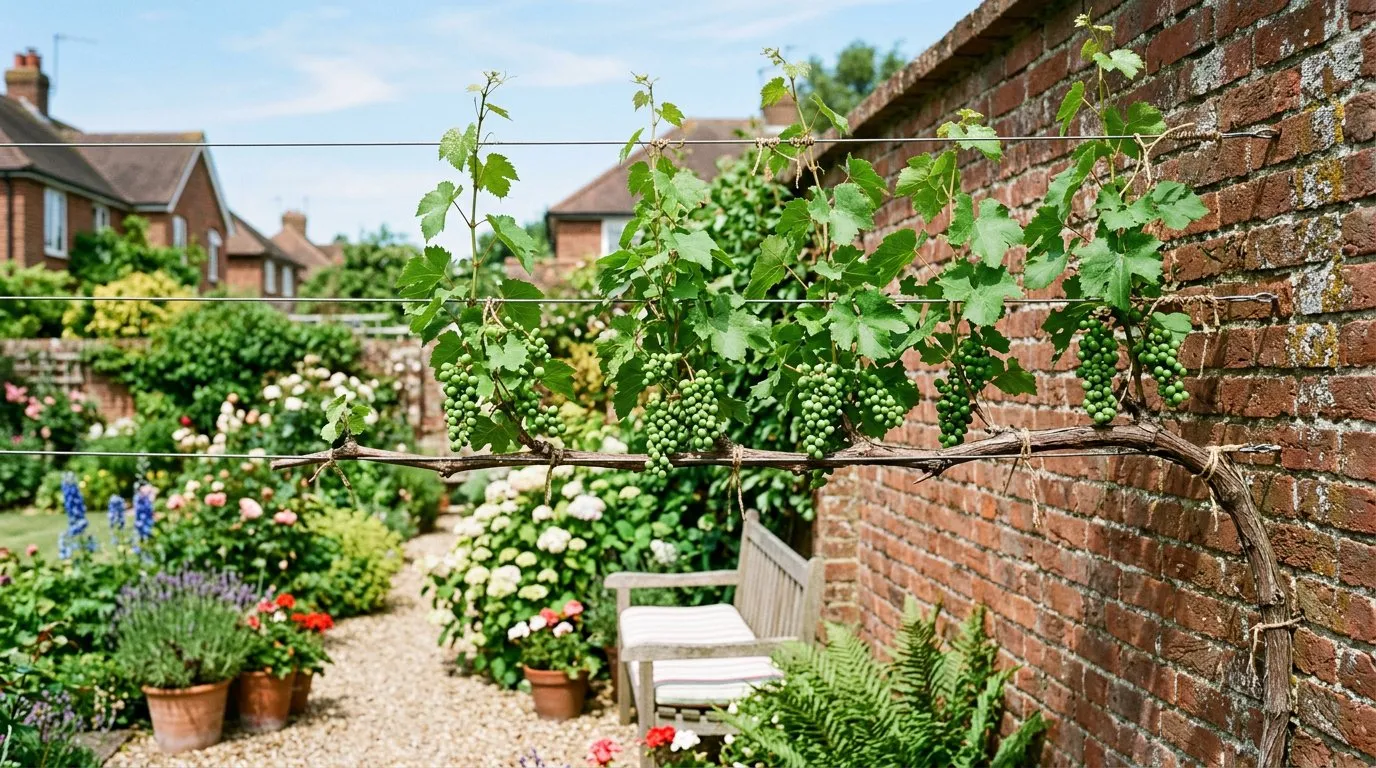 A mature vine trained on horizontal wires showing the permanent rod-and-spur framework.
| Variety | Type | Use | Colour | Ripens | Vigour | Disease resistance | Best for |
|---|---|---|---|---|---|---|---|
| Boskoop Glory | Outdoor | Dessert | Blue-black | September | Strong | Good | Beginners, all-round reliability |
| Muscat Bleu | Outdoor | Dessert | Deep blue | Early October | Moderate | Good | Flavour, cooler gardens |
| Seyval Blanc | Outdoor | Wine | Green-gold | Late September | Strong | Excellent | White wine, disease-prone sites |
| Regent | Outdoor | Wine | Dark blue | October | Moderate | Excellent | Red wine, low-spray growing |
| Solaris | Outdoor | Wine | Golden | Early September | Strong | Very good | Early harvest, northern gardens |
| Phoenix | Outdoor | Wine | Green-yellow | Late September | Moderate | Good | Aromatic white wine |
| Black Hamburg | Greenhouse | Dessert | Black | August | Very strong | Moderate | Large sweet dessert grapes |
| Muscat of Alexandria | Greenhouse | Dessert | Amber | September | Strong | Moderate | Finest dessert flavour |
Gardener’s tip: For a single vine on a garden wall, choose Boskoop Glory. It handles average British summers better than any other dessert grape and produces fruit sweet enough to eat fresh without any thinning. For two vines, add Seyval Blanc for a contrasting white wine grape that ripens a few weeks later.
Why we recommend Boskoop Glory for UK garden walls: After 30 years of growing grape vines across English gardens, Boskoop Glory is the only outdoor dessert variety that has never failed to ripen fully even in poor summers with below-average sunshine hours. In years where Muscat Bleu and Black Hamburg produced underripe, hard berries, Boskoop Glory still delivered bunches averaging 18-20 Brix sugar content, sweet enough to eat straight from the vine. For any UK gardener starting out with a single south-facing wall, no other dessert grape comes close.
Where to plant a grape vine
Location determines success more than any other factor. Grapes need full sun and warmth to ripen. In the UK, this means a south-facing wall, fence, or open aspect that gets direct sunlight for most of the day. West-facing walls work in southern England but may not provide enough warmth further north.
Wall and fence planting
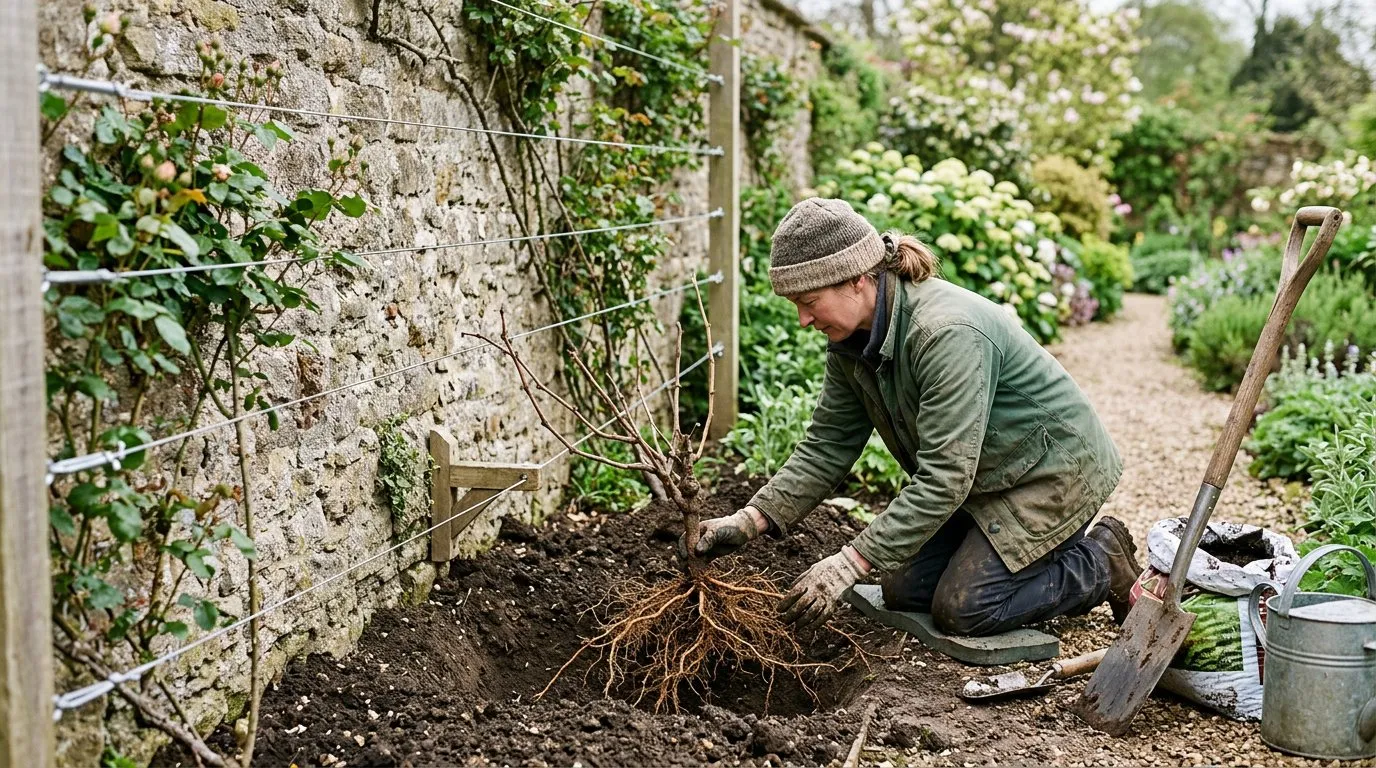 Planting a bare-root vine at the base of a wall with wires ready for training.
Most UK garden vines grow against walls and fences. The wall absorbs heat during the day and radiates it back at night, creating a warmer microclimate that ripens fruit earlier. Brick and stone walls are best. Wooden fences work but store less heat.
Fix horizontal training wires to the wall using vine eyes and tensioning bolts. Space wires 30cm apart vertically, starting 40cm above ground level. Use galvanised wire of at least 2.5mm gauge. The wires need to hold several kilograms of fruit and foliage by midsummer, so tension them firmly. Keep the wires 10-15cm away from the wall to allow air to circulate behind the foliage. Good air circulation is critical for stopping powdery mildew, the most common grape vine disease in Britain.
Open-ground planting
Wine grapes can grow in open ground without a wall, just as they do in commercial vineyards. Plant rows running north to south so both sides of the row receive equal sunlight. Use a post-and-wire system with end posts braced against the wire tension and intermediate posts every 3-4 metres. This approach suits gardeners with more space who want to grow several vines for winemaking.
Soil requirements
Grape vines tolerate a wide range of soils. They prefer free-draining ground and struggle in heavy clay that sits waterlogged in winter. Sandy or chalky soils suit them well. Vines planted in poor, stony ground often produce the best-flavoured fruit because mild stress concentrates sugars in the berries. Avoid very rich, heavily manured soil, which produces excessive leafy growth at the expense of fruit. If your soil is heavy, consider growing in containers as an alternative for a single vine.
How to plant a grape vine
Plant bare-root vines between November and March while the plant is dormant. This gives the roots time to establish before the first flush of spring growth. Container-grown vines from garden centres can go in at any time, but dormant planting still gives the strongest first-year growth.
Planting steps
- Dig a hole 45cm wide and 30cm deep, positioned 30-40cm away from the base of the wall
- Fork garden compost into the bottom of the hole to improve soil structure
- Set the vine at the same depth it was growing in its pot or nursery bed
- Angle the main stem towards the wall if planting against a structure
- Backfill with the excavated soil, firming gently around the roots
- Water thoroughly and apply a 5cm mulch of bark chips or compost around the base
- Cut the main stem back to three strong buds above the graft union
That final hard cut feels brutal on a newly planted vine. It is essential. Cutting back forces the vine to produce one strong leading shoot rather than several weak ones. That single strong shoot becomes the permanent trunk, or rod, of your vine.
Greenhouse planting
For greenhouse varieties like Black Hamburg, plant the vine outside the greenhouse with the main stem trained through a hole at the base of the wall. This gives roots access to natural rainfall and prevents them drying out in the baked greenhouse border soil. Train the rod up inside the greenhouse where fruit benefits from the trapped warmth.
How to train a grape vine
Training makes a permanent framework that carries fruiting wood for decades. The method depends on whether you are growing dessert grapes or wine grapes. If you are interested in training techniques for other fruit, our guide to training fruit trees as espaliers covers the same principles of permanent framework and annual renewal.
Rod-and-spur system (dessert grapes)
The rod-and-spur system is the standard method for dessert grapes on walls. A single permanent vertical rod carries short spurs at regular intervals along its length. Each spur produces one or two fruiting laterals each year.
Year one: Allow the strongest shoot to grow vertically as the main rod. Tie it to the wires as it grows. Remove all other shoots. By autumn, the rod should reach 1.5-2 metres.
Year two: In December or January, cut the rod back by half, leaving it at around 1 metre. This stimulates strong lateral growth in spring. During summer, laterals grow from buds along the rod. Allow these to extend and tie them to the horizontal wires. Pinch out flower trusses in year two so the vine channels energy into root and framework development.
Year three onwards: The vine begins fruiting. Each winter, cut laterals back to one or two buds from the main rod. In spring, these buds produce new shoots that carry fruit. Allow one bunch per lateral on a young vine. As the vine matures, it supports more fruit.
Guyot system (wine grapes)
The Guyot system replaces the fruiting canes entirely each year. In winter, select one cane (single Guyot) or two canes (double Guyot) from the previous summer’s growth. Tie these horizontally along the lowest wire. They produce fruiting shoots in spring. At the same time, train a new replacement cane vertically from the vine’s base for next year’s fruit. After harvest, remove the old horizontal canes and tie in the replacements.
This system produces more fruit than rod-and-spur but requires more winter pruning knowledge. It is the method used in commercial vineyards across the UK and France.
How to prune a grape vine
Pruning is the single most important skill in grape growing. Without it, a vine becomes a tangled mass of foliage that shades its own fruit and harbours disease. Grape vines need two separate pruning sessions each year: winter pruning and summer pruning.
Winter pruning (December to January)
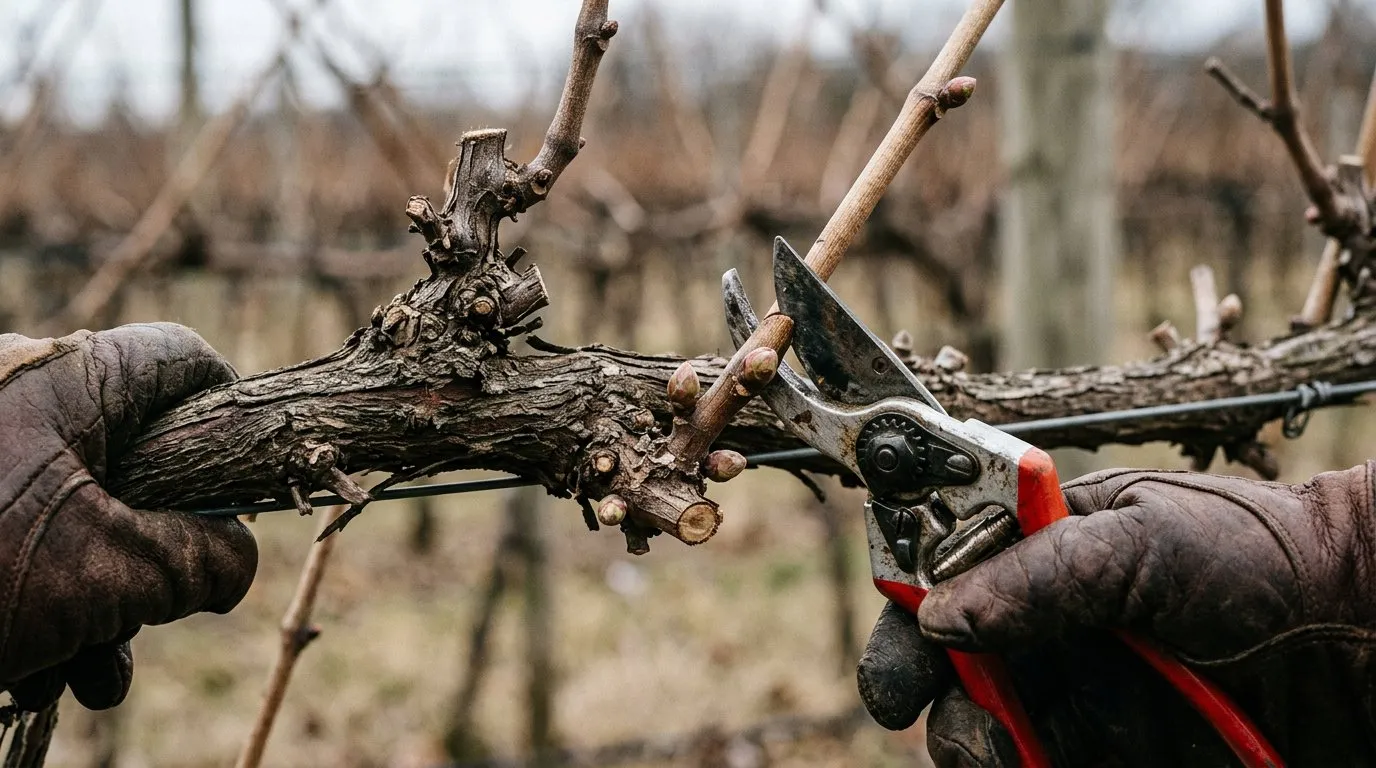 Winter spur pruning. Each lateral is cut back to one or two buds.
Prune in December or January only, while the vine is fully dormant. This timing is critical. If you prune after sap starts rising in late February, the cuts bleed copiously. The vine weeps sap for weeks, losing energy and potentially allowing disease entry. Early winter pruning avoids this problem entirely.
For the rod-and-spur system, cut every lateral back to one or two buds from the main rod. The stubs left behind become the spurs that give the system its name. Over the years, these spurs develop a knobbly, gnarled appearance. Remove any dead or weak wood completely.
For the Guyot system, select replacement canes and remove all others. Refer to the RHS grape vine pruning guide for illustrated Guyot instructions.
Summer pruning (June to August)
Summer pruning controls vigour and directs energy into fruit ripening rather than leaf growth. It is not optional. An unpruned vine produces a dense canopy that blocks sunlight from reaching the grapes and traps humid air around the fruit, promoting grey mould (botrytis).
- Pinch fruiting laterals to 5-6 leaves beyond the last fruit truss
- Pinch sub-laterals (side shoots growing from laterals) to one leaf
- Remove tendrils that wrap around fruit bunches
- Strip leaves shading fruit in late August to expose bunches to sunlight and improve air circulation
Repeat these pinching tasks every 7-10 days through summer. The vine grows fast in warm weather. Regular attention prevents the canopy getting ahead of you.
How to thin grapes for larger fruit
Thinning is what separates good dessert grapes from mediocre ones. Without thinning, each bunch contains too many berries packed tightly together. The vine cannot fill them all with sugar, and the close packing traps moisture that encourages grey mould.
Bunch thinning
In June, when bunches are fully formed but berries are still small and hard, remove the weakest bunches entirely. On a young vine (years three and four), leave only one bunch per lateral shoot. A mature vine supports two bunches per lateral in good years.
Berry thinning
For the finest dessert grapes, thin individual berries within each bunch. Use small pointed scissors to remove the innermost berries, creating space between those that remain. Aim to leave each remaining berry with enough room to swell to full size without touching its neighbours.
Professional grape growers thin up to half the berries in a bunch. For garden purposes, removing a third of the berries is enough to make a noticeable improvement in size and sweetness. Wine grape growers generally do not thin individual berries, as smaller berries with higher skin-to-juice ratios produce more concentrated wine.
Grape vine month-by-month calendar
This calendar covers the annual cycle for an established vine (year three onwards). Our monthly harvest guide shows how grapes fit alongside other crops through the season.
| Month | Task |
|---|---|
| January | Complete winter pruning by month end. Check wire tensions. Order new vines. |
| February | Finish any remaining pruning before mid-month. Do not prune after sap rises. |
| March | Plant bare-root vines. Apply a mulch of garden compost around established vines. |
| April | New shoots emerge from buds. Tie in young growth gently. Watch for late frost damage. |
| May | Flower trusses appear. Pinch growing tips of non-fruiting shoots to 5 leaves. |
| June | Flowering and fruit set. Begin bunch thinning. Start summer pinching of laterals. |
| July | Berry thinning for dessert grapes. Continue summer pruning every 7-10 days. |
| August | Berries start colouring (veraison). Net vines against birds and wasps. Strip shading leaves. |
| September | Harvest early varieties (Boskoop Glory, Solaris). Test sweetness by tasting. |
| October | Harvest later varieties (Regent, Seyval Blanc). Clear fallen leaves. |
| November | Plant new bare-root vines. Leaves fall. Begin winter pruning from late November. |
| December | Main winter pruning month. Cut laterals to 1-2 buds (spur) or select replacement canes (Guyot). |
Common pests and diseases
Good site selection and diligent summer pruning prevent most grape vine problems. Air circulation is the single best defence against fungal diseases. A vine trained flat against a wall with proper wire spacing and regular leaf stripping stays healthier than one allowed to grow into a dense thicket.
Powdery mildew
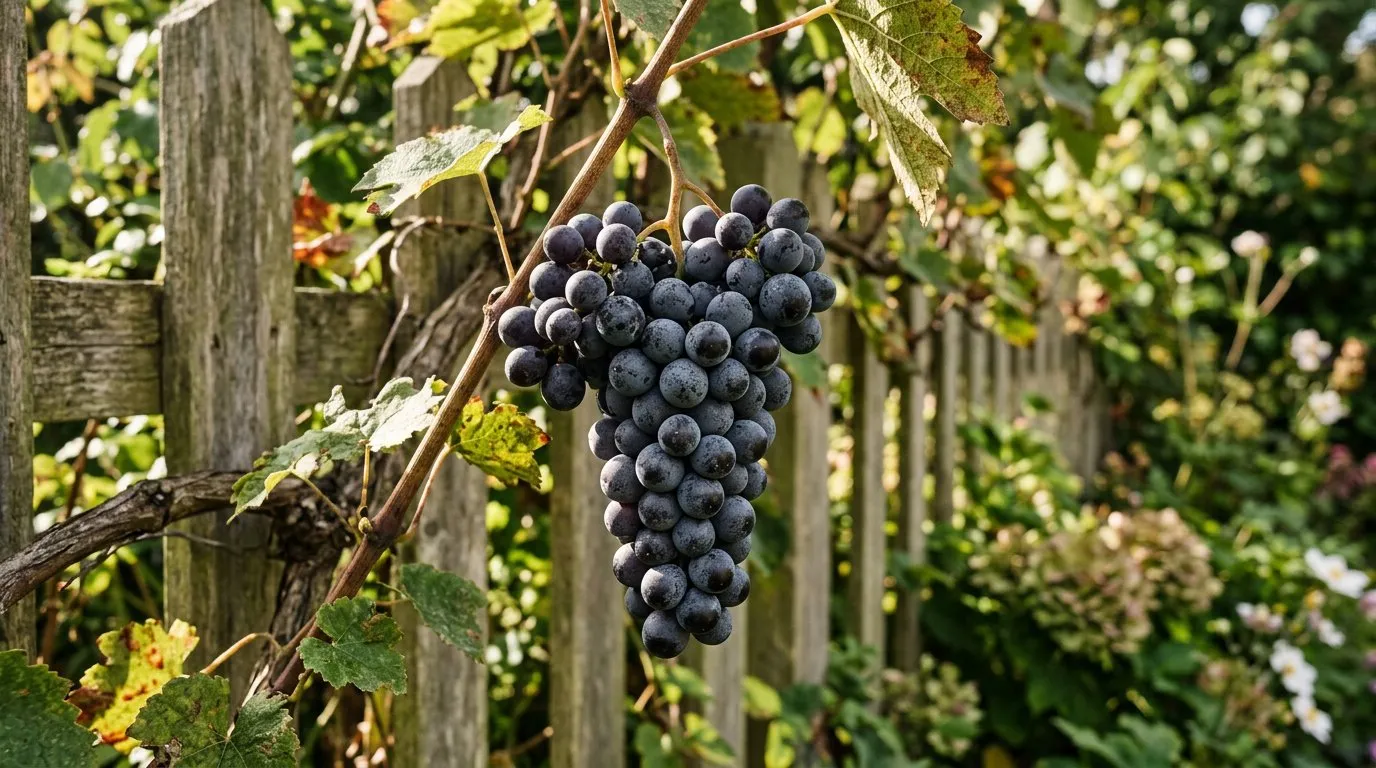 Ripe Boskoop Glory grapes in September. Harvest when berries are sweet and soft.
Powdery mildew appears as a white, dusty coating on leaves, shoots, and fruit. It thrives in warm, dry conditions with poor air circulation. Outdoor varieties like Seyval Blanc and Regent have strong natural resistance. Keep foliage open by summer pruning. Remove badly affected leaves and burn them. Sulphur-based sprays offer organic control if the problem is severe.
Grey mould (botrytis)
Grey mould rots fruit in damp autumns. Berries turn brown and fuzzy. Thinning bunches and removing shading leaves are the best preventive measures. Good air flow around fruit dries moisture before the fungus takes hold. Remove any affected fruit immediately to stop the mould spreading through the bunch.
Birds and wasps
Birds attack grapes from August as the fruit colours. Wasps follow as sugar levels rise. Net the entire vine with fine mesh (not bird netting, which traps birds) before fruit starts to soften. Wasp traps filled with sweet liquid reduce numbers but rarely eliminate the problem. Netting is the only reliable protection.
Five common mistakes when growing grape vines
1. Pruning too late in spring
Pruning after February causes heavy sap bleeding. The vine weeps from every cut for weeks, losing stored energy and creating wet surfaces where fungal spores settle. Always complete pruning by the end of January. If you miss the window, leave the vine unpruned until the following December rather than cutting in spring.
2. Skipping summer pruning
Without summer pruning, the vine produces a dense canopy that blocks sunlight from reaching the fruit. Grapes ripen slowly or not at all, and the humid conditions inside the canopy promote powdery mildew and grey mould. Pinch laterals and sub-laterals every 7-10 days from June to August. It takes five minutes per vine and makes the difference between a good crop and a poor one.
3. Planting on a north-facing wall
Grapes need direct sun and warmth to build sugar. A north-facing wall receives almost no direct sunlight, and the fruit never ripens. East-facing walls are only marginally better. A south-facing or south-west-facing aspect is necessary in all but the warmest microclimates. If you only have shade, consider blueberries, which tolerate partial shade better than grapes.
4. Not thinning fruit
Leaving every bunch and every berry on the vine produces many small, sour grapes rather than fewer sweet ones. Thin bunches in June and berries in July. One bunch per lateral on a young vine, two on a mature vine. For dessert grapes, also thin individual berries within each bunch for the sweetest, largest fruit.
5. Forgetting to net against birds
Birds strip a grape vine in days once the fruit colours. By the time you notice the damage, most of the crop is gone. Net the vine in early August before fruit starts to soften. Use fine mesh that excludes wasps as well as birds. Tuck the edges securely so nothing gets underneath.
Growing grape vines in containers
A single grape vine grows well in a large container on a sunny patio or balcony. Use a pot at least 45cm in diameter and 40cm deep, filled with loam-based compost (John Innes No. 3). Multi-purpose compost dries out too quickly and lacks the weight to anchor a top-heavy vine in wind.
Train the vine up a fan-shaped framework of canes or fix it to a sunny wall behind the container. Prune and summer-pinch exactly as you would a ground-planted vine. Water regularly through summer, as containers dry out far faster than open ground. Feed with a high-potash liquid fertiliser (tomato feed) every two weeks from flowering to harvest.
Container vines produce smaller crops than ground-planted vines, typically 1-2kg per year compared to 3-5kg. They are ideal for small gardens, patios, and courtyards where there is no border soil to plant into. Boskoop Glory and Seyval Blanc both perform well in pots.
Why grow grapes in a UK garden?
A grape vine is one of the few fruit plants that improves with age. While most fruit bushes decline after 10-15 years, a well-pruned vine hits its stride at five years old and keeps producing for half a century. The only other garden fruit with a similar lifespan is the fig.
The economics are straightforward. A bare-root vine costs 8 to 15 pounds. A south-facing wall or fence costs nothing to use. From year four, a single vine produces 3-5kg of grapes annually. That equates to roughly 15 to 20 bottles of wine or enough dessert grapes for several months of fresh eating. The flavour of sun-warmed grapes picked from your own garden is nothing like the chilled, imported fruit in supermarkets.
The UK wine industry proves the case on a larger scale. With over 900 vineyards now in production across England and Wales, the British climate clearly supports grape growing. According to WineGB, English and Welsh vineyards produced 12.2 million bottles in 2023. Garden growers benefit from the same warming trend, with longer growing seasons and warmer autumns that help fruit ripen fully.
Plant a vine this winter. Choose Boskoop Glory for dessert grapes, Seyval Blanc for wine, or both. Cut back hard, train along wires, and prune faithfully every winter and summer. In three years, you will be picking your own grapes. In thirty years, the vine will still be there, producing as generously as ever.
Now you’ve mastered grape vines, read our guide on growing fruit trees in the UK for the next step in planning a productive garden with a full harvest calendar from cherry season in June to late apples in October.
Lawrie has been gardening in the West Midlands for over 30 years. He grows his own veg using no-dig methods, keeps a wildlife-friendly garden, and writes practical advice based on real UK growing conditions.