Key takeaways
- Most UK allotment flooding is from saturated soil, not surface flow - drainage matters more than barriers
- 60cm-tall raised beds keep roots above the water table on most flood-prone sites
- French drains with perforated pipe and gravel cost £25-40 per metre to install yourself
- Soakaways need to be at least 5m from any structure and 1m above the water table
- Wait until soil is workable before walking on flooded beds - compaction is the worst secondary damage
- Discard root vegetables that have sat in standing water for more than 48 hours
- Plant flood-tolerant crops on prone areas: rhubarb, mint, watercress, willow, blackcurrant
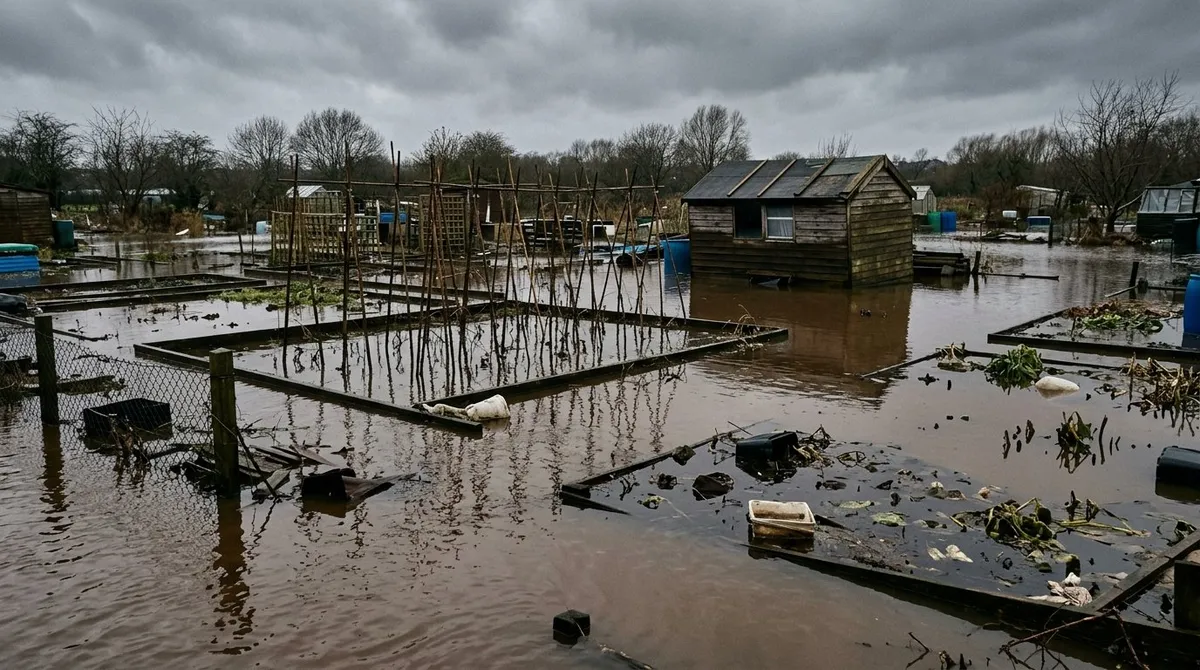
Allotment flooding is no longer a once-in-a-decade event. The 2023-24 winter set wettest-on-record marks across half of England and Wales. The Environment Agency reports a 30% rise in flooded UK growing land since 2020. Most allotment sites have seen at least one significant flood in the last five years. Many have seen two or three.
Why UK plots flood
Understanding the cause matters because the response differs by cause. UK allotment flooding has three main mechanisms.
Saturated soil and rising water table. The most common UK cause. Autumn and winter rainfall fills the soil profile. The water table rises until it is at or near the surface. Any further rain runs off rather than soaking in. Heavy clay soils are worst affected because they hold a lot of water but drain slowly.
Surface flow from neighbouring land. Less common but more dramatic. Concrete car parks, paved access roads, neighbouring industrial sites, and compacted footpaths shed water onto allotment land. A flood from this cause is fast and destructive, often arriving within an hour of heavy rain.
Watercourse overflow. Allotments next to streams, drainage ditches, or rivers can flood when the watercourse overtops or backs up. These events are typically forecast and can be prepared for, unlike the other two types.
The 2023-24 winter floods were mostly saturated-soil events with watercourse overflow on lower-lying sites. Climate models suggest both will become more frequent in UK winters. Drier summers and wetter winters are now the established trend.
How to assess your plot’s flood risk
Before doing any drainage work, understand what you are dealing with.
Check the Environment Agency flood map. check-for-flooding.service.gov.uk shows official flood risk for any UK address. Type in the postcode of your allotment site. The map shows surface water flood risk, river flood risk, and reservoir failure risk separately. Most allotment flooding is in the “surface water” category, which is the hardest to model accurately.
Walk the site after a heavy rain. Where does water pool? Where does it flow? Where does it disappear quickly? This tells you more than any map. Take photos at peak rain and 24 hours later.
Dig a test pit. A 60cm deep hole at the lowest point of your plot. After 24 hours of rain, check the water level. If the bottom is full of water, you have a high water table. If the water drains quickly, your subsoil has good drainage.
Talk to other plot holders. Veterans on the site know which plots flood and which do not. They have watched the patterns over decades. A 5-minute conversation often reveals more than a soil survey.
Check the historical aerial photos. Britain From Above and Google Earth Pro both have time-series aerial imagery. Some sites that flood today were marshland or watercourses 50-100 years ago. The land remembers.
Once you have this information, you can plan the right interventions for your specific plot.
Drainage method 1: Raised beds (the foundation)
The single most effective intervention for a flood-prone plot is to lift the growing surface above the flood level.
Standard raised beds (30cm tall): Suitable for plots that flood occasionally with under 20cm of water. Use scaffold boards or 200mm landscape timber. Fill with a mix of topsoil, compost, and a third by volume of horticultural grit for drainage. £40-80 per bed in materials.
Tall raised beds (60cm tall): Standard on flood-prone plots. Lift the root zone above the typical water table. Use 25mm thick scaffold boards or two layers of 150mm timber. Need internal cross-bracing every 2m to stop sides bowing under wet soil pressure. £80-150 per bed in materials.
Mounded beds (no walls): Cheap option. Build a 60cm tall mound of soil and compost in the shape of a long pyramid, with sloping sides. No walls, no timber. Plant down the sides as well as the top. Erosion is the trade-off - mounded beds need topping up annually and can wash out in extreme floods.
The trade-off with raised beds is they dry out faster in summer drought. On flood-prone plots this is usually acceptable - the alternative is losing crops to winter waterlogging. Pair with mulching to retain summer moisture.
A 5m x 1.2m bed at 60cm tall holds about 3.6 cubic metres of soil. That is around 4-5 tonnes by weight. Source compost in bulk - a 5-tonne load delivered costs £100-200 in most UK regions, much cheaper than bagged compost.
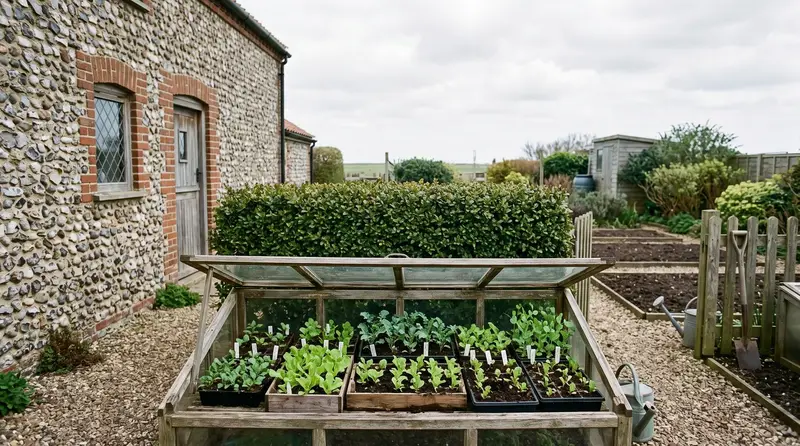
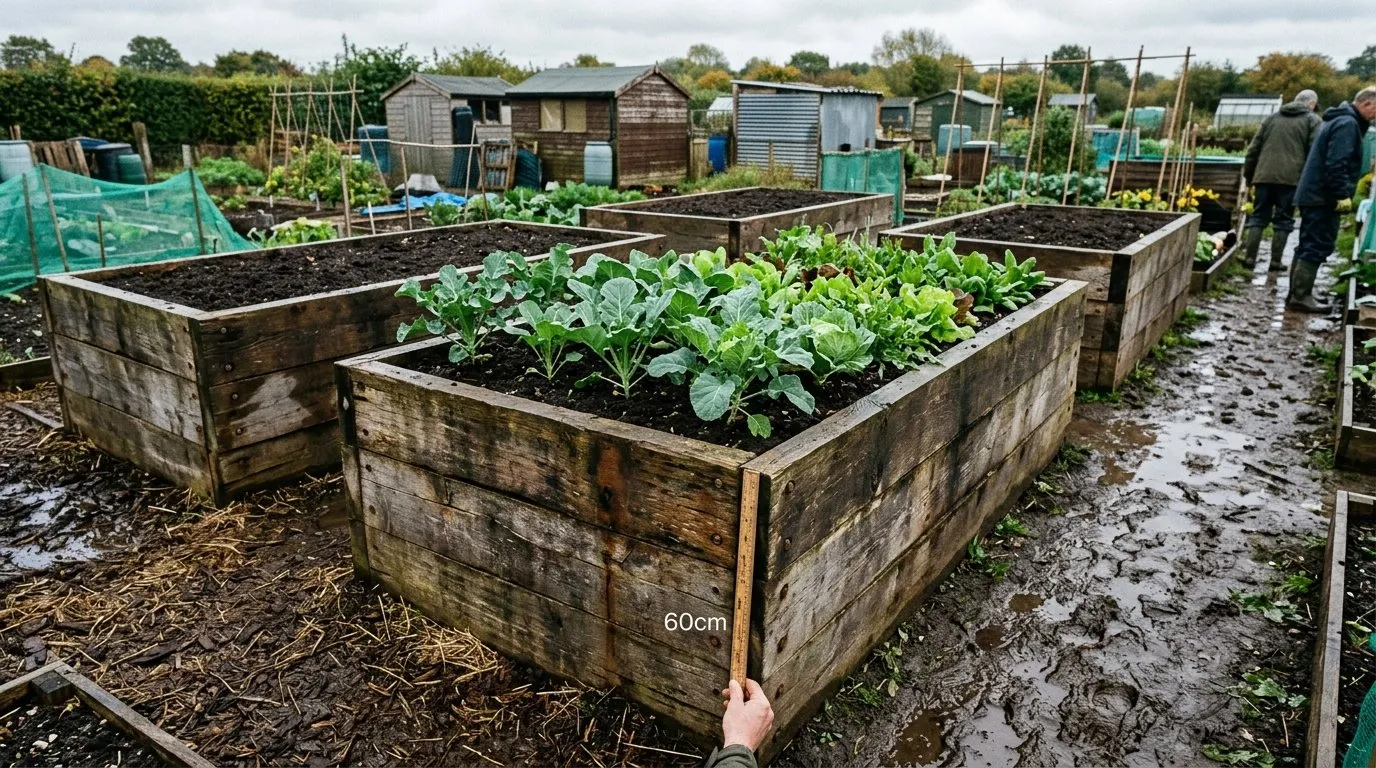 Tall raised beds (60cm) lift the root zone above the typical water table. Scaffold boards or doubled landscape timber are the cheap, durable option. The bed in this photo cost £85 in materials and has produced cabbage, kale, and winter salads through three flood events without crop loss.
Drainage method 2: French drains
A French drain is a gravel-filled trench with a perforated pipe at the bottom that channels water away from the wet area. It is the second-most-effective intervention after raised beds, and far cheaper than full site drainage works.
Materials per metre:
- 80mm perforated land drain pipe: £4-6 per metre
- 20mm angular gravel: £30 per tonne, around £8 per metre
- Permeable geotextile membrane: £4-6 per metre
- Sand-and-gravel for finishing: £4 per metre
Total: £20-25 per metre in materials. Add labour if you are paying someone, but most plot holders dig their own.
How to install:
-
Plan the route. The drain must slope from the wet area to a discharge point - either a soakaway, a watercourse, or a lower-lying area off your plot. Minimum slope is 1:100 (1cm fall per metre). Mark the route with string and pegs.
-
Dig the trench. 30cm wide and 50-60cm deep. Steeper slopes can be shallower; flatter ground may need a deeper trench. The bottom must have consistent slope - check with a spirit level on a long board.
-
Line with geotextile membrane. Stops soil washing into the gravel and clogging the pipe. Lap the membrane over the top with 30cm of overlap.
-
Add 100mm of gravel base. Levels the trench and provides a stable bed for the pipe.
-
Lay the perforated pipe with holes facing down. Counter-intuitive but correct - water enters through the holes from groundwater pressure underneath, not from above.
-
Fill around the pipe with gravel. Up to within 100mm of the surface.
-
Fold geotextile over the top. Seal the gravel from soil contamination.
-
Top with 100mm of soil or sand. Path-grade material if the drain runs under a path; topsoil if it runs across a bed.
A 10m French drain takes a fit person a long weekend to install. £200-250 in materials. Lasts 15-25 years if installed correctly.
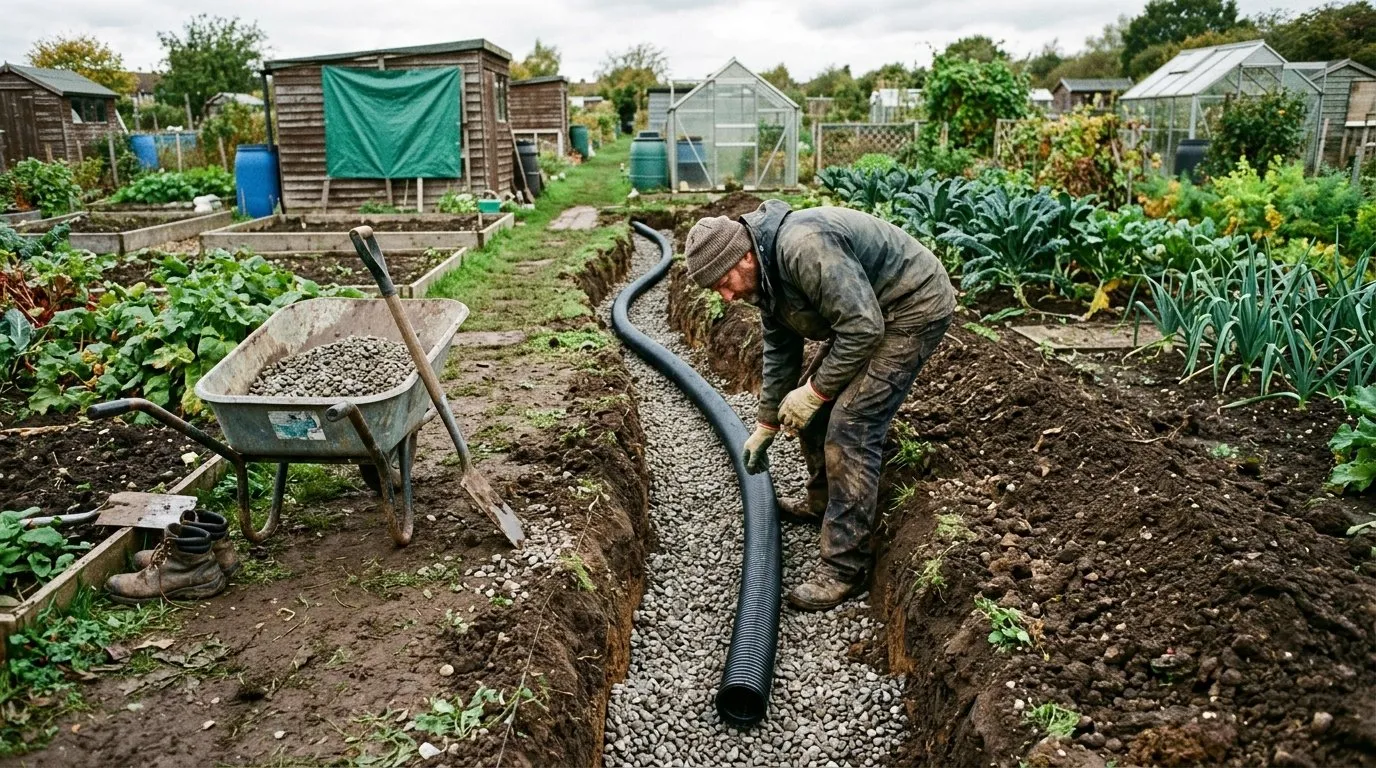 A French drain is a gravel-filled trench with a perforated pipe that channels groundwater away from wet areas. The pipe is laid with perforations downward - water enters from below through the gravel. Total cost around £25 per metre, lifespan 15-25 years.
Drainage method 3: Soakaways
A soakaway is a buried pit filled with rubble that absorbs runoff and slowly releases it into the surrounding soil. They work where the soil below has reasonable drainage but the surface struggles - exactly the situation on most clay-soil allotments.
Soakaways do not work on plots with a high water table. If your test pit is constantly full of water, the soakaway will be too. They also cannot handle continuous flow - they are designed for short-burst rainfall absorption.
Sizing: A typical allotment soakaway is 1m x 1m x 1m deep. This holds around 600 litres of water in the gravel pore spaces, plus releases water into the surrounding soil. Adequate for a 100 sq m catchment area.
Construction:
-
Site selection. At least 5m from any building, 5m from a boundary, and not on a slope. Position downhill of the wettest part of your plot.
-
Dig the pit. 1m x 1m x 1m. The spoil makes a small hill - useful for a Hugelkultur bed elsewhere on the plot.
-
Fill the bottom 60cm with broken brick rubble. Old bricks, broken paving slabs, demolition rubble. Many allotment sites have piles of this material lying around.
-
Top 40cm with 20mm gravel. Allows water to enter from above without immediately clogging.
-
Cover with permeable geotextile membrane. Keeps soil out.
-
Top with 100mm of soil. Plant a small bed on top - rhubarb thrives over a soakaway.
-
Connect surface drains. A French drain or surface gully feeds water into the soakaway.
A correctly-built soakaway absorbs 200-500 litres before backing up. After the storm, it slowly releases into surrounding soil over 24-72 hours.
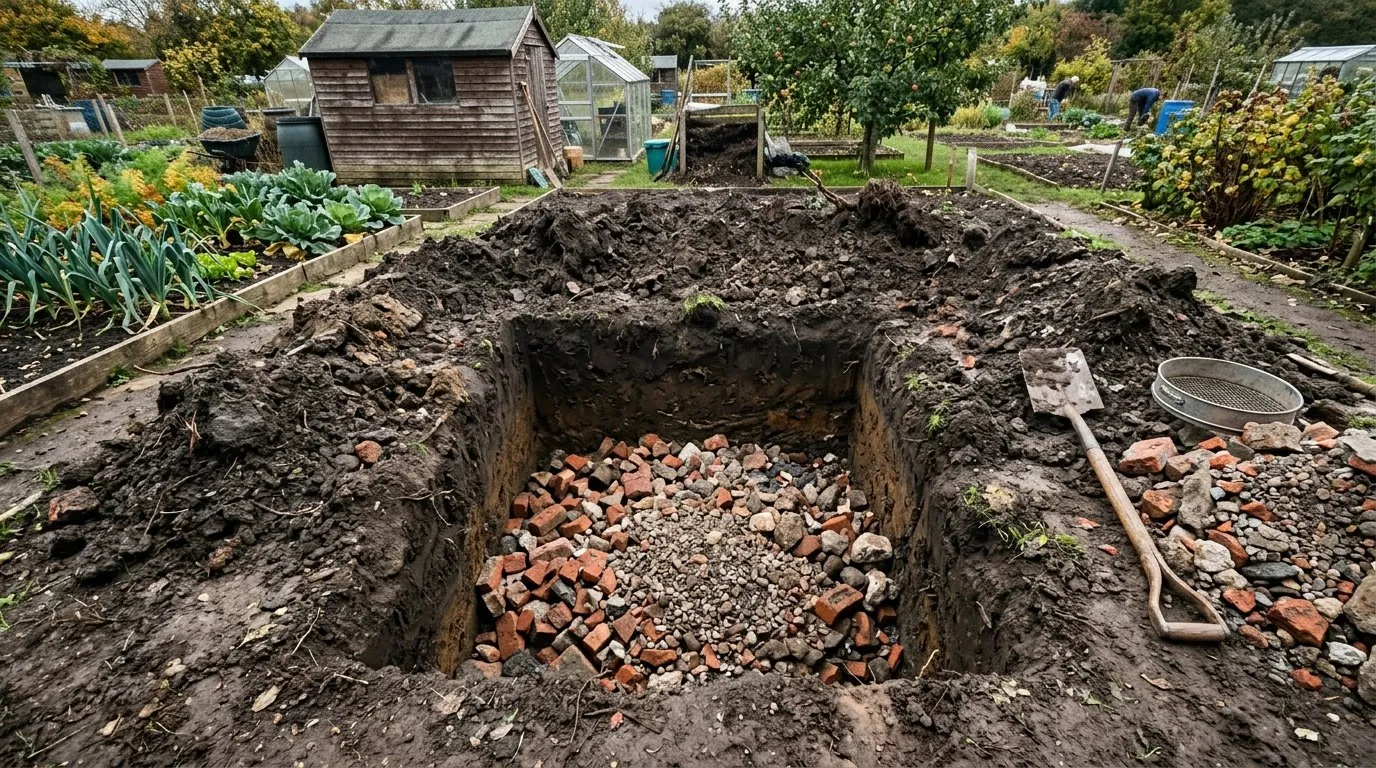 A soakaway is a buried pit that absorbs short bursts of rainfall. Use broken brick rubble for the bottom and gravel for the top, separated and topped with permeable membrane. Located at least 5m from any structure or boundary. Useless on plots with high water tables.
What to do when the water arrives
If your plot is flooding right now, here is the fast response.
Stop walking on saturated beds. Compaction is the worst secondary damage. A single bootprint on saturated soil destroys the air spaces that plant roots need. The damage takes 1-3 seasons to recover from. Stay on paths.
Lift any movable items now. Compost bins, water butts, hose pipes, fleece, netting, plant labels. Once they wash away, recovery is harder. Move them to higher ground or take them home.
Disconnect electrics. Solar lights, automatic vent openers, polytunnel heaters. Battery-powered items in standing water cause fires. Check the Electrical Safety First guidance if you have hardwired equipment.
Wait until water recedes naturally. Pumping out a flooded plot is rarely worth the effort. The water will drain in 24-72 hours on most sites. Forcing the issue causes more damage to soil structure.
Do not eat anything from the flood zone immediately. Floodwater contains sewage, agricultural runoff, road oil, and pathogens. Wait until you know it is safe.
After the flood: recovery in 2026
The recovery work is patient and slow. Most plot holders rush this and lose another season.
Wait until the soil is workable. This means you can walk on it without your boot leaving a clear footprint. On heavy clay, this can be 2-6 weeks after the water has gone. On sandy soil, often within a week. Walking on saturated soil compacts it severely.
Assess crop survival. Rules of thumb:
| Crop | Survival under flooding |
|---|---|
| Rhubarb, mint, watercress, willow | Indefinite - flood-tolerant |
| Brassicas (cabbage, kale, sprouts) | Often survive 5-7 days |
| Leeks | Often survive 5-7 days |
| Onions, garlic | Rarely survive 48 hours |
| Carrots, parsnips | Rarely survive 48 hours; food safety concern |
| Potatoes (in ground) | Rarely survive; tubers rot |
| Tomatoes, courgettes, beans | Almost never survive |
Discard root crops that have sat in floodwater for more than 48 hours. This is a food safety rule, not a quality preference. Floodwater carries Cryptosporidium, E. coli, and other pathogens that contaminate root vegetables. Even washing well does not guarantee safety. Compost them or bin them.
Top-dress beds with compost when workable. A 3-5cm layer of well-rotted compost helps restore aerobic soil bacteria killed by anaerobic flooding conditions. Plant green manures (see our green manures guide) on bare soil to rebuild soil structure - mustard, phacelia, and rye all work after spring flooding.
Re-test soil pH. Flooding can change soil pH temporarily, often making it more acid. A simple pH test kit (£5) shows whether you need to adjust with garden lime before replanting.
Replant flood-tolerant crops first. Beans, brassicas, and quick-growing salads recover the soil microbiome faster than slow-growing root crops. Save the carrots and parsnips for next year on cleaner ground.
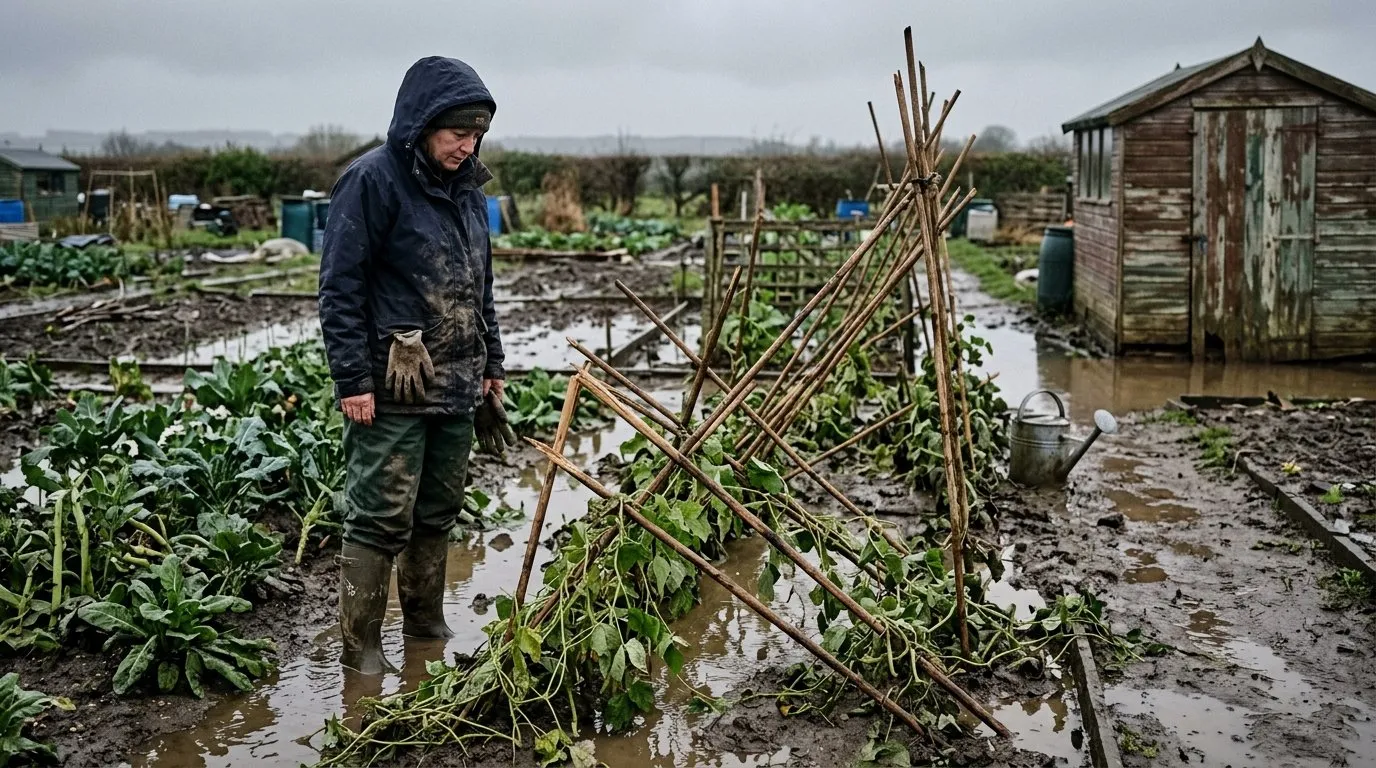 Flood recovery is mostly waiting. Walking on saturated soil to assess damage causes compaction that takes 1-3 seasons to fix. The patient response - wait, top-dress, replant flood-tolerant crops first - produces faster recovery than aggressive intervention.
Plant for the conditions you have
If your plot floods regularly, accept it and design around it. Some species thrive in waterlogged conditions. Plant them in the lowest sections and keep raised beds for everything else.
Reliable flood-tolerant edibles:
- Rhubarb - thrives in damp ground; 30+ year lifespan
- Watercress - prefers running water but adapts to wet ground
- Mint - any species; will spread aggressively
- Blackcurrant - tolerates wet feet better than other currants
- Blueberry - in acid soil, can handle damp conditions
- Comfrey - excellent compost activator, thrives on wet ground
- Willow - useful for plant supports, tolerates flooding indefinitely
Reasonable in damp conditions:
- Brassicas - most cabbages and kale tolerate winter wet
- Broad beans - autumn-sown varieties handle wet better than spring-sown
- Leeks - prefer well-drained but cope with periodic flooding
- Asparagus - in raised beds only, never in waterlogged ground
Avoid on wet plots without raised beds:
- Garlic, onion sets - rot in waterlogged soil
- Mediterranean herbs (rosemary, thyme, sage)
- Tomatoes, peppers, aubergines
- Most root crops (carrots, parsnips, beetroot)
- French beans (broad beans tolerate better)
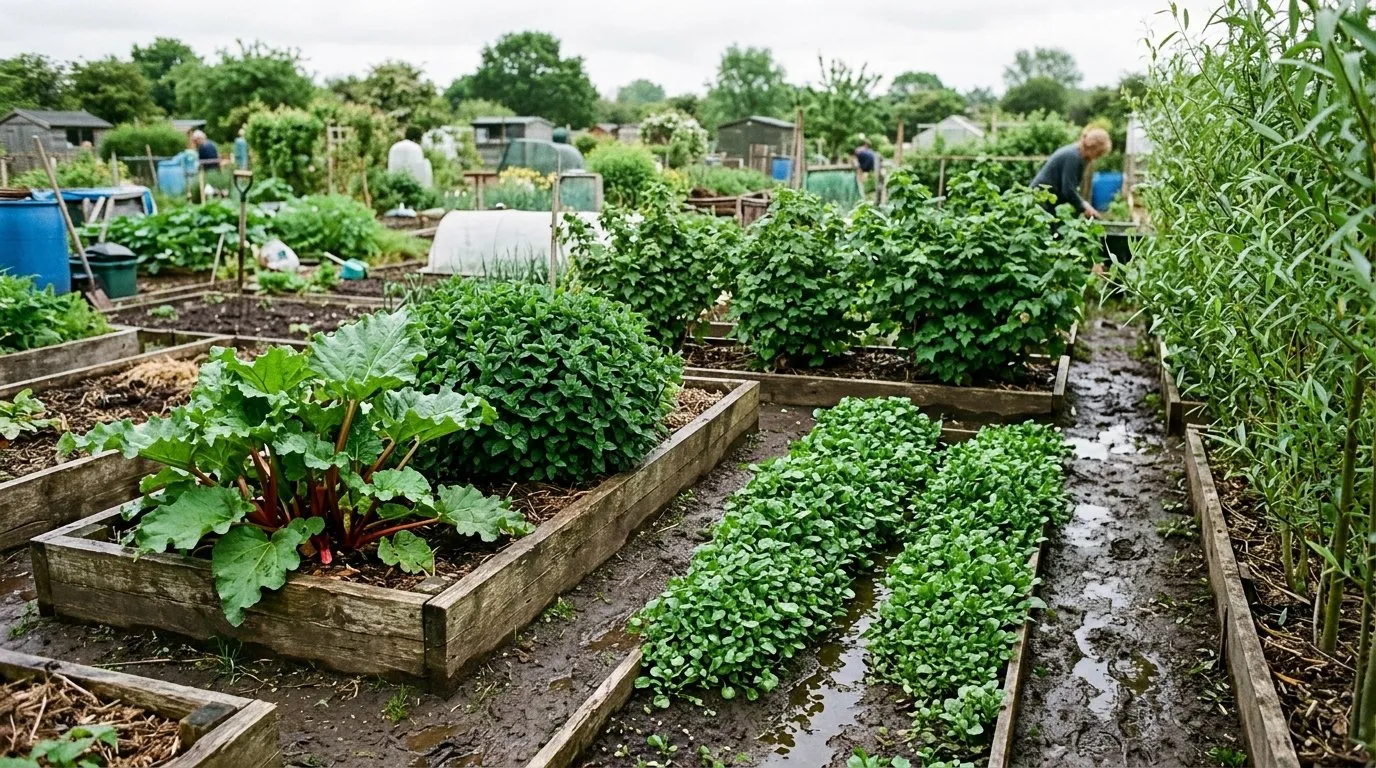 Flood-tolerant crops thrive on plots that flood regularly. Rhubarb, mint, watercress, blackcurrant, and willow can be planted directly on damp ground. Combined with raised beds for everything else, this creates a productive plot that works with the conditions rather than fighting them.
Climate adaptation for the next decade
UK climate models suggest the wetter-winter, drier-summer pattern will intensify through the 2020s and 2030s. Plot-level adaptation is now standard advice from organisations like the National Allotment Society.
Short-term (1-3 years):
- Build raised beds on lowest 25% of your plot
- Install at least one French drain
- Plant flood-tolerant species in the wettest area
- Add organic matter to clay soils annually
Medium-term (3-7 years):
- Convert paths to permeable surfaces (gravel, wood chip)
- Upgrade soakaway capacity if needed
- Plant willow or wet-tolerant fruit on flood-prone edges
- Develop a weather-watching routine for plot visits
Long-term (7+ years):
- Restructure entire plot around drainage if floods are persistent
- Consider plot-share or relocation if site is irrecoverable
- Lobby council and committee for site-wide drainage works
The councils that own most UK allotment land are not legally required to provide drainage works, but increasingly are doing so under climate adaptation budgets. A well-organised plot holders’ association can secure £5,000-50,000 in council or environmental grant funding for site-wide drainage.
Quick checklist
If your plot is at flood risk, work through this list over a single autumn:
- Check Environment Agency flood map and walk site after rain ✓
- Build at least one 60cm raised bed ✓
- Install a 5-10m French drain to a discharge point ✓
- Build a 1m soakaway in the lowest dry corner ✓
- Plant flood-tolerant crops in the wettest area ✓
- Add 5cm of compost annually to maintain soil structure ✓
- Photograph plot at peak flooding for insurance baseline ✓
- Talk to neighbouring plot holders about shared drainage ✓
- Lobby committee for site-wide drainage in 5-year plan ✓
Done before the autumn rains, this transforms a flood-prone plot from a regular casualty into a productive site that works with the weather.
Related articles
Our team produces practical UK gardening guidance from source research, contributor records and established horticultural practice. Editorial standards are overseen by Matt W.