Key takeaways
- The 1908 Smallholdings and Allotments Act remains the legal basis for UK allotment provision today
- The UK had 1.5 million allotment plots in 1943 - more than any country in the world per capita
- Dig for Victory produced an estimated 1.3 million tonnes of food per year during WW2
- Allotment numbers fell from 1.5 million in 1943 to under 250,000 by 1996 due to housing pressure
- The 2020 pandemic saw a 300% rise in waiting list applications and a return to the plot
- Statutory allotment land cannot be sold without Secretary of State approval (1925 Act)
- The current waiting list across England is estimated at 100,000-160,000 people
There has been an allotment in some form on Sneinton Hermitage in Nottingham since the 1830s. The same patch of ground, growing the same crops, tenanted by working families across nine generations. Most modern things in Britain are younger than that allotment.
This is the story of how British allotments came to exist, how they survived two world wars, what nearly killed them, and what brought them back. The shape of the modern allotment - a quarter-acre rented from the council, with a shed at one end and a cabbage patch in the middle - was set by laws written in 1845, 1908, and 1925, with a major chapter added between 1939 and 1945. Understanding how the system was built helps explain why it works the way it does today.
Before allotments: enclosure and the loss of common land
To understand allotments, you have to understand what was lost first.
For most of British history, ordinary rural people had access to common land. Common rights varied by region but typically included grazing for a cow or pig, gathering firewood, cutting turf for fuel, and growing small patches of vegetables. These rights were not charity - they were ancient and legally protected, often dating back to medieval custom.
Between 1750 and 1860, around 6.8 million acres of English common land were enclosed by Acts of Parliament - over a fifth of the country. Enclosure transferred common land into private ownership, usually to large landowners. The rural poor lost their grazing, their fuel, and their food-growing rights, often within a single generation.
The social consequences were severe. Rural unemployment rose. Poor relief costs ballooned. Migration to industrial cities accelerated. Several writers and politicians from the early 1800s onwards argued that the loss of land access for ordinary people was a moral and practical disaster. The earliest “allotments” - small parcels of land granted to labourers by landowners - emerged as private charity to fill the gap.
By 1830 there were perhaps 100,000 allotment-style plots in England, but they had no legal protection. A landowner could close them at will.
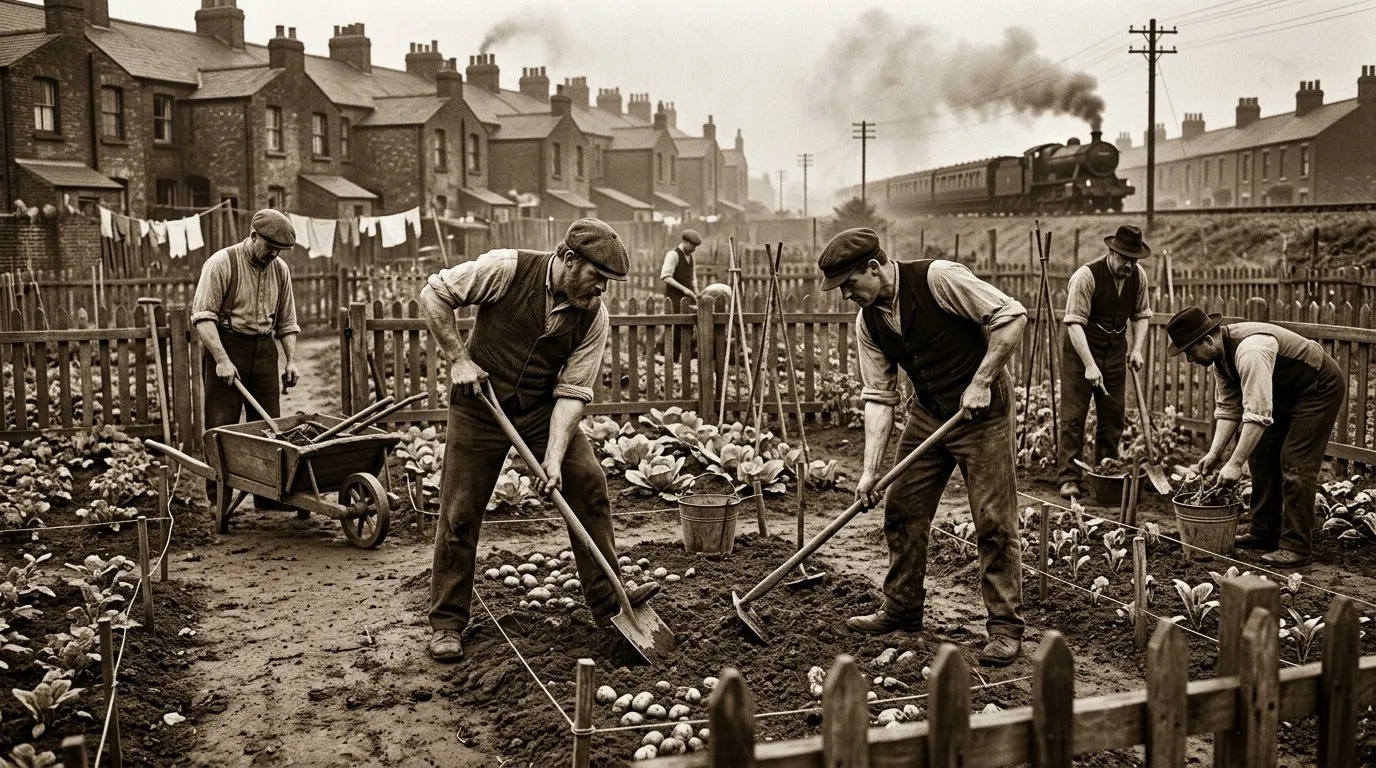 The early allotment movement was tied to industrial cities like Sheffield, Birmingham, and Manchester, where railway expansion created strips of unused land that became some of the first formal allotment sites. The men shown represent the typical pre-WW1 plot holder: industrial worker, often with a coal mining or factory job.
The General Enclosure Act 1845
The first major piece of allotment legislation arrived as a side-effect of yet more enclosure. The General Enclosure Act 1845 streamlined the parliamentary process for enclosing common land. Concerns about the impact on the poor led to a compromise: any new enclosure under the Act had to set aside a portion as field gardens for the labouring poor.
These field gardens are the direct legal ancestor of modern allotments. The Act required:
- Quarter-acre maximum size per person
- Tenancy by labouring poor only
- Annual rent set at the discretion of the local Inclosure Commissioner
The 1845 Act produced thousands of new allotment plots, particularly in counties undergoing late enclosure: Lincolnshire, Cambridgeshire, Norfolk. Many of these field gardens still exist as allotment sites today.
The 1845 Act was not perfect. Enforcement was patchy. Allotments were tied to enclosure projects, so areas with little or no enclosure got few or no allotments. But it established a key principle: allotments are a public good, not a private favour.
The Allotments Acts of 1887 and 1890
The next two major Acts came during a period of rural agricultural depression. Cheap grain imports from North America had collapsed UK farm wages. Rural unemployment rose. Politicians of all parties argued for expanded land access.
The Allotments and Cottage Gardens Compensation for Crops Act 1887 allowed local sanitary authorities (early local government) to provide allotments where the labouring population demanded them. For the first time, allotments could be provided actively, not just as a side-effect of enclosure.
The Allotments Act 1890 strengthened this provision and required councils to consider applications from any inhabitant. It also introduced the right to compensation for crops if a tenant was evicted - a basic tenant protection still relevant today.
These Acts produced thousands of new urban allotments. Industrial cities led: Sheffield, Birmingham, Manchester, Leeds. Railway companies leased strips of unused track-side land for allotments, producing the long thin sites characteristic of British inner cities.
By 1900, England and Wales had perhaps 600,000 allotment plots. The system was set, but the legal framework was still patchy.
The Smallholdings and Allotments Act 1908
The single most important piece of allotment legislation, and the foundation of the modern system. Still in force in 2026.
The 1908 Act consolidated the 1845, 1887, and 1890 Acts into a coherent legal framework, and added one decisive provision: a legal duty on local authorities to provide allotments when there is demand. Specifically, where six or more residents on the electoral register petition the council, the council has a statutory duty to act.
The Act also:
The “six residents” trigger is what made the Act so durable. It empowers ordinary people to demand action without needing political connections or wealth. A century later, this provision is still the basis of most successful allotment campaigns.
The 1908 Act was followed by the Allotments Act 1922 (which strengthened tenant security) and the Allotments Act 1925 (which protected statutory allotment land from being sold or repurposed without Secretary of State approval). Together, these three Acts form the legal triple-lock that has preserved most pre-1939 allotment sites.
Dig for Victory: 1939-1945
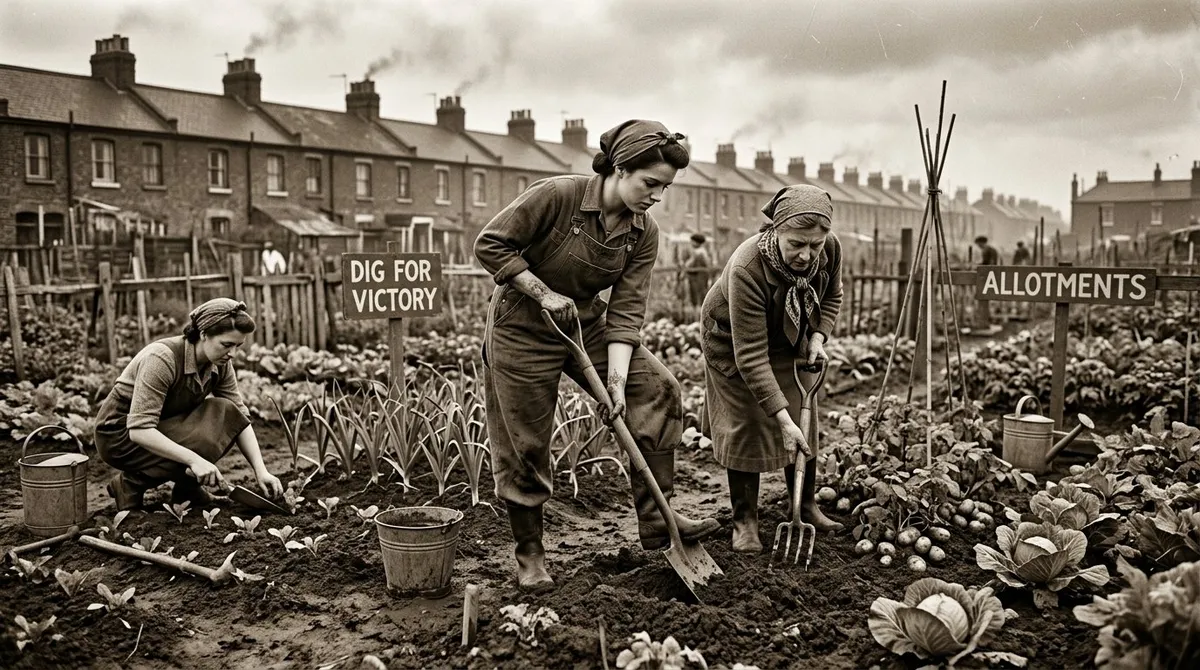
The Second World War transformed British allotments from a working-class institution into a national mass movement. Dig for Victory was the most successful gardening campaign in history.
The campaign was launched in October 1939 by the Ministry of Agriculture under Sir Reginald Dorman-Smith. Britain imported 70% of its food before the war. German U-boat attacks on shipping made imports increasingly dangerous. Domestic food production had to expand drastically and fast.
The numbers:
- 815,000 allotments by 1939, rising to 1.4 million by 1943, peaking at around 1.5 million
- An estimated 1.3 million tonnes of food produced annually from allotments and gardens
- Roughly 10% of UK food consumption during wartime rationing
- Crop value: estimated £69 million per year in 1940s prices
Where the plots came from: Anywhere flat. The Tower of London moat was dug up and planted with vegetables. Hyde Park became allotments. The grass squares of Russell Square, Bloomsbury Square, and Berkeley Square in London were given over to growing. Buckingham Palace lawns produced potatoes. Golf courses were ploughed. Railway embankments, bomb sites, public parks, and school playing fields all converted.
Who grew the food: The campaign deliberately targeted women, retirees, and children. Posters featured women digging, children harvesting, families eating. The Women’s Land Army organised volunteer labour. The Boy Scouts ran “kitchen front” cooking classes. Schools taught vegetable growing as a core subject.
The propaganda: The “Dig for Victory” slogan, the McKnight Kauffer posters, the radio broadcasts by Cecil “Mr Middleton” Middleton, the films from the Ministry of Information all reinforced one message: growing food at home was patriotic. The cultural impact lasted decades after the war.
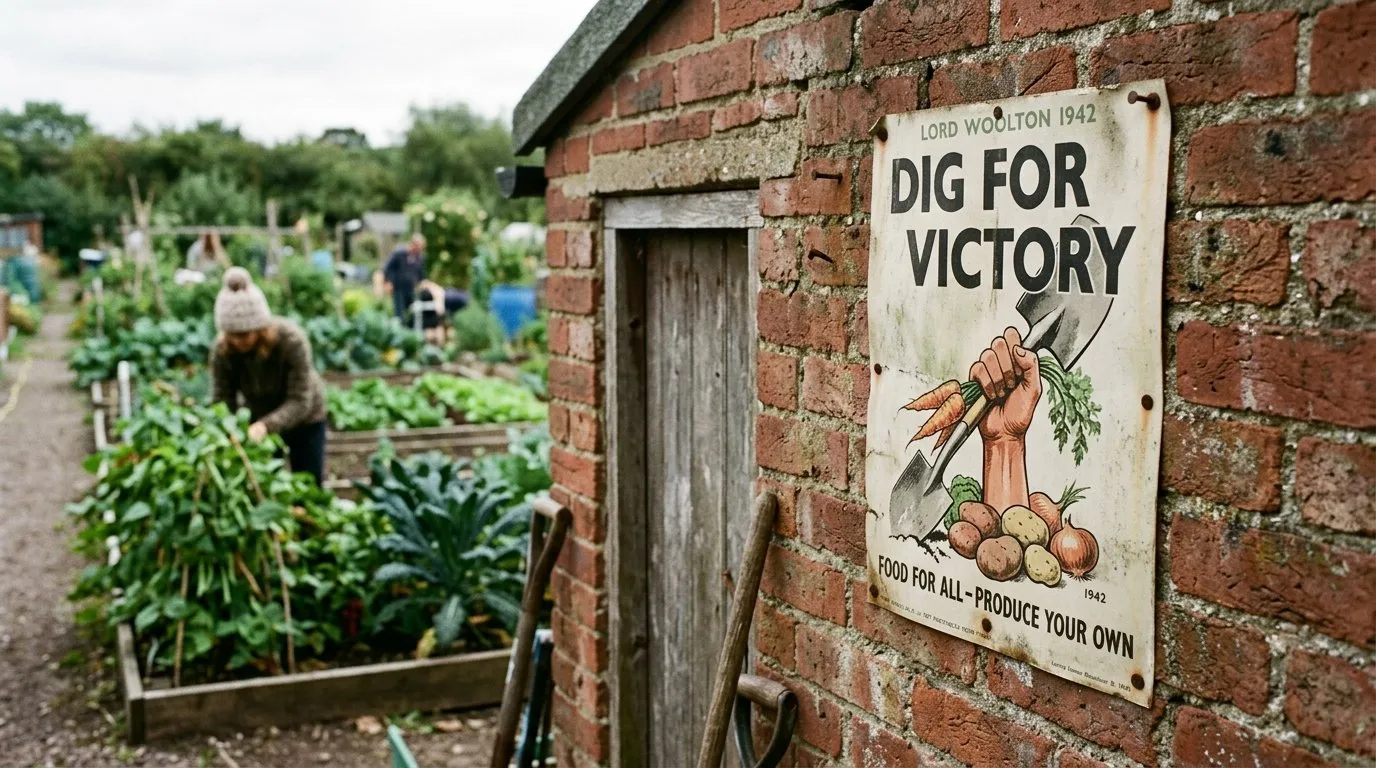 Dig for Victory was the most successful gardening campaign in history. Between 1939 and 1945, the UK doubled its allotment count and produced around 10% of national food consumption from gardens and small plots. The cultural memory of “Dig for Victory” still shapes British attitudes to vegetable growing today.
The campaign worked. Between 1939 and 1945, Britain went from importing most of its food to feeding itself, with allotments producing a significant fraction of the surplus. Vegetable consumption per head rose. Public health improved despite rationing. Wartime allotments are credited with keeping Britain fed during the U-boat blockades.
Postwar: rationing, reconstruction, and the long decline
Rationing did not end with the war. Bread rationing started in 1946 (it had not been needed during the war). Sugar, butter, and meat were rationed until 1954. Food security pressure on allotments continued well into the 1950s.
1946-1955: peak postwar use. Allotments stayed close to wartime numbers through the late 1940s. The 1947 Allotments Act extended wartime tenant protections. Most working-class families still grew at least some vegetables.
1955-1975: gradual decline. As rationing ended and supermarket distribution expanded, allotments became less essential. Younger families turned to garden lawns rather than vegetable plots. Suburban housing absorbed many former allotment sites. By 1970, plot numbers had fallen to around 600,000.
1975-2000: the slump. Television gardening shifted toward ornamental gardens. Convenience food and frozen vegetables became cheap. Inner-city allotments were sold for housing in many cities, particularly during the 1980s under pressure from local authorities looking for development revenue. Numbers fell to 297,000 by 1996. Many sites were abandoned, vandalised, or built over.
The Thorpe Report (1969) - the most thorough government review of allotment policy in the 20th century - warned that the system was at risk of collapse unless councils invested in modernisation. Most of its recommendations were ignored.
2000-2010: the start of the recovery. The River Cottage television series, Hugh Fearnley-Whittingstall’s writing, and a broader interest in food provenance pushed allotments back into public attention. Waiting lists started to grow. Numbers stabilised, then began rising for the first time in 60 years.
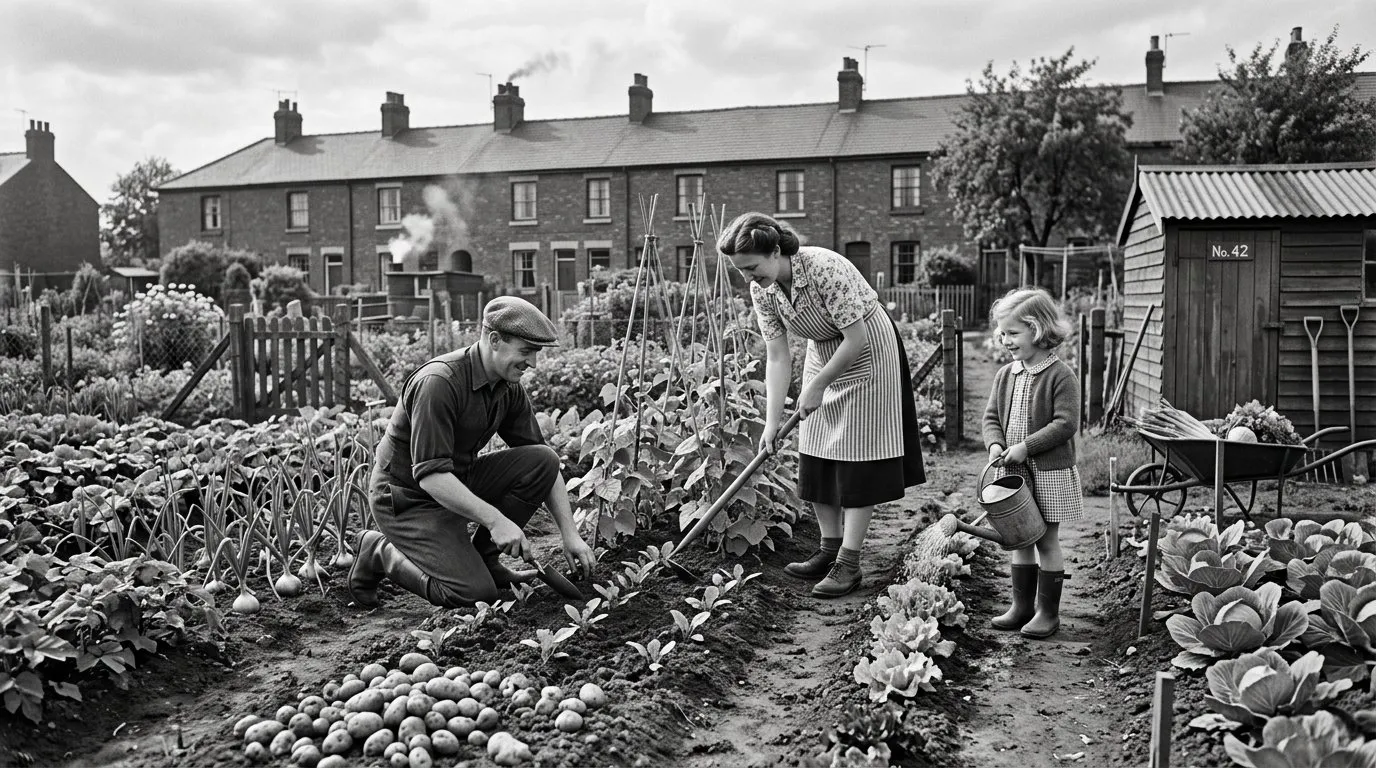 The postwar allotment was still essential family infrastructure. Rationing did not end until 1954 (meat) and food prices remained high. The shift toward ornamental gardens and supermarket food only became dominant in the 1960s and 1970s.
The 2020 boom
The COVID-19 lockdown that began in March 2020 transformed UK allotments overnight. The story is now familiar but worth telling properly.
In the first six weeks of lockdown, allotment waiting list applications across England rose by 300% on average and over 500% in some London boroughs. Two factors combined: people were stuck at home with time on their hands, and the empty supermarket shelves of March 2020 raised genuine food security concerns.
By summer 2020, every major city in the UK reported allotment waiting lists at record highs. Sites that had been half-empty for years were suddenly oversubscribed. Councils began dividing full plots into halves to meet demand. The National Allotment Society reported its membership doubling within twelve months.
Demand has stabilised since but remains well above pre-2020 levels. The current waiting list across England is estimated at 100,000-160,000 people, with average waits of 18 months and London waits commonly 3-5 years. The pre-2020 baseline was around 50,000-70,000.
The 2020 boom changed the demographics of UK allotments. The 25-45 age bracket grew sharply. Female participation rose. Many sites now report ethnic diversity at allotment level for the first time, particularly in London. The traditional retired-male profile of the postwar allotment is fading.
What the 1908 Act protects today
A century later, the legal framework written in 1908 still works. Recent court cases prove it.
Watford 2017: Watford Borough Council attempted to sell part of Farm Terrace allotment for housing. Local plot holders successfully argued that the land was statutory allotment land under the 1925 Act and could not be sold without Secretary of State approval. The High Court ruled in their favour. The site is still allotments.
Newcastle 2018: Newcastle City Council faced a similar challenge over the Chillingham Road allotment. Plot holders cited the 1908 Act’s requirement that councils provide allotments where demand exists. The case went to judicial review. The council backed down.
Lambeth 2021: Lambeth Council’s plan to redevelop part of Loughborough Park allotment was challenged by tenants citing the 1908 Act and 1925 Act. The plan was withdrawn after a 12-month campaign.
These cases follow a pattern. Modern councils sometimes try to reduce allotment land for development, planning gain, or housing pressure. Plot holders cite the Acts. Lawyers from organisations like the National Allotment Society step in. The Acts hold.
The 1908 Act is not perfect. Enforcement still depends on tenants knowing their rights and being willing to fight. Some councils slow-walk waiting lists. Some let sites fall into disrepair to discourage tenants. But the underlying legal protection has held for 117 years.
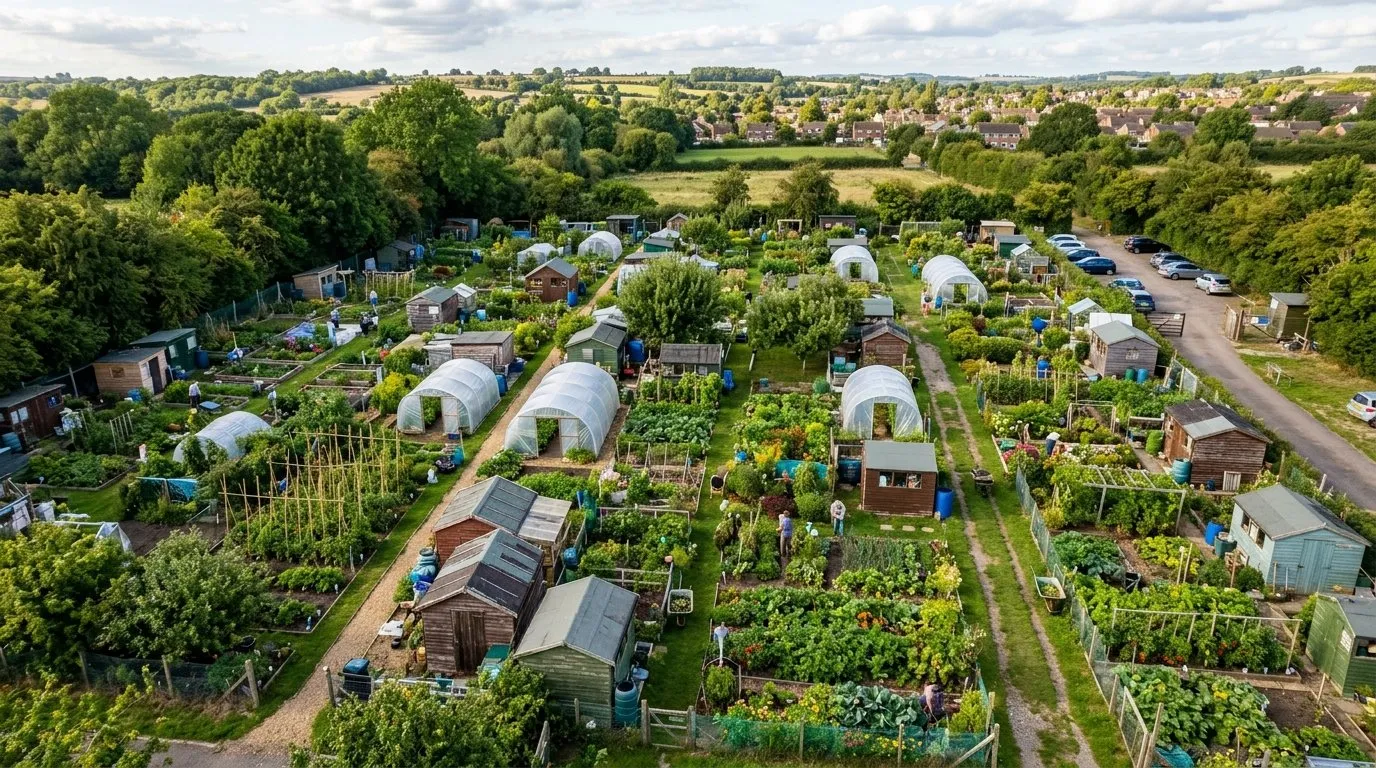 The 21st-century UK allotment is more diverse than any previous era - in plot size, growing methods, and the people on the plots. Polytunnels, raised beds, no-dig sections, wildlife areas, fruit cages, and traditional dig-and-rotate plots coexist on most sites.
What survives from the past
A modern UK allotment carries the imprint of every era of its history. Walking through a 100-year-old site you can see:
- Trench beds for pot leeks and long carrots, in the same form used since the 1880s
- Brick paths and walls from Victorian-era site infrastructure
- Cast-iron gates and railings from before WW1
- Wartime “Dig for Victory” sheds built from salvaged timber
- 1950s concrete water tanks from the postwar council infrastructure programme
- Allotment association huts from the 1920s when associations were first formalised
- Modern polytunnels and no-dig beds from the post-2010 revival
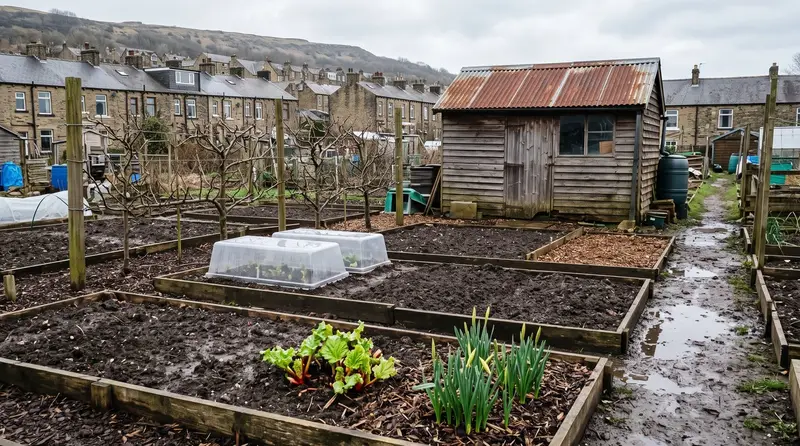
A 21st-century allotment is not a static museum. It is layered, with each generation building on the previous. The Sneinton site in Nottingham - active since the 1830s - has tenants who have been there for 40+ years working alongside members who joined in 2020.
This continuity is rare in British public infrastructure. Few public services have run uninterrupted for 200 years. The allotment system has, partly because of the legal framework, partly because of the cultural attachment, and partly because the food and the community that come from a plot are genuinely useful.
What comes next
The 2020-2030 decade is shaping up to be a critical one for UK allotments. Several pressures and opportunities are converging.
Climate change: Hotter, drier summers and wetter winters are challenging traditional allotment growing patterns. Sites are adapting with rainwater harvesting, more shade tolerance, and no-dig methods that retain soil moisture. Some sites are even moving to year-round polytunnel production.
Housing pressure: As land prices rise, pressure on statutory allotment land continues. Several councils are expected to seek Secretary of State approval to deregister sites in the next 5-10 years. The 1908/1925 Acts will be tested again.
Demographic change: The new generation of allotment holders is more diverse, more female, and more digitally connected than any before. Online communities like r/UKGardening are reshaping how knowledge is shared on plots.
Food security: Climate disruption to global food supplies, geopolitical instability, and rising supermarket prices are renewing interest in food self-sufficiency. The wartime spirit of Dig for Victory is genuinely relevant again.
The community that grew the food during the U-boat blockade may yet grow it through the climate crisis. The system is set up for it. The Acts of 1908 and 1925 will hold. The plots will keep producing.
Related articles
Our team produces practical UK gardening guidance from source research, contributor records and established horticultural practice. Editorial standards are overseen by Matt W.