Key takeaways
- Closed-shackle padlocks on hidden-screw hasps stop most opportunistic shed break-ins
- Mark every tool with your postcode in UV pen and permanent marker - photograph each one
- Most household contents insurance excludes allotment tools - ask your insurer to add them
- Solar PIR floodlights deter casual theft but offer little against determined offenders
- Always report theft to police - the crime number is needed for insurance and council action
- Layered security beats any single measure: lock + light + marking + neighbour watch
- Do not store anything you cannot replace - rotate valuable tools home each visit
Allotment theft has risen sharply across the UK since 2022. NFU Mutual reports a 15% increase in garden and shed theft claims. Sites that go years without incident get hit twice in a month. The good news: most allotment crime is opportunistic, and a few hours of work hardens your shed against the casual offender. This guide covers what works, what does not, and what to do when you are hit.
How common is allotment theft?
The honest answer is more common than people think, and getting worse.
| Source | Finding | Period |
|---|---|---|
| NFU Mutual | 15% rise in garden/shed theft claims | 2022-2024 |
| ONS Crime Survey | Theft from outbuildings up 22% in some regions | 2023-2024 |
| Allotment Garden survey (informal) | 41% of UK plot holders hit at least once | 2024 |
| Local authority FOIs | Average UK site reports 3-5 break-ins per year | 2023 |
Sites most at risk share common features: limited overlooking from houses, perimeter fencing in poor repair, easy vehicle access at night, and many sheds clustered together. Rural sites and urban-fringe sites are hit harder than densely-overlooked town-centre allotments.
The peak season for break-ins is autumn through winter. Long nights, plot holders visiting less often, and good resale demand for tools combine. Spring sees a smaller surge as thieves clear stock before the season starts.
What gets stolen most often
Knowing what is targeted helps you decide what to leave at home and what to lock down.
| Item | Share of claims | Why it is targeted |
|---|---|---|
| Hand tools (forks, spades, secateurs) | 35% | Easy to grab, easy to sell |
| Power tools (strimmers, mowers, blowers) | 25% | High resale value |
| Petrol and fuel cans | 10% | Cash-in-hand sale or own use |
| Produce | 15% | Seasonal, mostly opportunistic |
| Furniture (chairs, tables, water butts) | 8% | Bulky but easy to load |
| Cash and personal items | 7% | Wallets in jackets left behind |
The single most stolen item is a Stihl petrol strimmer. The second is a Bosch cordless drill. Resale demand is high, serial numbers are rarely registered, and most sell within hours of theft on Marketplace or out of car boots.
What is rarely stolen: heavy timber raised beds, mature plants, compost bins, water butts that are anchored down. If you lock a strimmer to the back wall of the shed with a chain, thieves move on to the next plot rather than spend 10 minutes cutting it free.
Securing your shed
This is the foundation of allotment security. Most break-ins happen through the shed door, the hinges, or a window. Here is what works.
The padlock and hasp
A padlock is only as strong as the hasp it is fitted to. The hasp is the steel plate the padlock loops through. A £100 padlock on a £4 hasp held by 4 short screws comes off in 30 seconds with a crowbar. Get both right.
Padlock spec to look for:
- Sold Secure Gold or CEN Grade 4 rating
- Closed shackle design (the loop is mostly enclosed by the body, leaving no room for bolt cutters)
- Hardened steel body and shackle
- Anti-pick keyway
Three padlocks that do all of this for £30-50:
- Squire SS65CS
- ABUS Granit 37/80
- Burg-Wachter Magno 770
Avoid: brass padlocks, combination padlocks, anything thinner than 9mm shackle, anything sold for under £15.
Hasp spec to look for:
- Hidden screws (or one-way screws) - the screw heads should not be visible when locked
- Through-fixings that go right through the door and frame, not just into the door panel
- Hardened steel plate over the screw heads
- Frame anchor - the staple side bolts to the door frame, not the door
A good hasp like the Squire HFA56 or ABUS 100/180 costs £15-25. Fitted with M6 coach bolts going right through the door and frame, with washers and locknuts on the inside, the hasp becomes harder to remove than the padlock is to cut. That is the goal.
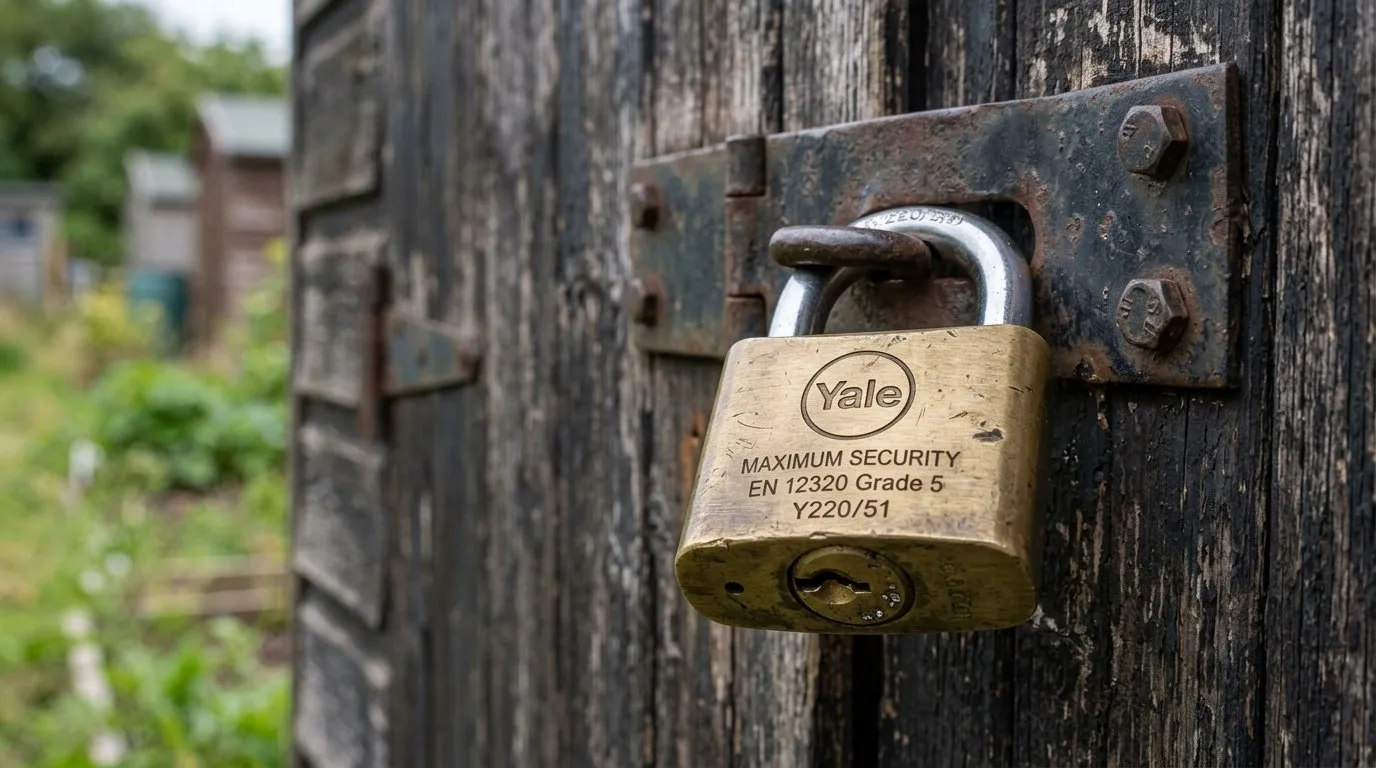 A closed-shackle padlock leaves almost no shackle exposed. Combined with a hidden-screw hasp anchored through the door frame, it stops most opportunistic break-ins. Shown: Squire SS65CS, around £40.
Hinges and the door itself
Half of forced entries come through the hinges, not the lock. Stand outside your shed and look at the hinges. If you can see screw heads on the outside, those screws come out in 30 seconds with a screwdriver. Replace them with one-way security screws (£5 a box from a hardware shop) or fit hinge bolts.
Hinge bolts are short steel pins fitted to the hinge side of the door frame that lock into matching holes in the door when closed. They prevent the door being lifted off even with the hinge pins removed. £8 a pair from any locksmith, fit in 20 minutes.
The door itself matters too. A 12mm tongue-and-groove door panel can be kicked through. If your shed has thin door panels, screw a piece of 18mm exterior plywood to the inside as reinforcement. Add a steel bar across the back of the door, anchored to the frame on both sides, for an extra layer.
Windows
A shed window is the second-easiest way in. If your shed has glass, replace it with 4mm polycarbonate (£20-30 per pane) or fit a steel grille on the inside. Better still, board it over from the inside if you do not need the light. Many plot holders fit a single high window for ventilation only, too small to crawl through.
Anchoring the shed itself
Light pre-built sheds without a base can be levered up by 3-4 strong adults and tipped over to access from the back. Sheds on slabs without anchoring are vulnerable. Anchor the shed to its base with corner braces and ground bolts. If the base is concrete, drill into it and through-bolt the floor frame. £30 of ironmongery makes the shed un-movable.
Plot-level deterrents
Not everything stays in the shed. Plot-level security covers tool storage, fuel, and the perimeter.
Lockable tool boxes. A heavy steel job-site tool box (Armorgard, Van Vault) bolted to a concrete pad gives a second layer of protection. Cost £150-400. Use it for the most stolen items - cordless drills, strimmers, secateurs sets. Even if the shed is broken into, the tool box may still hold.
Chain-and-anchor for power tools. Drill an eye bolt into the studwork at the back of the shed, run a 10mm hardened chain through the strimmer or mower handle, padlock the chain to the bolt. Adds 5-10 minutes to a theft - enough to send most opportunists elsewhere.
Fuel storage. Petrol cans walk faster than tools. Store fuel in a separate small lockable metal cabinet, or take it home each visit. Empty fuel cans deter fewer thieves but are still a target. If you must store fuel, never leave more than one can on site - thieves come back for the rest.
Thorny boundary planting. Hawthorn, blackthorn, pyracantha, or rugosa rose along the back boundary creates a physical barrier and is recommended by Crime Prevention Officers. £50-150 to plant a 5-metre boundary hedge. Takes 2-3 years to thicken, but acts as an early deterrent even when young.
Lockable gates between plots. If your plot is at the edge of the site, a lockable timber gate at the path entrance adds a layer. Most allotment committees allow this provided emergency access can be guaranteed.
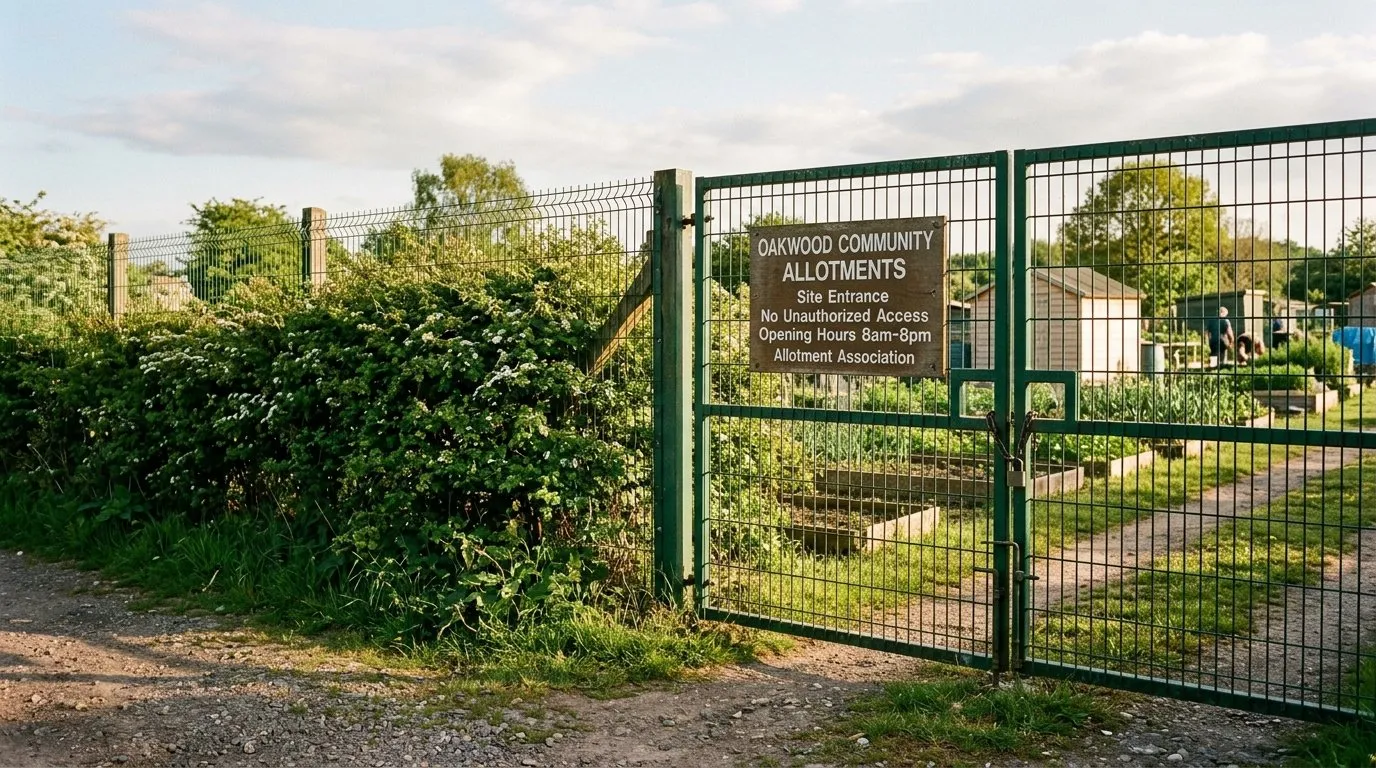 Site-wide perimeter fencing matters more than individual plot fencing. Push your committee to maintain or upgrade the boundary - replacing 6 sheds-worth of stolen tools costs more than 30 metres of weldmesh.
Marking your tools
Marking tools is one of the most effective deterrents. Police data shows marked tools are 30-50% less likely to be stolen and dramatically more likely to be returned to the owner if recovered. Two systems work together.
Visible marking
Write your postcode in black permanent marker (Sharpie or similar) on:
- Wooden handles of forks, spades, rakes, hoes
- Metal bodies of strimmers, drills, mowers (use white paint pen on dark surfaces)
- Petrol cans, jerry cans, fuel containers
- Wheelbarrow handles and frames
The point is not theft prevention so much as deterrence. A thief picking up a tool with a postcode on it knows it cannot be openly resold without questions.
Hidden UV marking
Apply SmartWater, Selecta DNA, or similar UV-only marking fluid to:
- The undersides and joins of tools
- Inside handles where marker would wear off
- Power tool battery compartments
- Petrol mowers (under the deck, on the engine)
These solutions show up only under police-issued UV scanners. Most stolen tools recovered by police are processed through a UV scan to find ownership. Marked tools get returned; unmarked tools get auctioned. SmartWater kits cost £20-50 and last years.
Photograph and record
Take a clear photo of every tool over £50. Capture:
- Brand and model markings
- Serial numbers (often on a sticker or stamped into the casing)
- Any identifying scratches or modifications
- The postcode/UV mark you applied
Store photos in cloud backup or email them to yourself. Insurance claims are much faster with photographic evidence. Police are far more likely to chase up identifiable items.
For higher-value tools, register serial numbers on Immobilise (the national property register, free for individuals at immobilise.com). Police forces check Immobilise routinely on recovered property.
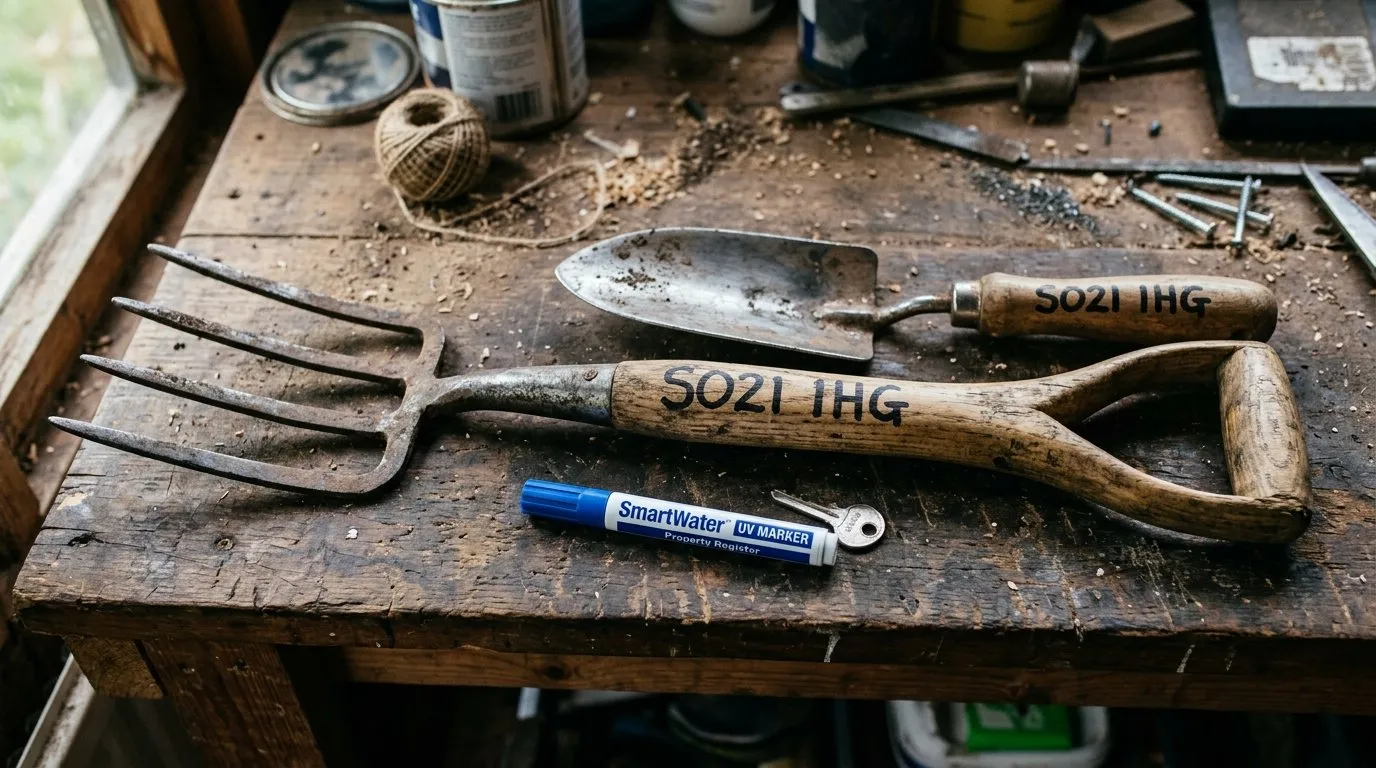 The two-part marking system. Visible postcode in permanent marker deters opportunistic theft. UV-only marking and Immobilise registration help police return recovered tools to their owner.
Site-level security
Individual plot security only goes so far. Most UK sites are bound by what the committee and council are willing to fund and maintain. Push for these site-wide measures.
Perimeter fencing
A maintained perimeter fence is the single biggest deterrent. Look for:
- Minimum 1.8m height
- Welded mesh (not chain-link, which is easily cut)
- Steel posts in concrete every 3m
- Anti-climb topping (rotating spikes or angled outward arms) where vandalism is repeat
- No gaps where vegetation has overgrown
Replacement fence runs £30-60 per metre installed. For most sites the cost is council-borne, but well-organised committees secure grants from local Police and Crime Commissioners (£500-£5,000 grants available in many areas) and Co-op Local Community Fund.
Gates and access control
Every gate needs:
- A heavy-duty closed-shackle padlock (committee-controlled, not personal)
- A code-rotation policy for combination locks (change every 6-12 months)
- Records of who has keys
- A clear policy on contractor and visitor access
Do not let gate locks become “common knowledge” combinations. Once everyone on the site shares the code with friends and family, casual theft access becomes trivial.
Lighting
Solar PIR floodlights mounted on shed roofs cost £40-100 each, need no wiring, and deter casual theft well. Mount them:
- 3-4m high (out of easy reach)
- Pointed at access paths and shed doors
- Set to high sensitivity, 30-second illumination cycles
Site-wide floodlighting on poles is more expensive (£500-2,000 per pole installed) but transforms a vulnerable site. Solar versions exist for sites without mains power.
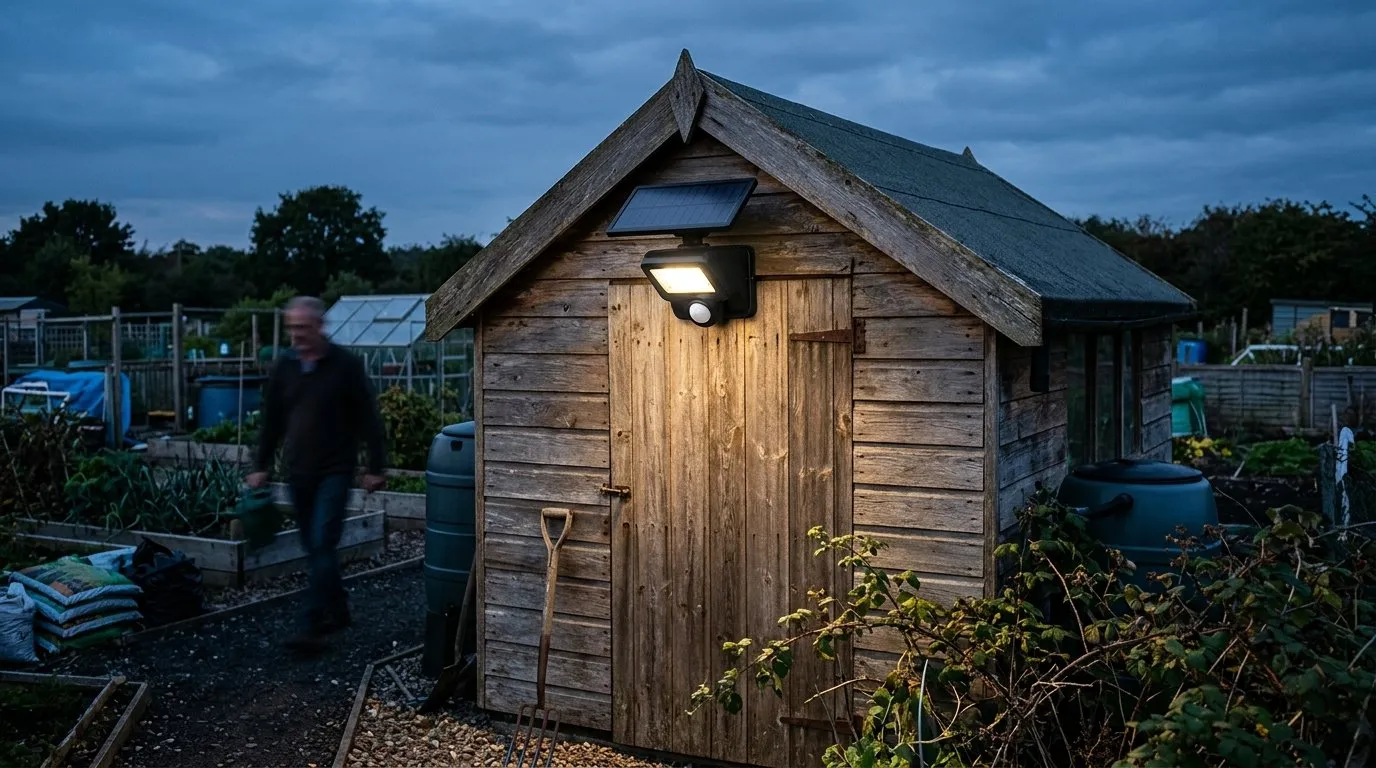 Solar PIR floodlights need no wiring and deter most casual theft. Mount 3-4m high pointed at the shed door and access paths. £40-100 each from any DIY shop. Replace batteries every 2-3 years.
CCTV and trail cameras
Site CCTV is more complicated than it looks. Plan for:
- GDPR compliance: signage at every entry point, a designated data controller, retention policy of 30 days max, no recording of individual private plots
- Coverage of communal areas only - paths, gates, communal building, not pointed at individual sheds
- Committee approval before installation
- A nominated person who reviews footage when theft occurs
Battery and solar trail cameras with 4G uplinks (£150-400 each) work for sites without mains power. Reolink Go and Wildgame trail cameras are popular. CCTV rarely prevents determined break-ins but provides footage that helps police identify repeat offenders across multiple sites.
Neighbour-watch arrangements
The cheapest and most effective security measure on most sites. A WhatsApp group for plot holders sharing:
- Suspicious activity sightings
- New faces on site
- Vehicles parked nearby
- Lights left on overnight
- Unusual noises after dark
Call out members visiting outside normal hours - “is that you Mike at 9pm?” - and neighbours quickly become eyes on the site. Coordinate visit times so the site is rarely deserted at dusk and dawn.
Pair this with a community gardening ethos: plot holders who know each other report theft faster, support each other on insurance claims, and lobby the council more effectively.
After a break-in: what to do
If you arrive to find your shed broken into, follow this sequence in order.
1. Photograph everything before touching anything. Damage to the lock and door, items moved or scattered, footprints, tyre tracks, anything dropped by the thief. Insurance and police want photos taken in situ.
2. Report to police on 101 or via online reporting. Get a crime number. Mention if any neighbouring plots were also hit. Patterns matter for investigation. Use 999 only if the offence is in progress.
3. Notify the allotment committee or council. Same day. Sites with documented incident records get faster council action on perimeter and lighting upgrades.
4. Submit an insurance claim. Provide the crime number, photos of damage, photos of stolen items, original purchase receipts if available, and any serial numbers. Most insurers process within 14-30 days.
5. Check Marketplace, eBay, and Gumtree for your tools listed locally. Stolen tools often appear within 24-48 hours. If you find one, take screenshots and notify police - do not contact the seller yourself.
6. Replace the lock and hasp before your next visit. Thieves often return within days. Upgrade if your previous setup was breached.
7. Mark all replacement tools before they enter the shed. Thieves probe sites for new soft targets.
Sites that respond visibly to break-ins - upgraded fencing within a month, new lighting within two months - tell thieves the site is hardened. Sites that ignore break-ins get hit again.
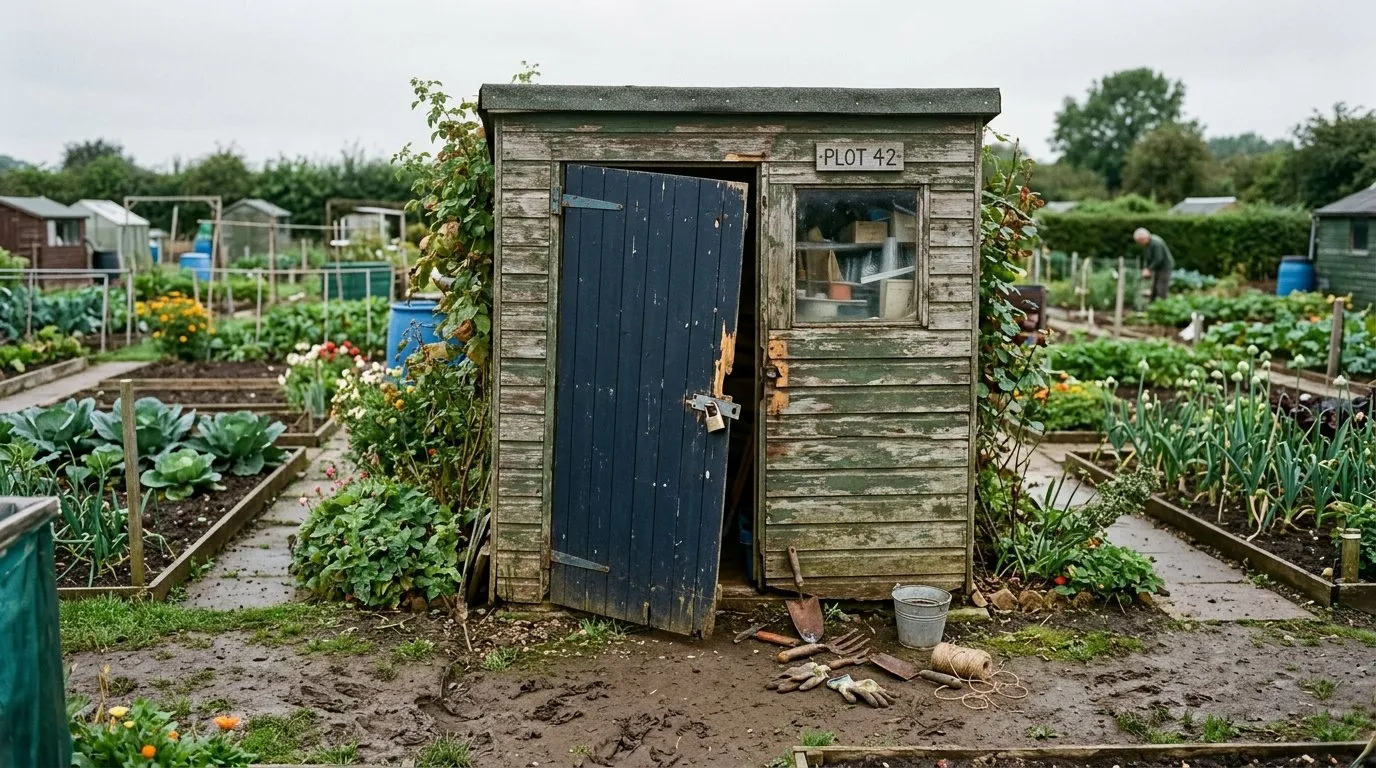 The aftermath of a typical opportunistic break-in. The hasp was pried off with a crowbar in under a minute, the lock body still attached. A frame-anchored hasp and through-bolted hinges would have meant the thieves moved on to the next shed.
Insurance: read the small print
Most household contents policies do not cover allotment tools by default. Common exclusions:
- Items stored away from the main residence overnight
- Items in outbuildings without dedicated cover
- Items on land you do not own
- Tools above a single-item value cap (often £100-250)
UK insurers known to offer allotment-specific cover:
- NFU Mutual (countryside-focused)
- LV (outbuildings extension on home contents)
- Direct Line (outbuildings up to £2,500)
- Saga Home Insurance (over-50s, includes outbuildings as standard)
Specialist allotment insurance through the National Allotment Society is available to NSALG members for around £15-25 per year and includes public liability, which is increasingly required by councils as part of tenancy agreements.
Photograph and document tools before storing them. Insurance claims are dramatically faster with proof of ownership.
What does not work
Some commonly-suggested measures sound sensible but produce little real security.
Cheap padlocks of any size. A £10 brass padlock with an open shackle is cut in 5 seconds with bolt cutters. Size does not equal strength.
“Beware of dog” signs without a dog. Thieves test these. The actual presence of dogs nearby helps; signs alone do not.
Old-style fake CCTV cameras. Identifiable as fakes within seconds by anyone looking. Real cameras (or no cameras at all) work better.
Hiding keys on the plot. Spare key under a stone, in a flowerpot, behind the rainbutt - thieves know all the spots.
Locking tools to lightweight items. A strimmer chained to a small wooden bench means thieves take the bench too.
Trusting the gate code. If 200 plot holders share a 4-digit gate combination, that combination has leaked. Treat the gate as undeterrent unless rotated frequently.
Personal-plot CCTV pointing into communal areas. Will get you in GDPR trouble fast. Personal cameras must point only at your own plot, not paths or other plots.
Building a culture of security
The sites with the lowest theft rates are not the ones with the most expensive infrastructure. They are the ones where plot holders look out for each other.
- New tenants get a brief security walk-round in their first week, including who to contact and the WhatsApp group invite
- The committee budget includes a small fund for shared security upgrades (lighting on shared sheds, gate maintenance, signage)
- Theft is reported, not hushed up. The site’s history is communicated openly so new tenants know what to expect
- Annual or quarterly security audits identify weak spots before they are exploited
- Plot holders attend each other’s working days. The more activity on site, the more eyes
These cultural measures cost nothing. They make the difference between a site that is hit twice a year and one that is hit twice a decade.
For more on getting involved with your committee and the wider allotment community, see community gardening UK.
Quick checklist
Before your next plot visit:
- Padlock to Sold Secure Gold or CEN 4 standard ✓
- Hasp anchored through to door frame with hidden screws ✓
- Hinge bolts or one-way hinge screws fitted ✓
- Solar PIR light pointed at door ✓
- Tools marked with postcode (visible) and UV pen (hidden) ✓
- Photographs of every tool over £50 ✓
- Serial numbers registered on Immobilise ✓
- Insurance covers allotment tools (in writing from insurer) ✓
- Member of site WhatsApp group ✓
- Crime numbers from any past incidents on file ✓
Tick every item over a single weekend and your plot moves from soft target to hardened site. The thieves go elsewhere.
Related articles
Our team produces practical UK gardening guidance from source research, contributor records and established horticultural practice. Editorial standards are overseen by Matt W.