Key takeaways
- November to March is the cutting season — hazel rods cut while dormant are pliable for 3-4 weeks before drying
- A 1.5m sweet pea wigwam uses 6 hazel rods plus 4 weavers and lasts 4-7 seasons — bought metal equivalent £35-£60
- Pea sticks are the simplest and most useful — push 45-75cm twiggy hazel into soil among emerging perennials in April
- Hazel beats birch for durability (5-7 years vs 2-3) but birch is finer and better for delicate plants like cosmos and cleome
- Domes for peonies and late perennials weave together at the top — once tied with twine they hold for the full season
- Always source from coppice or council cuttings — never strip wild hedgerow without permission
Most gardeners buy plant supports because nobody ever showed them how to make their own. There is nothing wrong with bought obelisks and peony hoops. But they cost £18 to £60 each, they always look bought, and most rust or bend within four or five years. A hazel wigwam costs nothing if you have access to coppice, and it outlasts the cheap powder-coated metal versions.
This guide walks through the November-to-March cutting season and the four structures worth knowing: pea sticks, wigwams, dome frames and obelisks. It covers the twisting trick that decides whether a rod bends or snaps, and a real cost comparison against the metal supports in garden centres.
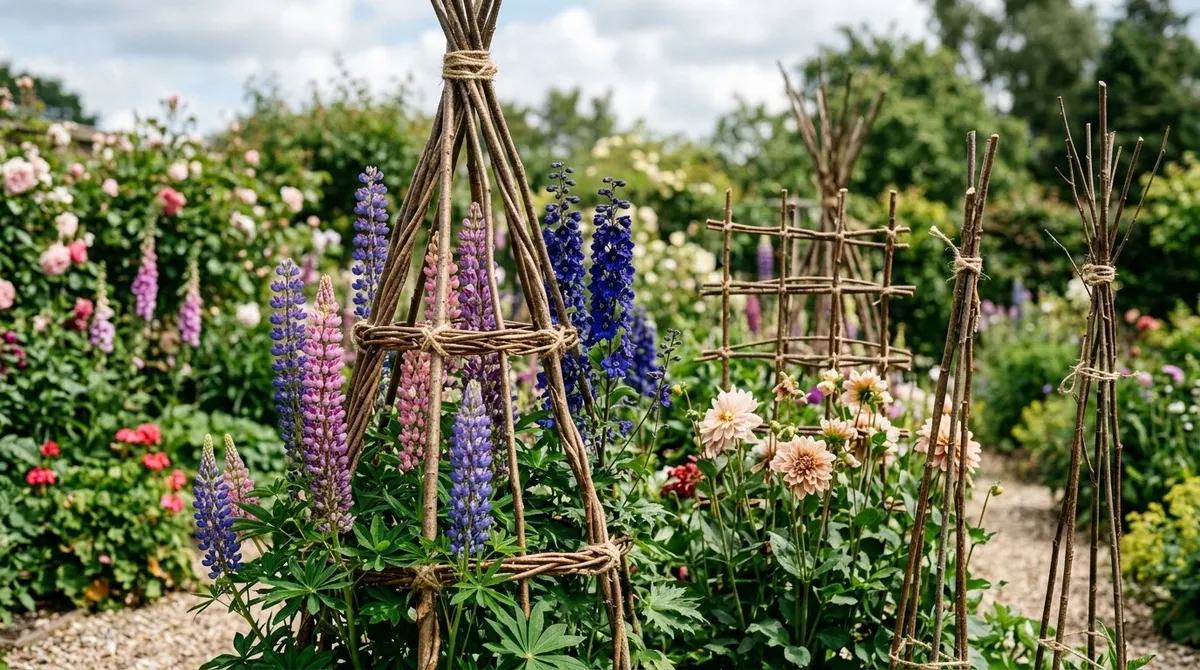
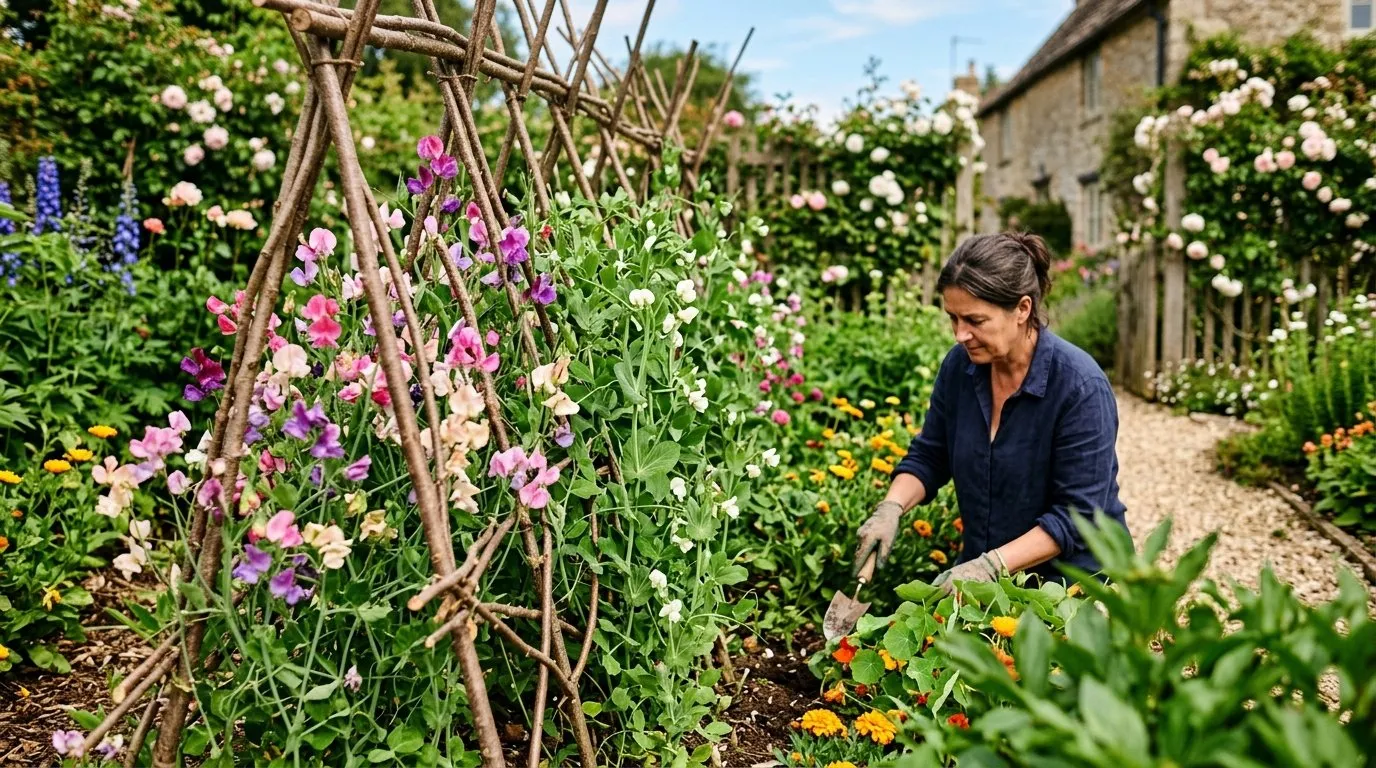 Hazel pea stick supports in a Staffordshire cottage border in late June. The structures cost nothing to make, last 4-7 seasons, and disappear into the planting once the perennials grow up through them.
Why hazel beats bought plant supports
Four things make DIY plant supports worth the effort over bought ones.
Cost. Bought peony hoops run £18-£28. Bought sweet pea wigwams £35-£60. Bought obelisks £45-£120. A garden with 8-12 supports costs £200-£500 in metal versus £0-£40 in hazel. Over a 10-year period the difference compounds: bought supports often need replacement every 4-6 seasons.
Plant compatibility. Twiggy hazel gives plants natural grip points. Sweet peas, runner beans and clematis self-attach without tying. Stiffer perennials like dahlias and helianthus lean against the rough surface and stay put. Smooth metal supports need tying in for nearly every plant.
Aesthetic. Hazel looks like the garden. It weathers from green-brown to silver-grey over a season and vanishes into the planting. Painted metal always looks shop-bought. Hazel obelisks and dome frames are what you see at National Trust and RHS show gardens, Sissinghurst and Beth Chatto’s gardens among them.
Sustainability. Coppicing is how hazel woods have been managed in Britain for centuries, and cutting them actually does the wood good. It opens the canopy for dormice and butterflies and keeps rural coppice workers in business. Metal supports carry the carbon of manufacture and end up as landfill or scrap.
For a complementary low-cost garden technique, see our guide to the Chelsea chop — coupling hazel supports with proper Chelsea chop technique often eliminates the need for staking entirely on shorter perennials.
When to cut hazel for plant supports
The cutting season runs from November through March. Within that window, two periods give the best material:
Early November (best for pliability): Wood still holds autumn moisture and bends easily. Most pliable for weaving wigwams and dome frames. Risk: weather can be wet and woodland access difficult.
Late February to mid-March (best for accessibility): Coppice work easier in dry weather, no leaves to clear from the rods. Slightly drier wood than November but still pliable enough to weave for 3-4 weeks after cutting.
Avoid:
- Summer cutting (June-September) — leaves present, sap rising, rods rot fast
- April-May — leaves emerging, rods difficult to clean
- After mid-March — increasingly dry and brittle
Cut rods retain pliability for 3-4 weeks at room temperature, or 8-10 weeks if stored in a cool damp shed wrapped in damp hessian. For very pliable weaving, soak rods in water for 24 hours before bending.
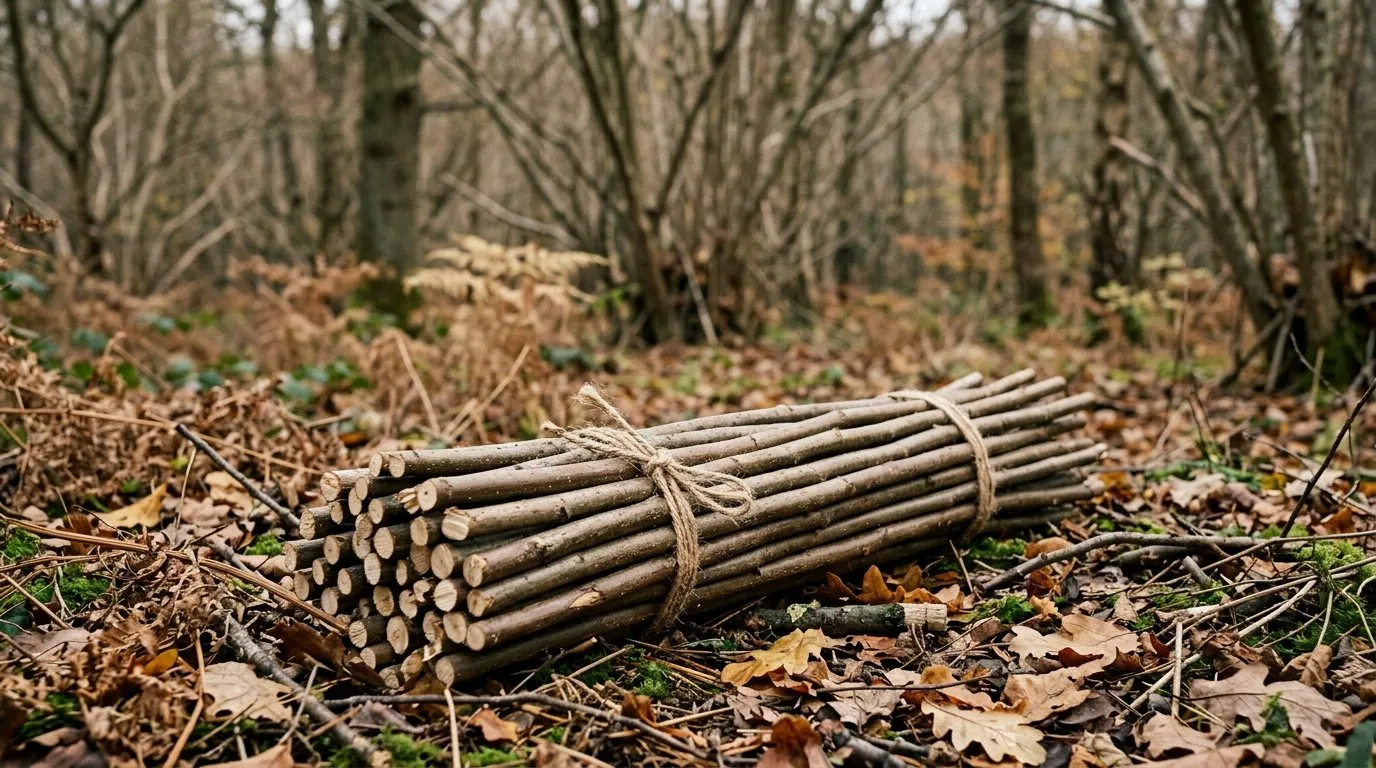 Fresh-cut hazel from a coppice in late November. The rods are pliable for 3-4 weeks at this stage — soak in water if storing longer than that.
Where to source hazel rods
Five reliable UK sources, in order of cost:
1. Coppice woodland (free with permission)
Local Wildlife Trusts often run coppice working days from October to March. Volunteers help cut hazel and most trusts allow workers to take rods home. Look up your county Wildlife Trust’s events page or the Small Woods Association.
2. Council tree-surgeon cuttings (free)
Local councils manage hedgerow and roadside hazel through autumn-winter contracts. Phone the council depot in October-November and ask whether you can collect cuttings. Many surgeons are pleased to drop bundles at allotments or community gardens.
3. Local farmer or landowner (£0-£10 per bundle)
Hedgerow hazel is often unmanaged. Ask farmers or landowners if you can cut a few rods in exchange for tidying up. Always ask permission and never cut without it — hedgerow trees are protected under the Hedgerows Regulations 1997.
4. Forestry supplier (£8-£15 per bundle of 10 rods)
Specialist suppliers sell pre-cut hazel bundles. UK suppliers include Coppice Resources, Say It With Wood, and Local Greenwood Suppliers. A bundle makes 2-3 wigwams or 8-10 pea sticks.
5. Grow your own hazel (long-term solution)
Four useful plant support structures
Pea sticks (the simplest)
Pea sticks are the easiest hazel support and the most useful for general perennial work. Push a 45-75cm twiggy hazel rod into soil among emerging perennials in early April. Plants grow up through the twigs, which provide structural support without visible staking.
Build: None — just push individual sticks into soil Time: 30 seconds per stick Best for: Perennials prone to flopping (geraniums, anemones, asters, achilleas), peas, dwarf beans
Sweet pea wigwam
The signature hazel structure. Six rods around 1.8-2m long, pushed into soil 30cm deep in a 50cm circle, tops drawn together and tied with twine 30cm from the top. Add 3-4 horizontal weavers twisted around the verticals at 30cm, 60cm, and 90cm.
Build steps:
- Mark a 50cm-diameter circle on bare soil
- Push 6 hazel rods 30cm deep at evenly spaced points around the circle
- Pull tops together gently, tie with jute twine 30cm from the top
- Take a thinner rod and weave it horizontally around the wigwam at 30cm height, twisting under and over each vertical
- Repeat at 60cm and 90cm
- Trim any excessive twiggy ends
Time: 30-45 minutes Materials: 6 hazel rods 1.8-2m + 3-4 thinner weavers Lifespan: 5-7 seasons Best for: Sweet peas, climbing French beans, runner beans, morning glories
Dome frame for peonies and late perennials
A 6-8 rod dome covers a 60-90cm diameter clump. Bend each rod into an arch from one side to the other and weave the top junction together with twine. Adds horizontal support for tall perennials that flop in wet summers.
Build steps:
- Cut 6-8 rods around 1.5-1.8m long
- Push one end into soil at the perimeter of the clump
- Bend over the clump and push the other end into soil on the opposite side
- Repeat with each rod, crossing at the top
- Tie all crossings together with jute twine
- Add 2-3 horizontal weavers around the dome edge
Time: 30-40 minutes Materials: 6-8 rods 1.5-1.8m + 2-3 weavers Lifespan: 4-6 seasons Best for: Peonies, tall asters, helianthus, late helleniums
Twiggy frame for tall annuals and dahlias
A square 4-rod frame with a horizontal cross-piece, covered with brushwood weaving. Ideal for dahlias and tall cosmos that need both vertical and horizontal support.
Build steps:
- Push 4 hazel uprights 1.2-1.5m tall into the soil at the corners of a 60cm square
- Tie a rectangular frame of horizontal rods at 60cm and 100cm heights
- Weave brushwood (the small twiggy ends from coppice cuttings) through the frame
- Plant dahlias inside the frame; they grow up and through
Time: 45-60 minutes Materials: 4 uprights + 4-8 horizontals + brushwood Lifespan: 3-5 seasons Best for: Dahlias, cosmos, cleome, tall sunflowers
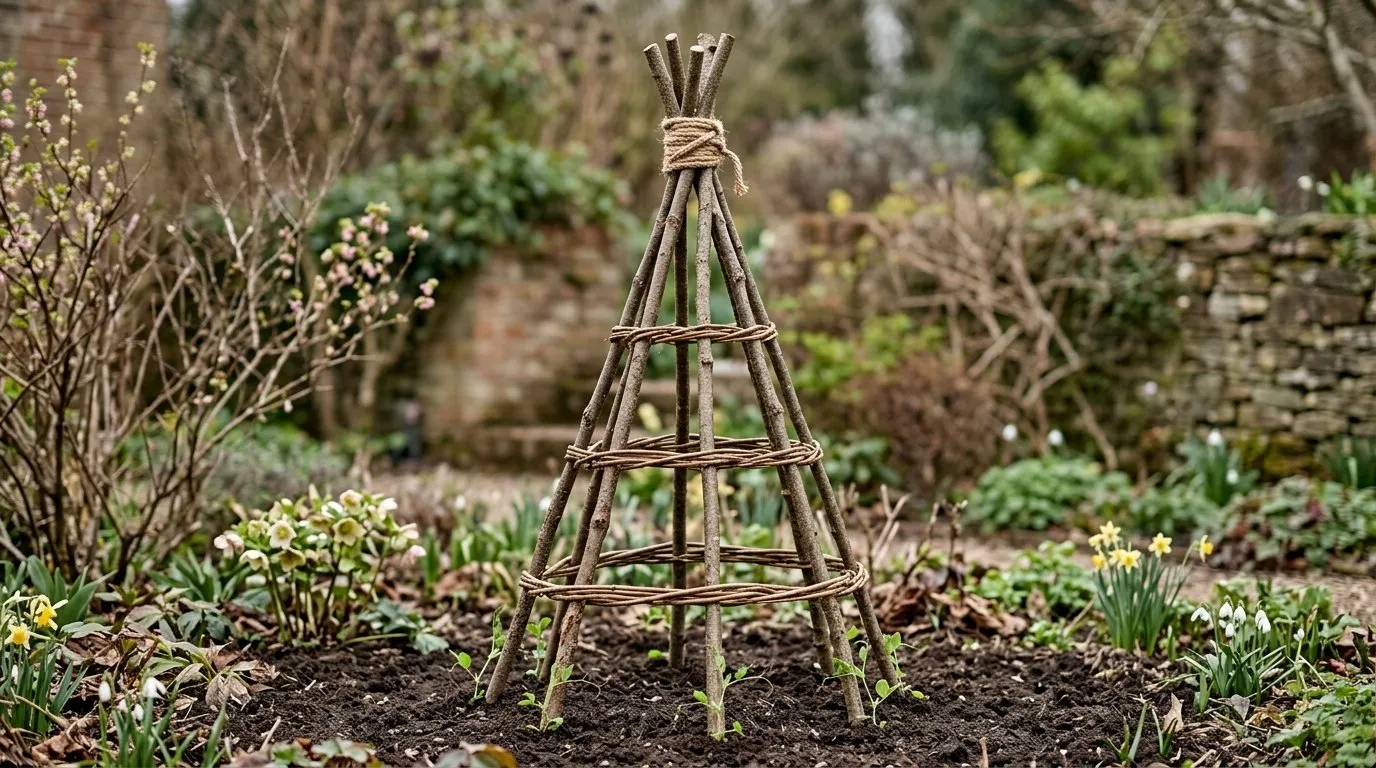 A finished sweet pea wigwam in March before planting. Six 1.8m rods, three horizontal weavers at 30cm, 60cm, and 90cm. Holds 6-8 sweet pea plants for the season.
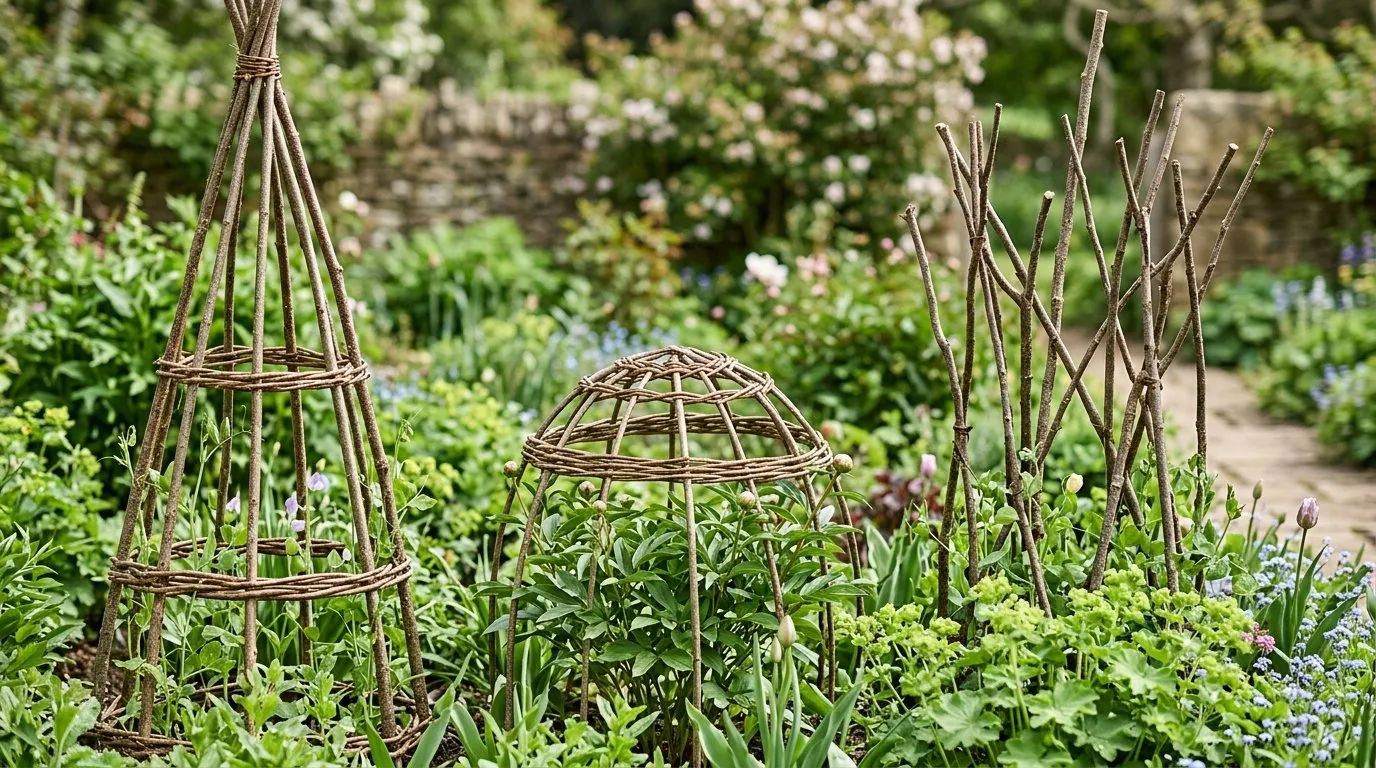 Three styles in one border: a sweet pea wigwam, a peony dome frame, and pea sticks among emerging asters. All cut from the same hazel coppice over 30 minutes one Saturday morning.
The twisting technique nobody talks about
The one thing that turns rough hazel work into proper coppice work is the twist. As you bend a fresh rod, twist it half a turn at the same time. The fibres then stretch evenly across the bend instead of crushing on one side. Bend without twisting and the rod snaps. Twist as you bend and a 2.5m rod will curve into a U-shape that holds for years.
It works because hazel fibres run in a spiral. Twisting spreads the bending stress along that spiral, so the rod gives way slowly rather than cracking. Hurdle-makers and hedge-layers have used the same trick for generations.
To practise the twist:
- Hold a freshly cut rod with both hands 60cm apart
- Begin to bend the centre toward you
- As the bend forms, twist your right hand clockwise (or your left hand counter-clockwise) by 30-45 degrees
- Continue the bend slowly, maintaining the twist
- The rod yields silently — if you hear cracking, you have not twisted enough
Give it 5-10 practice rods and the feel comes. After that you can bend 2-3m rods into clean arches without snapping them.
Costed comparison: DIY vs bought
A small UK cottage garden typically uses 8-12 plant supports per season. The 10-year cost difference is substantial.
| Support type | DIY hazel cost | Bought metal cost | Lifespan ratio |
|---|---|---|---|
| Pea sticks (8 needed) | Free-£8 total | £40-£80 | DIY 2-3yr, metal 5-8yr |
| Sweet pea wigwam (3 needed) | Free-£12 total | £105-£180 | DIY 5-7yr, metal 6-10yr |
| Peony dome frame (3 needed) | Free-£15 total | £75-£120 | DIY 4-6yr, metal 5-8yr |
| Twiggy frame (1 needed) | Free-£5 total | £35-£75 | DIY 3-5yr, metal 5-8yr |
| Total annual cost | £0-£40 | £255-£455 | — |
Even buying bundled hazel from a forestry supplier, DIY comes in under a tenth of the metal price. Reckon on 3-4 hours of cutting (one trip to a coppice) and 4-6 hours of weaving (one rainy Saturday afternoon).
Storing and reusing hazel supports
Properly stored hazel supports last twice as long as those left out year-round. After the autumn cut-back:
- Dismantle wigwams and dome frames
- Strip off twine and label each component (1.8m, 1.5m, weaver)
- Stack vertically against a north-facing shed wall under cover
- Cover with a tarpaulin or plastic sheet — but allow airflow
- Inspect in February for rot before re-using in spring
Pea sticks are usually too small to dismantle — push them deeper into the compost heap to break down.
A 20% replacement rate per year is normal — every spring some rods will have rotted. Cut replacements during the November-March window and weave them in.
For broader sustainable gardening practices, see our guides on making leaf mould and composting for the garden.
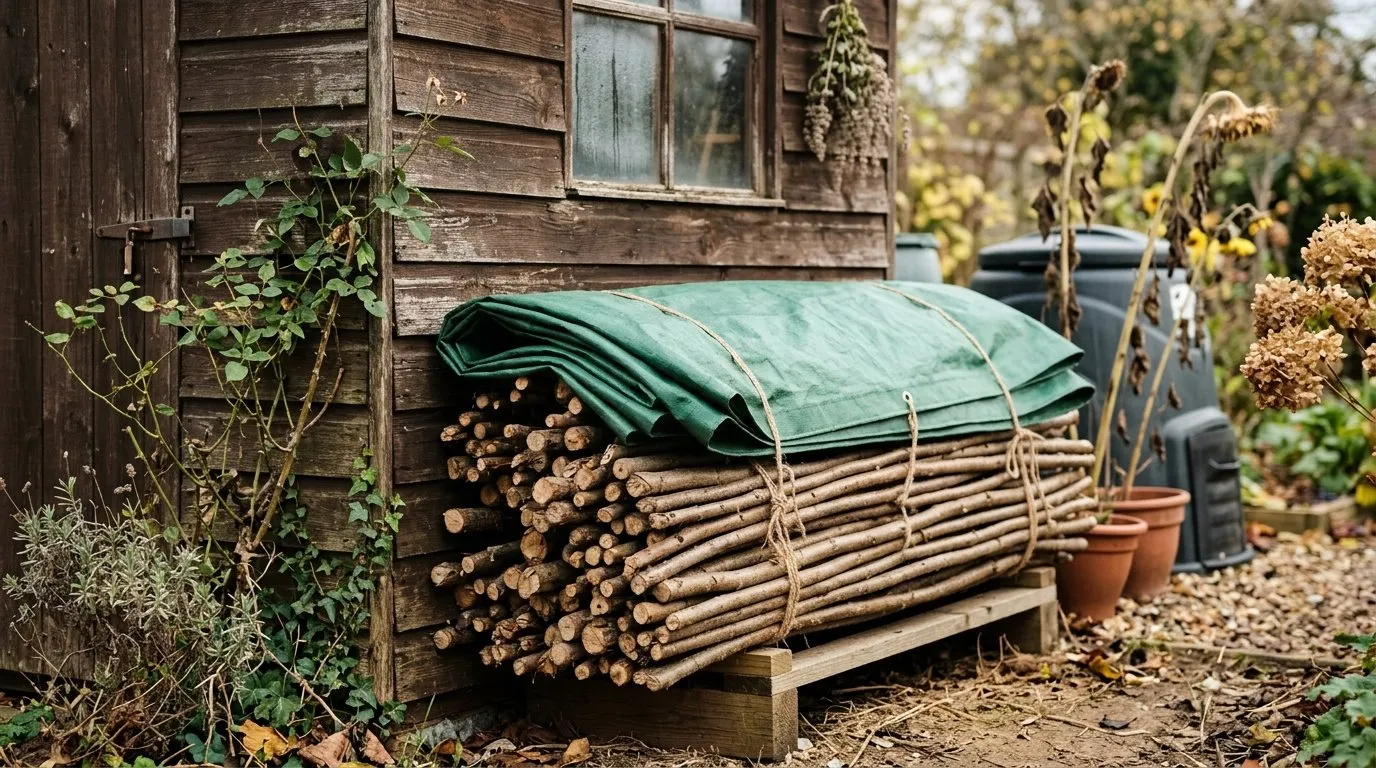 Hazel wigwam rods dismantled, stacked, and covered for winter. Proper storage doubles the lifespan from 3-4 years to 6-7 years per build.
Common DIY plant support mistakes
Cutting hazel in summer
Sap is rising, rods rot fast, and you lose the woodland’s annual coppice opportunity. Wait until November.
Forgetting the twist
The single most common cause of broken rods. Always twist as you bend.
Pushing rods too shallow
Plant supports need to go 25-30cm into the soil. Shallower and they pivot in wind. On hard ground, drill a starter hole with a metal spike before pushing the rod in.
Weaving with brittle dry rods
If a rod cracks audibly when bent, soak it in water for 12-24 hours before weaving. Or use it for pea sticks where bending is not required.
No horizontal weavers on wigwams
A 6-rod wigwam without horizontal weavers acts as a hinge — it twists in wind. Always add 3 weavers at 30cm, 60cm, and 90cm heights.
Storing supports outdoors uncovered
UK rain rots untreated hazel within 18 months. Always shelter under cover for winter.
Hazel plant support maintenance calendar
| Month | Task |
|---|---|
| November | Cut hazel rods. Take 50% more than you think you need |
| December | Build wigwams indoors during wet weather |
| January | Plan support placement on annual border layouts |
| February | Final cuts. Soak rods 24 hours if needed |
| March | Push pea sticks into emerging perennial clumps. Build sweet pea wigwams in their final positions |
| April-May | Weave dome frames over peonies and tall perennials before they reach 50cm |
| June-July | Add support ties only where supports are slipping (rare with hazel) |
| August-September | Photograph established supports for next-year planning |
| October | Dismantle, sort, and store under cover |
Total annual time: 8-12 hours per garden. Compared to assembling and rust-proofing 10+ metal supports, DIY hazel is faster after the first season.
Related reading: A cutting cycle keeps hazel producing straight rods, see our guide to pollarding and coppicing trees.
Frequently asked questions
When should I cut hazel for plant supports?
Cut hazel between November and March, while it is leafless and dormant. November-cut rods are most pliable because the wood is still wet from autumn. Late February to mid-March is the second-best window. Avoid cutting in summer — leaves are present, sap is rising, and cut rods rot quickly. Cut rods stay pliable for 3-4 weeks. After that they harden and snap when bent. Use within a month or store in a cool damp shed for 8-10 weeks.
Where can I get hazel rods for plant supports?
Three sources: coppice woodland (most reliable, often local woodland trusts sell cordwood at £30-£50 per cubic metre), council tree-surgeon cuttings (free, ask at council depots in November-February), and roadside hedgerow cuttings (only with landowner permission). Many local Wildlife Trusts run coppice working days where volunteers help cut hazel and take some home. Forestry supply companies sell pre-cut bundles of straight hazel rods at £8-£15 per bundle of 10 rods.
How long do hazel plant supports last in UK weather?
A well-made hazel support lasts 4-7 UK seasons. Hazel pea sticks (the smallest type) last 2-3 seasons because the small twiggy ends rot fastest. Wigwams and dome frames last 5-7 seasons because the main rods stay thick. Birch supports last 2-4 seasons — finer, less durable, but better for delicate plants. Storing supports under cover during winter doubles their life. Always check the bases each spring for rot before reusing.
How do you make a sweet pea wigwam from hazel?
Make a sweet pea wigwam from 6 hazel rods around 1.8-2m long pushed into soil 30cm deep in a 50cm-diameter circle. Pull the tops together and tie with twine 30cm from the top. Add 4 horizontal weavers (thinner rods) twisted around the wigwam at 30cm, 60cm, and 90cm heights. Sweet peas climb the verticals while the weavers add stiffness against wind. Total build time: 30-45 minutes per wigwam. The structure holds 6-8 vigorous sweet pea plants for the season.
Are hazel pea sticks better than bamboo canes?
Hazel pea sticks beat bamboo on three measures: durability, plant grip, and appearance. Hazel pea sticks last 2-3 UK seasons; bamboo canes split and snap within one season. Plants grip hazel naturally because of the twiggy structure; bamboo canes need ties. Hazel looks like the garden — bamboo always looks bought. The only place bamboo wins is uniformity for formal vegetable plots like cordon tomatoes, where hazel’s irregularity becomes a problem.
Can I use birch instead of hazel for plant supports?
Yes, birch works well for finer plant supports though it lasts half as long as hazel. Birch is more pliable and finer-twigged, making it ideal for delicate plants like cosmos, cleome, and tall annuals where hazel rods would look too coarse. Cut in the same November-March window. Birch supports last 2-4 UK seasons before becoming brittle. A common practice is to mix birch fines among hazel rods on the same support — hazel for structure, birch for finer twigginess.
How much does a DIY hazel plant support cost?
DIY hazel supports cost between zero and £4 each. Free if you cut your own from coppice, council cuttings, or with permission from hedgerow owners. £2-£4 if buying pre-cut bundles from forestry suppliers (typically 10-20 rods per bundle, enough for 2-3 wigwams or 8-10 pea sticks). Bought metal plant supports range from £18 (basic peony hoop) to £60+ (decorative obelisk). DIY hazel pays back the time investment within one season at typical perennial prices.
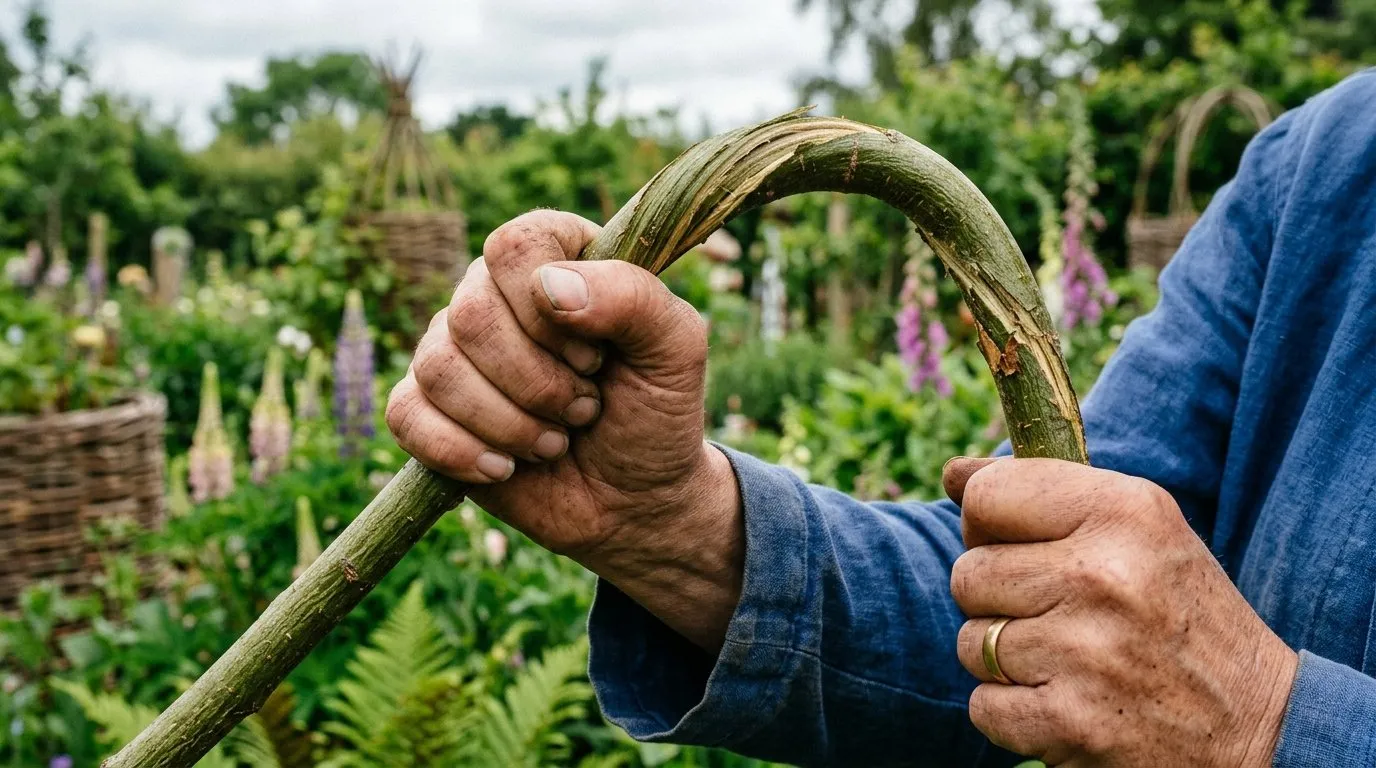 The twist-and-bend technique. Hands rotate the rod 30-45 degrees while bending — the spirally arranged hazel fibres yield instead of snapping, allowing 2.5m rods to curve into perfect arches.
Sources: Small Woods Association | Royal Horticultural Society - using natural materials in gardening
Our team produces practical UK gardening guidance from source research, contributor records and established horticultural practice. Editorial standards are overseen by Matt W.