Key takeaways
- Do not try to clear the entire plot at once - tackle 25% by hand and mulch the rest
- Cardboard and 10cm of compost smothers most weeds within 6 months without digging
- Brambles need cutting then crown removal - leaving roots means regrowth in spring
- Couch grass rhizomes regrow from any fragment - sieve the soil after digging
- Mare's tail and bindweed cannot be dug out - weaken them by repeated cutting
- Burn perennial weed roots, do not compost - they survive most home compost heaps
- Plant potatoes in your first cleared section - they break up soil while you work
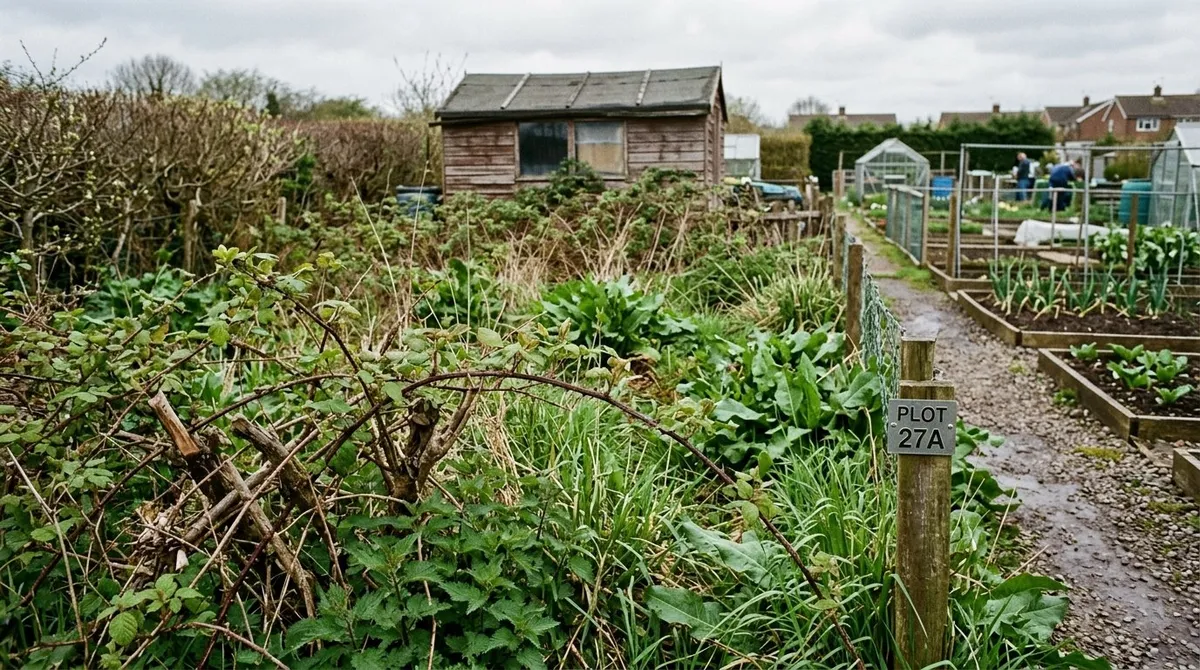
You have signed the tenancy, picked up the key, and walked onto your new allotment for the first time. The plot is a sea of brambles, nettles, and chest-high grass. Fellow plot holders are nodding sympathetically. The committee secretary mentions the previous tenant gave up two years ago.
This is the most common starting point for a UK allotment. Almost every new tenant inherits a plot that needs clearing. The good news: every plot, however bad it looks, can be cleared. The bad news: it takes longer and more work than you expect.
Do not try to clear the whole plot at once
A standard UK allotment is 250 square metres - 25 metres long by 10 metres wide, give or take. That is roughly the size of a tennis court. Clearing it completely by hand takes 60-100 hours of physical labour spread across 3-4 months. Most new plot holders cannot sustain that pace.
The phased approach works better. Clear 25% of the plot by hand for year one growing. Cover the remaining 75% with cardboard and compost. By the start of year two, the mulched ground will be soft, weed-suppressed, and ready to plant directly. By year three you have a fully cultivated plot without the back injury.
This works because:
- Annual weeds die under mulch within 4-8 weeks. Cardboard blocks light and they cannot photosynthesise.
- Perennial weeds weaken but rarely die completely under mulch. They use stored energy trying to push through and exhaust their reserves over 12-18 months.
- Soil structure improves as worms pull cardboard fragments and compost into the soil. The buried weed roots add organic matter.
- You get a harvest in year one instead of spending the whole season just clearing.
The only mistake is to clear too much. A 5-rod half plot section is plenty for your first season. If you have a 10-rod full plot, clear 5 rods, mulch the other 5, and expand by another quarter each year.
Identify what you are dealing with
Before reaching for the loppers, identify the weeds. The clearing method depends on what you have. Here are the seven most common UK allotment weeds and what each one needs.
| Weed | Identifier | Difficulty | Method |
|---|---|---|---|
| Brambles | Thorny canes, dark berries | Hard | Cut, dig out crown, burn |
| Couch grass | Wiry white rhizomes underground | Hard | Fork out, sieve, repeat |
| Bindweed | Climbing white trumpet flowers | Very hard | Cut weekly, mulch, accept partial control |
| Mare’s tail (Equisetum) | Asparagus-like green spears | Almost impossible | Cut weekly for years |
| Nettles | Stinging leaves, yellow root mass | Easy | Cut, dig, compost |
| Docks | Long taproots, broad leaves | Medium | Dig out full root |
| Annual weeds (chickweed, groundsel, fat hen) | Soft, shallow-rooted | Very easy | Hoe or mulch |
The tough four - brambles, couch, bindweed, and mare’s tail - need active intervention. Annual weeds and nettles disappear under mulch alone.
Tools that earn their keep
You do not need much, but the right tools make this manageable. Here is what actually works on overgrown UK plots.
Long-handled loppers (essential). Cut brambles, dock stems, and elder regrowth in seconds. Get bypass loppers, not anvil. The Felco 22 or ARS LPB-30 will handle 30mm canes without strain. Around £40-80 new, often £15 secondhand on Marketplace.
Stainless steel digging fork (essential). A garden fork lifts perennial roots without slicing them. Spades are wrong for clearing - they cut couch grass into dozens of fragments that all regrow. Bulldog and Spear & Jackson make good ones for £25-40. Our best secateurs UK guide covers cutting tools in detail.
Strimmer with brushcutter blade (very useful). A petrol strimmer with a metal blade flattens chest-high growth in an hour. Without one, the same job takes a full weekend with shears. Hire one for £30 a day from a local tool hire shop if you do not want to buy.
Dutch hoe (essential later). Once cleared, a sharp Dutch hoe keeps annual weeds out forever. Skim it 2cm under the soil surface weekly during the growing season. Five minutes does what an hour of pulling does later.
Wheelbarrow. A no-brainer. Get a galvanised one with pneumatic tyres - the plastic-tray builder’s barrows split when overloaded. Around £80 new.
Heavy gloves. Nettles, brambles, and broken glass all reward thick leather gloves. Get rigger’s gloves, not gardening gloves. They cost £8-15 and last years.
Tarpaulin. Lay one beside your work area for piling weeds and roots. Carrying weeds across the plot drops seed everywhere.
What you do not need: rotavator, weedkiller, expensive raised bed kits. A rotavator chops perennial roots into thousands of fragments that all regrow. Most allotment sites ban glyphosate. Raised beds come later, after you have soil to put in them.
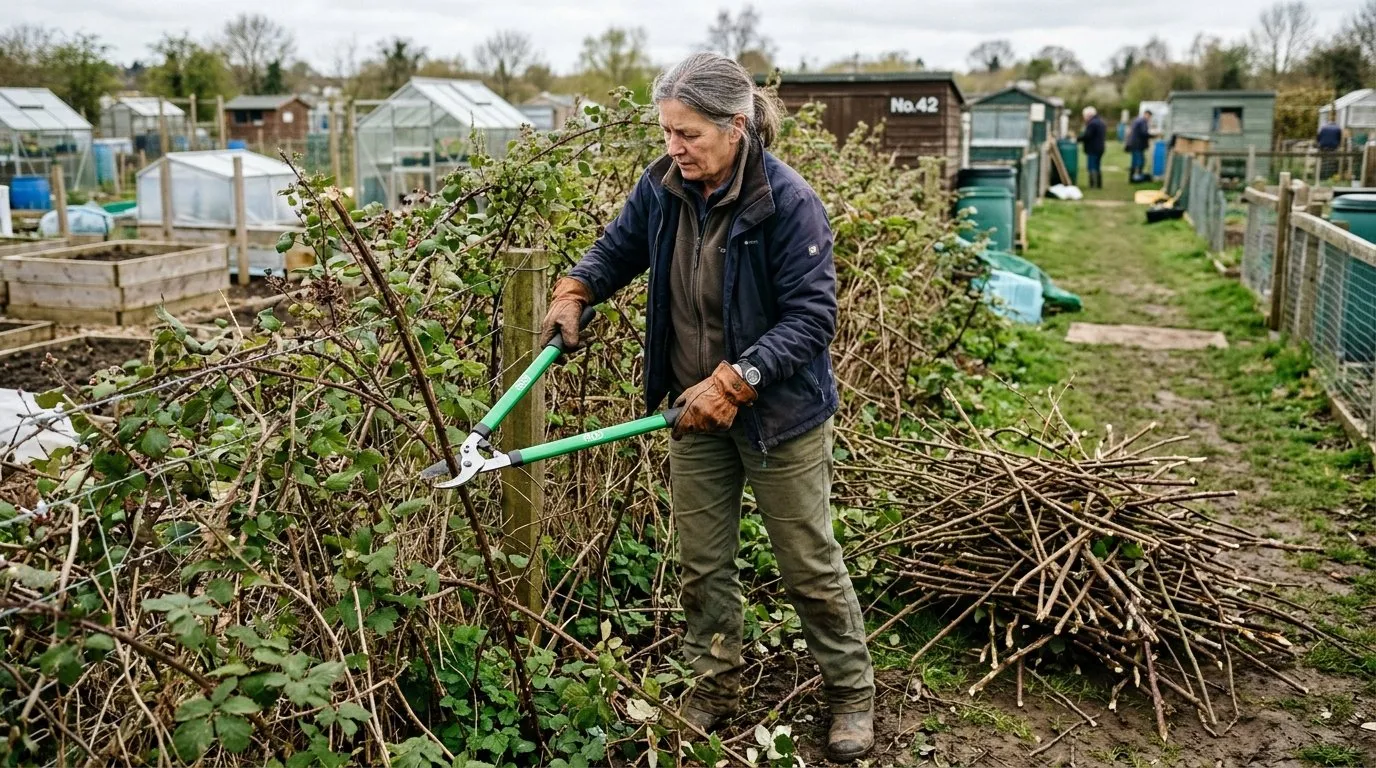 Long-handled loppers cut brambles cleanly. Wear thick leather rigger’s gloves - bramble thorns tear through cotton or rubber gloves in minutes. Cut canes back to ground level first, then dig out the crown.
Method 1: Cardboard and cover (recommended for most plots)
This is the no-dig approach popularised by Charles Dowding. It is the easiest method for most overgrown plots, and it builds soil at the same time. The principle is simple: block light, smother weeds, build a fertile growing surface on top.
Step 1: Strim or cut top growth to 5cm. You do not need to clear it - just knock the height down so cardboard lies flat. Leave the cuttings in place; they break down under the mulch.
Step 2: Lay cardboard over the entire area. Use 200gsm corrugated cardboard, the thicker the better. Overlap pieces by 30cm so light cannot get through gaps. Remove all tape, staples, and shiny printed surfaces - matte cardboard breaks down faster.
Step 3: Wet the cardboard thoroughly. Wet cardboard knits together; dry cardboard blows away. Use a hose, watering cans, or wait for rain.
Step 4: Cover with 10cm of compost or well-rotted manure. This is the growing layer. Quality matters - use peat-free multi-purpose compost (£3-5 a bag), municipal compost from the council (£25 a tonne delivered), or well-rotted manure if you can source it free from a local stable. Total cost for a 5-rod section is £80-150.
Step 5: Plant straight into the compost layer. You can plant the same day. Potatoes, courgettes, runner beans, and squash all work. Pull the compost back, drop the potato in, cover. The compost layer feeds the plants, the cardboard kills the weeds beneath, the worms do the soil-building.
Step 6: Top up annually. Each autumn, add another 5cm of compost to the surface. After 2-3 years the cardboard will have rotted, the weed seeds beneath will have run out of viable seed bank, and you will have 30-40cm of fertile dark loam.
This works on every weed except mare’s tail. Mare’s tail will push up through cardboard, compost, and even concrete. Cut its growth weekly when you spot it.
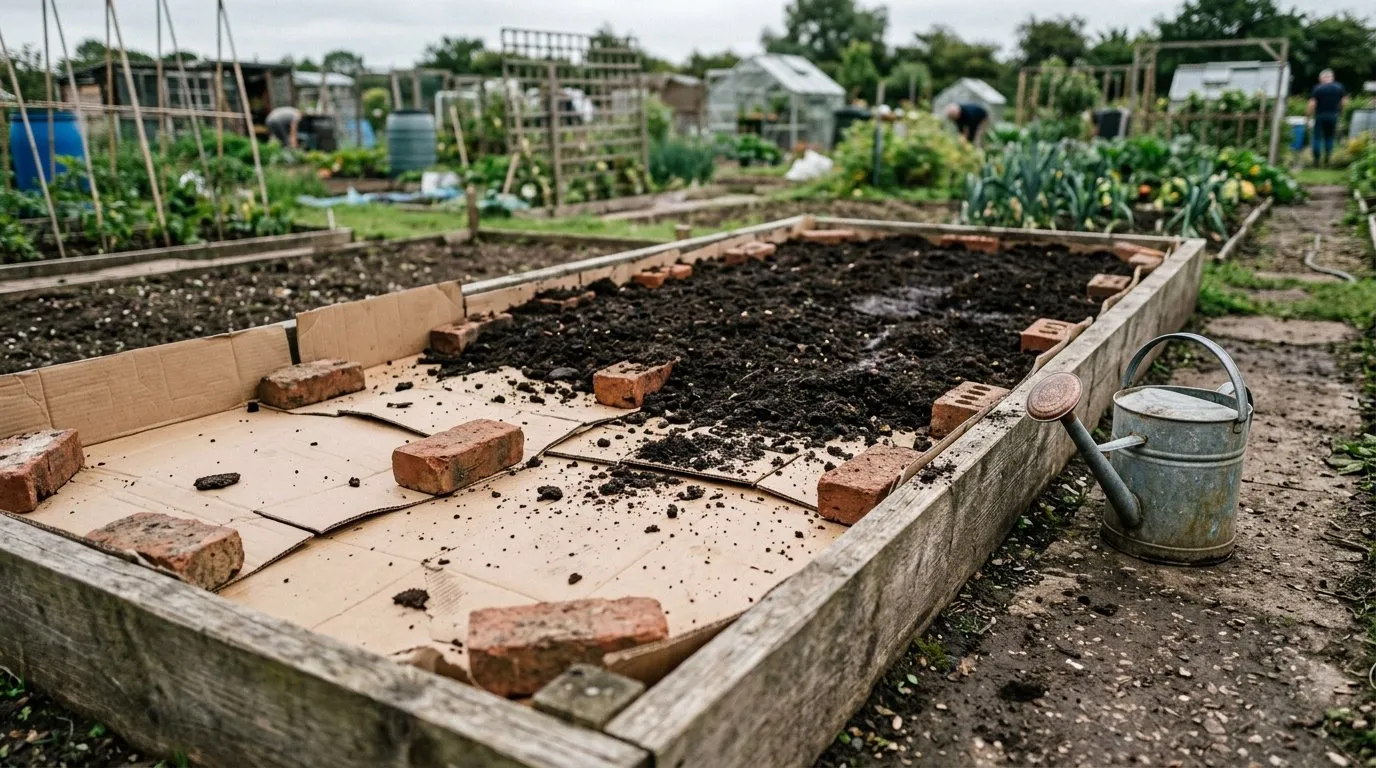 The no-dig clearing method. Cardboard blocks light, compost feeds plants and worms, weeds beneath die from darkness. Most annuals are gone in 4-8 weeks; perennials weaken over 12-18 months.
For a deeper look at building permanent no-dig beds, see our no-dig gardening guide.
Method 2: Dig and pull (for the section you plant in year one)
The cardboard method works for the area you are mulching, but the section you plant in year one needs to be cleared by hand. There is no shortcut for this. Here is the most efficient sequence.
Strim or cut top growth. Same as Method 1 - get the area down to 5cm so you can see what you are doing.
Tackle brambles first. Cut canes back to 10cm above ground. Dig around the crown with a fork - the woody base where stems meet roots. Lift the crown with all roots attached. Brambles regrow from any crown fragment, but small root pieces left behind do not regrow. Throw the canes and crowns onto the burn pile.
Fork out perennial roots. Push the fork in to its full depth, lever back, and lift the soil with the roots intact. Shake soil free. Pick out every white rhizome (couch grass), white root cord (bindweed), or thick taproot (dock). Work in 1m squares, finishing each before moving on.
Sieve sections with bad couch grass. A 5mm soil sieve catches every rhizome fragment. Tedious but worth it - a single fragment regrows into a full network within a year. Hire a 1.5m mesh garden sieve or buy one for £30.
Rake the surface flat and remove obvious weed seeds. Annual weed seeds will germinate within 2-3 weeks. Hoe them off as soon as they appear.
Mulch any cleared section you are not planting immediately. Even a week of bare soil produces dozens of weed seedlings. Cover with cardboard or 5cm of compost until you are ready to plant.
A practiced gardener clears 1 square metre per hour by hand on bramble and couch ground. A 25 square metre section (5m x 5m, enough for a starter bed) takes 25 hours - five afternoons or three weekends.
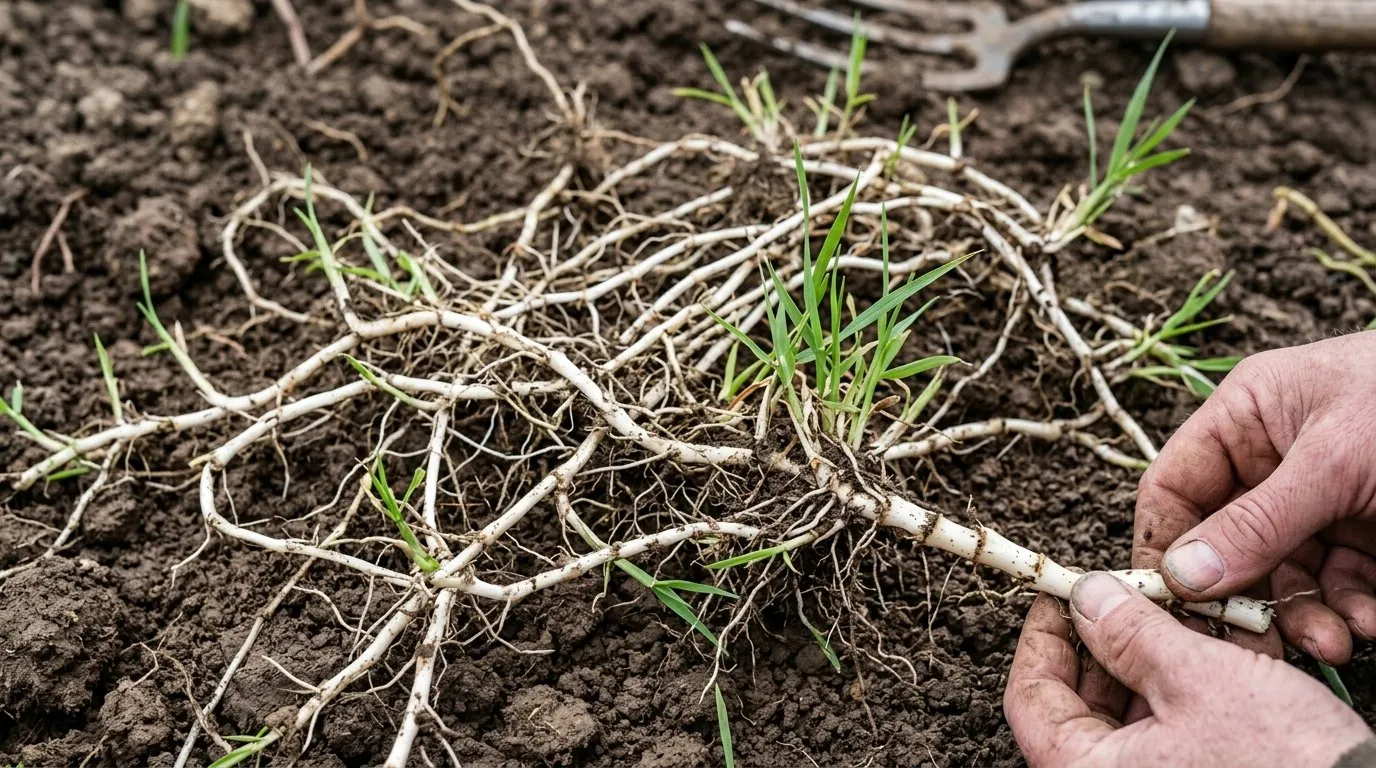 Couch grass rhizomes regrow from any fragment. Use a fork (never a spade), lift sections intact, and pick out every wiry root. Sieve the soil afterwards. Burn the rhizomes - home compost is rarely hot enough to kill them.
Method 3: Strim and smother (for very overgrown plots)
If your plot is so overgrown you cannot see the boundaries, start with brute force.
Hire a brushcutter for a day. A petrol strimmer with a steel blade flattens 6-foot brambles, head-high willowherb, and small saplings. £30-40 from a tool hire shop. Wear ear defenders, eye protection, and steel-toed boots. Work systematically across the plot in 1m strips.
Rake the cuttings into piles. Fresh bramble canes are useful for pea sticks once dry. Nettle stems make good liquid feed. Everything else goes on the burn pile or into a compost heap (annuals only; perennial roots burn).
Cover the cleared ground with cardboard immediately. Within 2-3 days of strimming, perennial weeds put up new shoots. Cardboard goes on before they get established.
Decide on your year-one plot. Choose your most accessible 5m x 5m section near the path. Pull the cardboard back and start hand-clearing.
This combination of strim-then-cardboard-then-hand-clear is the fastest way through a truly bad plot. You can be planting potatoes within 4 weeks of getting the keys.
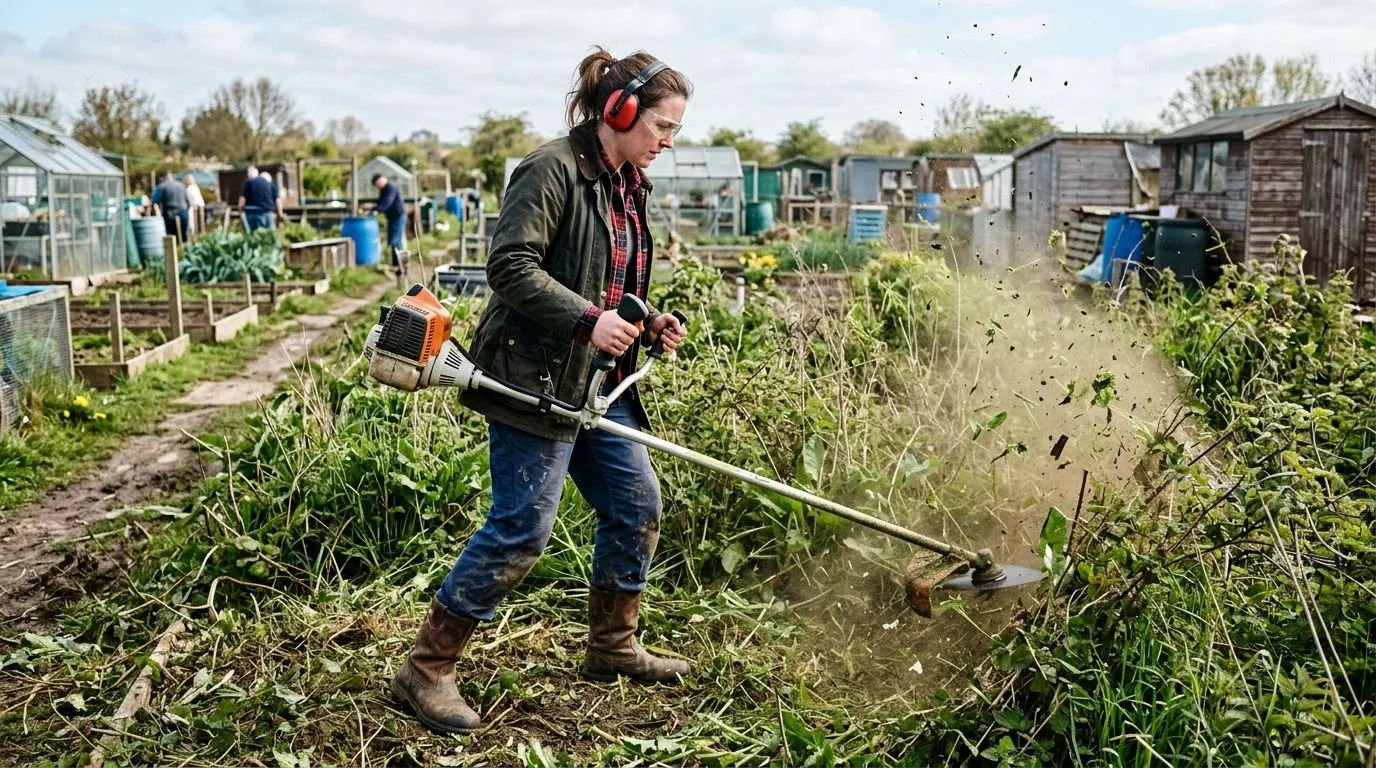 A petrol strimmer with a steel brushcutter blade clears chest-high growth in an hour. Hire one for £30 a day. Wear ear defenders, eye protection, and steel-toed boots - this is the most dangerous tool you will use on the plot.
Dealing with specific weeds
Some weeds need particular attention. Here is what works for the worst offenders.
Brambles (Rubus fruticosus). Cut canes to ground level, dig out crowns, burn the lot. New shoots from any roots left will be soft and easy to cut. Repeat for 2-3 seasons. Brambles indicate fertile soil - your reward for clearing them is a productive bed.
Couch grass (Elymus repens). Fork-and-pick is the only reliable method. Sieve the soil if you can. Mulching weakens couch but rarely kills it - the rhizomes can lie dormant for years and regrow when light returns. After clearing, plant a thick green manure (rye, mustard) to crowd out any survivors.
Bindweed (Calystegia sepium). White roots run 3-5 metres deep and snap into many fragments, each capable of regrowth. Accept you cannot eliminate it. Cut top growth weekly during the growing season for 3-5 years to weaken the root system. Bindweed weakens but never disappears on most plots. Many UK allotment holders learn to coexist with it.
Mare’s tail (Equisetum arvense). A prehistoric plant - 350 million years old. Roots reach 2 metres down. No mechanical control eradicates it. Cut top growth weekly to exhaust the rhizomes over 3-5 years. Improve drainage (mare’s tail prefers wet, compacted soil). Glyphosate works but is banned on most UK allotment sites. Mare’s tail will outlast you.
Nettles (Urtica dioica). Easy. Cut tops, fork out the yellow root mass, compost or use as liquid fertiliser. The leaves make decent soup. Nettles indicate high-nitrogen, fertile soil - perfect for vegetables once cleared. Often gone after one good clearing.
Docks (Rumex obtusifolius). Long single taproot. Dig with a fork going straight down, lever back, pull the whole root out. Any fragment left regrows. Compost the leaves, burn the roots.
Annual weeds (chickweed, groundsel, fat hen, hairy bittercress). Hoe weekly during the growing season. Most cannot survive being cut at the base. The seeds in the soil will keep germinating for 5-7 years - regular hoeing exhausts the seed bank. Never let an annual weed flower; one plant produces 50,000+ seeds.
External resource: the Royal Horticultural Society’s perennial weeds guide covers identification and organic control for every weed mentioned here.
What to burn, compost, or bin
Not all weeds belong on the compost heap. Sorting them now saves problems later.
Burn (perennial weed roots and seeded annuals):
- Bramble canes and crowns
- Couch grass rhizomes (unless hot composting at 60°C+)
- Bindweed roots
- Mare’s tail stems and roots
- Dock and dandelion roots
- Any weed that has gone to seed (the seeds survive cool composting)
- Diseased plant material (blight, club root, rust)
Compost (annual weeds, leaves, soft growth):
- Nettle leaves and stems (excellent compost activator)
- Chickweed, groundsel, fat hen (before they flower)
- Soft prunings
- Grass clippings (in moderation)
- Bramble leaves stripped from canes
- Vegetable kitchen scraps
Bin or take to council green waste:
- Anything you cannot identify
- Plant material covered in synthetic netting
- Anything mixed with rubble or non-organic debris
Year-one growing plan for a freshly cleared plot
Once you have your first 25 square metres cleared, here is what to plant. These are the crops that succeed in disturbed allotment soil with minimum experience.
| Crop | Plant when | Why it works on a new plot |
|---|---|---|
| First early potatoes | March-April | Roots break up compacted soil; foliage suppresses weeds |
| Courgettes | May (transplant) | Big leaves shade out weeds; prolific from one plant |
| Runner beans | May | Fix nitrogen; vertical growing saves space |
| Cut-and-come-again salad | March-September | Fast harvest builds confidence |
| Squash and pumpkins | May-June | Sprawling foliage suppresses weeds; big harvest in autumn |
| Beetroot | April-July | Tolerant of imperfect soil; leaves are edible too |
Avoid in year one: cauliflower (fussy), parsnips (need fine seedbed), carrots (forking on stones), celery (heavy feeders), asparagus (3-year wait).
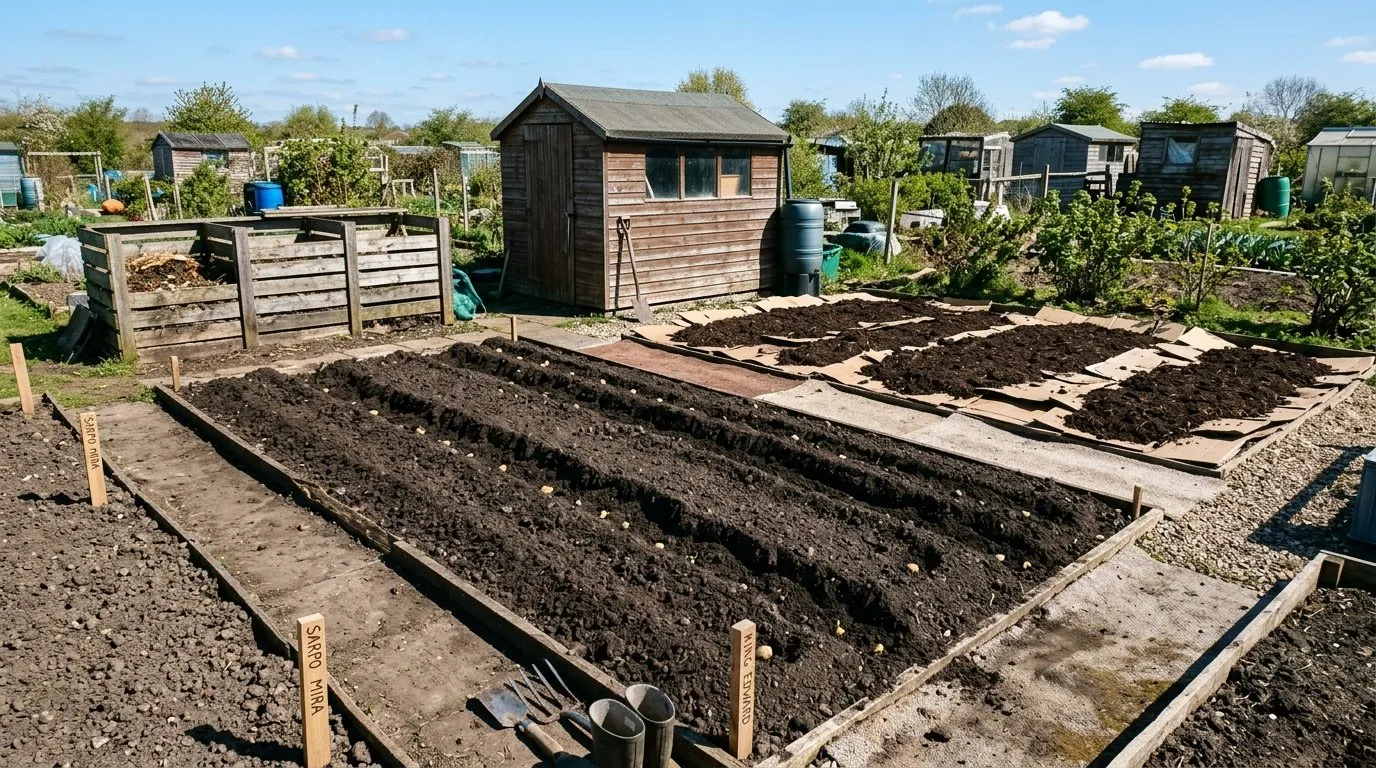 Year-one success. Clear a quarter, plant potatoes and courgettes, mulch the rest with cardboard and compost. By the end of summer the cleared section produces a harvest and the mulched ground is soft enough to expand into for year two.
What about renting a digger or rotavator?
Tempting, but usually wrong. Here is why.
Rotavators chop perennial roots into fragments. Every fragment regrows. A rotavator on a couch-grass plot turns one weed into a thousand. Allotment veterans tell horror stories of plots that took 5 years to recover from a single rotavator pass.
Mini-diggers compact the subsoil. A digger on wet clay leaves a compacted layer that takes years to break down. Worse on small plots than digging by hand.
Hire makes economic sense only for plots over 250 sq m of bare cleared ground. If you are clearing 25 sq m for year one and mulching the rest, hand tools are faster and cheaper.
The exception: if you have inherited bare, weed-free soil that just needs breaking up (rare, but it happens), a single light rotavator pass before planting potatoes can save a weekend of digging. Otherwise, stick with the fork.
When to ask for help
Allotment communities are generous if you ask early. Common offers from neighbouring plot holders include:
- Loan of tools (especially strimmers, sieves, wheelbarrows)
- Help with brambles in exchange for a future favour
- Free seedlings when their successions overproduce
- Compost from their heap if they have surplus
- Identification of weeds and pests
Most allotment sites also have working parties or open days where members help clear plots together. Joining one in your first month builds connections faster than anything else.
If your plot has been abandoned for over 5 years, the council may have a clearance grant or volunteer team available. Ask the allotments officer. Some councils contribute £100-300 toward initial clearance for new tenants taking on neglected plots.
What to expect by season
Clearing a plot is not a finite job - it is the foundation of long-term plot management. Expect this rough timeline:
- Month 1: Strim, cardboard 75%, hand-clear 25%. Plant potatoes, courgettes, runner beans.
- Month 2-3: Weed regrowth starts. Hoe weekly on cleared sections. Top up cardboard where weeds push through.
- Month 4-5: First harvest. Mulched ground softens.
- Month 6: Cardboard fully decomposed in mulched sections. Light hand-clearing reveals soil ready for autumn planting.
- Year 2: Plant the previously mulched ground directly into compost. Continue mulching new areas as you expand.
- Year 3: Fully cultivated plot; ongoing seasonal weeding takes 2 hours per week.
The plots that succeed long-term are the ones where the new tenant cleared sustainably and built soil for the future. The plots that fail are the ones where someone tried to do everything in year one, exhausted themselves, and gave up.
Get your plot cleared, planted, and producing. The rest comes naturally.
Related articles
Our team produces practical UK gardening guidance from source research, contributor records and established horticultural practice. Editorial standards are overseen by Matt W.