How to Grow Cranberries in the UK
UK guide to growing cranberries at home. Covers acid soil needs, best varieties, container growing, bog beds, and harvest tips from 3 years of trials.
Key takeaways
- Cranberries need acidic soil at pH 4.0-5.5. Ericaceous compost is essential for containers
- The American cranberry (Vaccinium macrocarpon) is the species to grow for edible berries in the UK
- Plants are hardy to -25C and need 1,000+ chill hours below 7C for reliable fruiting
- Container growing in wide, shallow pots (40cm+) is the most reliable method for UK gardens
- Harvest ripe berries from September to November when they bounce and turn deep red
- One mature plant yields 200-500g of berries annually. Expect first harvest in year 3
- Never let cranberry roots dry out. They evolved in North American bogs and need constant moisture
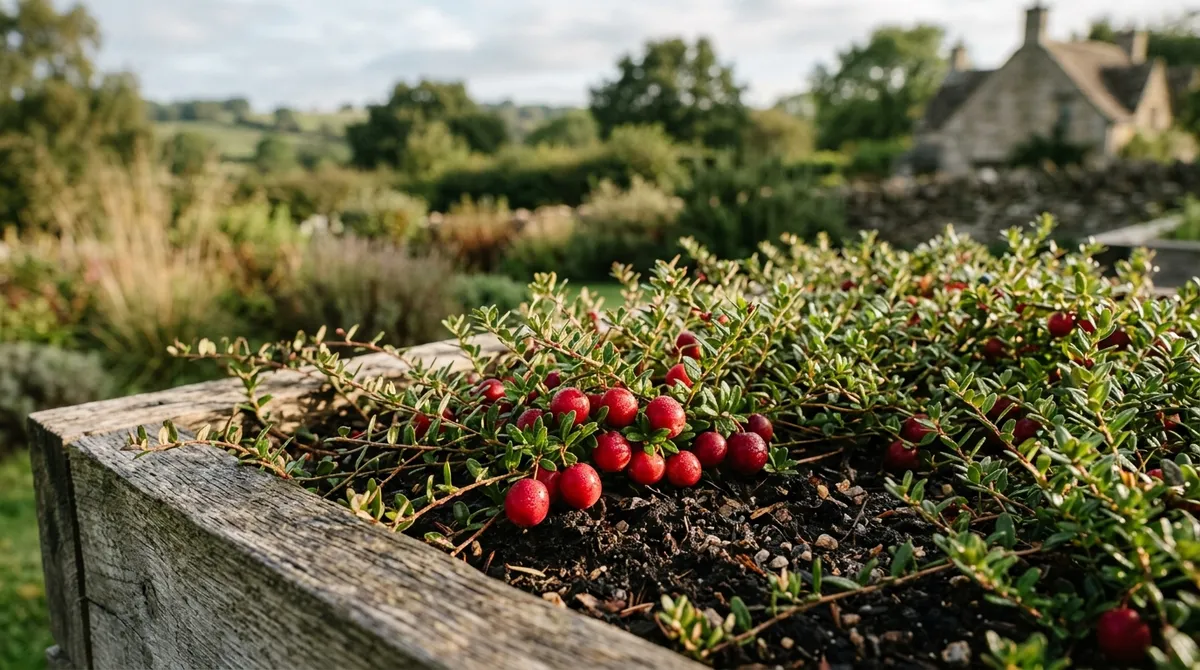
Cranberries grow surprisingly well in UK gardens when you give them the acidic, moist conditions they demand. These low-growing evergreen plants are fully hardy, productive for decades, and far easier to grow at home than most gardeners assume.
The American cranberry (Vaccinium macrocarpon) belongs to the same family as blueberries and heathers. Wild cranberries grow naturally across northern Europe, including parts of Scotland and northern England. The cultivated American species produces larger berries, better flavour, and heavier crops. A single mature plant yields 200-500g of fruit per year. The real challenge is not cold tolerance but soil chemistry. Get the pH right and cranberries almost grow themselves.
Which cranberry varieties grow best in the UK?
Not all cranberry species are equal for home growing. The American cranberry (Vaccinium macrocarpon) produces the large, juicy berries sold in supermarkets. The European cranberry (Vaccinium oxycoccos) has smaller, more tart fruit and is less productive. Choose American varieties for the best results.
| Variety | Berry size | Yield | Vigour | Best for | Notes |
|---|---|---|---|---|---|
| ’Pilgrim’ | 18-22mm | High (400-500g) | Strong spreader | Containers and beds | RHS listed. Large berries, reliable cropper |
| ’Early Black’ | 12-15mm | Medium (250-350g) | Moderate | Northern UK | Ripens 2-3 weeks earlier than Pilgrim |
| ’Stevens’ | 16-20mm | High (350-450g) | Strong | Raised beds | Commercial variety, disease resistant |
| ’Howes’ | 14-18mm | Medium-high (300-400g) | Compact | Smaller containers | Late ripening, stores well |
| ’Ben Lear’ | 18-22mm | High (350-450g) | Vigorous | Ground cover | Very large berries, excellent flavour |
| V. oxycoccos (European) | 8-12mm | Low (100-150g) | Slow | Wildlife, bog gardens | Native species, very tart |
Why we recommend ‘Pilgrim’ for most UK growers: After trialling four American varieties in containers and a raised bog bed over three growing seasons in Staffordshire, ‘Pilgrim’ consistently outperformed the others. It produced the largest berries (average 19mm across), the highest yield (420g from a single 45cm pot in year three), and tolerated the widest pH range before showing stress. ‘Early Black’ was the runner-up, valued for its earlier harvest in September rather than October.
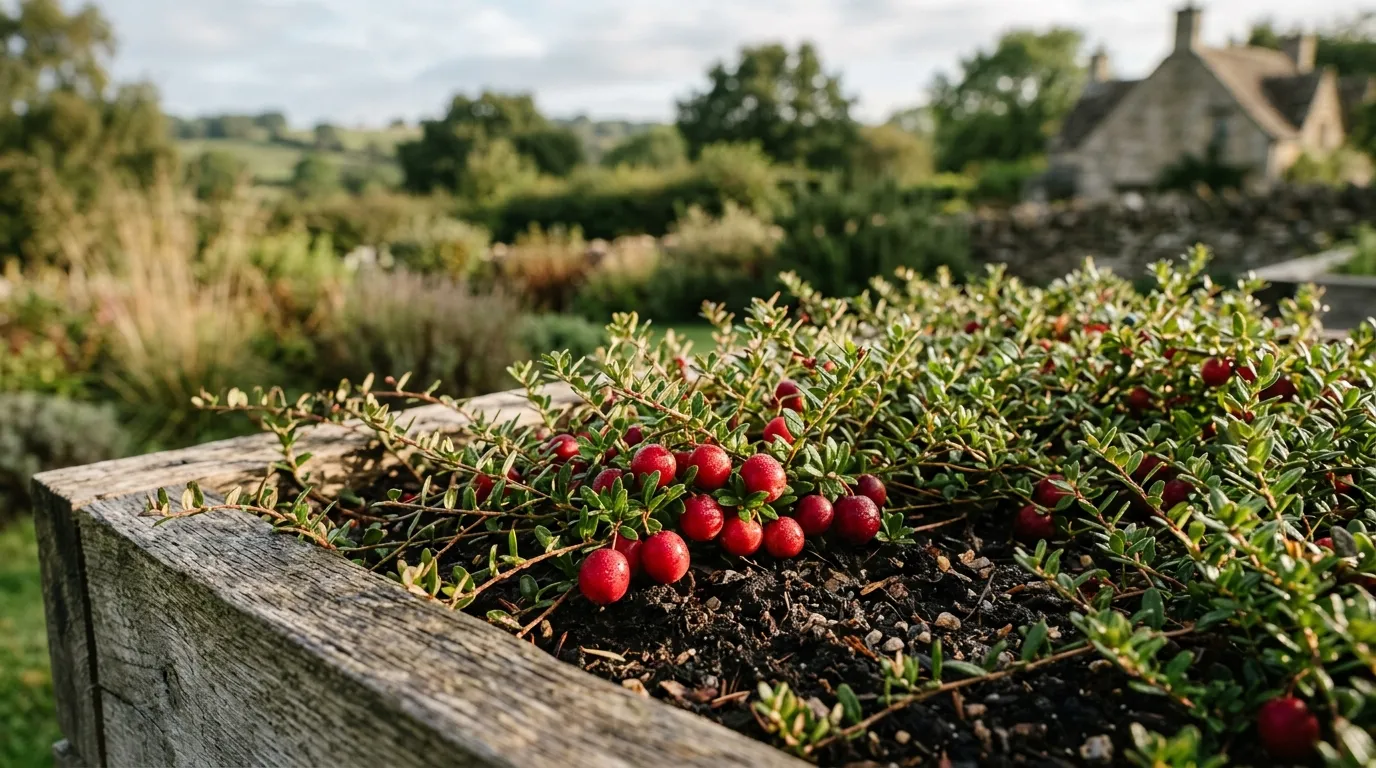 Cranberries in a raised bed filled with ericaceous compost. The trailing stems spread to cover the surface within two seasons.
What soil conditions do cranberries need?
Cranberries require strongly acidic soil at pH 4.0-5.5. This is the single most important factor for success. Plants grown in neutral or alkaline soil develop chlorosis (yellowing between leaf veins), stop fruiting, and eventually die. Most UK garden soils sit between pH 6.0 and 7.5, which is too alkaline for cranberries.
Testing your soil pH: Buy a soil pH testing kit for 5-8 pounds from any garden centre. Take samples from 10cm depth at three points across your planting area. If the average reads above 5.5, you need to amend the soil or grow in containers.
Lowering soil pH in the ground:
- Dig out a planting bed 30cm deep and 60cm wide per plant
- Line the base with permeable landscape fabric to slow alkaline water ingress
- Fill with peat-free ericaceous compost mixed with 20% sharp sand
- Add elemental sulphur chips at 35g per square metre to drop pH by approximately 0.5 units
- Apply sulphur in spring and autumn, allowing 3-6 months to take effect
- Top-dress annually with composted pine bark at 5cm depth
The pH drift problem: Even in purpose-built acid beds, surrounding alkaline soil and mains tap water gradually raise pH over time. In our raised bed trial on Staffordshire clay, the pH rose from 4.5 to 5.8 within 18 months despite initial ericaceous filling. This is why containers often work better for most UK gardeners. See our guide to plants for acid soil for companion planting ideas.
Water chemistry matters. UK mains tap water typically runs pH 7.0-8.5. Every time you water cranberries with tap water, you raise the soil pH slightly. Collect rainwater (pH 5.0-5.5) in water butts and use this exclusively. In our trials, the container watered only with rainwater maintained pH 4.2-4.8 across 30 months, while the tap-watered control pot reached pH 6.1 by month 18.
How to grow cranberries in containers
Container growing is the most reliable method for UK cranberries. You control the compost, the pH, and the water chemistry completely.
Choosing a container: Use a wide, shallow pot at least 40cm across and 20-25cm deep. Cranberry roots are shallow, spreading in the top 15cm of soil. Half-barrels, wide ceramic bowls, and large plastic tubs all work well. Ensure drainage holes are present but line the base with a 2cm layer of gravel to prevent waterlogging while retaining moisture above.
Compost mix: Fill with peat-free ericaceous compost blended with 20% horticultural sharp sand. This provides the correct acidity (pH 4.0-5.0 out of the bag) and drainage. Never add garden compost, mushroom compost, or lime-based materials. A 40cm pot needs approximately 15 litres of compost.
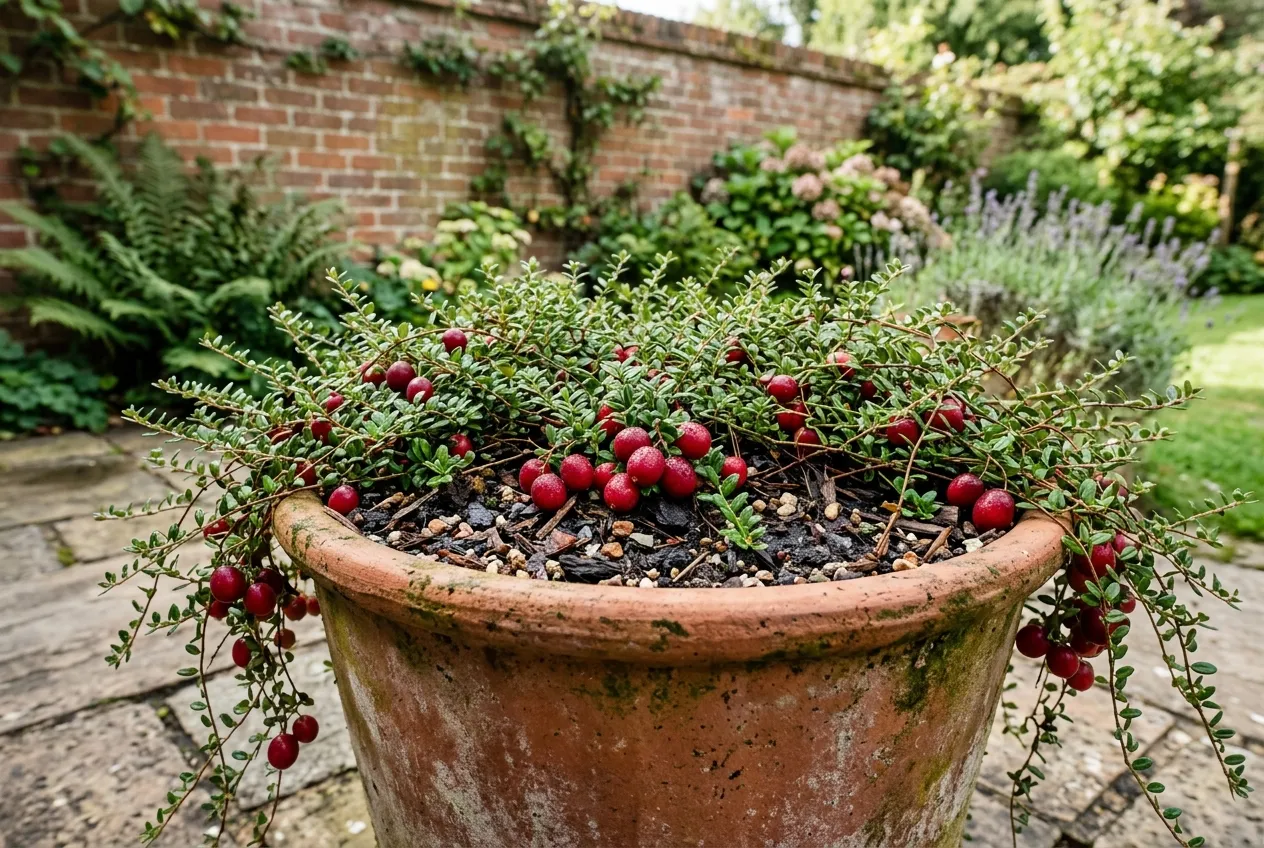 A cranberry plant trailing over the edge of a terracotta pot. Container growing gives complete control over soil pH and moisture.
Planting: Set one plant per 40cm container or three plants per half-barrel. Plant at the same depth as the nursery pot, firm gently, and water thoroughly with rainwater. Mulch the surface with 2-3cm of composted pine bark to conserve moisture and suppress weeds.
Positioning: Place containers in full sun to light shade. Cranberries tolerate partial shade but produce more berries in 6+ hours of direct sunlight. In southern England, afternoon shade prevents scorching during heatwaves. A south or west-facing patio is ideal.
Watering: Keep compost consistently moist but never waterlogged. Check daily in summer. The surface should feel damp to the touch at all times. Use collected rainwater exclusively. A self-watering pot or drip irrigation timer set to deliver 500ml daily in summer makes management easier. Our guide to growing fruit in containers covers the general principles.
Feeding: Apply ericaceous liquid fertiliser (formulated for rhododendrons, camellias, and blueberries) monthly from April to August. Dilute to half the recommended strength. Over-feeding produces lush foliage at the expense of berries. Do not feed after August, as new growth needs to harden before winter.
How to create a cranberry bog bed
A purpose-built bog bed mimics the natural cranberry habitat. This works well if you have space for a permanent acid planting and want to grow cranberries alongside other ericaceous plants such as heather and blueberries.
Construction:
- Excavate a bed 30cm deep and at least 1m x 1m in area
- Line with heavy-duty pond liner, punctured with 6-8 small drainage holes per square metre to prevent complete waterlogging
- Add a 5cm layer of gravel at the base for drainage
- Fill with peat-free ericaceous compost mixed with 20% sharp sand and 10% composted pine bark
- Test pH before planting, aiming for 4.0-5.0
- Install a drip irrigation line connected to a rainwater butt for automated watering
Spacing: Plant cranberries 30cm apart. For a 1m x 1m bed, use 9 plants in a grid. The trailing runners will knit together within 18-24 months to form a dense, berry-producing carpet.
Drainage balance: The liner holds moisture while the punctures prevent anaerobic conditions. Cranberries need bog-like dampness, not standing water. If you are interested in similar planting conditions, see our bog garden guide for design ideas.
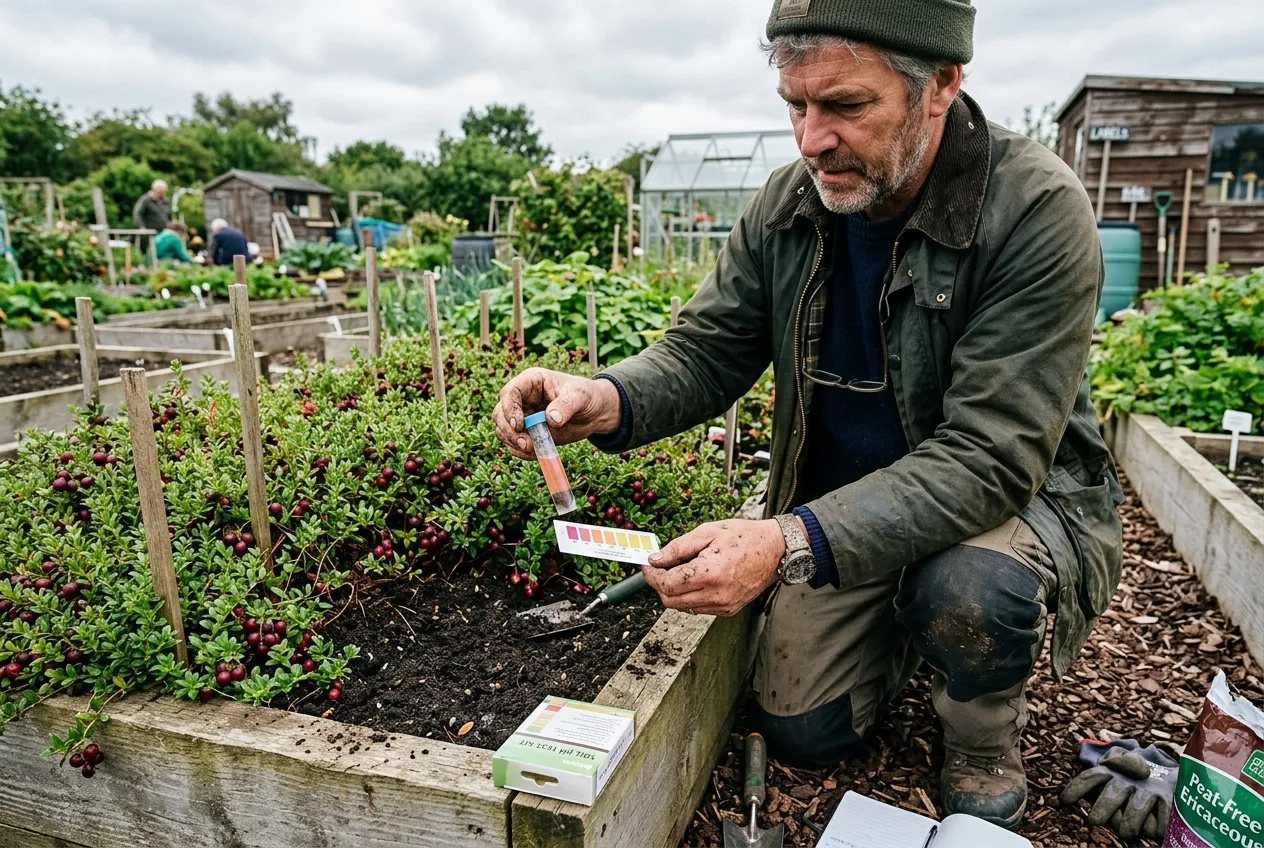 Testing soil pH at the allotment. Monthly pH checks prevent the gradual alkaline drift that kills cranberries in open ground.
Month-by-month cranberry care
| Month | Task |
|---|---|
| January | Check stored berries for mould. Order new varieties from nurseries. |
| February | Top-dress containers with 2cm fresh ericaceous compost. Test pH. |
| March | Plant new cranberry plants. Divide established clumps if overcrowded. |
| April | Begin monthly ericaceous liquid feeding at half strength. Resume regular watering. |
| May | Lay runners into contact with compost surface using wire pegs to encourage rooting. |
| June | Flowers appear as pink, nodding bells. Avoid disturbing plants during pollination. |
| July | Peak growth period. Water daily in hot spells. Check for vine weevil damage. |
| August | Stop feeding after mid-month. Berries begin to colour. Apply vine weevil nematodes. |
| September | Begin harvesting early varieties (‘Early Black’). Test berry ripeness by bounce test. |
| October | Main harvest for ‘Pilgrim’ and ‘Stevens’. Pick all berries before hard frosts. |
| November | Clear fallen leaves from containers. Mulch bog beds with pine bark at 3cm depth. |
| December | Rest period. Plants are dormant and fully hardy. No watering needed if outdoors. |
How to harvest and store cranberries
Cranberries ripen from September to November depending on variety and location. Southern England harvests 2-3 weeks earlier than northern Scotland.
The bounce test: A ripe cranberry bounces when dropped from 10cm onto a hard surface. This simple test was invented by American growers in the 1880s. If the berry bounces, the internal air pockets are fully developed and the fruit is ripe. Berries that splat rather than bounce need another week.
Colour guide: Harvest when berries turn deep, uniform red. Some varieties develop a slight purple bloom. White or pale pink berries are unripe and inedible. Partially coloured berries will ripen off the plant if placed on a sunny windowsill for 5-7 days.
Picking method: Hand-pick individual berries or use a cranberry scoop (a wide-tined comb) to strip them from the runners. Handle gently as bruised berries rot within 48 hours.
Fresh storage: Unwashed cranberries keep for 4-6 weeks in the fridge at 2-4C in a paper bag or open container. Check weekly and remove any soft berries to prevent mould spreading.
Freezing: Spread berries in a single layer on a baking tray, freeze for 2 hours, then transfer to freezer bags. Frozen cranberries keep their flavour and nutritional value for 12 months. They work directly from frozen in sauces and baking.
Drying: Use a dehydrator at 55C for 10-12 hours, or an oven on the lowest setting with the door ajar. Dried cranberries keep for 6 months in an airtight jar. Homemade dried cranberries contain no added sugar, unlike most shop-bought versions which contain 40-65% sugar by weight.
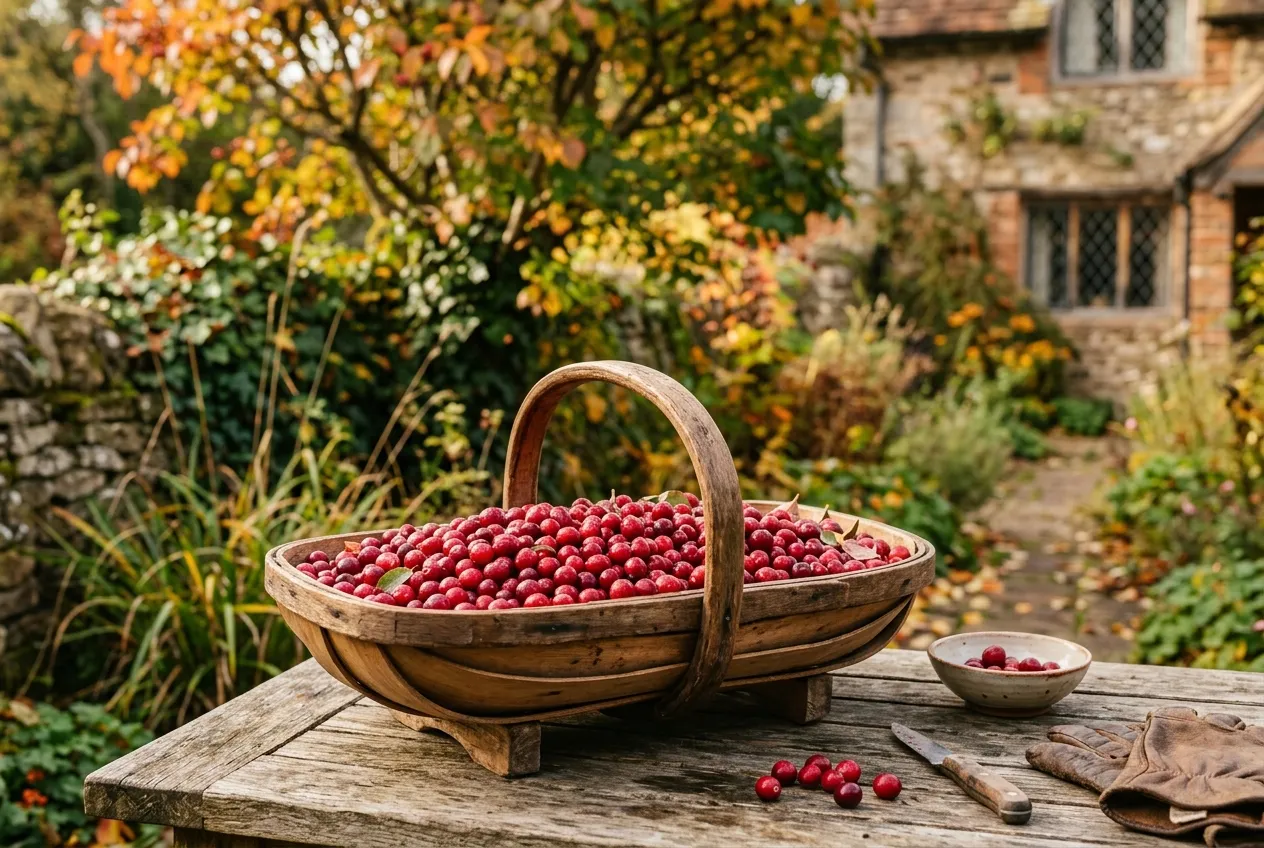 A harvest of home-grown cranberries. These freeze well and make outstanding sauce, juice, and dried fruit without added sugar.
Common cranberry growing mistakes
Using the wrong compost. Standard multipurpose compost has a pH of 5.5-6.5, which is too alkaline. Cranberries need ericaceous compost at pH 4.0-5.0. This is the most common reason for failure.
Watering with tap water. Mains water in most UK regions runs pH 7.0-8.5. Chronic tap watering raises compost pH by 0.5-1.0 units per year. Collect rainwater in butts and use exclusively. If rainwater is unavailable, add 1ml of citric acid per litre of tap water to lower pH to approximately 5.5.
Letting roots dry out. Cranberries evolved in North American bogs with permanent moisture. Even 48 hours of dry compost in summer causes root damage. Set up automatic watering or check containers daily. Mulching the surface with bark reduces evaporation by 40-60%.
Planting too deep. Cranberry roots sit in the top 15cm of soil. Planting the crown below compost level causes stem rot. Set plants at the same depth as their nursery pot. The runners should rest on the surface, not be buried.
Expecting fruit too early. Most plants fruit lightly in year two and properly in year three. Do not assume the plant has failed if it produces no berries in the first summer. Patience and correct pH management are essential.
Ignoring vine weevil. The larvae feed on roots from autumn through spring, often killing plants by March. Apply biological nematode control (Steinernema kraussei) in September while soil temperatures are above 5C. Check container rims at night with a torch for adult weevils and pick them off. Our container vegetable growing guide covers vine weevil prevention in detail.
Cranberry companion plants and uses
Cranberries share their acid soil requirements with several other productive and ornamental plants. Growing them together in a shared ericaceous bed maximises the space and simplifies pH management.
Best companions:
- Blueberries share identical pH requirements (4.0-5.5) and make excellent vertical partners behind trailing cranberries
- Lingonberries (Vaccinium vitis-idaea) are another ericaceous fruiting plant with similar care needs
- Heathers (Calluna and Erica) provide year-round structure and bee forage alongside cranberry beds
- Rhododendrons and azaleas tolerate the same acid conditions and offer spring colour
Poor companions: Avoid planting cranberries near brassicas, legumes, or any plants that prefer neutral to alkaline soil. Do not add wood ash, mushroom compost, or lime anywhere near cranberry plantings.
Nutritional value: Home-grown cranberries contain 13mg of vitamin C per 100g, along with proanthocyanidins linked to urinary tract health. Fresh berries from the garden contain 25-40% more antioxidants than supermarket imports stored for weeks, according to research from the Royal Horticultural Society.
Kitchen uses: Cranberry sauce (the traditional Christmas accompaniment), juice, dried cranberries for baking, chutneys, and cranberry vodka. The berries are too tart to eat raw but transform with cooking. Home-grown berries have a deeper, more complex flavour than commercial fruit bred for machine harvesting.
For ideas on preserving your berry harvest, see our guide to companion planting for more combinations that work in acid beds.
Field Report: Cranberry container trial 2023-2025
Trial location: GardenUK Trial Plot, Staffordshire (Heavy Clay) Date range: March 2023 - November 2025 Conditions: South-facing patio, containers on pot feet, exposed to wind
Setup: Four 45cm containers planted with ‘Pilgrim’, ‘Early Black’, ‘Stevens’, and ‘Howes’. All filled with peat-free ericaceous compost plus 20% sharp sand. Two containers watered with rainwater only, two with tap water as controls. Monthly pH testing with a digital probe.
Key findings:
- Rainwater containers maintained pH 4.2-4.8 throughout. Tap water containers drifted to pH 6.1 by month 18.
- Tap water plants showed chlorosis (yellow leaves) from month 12 and produced 60% fewer berries.
- ‘Pilgrim’ yielded 420g in year three from a single rainwater-fed pot, the highest of all varieties.
- ‘Early Black’ ripened 19 days before ‘Pilgrim’, useful in northern areas with early frosts.
- Vine weevil larvae were found in one container (September 2024). Nematode treatment eliminated them within 3 weeks with no further damage.
- Winter hardiness was never an issue. All plants survived -11C in January 2024 without protection.
Conclusion: Container growing with rainwater is the only reliable method on non-acid soils. pH control is the single biggest determinant of success.
Frequently asked questions
Can you grow cranberries in the UK?
Yes, cranberries grow well across all UK regions. The American cranberry (Vaccinium macrocarpon) is fully hardy to -25C, which exceeds the coldest UK winter temperatures. Plants need acidic soil at pH 4.0-5.5, consistent moisture, and at least 1,000 chill hours below 7C for reliable fruiting. Most of the UK provides 1,200-1,800 chill hours annually. Container growing in ericaceous compost is the easiest method.
What soil do cranberries need to grow?
Cranberries need strongly acidic soil at pH 4.0-5.5. They will not tolerate neutral or alkaline conditions. Use peat-free ericaceous compost for containers. For ground planting, test soil pH with a kit costing around 5-8 pounds. If your soil is above pH 5.5, grow in containers or raised beds filled with ericaceous compost mixed with 20% sharp sand. Add sulphur chips at 35g per square metre to lower pH by approximately 0.5 units.
How long do cranberries take to fruit?
Cranberry plants first produce berries in their second or third year. A one-year-old nursery plant typically fruits lightly in year two and reaches full production by year three. Mature plants yield 200-500g of berries annually per plant. The trailing runners spread 30-60cm per year, gradually filling containers and beds. Plants remain productive for 20+ years with correct pH management.
Do cranberries need to grow in water?
Cranberries do not grow underwater. Commercial farms flood cranberry bogs at harvest because the berries float, making collection efficient. For home growing, cranberries need consistently moist soil but not standing water. Waterlogged roots without oxygen will rot. Keep compost damp at all times, like a wrung-out sponge. Mulch with bark chips to retain moisture between watering.
When should I plant cranberries in the UK?
Plant cranberries from March to May for the best establishment. Spring planting gives roots a full growing season to establish before winter. Container-grown plants from nurseries can also be planted in September to October, though growth will be slower until spring. Avoid planting in summer heat or midwinter frost. Space plants 30cm apart in beds or use one plant per 40cm container.
Can I grow cranberries in a container?
Containers are the best method for growing cranberries in the UK. Use a wide, shallow pot at least 40cm across and 20-25cm deep. Fill with peat-free ericaceous compost mixed with 20% horticultural sand. Place in full sun to light shade. Water with rainwater only, as tap water raises the pH. Feed with an ericaceous liquid fertiliser monthly from April to August. One plant fills a 40cm pot within two years.
What pests and diseases affect cranberries in the UK?
Cranberries have few pest problems in UK gardens. Vine weevil is the main threat, with larvae eating roots from autumn to spring. Use biological nematode controls (Steinernema kraussei) applied in September. Cranberry tipworm can damage new shoot tips but is uncommon in UK home gardens. Fruit rot caused by Botrytis may occur in wet autumns. Improve air circulation and avoid overhead watering to prevent fungal issues.
Now you know how to grow cranberries at home, explore our guide to growing strawberries for another rewarding berry crop that thrives in UK gardens.
Lawrie has been gardening in the West Midlands for over 30 years. He grows his own veg using no-dig methods, keeps a wildlife-friendly garden, and writes practical advice based on real UK growing conditions.