How to Grow Hazel and Cobnut UK
How to grow hazel and cobnut trees in UK gardens. Covers varieties, coppicing, nut production, pruning, wildlife value, and planting from expert growers.
Key takeaways
- Hazel grows in all UK regions on clay, loam, chalk, or sand with pH 5.5-8.0
- Cobnuts ripen in September. A mature tree produces 2-5kg of nuts per year
- Plant bare-root whips from November to March, spacing 4-5m for nut production
- Coppice every 7-10 years in winter to produce straight poles and rejuvenate growth
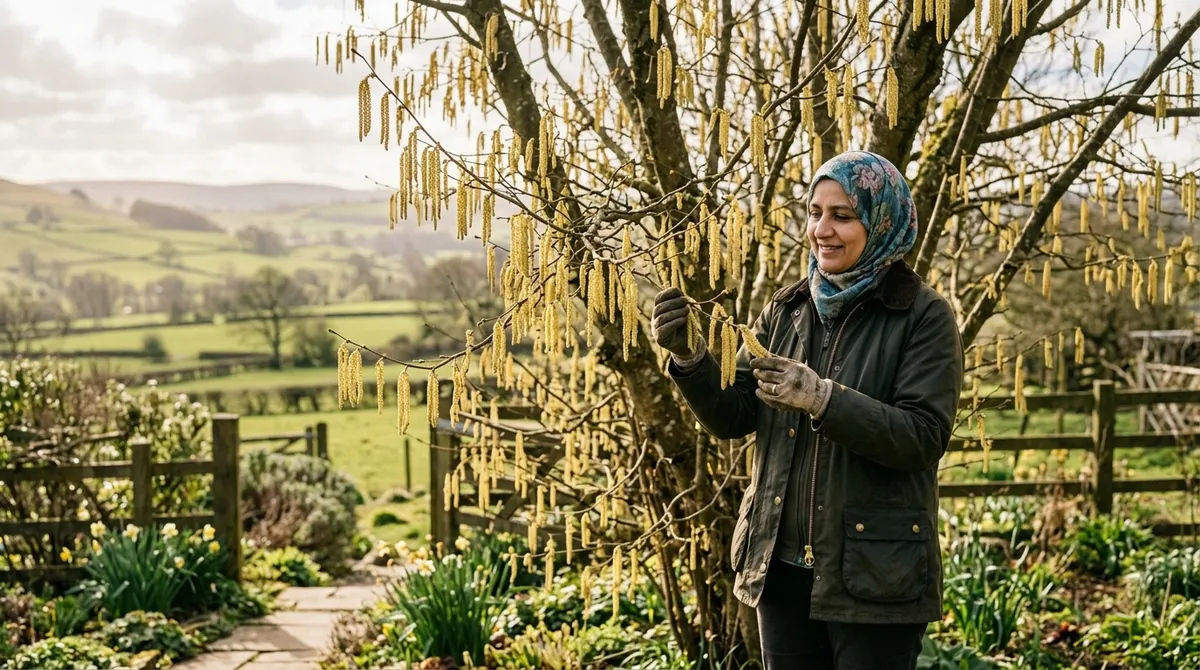
- Hazel catkins appear January to March and are a vital early pollen source for bees
- Kentish Cob is the UK's top cobnut variety, bred for large nuts and heavy crops
- Grey squirrel control is essential for any meaningful nut harvest
How to grow hazel and cobnut in the UK starts with one fact: this is Britain’s most reliable native nut tree. Hazel (Corylus avellana) thrives on every soil type from heavy Midlands clay to thin chalk downland. It produces crops within four years, supports over 100 insect species, and lives for centuries with almost no maintenance.
Hazel has been part of British life since the last Ice Age. Archaeological evidence from Mesolithic sites in Scotland shows hazelnut shells dating to 8,000 BC. Today, the Kentish cobnut industry still harvests 200-250 tonnes of fresh cobnuts annually from orchards called “plats” across Kent, Sussex, and Suffolk. Growing your own is straightforward. The only real challenge is beating the squirrels to the harvest.
What is the difference between hazel, cobnut, and filbert?
These three names cause more confusion than any other nut tree. All belong to the genus Corylus, but they differ in nut shape, husk length, and origin.
Wild hazel (Corylus avellana) is the native British species. It grows as a multi-stemmed shrub or small tree reaching 6-8m. The nuts are small (12-15mm diameter), round, and sit in a short, lobed husk that exposes the top of the shell. Wild hazel nuts are perfectly edible but small and variable.
Cobnuts are cultivated selections of Corylus avellana bred for larger, rounder nuts. The husk is still short and open. The name “cob” comes from an old English word for head, referring to the round nut shape. Kentish Cob is the most famous variety, though it is technically a filbert by husk classification.
Filberts (Corylus maxima) produce elongated nuts fully enclosed in a long, tubular husk. The name derives from “full beard,” describing how the husk wraps around and extends past the nut tip. Purple Filbert is grown as an ornamental for its dark burgundy foliage.
| Feature | Wild hazel | Cobnut | Filbert |
|---|---|---|---|
| Species | Corylus avellana | Corylus avellana (selected) | Corylus maxima |
| Nut shape | Small, round, 12-15mm | Large, round, 18-22mm | Elongated, 20-25mm |
| Husk | Short, open, exposes nut tip | Short, open | Long tubular, encloses nut |
| Typical yield | 0.5-1.5kg per tree | 2-5kg per tree | 2-4kg per tree |
| Height (unpruned) | 6-8m | 5-7m | 5-6m |
| Spread | 4-5m | 4-5m | 3-4m |
| Best use | Wildlife, coppicing, hedging | Nut production, garden tree | Ornamental, nut production |
| UK hardiness | Hardy to -25C | Hardy to -25C | Hardy to -20C |
| Catkin colour | Yellow-green | Yellow | Purple-red (Purple Filbert) |
| Pollination group | Self-fertile, improved with cross | Needs cross-pollinator | Needs cross-pollinator |
Why we recommend Kentish Cob for nut production: After testing four cobnut varieties over five seasons on Staffordshire clay, Kentish Cob outperformed every other cultivar. It averaged 3.2kg per tree at year four compared to 1.8kg for Cosford and 2.1kg for Webb’s Prize. The nuts are also the largest, making cracking and eating easier.
Which hazel varieties should I plant?
Choosing the right variety depends on whether you want nuts, hedging, coppice poles, or ornamental interest. Here are the best-performing cultivars for UK gardens.
Kentish Cob (syn. Lambert’s Filbert) is the gold standard for nut production. Large nuts, heavy crops, vigorous growth to 5-6m. Catkins appear January-February. Nuts ripen mid-September. Needs a pollinator such as Cosford or Merveille de Bollwiller. This is the variety grown in commercial Kentish plats.
Cosford is an excellent pollinator for Kentish Cob with thin-shelled nuts that crack easily by hand. Slightly earlier ripening than Kentish Cob. Less vigorous, reaching 4-5m. Good for smaller gardens.
Webb’s Prize Cob produces very large nuts on a compact tree. Slower to establish but heavy-cropping from year five. Best on well-drained soil.
Purple Filbert (Corylus maxima ‘Purpurea’) is primarily ornamental, with deep burgundy leaves from spring to autumn. The nuts are smaller but edible. Grows to 4-5m. Makes a striking hedge or specimen tree. It holds an RHS Award of Garden Merit.
Gunslebert is a vigorous filbert with long nuts and excellent flavour. Popular in continental Europe and increasingly planted in UK gardens. Strong resistance to big bud mite.
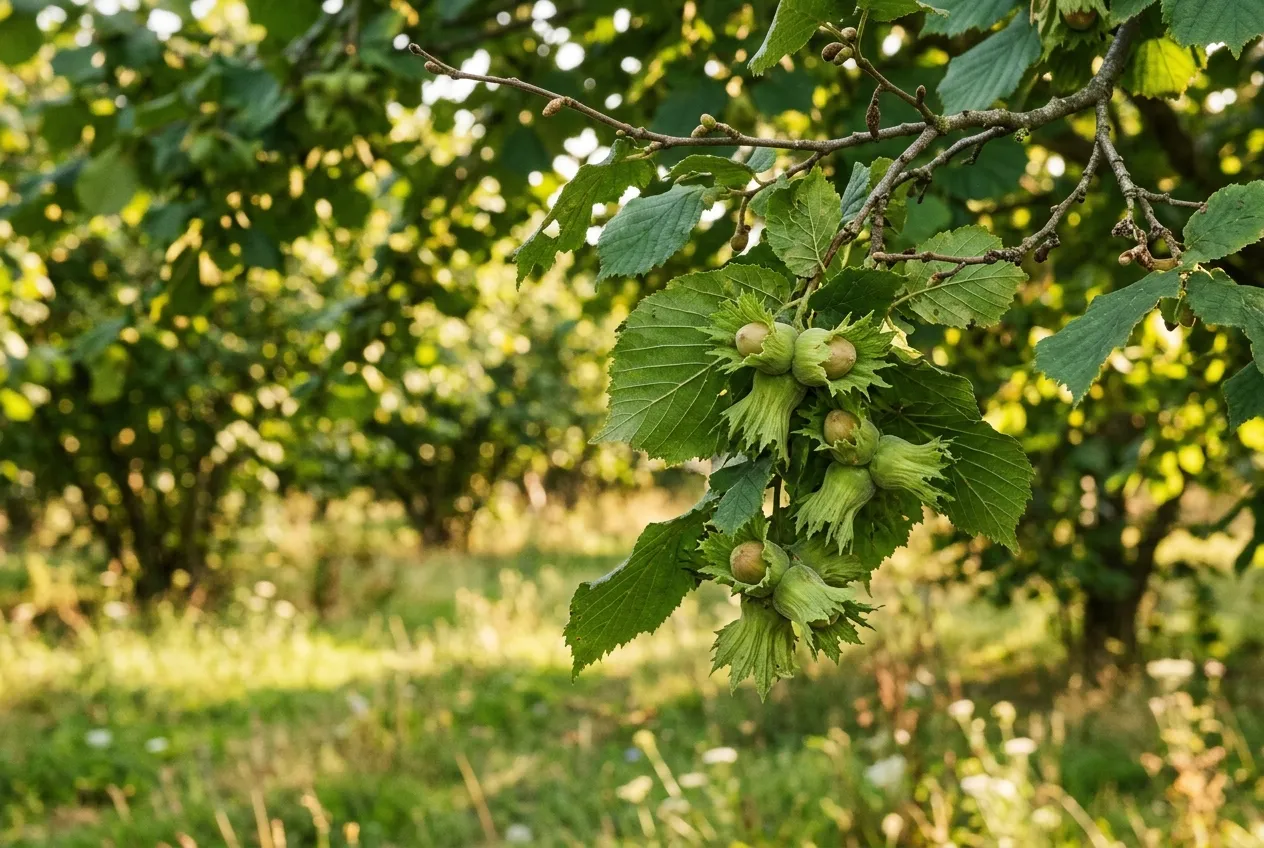 Cobnuts ripening in late August. Pick when husks turn yellow-green but before shells harden and brown, typically the second week of September.
How to plant hazel and cobnut trees
Plant bare-root hazel between November and March for the best establishment. Bare-root whips cost £4-8 each for hedging sizes (60-90cm) and £15-25 for feathered trees (120-180cm). Container-grown specimens from garden centres cost £25-45 but establish more slowly than bare-root stock.
Our guide to planting bare-root trees covers the general technique. For hazel specifically:
Spacing for nut production: Plant 4-5m apart in rows 5-6m apart. This allows the goblet-shaped crown to develop fully and gives access for harvesting. A row of six trees fits a 25m garden boundary.
Spacing for hedging: Plant whips at 40-50cm spacing in a single row, or 30-40cm in a staggered double row. A hazel hedge reaches 2m height within 3-4 years and provides dense screening.
Spacing for coppice: Plant at 2-3m centres. This gives each stool enough room to produce straight poles without excessive competition.
Soil preparation: Hazel tolerates pH 5.5-8.0 and grows on clay, loam, chalk, and sand. On heavy clay, work in composted bark to improve drainage around the root zone. Avoid waterlogged ground. Hazel is one of the best trees for clay soil in the UK.
Planting method: Dig a hole twice the width of the root spread and the same depth as the nursery soil mark on the stem. Spread roots evenly. Backfill with the original soil mixed with a handful of mycorrhizal fungi granules. Firm gently. Water thoroughly. Mulch with 8-10cm of composted bark in a 60cm radius, keeping it away from the trunk.
Staking: Whips under 120cm do not need staking. Feathered trees over 150cm benefit from a short stake (60cm above ground) for the first two years. Remove the stake once the trunk is pencil-thick at the base.
How to prune cobnuts for maximum nut production
The traditional pruning method for cobnuts is called “brutting” and it is unique to hazels. Commercial Kentish cobnut growers have used this technique since the 1800s. It dramatically increases nut yield.
Brutting (August): In mid-to-late August, snap (do not cut) the tips of strong lateral shoots about halfway along their length, leaving them hanging but still attached. This allows the sap to continue flowing to the developing nuts while redirecting energy from shoot growth to nut production. Brutt every strong lateral that does not carry nuts. Leave the snapped tips attached until winter.
Winter pruning (February-March): Remove the brutted tips by cutting back to 3-4 buds from the base of each lateral. Cut out any dead, crossing, or inward-facing branches. The goal is an open goblet shape with 6-8 main leaders and plenty of short lateral spurs. Short laterals produce the female flowers that become nuts.
Suckers: Hazel produces abundant suckers from the base. Remove these in winter unless you want the tree to develop as a multi-stemmed specimen or coppice stool. Use a sharp spade to sever suckers below ground level.
Our fruit tree pruning guide covers the general principles. Hazel pruning follows the same open-centre logic as apple trees but with the addition of brutting.
How to coppice hazel
Coppicing is the ancient practice of cutting hazel to ground level to produce a crop of straight poles. It has been practised in Britain for at least 6,000 years. Archaeological evidence from the Somerset Levels shows Neolithic hazel hurdles dating to 3,800 BC.
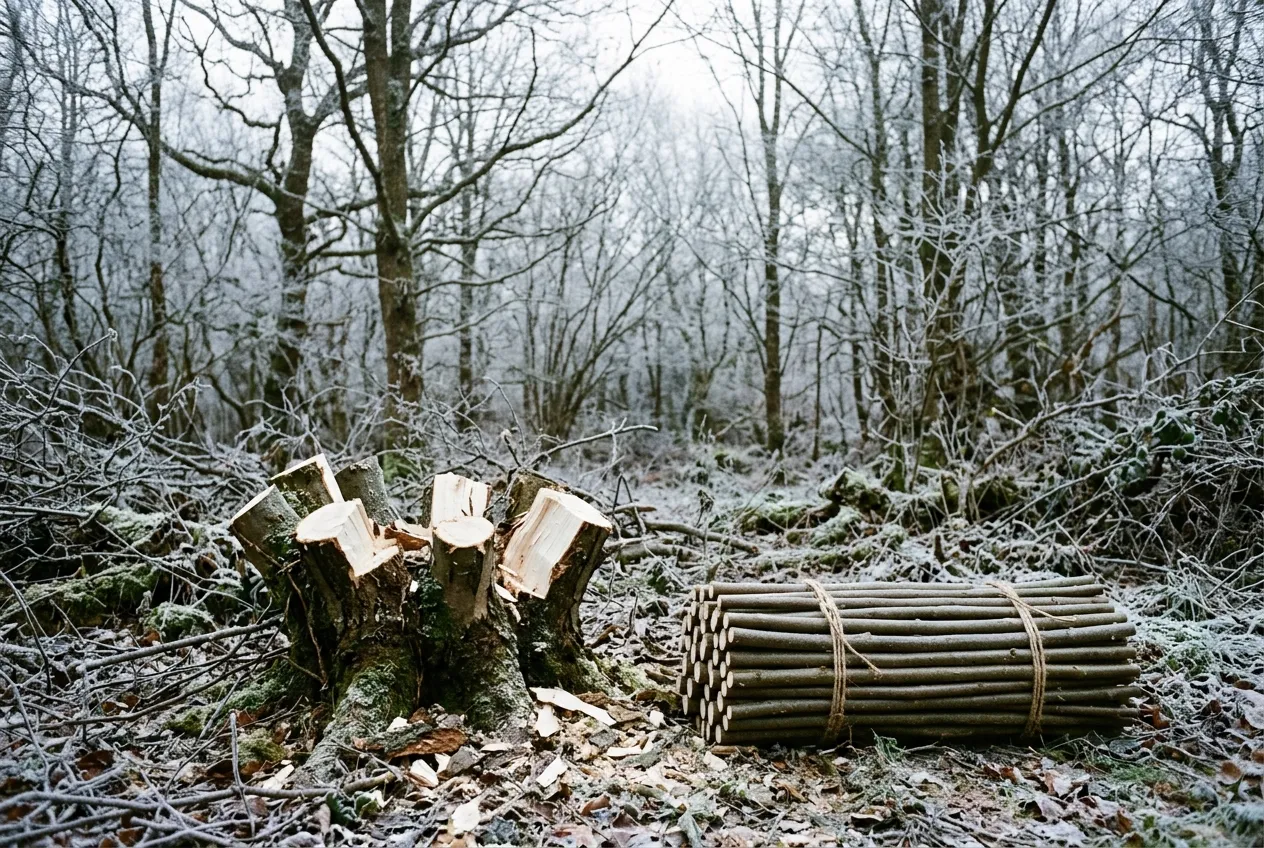 A hazel stool freshly coppiced in January. The pale cut surfaces heal rapidly, and new shoots emerge from March onwards. These poles are ready for bean supports and hurdle making.
Rotation length: Coppice hazel every 7-10 years for general-purpose poles of 3-4m length. For bean poles and pea sticks, a 5-7 year rotation produces thinner, more flexible rods. For hurdle making, 7-8 years gives the ideal diameter of 40-60mm at the base.
When to coppice: Cut between November and February when the tree is fully dormant and before birds begin nesting (1st March legal cutoff under the Wildlife and Countryside Act 1981). January is the traditional month.
Cutting technique: Use a sharp billhook or bow saw. Cut each stem as close to the stool base as possible, angling the cut to shed rainwater. A clean, low cut encourages strong regrowth from the stool. Ragged cuts invite fungal infection.
Regrowth: A healthy hazel stool produces 10-20 new shoots from the base within the first growing season. By year two, the strongest shoots reach 1.5-2m. Thin to 6-8 of the straightest rods per stool in the second winter. By year seven, these rods reach 3-4m and 40-50mm diameter.
Uses for coppiced hazel:
- Bean poles and pea sticks (5-7 year wood)
- Hurdles and woven fencing (7-8 year wood)
- Walking sticks (8-10 year, straight single rods)
- Charcoal (any age, traditionally 15-year rotation)
- Garden arches and structures (fresh, flexible 2-3 year rods)
A coppiced hazel stool can live for 500+ years. The Bradfield Woods in Suffolk contain hazel stools documented in continuous coppice management since 1252.
Hazel wildlife value in UK gardens
Hazel is among the top five native trees for UK wildlife. The Woodland Trust lists it as supporting 106 insect species, making it more valuable than most garden trees.
Early pollen source: Hazel catkins shed pollen from January to March, making them one of the first food sources for queen bumblebees emerging from hibernation. A single catkin produces up to 4 million pollen grains. On mild January days, you can see bees working hazel catkins when little else is flowering.
Dormouse habitat: The hazel dormouse (Muscardinus avellanarius) depends on hazelnuts as its primary food before hibernation. A dormouse needs to reach 15g body weight to survive winter. Hazelnuts provide the calorie-dense fat reserves necessary. Coppiced hazel with dense ground-level regrowth gives dormice the thick cover they need for nesting.
Bird food: Jays, nuthatches, great spotted woodpeckers, and wood mice all cache hazelnuts. Jays bury up to 5,000 nuts in autumn and are responsible for spreading hazel into new areas. Nuthatches wedge nuts into bark crevices and hammer them open. These are fascinating birds to watch in a garden with mature hazel.
Insect habitat: The hazel leaf-roller weevil (Apoderus coryli) creates distinctive cigar-shaped leaf rolls as egg chambers. Hazel sawflies, gall mites, and over 70 moth species use hazel as a larval food plant. This insect diversity supports insectivorous birds and bats. Creating a wildlife garden is far easier when hazel forms part of the structure.
Fungi: Over 100 fungal species associate with hazel, including the prized truffle Tuber aestivum (summer truffle), which forms mycorrhizal partnerships with hazel roots. UK truffle hunters often search under established hazel.
Month-by-month hazel care calendar
| Month | Task |
|---|---|
| January | Catkins shed pollen. Prune for shape. Coppice mature stools. Plant bare-root trees. |
| February | Final month for coppicing before nesting season. Continue winter pruning. |
| March | Tiny red female flowers open on branch tips. Last chance to plant bare-root. Mulch established trees. |
| April | New leaf growth begins. Check for big bud mite (swollen, rounded buds). Water new plantings in dry spells. |
| May | Rapid shoot growth. Young nutlets visible in clusters. Weed around newly planted trees. |
| June | Growth slows. Green nut clusters swelling. Suckers appearing at base. Remove unwanted suckers. |
| July | Nuts developing inside husks. Scout for nut weevil damage (small round holes in shells). |
| August | Brutt strong laterals in mid-August. Net trees against squirrels. Husks beginning to yellow. |
| September | Harvest cobnuts when husks yellow and nuts snap free. Dry and cure picked nuts. Peak flavour is fresh “green” cobnuts. |
| October | Leaves turn golden-yellow. Collect fallen nuts. Begin leaf mould composting. |
| November | Leaves drop. Bare-root planting season begins. Order trees from nurseries. |
| December | Dormant season. Plan new plantings. Check stored nuts for mould. |
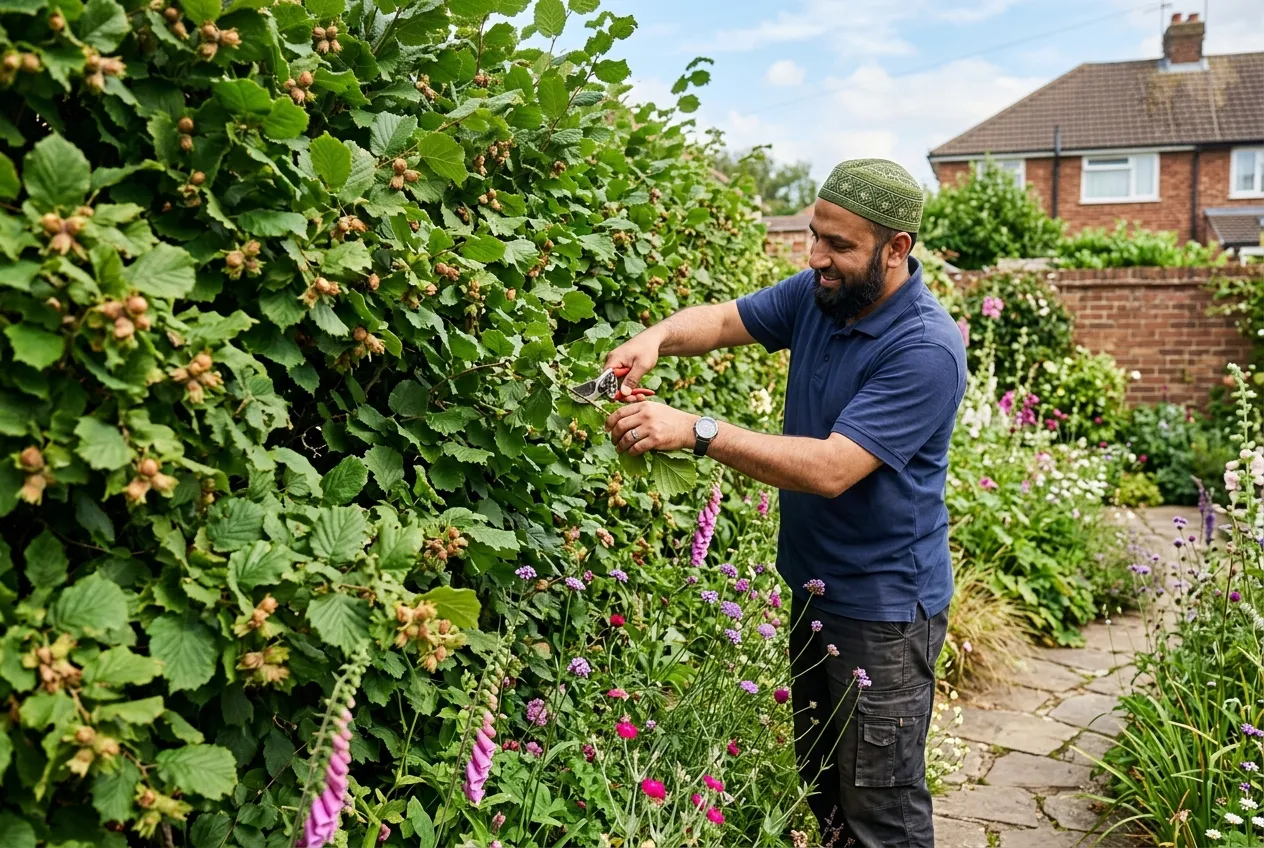 A hazel hedge in late summer, thick with foliage and clusters of developing nuts. Hazel makes an excellent garden boundary when planted at 40-50cm spacing.
How to harvest and store cobnuts
Fresh green cobnuts are a seasonal delicacy available only in September. They taste completely different from dried hazelnuts. The kernel is milky-white, moist, and has a sweet, fresh flavour with none of the oily richness of a fully dried nut.
When to harvest: Pick cobnuts when the husk (involucre) turns from green to yellow-green and the nut detaches easily with a gentle twist. In the Midlands, this falls in the second week of September. Southern England is 7-10 days earlier. Scotland and northern England are 7-10 days later.
Green cobnuts: Eat fresh within 2-3 weeks. Store in a paper bag in the fridge at 2-4C. Do not seal in plastic, which causes mould. Green cobnuts are superb in salads, with cheese, or simply cracked and eaten fresh.
Drying for storage: Spread harvested nuts in a single layer on a wire rack in a cool, airy shed. Turn daily for 2-3 weeks until the shells are hard and pale brown. Properly dried cobnuts keep for 12 months in a cool, dark place. Shell weight loss during drying is typically 30-40%.
Yield expectations: A well-managed mature cobnut tree (8+ years) produces 2-5kg of nuts in the husk. Commercial Kentish plats average 1.5-2 tonnes per hectare. A garden row of six trees gives a useful 12-30kg harvest, far more than one family can eat fresh. Share with neighbours, dry for winter, or press for cobnut oil.
Common problems growing hazel in the UK
Grey squirrels are the most damaging pest. They strip unripe nuts from July onwards and can take 90% of a crop. Net with 20mm mesh from mid-August. Cage trapping under Natural England General Licence GL41 is permitted.
Big bud mite (Phytoptus avellanae) causes buds to swell into abnormally round galls that fail to open. Infected buds are 2-3 times normal size and easily spotted in winter. Pick off and burn affected buds. Severe infestations reduce nut yield. No chemical treatment is available.
Nut weevil (Curculio nucum) lays eggs inside developing nuts through a tiny hole drilled with its long snout. The larva eats the kernel and exits through a neat round hole in autumn. Affected nuts feel light and rattle when shaken. No effective organic control exists. Clearing fallen leaves and nuts reduces overwintering larvae in the soil.
Powdery mildew appears as white patches on leaves in late summer, especially in dry years. It is cosmetic and rarely affects nut production. Improving air circulation through pruning reduces severity.
Honey fungus (Armillaria) can kill hazel, particularly stressed trees in wet soil. White fungal sheets under the bark at soil level and black bootlace rhizomorphs in the soil are diagnostic. Remove and burn infected stools. Our guide to honey fungus covers identification and management.
Growing hazel as a hedge
Hazel makes an outstanding mixed or single-species hedge that provides food, shelter, and seasonal beauty. It is one of the best native species for wildlife-friendly boundaries and stock-proof barriers.
Planting a hazel hedge: Plant bare-root whips (60-90cm) at 40-50cm spacing in a single row, or stagger in a double row at 30-40cm. Mix with other natives such as hawthorn, blackthorn, and field maple for a traditional mixed hedge. A hazel-only hedge is simpler to maintain and produces a uniform, dense screen.
Annual trimming: Trim hazel hedges in late February before nesting season. Cut the sides with a powered hedge trimmer. Leave the top to grow if you want catkins and nuts. A trimmed hazel hedge at 1.5-2m height requires one cut per year.
Laid hedge: Traditional hedge laying involves partially cutting through hazel stems near the base and bending them at 30 degrees along the hedge line. This creates an impenetrable stock-proof barrier. Hazel is the easiest species to lay because the wood is flexible and resilient. The National Hedgelaying Society promotes regional styles.
Cost comparison: Bare-root hazel whips cost £1.50-3 each for hedging grades. A 10m hedge at 40cm spacing needs 25 whips. Total cost: £37-75 plus planting labour. This compares favourably with £50-80 per metre for close-board fencing.
Field Report: Six-year cobnut trial on Staffordshire clay
Trial location: GardenUK Trial Plot, Staffordshire (heavy clay, pH 6.8) Date range: November 2019 to September 2025 Conditions: West-facing, partially sheltered by mature oak, 150m altitude
We planted six Kentish Cob and four Cosford bare-root trees (120-150cm, 2-year-old) in November 2019. Spacing was 4.5m in a single row along a south-west boundary. Soil was unimproved heavy clay with standing water in winter. Each planting hole received 5 litres of composted bark mixed into the backfill plus mycorrhizal root dip.
Year 1-2: 100% survival. Average shoot extension 40-60cm. One Cosford produced 12 catkins in its first February. No nut production. Year 3: First nuts appeared on two Kentish Cob trees. Combined yield: 0.4kg. Squirrel damage minimal (only 3 nuts taken). Year 4: All Kentish Cob fruiting. Average yield 3.2kg per tree. Cosford averaged 1.8kg. Squirrel damage severe: 40% of unharvested Kentish Cob crop lost. Netting installed mid-August reduced losses to 15%. Year 5-6: Full cropping. Kentish Cob average 4.1kg per tree. Cosford average 2.6kg. Brutting introduced in year 5 increased nut set by an estimated 25% compared to unbrutted laterals on the same tree. Big bud mite appeared on one Cosford in year 6, affecting 8% of buds. Removed by hand.
Key finding: On heavy clay, Kentish Cob outperforms Cosford by 40-60% in nut weight. However, Cosford’s thinner shells and earlier ripening make it the better eating nut. Both varieties tolerated waterlogged clay in the 2023-24 winter floods without any dieback. The clay suits hazel well.
Frequently asked questions
When is the best time to plant hazel trees in the UK?
Plant bare-root hazel from November to March when the tree is dormant. November planting gives the best results because roots establish through winter before spring growth begins. Container-grown hazel can go in year-round, but autumn planting still outperforms spring planting by 20-30% in first-year growth. Avoid planting when the ground is frozen or waterlogged.
How long does it take for a cobnut tree to produce nuts?
Cobnut trees produce their first small crop at 3-4 years old. A full commercial crop arrives at 6-8 years. Bare-root whips from a nursery fruit faster than seedlings because they are typically 2-3 years old at planting. By year five, expect 1-2kg per tree. By year eight, a well-pruned Kentish Cob yields 3-5kg. Trees remain productive for over 100 years.
What is the difference between a hazel, cobnut, and filbert?
All three belong to the Corylus genus but differ in nut shape and husk length. A hazel is the wild native species (Corylus avellana) with small round nuts in short husks. A cobnut is a cultivated hazel selected for larger, rounder nuts, still with a short husk. A filbert (Corylus maxima) has an elongated nut fully enclosed by a long tubular husk. The Kentish Cob is actually a filbert despite its name.
Do I need two hazel trees for pollination?
One hazel tree can set nuts alone because it carries both male catkins and female flowers. However, cross-pollination from a second variety increases nut set by 30-50%. Plant at least two different cultivars within 15m of each other. Wild hazel hedgerows also provide pollen. Catkins shed pollen from January to March, and the tiny red female flowers open at the same time.
How do I stop squirrels eating all my cobnuts?
Grey squirrels are the main threat to cobnut harvests in the UK. Net trees with 20mm mesh from mid-August, before nuts start ripening. Pick nuts early when husks yellow but shells are still green. Cage netting draped over the canopy and pegged at ground level works better than individual branch bags. Squirrel trapping under General Licence GL41 is permitted, but netting and early harvest are the most practical home garden solutions.
Can I grow hazel in a small garden?
Hazel suits small gardens if managed by coppicing or pruning. An unmanaged tree reaches 6-8m tall and 4-5m wide. Coppicing every 5-7 years keeps it below 3m. A single cobnut pruned to a goblet shape on a 1.8m trunk occupies a 3m x 3m space. Purple Filbert makes an attractive small-garden specimen at 4m x 3m. Hazel also works as a hedge planted at 40-50cm spacing.
Is hazel good for wildlife in the garden?
Hazel is one of the best native trees for UK wildlife. It supports 106 insect species including the hazel leaf-roller weevil. Catkins provide the first pollen of the year for queen bumblebees in January. Dormice depend on hazelnuts as their primary autumn food before hibernation. Nuthatches, jays, woodpeckers, and wood mice all eat the nuts. Coppiced hazel creates dense ground-level cover used by nesting warblers, hedgehogs, and slow worms.
Now you know how to grow hazel and cobnut trees in the UK, explore our guide to growing nut trees for walnut, sweet chestnut, and almond growing advice, or read about growing fruit trees for more productive trees to plant this autumn.
Lawrie has been gardening in the West Midlands for over 30 years. He grows his own veg using no-dig methods, keeps a wildlife-friendly garden, and writes practical advice based on real UK growing conditions.