How to Grow Snapdragons in the UK
UK guide to growing snapdragons from seed. Covers tall, dwarf, and trailing types, sowing times, pinching, rust prevention, and cut flower care.
Key takeaways
- Sow indoors from February at 18-21C; seeds need light to germinate so do not cover
- Pinch the growing tip at 10cm tall to produce 6-8 flowering side shoots per plant
- Tall varieties (90-120cm) make the best cut flowers with a vase life of 7-10 days
- Dwarf types (15-25cm) suit containers, window boxes, and border edging
- Deadhead spent spikes weekly to extend flowering from June to late October
- Antirrhinum rust (Puccinia antirrhini) is the main UK disease; choose resistant varieties
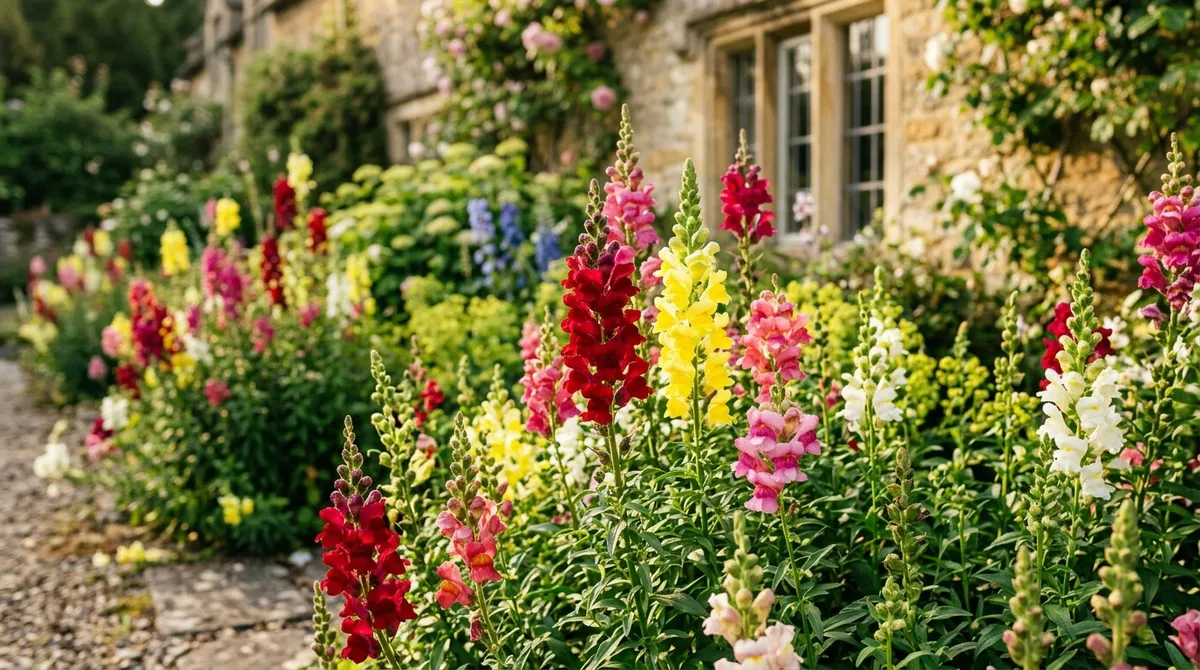
Snapdragons are one of the most rewarding annuals to grow in the UK, producing vivid flower spikes from June until the first hard frost. They thrive in full sun, tolerate most soil types, and make outstanding cut flowers with a vase life of 7-10 days. The botanical name Antirrhinum majus comes from the Greek for “like a snout”, describing the dragon-jaw shape each flower makes when squeezed.
Few annuals offer the same combination of height, colour range, and season length. Snapdragons grow in every shade except true blue, from deepest burgundy through peach, lemon, and pure white. They fill the gap between spring bulbs finishing and summer perennials hitting their stride. Children love them for the “snapping” flowers, and pollinators work the tubular blooms from dawn until dusk.
Which type of snapdragon should I grow?
Snapdragons divide into four groups based on height. Choosing the right group determines whether your plants work as cut flowers, border fillers, or container subjects.
Tall Group I (90-120cm): These are the cut flower varieties. Rocket, Madame Butterfly, and Animation series produce long, sturdy stems ideal for vases. They need staking in exposed gardens. Plant at the back of borders or in a dedicated cutting garden where height is an advantage.
Intermediate Group II (45-75cm): The most versatile group for UK gardens. Chantilly, Sonnet, and Liberty series produce multiple branching stems without staking. They work as mid-border plants, in cottage garden schemes, and as cut flowers for shorter arrangements. The Chantilly series has an RHS Award of Garden Merit.
Dwarf Group III (20-40cm): Compact bedding types including the Snapshot, Montego, and Floral Showers series. Ideal for container gardening, window boxes, and border edging. They branch naturally without pinching and flower prolifically.
Trailing Group IV (15-25cm): Spreading varieties like the Candy Showers and Luminaire series. These cascade from hanging baskets and raised containers. They tolerate more shade than upright types and produce smaller but more numerous flowers.
| Feature | Tall (Group I) | Intermediate (Group II) | Dwarf (Group III) | Trailing (Group IV) |
|---|---|---|---|---|
| Height | 90-120cm | 45-75cm | 20-40cm | 15-25cm (trailing) |
| Best use | Cut flowers, back of border | Mid-border, cottage garden | Containers, edging | Hanging baskets, walls |
| Stems per plant (pinched) | 6-8 | 8-12 | 10-15 (natural) | 12-20 (natural) |
| Staking needed | Yes | No | No | No |
| Vase life | 7-10 days | 5-7 days | Not suitable | Not suitable |
| First flower (from sowing) | 14-16 weeks | 12-14 weeks | 10-12 weeks | 10-12 weeks |
| Spacing | 30cm | 25cm | 20cm | 25cm (basket centres) |
| RHS AGM varieties | Rocket series | Chantilly series | Snapshot series | Candy Showers |
| Seed cost per packet | £2.50-£3.50 | £2.50-£3.50 | £2.00-£3.00 | £3.00-£4.00 |
Why we recommend Intermediate types for most UK gardeners: After trialling 14 varieties across two Staffordshire plots, the Chantilly series gave the best all-round performance. It produced 10-12 stems per plant without staking, tolerated Midlands wind without flopping, and gave usable cut stems of 50-60cm. For dedicated cut flower growers, Madame Butterfly remains the gold standard.
How to sow snapdragons from seed
Snapdragon seeds are dust-fine. One gram contains approximately 6,000-8,000 seeds. They require light to germinate, so surface-sow without covering.
Timing matters. Sow from early February for the longest flowering season. March sowings flower two weeks later. April sowings give a shorter display. In our Staffordshire trials, February-sown plants produced first flowers in late May. March-sown plants did not flower until mid-June.
Step-by-step indoor sowing:
- Fill 9cm pots or module trays with fine seed compost. Water thoroughly and let drain.
- Scatter seeds thinly on the surface. Press gently with a flat piece of card.
- Do not cover with compost or vermiculite. Seeds need light.
- Place in a heated propagator or on a warm windowsill at 18-21C.
- Keep compost moist with a fine mist spray. Never let it dry out completely.
- Germination takes 10-14 days at 18-21C, or up to 21 days at lower temperatures.
- Once seedlings show two true leaves, prick out into individual 7cm pots.
- Grow on at 15-16C in bright light. Temperatures above 20C cause leggy growth.
Our guide to sowing seeds indoors covers propagator setup and lighting in detail.
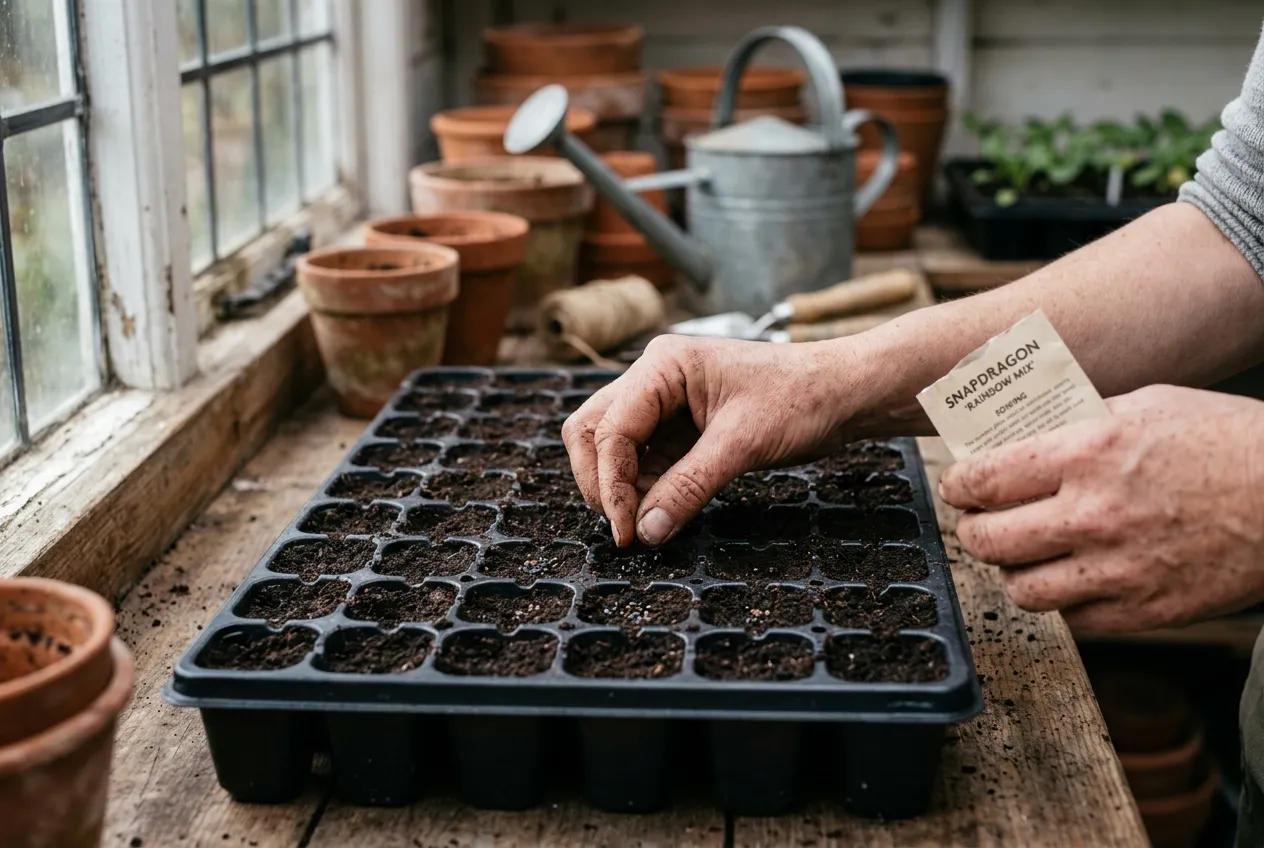 Snapdragon seeds are tiny and need light to germinate. Press them gently onto the compost surface without covering.
When and how to plant snapdragons outside
Harden off seedlings for 10-14 days before planting out. Move trays outdoors during the day and bring them back inside at night. Snapdragons tolerate light frosts down to -3C once hardened, but newly transplanted seedlings will not survive a late freeze.
Plant out after the last frost. In southern England this is typically mid-May. In the Midlands and northern England, wait until late May. Scottish gardeners should plant from early June. Check your local last frost date and add a week as a buffer.
Site and soil: Snapdragons perform best in full sun with at least 6 hours direct sunlight daily. They tolerate partial shade but produce fewer flowers and weaker stems. Any well-drained garden soil suits them. On heavy clay, add 30% horticultural grit to the planting hole. They prefer a slightly acidic to neutral pH of 6.0-7.0 but tolerate alkaline soils up to pH 8.0.
Planting distances: Space tall varieties 30cm apart, intermediates 25cm, and dwarfs 20cm. Closer spacing creates competition that weakens stems and increases humidity around foliage, encouraging rust disease.
Pinching: When plants reach 10cm tall, pinch out the main growing tip with your thumb and forefinger. This is the single most important technique for snapdragons. It forces 6-8 side shoots to develop from the leaf joints below the pinch point. Each side shoot produces its own flower spike, tripling the number of blooms per plant. Skip this step only if you are growing for exhibition and want one tall, single spike.
Month-by-month snapdragon care calendar
| Month | Task |
|---|---|
| January | Order seed. Clean pots and trays. Check propagator heating. |
| February | Sow seed indoors at 18-21C. Place in bright light. |
| March | Continue sowing. Prick out February-sown seedlings into 7cm pots. |
| April | Grow on at 15-16C. Begin hardening off in mild areas. Pinch tips at 10cm. |
| May | Plant out after last frost. Water in well. Apply slug protection. |
| June | First flowers appear. Begin deadheading spent spikes. Start fortnightly feeding. |
| July | Peak flowering period. Cut stems for vases. Watch for rust symptoms. |
| August | Continue deadheading and cutting. Side-dress with high-potash feed. |
| September | Flowering continues in warm autumns. Collect seed from open-pollinated types. |
| October | Frost kills top growth. Clear spent plants. Add to compost heap if rust-free. |
| November | Rest period. Review variety performance notes. Plan next year’s selection. |
| December | Order seed catalogues. Source early-season varieties for February sowing. |
This calendar works alongside a broader flower planting schedule to keep your borders in colour year-round.
Snapdragons as cut flowers
Snapdragons rank among the top five cut flowers for UK growers. Professional flower farmers grow them by the thousand. Home growers can achieve near-professional quality with the right varieties and technique.
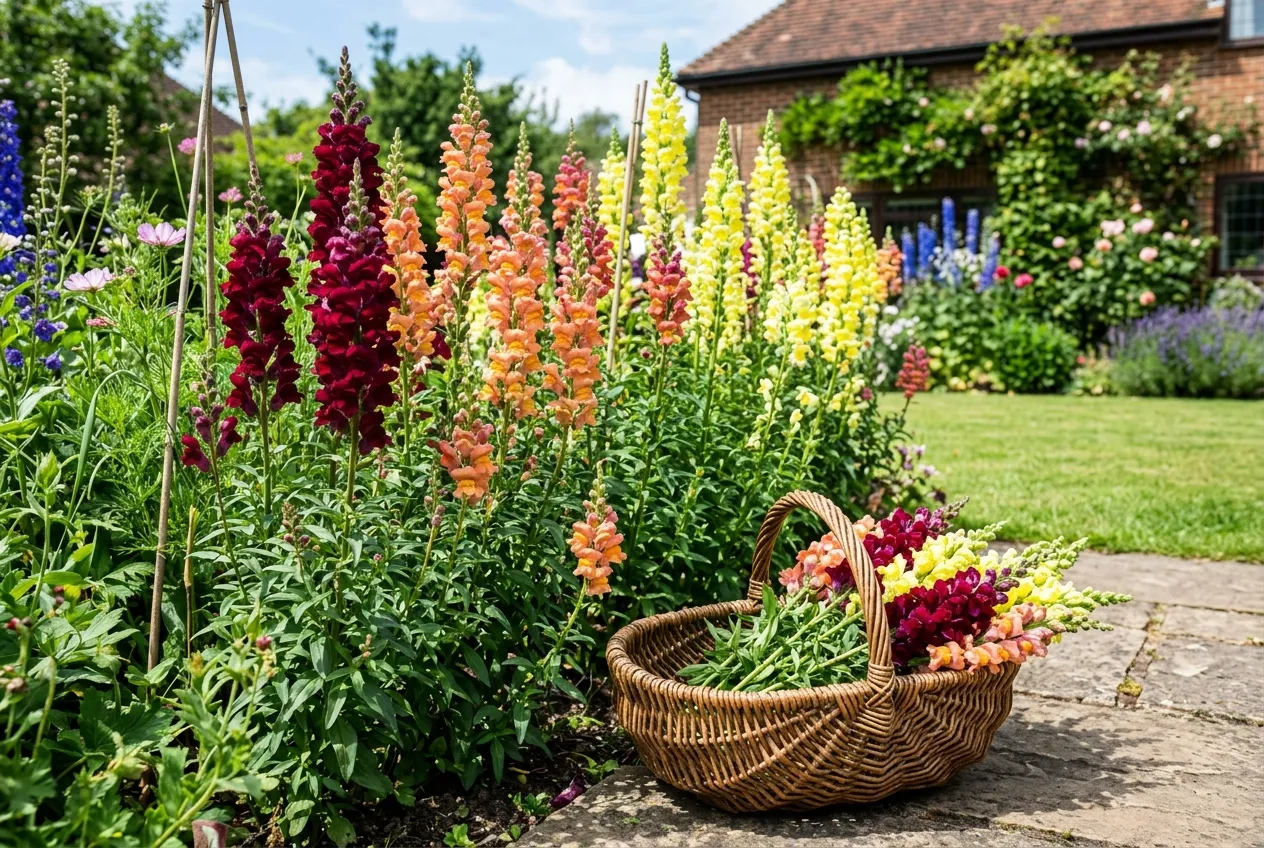 Tall snapdragons like the Rocket and Madame Butterfly series produce stems of 80-120cm, ideal for dramatic vase arrangements.
When to cut: Harvest when the bottom third of flowers on the spike have opened. The remaining buds will continue opening in the vase over 7-10 days. Cut in the early morning when stems are turgid with water. Use sharp, clean secateurs and cut at an angle.
Conditioning: Strip all leaves below the waterline. Place stems immediately into deep, cool water (10-15C) with a universal flower food. Leave in a cool, dark room for 4-6 hours before arranging. Re-cut stems by 2cm every 3 days to maintain water uptake.
Best cut flower varieties:
- Madame Butterfly — Double, azalea-like blooms. 80-90cm stems. Excellent vase life of 8-10 days. Available in mixed colours or single shades.
- Rocket series — Classic single-flower spikes. 90-120cm stems. The professional standard. Strong, straight stems that do not curve.
- Chantilly series — Open-faced, butterfly-type flowers. 60-75cm stems. Pastel shades. Slightly shorter vase life of 5-7 days but more graceful in arrangements.
- Costa Silver — Bicolour white and deep rose. 70cm stems. Unusual colouring that stands out in mixed bunches.
Snapdragons pair well with dahlias, roses, and grasses in late-summer arrangements. They add vertical drama that few other annuals can match.
Dealing with antirrhinum rust
Antirrhinum rust (Puccinia antirrhini) is the most serious snapdragon disease in the UK. It arrived in Britain in the 1930s and has been present ever since. The disease produces distinctive orange-brown powdery pustules on the undersides of leaves and can defoliate a plant entirely within 3-4 weeks of first symptoms.
Identification: Look for small, circular, dark brown spots on the upper leaf surface. Turn the leaf over and you will see corresponding raised pustules packed with orange-brown spores. Infected stems develop elongated, sunken lesions. Badly affected plants become stunted and stop flowering.
Prevention is the primary strategy:
- Choose resistant varieties. Madame Butterfly, the Rocket series, and most modern F1 hybrids carry partial rust resistance. Heritage open-pollinated types are far more susceptible.
- Space plants 25-30cm apart. Good airflow between plants prevents the humid microclimate rust spores need to germinate.
- Water at the base. Never use overhead irrigation. Wet foliage provides the 4-6 hours of surface moisture rust spores need to penetrate leaf tissue.
- Remove infected leaves immediately. Bag them and put them in household waste. Never compost rust-infected material.
- Rotate planting sites. Do not grow snapdragons in the same bed for consecutive years. Rust spores overwinter on infected debris in the soil. A two-year gap breaks the cycle.
Chemical control: Fungicides containing tebuconazole (sold as Bayer Fungus Fighter) provide some protection when applied as a preventive spray before symptoms appear. Once rust is established, chemical control is largely ineffective. The RHS snapdragon growing guide provides current approved fungicide lists.
Field Report Trial location: GardenUK trial plots, Staffordshire (heavy clay) and West Midlands (sandy loam) Date range: April 2024 to October 2025 Conditions: South-facing, partially sheltered by 1.8m fence Observation: In the 2024 season, rust appeared on open-pollinated ‘Brighton Rock’ plants by mid-July and destroyed all foliage by late August. In the same bed, ‘Madame Butterfly’ showed no rust symptoms until early September and continued flowering until the October frost. In 2025, we trialled the Rocket series alongside Chantilly and confirmed that both F1 types resisted rust significantly better than any heritage variety. Spacing at 30cm vs 20cm made a measurable difference too. The wider-spaced plants had 60% less rust infection than the closer-planted ones.
Growing snapdragons in containers
Dwarf and trailing snapdragons thrive in containers, making them ideal for patios, balconies, and doorstep displays. They flower continuously from June to October with minimal fuss.
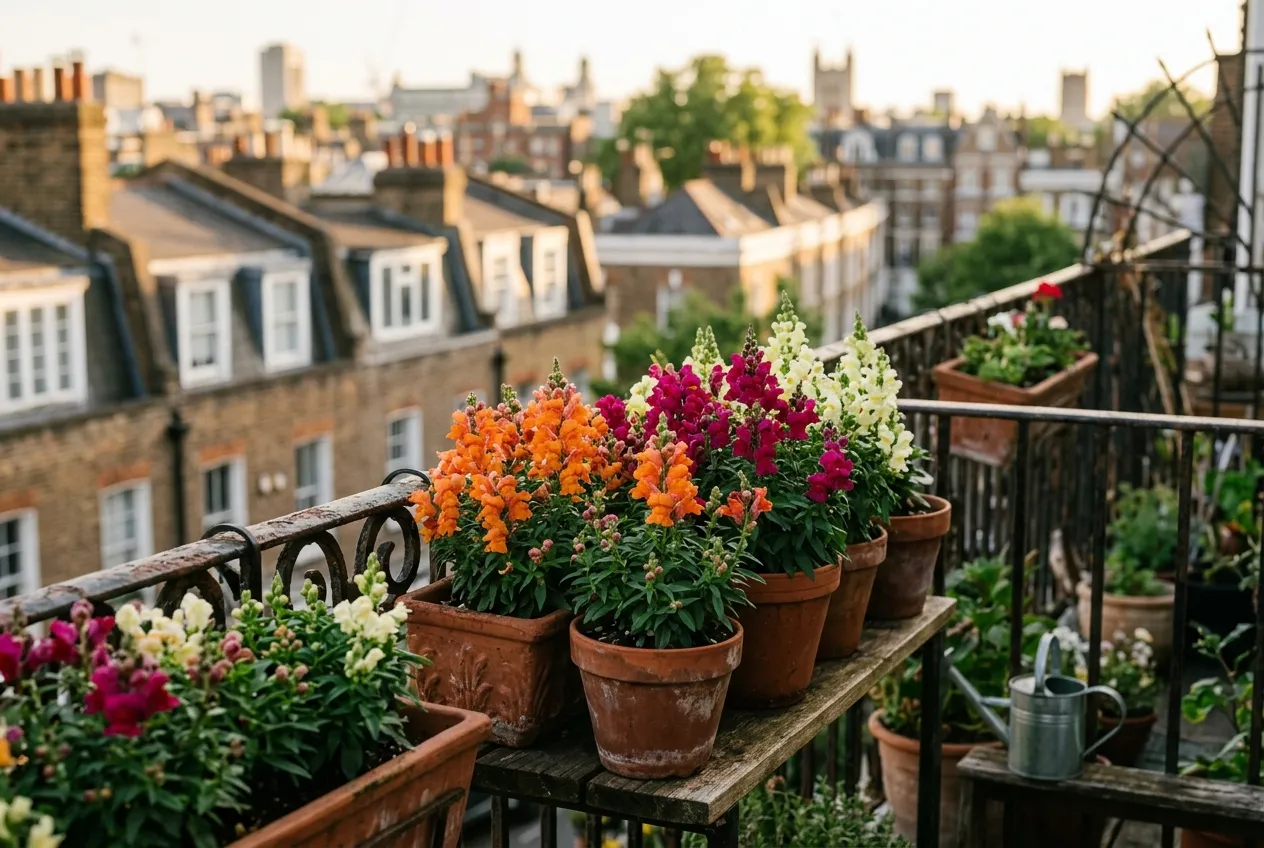 Dwarf snapdragons like the Snapshot and Magic Carpet series suit pots of 20cm diameter or larger.
Container size: Use pots at least 20cm in diameter and depth. Three dwarf plants per 30cm pot creates a full display. For hanging baskets, use trailing Candy Showers planted at 5 plants per 35cm basket.
Compost mix: Multipurpose compost with 20% perlite added for drainage. Snapdragons hate sitting in waterlogged compost. Terracotta pots are preferable to plastic because they allow moisture to evaporate through the walls.
Feeding: Apply a high-potash liquid feed (tomato fertiliser at full strength) every 14 days from June onwards. Potash drives flower production. Nitrogen-heavy feeds push leafy growth at the expense of blooms.
Watering: Daily in summer, twice daily in heatwaves. Container compost dries out far faster than ground soil. Poke a finger 3cm into the compost. If it feels dry, water immediately. Wilted snapdragons recover from brief drought but lose lower leaves permanently.
Overwintering containers: In mild areas (RHS Hardiness Zone H4, minimum -5C), move pots against a south-facing wall and cover with fleece during hard frosts. Plants may survive to flower again in spring, though performance is weaker. In most cases, starting fresh from seed each year gives better results.
Container-grown snapdragons combine well with other summer bedding plants and work particularly well in cottage garden planting schemes alongside sweet Williams, stocks, and cornflowers.
Companion planting with snapdragons
Snapdragons attract bumblebees, honeybees, and hoverflies. The tubular flower structure suits long-tongued pollinators, making snapdragons valuable in any pollinator-friendly planting scheme.
Good companions:
- Sweet peas — Both enjoy full sun and well-drained soil. The sweet pea adds scent that snapdragons lack.
- Cosmos — Similar height and airy texture. Fills the gaps between snapdragon spikes.
- Salvias — Complementary flower forms. Red salvias with yellow snapdragons create striking contrast.
- Lavender — Low foreground for tall snapdragons. Both tolerate lean soil.
- Marigolds — Trap crop for aphids that might otherwise target snapdragons.
Poor companions: Avoid planting near crops that need heavy feeding (brassicas, courgettes). Snapdragons perform worst in rich, heavily manured ground where soft growth invites aphids and rust.
Common mistakes when growing snapdragons
Sowing too late. Snapdragons need 12-16 weeks from seed to flower. Sowing after mid-March in the UK shortens the flowering season by 4-6 weeks. February sowings give the longest display.
Forgetting to pinch. An unpinched snapdragon produces one stem with one flower spike. Pinching at 10cm tall produces 6-8 stems. This is the difference between a sparse plant and a bushy, flower-packed specimen.
Overwatering seedlings. Damping off (Pythium and Rhizoctonia species) kills more snapdragon seedlings than any other problem. Use free-draining seed compost. Water from below by standing trays in shallow water for 10 minutes. Remove from water immediately. Never leave pots sitting in saucers of water.
Ignoring rust. Antirrhinum rust spreads explosively in warm, humid weather. By the time you see symptoms on several plants, spores have already colonised the entire row. Start with resistant varieties and maintain 25-30cm spacing. Prevention is the only reliable strategy.
Planting in shade. Snapdragons in shade produce tall, weak stems that flop and few flowers. They need a minimum of 6 hours direct sun. In partial shade, choose trailing types from Garden Organic’s recommended list which tolerate lower light better than tall varieties.
Saving snapdragon seed
Open-pollinated snapdragon varieties produce viable seed that comes reasonably true to type. F1 hybrids will not breed true and seed saving from these is not worthwhile.
When to collect: Seed pods form on the lower part of each spent flower spike. The pods are small, round capsules with three holes at the top, resembling tiny skulls. Wait until pods turn brown and dry on the plant, typically August to September. Shake the stem over a paper bag and the tiny black seeds fall out through the holes.
Storage: Dry seeds on a paper towel for 48 hours in a warm room. Store in labelled paper envelopes inside an airtight container with a sachet of silica gel. Seeds remain viable for 2-3 years when stored at 5-10C. A sealed jar in the fridge is ideal.
Self-sowing: In sheltered southern gardens, snapdragons self-sow freely in gravel, paving cracks, and at the base of warm walls. These volunteer seedlings are often tougher than nursery-raised plants but flower colours will be unpredictable. Thin self-sown clumps to 20cm spacing by late April and treat them as free plants.
Frequently asked questions
When should I sow snapdragon seeds in the UK?
Sow snapdragon seeds indoors from February to mid-March. Seeds need light to germinate, so press them onto the compost surface without covering. Maintain a temperature of 18-21C and expect germination in 10-14 days. In northern England and Scotland, sow by late February for the longest flowering season. Outdoor direct sowing rarely works in the UK because snapdragons need a long growing season of 12-16 weeks before flowering.
Do snapdragons come back every year in the UK?
Snapdragons are short-lived perennials but grow best as annuals in the UK. In mild areas of southern England and sheltered coastal gardens, they sometimes survive winter and regrow in spring. However, plants weaken significantly in their second year and produce fewer, smaller flower spikes. Sowing fresh seed each February gives far stronger plants. Self-sown seedlings often appear in gravel paths and cracks in paving where drainage is sharp.
How do I stop my snapdragons getting rust?
Choose rust-resistant varieties like ‘Madame Butterfly’ or the Rocket series. Antirrhinum rust (Puccinia antirrhini) produces orange-brown pustules on leaf undersides and can defoliate plants within weeks. Space plants 25-30cm apart for airflow. Water at the base, never overhead. Remove infected leaves immediately and dispose of them in household waste, not the compost heap. The RHS rates rust as the single most damaging snapdragon disease in the UK.
Should I pinch out snapdragons?
Yes, pinch the main growing tip when plants reach 10cm tall. This forces 6-8 side shoots to develop, each producing its own flower spike. Unpinched plants grow a single tall stem with one spike, which is useful for exhibition but poor for garden display or cutting. Pinching delays first flowering by about 10 days but triples the total number of blooms per plant over the season.
Can I grow snapdragons in pots and containers?
Snapdragons grow well in containers of at least 20cm diameter and depth. Use dwarf varieties like the Magic Carpet or Snapshot series, which reach only 15-25cm tall. Fill pots with multipurpose compost mixed with 20% perlite for drainage. Feed fortnightly with a high-potash liquid fertiliser from June onwards. Container-grown snapdragons need watering daily in summer because they dry out faster than ground-planted specimens.
Are snapdragons poisonous to pets or children?
Snapdragons are non-toxic to humans, dogs, and cats. The RHS does not list Antirrhinum as a hazardous plant. The flowers are technically edible and sometimes used as cake decorations, though they have little flavour. This makes snapdragons one of the safest flowering plants for family gardens and homes with pets.
What is the best snapdragon variety for cutting?
‘Madame Butterfly’ is the best UK cut flower snapdragon. It produces double, azalea-like blooms on 80-90cm stems with a vase life of 7-10 days. The Rocket series is the professional grower’s choice for single-bloom spikes reaching 90-120cm. For shorter arrangements, the Chantilly series at 60-75cm offers ruffled, open-faced flowers in pastel shades. Cut when the bottom third of flowers on the spike are open for maximum vase life.
Now you know how to grow snapdragons from seed through to cutting, read our guide on the best summer flowers for UK gardens to build a border that stays in colour from June to October.
Lawrie has been gardening in the West Midlands for over 30 years. He grows his own veg using no-dig methods, keeps a wildlife-friendly garden, and writes practical advice based on real UK growing conditions.