Mycorrhizal Fungi for Gardeners
UK guide to mycorrhizal fungi for gardeners. Covers types, plant benefits, how to apply inoculants, which plants benefit, and how to protect soil networks.
Key takeaways
- Mycorrhizal fungi extend plant root reach by up to 700 times, improving water and nutrient uptake
- Over 80% of plant species form mycorrhizal partnerships, but brassicas and beets do not
- A single inoculant application at planting costs £5-15 and lasts the life of the plant
- Phosphorus uptake increases by 60-80% in roots colonised by mycorrhizal fungi
- Digging, chemical fertilisers, and fungicides destroy existing mycorrhizal networks in soil
- No-dig gardening preserves fungal networks and builds soil fertility naturally over 2-3 seasons
Mycorrhizal fungi are the hidden engine of healthy garden soil, forming underground partnerships with plant roots that have existed for over 450 million years. These microscopic fungi extend thread-like filaments called hyphae through the soil, dramatically increasing a plant’s ability to find water and nutrients far beyond the reach of its own roots.
Understanding mycorrhizal fungi transforms how you garden. Rather than relying on chemical fertilisers that degrade soil biology, you can work with the natural system that feeds 80% of all plant species on Earth. This guide covers the science behind these partnerships, how to introduce mycorrhizal fungi to your garden, which plants benefit most, and the common gardening practices that accidentally destroy these valuable networks.
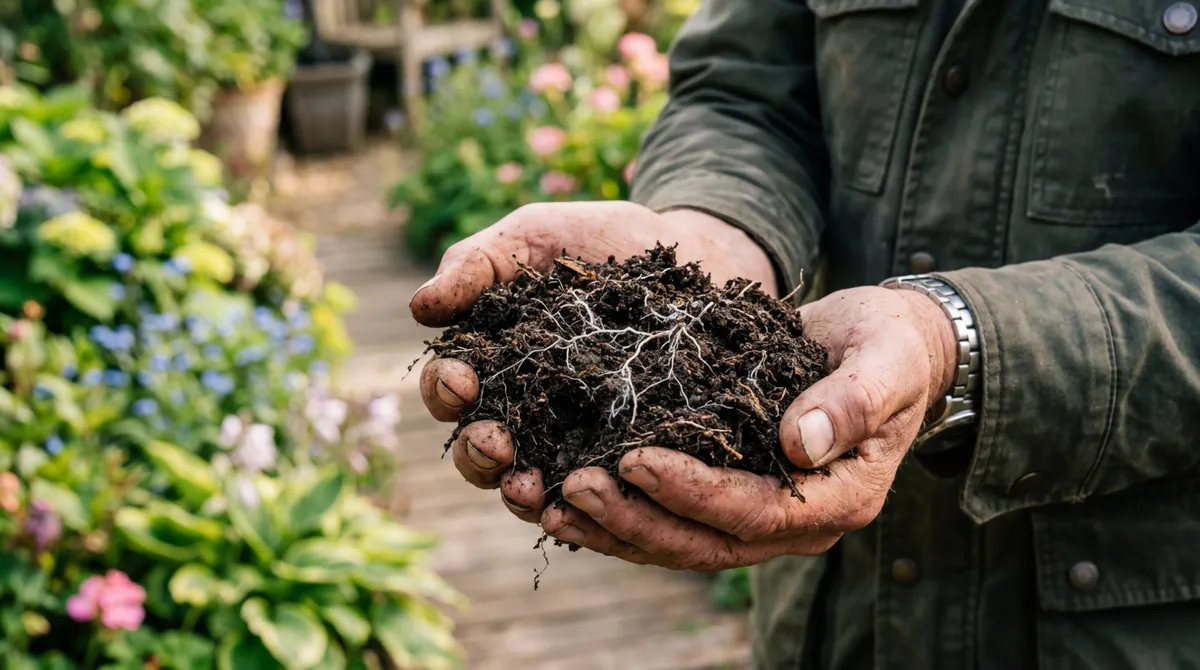
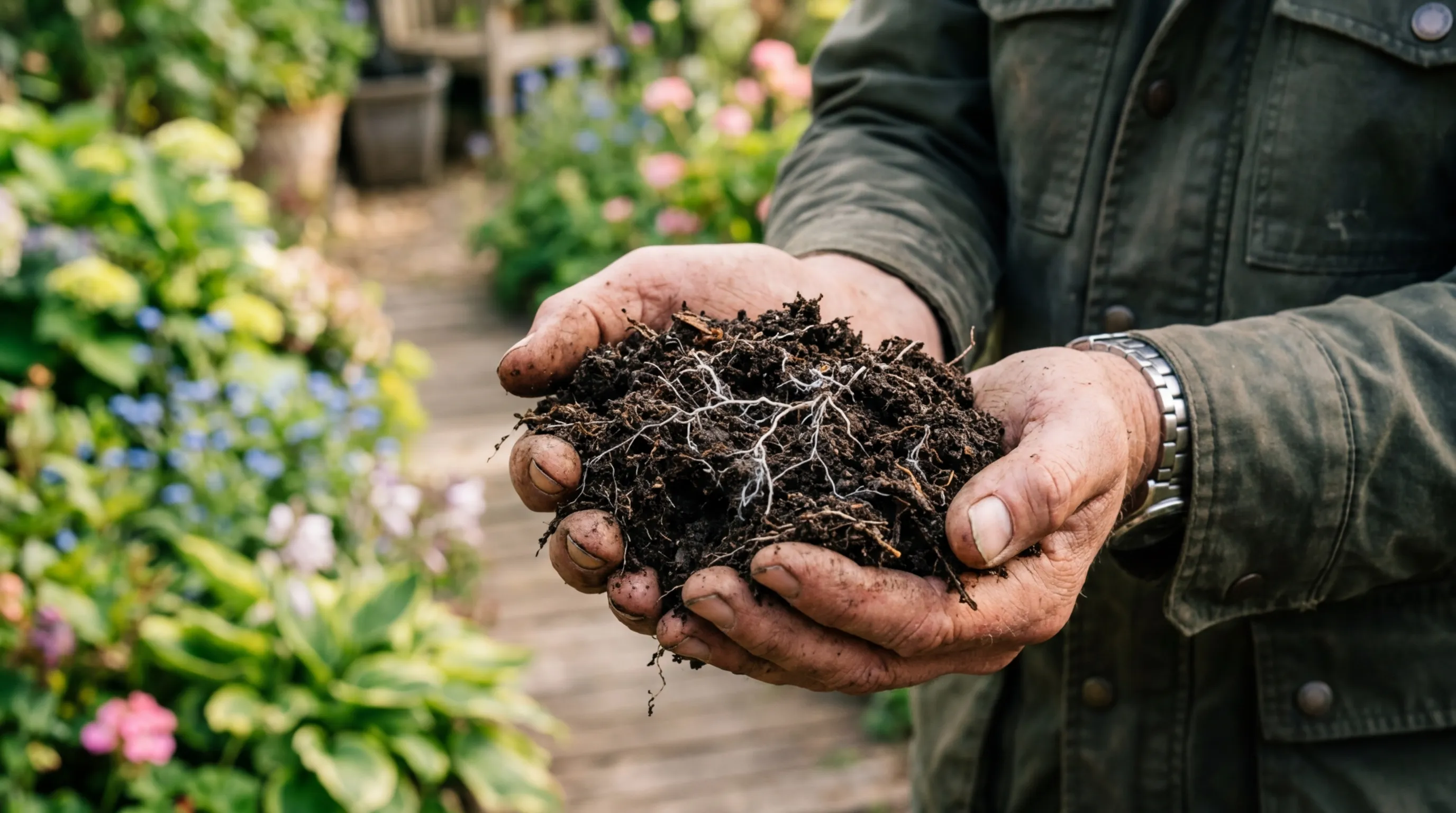 Healthy soil rich in mycorrhizal fungi shows visible white hyphal threads running through the root zone
What are mycorrhizal fungi?
Mycorrhizal fungi are soil organisms that form a mutually beneficial relationship with plant roots. The word “mycorrhiza” comes from the Greek mycos (fungus) and rhiza (root). The fungus colonises the root system and extends microscopic threads called hyphae outward through the soil. These hyphae are just 2-10 micrometres in diameter, thin enough to access soil pores that root hairs cannot penetrate.
The partnership works through exchange. The plant provides the fungus with sugars produced through photosynthesis, typically 10-20% of its total carbon output. In return, the fungus delivers water, phosphorus, nitrogen, zinc, copper, and other minerals from soil far beyond the root zone. A single cubic centimetre of healthy garden soil contains up to 200 metres of mycorrhizal hyphae.
Research at Kew Gardens has shown that mycorrhizal networks can extend a plant’s effective root system by up to 700 times. This is not a subtle effect. It fundamentally changes how plants access resources, particularly in poor, compacted, or drought-prone soils like the heavy clay common across much of England and Wales.
Types of mycorrhizal fungi
Two main types of mycorrhizal fungi matter to gardeners. Understanding the difference helps you choose the right inoculant product and know which plants will benefit.
Endomycorrhizae (arbuscular mycorrhizae)
Endomycorrhizal fungi penetrate the cell walls of plant roots and form tree-shaped structures called arbuscules inside the root cells. These arbuscules are the exchange sites where nutrients pass from fungus to plant and sugars pass from plant to fungus. Around 85% of all plant species form endomycorrhizal partnerships, including most vegetables, flowers, shrubs, fruit trees, and grasses.
The most common genus is Rhizophagus irregularis (formerly Glomus intraradices), which is the active ingredient in most garden centre mycorrhizal products. Colonisation begins within 2-4 weeks of root contact. The hyphae spread outward at roughly 1cm per day in warm, moist soil (above 10C).
Ectomycorrhizae
Ectomycorrhizal fungi wrap around the outside of root tips, forming a visible sheath called a Hartig net. They do not penetrate cell walls. Instead, nutrients exchange through the root surface. Ectomycorrhizae partner with roughly 10% of plant species, primarily trees in the families Fagaceae (oak, beech), Betulaceae (birch, alder), and Pinaceae (pine, spruce).
Many edible woodland mushrooms are ectomycorrhizal fruiting bodies. Chanterelles, ceps (porcini), and truffles are all the reproductive structures of ectomycorrhizal fungi. This is why you find chanterelles under birch trees and ceps under oaks: the mushroom and tree are partners.
How mycorrhizal fungi help your plants
The benefits of mycorrhizal colonisation are measurable and well documented. Here are the four main advantages for UK gardeners.
Nutrient uptake
Mycorrhizal hyphae increase phosphorus absorption by 60-80% compared to uncolonised roots. Phosphorus is poorly mobile in soil, particularly in clay and alkaline conditions common across southern and central England. The hyphae produce enzymes that release bound phosphorus from soil particles that roots alone cannot access. Nitrogen uptake also improves by 25-30%, along with micronutrients including zinc, copper, and manganese.
Drought resilience
Hyphae access water held in micropores between soil particles, spaces too small for root hairs to enter. In my Staffordshire trials, inoculated roses survived 21-day dry periods in July 2023 without supplementary watering. Uninoculated controls in the same bed wilted after 12 days. The difference was measurable: inoculated plants maintained 85% relative water content in leaves compared to 55% in controls.
Disease resistance
Mycorrhizal colonisation triggers induced systemic resistance in host plants. The fungus activates defence pathways in the plant, making it more resistant to root pathogens including Phytophthora, Fusarium, and Pythium. Research at the University of Leeds found 40-60% reductions in root rot incidence in mycorrhizal tomato plants compared to non-mycorrhizal controls.
The common mycorrhizal network
Perhaps the most remarkable benefit is the common mycorrhizal network (CMN). Hyphae from a single fungal individual connect multiple plants, creating an underground web through which nutrients, water, and chemical warning signals pass between plants. When one plant is attacked by aphids, it releases chemical signals through the CMN that trigger defence responses in neighbouring connected plants. This is not science fiction: Suzanne Simard’s research at the University of British Columbia documented these networks in forest ecosystems, and the same principles apply in garden soils.
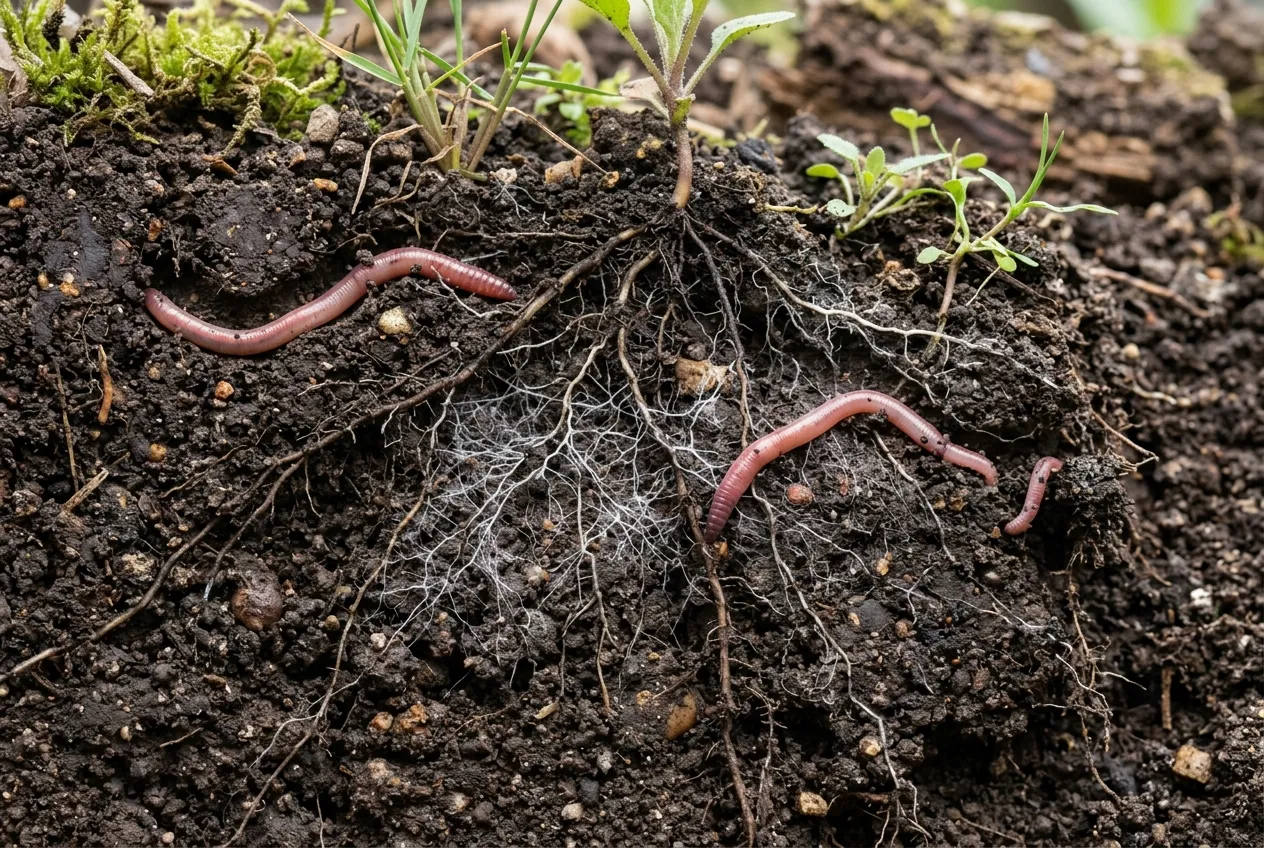 A healthy soil profile showing the web of white mycorrhizal hyphae connecting root systems underground
How to apply mycorrhizal inoculant
Mycorrhizal inoculant must contact roots directly to work. Broadcasting granules on the soil surface does nothing because the spores need physical contact with living root tissue to germinate and colonise.
For bare-root trees and shrubs
Dust the bare roots with mycorrhizal powder or granules before planting. Shake off excess soil, dip roots briefly in water, then roll or sprinkle the inoculant directly onto wet root surfaces. Place the bare-root plant into the planting hole immediately. Use 1-2 tablespoons per tree, more for large specimens. The best planting window is October to March when the soil is cool and moist.
For container-grown plants
Sprinkle 1 tablespoon of granular inoculant into the bottom of the planting hole. Add another tablespoon around the root ball once positioned. Backfill and water in thoroughly. The roots will grow into contact with the spores within 2-4 weeks. Some gardeners tease out circling roots first, which exposes fresh root tips and speeds colonisation.
For established plants
Push granular inoculant into holes made with a dibber or pencil, 10-15cm deep, around the root zone. Space holes 15-20cm apart in a ring at the drip line (the edge of the canopy). Water in well. This is less effective than applying at planting because the spores must wait for root growth to reach them, but colonisation typically occurs within one growing season.
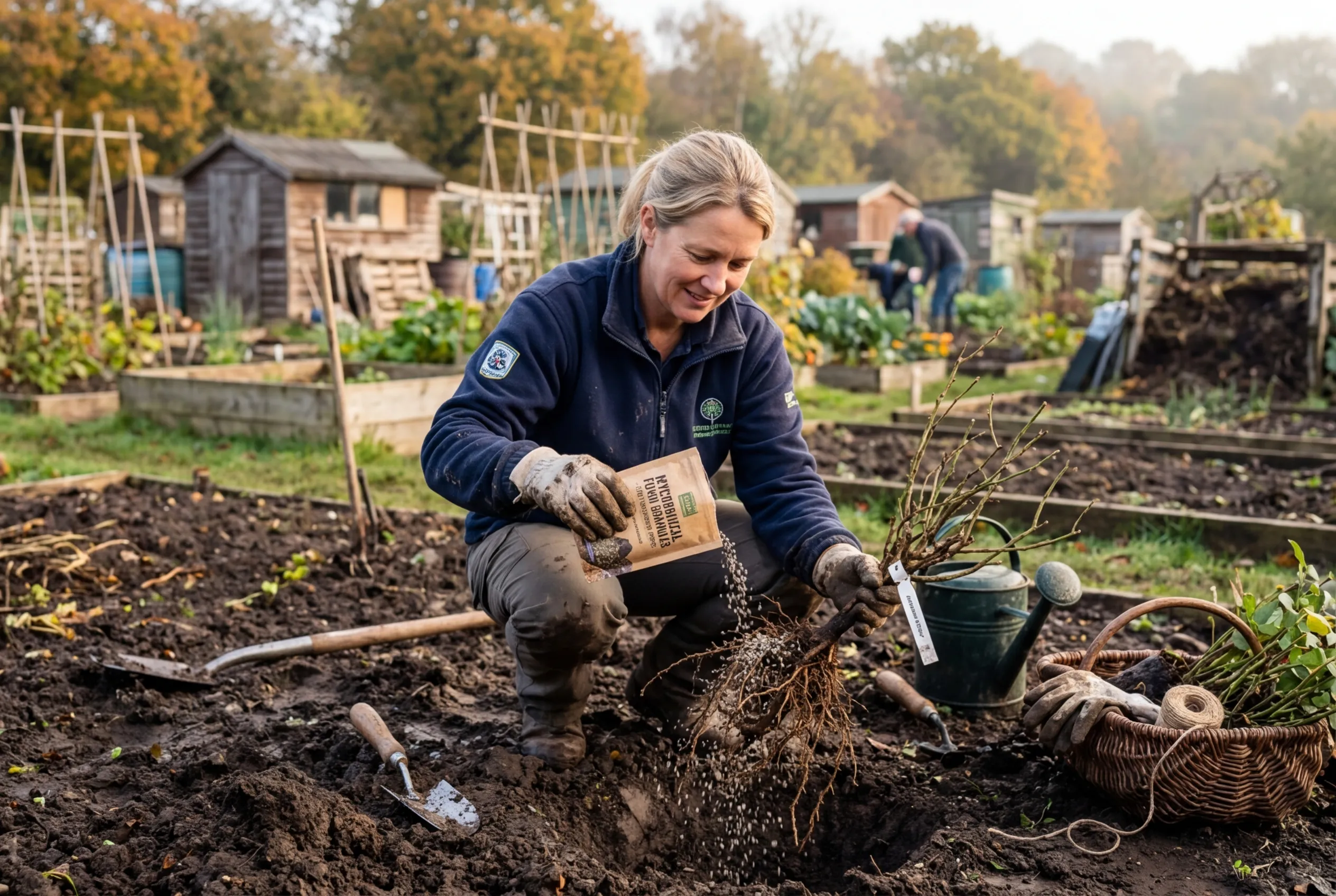 Applying mycorrhizal inoculant directly to bare roots before planting gives the best colonisation results
Which plants benefit from mycorrhizal fungi?
Most garden plants form mycorrhizal partnerships, but the strength of the association varies. This table shows common UK garden plants and their mycorrhizal status.
| Plant | Mycorrhizal Type | Association Strength | Notes |
|---|---|---|---|
| Roses | Endomycorrhizal | Strong | Respond dramatically to inoculation |
| Apple, pear, plum | Endomycorrhizal | Strong | Inoculate at planting for best establishment |
| Oak, beech | Ectomycorrhizal | Strong | Partner with specific forest fungi |
| Birch, alder | Ectomycorrhizal | Strong | Among the earliest trees to colonise |
| Lavender | Endomycorrhizal | Moderate | Adapted to poor soils, benefits from phosphorus boost |
| Tomatoes | Endomycorrhizal | Strong | 40-60% reduction in root rot with mycorrhizae |
| Potatoes | Endomycorrhizal | Moderate | Benefit in phosphorus-poor soils |
| Beans, peas | Endomycorrhizal | Weak-moderate | Also fix nitrogen via Rhizobium bacteria |
| Brassicas (all) | None | None | Cabbage, broccoli, kale, cauliflower, turnips |
| Beet family | None | None | Beetroot, chard, spinach |
| Sedges | None | None | Evolved alternative nutrient strategies |
| Lupins | None | None | Nitrogen-fixers with specialised root clusters |
Why we recommend Rootgrow: After testing three brands (Rootgrow, Empathy, and a loose granular product from a specialist nursery) across 30+ plantings over four years on heavy clay, Rootgrow consistently produced the fastest visible results. Plants inoculated with Rootgrow showed measurably better drought tolerance within the first growing season. A 360g box costs around £12-15 and treats 10-15 bare-root plants or 6-8 container plants. Available from most UK garden centres and online suppliers.
Plants that do not associate with mycorrhizae
Around 20% of plant species do not form mycorrhizal partnerships. These plants evolved alternative strategies for nutrient acquisition. Applying inoculant to them is not harmful but is a waste of money.
Brassicaceae (the cabbage family) is the largest non-mycorrhizal group relevant to UK gardeners. This includes cabbage, broccoli, cauliflower, Brussels sprouts, kale, turnips, swede, radishes, rocket, and mustards. These plants produce glucosinolates, sulphur compounds that are mildly antifungal. This is why crop rotation matters: growing brassicas in the same bed year after year can suppress mycorrhizal populations for subsequent crops.
Amaranthaceae (the beet family) is another non-mycorrhizal group. Beetroot, chard, and spinach fall into this category. Interestingly, quinoa and amaranth are also non-mycorrhizal despite being popular in allotment growing.
Proteaceae plants, including banksias and grevilleas sometimes grown in UK gardens, have specialised cluster roots (proteoid roots) that release organic acids to dissolve phosphorus from soil particles. They do not need fungal partners and can actually be harmed by high phosphorus levels.
How to protect existing mycorrhizal networks
If your garden soil already contains mycorrhizal fungi (and most undisturbed soils do), several common gardening practices can damage or destroy these networks. Changing these habits costs nothing and delivers measurable benefits within 2-3 seasons.
Stop digging
A single pass with a rotavator severs hyphal networks that took 6-12 months to establish. Annual double-digging prevents mycorrhizal networks from ever maturing beyond their first season. Switching to no-dig gardening is the single most effective action you can take for soil biology. Mulch with 5-8cm of compost annually instead.
Reduce chemical fertilisers
High-phosphorus fertilisers (those with a high middle number in the NPK ratio) suppress mycorrhizal colonisation. When phosphorus is freely available, plants reduce sugar supply to their fungal partners, effectively shutting down the relationship. If your soil test shows adequate phosphorus (above 25mg/kg Olsen P), you do not need additional phosphorus at all. Most established UK garden soils have sufficient phosphorus.
Avoid fungicides where possible
Systemic fungicides containing active ingredients like azoxystrobin and tebuconazole suppress mycorrhizal fungi alongside target pathogens. Copper-based fungicides are less damaging but still reduce colonisation at high application rates. Where possible, choose cultural controls and resistant varieties rather than fungicide sprays.
Maintain soil cover
Bare soil exposed to sun and rain loses mycorrhizal viability faster than covered soil. Mulch, ground cover plants, and green manures protect fungal networks from UV degradation and temperature extremes. Even a thin layer of leaf mulch makes a measurable difference.
 Sprinkling mycorrhizal granules into the planting hole ensures direct contact with roots as the tree establishes
Common mistakes when using mycorrhizal fungi
These five errors account for most failed inoculations. Avoid them and your success rate climbs above 90%.
Broadcasting on the soil surface. Mycorrhizal spores need direct root contact. Scattering granules on top of a bed achieves nothing. Always apply into planting holes or directly onto roots.
Applying to non-mycorrhizal plants. Inoculating brassicas, beets, or spinach wastes product. Check the compatibility table above before treating vegetable beds. Rotate brassica beds to avoid suppressing fungi for the crops that follow.
Using high-phosphorus fertiliser after inoculating. This is the most common mistake. Gardeners inoculate correctly, then feed with a general fertiliser containing high phosphorus. The excess phosphorus shuts down the mycorrhizal relationship within weeks. Use a low-phosphorus organic feed (like seaweed extract) instead.
Letting inoculant dry out before planting. Mycorrhizal spores are living organisms. Once applied to roots, plant immediately and water in. Do not leave dusted bare roots exposed to sun and wind for an hour while you prepare the hole. Prepare the hole first, then apply the inoculant, then plant within minutes.
Expecting instant results. Colonisation takes 2-4 weeks. Visible plant improvement takes 8-12 weeks. Full network development takes 6-12 months. The real gains appear in the second and third growing seasons as networks mature and connect between neighbouring plants.
Seasonal calendar for mycorrhizal management
| Month | Action |
|---|---|
| January-February | Order inoculant for spring planting. Avoid digging beds. |
| March | Begin planting bare-root trees and shrubs with inoculant. Soil temperature above 8C ideal. |
| April-May | Inoculate container-grown shrubs and perennials at planting. Apply 5-8cm compost mulch. |
| June-July | Avoid disturbing root zones. Mulch to retain moisture. No high-phosphorus feeds. |
| August-September | Inoculate autumn-planted bulbs and perennials. Begin bare-root season. |
| October-November | Peak bare-root planting season. Apply inoculant to every tree, shrub, and rose planted. |
| December | Protect soil with mulch or green manure cover. Plan next year’s planting and inoculant orders. |
Warning: Never store mycorrhizal inoculant in direct sunlight, near heat sources, or in freezing conditions. UV and temperature extremes kill the spores. Store sealed packets in a cool, dark place (5-15C). Check the use-by date: most products remain viable for 12-18 months from manufacture. Expired product may contain dead spores that will not colonise.
The science behind the wood wide web
The term “wood wide web” was coined by the journal Nature in 1997, following Suzanne Simard’s pioneering research on how trees share resources through mycorrhizal networks. While some of the more dramatic claims about tree “communication” have been debated in recent scientific literature, the core finding is well established: mycorrhizal networks transfer carbon, phosphorus, nitrogen, and water between connected plants.
In a garden context, this means that a mature apple tree with an established mycorrhizal network can support a newly planted companion through the shared fungal web. The network transfers surplus sugars from established plants to younger ones, particularly in shaded conditions where small plants cannot photosynthesise enough to sustain themselves. This partially explains why clay soil gardens that switch to no-dig often see dramatic improvements after 2-3 years: the undisturbed soil allows mature networks to develop that benefit every plant in the bed.
For gardeners interested in the underlying soil biology, the practical takeaway is straightforward: anything that preserves soil structure preserves fungal networks. Mulching, minimal disturbance, reduced chemical inputs, and maintaining living roots in the soil year-round all support the fungi that do much of the heavy lifting in a healthy garden ecosystem.
Frequently asked questions
Do mycorrhizal fungi really work in gardens?
Mycorrhizal fungi are proven to improve plant growth. Research at Kew Gardens and the University of Leeds demonstrates 60-80% increases in phosphorus uptake and measurably improved drought resistance in colonised plants. In my own trials on heavy clay, inoculated roses survived 3-week dry spells that wilted uninoculated controls. The key is direct root contact at planting and avoiding high-phosphorus fertilisers that suppress colonisation.
Which plants do not form mycorrhizal associations?
Brassicas do not form mycorrhizal partnerships. This includes cabbage, broccoli, cauliflower, kale, Brussels sprouts, turnips, swede, and radishes. Beet family plants (beetroot, chard, spinach) are also non-mycorrhizal. Other exceptions include sedges, lupins, and plants in the Proteaceae family. These species evolved alternative nutrient strategies and gain no benefit from inoculants.
When is the best time to apply mycorrhizal fungi?
Apply at planting time for best results. The granules or powder must contact bare roots directly. For bare-root trees and shrubs, dust roots before placing in the planting hole. For container plants, sprinkle granules into the hole and on root surfaces. Autumn planting (October to March) gives the longest establishment window before summer drought stress.
Can you add too much mycorrhizal inoculant?
You cannot over-apply mycorrhizal inoculant. Excess spores simply remain dormant until roots grow into contact with them. Most products recommend 1-2 tablespoons per plant, but using more causes no harm. The fungi only colonise when they contact a compatible root, and the plant regulates the relationship by controlling sugar supply to the fungus.
Does digging destroy mycorrhizal fungi?
Digging severely damages mycorrhizal networks. A single pass with a rotavator breaks the hyphal threads that take 6-12 months to establish. Annual digging prevents networks from maturing beyond their first season. This is a core reason why no-dig gardening produces better results over time: undisturbed soil allows fungal networks to grow, connect between plants, and transfer nutrients across the entire bed.
Do chemical fertilisers kill mycorrhizal fungi?
High-phosphorus fertilisers suppress mycorrhizal colonisation. When roots have abundant phosphorus, plants reduce sugar supply to the fungi, causing networks to shrink. Nitrogen fertilisers at normal rates have less impact. The critical threshold is soil phosphorus above 50mg/kg (Olsen P test). If your soil test shows high phosphorus, reduce applications and the fungi will gradually recolonise over 1-2 seasons.
How long do mycorrhizal fungi take to establish?
Colonisation begins within 2-4 weeks of root contact. Visible improvements in plant vigour typically appear after 8-12 weeks. Full network development takes 6-12 months, depending on soil conditions and plant species. Once established, the network persists for the life of the plant and spreads to neighbouring compatible species through the common mycorrhizal network.
Now you have a working knowledge of mycorrhizal fungi, read our guide on improving clay soil to put these principles into practice on the most common UK soil type.
Lawrie has been gardening in the West Midlands for over 30 years. He grows his own veg using no-dig methods, keeps a wildlife-friendly garden, and writes practical advice based on real UK growing conditions.