Key takeaways
- Camassias flower from early May to mid-June — the crucial 4-6 week gap between tulips finishing and summer perennials starting
- Plant bulbs 10cm deep and 15cm apart in September-November, in damp soil that other bulbs would rot in
- Slug and deer resistant — unlike tulips and lilies, camassias survive with no protection in rural and woodland gardens
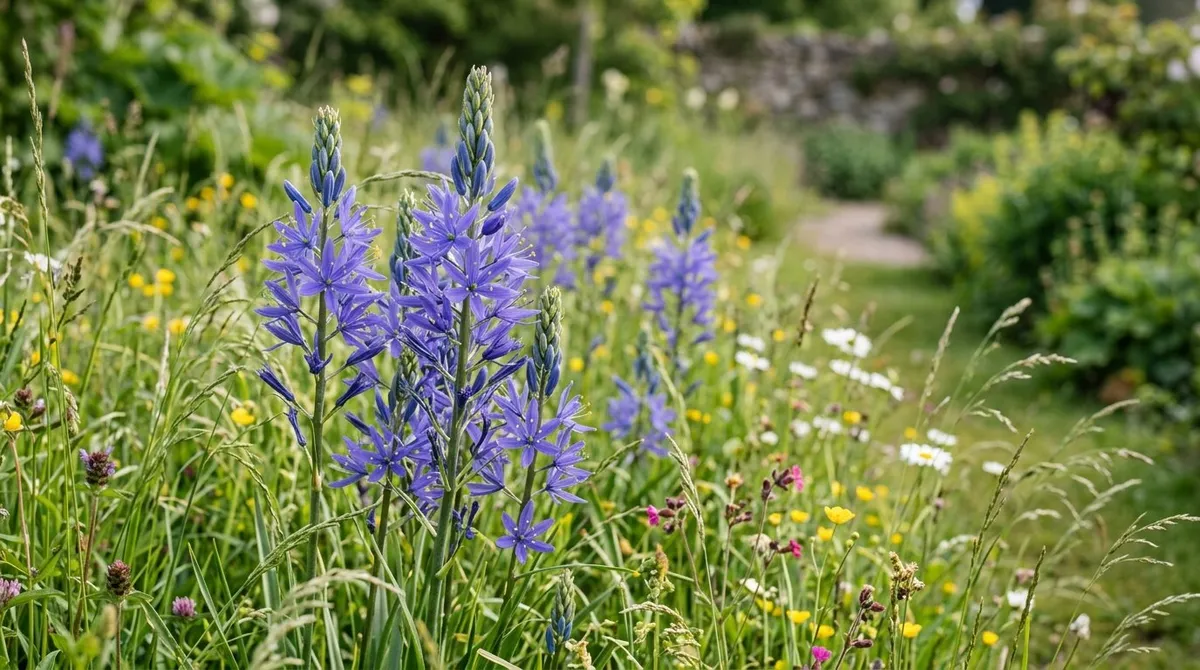
- Camassia leichtlinii 'Caerulea' is the tallest and most elegant at 120cm, naturalising beautifully in long grass
- Ideal for meadow planting mixed with orchids, fritillaries, and wildflowers — cuts cleanly after flowering
- Native Americans used camassia bulbs as a staple food crop, harvested in autumn and slow-baked for 24-48 hours
Camassias fill the one gap in the British bulb calendar that nothing else does. Tulips finish in late April. Most summer perennials do not start flowering until mid-June. That leaves a three to six week window in May when the border can look tired. Camassias close the gap elegantly with tall blue spires reaching 120 centimetres — almost chest high — above whatever is coming through beneath.
They also solve the wet-soil bulb problem. Most spring bulbs rot in heavy clay or damp meadow ground. Camassias evolved in moist meadows of the Pacific Northwest, where soil stays saturated from October to May. Plant them in the boggy bit of your garden where daffodils have failed and they will thrive there for decades, multiplying by both seed and bulb offsets.
This guide covers the five species worth growing, the October planting routine that doubles your establishment rate, how to combine camassias with fritillaries and orchids for a proper meadow effect, and why this is one of the few UK bulbs no slug or rabbit will touch.
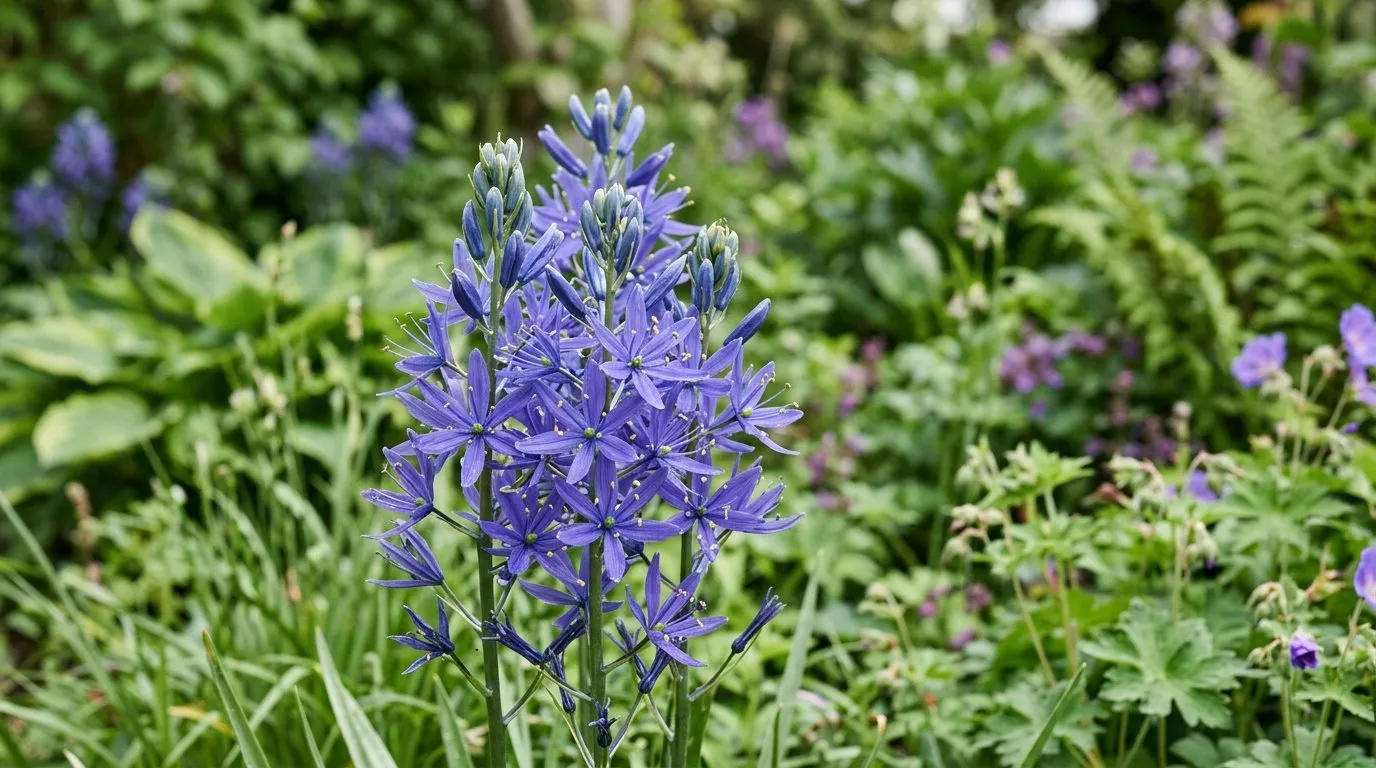 Camassia leichtlinii ‘Caerulea’ naturalised in long meadow grass in mid-May. The damp-tolerant tall spires close the gap between tulips and summer perennials.
What is camassia?
Camassia (sometimes spelled camassi or quamash) is a hardy bulbous perennial in the Asparagaceae family, the same group that includes agaves and asparagus. Five species are native to moist meadows, damp grassland, and stream banks across western North America, from British Columbia south to northern Mexico. Native Americans harvested camassia bulbs as a staple food crop for at least 8,000 years, slow-baking them in pit ovens to convert the bitter inulin starches into sweet digestible sugars.
The plant grows from a brown-coated bulb 3-5cm across. In spring, strap-like green leaves emerge, followed by a single flowering stem reaching 45-120cm tall depending on species. Each stem carries 20-40 star-shaped flowers opening from the bottom upward over 2-3 weeks. Flowers are blue, white, or cream in garden varieties.
Introduced to British horticulture in 1837, camassia was slow to catch on until the 1990s when meadow-style planting became fashionable. It is now widely planted in damp orchards, wildflower meadows, and the naturalistic “New Perennial” style popularised by Piet Oudolf.
Unlike typical spring bulbs like daffodils and tulips, camassia thrives on wet soils that would rot most other bulbs. That single difference makes them invaluable for gardens with heavy clay or seasonally waterlogged areas.
Which camassia species grow best in UK gardens?
Five species dominate UK nurseries, with Camassia leichtlinii the most widely sold and easiest to grow.
| Species | Flower Colour | Height | Flowering Time | Notes |
|---|---|---|---|---|
| C. leichtlinii ‘Caerulea’ | Rich blue | 90-120cm | Mid-May to mid-June | Tallest, most elegant, slowest to establish |
| C. leichtlinii ‘Alba’ | Pure white | 90-120cm | Mid-May to mid-June | Lovely with white narcissi and tulips |
| C. cusickii | Lavender-blue | 60-80cm | Early-mid May | Shorter, faster establishment |
| C. quamash | Deep blue | 30-60cm | Late April-May | Smaller native species, earliest to flower |
| C. esculenta | Blue-purple | 30-50cm | Early May | Edible species used by Native Americans |
| C. leichtlinii ‘Sacajawea’ | Cream + variegated | 80cm | Mid-May | Striking variegated foliage |
Camassia leichtlinii ‘Caerulea’
Camassia leichtlinii ‘Alba’
The white form of the above. Just as vigorous and tall but with pure white flowers that glow at dusk. Fantastic in a white garden planting scheme or anywhere you want to lighten a shaded corner.
Camassia cusickii
A shorter, earlier-flowering species that establishes faster. 70cm tall in most UK gardens with densely packed lavender-blue flowers. Flowers 1-2 weeks before C. leichtlinii, extending the total camassia season to 5-6 weeks when both are grown together.
Camassia quamash
The smallest common species at 30-60cm, with deep blue flowers in late April. Better for front-of-border positions than meadow naturalising because of its shorter stature. Tolerates slightly drier soil than other camassias.
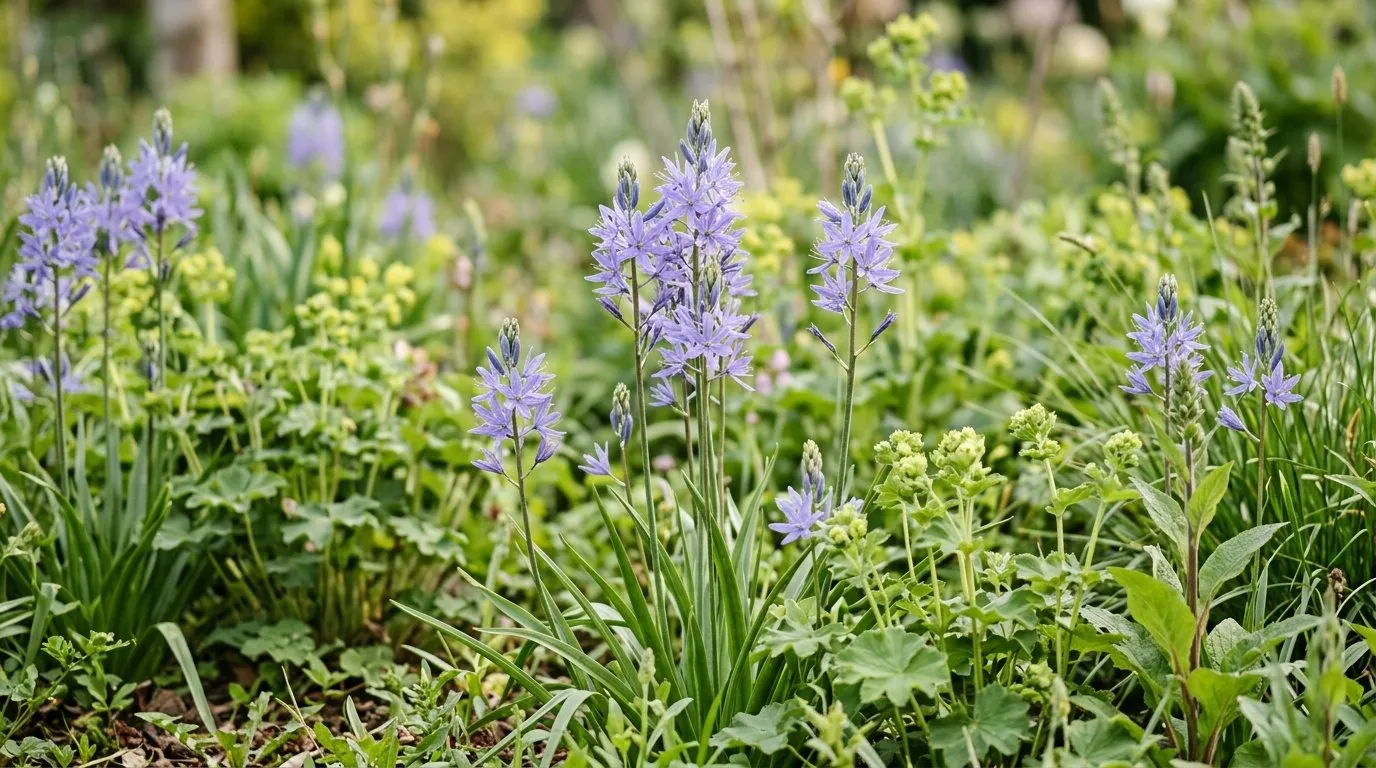 C. cusickii in early May. Shorter and denser than leichtlinii — better for front-of-border positions.
Where do camassias grow best in UK gardens?
Three conditions make camassias happy: spring moisture, summer dormancy, and decent depth of soil.
Light: Full sun to partial shade. Deep shade reduces flowering by 40-50%, so even woodland-edge plantings need at least a half-day of sunshine. In Scotland and northern England, full sun produces the strongest spikes. In southern England, light afternoon shade prevents flower colour fading in heat.
Soil: Moist to wet, fertile, on the heavy side. Heavy clay suits camassias perfectly because it stays damp when lighter soils dry out in late spring. Sandy soil works only if regularly watered or mulched heavily. Chalky ground is tolerable but produces shorter stems.
Moisture: The key requirement. Soil should stay consistently moist from February to June, while bulbs are actively growing. Summer drought is fine once the foliage has died back. Camassias grown in seasonal bog or stream-side plantings thrive; those in dry rockeries struggle.
Position: Meadow and long-grass plantings show camassias off best. Orchard grass, wild-flower meadow strips, and damp ditches all work. Conventional mixed borders are fine but require deadheading to prevent unwanted seedlings.
For inspiration on damp-soil planting, see how to create a bog garden and mini meadow wildflower planting.
How to plant camassia bulbs
Plant bulbs in autumn, October being optimal. The window runs from early September to late November, though September plantings establish strongest roots before winter.
Step 1 - Source bulbs. Buy from reputable bulb suppliers. Bulbs should be firm, 3-5cm across, with intact brown skins and no soft spots. Reject any with mould or visible damage. Expect to pay £6-£12 for 10 bulbs from UK specialists.
Step 2 - Prepare the ground. For meadow plantings, cut grass short one week before planting. For border plantings, dig in garden compost or leaf mould. On very heavy clay, mix sharp grit into the top 20cm to improve local drainage without eliminating the moisture bulbs need.
Step 4 - Space correctly. 15cm between bulbs for a natural look, or 10cm for denser displays. Scatter bulbs by tossing handfuls and planting where they land to avoid regular patterns.
Step 5 - Water in. Unless the soil is already saturated from autumn rain, water heavily after planting to settle the soil and trigger root growth.
For a full step-by-step approach to layered spring bulb planting, see bulb lasagne planting.
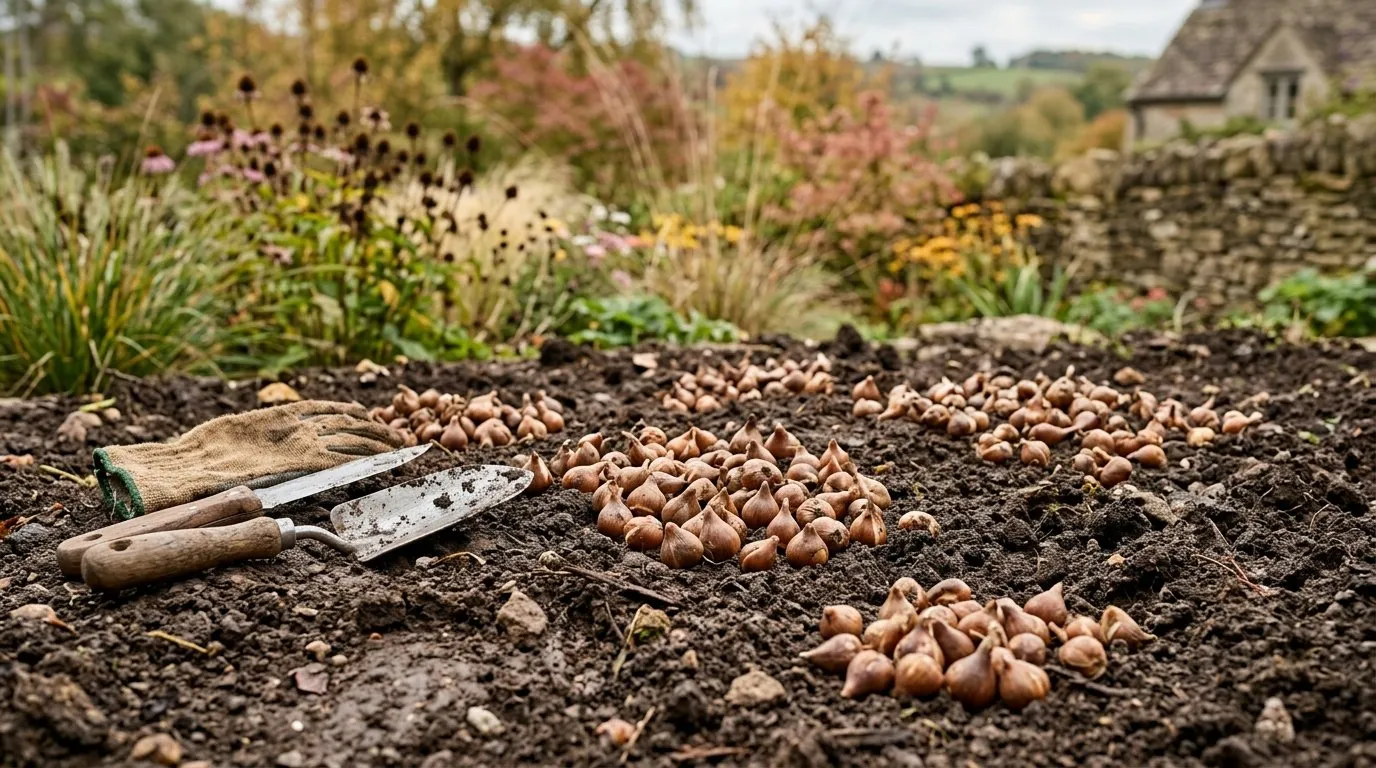 Camassia bulbs ready for October planting. Space 15cm apart, 10-15cm deep, in groups of 7-15 for natural-looking clumps.
How to naturalise camassia in grass
The mowing schedule is the critical factor.
- March to mid-July: Do not mow. Let grass grow long. Camassia foliage needs 8-10 weeks after flowering to photosynthesise and feed next year’s bulb.
- Mid-July: First cut, with blades set high (10-12cm). This removes tall grass while camassia foliage has fully browned and pulled back nutrients into the bulbs.
- August to October: Mow monthly at normal height.
- November to February: Stop mowing. Frost protection.
Mow-too-early is the single biggest mistake. If the grass is cut in May or June while camassia leaves are still green, the bulb cannot build energy for the following year. Flowering drops by 50% within two seasons and the planting fades out over 5-7 years.
Partner plants for naturalising:
- Snake’s head fritillary (Fritillaria meleagris) - flowers in April, finishes as camassia starts
- Orchids (Dactylorhiza species) - flower in June, take over as camassia finishes
- Yellow rattle (Rhinanthus minor) - suppresses grass vigour, supporting meadow establishment
- Ox-eye daisies - July flowering, continuing the meadow display
- Pheasant’s eye narcissus (Narcissus poeticus) - April-flowering, same damp meadow conditions
For a white-flowered partner that extends the same grassy display, ornithogalum for naturalising in grass works alongside camassia in the same damp meadow conditions.
How to combine camassia in mixed borders
In conventional borders, camassias provide mid-height structure in the May gap between bulbs and summer perennials.
Classic blue combination: C. leichtlinii ‘Caerulea’ with late tulips in soft yellow or cream, forget-me-nots at the front, and alliums coming through for June. Peak in mid-May, continuing into early June.
White and green scheme: C. leichtlinii ‘Alba’ with cream Iris sibirica, white astrantia, and lime-green alchemilla. Cool, elegant, and pollinator-friendly.
Wildflower edge: C. cusickii, Anthriscus sylvestris ‘Ravenswing’ (dark-leaved cow parsley), pink campion, and ox-eye daisies. Modern naturalistic style that blends border and meadow.
Orchard underplanting: Camassia with Narcissus ‘Thalia’, snake’s head fritillaries, and wood anemones. Flowers sequentially from March to June under fruit trees.
Deadhead camassia after flowering in contained border plantings to prevent self-seeding into inappropriate spots.
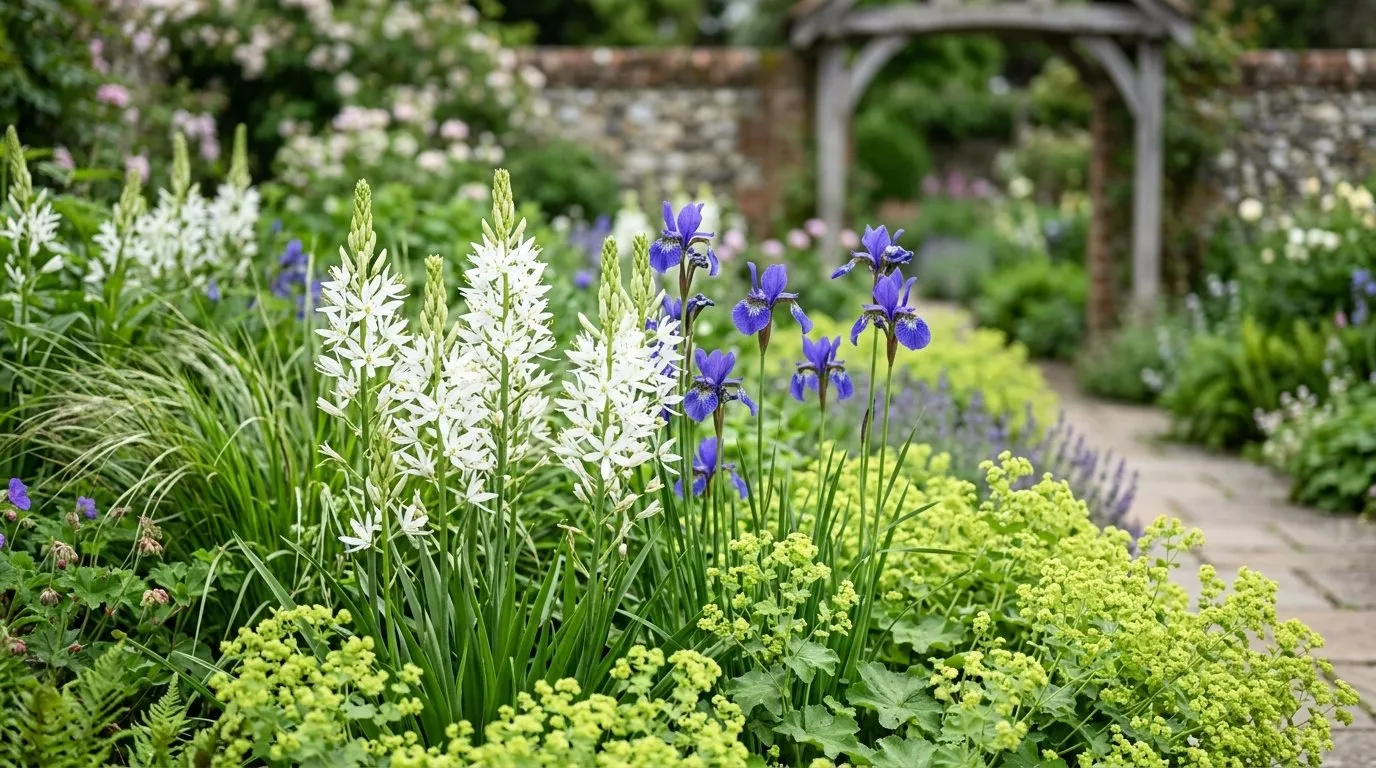 C. leichtlinii ‘Alba’ with Iris sibirica and alchemilla. A cool white-and-blue combination peaking in mid-May.
How to divide and propagate camassia
Camassia clumps grow denser over 5-8 years through bulb offsets forming around the parent. Eventually flowering reduces as bulbs compete. Division rejuvenates clumps.
When: July, once foliage has died back completely.
How:
- Fork up the whole clump, keeping a wide spread to avoid damaging bulbs.
- Separate individual bulbs by hand. A 5-year-old clump typically yields 3-5 bulbs per original planting.
- Replant the largest bulbs (flowering size) at original depth and spacing.
- Plant smaller offsets in a nursery bed or pot for 2-3 years until they reach flowering size (about 3cm diameter).
- Water well and mulch with leaf mould.
From seed: Collect seed from mature pods in July as they turn brown but before splitting. Sow immediately in pots of gritty compost outdoors. Germination occurs the following spring. Plants reach flowering size in year 4-5.
Common camassia problems
Slugs, rabbits, and deer. None of these are significant problems. Camassia bulbs and leaves contain saponins that deter herbivores. The rare damage comes from rabbits nibbling fresh spring growth in late March, which the plants shrug off.
Flopping stems. Tall C. leichtlinii can flop in wet windy spells. This is mostly cosmetic; stems right themselves once weather settles. If problematic, use discreet brushwood supports in mid-April before stems elongate.
Poor flowering. Usually caused by planting too shallow (under 8cm), too much shade, or insufficient moisture. Lift bulbs in July and replant 10-15cm deep in a better position.
Bulbs rotting. Rare but occurs in extended waterlogging with no drainage. Camassias tolerate wet but not stagnant water. Improve drainage slightly by adding grit to planting holes.
Foliage dying early. Browning foliage in late May or June indicates rapid drying of the soil. Mulch heavily in spring to retain moisture. The bulb can survive one bad year but repeated early dieback weakens the plant.
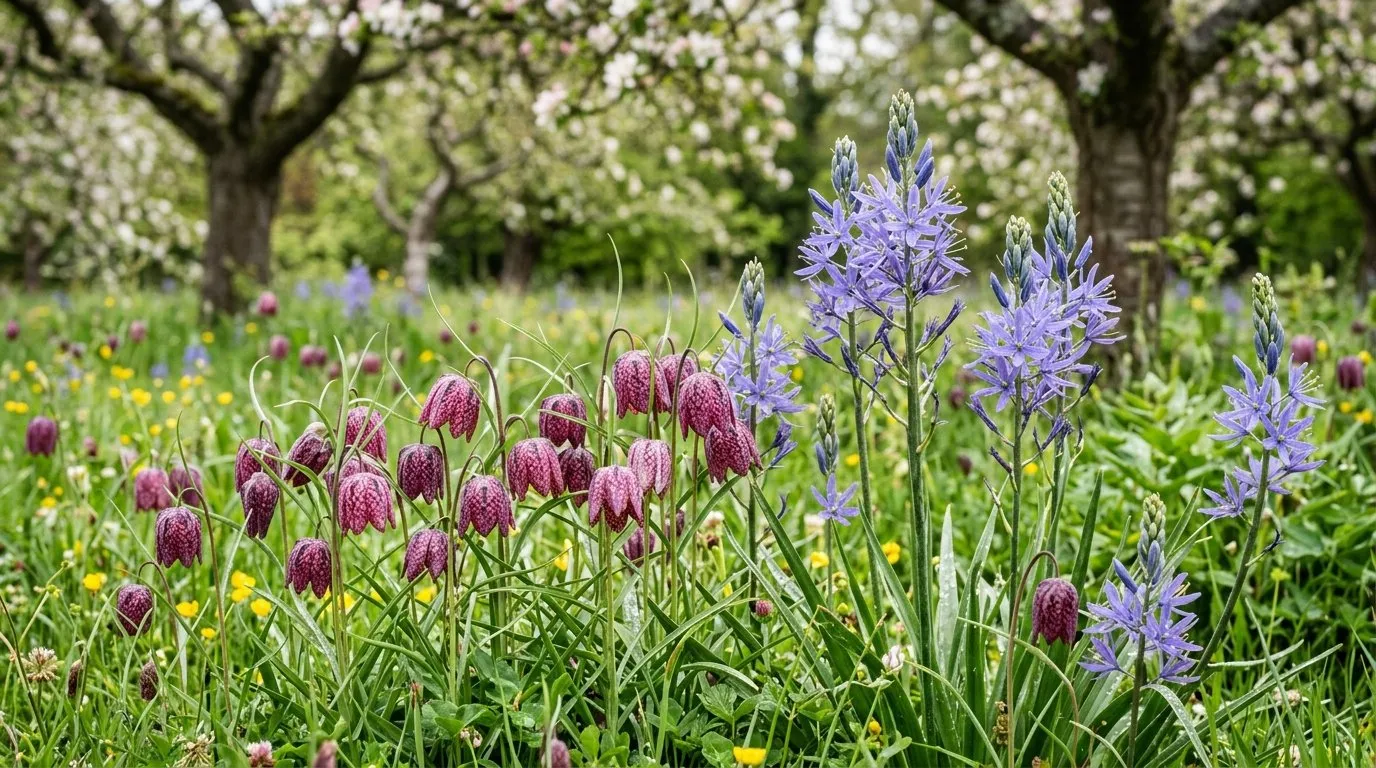 Camassia and snake’s head fritillaries in a damp meadow. Sequential May flowering creates a full six weeks of wildflower display.
Camassia maintenance calendar
| Month | Task | Time per 50 bulbs |
|---|---|---|
| February | Check for rabbit damage on emerging tips | 5 minutes |
| March | Growth begins. Stop mowing meadow plantings | None |
| April | Monitor for waterlogging in severe wet. First flowers on early species | Minimal |
| May | Peak flowering. Enjoy. Photograph for records | None |
| June | Late flowers finish. Deadhead border plantings if self-seeding unwanted | 30 minutes |
| July | Foliage dies back. First mow of meadow at high blade setting | Variable |
| August-September | Divide congested clumps | 1-2 hours (division year) |
| October | Plant new bulbs. Mulch existing plantings | 1 hour per 50 new bulbs |
| November-January | Dormant. No action needed | None |
Total annual maintenance is around 2-3 hours per 50 bulbs in a non-division year. Meadow plantings need essentially no weekly care beyond the seasonal mow.
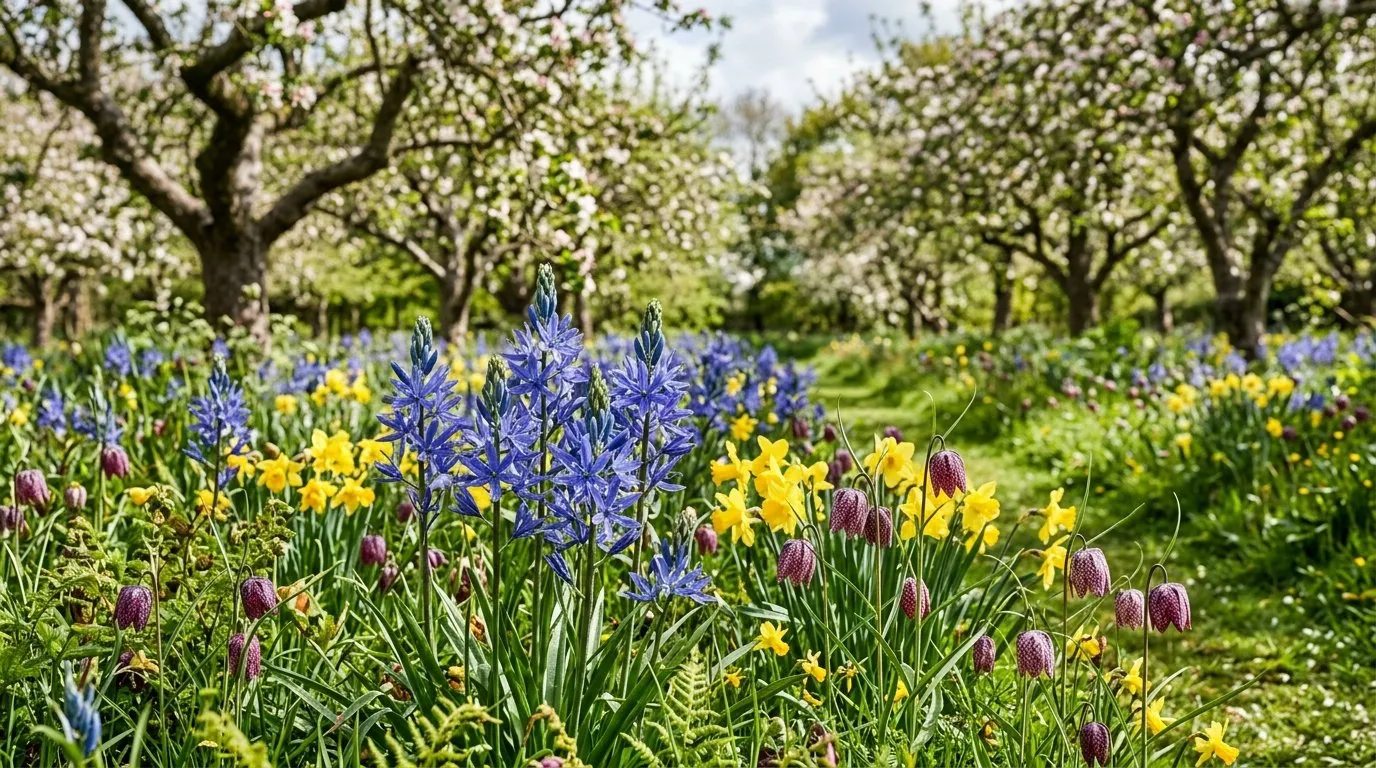 Camassia in a naturalised orchard meadow with daffodils and fritillaries. Sequential flowering March-May creates a full spring display.
Where to buy camassia bulbs in the UK
Buy from specialist bulb suppliers in September for planting in October. Peter Nyssen, Avon Bulbs, and J Parker’s all carry reliable camassia stock. Expect to pay:
- C. leichtlinii ‘Caerulea’ (blue) - £0.80-£1.50 per bulb in 10-bulb packs
- C. leichtlinii ‘Alba’ (white) - £1.00-£2.00 per bulb
- C. cusickii - £0.50-£1.00 per bulb (often cheapest)
- C. quamash - £0.30-£0.60 per bulb (smallest and cheapest)
A 10 square metre meadow planting needs 60-100 bulbs for a good display, costing £50-£120 depending on species. Bulbs multiply over time, so this is a one-off investment for decades of May flowering.
For guidance on broader bulb planting and care, see our spring bulb care and when to plant spring bulbs guides.
Frequently asked questions
When should I plant camassia bulbs in the UK?
Plant camassia bulbs from September to November, ideally October. Bulbs planted in September have 2-3 weeks of root development before winter cold sets in. Planting in December or January still gives a reasonable first-season flowering display but roots establish less strongly. Avoid spring planting, which gives weak flowers and stressed plants for the first season.
How deep should you plant camassia bulbs?
Do camassias naturalise in UK grass?
Camassias naturalise exceptionally well in long grass, spreading slowly by both seed and offset bulbs. A planting of 20 bulbs typically triples to 60-80 flowering stems within 5-7 years in suitable damp conditions. They work best in meadows, orchard grass, or shaded lawns that can be left uncut from March to mid-July. Regular mowing in spring kills the foliage before it feeds the bulb, preventing naturalisation.
What is the difference between Camassia leichtlinii and Camassia cusickii?
Camassia leichtlinii is taller (90-120cm) with larger, more evenly spaced star-shaped flowers in blue, white, or cream. Camassia cusickii is shorter (60-80cm) with lavender-blue flowers densely packed on the spike. C. leichtlinii flowers 1-2 weeks later than C. cusickii. Both species tolerate damp soils, but C. cusickii is slightly more drought-tolerant and faster to establish in new plantings.
Are camassias slug-resistant?
Should I deadhead camassia?
Deadhead camassia only if you do not want self-seeding. Cut the flower stem at the base with secateurs once the last flowers fade in June. If you leave the seed heads, each stem produces 50-200 seeds that germinate in year one and reach flowering size in year 4-5. This is how meadow plantings naturalise. For contained border displays, deadheading prevents unwanted seedlings.
Can you eat camassia bulbs?
Native Americans ate camassia bulbs as a staple food crop, harvesting in autumn and slow-baking in pit ovens for 24-48 hours to convert indigestible starches into sweet sugars. Raw bulbs are mildly toxic and unpalatable. Do not confuse edible camassia with the similar-looking but deadly Zigadenus (death camas), which sometimes grows in the same meadows. For safety, treat garden camassias as ornamental only.
Sources: RHS Camassia growing guide | Plantlife - meadow planting resources
Our team produces practical UK gardening guidance from source research, contributor records and established horticultural practice. Editorial standards are overseen by Matt W.