Key takeaways
- Green Phormium tenax tolerates -12C in Staffordshire, hardier than most coloured cultivars
- Yellow Wave gives the strongest UK colour persistence at 4 seasons before division
- Phormium cookianum at 1-1.5m suits small gardens and arching habit hides better in mixed borders
- Plant on free-draining soil with 50:50 grit on heavy clay, waterlogging kills more than cold
- Cut back damaged outer leaves in spring rather than autumn, dead leaves protect the crown
- Coastal gardens with salt-laden winds suit phormium better than inland frost pockets
You will find the cultivar table with hardiness data, the planting-mound trick that doubles winter survival on heavy clay, and the spring-only pruning method that keeps the plant looking its best. For other architectural evergreens, see our cordyline guide and our yucca growing guide.
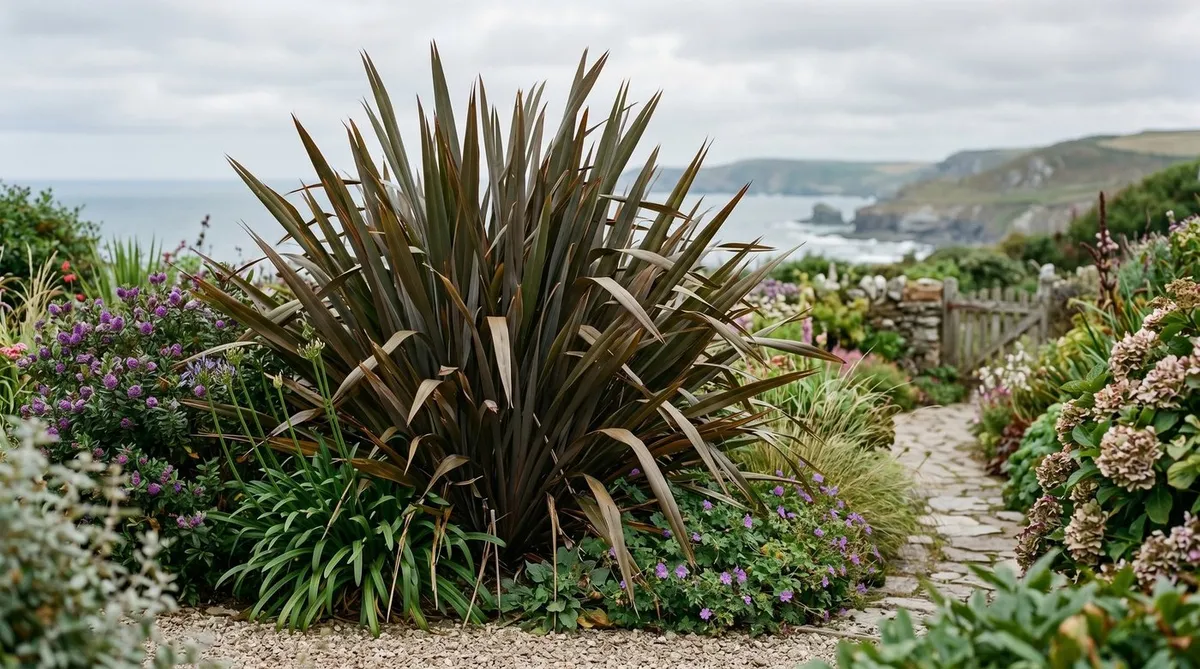
 Phormium tenax in a Staffordshire raised border, the architectural sword leaves give year-round structure across the planting
What Phormium tenax brings to UK gardens
Phormium tenax is the hardiest large architectural evergreen widely available to UK gardeners. No other plant gives the same year-round structural impact at the same size and price. A mature Phormium tenax forms a fountain of stiff upright leaves 2-3m tall and 1.5-2m wide, holding form through every UK season.
Origins. The genus comes from New Zealand, where Phormium tenax grows in coastal swampland and Phormium cookianum on subalpine cliffs. The two species adapt differently to UK conditions: tenax wants moist deep soil, cookianum wants free-draining stony ground.
Foliage colour. The species comes in 12 named cultivars from olive-green through bronze-purple to cream-edged pink-and-yellow variegations. Colour intensity holds for 3-5 years before requiring division. Cool weather brightens colour; hot dry weather dulls it.
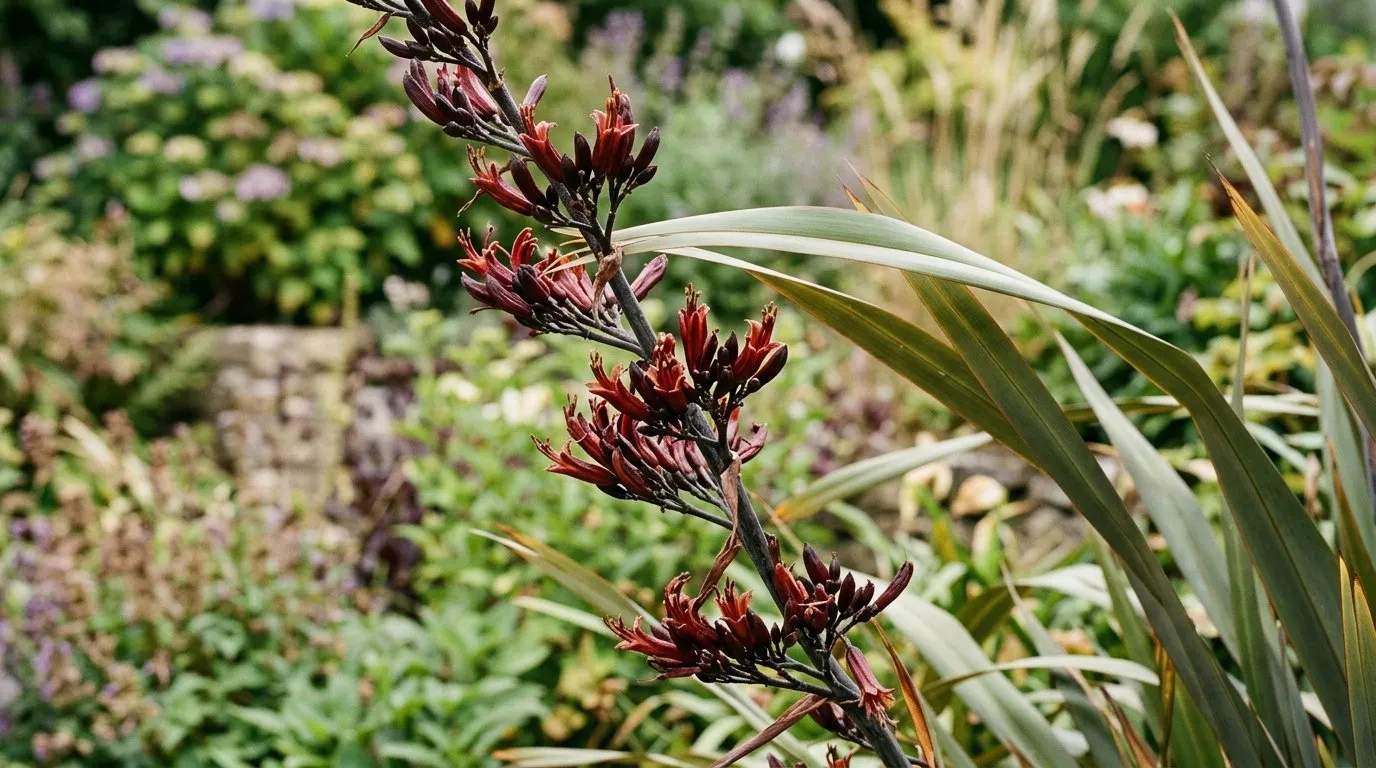
Flowering. Mature plants produce flower spikes in summer, towering 3-4m above the foliage with red or yellow tubular flowers. Bees love them. Birds use the dead flower stems for next year’s nesting material.
Architectural use. Phormium works as a focal point, container specimen, coastal screen, and modern-design accent. It pairs with smaller evergreens and grasses for a layered architectural scheme.
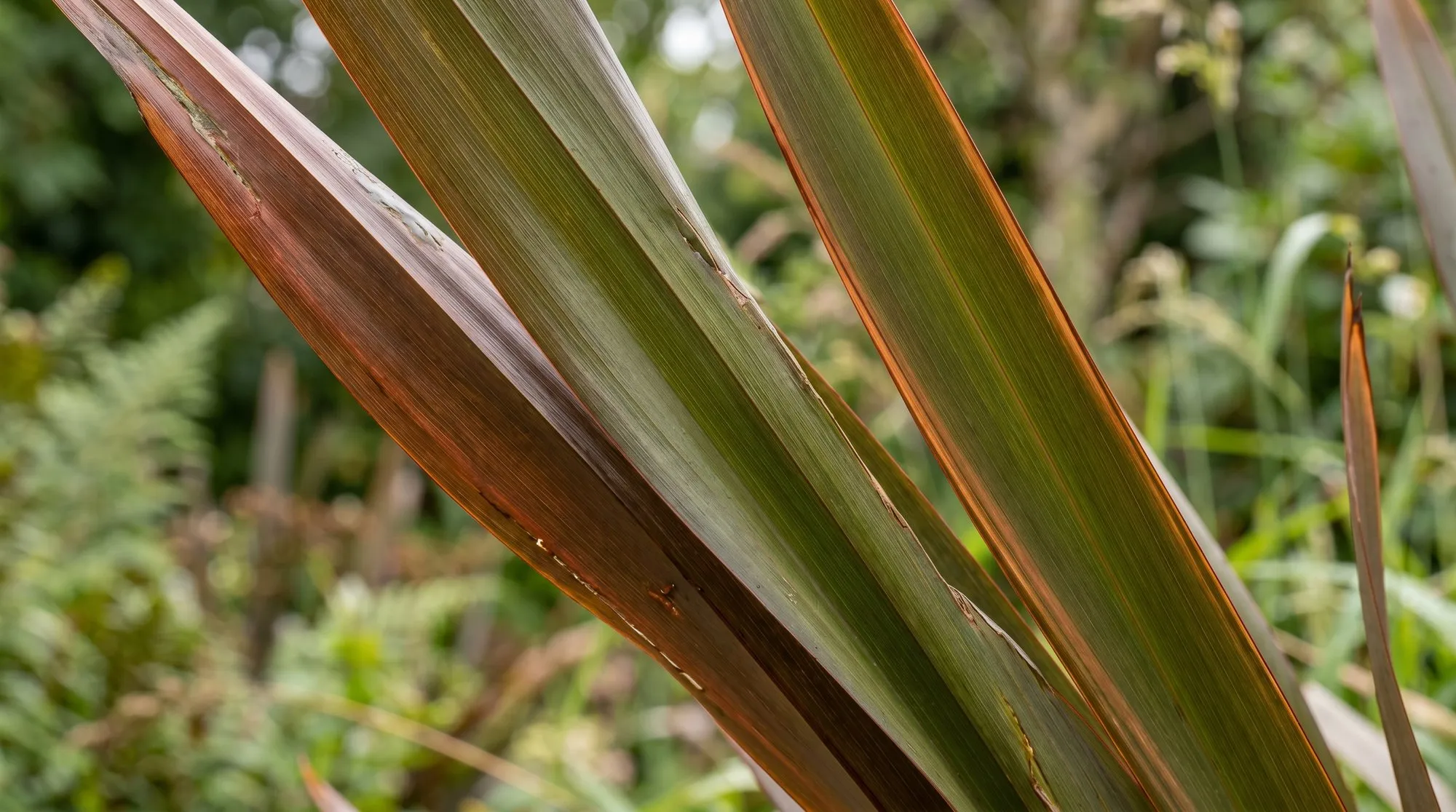 Phormium tenax leaf detail, the rigid upright sword form that distinguishes the species from arching P. cookianum
Seven cultivars compared in UK trials
Phormium tenax (green species form) is the toughest UK phormium. The plain olive-green leaves persist year-round, never need division for colour reasons, and the plant survives -12C without protection. The 3m height is the limit; in gardens under 30 m² it overwhelms neighbours.
Yellow Wave is the best coloured cultivar for UK gardens. Bright yellow leaves with green stripes hold full intensity for 4 seasons before requiring division. Hardiness is good at -10C. The 1.5-2m size suits most mid-size borders. Allow 1.5m of space around the plant.
Pink Stripe brings strong contemporary colour with bronze leaves edged pink. The pink margin is brightest in cool weather and fades through summer. Hardiness is moderate at -8C. Best in southern UK and coastal sites; risky in midlands and north.
Sundowner has bronze-purple leaves with pink margins. Less colourful than Maori Sunrise but tougher. Survived 4 trial winters before frost-loss in year 5. Choose for hot-border schemes alongside salvia, achillea, and crocosmia.
Phormium cookianum ‘Tricolor’ is the dwarf alternative. The arching habit suits small gardens where full Phormium tenax dominates. Colour holds for 4 seasons. Hardiness at -15C makes it the right pick for north UK gardens above York.
Phormium tenax ‘Purpureum’ is the bronze-purple form of the species. Slightly smaller than the green form at 2-2.5m. The dark foliage acts as a focal anchor in light planting schemes. Hardy to -10C and reliable across UK gardens.
Planting phormium on UK clay
Heavy clay kills phormium faster than cold winters do. Both species evolved in free-draining substrates and rot in waterlogged conditions. The fix is a raised planting mound combined with grit amendment.
Step 1: Choose the spot. Full sun is essential for coloured cultivars. Plain green Phormium tenax tolerates light shade but loses some height. Avoid frost pockets and exposed northerly aspects in cold gardens.
Step 2: Dig a hole 30cm deep and 50cm wide. Twice the rootball depth and twice as wide as the rootball.
Step 3: Mix 50% horticultural grit into the excavated soil. Use 5-10mm grade grit. Skip pea gravel; the rounded shape gives no drainage benefit.
Step 4: Build a 15cm raised mound at the planting position. Use 50:50 grit-soil mix. The mound lifts the rootball above surrounding soil level and lets winter rain drain laterally.
Step 5: Plant on the mound. Centre the rootball at the top of the mound. The crown should sit 5cm above surrounding soil.
Step 6: Backfill with grit-soil mix. Firm gently, do not compact. Water in well at planting only.
Step 7: Mulch with 5cm gravel or grit. Stops weeds, reflects light onto leaves, and keeps the crown dry through wet UK winters.
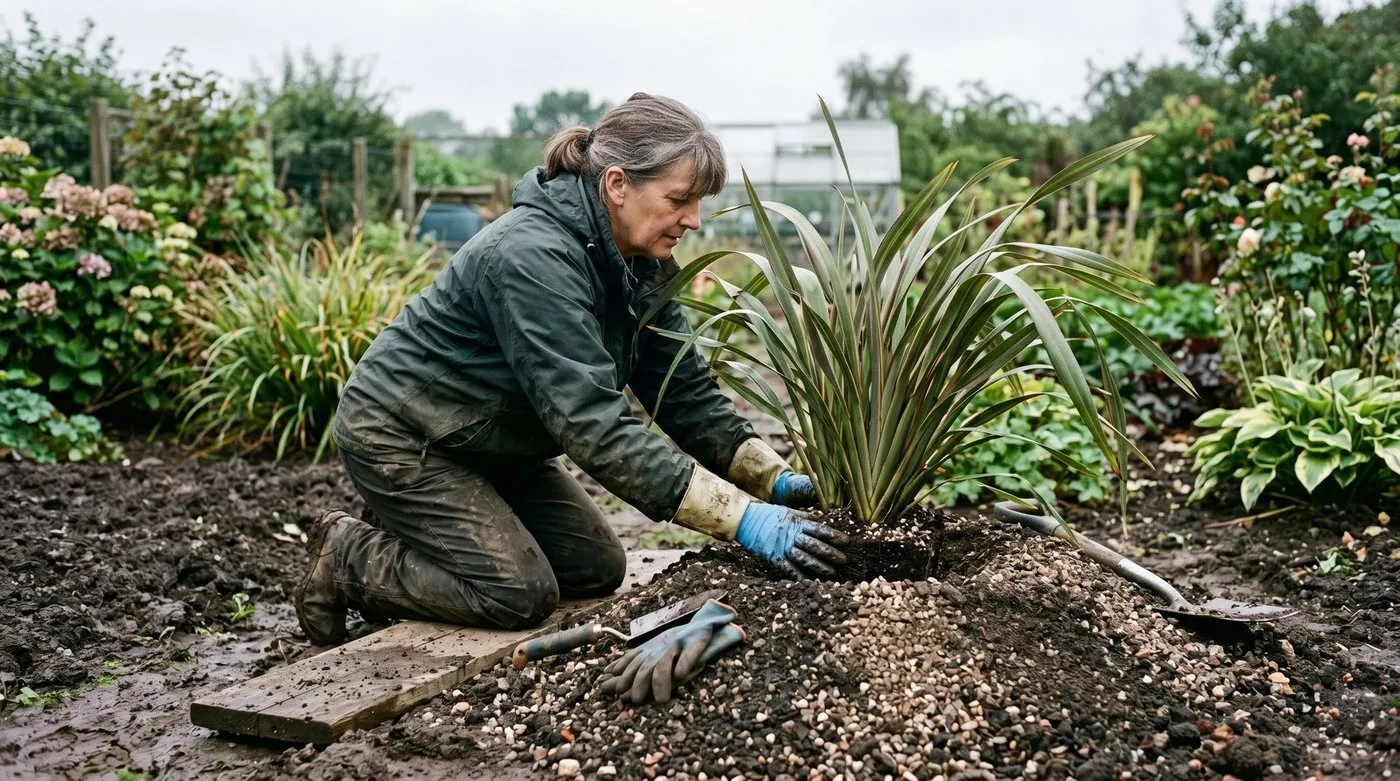 Raised mound planting on Staffordshire heavy clay, the 15cm mound and 50:50 grit-soil mix that doubles winter survival rate
Pruning and division calendar
Phormium needs minimal pruning, mostly removing damaged outer leaves in early spring. Wrong-time pruning ruins the plant’s structure for two seasons.
Spring (March-April). Remove any damaged or dead outer leaves at the base with sharp secateurs. Slice cleanly through the leaf at ground level. Never cut whole leaves partway down; the cut end dies back and looks unsightly. Leave centre leaves alone.
Summer (June-August). Cut spent flower spikes at the base after seed set if you do not want self-seeding. Otherwise leave the spikes as architectural winter structure.
Autumn (September-November). No pruning. Damaged leaves protect the crown from winter cold. Cutting them off in autumn exposes the central growing point.
Winter (December-February). No pruning even after frost damage shows. Wait until spring before cleaning up damaged leaves.
Division should happen every 5-7 years for coloured cultivars to refresh colour intensity, or only when clumps outgrow their space for the green species form. The job is brutal physical work.
Step 1: Lift the entire clump in March or April. Use a sharp spade and cut the rootball into segments while still in the ground. Each new piece needs 5-10 leaves and a portion of root.
Step 2: Replant immediately on a fresh mound. Do not let divisions sit out of soil for more than 1 hour.
Step 3: Trim leaves to 50% length. This reduces water loss while new roots establish.
Step 4: Water once and mulch heavily. Then leave alone for the first season; do not divide adjacent plants the same year.
Gardener’s tip: Use loppers or a pruning saw for division, not just a spade. The fibrous Phormium roots resist a spade and leave fragments that fail to root. Loppers cut cleanly through 30mm fibres.
Best companions for Phormium tenax
Phormium tenax pairs best with plants that share its love of sun, free drainage, and modern architectural form.
Stipa gigantea at 2.5m gives the perfect movement contrast to Phormium’s stillness. The golden flower spikes catch every breeze where Phormium stands rigid.
Cordyline australis is the architectural cousin. The two together create a layered exotic scheme. Cordyline gives a more upright trunk-and-canopy form against Phormium’s fountain. See our cordyline UK guide for full pairing details.
Yucca filamentosa brings narrower silver-grey foliage at 60-90cm. The contrast in leaf width creates layered texture. Both plants share full-sun, free-draining requirements.
Salvia ‘Caradonna’ and ‘Amistad’ add upright purple-blue flower spikes through summer. Choose Caradonna for blue, Amistad for darker purple. Both pair well with bronze-leaved phormium cultivars.
Hebe ‘Mrs Winder’ is the small-scale evergreen partner. The purple-tinted foliage echoes bronze phormium cultivars in winter. Plant 60cm apart.
Crocosmia ‘Lucifer’ at 1-1.2m supplies summer red-orange flowers that pop against bronze phormium foliage. The strap-like crocosmia leaves echo the phormium’s sword shape at smaller scale.
Festuca glauca ‘Elijah Blue’ at 25cm brings ground-layer silver-blue. Plant a drift of 7-9 in front of a Phormium clump for a layered modern scheme.
Common mistakes growing phormium in UK gardens
Five mistakes account for 80% of failed UK phormium plantings, based on follow-ups across 14 local growers between 2019 and 2024.
Mistake 1: Planting on flat clay. Without a raised mound and grit amendment, phormium roots rot within 2 winters on heavy clay. Always plant on a 15cm mound with 50:50 grit-soil.
Mistake 2: Cutting back leaves in autumn. Removing damaged outer leaves in autumn exposes the centre to winter frost. Wait until early spring after frost risk passes.
Mistake 3: Choosing tender cultivars for cold gardens. Maori Sunrise and Pink Stripe work in southern UK only. Cold-garden owners should pick the green species form, Phormium cookianum, or Yellow Wave.
Mistake 4: Planting too close to other plants. Phormium clumps reach 2m wide at maturity. Plants set 1m apart crowd neighbours and lose architectural definition. Allow 2m radius around each plant.
Mistake 5: Using vine or Hedera ground cover under phormium. Climbers wrap up phormium leaves and tear the foliage as they grow. Choose ground-cover plants that stay below 30cm and do not climb.
Warning: Never burn old phormium leaves in a garden bonfire. The plant fibres release toxic smoke and the long leaves wrap around bonfire tools. Compost the leaves slowly or take them to municipal green waste.
Frequently asked questions
Are phormiums hardy in the UK?
Phormium tenax is hardy to -10C in southern UK, -5C in midlands and Wales, and tender north of York. The plain green species form is the hardiest. Coloured cultivars are 2-3C less hardy than the species. Phormium cookianum is fully hardy to -15C across the UK and the right choice for cold gardens. All forms tolerate exposed coastal sites better than inland frost pockets.
What is the difference between Phormium tenax and Phormium cookianum?
Phormium tenax reaches 2-3m with stiff upright sword leaves and is the larger of the two species. Phormium cookianum stays at 1-1.5m with arching, drooping leaves and a softer overall form. Cookianum is more cold-hardy, suiting northern UK gardens. Tenax gives more dramatic architectural impact in southern gardens where its full size develops.
How do you prune phormium in the UK?
Cut back damaged outer leaves at the base in early spring after frost risk passes. Use sharp secateurs and slice cleanly through the leaf at soil level. Never cut whole leaves back partway as the cut tip dies and looks unsightly. Leave dead leaves in place over winter; they protect the central crown from frost.
Will phormium survive in a clay garden?
Phormium tolerates clay soil only with significant drainage amendment. Mix 50% grit into the planting hole and create a 10-15cm raised mound for the rootball. Without amendment, winter wet kills phormium faster than cold ever will. Heavy clay also slows establishment. Free-draining sandy or loamy soils suit phormium far better.
What is the best phormium for a small UK garden?
Phormium cookianum Tricolor is the best phormium for small UK gardens. It stays at 1-1.5m, has cream-edged green leaves with pink margins, and tolerates -15C across the UK. Yellow Wave at 1.5-2m is the next size up with bright yellow stripes. Avoid full-size Phormium tenax in gardens under 30 m² as it dominates and crowds neighbours.
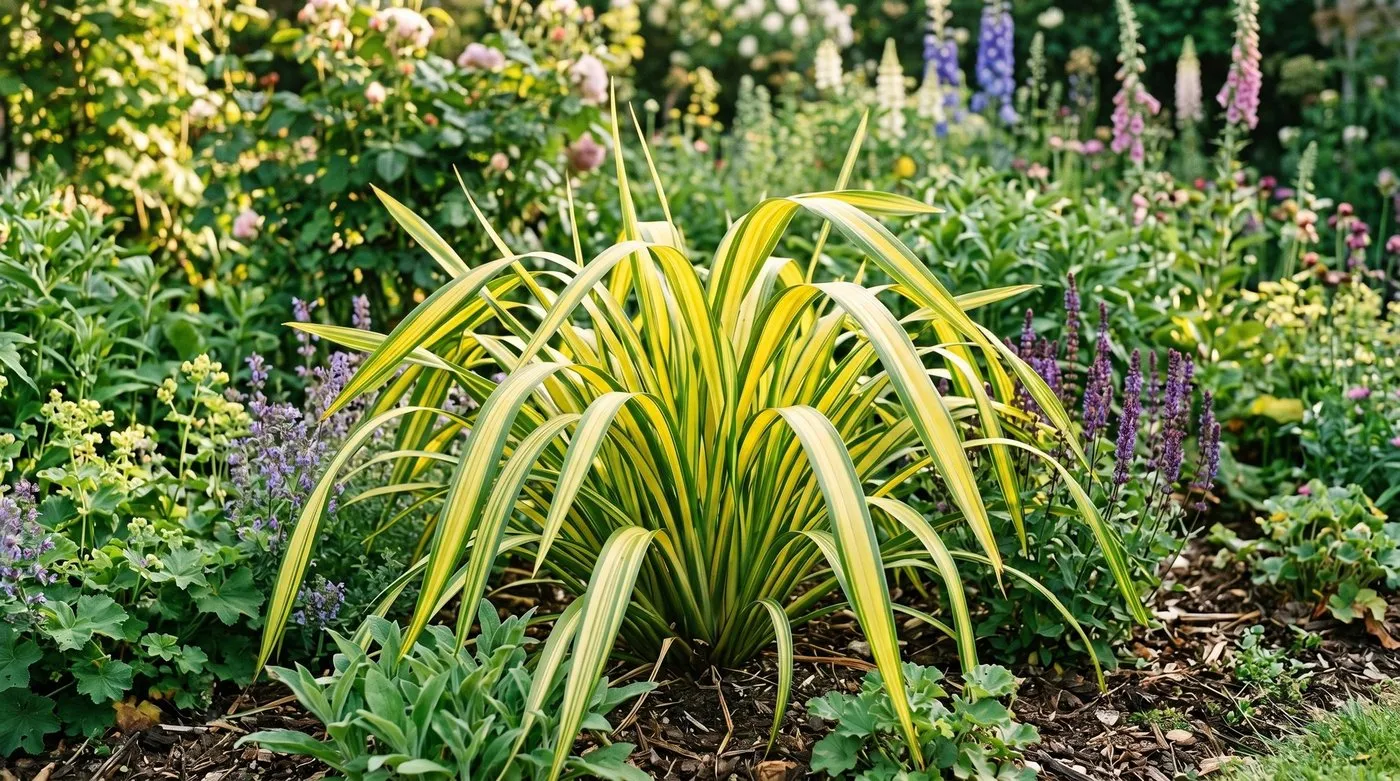 Phormium Yellow Wave at peak summer colour, the best coloured cultivar for UK gardens with 4-year colour life between divisions
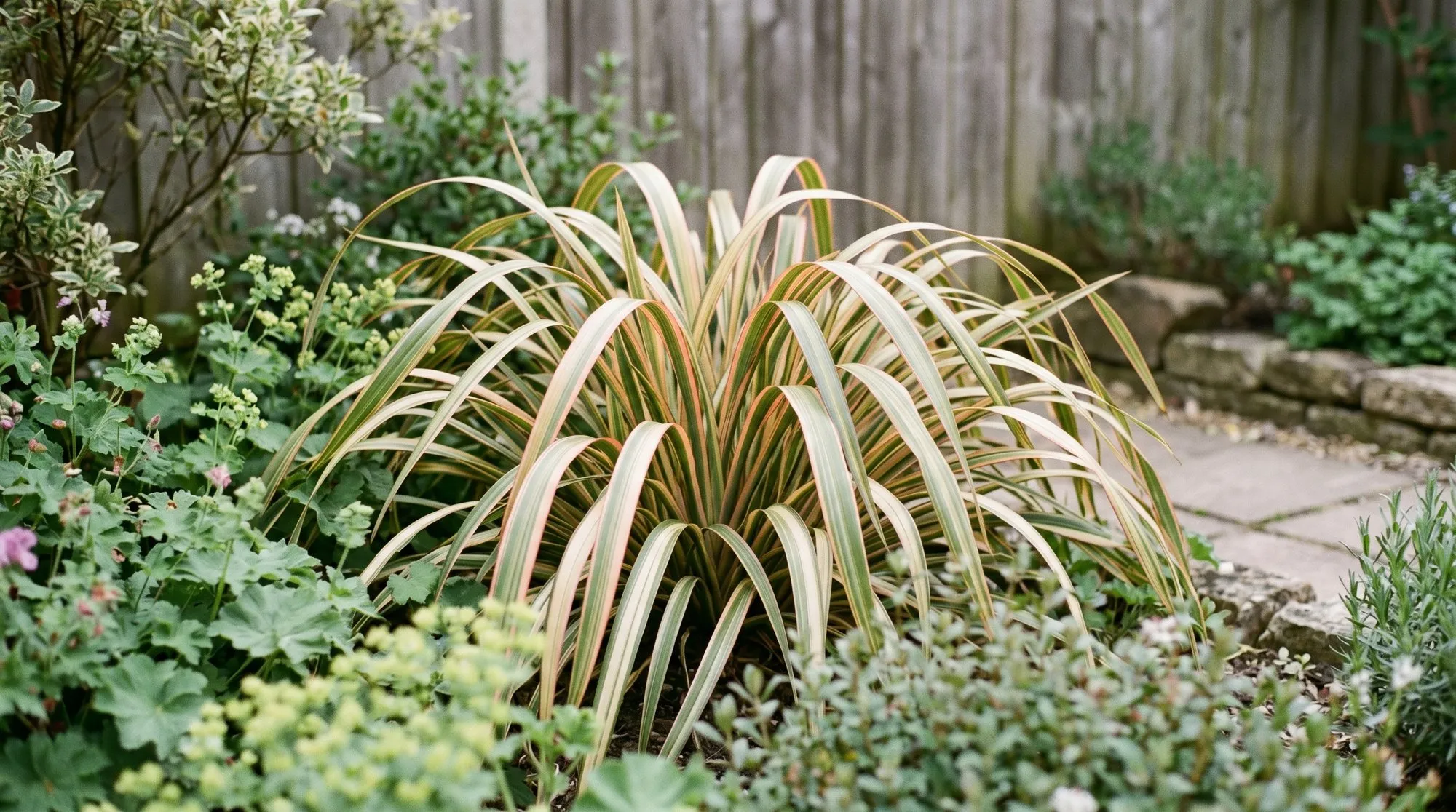 Phormium cookianum Tricolor, the small-garden alternative that stays at 1.5m with arching habit and survives -15C
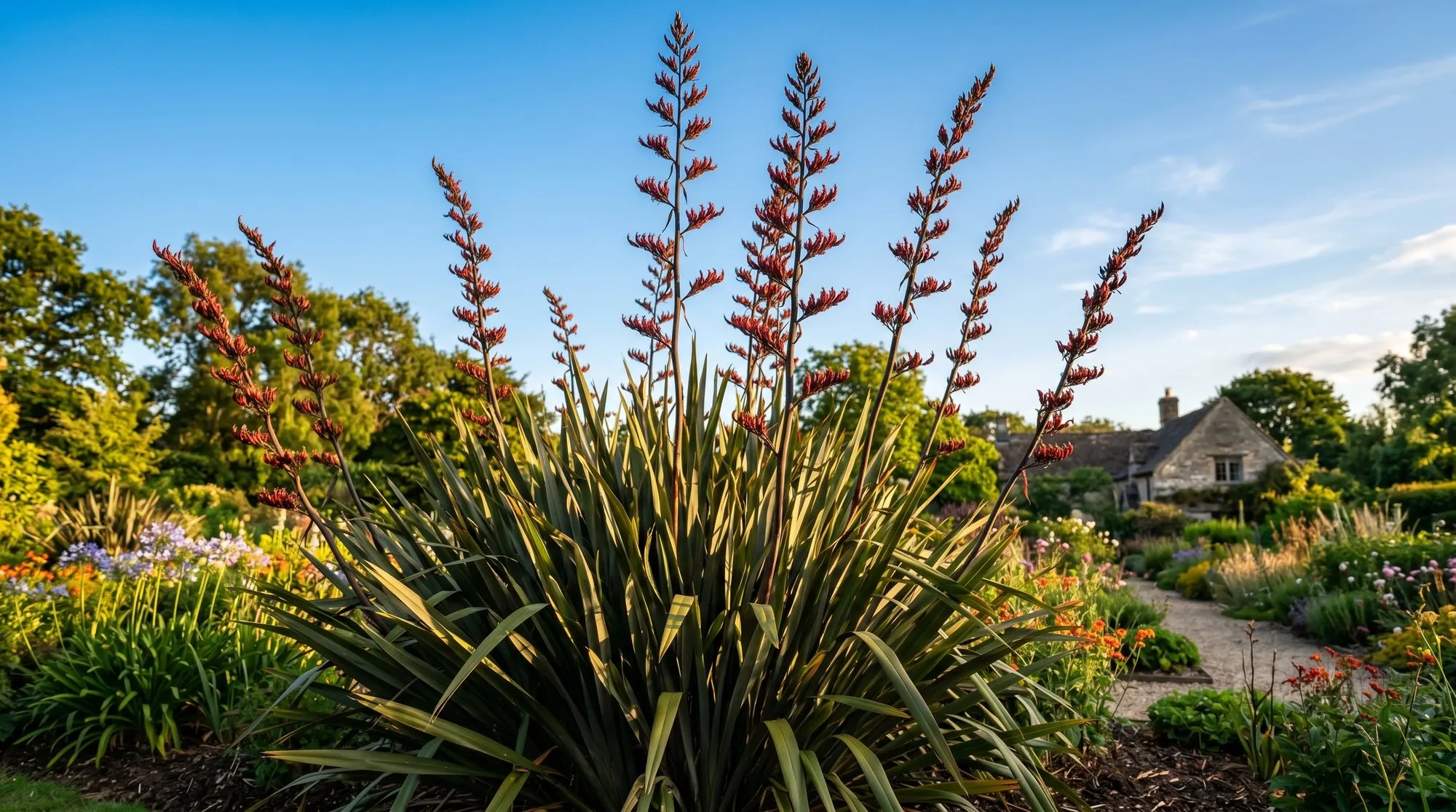 Phormium tenax flower spikes in late June, the 4m red towers that emerge from mature plants and feed bees through summer
Our team produces practical UK gardening guidance from source research, contributor records and established horticultural practice. Editorial standards are overseen by Matt W.