Key takeaways
- Deschampsia cespitosa is one of the few native British grasses used as a high-end ornamental, growing wild across UK woodlands and meadows
- Six garden-worthy varieties cover heights from 30cm to 1.5m, with flowering colours from silver-gold through bronze and copper
- Hardy to minus 25C and tolerates heavy clay, damp soil, and partial shade where most ornamental grasses fail
- Cut back in late February to 8-10cm — Deschampsia is deciduous despite looking semi-evergreen, and old foliage smothers fresh growth
- Piet Oudolf uses 'Goldtau' as the matrix grass in major prairie-style schemes including the High Line in New York
- Plant 3-5 plants per square metre in groups of 7-15 for natural drift effect, spacing 50cm apart
Deschampsia cespitosa, or tufted hair grass, is one of the most useful ornamental grasses for UK gardens and the only commonly grown garden grass that is also a true British native. It thrives where most ornamental grasses fail. Heavy clay, damp soil, partial shade, exposed sites, and acid or alkaline ground all suit it. The flowering panicles form a haze of golden, bronze, or silver flower spikelets from June through to autumn.
This guide covers the six best Deschampsia varieties for UK gardens, how to plant and maintain them, and why designers like Piet Oudolf use them as the foundation of large naturalistic schemes. For wider context on grass selection, see our ornamental grasses guide.
What is Deschampsia cespitosa?
Deschampsia cespitosa is a clump-forming, semi-evergreen, hardy perennial grass native to the UK and most of Europe. The species name cespitosa comes from the Latin for “tufted”, describing its dense mound of fine arching foliage. In gardens it forms a tussock 30-40cm wide and 30-50cm tall before sending up flowering panicles 60-150cm above the leaves.
The species grows wild across the UK from Cornwall to the Scottish Highlands. Plantlife records it as a characteristic species of damp meadows, woodland clearings, and upland flushes. It is one of the few grasses listed in their database of important UK native flora. On well-drained acid moorland it gives way to the related D. flexuosa, or wavy hair grass.
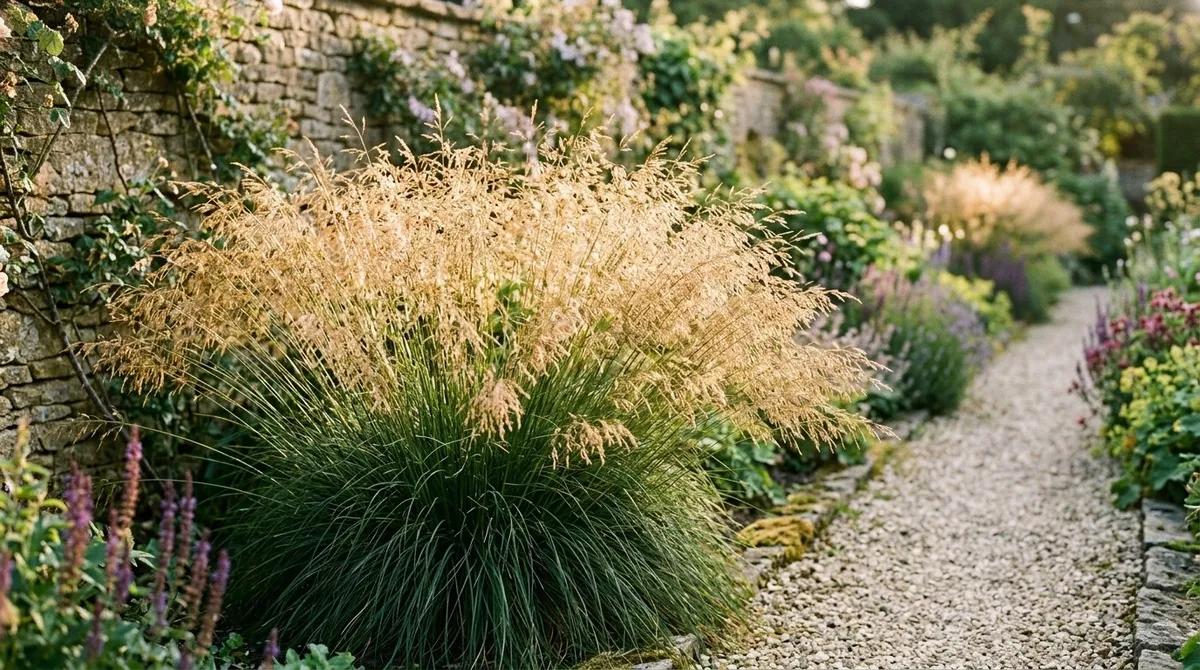
The garden value sits in the flowering panicles. Each panicle is 20-30cm long, made of hundreds of tiny spikelets that catch the light. In low evening sun the effect reads as a glowing haze rather than discrete flower stems. The hazing effect is why Deschampsia is the go-to matrix grass for naturalistic planting designers across Europe.
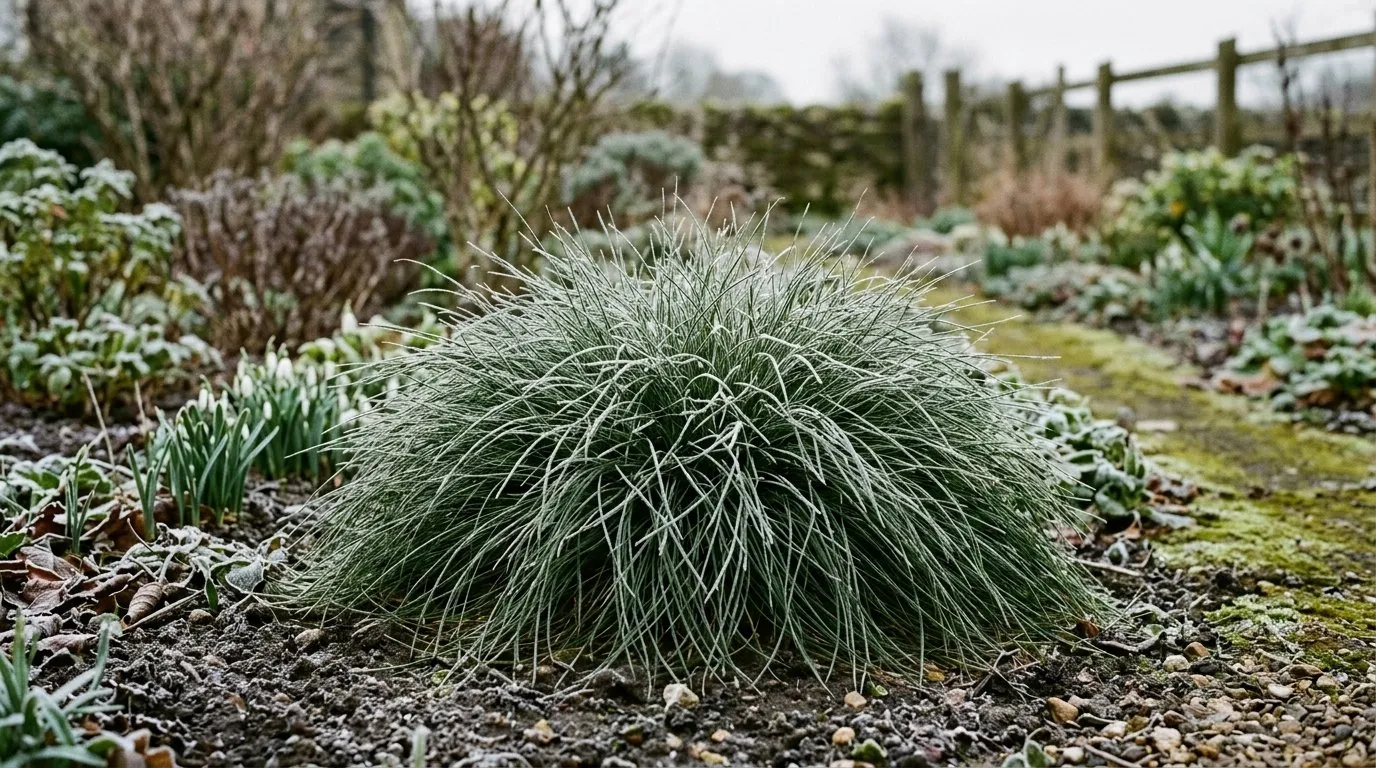 The dense semi-evergreen tussock of Deschampsia cespitosa in March, before flowering. The foliage is fine, dark green, and arches outwards to 40cm wide.
Why a UK native ornamental grass matters
Most ornamental grasses sold in UK garden centres come from North America (Panicum, Sporobolus), East Asia (Miscanthus, Hakonechloa), South America (Pampas), or southern Europe (Stipa). Deschampsia cespitosa is one of the few that originated on these islands. That changes how it grows.
Native grasses cope with British rainfall, native pests, and our temperature swings without showing the stress that bothers introduced species. Deschampsia is fully hardy down to minus 25C, far below anything UK winters will throw at it. It tolerates 200mm of summer rain without rotting. It survives waterlogged clay where Stipa and Miscanthus die.
The other benefit is wildlife. Native grasses host moth larvae, leafhoppers, and ground-nesting bumblebees in numbers that introduced species do not match. The Wildlife Trusts list Deschampsia as a host plant for at least 12 native moth species including the Common Wainscot and Speckled Footman.
The 6 best Deschampsia varieties for UK gardens
Six named varieties stand out for garden use. Five are forms of D. cespitosa, and the sixth is D. flexuosa ‘Tatra Gold’, which is technically a different species (wavy hair grass) but is sold and used as a Deschampsia in UK nurseries.
Variety comparison table
| Variety | Cultivar / Species | Height | Flowering colour | Flowering month | Best for |
|---|---|---|---|---|---|
| ’Goldtau’ | D. cespitosa | 75cm | Golden bronze | June-August | Mixed borders, matrix planting, small gardens |
| ’Bronzeschleier’ | D. cespitosa | 1.2m | Bronze, ageing copper | July-September | Tall border accents, autumn structure |
| ’Goldschleier’ | D. cespitosa | 1.5m | Silver-gold | June-August | Large prairie schemes, see-through screens |
| ’Tatra Gold’ | D. flexuosa | 60cm | Yellow-green panicles, gold foliage | May-July | Light shade, woodland edge, acid soil |
| ’Northern Lights’ | D. cespitosa (variegated) | 30cm | Rare, foliage plant | N/A flowers seldom | Containers, edging, year-round colour |
| ’Pixie Fountain’ | D. cespitosa | 50cm | Pale gold | June-August | Small borders, courtyard gardens |
’Goldtau’ (Golden Dew)
This is the variety to plant if you only grow one Deschampsia. ‘Goldtau’ was selected at Karl Foerster’s nursery in Germany in 1965 and is the standard matrix grass used by Piet Oudolf. It reaches 75cm in flower with a 30-40cm foliage clump at the base. The flowering panicles open green in late June, turn golden through July, and hold a warm bronze tone into September.
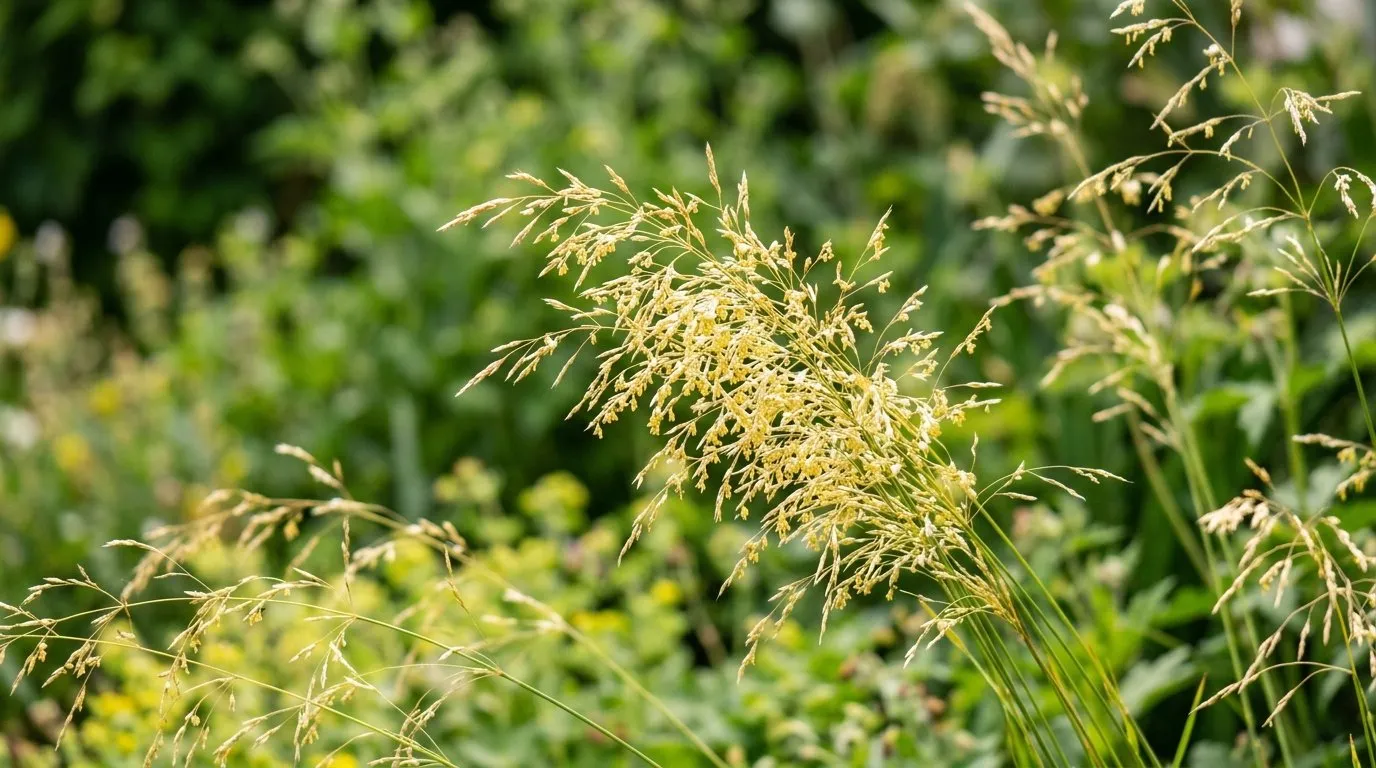 ‘Goldtau’ flowering panicles in early July. Each panicle holds hundreds of tiny golden spikelets that catch low light.
‘Bronzeschleier’ (Bronze Veil)
A taller, later-flowering selection reaching 1.2m. The flower panicles open green-bronze in early July and deepen to copper-bronze through August. By late September the seed heads are a rich rust colour. It holds structure into November before frosts knock it down.
‘Bronzeschleier’ is the choice for autumn-into-winter structure in a large border. Pair it with rust-coloured Helenium ‘Moerheim Beauty’, dark Sanguisorba ‘Tanna’, and the bronze leaves of Persicaria amplexicaulis ‘Firetail’ for an autumn scheme that reads warm even in October mist.
‘Goldschleier’ (Gold Veil)
The tallest commonly grown selection at 1.5m. Flowering panicles open silver-gold in late June and hold their colour for 8-10 weeks. The plant is a see-through screen rather than a solid mass, which suits very large naturalistic plantings of 50 square metres or more. In smaller gardens it can look out of scale.
‘Tatra Gold’ (D. flexuosa)
A different species but sold as a Deschampsia. D. flexuosa is wavy hair grass, a UK native of acid woodland and moorland. ‘Tatra Gold’ has yellow-green foliage that holds gold tones from spring to late autumn. It reaches 60cm in flower with airy yellow panicles from May to July. It needs acid or neutral soil and partial shade, where it outperforms every other Deschampsia. Plant it under birch, oak, or pine where ericaceous conditions occur naturally.
‘Northern Lights’
A variegated dwarf form reaching just 30cm. Foliage is striped pink, cream, and green, deepening to purple-pink through autumn. It rarely flowers in the UK climate. Use it as a foliage feature in containers, low edging, or rock gardens. Slower-growing and more demanding than the green forms. It needs very well-drained soil and protection from wet winters in the north.
‘Pixie Fountain’
A compact form of the wild species reaching 50cm. Pale gold flowering panicles from late June. It is hard to find in the UK trade but worth seeking out for small borders where ‘Goldtau’ would be too tall. Try Knoll Gardens or Hoyland Plant Centre.
Where to plant deschampsia
Deschampsia tolerates a wider range of conditions than any other commonly sold ornamental grass. It will grow in full sun to partial shade, on clay, loam, or sand, in damp or moderately dry soil, at any pH from 4.5 to 7.5. The two firm rules are: avoid full deep shade and avoid permanently arid sandy soil.
Soil
Sandy soil works but plants stay smaller and need irrigation in dry summers. Add 5kg of well-rotted compost per square metre at planting to improve moisture retention. Chalk soil is fine. Acid moorland-style soil suits D. flexuosa ‘Tatra Gold’ specifically.
Position
Three to six hours of direct sun gives the best flowering. South or west-facing borders are ideal. East-facing borders work but flowering is 20-30 percent less dense. North-facing borders flower poorly unless sun reaches the plants for part of the day. D. flexuosa ‘Tatra Gold’ is the only Deschampsia that performs well in full woodland shade.
Spacing
Plant 50cm apart for a continuous matrix effect, or 70cm apart for individual specimen tussocks. For matrix planting, allow 4-5 plants per square metre. For accent groups in mixed borders, use 7, 9, or 11 plants per group with 50cm spacing.
How to plant deschampsia
Plant in spring (March to May) or early autumn (September to mid-October) when soil is moist and warm. Avoid summer planting unless you can water heavily for the first 4-6 weeks. Avoid winter planting on clay where waterlogging will rot fresh roots before they establish.
Step by step
- Dig a planting hole twice the width of the rootball and the same depth. A 2-litre nursery pot needs a hole 30cm wide and 20cm deep.
- Fork the bottom of the hole to break up any compacted layer. On heavy clay, fork in a handful of horticultural grit.
- Mix 1 part well-rotted compost with 2 parts excavated soil. Avoid peat-based composts which lock up over winter.
- Tease out the rootball edges with your fingers. Pot-bound roots need to be loosened or they keep circling.
- Plant at the same depth as the pot. Never bury the crown deeper than the original pot soil line.
- Backfill, firm gently with your foot, and water in heavily with 5-8 litres per plant.
- Mulch with 3-5cm of bark or compost in a 30cm circle, keeping mulch 5cm clear of the crown.
For the first six weeks, water 5 litres per plant per week if rainfall is below 10mm. After that, established Deschampsia rarely needs irrigation in UK conditions.
Cutting back deschampsia
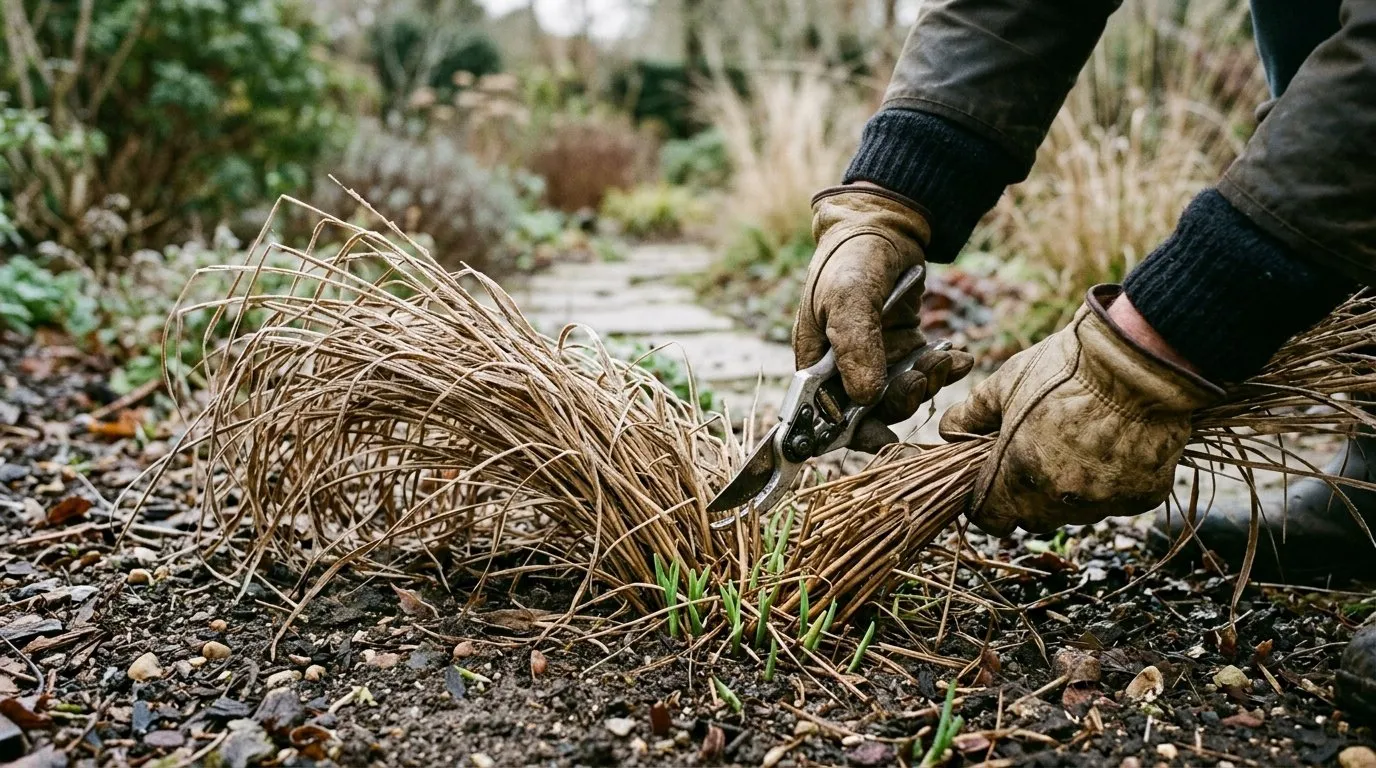 Cut every Deschampsia clump to 8-10cm in late February before new growth pushes through. Sharp hand shears or hedge shears both work for clumps under 60cm wide.
When to cut
Cut between mid-February and early March in the Midlands and southern England. Northern gardens and Scotland should wait until late March. The trigger is when fresh green growth shows at the base of the clump, but before it reaches more than 5cm.
Never cut in autumn. The dead foliage protects the crown from frost and provides essential winter habitat for ground beetles, ladybirds, and overwintering bumblebee queens. It also adds structure and movement to the garden through the dullest months.
How to cut
For clumps under 60cm wide, sharp hand shears work fine. Larger clumps need hedge shears or a battery hedge trimmer. Cut to 8-10cm above the crown. Going lower risks damaging emerging shoots.
Compost the cuttings or shred them as mulch. The fine foliage breaks down within 6 months in a hot heap. Do not burn unless the clumps were diseased.
Year two flowering test
The lesson: Deschampsia behaves as a deciduous grass in UK conditions despite the marketing claims. Cut every clump every spring without exception.
Dividing deschampsia
Lift and divide every 4-5 years in March or April when fresh growth is just starting. Plants left undivided beyond 6 years develop dead centres and flowering drops by 40-60 percent. Division is also the easiest way to multiply your stock.
Lift the whole clump with a fork, easing under the rootball. On clay, work the fork around the clump in four positions before lifting. Wash off enough soil to see where natural divisions occur. A mature clump 50cm wide will give 4-6 divisions.
Cut through the rootball with a sharp spade or pull apart with two forks back to back. Each division should have 3-5 fresh shoots and a healthy root mass. Replant immediately at the same depth and water in well. Discard the woody, dead centre.
Divisions establish quickly and flower in their first season if planted in March or April. September divisions flower the following year. Avoid summer division.
Matrix planting and naturalistic design
Deschampsia ‘Goldtau’ is the most-used matrix grass in modern naturalistic planting schemes across Europe. Piet Oudolf, Tom Stuart-Smith, and Dan Pearson all use it as the connecting tissue between flowering perennials. The High Line in New York uses ‘Goldtau’ across multiple planting blocks. The Hauser & Wirth garden at Durslade Farm in Somerset uses it through Oudolf’s flagship UK matrix planting.
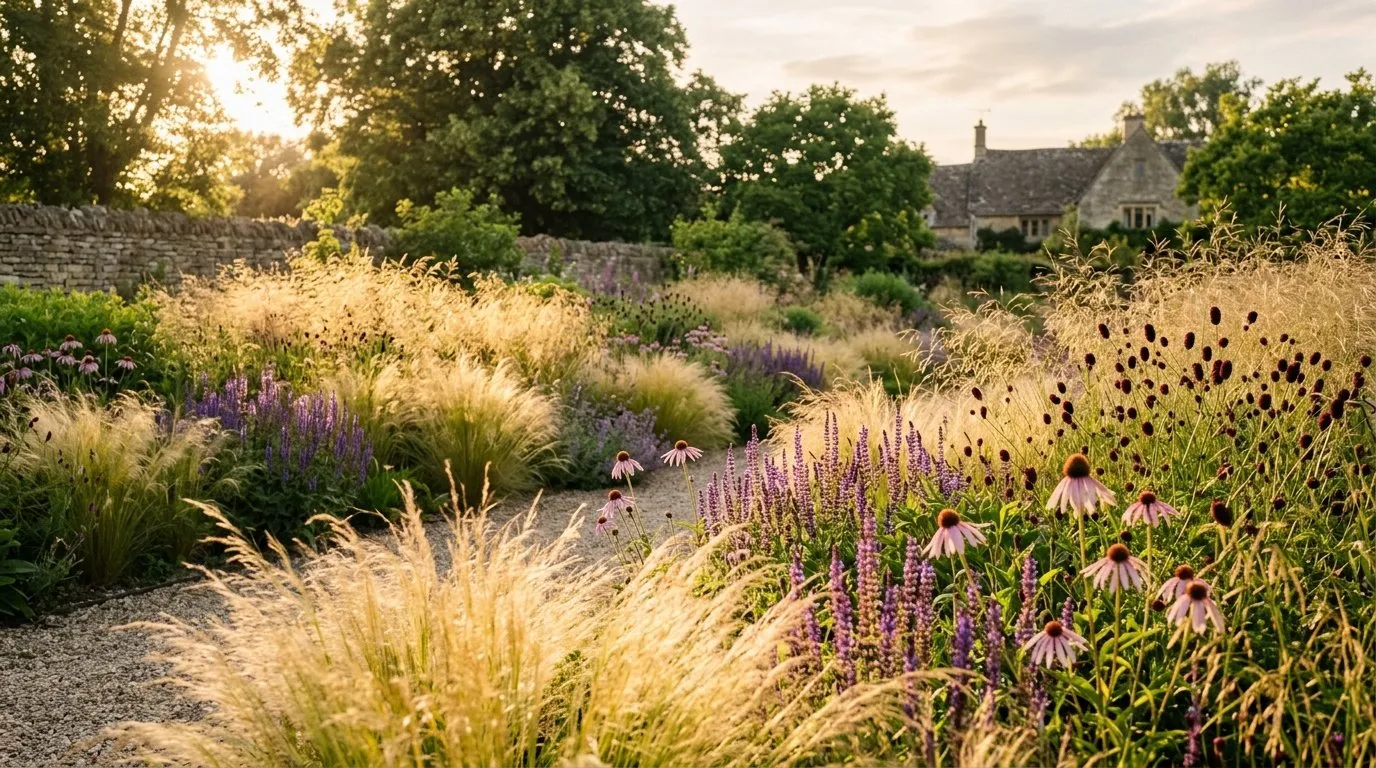 Matrix planting at its most effective. ‘Goldtau’ weaves between Salvia nemorosa, Echinacea pallida, and Sanguisorba officinalis in a UK prairie-style border.
How matrix planting works
The matrix is the dominant grass that fills 40-60 percent of the planting area. Flowering perennials punctuate the matrix in groups of 5-15 plants. The matrix gives visual continuity, while the perennials provide colour and seasonal change.
Plant 4-5 ‘Goldtau’ per square metre across the entire scheme. Then add perennials in clusters between the grass plants. Each perennial group should occupy 1-2 square metres and contain a single species. Allow at least 60cm between perennial groups.
The grass haze unifies the scheme even when individual perennials go over. By August, when many border perennials look tired, the Deschampsia panicles are at peak. By October the perennials have finished and the bronze grass seed heads carry the scene through to frost.
Best matrix companions
The strongest pairings for ‘Goldtau’ matrix planting:
- Sanguisorba officinalis ‘Tanna’ — dark red drumstick flowers, 60cm
- Salvia nemorosa ‘Caradonna’ — deep violet spikes, 50cm
- Echinacea pallida — pale pink reflexed petals, 90cm
- Persicaria amplexicaulis ‘Firetail’ — red bottlebrush flowers, 1.2m
- Astrantia major ‘Roma’ — pink pincushion flowers, 50cm
- Eupatorium maculatum ‘Atropurpureum’ — flat-headed dusty pink umbels, 1.8m
For more border-ready perennials, see our guide to the best perennial plants for UK gardens.
Pests and diseases
Rust
Cut back hard in spring as standard practice. Remove and dispose of any visibly rusted foliage in summer rather than composting it.
What does not bother deschampsia
- Slugs and snails — fine grass foliage holds no interest
- Aphids — no recorded UK populations on Deschampsia
- Vine weevil — does not feed on grass roots
- Powdery mildew — almost never seen
- Honey fungus — generally resistant
Companion benefit
Deschampsia hosts ground beetles and parasitic wasps in significant numbers. The dense crown shelters predators that prey on aphids, small caterpillars, and slugs in adjacent perennials. Planting Deschampsia through a vegetable garden border supports natural pest control across the whole bed.
Propagation from seed
Deschampsia cespitosa grows readily from seed sown in spring or autumn. Wild-collected seed and most named varieties (including ‘Goldtau’ and ‘Bronzeschleier’) come fairly true. ‘Northern Lights’ must be propagated by division because seedlings revert to plain green.
Seed sowing method
- Collect ripe seed in late September when panicles turn brown and seed shakes free easily. Each panicle holds 50-200 viable seeds.
- Store seed dry and cool until sowing time. Refrigerate for 4-6 weeks if sowing in spring.
- Sow in March or April in 9cm pots filled with peat-free seed compost.
- Surface-sow and press lightly. Do not bury — Deschampsia needs light to germinate.
- Keep at 15-18C in a cold frame or unheated greenhouse. Germination takes 10-21 days.
- Prick out at 4-leaf stage into individual 9cm pots.
- Grow on for one season before planting out the following spring.
Plants from seed flower in their second or third year. Self-sown seedlings appearing in your garden often perform as well as bought stock.
Month-by-month maintenance calendar
| Month | Task |
|---|---|
| January | Leave clumps standing. Enjoy frosted seed heads. Plan new planting positions. |
| February (mid to late) | Begin cutting back established clumps to 8-10cm. Compost the cuttings. |
| March | Finish cutting back. Apply 2-3cm well-rotted compost mulch. Lift and divide overgrown clumps. |
| April | Plant out new plants and divisions. Sow seed in pots in cold frame. Top up gravel mulches. |
| May | Check new plants for moisture stress. Water 5 litres per plant per week if rainfall under 10mm. |
| June | First flowering panicles emerge late month on ‘Goldtau’ and ‘Goldschleier’. No work needed. |
| July | Peak flowering. ‘Bronzeschleier’ starts flowering mid-month. Photograph for autumn reference. |
| August | ’Goldtau’ panicles deepen to bronze. Watch for rust in damp weather. Remove rusted foliage. |
| September | Last flush on ‘Bronzeschleier’. Collect seed from species and ‘Goldtau’. Plant new plants. |
| October | Stop planting after mid-month. Foliage starts to die back. Leave standing for winter structure. |
| November | Frosts begin to colour seed heads. Take final autumn photos. No cutback. |
| December | Standing seed heads catch frost beautifully. Enjoy the structure. |
Common mistakes growing deschampsia
1. Cutting back in autumn
The most common error. Autumn cutting removes winter structure, eliminates wildlife habitat, and exposes the crown to frost damage. Always cut in late February or March, never before mid-November and ideally not before March.
2. Believing the “evergreen, no cutback” claim
Plant labels and online listings often describe Deschampsia as evergreen needing no maintenance. In UK conditions this is wrong. Old foliage smothers fresh growth and reduces flowering by 30-40 percent. Cut every clump every spring without exception.
3. Planting too dry
Deschampsia is marketed alongside drought-tolerant grasses like Stipa, but it actually wants consistent moisture. On dry sandy soil without irrigation, plants stay small and short-lived. Either choose a different grass for dry conditions or improve the soil with compost before planting.
4. Spacing too widely
Single specimen plants look weak and out of place. Deschampsia works as a mass, not a specimen. Plant in groups of 7, 9, 11, or more at 50cm spacing. For matrix planting, fill at least 4 square metres with continuous grass.
5. Buying named varieties from poor sources
Cheap Deschampsia from supermarkets is often the wild species sold under a variety name. Always buy from a specialist grass nursery. Knoll Gardens in Dorset, Hoyland Plant Centre in Yorkshire, and Marchants Hardy Plants in East Sussex all sell verified named varieties. Expect to pay 8-15 pounds for a 2-litre plant.
Autumn and winter colour
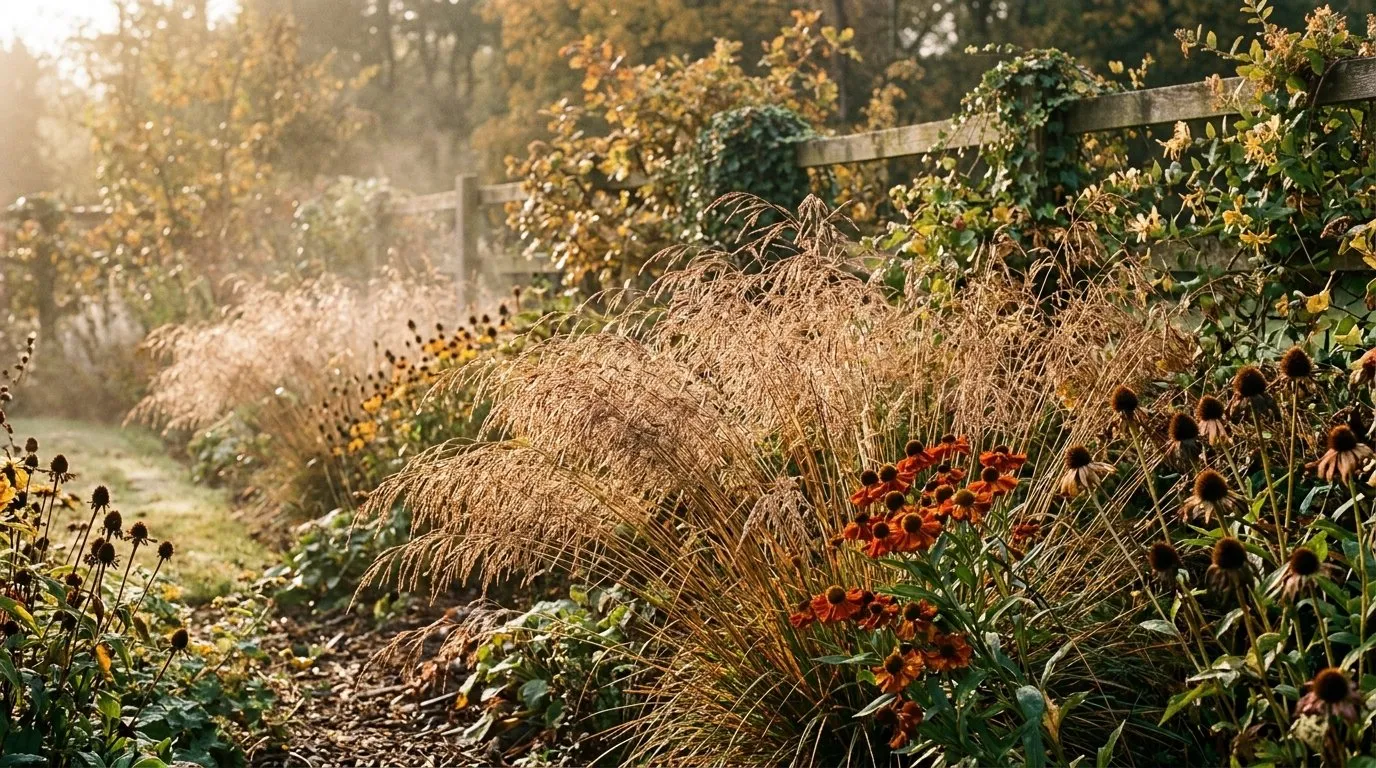 ‘Bronzeschleier’ in late September. The flowering panicles deepen from green-bronze in July through to copper-brown by October.
The autumn show is part of why Deschampsia earns its border space. Flowering panicles fade through gold, bronze, copper, and finally pale tan. Seed heads catch low autumn light and hold their shape into November. Frost-rimed panicles in December and January provide some of the best winter structure in any garden.
Frequently asked questions
Is deschampsia a UK native grass?
Deschampsia cespitosa is a true UK native grass. It grows wild across damp woodlands, meadows, and moorland from Cornwall to the Scottish Highlands. Plantlife lists it as a key species in lowland meadow and upland flush habitats. The garden cultivars are selected forms of the wild species, not foreign introductions.
Should I cut back deschampsia in autumn or spring?
Cut back in late February or early March, never in autumn. The dead foliage protects the crown from winter frost and provides winter structure in the garden. Spring cutting also gives birds and insects shelter through the cold months. Cut to 8-10cm before new growth emerges in April.
How tall does Deschampsia ‘Goldtau’ grow?
‘Goldtau’ reaches 75cm in flower with foliage 30-40cm tall. The flowering panicles add another 30-40cm above the leaves, giving a total height around 75-90cm at peak. It is shorter and tidier than the wild species, which can reach 1.5m, making ‘Goldtau’ the most garden-friendly Deschampsia for borders under 1m wide.
Does deschampsia grow in clay soil?
Deschampsia cespitosa thrives on heavy clay including waterlogged spots that kill most ornamental grasses. It tolerates damp clay better than any other commonly grown ornamental grass in the UK. On heavy clay it forms larger, longer-lived clumps than on sandy soil and rarely needs irrigation.
Can deschampsia grow in shade?
Deschampsia tolerates partial shade and light woodland conditions. Three to four hours of direct sun gives the best flowering. In deep shade, plants survive but flower poorly. D. flexuosa (wavy hair grass) is the better choice for full woodland shade and acid soil.
How do I divide deschampsia?
Divide established clumps every 4-5 years in March or April. Lift the whole plant with a fork, then split into sections with a sharp spade or two back-to-back forks. Replant divisions immediately at the same depth and water well. Each division should have 3-5 fresh shoots.
Does deschampsia self-seed?
The wild species and ‘Goldtau’ both self-seed in UK gardens. Seedlings appear in gravel paths, paving cracks, and bare soil from June onwards. Most named varieties come fairly true from seed but some variation occurs. Deadhead spent flower stems in late September to control spread, or pull seedlings in spring.
What plants pair well with deschampsia?
Deschampsia pairs brilliantly with Sanguisorba, Echinacea, Salvia nemorosa, Persicaria amplexicaulis, Astrantia, and Eupatorium. The fine flower haze contrasts with bold perennial flowers. Piet Oudolf uses ‘Goldtau’ as a matrix grass weaving between flowering perennials in 60-70 percent of his commercial planting schemes.
Now you understand how to grow deschampsia, read our guide to Stipa feather grass for UK gardens for the next step in building a complete ornamental grass border.
Our team produces practical UK gardening guidance from source research, contributor records and established horticultural practice. Editorial standards are overseen by Matt W.