How to Grow Choisya in the UK
Grow choisya (Mexican orange blossom) in UK gardens with our expert guide. Covers five top varieties, planting, pruning, and frost protection.
Key takeaways
- Choisya ternata holds the RHS AGM and is hardy to -10°C in sheltered positions across most of England and Wales
- Sundance has golden-yellow foliage but fewer flowers than the green form — position in partial shade to prevent leaf scorch
- Aztec Pearl has narrower, more elegant leaves and a compact 1.5m habit — ideal for smaller gardens and containers
- Prune immediately after the main spring flush in June — never prune in autumn or you remove next year's flower buds
- White Dazzler stays under 1.2m and suits pots, patios, and balconies where space is limited
- Crushed choisya leaves release a strong citrus scent — plant beside paths and doorways for maximum fragrance
- Young plants need fleece protection in their first two winters; established shrubs tolerate -10°C without cover
Choisya is one of the most reliable evergreen shrubs for UK gardens, producing clusters of fragrant white flowers in late spring and often again in autumn. The glossy, aromatic foliage looks good in every month of the year. Given a sheltered spot and well-drained soil, a choisya will thrive for decades with very little attention.
The common name “Mexican orange blossom” comes from the citrus-like scent of both flowers and crushed leaves. Despite its Mexican origins, choisya has been grown in British gardens since the 1820s. The RHS growing guide for choisya confirms its suitability for most of England, Wales, and sheltered Scottish gardens. This guide covers five proven varieties, planting technique, pruning timing, and how to protect young plants through their first UK winters.
Which choisya variety should you grow?
Five varieties dominate UK garden centres. Each has a different size, leaf colour, and habit. Choosing the right one depends on your available space, exposure, and whether you value foliage colour or maximum flower production.
Choisya ternata — the original
The straight species is the toughest and most floriferous form. It holds the RHS Award of Garden Merit. Mature plants reach 2-2.5m tall and wide, forming a dense, rounded dome of glossy dark green leaves. Each leaf is divided into three leaflets — the botanical name “ternata” refers to this arrangement.
Flowers appear in dense clusters during May and June, with a lighter second flush in September and October. Each flower is white, star-shaped, and roughly 25mm across. The fragrance is intense — sweet and citrusy — and carries several metres on still evenings. This is the variety to choose if you want maximum flowers and bulletproof hardiness.
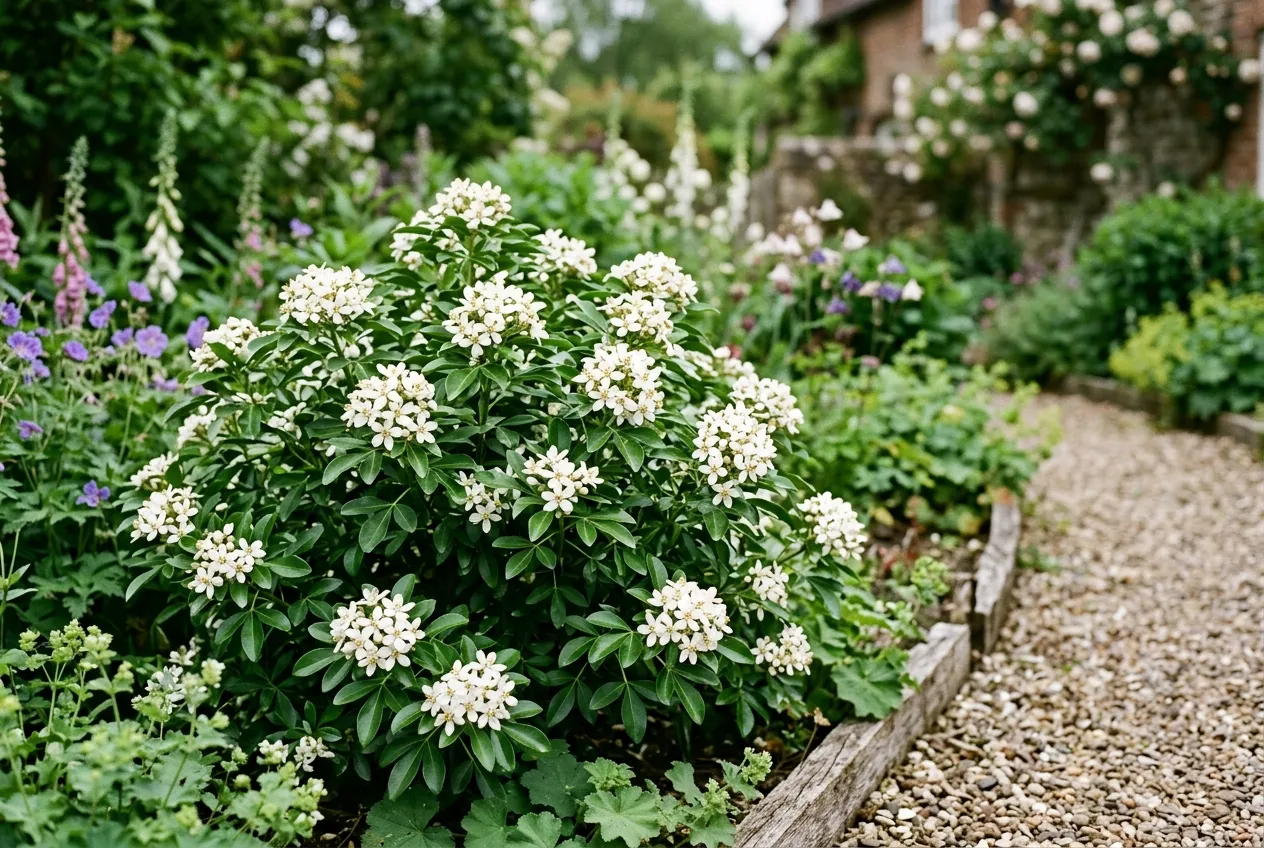 Choisya ternata produces dense clusters of fragrant white flowers on a tough evergreen framework
Choisya ternata Sundance (‘Lich’)
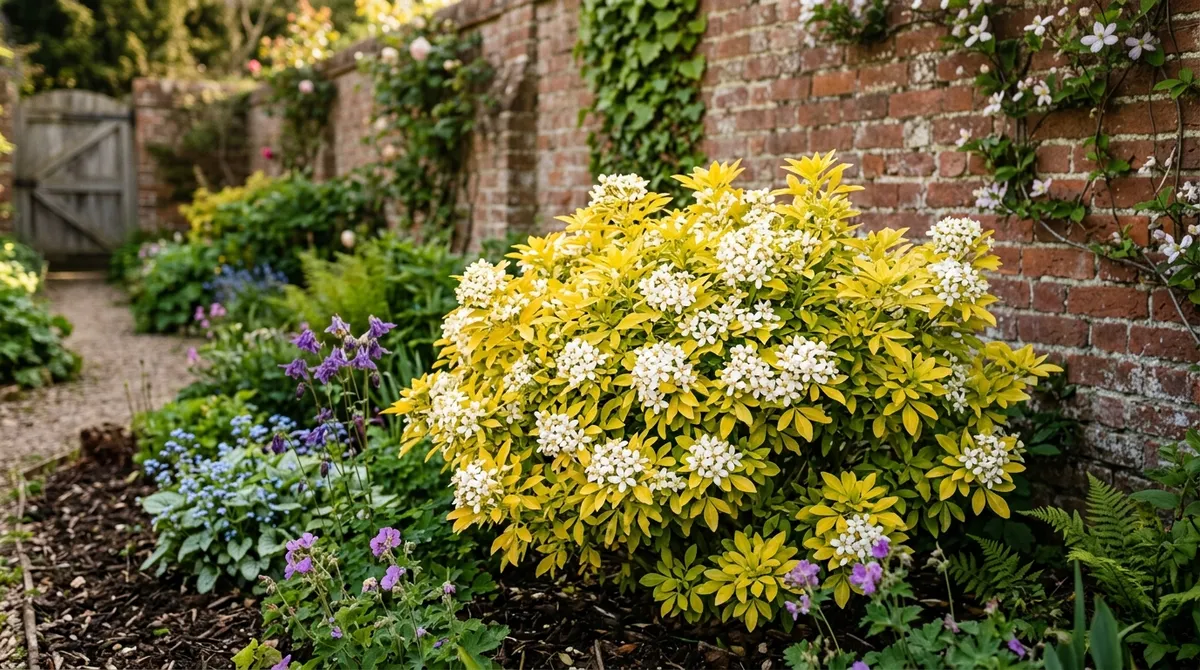
Sundance is the golden-leaved sport of C. ternata, selected at Lich nursery in Staffordshire. New growth emerges bright yellow, maturing to lime-green through summer. The golden colour is strongest in spring and again after a late-summer prune.
Sundance produces fewer flowers than the green form. The trade-off is twelve months of eye-catching foliage colour. It reaches 2m but grows more slowly. Position in partial shade — full sun scorches the leaves to a washed-out cream, while deep shade turns them plain green. A west-facing wall is ideal.
Choisya x dewitteana Aztec Pearl
A hybrid between C. ternata and the Mexican species C. dumosa. Aztec Pearl has narrow, finely divided leaflets that give a more elegant, textured look than the plain ternata. The habit is compact — 1.5m tall and 1.5m wide at maturity.
Flowers are larger than ternata at 30mm across, opening from pink-tinged buds to pure white. The scent is stronger per flower. Aztec Pearl holds the RHS AGM and is the best choice for smaller gardens where ternata would outgrow the space. It also makes a superb informal hedge at 1m spacing.
Choisya x dewitteana White Dazzler
White Dazzler is a compact sport of Aztec Pearl, staying below 1.2m tall and 1m wide. The foliage is the same fine-textured type as Aztec Pearl, but denser and more cushion-like. Flower production is exceptional for such a small plant — it is often smothered in white blooms during May.
This is the best choisya for containers, balconies, and patios. The compact size means it suits a 40-50cm pot without annual pruning. It also works as a low evergreen shrub at the front of a border.
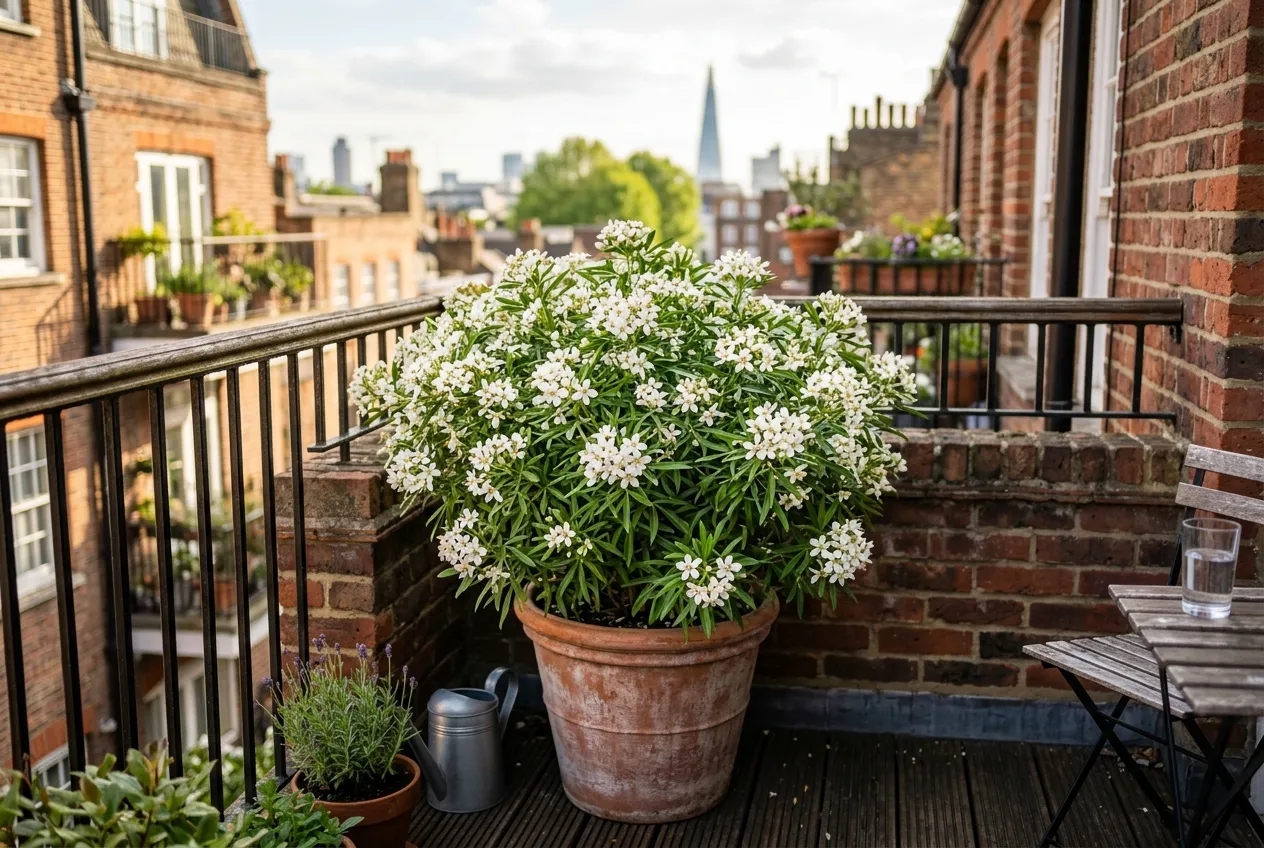 White Dazzler stays compact at under 1.2m and is ideal for containers and small urban spaces
Choisya x dewitteana Apple Blossom
The newest widely available variety. Apple Blossom produces pink-flushed buds that open to pale blush-pink flowers — a first for the genus. The effect is soft and pretty against the dark green, finely divided foliage. Mature size is 1.5-1.8m.
Apple Blossom is slightly less hardy than ternata, rated to around -8°C. In colder northern gardens, grow it against a warm wall or in a container. The pink colouring is strongest in cooler springs — hot weather bleaches the flowers to white within a day or two.
Choisya variety comparison
| Variety | Mature height | Leaf colour | Flower colour | Repeat flowering | RHS AGM | Hardiness |
|---|---|---|---|---|---|---|
| C. ternata | 2-2.5m | Dark green | White | Yes (Sept-Oct) | Yes | -10°C |
| Sundance | 1.8-2m | Golden-yellow | White (fewer) | Occasional | Yes | -10°C |
| Aztec Pearl | 1.5m | Dark green, narrow | White from pink buds | Yes (Sept-Oct) | Yes | -10°C |
| White Dazzler | 1-1.2m | Dark green, narrow | White | Yes (Sept-Oct) | Pending | -9°C |
| Apple Blossom | 1.5-1.8m | Dark green, narrow | Pink fading white | Occasional | No | -8°C |
Where to plant choisya
Site selection determines whether a choisya thrives or merely survives. Three factors matter most: shelter, sunlight, and drainage.
Shelter is the priority. Choisya foliage is evergreen and holds its leaves through winter, making it vulnerable to desiccation by cold winds. An east-facing position is the worst — morning sun thaws frozen leaves too rapidly, causing brown patches. A south-west or west-facing wall is ideal. The wall stores daytime heat and radiates it back overnight, raising the microclimate by 2-3°C.
Sunlight affects flowering. Full sun produces the most blooms on green-leaved varieties. Sundance needs partial shade to keep its golden colour without scorching. All varieties tolerate light dappled shade but flower less freely. If your garden is mostly shaded, check our guide to the best shrubs for shade for alternatives.
Drainage is non-negotiable. Choisya will not tolerate waterlogged soil. The roots rot within weeks in standing water. On heavy clay soil, dig a planting hole 50% wider than the rootball and backfill with a 50:50 mix of the excavated clay and sharp horticultural grit. On chalky alkaline soil, choisya grows well — it tolerates pH up to 7.5 without issue.
How to plant choisya
Plant container-grown choisya at any time of year, though March to May and September to October give the best results. Avoid planting in frozen ground or during drought.
Step-by-step:
- Dig the hole — twice the width of the rootball and the same depth. Never plant deeper than the nursery soil level.
- Improve drainage — mix sharp grit into heavy clay at a 1:3 ratio (grit to soil). On sandy or loamy soil, no amendment is needed.
- Soak the rootball — stand the pot in a bucket of water for 20 minutes before planting. Air pockets in dry compost prevent roots establishing.
- Backfill and firm — work the amended soil around the rootball, firming gently with your fingers. Leave a slight saucer depression around the stem to catch water.
- Water in — give 10 litres immediately after planting. Water weekly through the first summer if rain is scarce.
- Mulch — spread a 5-7cm layer of bark chip or garden compost in a ring around the base, keeping it 5cm clear of the stem.
Spacing: Allow 1.5-2m between ternata plants, 1-1.2m for Aztec Pearl, and 0.8-1m for White Dazzler. For an informal hedge, reduce spacing by 25%.
How to prune choisya
Choisya flowers on stems produced the previous year. Pruning at the wrong time is the single biggest cause of flowerless plants. The rule is straightforward: prune in June, immediately after the main spring flush finishes.
Annual maintenance pruning:
- Cut back any stems that have grown beyond the desired shape.
- Remove frost-damaged tips (brown and crispy growth from the previous winter).
- Thin out one in five of the oldest stems at ground level to keep the centre open and airy.
Renovation pruning for overgrown plants:
- Hard prune to 30-40cm in late April or early May.
- The plant will regenerate from bare wood within one growing season.
- Expect no flowers for 12-18 months after hard pruning.
- Feed with a balanced granular fertiliser (such as Growmore at 70g per square metre) after hard pruning to support regrowth.
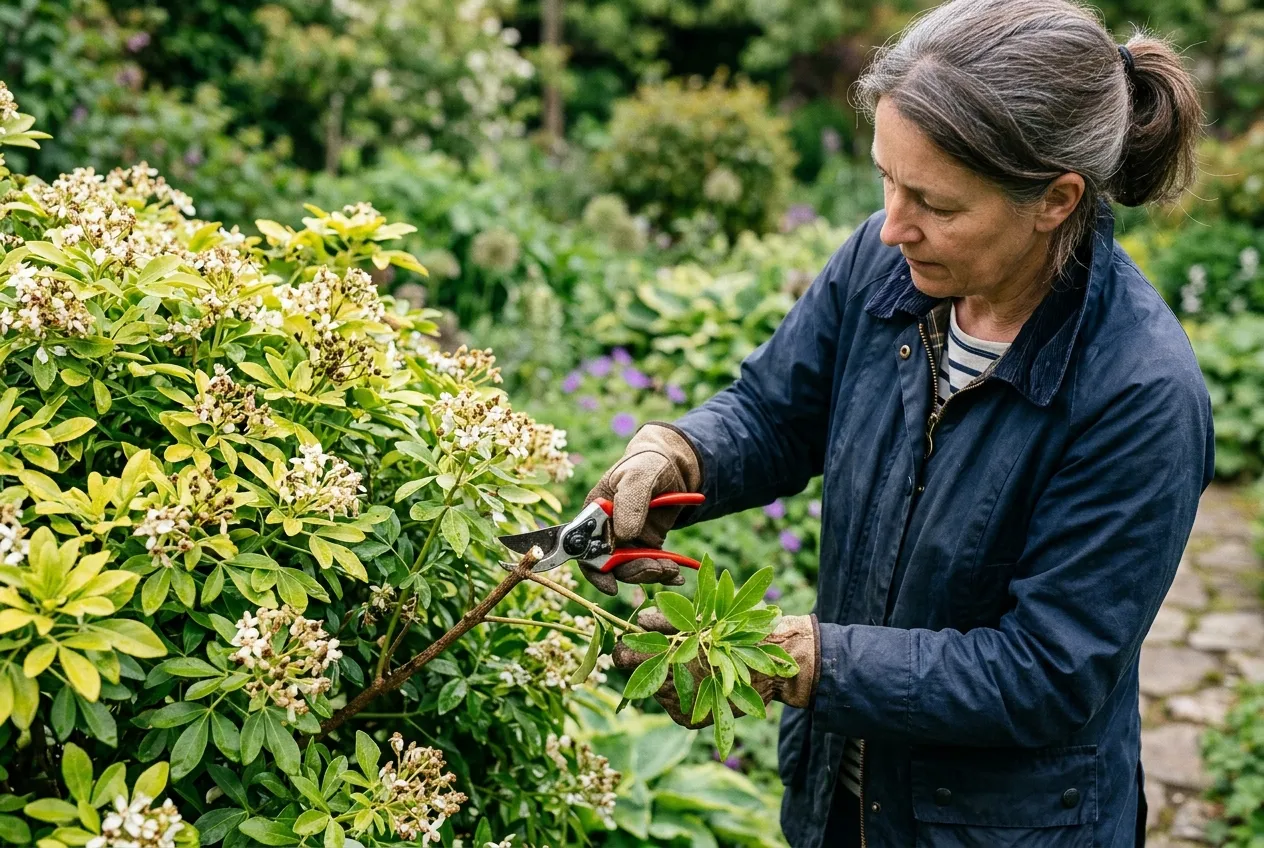 Prune choisya in June after the spring flowers fade — never cut back in autumn or winter
Sundance benefits from an additional light trim in August. This encourages a flush of bright golden new growth that holds its colour through autumn and winter.
Monthly care calendar
| Month | Task |
|---|---|
| January | Check fleece on young plants. Remove snow from branches to prevent snapping. |
| February | Inspect for frost damage. Do not prune yet. |
| March | Apply slow-release fertiliser (Vitax Q4 or Growmore at 70g/m²). Mulch with 5-7cm garden compost. |
| April | Renovation prune overgrown plants if needed (sacrifice one season of flowers). |
| May | Main flowering period begins. Water container plants weekly. |
| June | Prune after flowering. Take semi-ripe cuttings from non-flowering shoots. |
| July | Water during dry spells — 10 litres per plant weekly if rain is absent for 10+ days. |
| August | Light trim of Sundance for fresh golden growth. Second flush of buds forming. |
| September | Autumn reflowering on ternata and Aztec Pearl. Reduce watering. |
| October | Plant new container-grown specimens. Check supports on wall-trained plants. |
| November | Apply fleece to plants under 3 years old before the first hard frost. |
| December | Avoid pruning. Protect roots with extra mulch in severe cold (below -8°C). |
Frost protection for young choisya
Established choisya plants (four years old and above) tolerate temperatures down to -10°C without protection. Young plants are more vulnerable because their root systems are shallow and their stems are thinner.
First and second winter protection:
- Wrap the entire plant loosely in two layers of horticultural fleece when temperatures drop below -5°C.
- Anchor the fleece at the base with stones or pegs — it must not blow off.
- Remove the fleece during mild spells above 5°C to allow air circulation and prevent fungal problems.
- Mulch the root zone with 10cm of bark chip for insulation.
Container plants are more exposed than those in the ground. The roots in a pot freeze faster because there is no surrounding earth for insulation. Move pots against a warm wall in November. In severe cold, wrap the pot itself in bubble wrap to protect the root zone.
For more fragrant shrub options that complement choisya in a mixed border, several choices flower at different times to extend the scented season.
Common problems
Brown leaf tips: Almost always cold wind damage or frost scorch. Move to a more sheltered spot or protect with fleece. Not a disease.
Yellowing lower leaves: Usually caused by waterlogging or poor drainage. Check that the base of the plant is not sitting in pooled water. Improve drainage with grit.
Few or no flowers: Wrong pruning time (autumn or winter pruning removes buds), too much shade (under 4 hours of direct sun), or excessive nitrogen feed.
Leggy, bare stems: The plant has outgrown its space or been shaded by neighbouring plants. Hard prune in April — choisya regenerates reliably from old wood.
Leaf spots: Occasional fungal spotting in wet summers. Rarely serious. Improve air circulation by thinning congested stems. No chemical treatment needed.
Choisya is notably trouble-free compared to many flowering shrubs. It suffers no serious pests in the UK. Slugs and snails ignore the aromatic foliage. Deer and rabbits avoid it.
Propagation
Semi-ripe cuttings taken in June or July root readily. Choose non-flowering side shoots 8-10cm long. Remove the lower pair of leaves and dip the cut end in hormone rooting powder (0.8% IBA). Insert into a 50:50 mix of perlite and peat-free multipurpose compost. Cover with a clear plastic bag or propagator lid. Roots develop in 6-8 weeks at 18-22°C.
Pot on rooted cuttings into 9cm pots of John Innes No. 2 compost. Grow on in a sheltered cold frame through the first winter. Plant out the following spring after the last frost.
The Bumblebee Conservation Trust lists choisya as a valuable nectar source for early-season pollinators, making it a worthwhile addition to any wildlife-friendly planting scheme.
Frequently asked questions
Lawrie has been gardening in the West Midlands for over 30 years. He grows his own veg using no-dig methods, keeps a wildlife-friendly garden, and writes practical advice based on real UK growing conditions.