Key takeaways
- Colchicum flowers in September-October from bare earth — 'naked ladies' because leaves come separately in spring
- Plant corms in July-August at 10cm depth, 15cm apart — flowers appear within 4-6 weeks
- Colchicum is NOT a true crocus and should not be confused with edible saffron crocus (Crocus sativus)
- All parts contain colchicine and are highly toxic to humans, livestock, and pets — handle corms with gloves
- Large spring leaves die back messily by early July — hide with later perennials or allow in meadow grass
- C. 'Waterlily' is the showiest cultivar with fully double lilac-pink flowers; 'The Giant' is the largest single-flowered form
Colchicums are the strangest plant in the British bulb calendar. They flower in September and October from completely bare earth, with no leaves in sight — hence the common name naked ladies. Then in April, six months after the flowers have faded, they throw up huge strap-shaped leaves that spread outward like a cabbage and die back messily in July.
That double personality makes them perplexing for beginners and indispensable for gardeners who know how to use them. A properly sited colchicum gives you a pink or lavender splash in autumn exactly when the garden is winding down and most perennials have finished. The trick is putting the corms somewhere the untidy spring foliage will not spoil a display — long grass, shrub underplantings, or behind later-emerging perennials.
This guide covers the six best cultivars for British gardens, the critical July-August planting window that triggers same-season flowering, the foliage management problem that ruins most new plantings, and the toxicity rules that mean these beautiful flowers need siting with care.
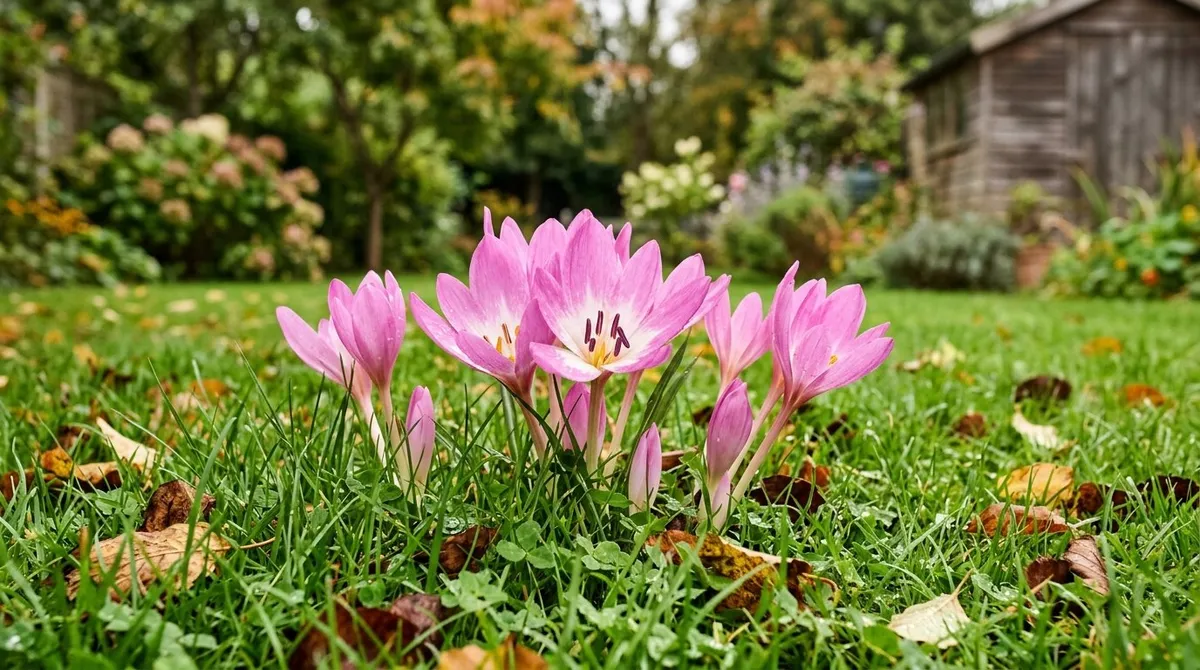
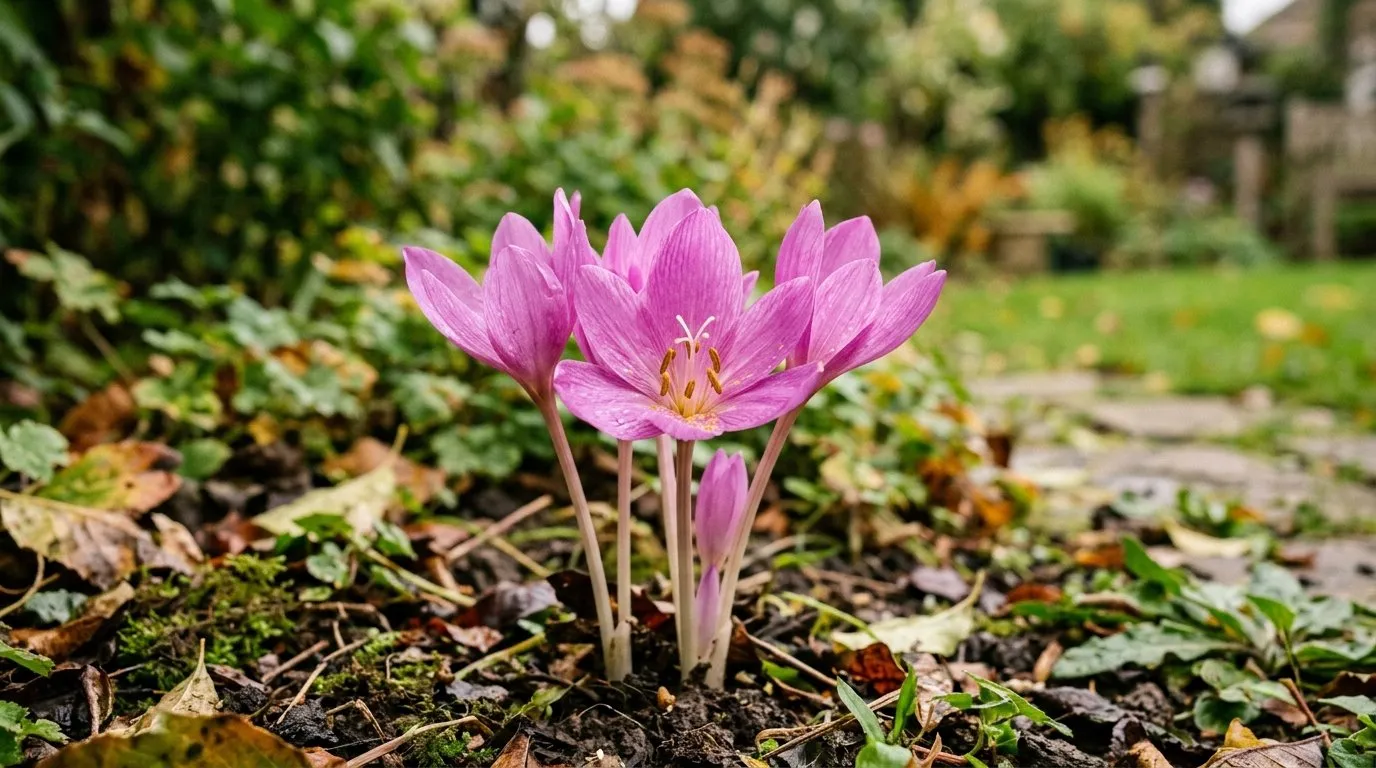 Colchicum speciosum ‘The Giant’ flowering in late September on a UK lawn. Leaves appear separately in spring.
What is colchicum and how does it differ from crocus?
Colchicum is a hardy cormous perennial in the Colchicaceae family, native to meadows, scrubland, and grassy hillsides across Europe, North Africa, and western Asia. Around 100 species exist worldwide, with 6-8 commonly grown in UK gardens. The name comes from Colchis, an ancient region on the Black Sea coast of modern Georgia where many species originate.
Colchicum is not a true crocus, despite looking similar. True crocuses belong to the Iridaceae family (the iris family) and have three stamens, whilst colchicums belong to the Colchicaceae family and have six stamens. More importantly, all colchicums contain colchicine, a highly toxic alkaloid, whereas the saffron crocus (Crocus sativus) produces the edible spice saffron with no toxic properties. Confusing the two has killed people historically.
The plant grows from a large brown-skinned corm up to 7cm across. Flowers emerge in autumn directly from bare ground on short white stems, typically 8-15cm tall. Each corm produces 2-6 flowers over the September-October flowering period. Spring brings large strap-shaped leaves that grow to 30cm tall and 8cm wide, dying back in early July.
Historical medical note: colchicine has been used since ancient Egyptian times to treat gout. Modern medicine still uses the compound, extracted from colchicum corms, for gout and familial Mediterranean fever. Despite its toxicity, colchicine at correct medical doses is an important drug.
Which colchicum varieties grow best in UK gardens?
Six cultivars dominate UK nurseries, differing in flower size, colour, and flowering time.
| Variety | Flower Colour | Height | Flowering Time | Notes |
|---|---|---|---|---|
| ’The Giant’ | Lavender-pink | 15cm | Sept-Oct | Largest single flowers, 10cm wide |
| ’Waterlily’ | Rich lilac-pink | 10cm | Sept-Oct | Fully double flowers, most ornamental |
| ’Album’ | White | 12cm | Sept-Oct | Pure white goblets, elegant |
| C. speciosum | Pink-purple | 15cm | Sept | Largest flowers, earliest |
| C. autumnale | Pale lilac | 10cm | Sept-Oct | Most naturalised species in UK meadows |
| ’Rosy Dawn’ | Soft rose-pink | 12cm | Oct | Latest flowering, scented |
Colchicum ‘Waterlily’
Colchicum ‘The Giant’
The largest single-flowered cultivar, with goblet-shaped flowers up to 10cm wide in soft lavender-pink fading to white at the base. 15cm tall and vigorous. Best for mass naturalising where the large flowers show to advantage. Increases steadily without attention.
Colchicum autumnale
The most widely naturalised species in the UK, including in some wildflower meadows. Smaller flowers than cultivated forms but very vigorous, with 4-6 flowers per corm. Self-seeds readily in long grass, gradually colonising suitable damp meadow areas over decades.
Colchicum ‘Album’
The white form. A group of 10 ‘Album’ flowering at dusk is one of the loveliest sights in a September garden. Performs identically to coloured forms but shows up far better in shade than pink varieties.
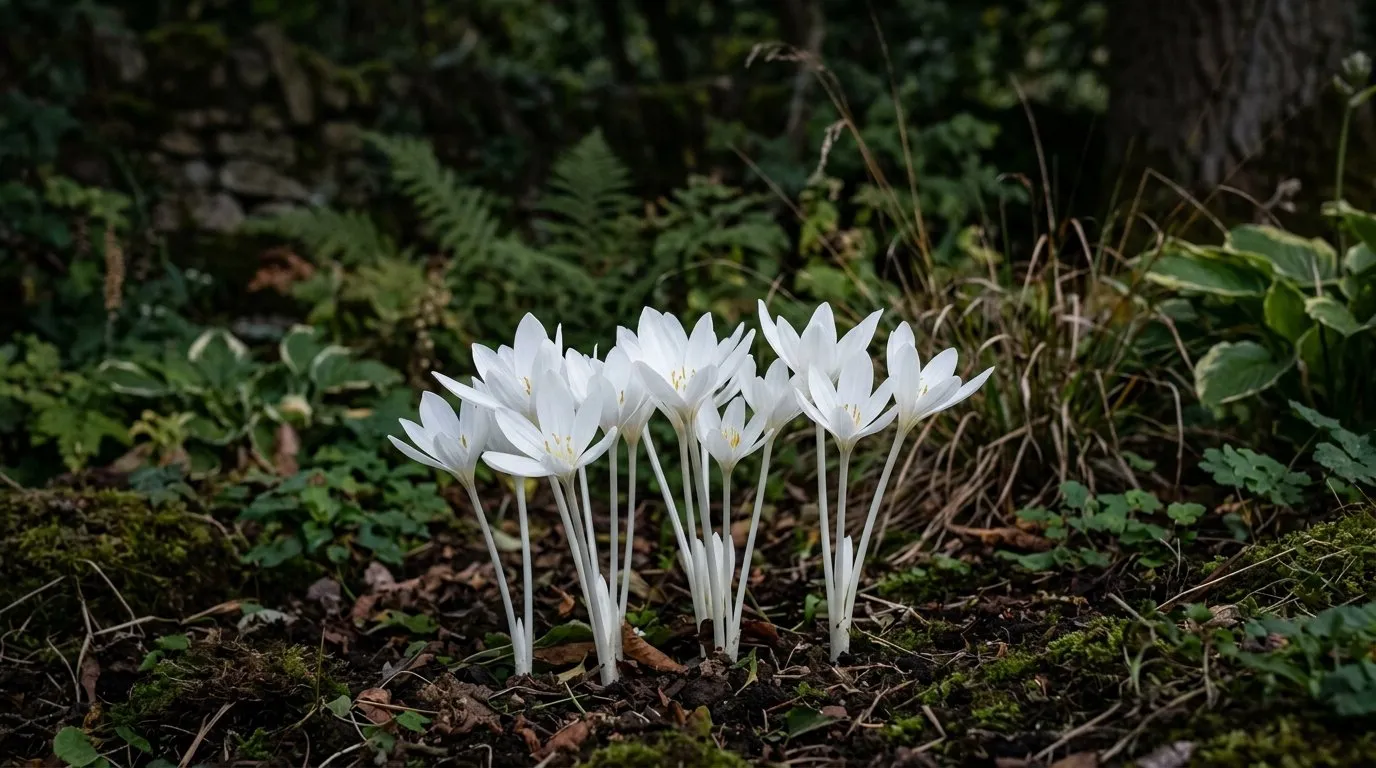 ‘Album’ glowing at dusk in mid-September. White varieties show up far better than pinks in shaded positions.
Where do colchicums grow best in the UK?
Colchicums are less fussy than most bulbs but rewards good siting with stronger flowering and faster naturalising.
Light: Full sun to light shade. Dappled shade beneath deciduous trees is ideal because flowering occurs in September when leaves are still on the trees but increasingly thinning. Deep shade reduces flowering significantly.
Soil: Moist but well-drained. Humus-rich fertile soil produces the biggest corms and most flowers. Heavy clay is tolerated if not waterlogged; sandy soil works with mulching. Chalky ground is fine.
Moisture: Summer moisture matters more than winter. Corms are semi-dormant from July to September and need decent soil moisture to develop flower buds. Long summer drought reduces flowering the following autumn.
Position: Three settings work particularly well: long grass in meadows or orchards; beneath deciduous shrubs where spring leaves are hidden; and the middle of large perennial clumps that emerge in late spring to mask the dying colchicum foliage.
What to avoid: Formal borders next to low-growing perennials, pathways where the large spring leaves block access, and any spot where the yellowing July foliage will dominate the view.
For broader meadow planting context, see mini meadow wildflower area and best plants for shade.
How to plant colchicum corms
Timing matters more for colchicums than for any other bulb. Plant in the 4-6 week window from mid-July to late August to trigger flowering the same autumn. Bulbs held in storage into September often flower while still in the bag or packaging.
Step 1 - Buy early. Order corms for July-August delivery from specialist bulb suppliers like Avon Bulbs or Peter Nyssen. Corms should be firm, unblemished, 4-7cm across, with intact papery skin and no visible sprouts. Large corms cost £2-£5 each.
Step 2 - Plant immediately on arrival. Do not store purchased corms. Every week in a paper bag costs you flowering vigour. If you cannot plant immediately, keep corms in a cool dark place no more than a week.
Step 3 - Use gloves. All parts contain colchicine. Wear disposable nitrile gloves when handling corms and wash tools after use. Do not plant with food-prep implements.
Step 5 - Space correctly. 15cm apart in groups of 7-15 for natural-looking clumps. For meadow naturalising, scatter corms across the area and plant where they land to avoid regular patterns.
Step 6 - Water in. Soak the area after planting. Flowering typically begins 4-6 weeks later in September.
For related autumn bulb planting see our guide on spring bulb care after flowering.
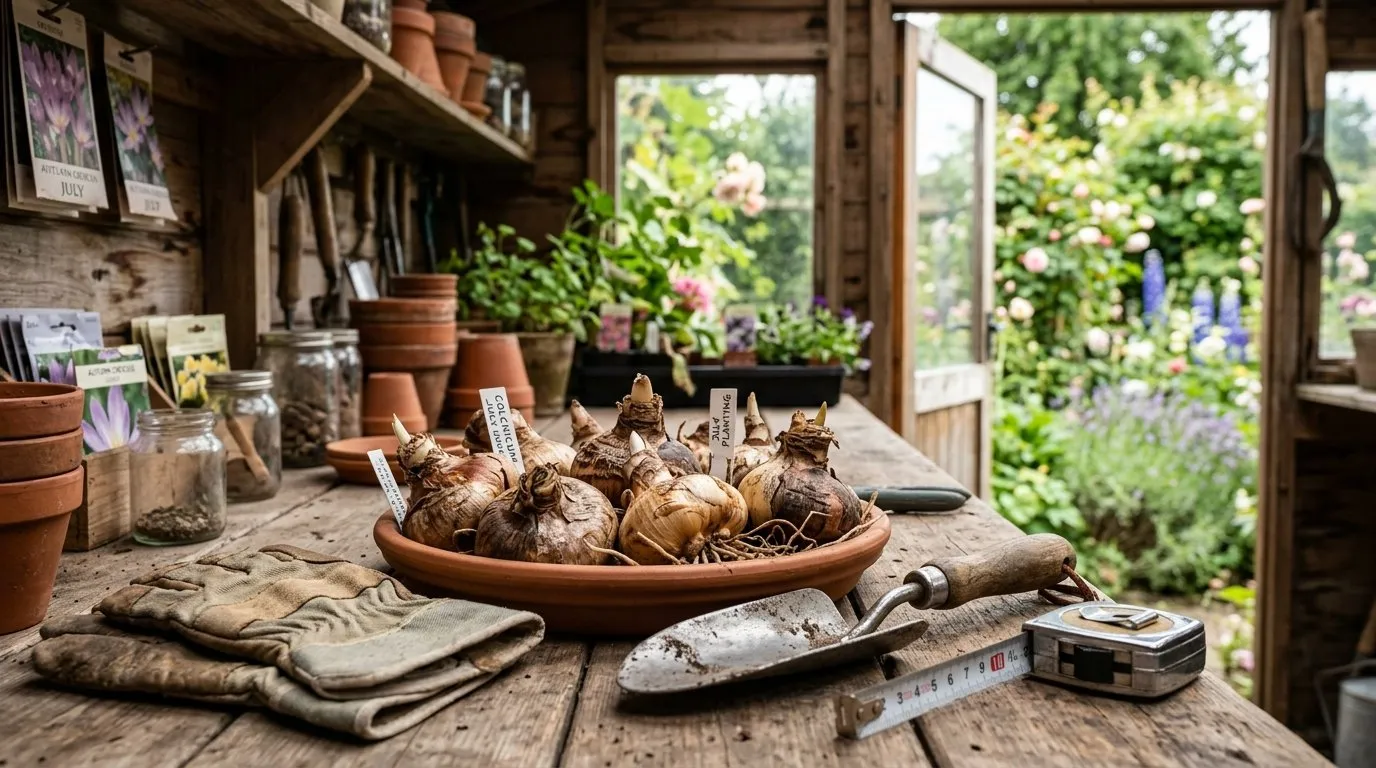 Colchicum corms ready for July planting. Always wear gloves — all parts are toxic.
Handling the colchicum leaf problem
The single biggest issue for most gardeners is what to do about the large spring foliage. Each corm produces 3-5 strap-shaped leaves that emerge in March, reach 30cm tall by mid-April, and start yellowing from late May. By early July they collapse into a wet untidy mess.
Strategy 1: Plant in long grass. The best solution. Meadow or orchard grass hides leaves as they grow, and when the grass is left uncut until mid-July the colchicum leaves die back naturally beneath. This is also how they grow in the wild.
Strategy 2: Plant beneath late-emerging perennials. Hostas, hardy geraniums (especially G. macrorrhizum), ferns, and Japanese anemones all produce substantial foliage from late April that grows up through and around dying colchicum leaves. By the time the colchicums yellow in June, the companion foliage masks them.
Strategy 3: Plant beneath deciduous shrubs. Roses, hydrangeas, and deciduous viburnums all leaf up in April, casting shade over the colchicum foliage zone. The foliage is less visually prominent under shrubs than in open border positions.
What not to do: Never cut leaves before they yellow. Cutting green foliage starves the corm by preventing photosynthesis during the energy-storage window. Three consecutive years of early cutting kills most clumps. If leaves are truly unsightly, tie them loosely with twine rather than cutting.
Brown and yellowed leaves can be cleared from early July onward once they are soft and easily detached. Compost them — colchicine breaks down in composting and finished compost is safe to use.
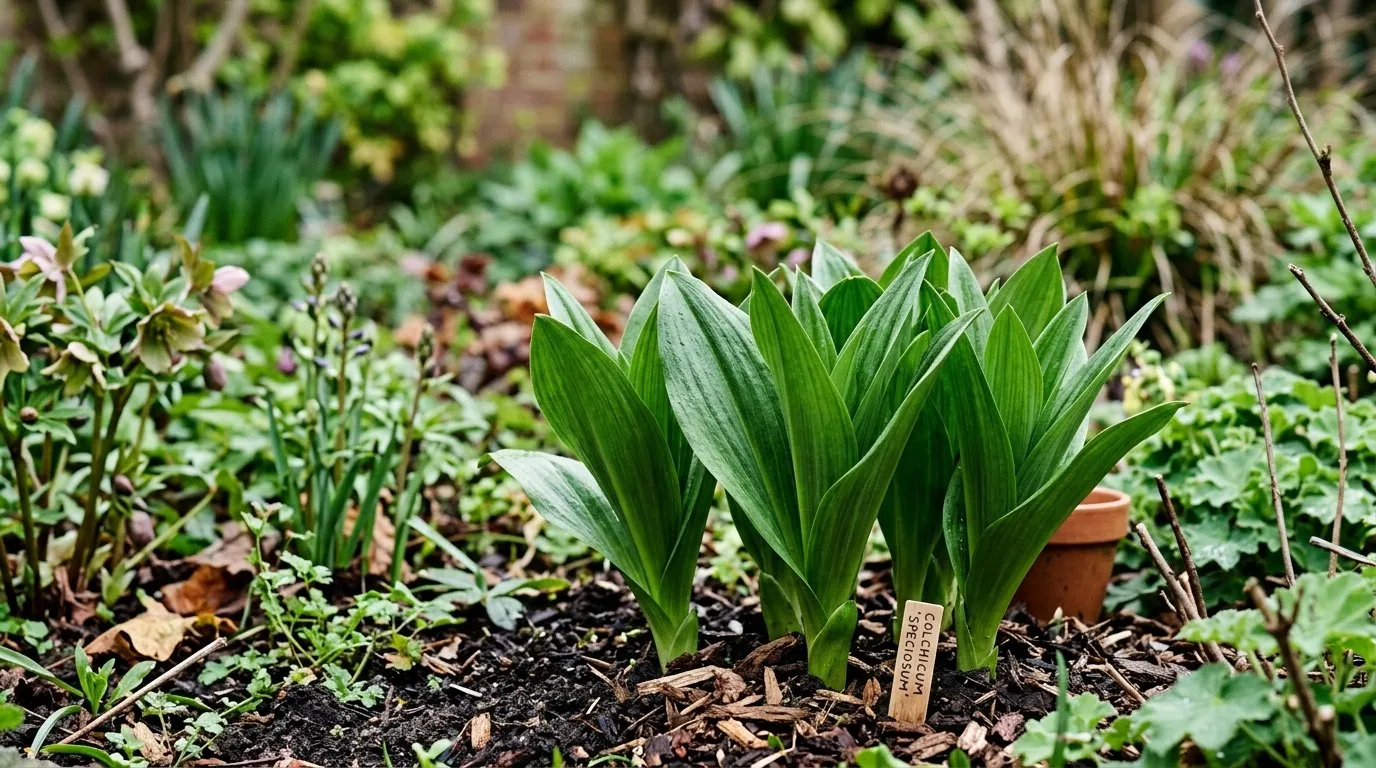 Colchicum leaves in April. Big, strappy, and completely at odds with the delicate autumn flowers — plan positions accordingly.
How to combine colchicum in borders and meadows
Three combinations work particularly well for UK gardens.
Late perennial border
Colchicum ‘Waterlily’ with Anemone x hybrida ‘Honorine Jobert’, Aster x frikartii ‘Monch’, and Panicum virgatum ‘Heavy Metal’. All flower or peak together in September and October, with the colchicums providing ground-level pink below the taller perennials.
Shrub underplanting
‘The Giant’ or ‘Album’ planted beneath hydrangeas, spring-flowering viburnums, and old roses. Shrub foliage masks the summer leaf dieback, and autumn colchicum flowers emerge after shrubs have finished their main display.
Meadow naturalising
Colchicum autumnale or ‘The Giant’ planted in orchard grass alongside daffodils, snake’s head fritillaries, and camassia. Sequential flowering from March (daffodils) through April (fritillaries), May (camassia), to September (colchicum) gives six months of wildflower meadow displays.
Woodland edge
‘Album’ or ‘Rosy Dawn’ with Cyclamen hederifolium, Helleborus x hybridus, and ferns. All four tolerate dry shade and dappled light. Colchicum provides September colour, cyclamen flowers September-November, hellebores follow from January, and ferns cover the spring-summer gap.
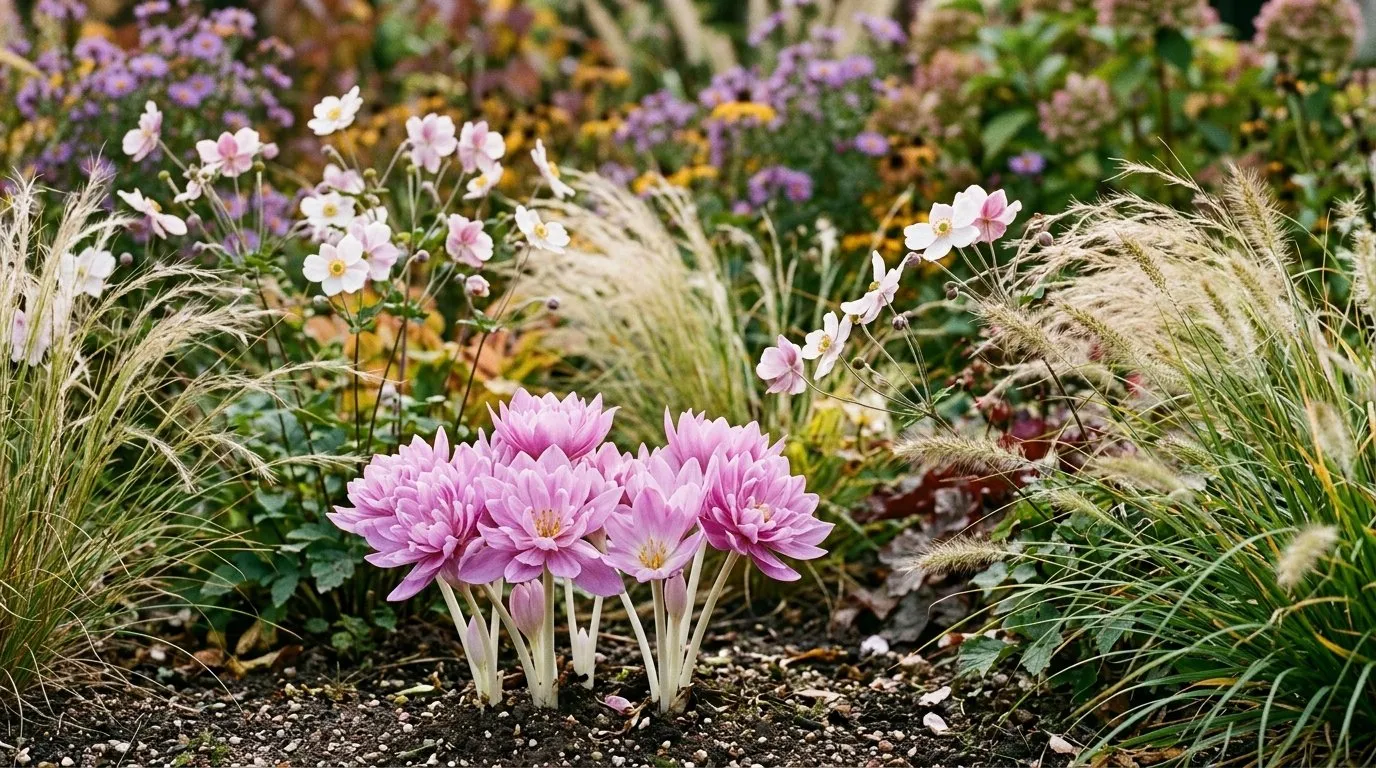 ‘Waterlily’ with autumn-flowering aster and Japanese anemone. A mid-September combination in a mixed border.
Common colchicum problems
Slug damage to autumn flowers. Slugs eat emerging buds and petals, leaving ragged holes. A scattering of sharp grit or copper tape around clumps in late August-September provides protection. A nematode drench in mid-August works preventively.
Flopping flower stems. The thin white flower tubes are easily flattened by rain or wind. Plant among low grass or around the base of perennials that can provide side support.
Squirrel and mouse damage to corms. Rare but occasionally a problem in rural gardens. Plant extra deep (12-15cm) or lay fine wire mesh over the planting area until the soil settles.
Yellowing leaves in early May. Usually cold damage or waterlogging. Healthy plants hold green foliage until late May or early June. If dieback is consistently early, improve drainage or move corms to a better-drained spot.
Non-flowering corms. See FAQ below. Most commonly caused by recent planting, insufficient corm size, or disturbance.
Is colchicum safe to grow?
All parts of colchicum contain colchicine, a highly toxic alkaloid. Lethal dose in humans is estimated at 0.8mg/kg body weight - equivalent to the colchicine content of roughly 10-15g of fresh corm tissue for an adult, or a single corm for a small child.
Symptoms of colchicum poisoning develop 2-24 hours after ingestion and include burning mouth, vomiting, diarrhoea, kidney damage, respiratory failure, and cardiac arrest. There is no antidote. Emergency treatment requires immediate hospitalisation.
Plant siting precautions:
- Children: Do not plant in areas children can access unsupervised. The pink flowers are attractive and the corms can be dug up by small hands.
- Dogs: High risk. Dogs that dig up corms can ingest fatal doses. Plant in grassy meadow areas or fenced-off beds.
- Livestock: Lethal to cattle, sheep, horses, and goats. Never plant in pastures.
- Gardeners: Low risk during normal handling. Always wear gloves when planting, dividing, or handling bulk corms. Wash hands after contact. Keep tools separate from food-preparation equipment.
The Royal Horticultural Society potentially harmful plants list classifies colchicum in category A - most toxic - alongside foxglove, monkshood, and yew.
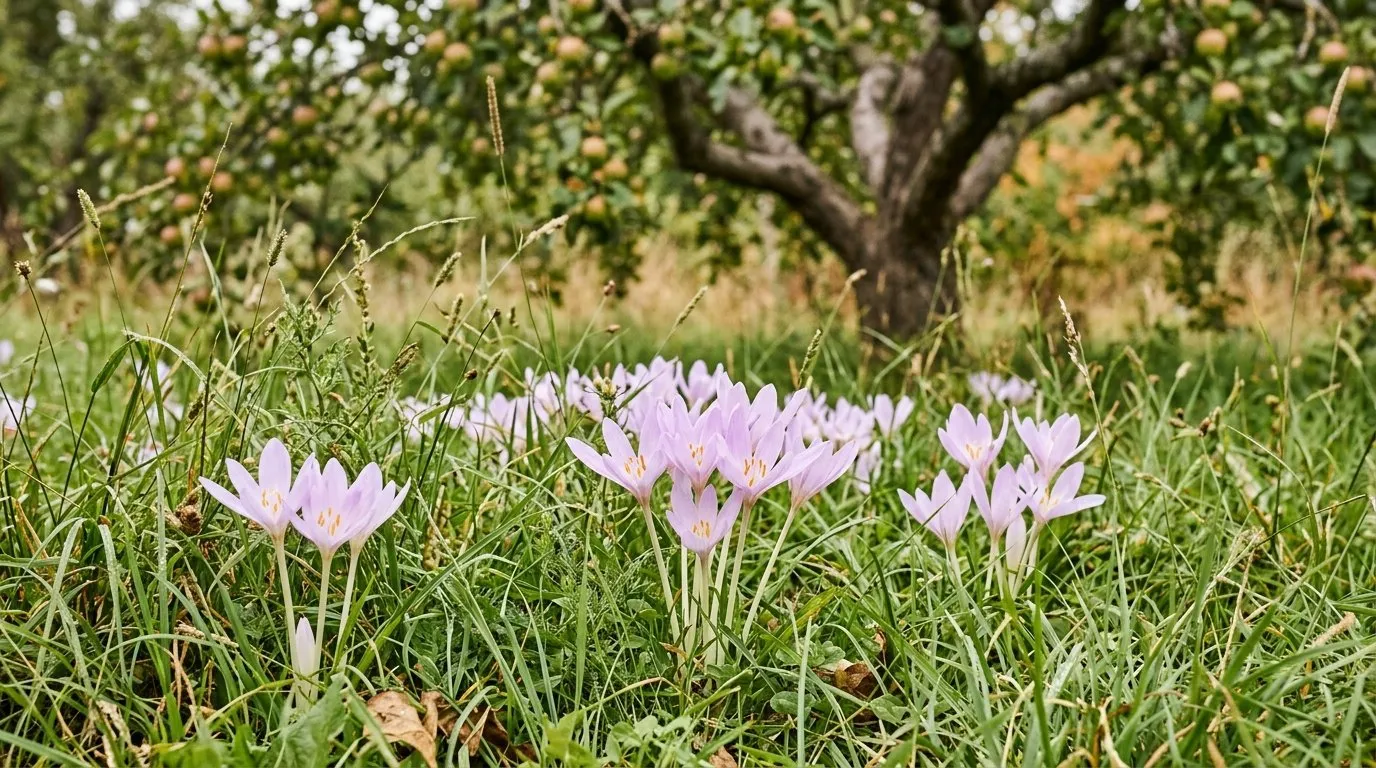 Colchicum autumnale naturalising in long orchard grass. Sequential flowering with camassia, fritillaries, and daffodils gives a six-month meadow display.
Colchicum maintenance calendar
| Month | Task | Time per 20 corms |
|---|---|---|
| February-March | Leaves start emerging. Check for waterlogging | 5 minutes |
| April | Leaves at full size. Do not cut | None |
| May | Leaves begin yellowing. Tolerate mess | None |
| June-Early July | Leaves die back. Remove once fully brown | 15 minutes |
| Mid-July | Plant new corms. Mow any meadow areas at high blade | 30 minutes planting |
| August | Continue planting new corms. Mulch existing clumps | 20 minutes |
| September-October | Flowering. Slug-proof with grit or nematodes | Enjoy |
| November-January | Dormant. No action | None |
Total annual maintenance runs to around 1-2 hours per 20 corms. Meadow naturalised plantings need only seasonal mowing decisions.
Where to buy colchicum corms in the UK
Buy from specialist bulb nurseries in June-July for delivery and planting in July-August. Avon Bulbs, Peter Nyssen, Broadleigh Gardens, and J Parker’s all carry quality stock. Prices:
- ‘The Giant’ (large single) - £2.50-£4.00 per corm
- ‘Waterlily’ (double) - £3.50-£5.50 per corm
- ‘Album’ (white) - £2.50-£4.00 per corm
- C. autumnale (species) - £1.00-£2.00 per corm in 10-packs
- ‘Rosy Dawn’ (scented) - £3.00-£4.50 per corm
A 3 square metre planting needs 20-30 corms for a visible display, costing £50-£120 depending on cultivar. Corms multiply over time through offsets, so a one-off investment gives decades of autumn flowering.
Frequently asked questions
When do colchicums flower in the UK?
Colchicums flower from early September to mid-October in UK gardens, with peak bloom in late September. Each corm produces 2-6 goblet-shaped flowers over 3-5 weeks. Flowering occurs from bare earth without leaves, earning the common name naked ladies. In mild autumns flowering extends into November, while cold early autumns compress the display to 3 weeks.
When should I plant colchicum corms?
Plant colchicum corms in July or early August, 4-6 weeks before expected flowering. Unlike spring bulbs, colchicums should not wait until autumn for planting. Corms planted in September often flower while sitting in nursery bags. Dig in corms 10cm deep and 15cm apart in groups of 7-15. Use gloves when handling — all parts contain the toxic alkaloid colchicine.
Is colchicum the same as saffron?
No, colchicum is not the same as saffron and should never be confused with it. Saffron comes from Crocus sativus, a true crocus flowering in autumn with bright orange stigmas used as the food spice. Colchicum contains the toxic alkaloid colchicine and is NOT edible. Both plants flower in autumn and have been confused historically, with tragic poisoning cases. Learn to identify both plants before harvesting any autumn-flowering crocus-like plant for culinary use.
Why are my colchicums not flowering?
The most common cause of non-flowering colchicum is recent planting — newly planted corms may skip a season while establishing roots. Other causes include too much summer shade, insufficient corm size at planting (under 3cm diameter), or disturbance of established clumps. Colchicums flower best in full sun on well-drained soil and should not be moved once settled. Feeding with potassium-rich tomato fertiliser in spring improves flowering.
Are colchicum leaves meant to be so big?
Yes, colchicum leaves are large and often surprise gardeners who only saw the autumn flowers. Each corm produces 3-5 strap-shaped leaves up to 30cm long and 8cm wide in April-May. Leaves die back untidily by early July after feeding the corm for next year’s flowers. Never cut leaves before they yellow — doing so starves the corm. Plan planting positions to hide or accommodate the large spring foliage.
Can I plant colchicum in a lawn?
Colchicums naturalise beautifully in lawns and long grass. Plant in groups of 15-25 corms per square metre for natural-looking clumps. Stop mowing the area from March to late June to allow leaves to feed the corm. First mow of summer should be mid-to-late July at a high blade setting. Mowing too early kills the corms within 2-3 seasons. Choose shaded orchard grass or meadow edges for best naturalising.
Are colchicums poisonous?
Yes, colchicums are highly poisonous. All parts — corms, leaves, flowers, and seeds — contain colchicine, a toxic alkaloid used medically to treat gout. Ingestion of any amount causes vomiting, burning mouth, kidney damage, and in severe cases cardiovascular collapse. A single corm contains enough colchicine to kill a child or small pet. Plant away from areas accessible to children, dogs, or livestock. Wear gloves when handling.
Sources: RHS Colchicum profile | Royal Horticultural Society Potentially Harmful Plants
Our team produces practical UK gardening guidance from source research, contributor records and established horticultural practice. Editorial standards are overseen by Matt W.