Key takeaways
- Cordyline australis tolerates -10C when mature but young plants need protection below -5C
- The green-leaved species is hardier than purple, red, and variegated cultivars by 3-5 degrees
- Plant in full sun on free-draining soil — cordylines rot in waterlogged clay
- Wrap trunks and tie leaves upright in November to protect from winter wet and crown rot
- Container-grown cordylines need moving to sheltered spots or unheated greenhouses below -2C
- After flowering (usually year 8-10), the main trunk dies but side shoots from the base continue growing
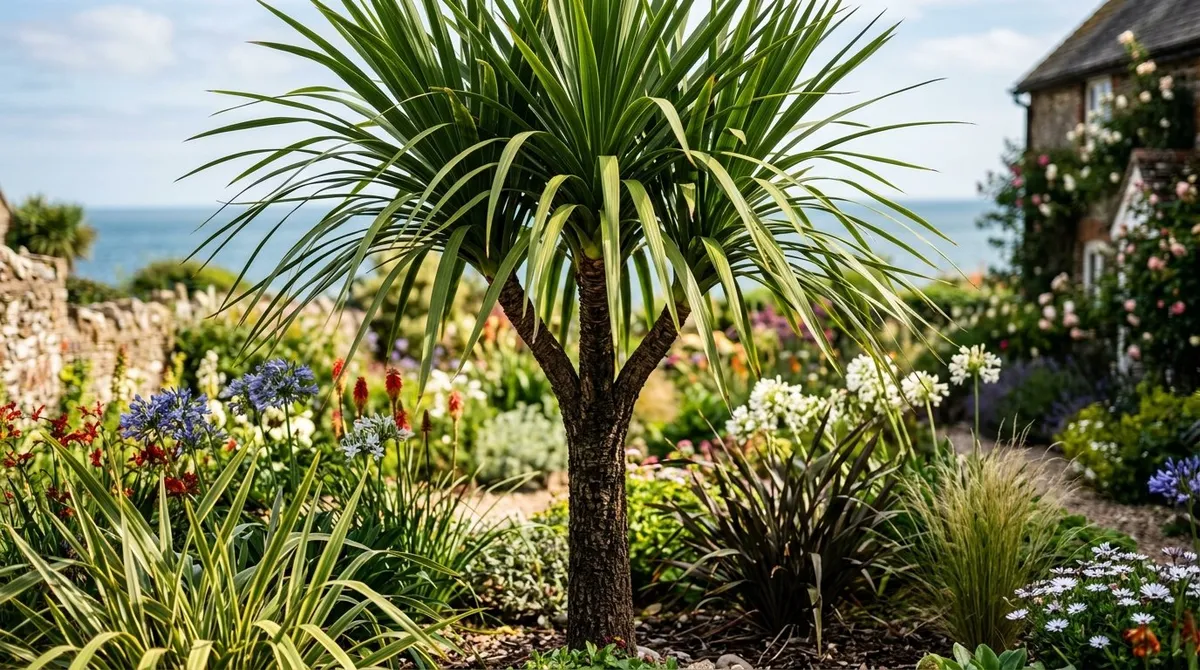
Cordyline is the plant that made the English Riviera look Mediterranean. Introduced from New Zealand in 1823 and widely planted in Torbay, Devon, from the 1860s onward, it gave seaside resorts a tropical silhouette that no hardy native could match. A mature Cordyline australis, 10 metres tall with a forked trunk and tufts of sword leaves catching the light, still reads as unmistakeably exotic in a British garden.
What most people do not know is that it is not a palm at all. Cordyline australis belongs to the asparagus family, closer to hostas and agaves than to coconut palms. The palm-like habit evolved separately. That botanical quirk has a practical consequence: cordylines are hardier than real palms and cope with UK winters that would kill most tropical-looking plants.
This guide covers the hardiest varieties, how to protect young plants through their first three winters, the container-growing rules for gardens too cold for open-ground planting, and what to do when the trunk collapses after a severe frost.
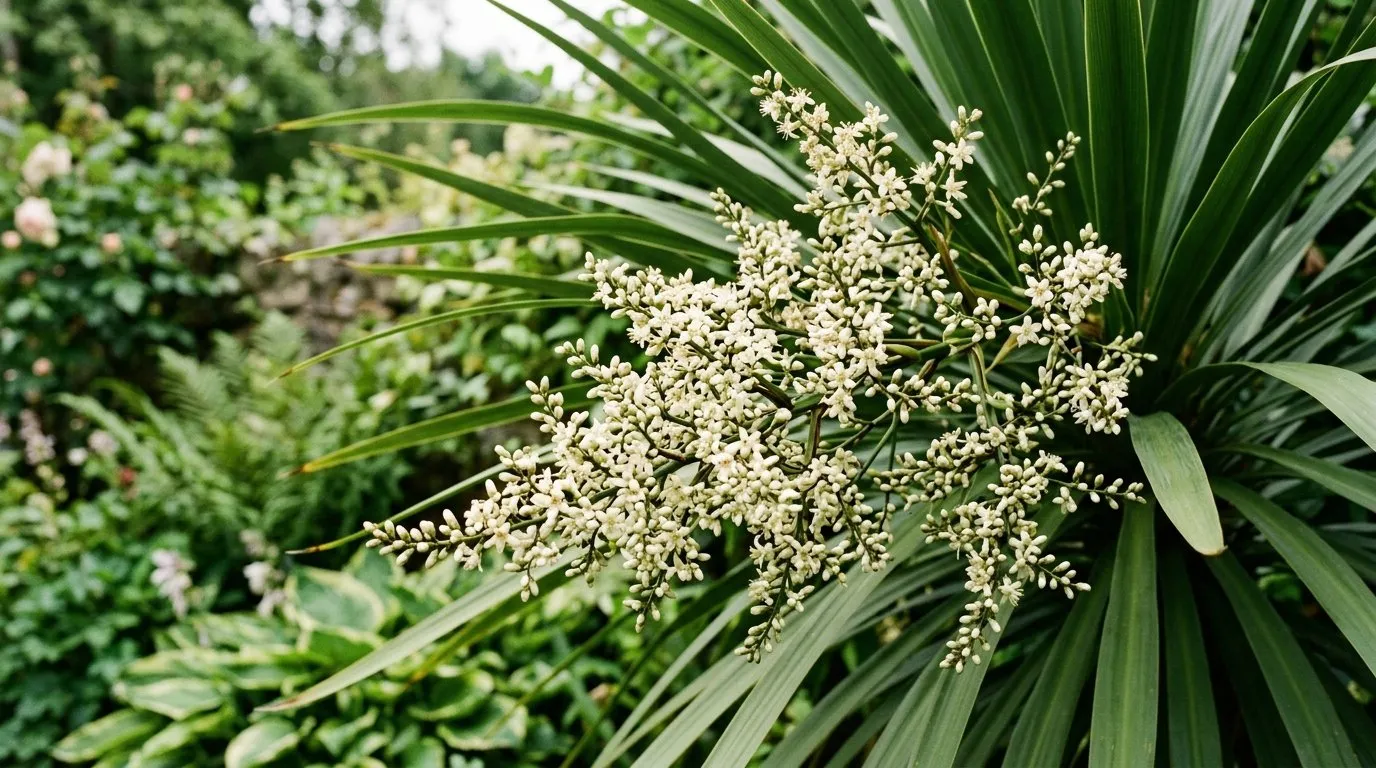 A mature Cordyline australis in a south-facing border. Coastal and southern UK gardens grow these to full height with no protection.
What is cordyline?
Cordyline australis is an evergreen tree native to New Zealand, where Maori name it ti kouka. It belongs to the Asparagaceae family, not the Arecaceae (true palm) family, despite the palm-like appearance. The single trunk is topped with dense tufts of sword-shaped leaves up to 90cm long and 3-6cm wide. Mature specimens reach 8-12 metres in their native habitat and in the mildest UK gardens.
Introduced to Britain by Allan Cunningham in 1823, it was first planted at Kew. By 1860 it had spread to coastal resorts, where the mild oceanic climate allowed it to reach full maturity. The Torbay area in Devon still holds several specimens over 10 metres tall, some over 150 years old. The plant is sometimes called the Torbay palm for that reason.
Two other species are grown in UK gardens. Cordyline indivisa is larger-leaved but less hardy, surviving only in Cornwall and the Scilly Isles. Cordyline fruticosa (the red-leaved “ti plant”) is a houseplant not suitable for outdoor UK conditions.
Unlike true drought-tolerant Mediterranean plants, cordylines actually prefer moderate moisture and tolerate rather than need dry conditions. That makes them surprisingly versatile in British gardens, which rarely suffer extended drought.
Which cordyline varieties grow best in UK gardens?
Six cultivars dominate UK garden centres. Green-leaved forms are hardiest; coloured varieties are progressively less so.
| Variety | Leaf Colour | Hardiness | Height | Notes |
|---|---|---|---|---|
| C. australis (type) | Mid-green | Hardy to -10C | 8-12m | Most reliable, cheapest |
| ’Albertii’ | Green + cream stripe | -8C | 5-7m | Variegated, slower growing |
| ’Torbay Dazzler’ | Cream + green stripe | -6C | 3-5m | Striking variegation, needs shelter |
| ’Red Star’ | Deep bronze-purple | -5C | 2-4m | Popular coloured form, compact |
| ’Torbay Red’ | Bright burgundy | -5C | 3-5m | Intense colour, less hardy |
| ’Pink Passion’ | Pink and green | -3C | 2-3m | Conservatory or summer patio only |
Cordyline australis (the type)
The plain green-leaved species is the one to plant if you want a plant that will survive long-term in most of the UK. Hardy to -10C when mature, it grows steadily by 15-30cm a year, reaching 3-4 metres in 10-12 years in a sheltered inland garden. Coastal southern gardens push it to 8 metres or more. Flowers in July of its 8th to 10th year, producing creamy panicles up to 1.5m long.
Cordyline ‘Red Star’
Cordyline ‘Torbay Dazzler’
Striking cream and green variegated foliage. Beautiful in a container by a doorway or as a focal point in a sheltered border. Hardiness drops to around -6C, so in anywhere north of London this is a container plant that spends winters in shelter. Grows more slowly than the type.
Where do cordylines grow best in UK gardens?
Cordylines need three things: warmth in summer, sharp drainage in winter, and shelter from cold winds. Match all three and they grow reliably from Sussex to Aberdeen. Fail on any of them and survival becomes a gamble.
Light: Full sun. 6+ hours of direct sun daily produces the strongest trunk, the deepest leaf colour, and the best flower spikes. Shade produces lax growth, pale leaves, and weaker winter hardiness. In hot southern gardens, a light amount of afternoon shade is acceptable but not needed.
Soil: Free-draining, moderately fertile. Sandy loam is ideal. Heavy clay needs significant improvement with grit before planting. Chalk is fine. Acid soils are tolerated. The single non-negotiable factor is drainage: cordylines rot in waterlogged winter ground.
Shelter: Cold drying winds damage leaves and kill young plants faster than cold temperatures alone. Plant on the sheltered side of a wall, fence, or hedge. South-facing walls are ideal, providing reflected heat through winter. Avoid exposed corners where wind funnels.
Region: Coastal Devon, Cornwall, west Wales, southwest Scotland, and the Scilly Isles grow cordylines to full maturity with no protection. Southern England inland, Ireland, and the Welsh coast grow them well with occasional winter wrapping. Northern England and Scotland grow them successfully with consistent winter protection or as container plants brought under cover.
How to plant cordyline in the UK
Plant container-grown cordylines in April or May after the last frost. Autumn planting is possible in coastal regions but risky inland because young plants lack established roots to pull them through winter.
Step 1 - Choose the right plant size. A 1-1.5m plant establishes faster than a 3m specimen and costs a fifth the price. Large cordylines often suffer transplant shock that sets them back 2-3 years. Small plants overtake them within 5 seasons.
Step 2 - Prepare the planting hole. Dig a hole twice the width of the root ball and the same depth. On clay, dig deeper and backfill the base with 20cm of sharp grit. Mix a bucket of horticultural grit into the soil you will use for backfilling.
Step 3 - Position correctly. Set the plant with the top of the root ball level with the surrounding soil. Planting too deep causes trunk rot. Plant on a 10cm-high mound if drainage is marginal.
Step 4 - Stake if needed. Young plants in exposed sites need a single sturdy stake driven in on the windward side, tied with soft tree straps. Remove the stake after 2 years once roots have established.
Step 5 - Water and mulch. Water heavily at planting, then weekly for the first 12 weeks during the growing season. Apply 50mm of bark chip mulch over the root zone, keeping it clear of the trunk.
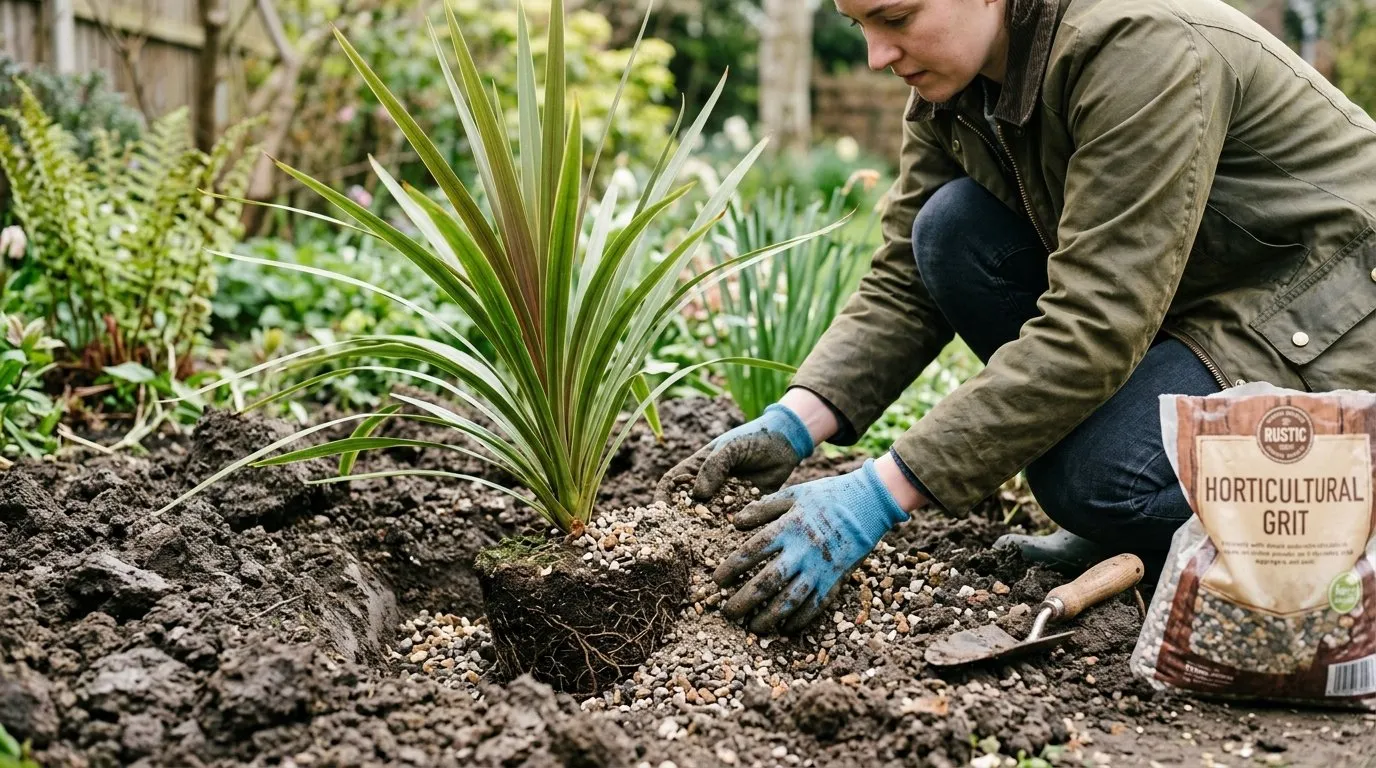 Planting cordyline on heavy clay. Sharp grit mixed through the backfill ensures winter drainage.
How to protect cordyline in winter
The single most common cause of cordyline death in the UK is winter failure. Protection against three specific threats transforms survival rates.
Threat 1 - Crown rot from winter wet
Rain collects in the central crown where leaves meet the trunk. In freeze-thaw cycles, this water freezes, expands, and damages the growing point. Prevent by tying leaves gently upright in late November with soft jute twine. This creates a teepee shape that sheds rain and reduces crown exposure. Remove the ties in mid-March.
Threat 2 - Trunk freezing
Internal trunk tissue freezes and thaws repeatedly in severe winters, causing collapse by March. Wrap the trunk with horticultural fleece (2-3 layers for cold-area plants) or hessian, secured with twine. Wrap from ground to just below the leaf crown. A straw-filled chicken-wire tube also works for larger specimens.
Threat 3 - Root zone freezing
Cordyline roots can die at -8C if soil freezes deep. Mulch the root zone with 100-150mm of bark chips in late October. On exposed sites, a 50cm-diameter ring of straw bales stacked against the trunk provides further root insulation.
Timing: Wrap in late November once temperatures have dropped consistently below 5C overnight. Unwrap in late March as growth resumes. Early wrapping in autumn risks fungal problems from trapped humidity.
For more detailed guidance on winter protection techniques, see our guide to how to protect plants from frost and how to overwinter plants.
How to grow cordyline in containers
Container growing gives cold-area gardeners access to cordylines they could not grow in the ground. It also allows colourful varieties like ‘Red Star’ and ‘Torbay Dazzler’ to be moved under cover in severe weather.
Pot size: Start with a 40cm pot and move up one size every 3 years. Mature container cordylines live happily in 60-70cm pots indefinitely. Terracotta breathes better than plastic but dries out faster in summer.
Compost: John Innes No. 3 with 20% added horticultural grit. Standard multipurpose compost stays too wet in winter and causes root rot. Avoid peat-free mixes that retain water excessively.
Watering: Weekly in summer, keeping the compost evenly moist but not saturated. Monthly in winter, only enough to prevent complete drying out. Poor drainage kills more container cordylines than anything else.
Feeding: Balanced liquid fertiliser (tomato feed is fine) fortnightly from April to August. No feeding in winter.
Winter care: Move pots to a sheltered north-facing wall or unheated greenhouse when forecasts dip below -2C. Bubble-wrap the pot to insulate roots. Bring inside (unheated porch is ideal) for brief severe cold snaps below -5C.
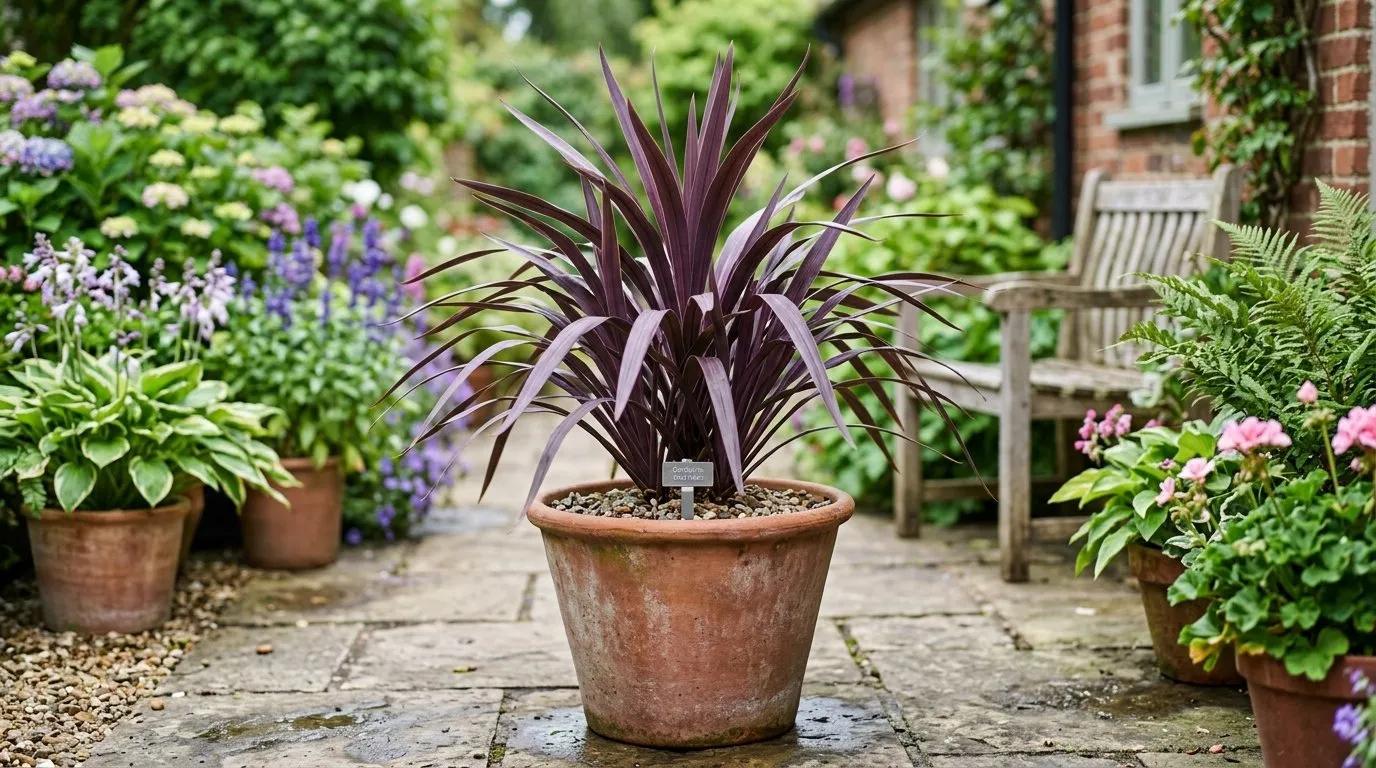 Cordyline ‘Red Star’ in a 50cm terracotta pot. Moveable to shelter in severe cold — essential for coloured varieties inland.
Cordyline flowering and post-flowering renewal
Cordylines flower after 8-10 years of growth, sometimes later in cooler regions. The flower spike emerges from the crown in June, reaching 1-1.5 metres and branching into a wide creamy-white panicle that opens in July. The fragrance is sweet and honey-like, attracting bees and hoverflies for 3-4 weeks.
After flowering, the main trunk stops extending in height. New side shoots emerge from the base over the following 1-2 years, creating the classic multi-stemmed mature tree silhouette. The original trunk gradually dies off over 3-5 years.
Do not panic when the main trunk dies. This is natural cordyline biology. Simply remove dead leaves as they brown and cut the dead trunk cleanly at the base in late spring, once the side shoots are established at 1 metre or more. From that point the plant lives on through its suckers, which themselves flower after a further 8-10 years.
Common cordyline problems
Collapsed trunk after winter. Cut back to firm living tissue, often at ground level. Fresh shoots emerge from the base in May-June. Recovery takes 3-5 years for a new stem to reach 1 metre.
Brown-tipped or yellowing leaves. Old leaves yellow naturally and drop over 2-3 years. Brown leaf tips result from wind damage, frost, or drought stress. Cut leaves cleanly at the base with secateurs. Never pull - this tears the trunk bark.
Cordyline slime flux. Oozing reddish-brown sap from the trunk indicates bacterial infection, usually following frost damage. Wipe the trunk clean and allow to dry. Severe cases are untreatable - remove the affected stem and allow base shoots to take over.
Sooty mould on leaves. Caused by aphids or mealybugs feeding on leaves, leaving sticky honeydew. See our guide on aphids for treatment. Hose foliage with soapy water and apply neem oil fortnightly until clear.
Root rot. Yellowing foliage, soft base, and loose trunk indicate waterlogging. Improve drainage by adding grit around the root zone or relocate to a drier site. Container plants: repot into fresh compost with added grit.
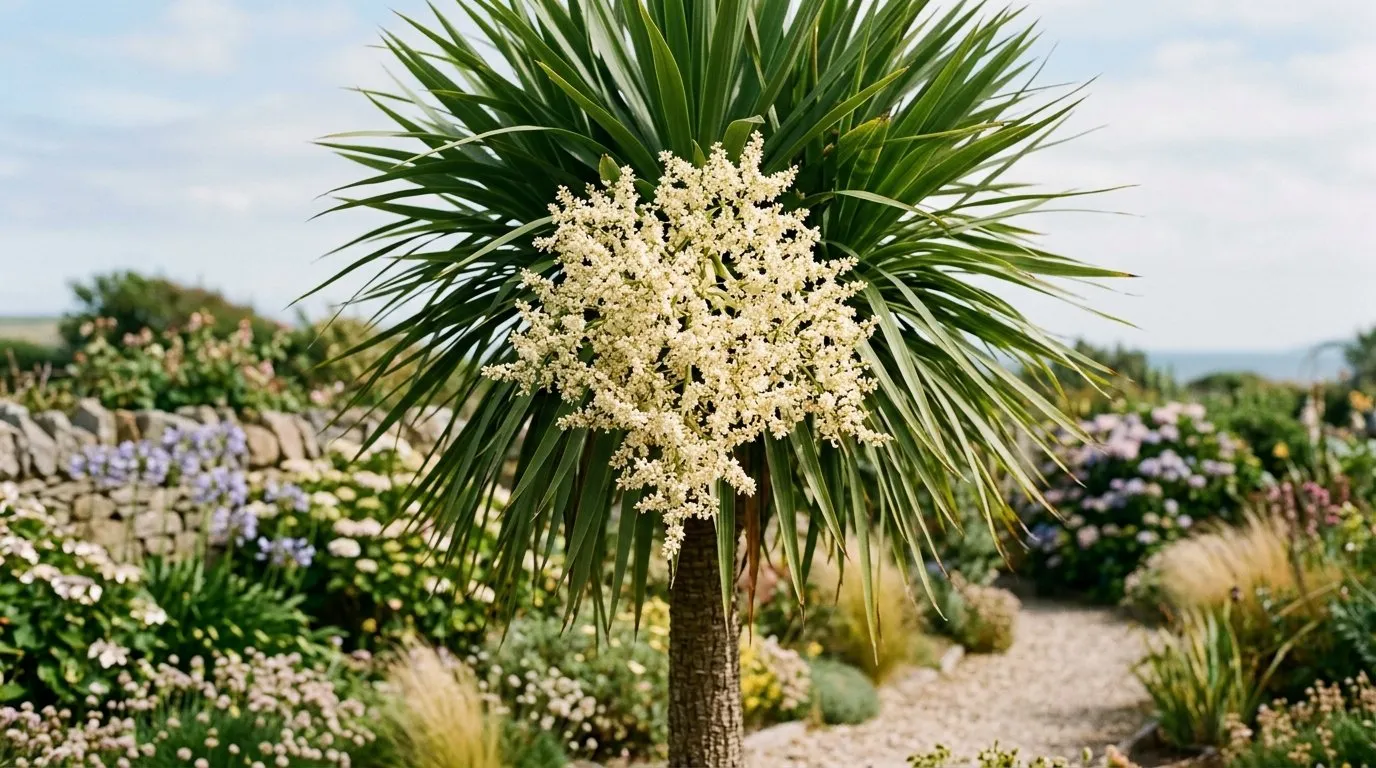 A mature cordyline in flower in July. The creamy-white panicle is sweetly fragrant and attracts bees for several weeks.
Cordyline maintenance calendar
| Month | Task | Time per plant |
|---|---|---|
| March | Remove winter wrapping. Cut any dead leaves. Check trunk for damage | 30 minutes |
| April-May | Plant new cordylines. Mulch established plants. Apply balanced feed | 20 minutes |
| June-August | Water weekly during dry spells. Remove any yellowing lower leaves | 15 minutes per week |
| September | Reduce watering. Last feed of the season | 10 minutes |
| October | Mulch root zone thickly with bark chips | 30 minutes |
| November | Tie leaves upright. Wrap trunk with fleece or hessian | 30-45 minutes |
| December-February | Leave wrapped. Check after storms. Brush snow off wrapped leaves | 5 minutes per check |
Total annual maintenance per plant is around 4-6 hours including wrapping. Unwrapped mature coastal plants need less than 2 hours annually.
Where to buy cordyline in the UK
Young cordylines are widely sold at garden centres in spring at around £15-£25 for a 1m ‘Red Star’ or plain green, £35-£60 for a 1.5-2m specimen. Specialist exotic plant nurseries stock rarer named varieties and larger plants. Mail-order delivers 90cm plants for £20-£40 depending on season.
Buy from suppliers in similar or colder climates to yours if possible. A plant grown outdoors in Yorkshire is better acclimated than one raised under glass in Cornwall. Ask where the stock was grown.
For broader exotic-style planting, partner cordylines with hardy exotic-look plants like hardy palms, phormiums, yuccas, and ornamental bananas.
Frequently asked questions
Is cordyline hardy in the UK?
Green-leaved Cordyline australis is hardy across most of the UK once established, tolerating -10C in mature specimens. Young plants under 1m tall need protection below -5C. Coloured varieties like ‘Red Star’ and ‘Torbay Dazzler’ are less hardy and may suffer damage at -3C. Coastal gardens in Devon, Cornwall, and west Wales grow cordylines unprotected to maturity; inland and northern gardens need winter wrapping.
How fast do cordylines grow in the UK?
Cordylines grow 15-30cm per year in UK gardens, slower than in their native New Zealand where they reach 50cm annually. A garden-centre 1m plant typically takes 6-8 years to double in height and 10-12 years to flower. Growth slows further in colder or shaded positions. Container plants grow more slowly than those in the ground, reaching around 2m over 8 years.
Why has my cordyline trunk collapsed?
A collapsed cordyline trunk means the plant has frozen and thawed repeatedly, causing the internal tissue to rot. This usually happens in late winter after a severe cold spell. Cut the collapsed trunk back to firm wood, often at ground level. Fresh shoots typically sprout from the base in May-June. Future protection: tie leaves upright in November and wrap the trunk with fleece or hessian through winter.
Can I grow cordyline in a pot?
Cordyline australis grows well in large containers of 50cm diameter or more. Use John Innes No. 3 compost with 20% added grit for drainage. Water weekly in summer, monthly in winter. Feed monthly from April to August with balanced fertiliser. Move to a sheltered spot or unheated greenhouse when temperatures drop below -2C. Repot every 3-4 years in spring.
Why is my cordyline flowering?
Cordyline flowering is a sign of maturity, usually occurring 8-10 years after planting. The plant produces a large creamy-white panicle up to 1.5m long from the crown in July-August. The fragrance is sweet and attracts bees. After flowering, the main trunk stops growing and eventually dies, but side shoots from the base grow on to form a multi-stemmed tree. This is natural and not a cause for concern.
Is cordyline poisonous to dogs?
Cordyline australis is not listed as toxic to dogs or humans by UK veterinary or plant databases. The closely related Cordyline fruticosa, commonly grown as a houseplant, is mildly toxic to pets if eaten in quantity and can cause vomiting. For garden cordylines, only handling concerns apply — the sword-shaped leaves have sharp tips that can cause minor scratches or eye injuries. Plant away from paths.
How do I protect cordyline in winter?
Tie all leaves gently upright with soft twine in November, creating a protective bundle around the crown. Wrap the bundled leaves and trunk with horticultural fleece (2-3 layers for severe cold areas) secured with twine. Leave the wrapping in place from late November to late March. Mulch the root zone with 100mm of bark chips. For potted plants, move to an unheated greenhouse or sheltered north-facing wall below -2C.
Sources: RHS Cordyline australis profile | The Tree Register of the British Isles
Our team produces practical UK gardening guidance from source research, contributor records and established horticultural practice. Editorial standards are overseen by Matt W.