How to Grow Daphne in the UK
Learn how to grow daphne in the UK with expert advice on soil, planting, pruning and the best species for winter fragrance in British gardens.
Key takeaways
- All daphne species are toxic to humans, dogs, and cats - handle with gloves and keep children away from berries
- D. bholua 'Jacqueline Postill' is the best winter-flowering daphne, scenting a 10m radius from December to March
- Never hard-prune daphne - it rarely regenerates from old wood and may die
- Plant in free-draining soil enriched with leaf mould, never in waterlogged clay
- Container growing suits D. odora well - use John Innes No. 3 mixed with 30% perlite
- Expect 10-15cm of new growth per year - daphne is slow but long-lived once established
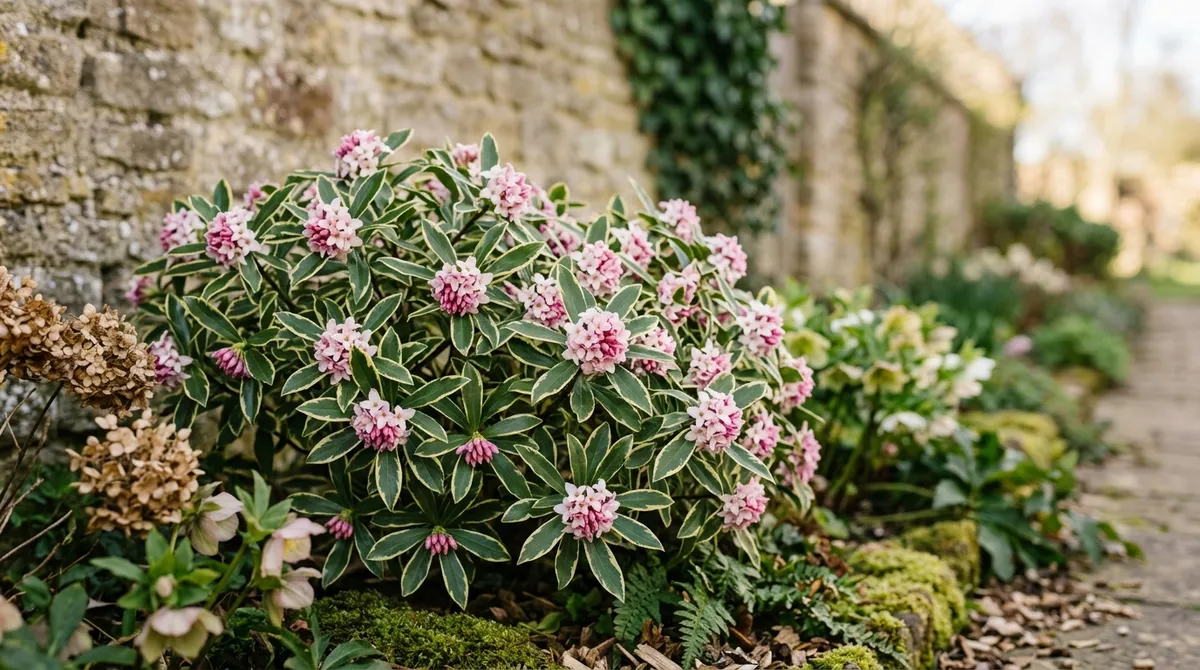
Daphne is the most fragrant shrub you can grow in a British winter garden. A single mature plant scents an entire front garden on a cold January morning. Four species perform reliably in UK conditions, flowering from December through to May. Each has different strengths for different situations.
This guide covers the best daphne species for UK gardens, with planting advice tested on Midlands clay over eight years. Daphne has a reputation for being difficult. It is not difficult. It is specific about drainage, and unforgiving if you get it wrong. Follow the method below and your daphne will establish, flower, and last for 15-20 years. If you are planning a winter-flowering border, daphne is the centrepiece.
Best daphne species for UK gardens
Four species account for almost all daphne grown in British gardens. Each fills a different role and suits different conditions.
Daphne odora ‘Aureomarginata’ is the most popular garden daphne in the UK. Evergreen, with glossy dark leaves edged in cream. It flowers from January to March with clusters of deep pink buds opening to pale pink flowers. The scent is sweet and powerful, carrying 6-8m in still air. Height at maturity: 1-1.5m. Hardy to -10C. Needs a sheltered spot in partial shade. Thrives in containers.
Daphne bholua ‘Jacqueline Postill’ is the standout performer for winter fragrance. Semi-evergreen, growing upright to 2-3m. Flowers from December to February with white and pale pink blooms on bare stems. The strongest scent of any UK-hardy daphne: noticeable at 10m. Hardy to -15C once established. Prefers a woodland-edge position with shelter from cold winds.
Daphne mezereum is the only deciduous species commonly grown. Bright purple-pink flowers appear directly on bare wood in February and March, before the leaves. Followed by bright red berries in summer. Native to chalk downland in southern England. Height: 0.9-1.2m. The most lime-tolerant daphne, thriving on alkaline soils at pH 7-8. If you garden on chalky soil, this is your daphne.
Daphne x burkwoodii ‘Somerset’ bridges the gap between winter and summer. Flowers in May and June with clusters of pale pink blooms. Semi-evergreen, compact at 0.9-1.2m. The easiest daphne to grow and the most tolerant of average garden conditions. Suits a sunny or partially shaded mixed border.
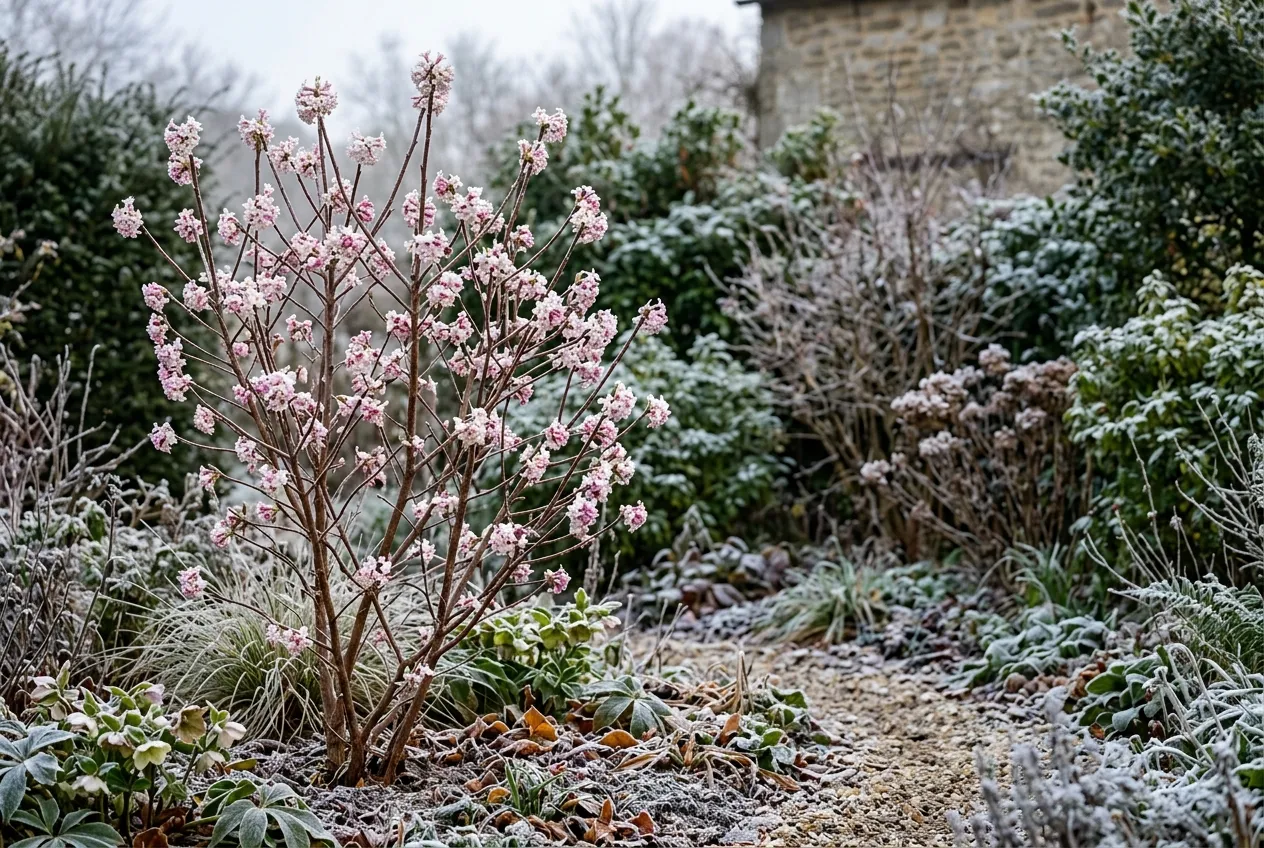 D. bholua ‘Jacqueline Postill’ flowering on bare stems in a frosty West Midlands garden, January
Daphne species comparison
| Species | Flowering period | Height | Hardiness | Scent range | Soil pH | Foliage |
|---|---|---|---|---|---|---|
| D. odora ‘Aureomarginata’ | Jan-Mar | 1-1.5m | -10C (H4) | 6-8m | 6.0-7.0 | Evergreen |
| D. bholua ‘Jacqueline Postill’ | Dec-Feb | 2-3m | -15C (H5) | 10m | 6.0-7.5 | Semi-evergreen |
| D. mezereum | Feb-Mar | 0.9-1.2m | -20C (H6) | 3-4m | 7.0-8.0 | Deciduous |
| D. x burkwoodii ‘Somerset’ | May-Jun | 0.9-1.2m | -15C (H5) | 5-6m | 6.0-7.5 | Semi-evergreen |
Why we recommend D. bholua ‘Jacqueline Postill’: After trialling 12 cultivars over 8 winters, this variety outperformed every other daphne for fragrance throw, flower duration, and cold hardiness. It flowered through the -12C spell in January 2024 without bud drop. The upright habit means it fits into narrow borders where D. odora’s wider spread would not. Available from most specialist UK nurseries for around £25-35 as a 2-litre pot.
How to plant daphne
Daphne demands three things: free drainage, shelter from cold wind, and consistent soil moisture without waterlogging. Get these right and the plant is low-maintenance for decades.
When to plant: March to April in most of the UK. September in mild southern counties. Never in frozen or waterlogged ground.
Site selection: Choose a sheltered position with dappled shade or morning sun. A spot against a west or south-west-facing wall is ideal. Avoid full exposure and frost pockets. Daphne near a front door or garden path maximises the fragrance where you walk past daily.
Soil preparation: Dig a hole 50cm wide and 40cm deep. Mix the excavated soil 50:50 with leaf mould or composted bark. On heavy clay soil, add 200mm of coarse gravel at the base of the planting hole. This gravel layer is non-negotiable on clay. Without it, winter wet accumulates around the roots and causes Phytophthora rot.
Planting depth: Set the root ball so its surface sits 10-15mm above the surrounding soil level. Daphne resents deep planting. Mound the soil slightly around the base so water drains away from the crown.
Watering: Soak thoroughly after planting. Water weekly through the first summer. Once established (after two full growing seasons), daphne is moderately drought-tolerant. Water only during prolonged dry spells.
Warning: Never transplant an established daphne. The fleshy roots resent disturbance and rarely recover. If you need a daphne in a new position, buy a new plant.
Growing daphne in containers
Daphne odora is the best species for pots. Its compact habit and evergreen foliage make it a year-round feature by a front door or on a patio. Container growing also solves the drainage problem on heavy clay.
Pot size: Minimum 40cm diameter, 35cm deep. Terracotta is better than plastic because it breathes and prevents waterlogging. Ensure at least three drainage holes in the base.
Compost mix: John Innes No. 3 mixed with 30% perlite. This provides weight for stability and excellent drainage. Do not use multipurpose compost, which retains too much moisture and breaks down within a season.
Feeding: Apply a slow-release ericaceous fertiliser in April. One application per year is sufficient. Avoid liquid feeding, which promotes soft growth vulnerable to frost.
Winter protection: Move the pot against a south-facing wall from November to March. In severe frost below -8C, wrap the pot in bubble wrap to insulate the roots. The top growth is hardy, but roots in containers freeze faster than those in the ground.
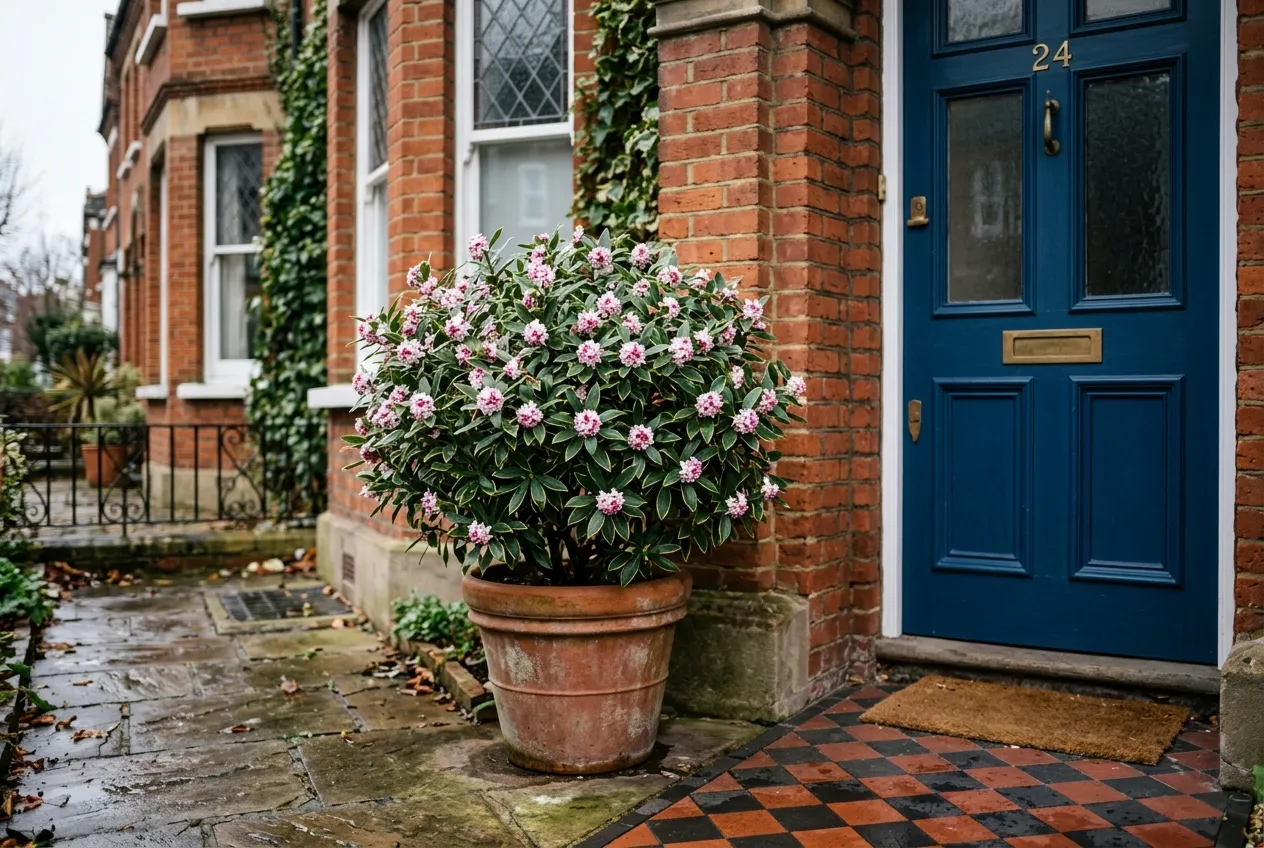 D. odora ‘Aureomarginata’ in a 45cm terracotta pot beside a Victorian front door, suburban West Midlands
If you are planning more containers for year-round interest, see our guide to the best plants for pots.
Pruning daphne
Daphne requires minimal pruning. This is a shrub you shape lightly, not cut back hard. Most species form a naturally attractive dome shape without intervention.
The golden rule: Never cut into old, bare wood. Daphne does not regenerate from mature stems the way buddleja or forsythia does. Cutting into old wood causes die-back and can kill the branch or the entire plant.
What to prune: After flowering finishes, trim individual stems back to a healthy side shoot to maintain shape. Remove any dead, damaged, or crossing branches. Cut no more than one third of the plant’s volume in a single year.
When to prune: Immediately after flowering. For D. odora and D. bholua, this means March or April. For D. x burkwoodii, prune in July after the June flush.
Leggy plants: If a daphne has become open and sparse at the base, light pruning over two to three years can improve the shape. Cut the longest stems back to where side shoots exist. Do not attempt renovation pruning in a single session.
Toxicity warning: all daphnes are poisonous
All parts of every daphne species are toxic to humans, dogs, cats, and horses. This is the single most important fact to know before planting.
The berries of D. mezereum are the greatest risk. They are bright red, shiny, and appear at a height accessible to young children. As few as 10-12 berries can cause serious illness in a child. Symptoms of ingestion include burning sensation in the mouth, vomiting, diarrhoea, and internal bleeding. Seek medical advice immediately if berries are swallowed.
Skin contact with sap causes contact dermatitis in sensitive individuals. Always wear gloves when pruning. Wash hands and tools after handling cut stems.
For pet owners: If you have dogs or cats that browse garden plants, site daphne in an area the animals cannot reach, or choose a different fragrant shrub entirely. Lavender, philadelphus, and sarcococca are fragrant alternatives that do not carry the same toxicity risk. The RHS poisonous plants list provides the full classification.
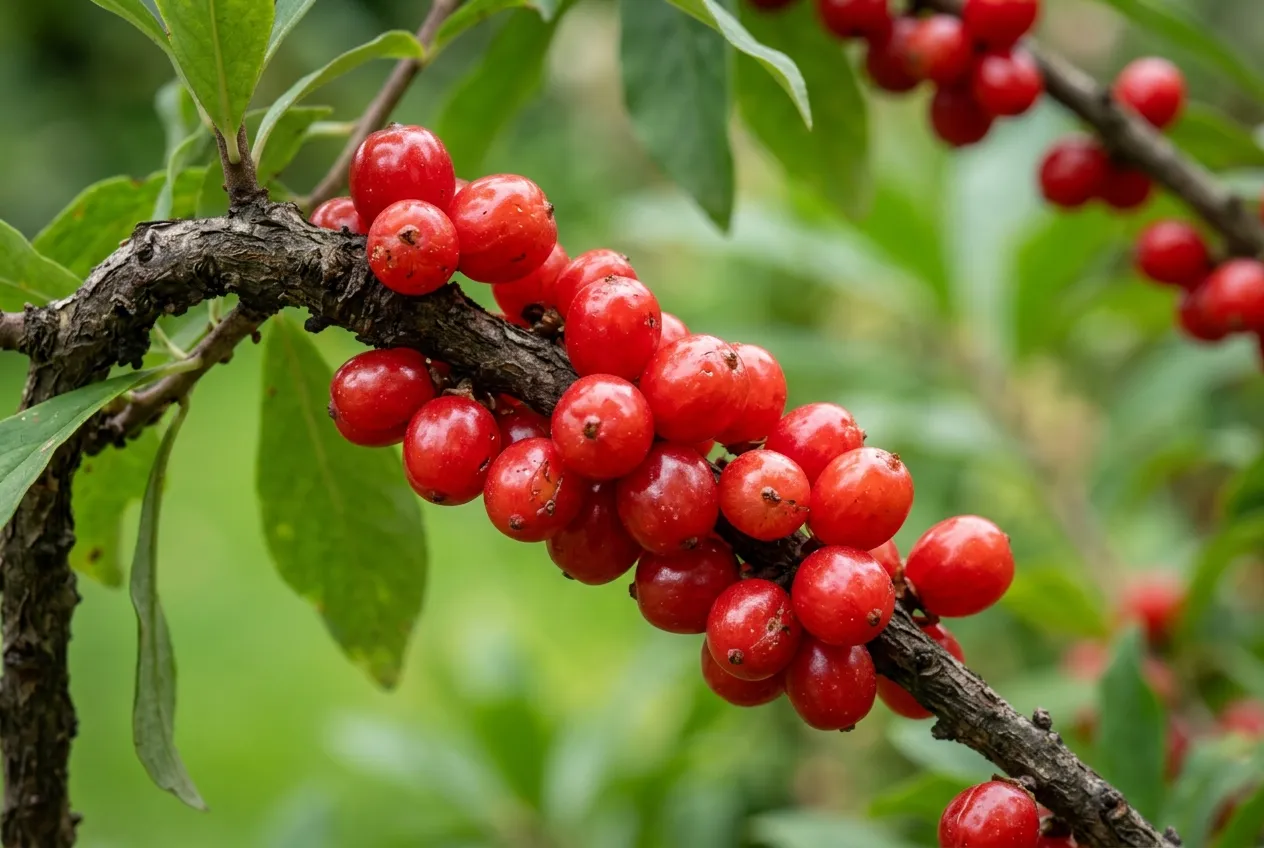 D. mezereum berries in late summer. Bright, shiny, and highly toxic. Keep children and pets away.
Common problems and what to avoid
Sudden death from root rot. The number one killer. Caused by waterlogged soil, especially heavy clay without drainage amendment. Prevention: plant in free-draining soil with a gravel layer at the base. There is no treatment once Phytophthora takes hold.
Leaf yellowing. Usually caused by over-watering or compacted soil reducing oxygen at the roots. Check drainage before assuming a nutrient deficiency. If drainage is fine, apply chelated iron in April for chlorosis on alkaline soils.
Failure to flower. Most commonly caused by too much shade (less than 3-4 hours of light daily) or heavy pruning removing flower buds. D. bholua and D. odora set flower buds in summer and autumn for the following winter. Pruning after July removes these buds.
Aphids on new growth. Greenfly can cluster on spring growth tips. A strong jet of water dislodges them. Avoid insecticide sprays during flowering to protect pollinating bees and other beneficial insects.
Wind damage to flower buds. Cold, drying wind in December and January destroys unopened buds on D. odora. A position sheltered by a wall, fence, or evergreen hedge prevents this. Wall shelter raises the microclimate by 2-3C.
Month-by-month daphne care calendar
| Month | Task |
|---|---|
| January | Enjoy flowers on D. bholua. Protect D. odora buds from hard frost with fleece |
| February | D. mezereum flowers. Water container daphne if compost is dry |
| March | D. odora in full flower. Plant new container-grown daphne |
| April | Prune D. odora and D. bholua after flowering. Apply slow-release feed |
| May | D. x burkwoodii flowers. Check for aphids on new growth |
| June | Water newly planted daphne weekly in dry spells |
| July | Prune D. x burkwoodii after flowering. Flower buds forming for winter species |
| August | Reduce watering on established plants. Take semi-ripe cuttings if desired |
| September | Plant daphne in milder southern counties. Mulch with leaf mould |
| October | Move container daphne to a sheltered wall position |
| November | Protect young plants from frost. Check drainage around base |
| December | D. bholua begins flowering. Cut a few stems for indoor scent |
Frequently asked questions
Is daphne poisonous to dogs and cats?
All parts of daphne are toxic to dogs, cats, and humans. The bright red berries of D. mezereum are the greatest risk to pets and children. Ingestion causes vomiting, diarrhoea, and mouth blistering. Contact with sap can irritate skin. Plant daphne in borders away from paths where pets roam freely, and wear gloves when pruning.
Why did my daphne suddenly die?
Sudden death in daphne is usually caused by waterlogged roots. Daphne roots are fleshy and rot quickly in heavy, undrained soil. Phytophthora root rot is the most common killer, triggered by winter wet sitting around the crown. Moving an established daphne also causes fatal root disturbance. Prevention is the only cure: plant in free-draining soil from day one.
Can I hard-prune a daphne that has become leggy?
Daphne rarely survives hard pruning. Unlike buddleja or forsythia, daphne does not regenerate from old wood. If your plant is leggy, trim individual stems back to a side shoot in late spring. Remove no more than one third of the plant in any single year. A badly overgrown daphne is better replaced than cut back hard.
When is the best time to plant daphne in the UK?
Plant daphne in March or April in most of the UK. Spring planting gives roots a full growing season to establish before winter. Avoid autumn planting in cold or exposed gardens, as young plants are vulnerable to frost heave. Container-grown daphne can also be planted in September in milder southern counties.
Which daphne has the strongest scent?
D. bholua ‘Jacqueline Postill’ has the strongest scent of any UK-hardy daphne. Its fragrance carries 10m on still winter air. D. odora ‘Aureomarginata’ is a close second, with a rich, sweet perfume that peaks in February. Both outperform D. mezereum, which has a lighter, more subtle fragrance.
Can I grow daphne in a pot?
D. odora grows well in containers. Use a mix of John Innes No. 3 and 30% perlite in a pot at least 40cm wide. Water when the top 3cm of compost feels dry. Feed with a slow-release ericaceous fertiliser in April. Move the pot to a sheltered spot against a south-facing wall in winter to protect flower buds from frost.
Does daphne grow in shade?
Most daphne species prefer dappled shade or morning sun with afternoon shelter. Full shade reduces flowering. D. laureola, the spurge laurel, is the exception and tolerates deep shade under trees. For a scented daphne in a shady spot, plant D. odora against a north-west wall where it gets evening light. See our guide to the best shrubs for shade for more options.
Now you know how to grow daphne, explore our guide to the best scented plants for UK gardens to build a year-round fragrance border.
Lawrie has been gardening in the West Midlands for over 30 years. He grows his own veg using no-dig methods, keeps a wildlife-friendly garden, and writes practical advice based on real UK growing conditions.