Key takeaways
- 'Emerald Gaiety' (cream and green variegated) is the single best all-round cultivar for UK gardens: hardy, ground-cover or climber, mildew-free
- Evergreen Euonymus fortunei varieties can climb like ivy if given a support — they reach 3m on a warm wall in 8-10 years
- Deciduous spindles (E. alatus, E. europaeus) offer blazing red autumn foliage and pink-orange seed capsules — better than any acer for most UK gardens
- Euonymus scale (Unaspis euonymi) is the one pest to watch — treat with horticultural oil in early March before eggs hatch
- Plant in autumn (October-November) or spring (March-April) for best establishment — both evergreen and deciduous types
That tolerance is what most people miss. Garden centres stock one or two variegated japonicus and a few deciduous spindles for autumn colour, but the genus contains around 130 species and 40 widely grown cultivars, covering ground cover to 6-metre small trees. They are hardy to minus twenty, take any soil you give them, and grow in sun, partial shade or dry shade. The only thing they dislike is sitting in winter water.
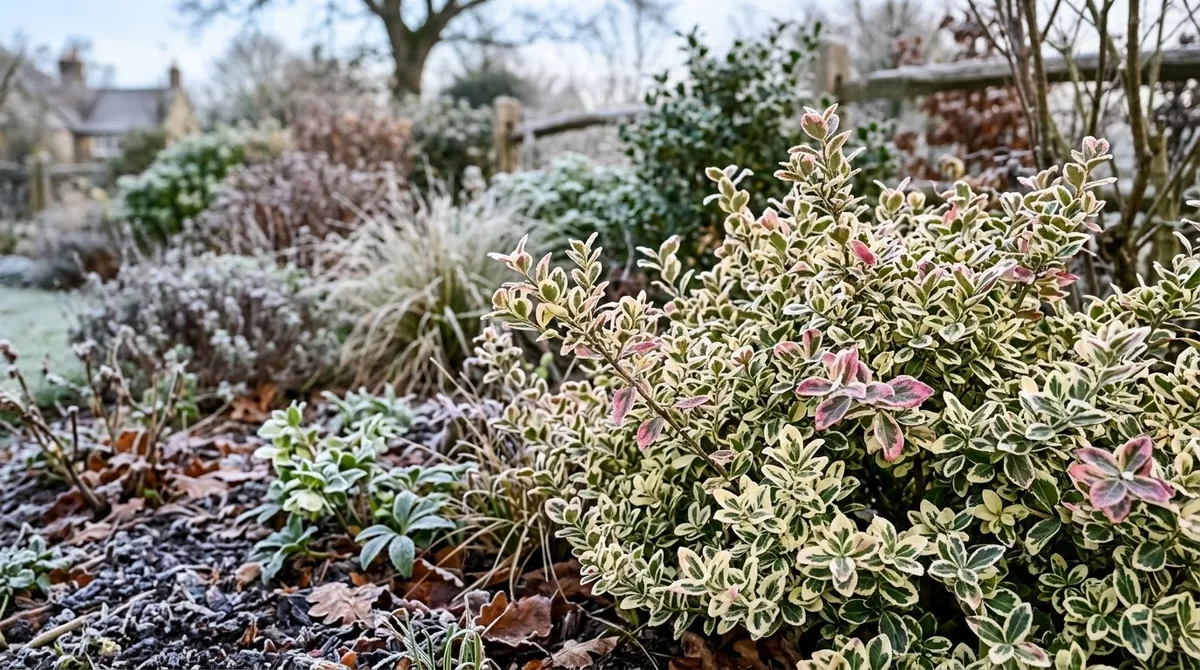
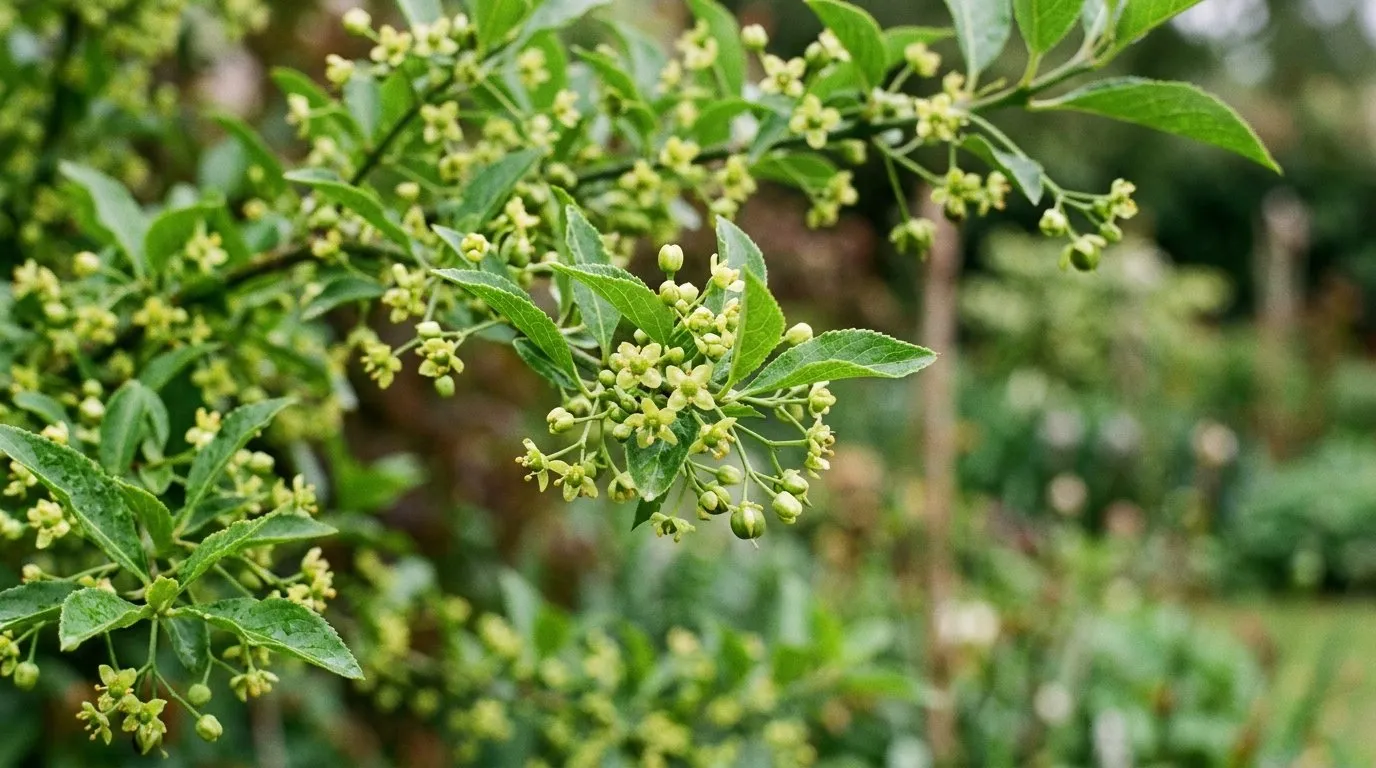 ‘Emerald Gaiety’ in mid-January, bringing winter colour to a UK border when almost everything else has finished.
What is euonymus and how many types are there?
Euonymus is a genus of around 130 species of hardy evergreen and deciduous shrubs, trees, and climbers in the Celastraceae family. Native across the northern hemisphere, from Britain through Europe and into central Asia, China, and North America. Around 12 species and 40 cultivars are widely grown in UK gardens, falling into three practical groups: evergreen spreading/climbing (E. fortunei), evergreen upright (E. japonicus), and deciduous spindles (E. alatus, E. europaeus).
According to the Royal Horticultural Society, euonymus is among the most adaptable garden shrubs, with AGM (Award of Garden Merit) winners from every group.
Which euonymus varieties grow best in UK gardens?
Euonymus fortunei ‘Emerald Gaiety’ (the one to plant first)
Plant 60cm apart for ground cover. A single specimen covers 1-1.2 square metres after 5 years. For wall training, plant 50cm from the wall base and guide the first shoots with canes for the first 2 years. After that it climbs itself.
Euonymus fortunei ‘Emerald ‘n’ Gold’ (AGM)
The yellow-variegated partner to ‘Emerald Gaiety’. Bright gold margins on green leaves, turning orange-red in winter. Slightly less vigorous than ‘Emerald Gaiety’ at 60cm x 90cm. Ideal for front-of-border planting where winter colour matters. Holds colour better in full sun than ‘Emerald Gaiety’, but foliage can scorch in hot dry sites.
Euonymus alatus (winged spindle)
Euonymus japonicus ‘Aureomarginatus’
A large evergreen (2-3m) with big glossy green leaves edged in gold, and the traditional choice for a hedge. It grows fast at 30cm per year, copes with coastal conditions, and clips well, making a semi-formal evergreen hedge 1.5-2m in 5-7 years. Choose it for a bright winter boundary hedge in a south-facing spot. It is less hardy than the fortunei varieties: fine to -15C, but the leaves can take damage in exposed sites below that.
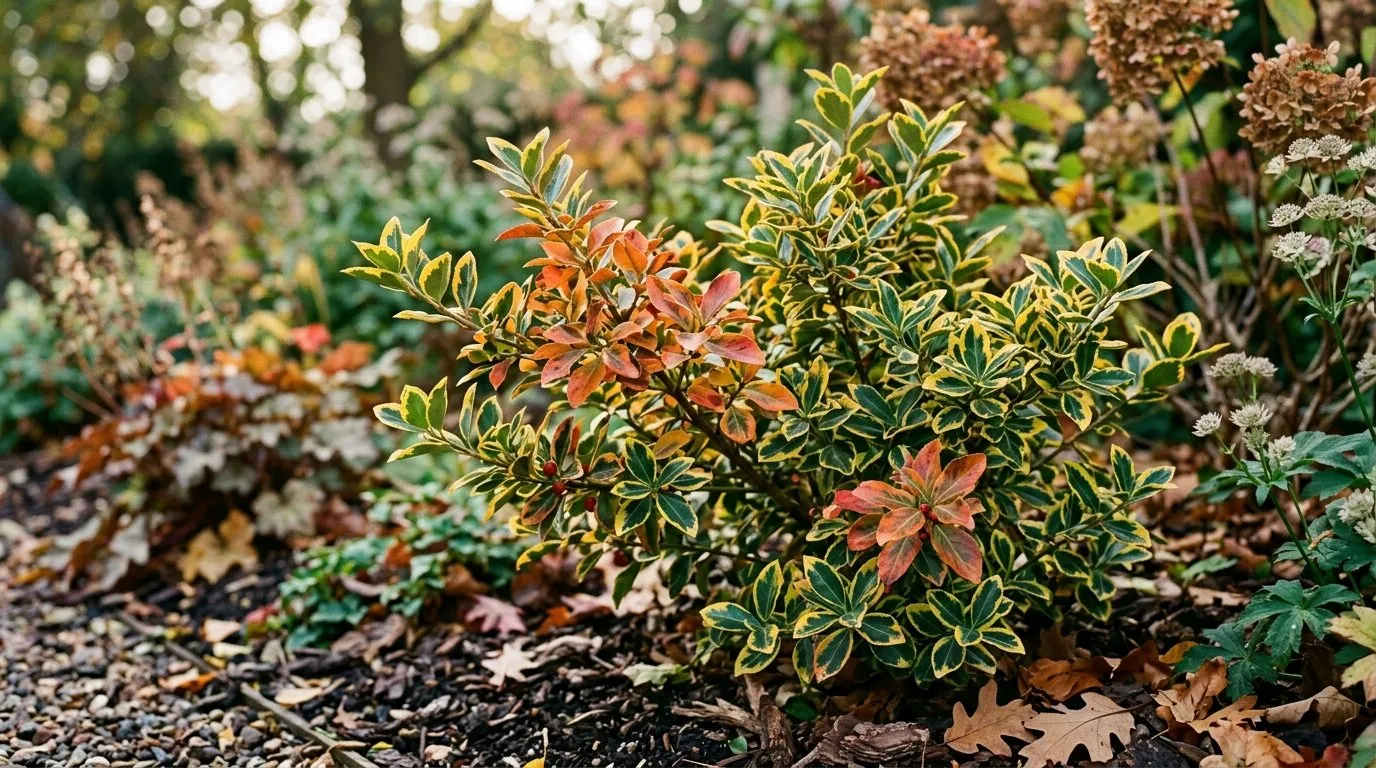 ‘Emerald ‘n’ Gold’ in November. Cold triggers the orange-red flush on the gold margins.
Where do euonymus grow best in UK gardens?
The short answer is almost anywhere. There are a few nuances worth knowing, though.
Light: Full sun to deep shade. Evergreen fortunei varieties genuinely tolerate dry shade under mature trees — one of the few shrubs that does. Variegated types hold colour best in partial shade (morning sun, afternoon shade) but survive in both extremes. Deciduous spindles need at least 4 hours of direct sun for reliable autumn colour; in deep shade they stay green and leaf fall is unremarkable.
Soil: Any reasonable soil. Heavy clay, sand, chalk, and loam all work once established. Neutral to mildly alkaline pH is ideal but acid soils are tolerated. The one thing euonymus genuinely dislikes is sitting in waterlogged winter clay. On heavy clay that stays wet from November to March, either plant on a raised mound (15-20cm above ground level) or dig grit into the top 30cm of soil.
Moisture: Moderate. Established plants tolerate summer drought once their roots are in. First-year plants need weekly watering during dry spells from April to September. After year 2, most euonymus need no supplementary irrigation.
Shelter: Coastal-tolerant. E. japonicus in particular thrives in salt-spray zones and forms one of the best hedging options for Cornish and Scottish coastal gardens. Exposed windy sites dry foliage out but rarely kill plants.
For reliable companion planting, see our guide on best plants for shade in the UK.
How to plant euonymus
Autumn (October-November) or spring (March-April) are the two best planting windows. Container-grown plants can go in at any time except during frost or drought.
Step 1 — Prepare the soil. Dig a hole twice the width of the root ball and the same depth. On heavy clay, add a bucket of horticultural grit. On sand, add a bucket of garden compost for moisture retention.
Step 2 — Soak the root ball. Submerge the pot in a bucket of water for 10 minutes until bubbles stop rising. Dry root balls take months to properly integrate with surrounding soil; pre-soaked ones root out within weeks.
Step 3 — Plant at the original depth. Set the top of the root ball level with the surrounding soil. Planting too deep causes stem rot on euonymus more than almost any other shrub.
Step 4 — Spacing. Ground-cover forms: 60cm apart. Specimen shrubs: 1.2-1.5m apart. Hedging: 40-50cm apart for a 1-1.5m hedge, 60-75cm for taller screens.
Step 5 — Water and mulch. Soak the planting hole thoroughly. Apply 50mm of garden compost or bark chip mulch around the plant, keeping it 3cm clear of the stem.
Water new plants weekly for the first 12 weeks of the growing season. After that they fend for themselves.
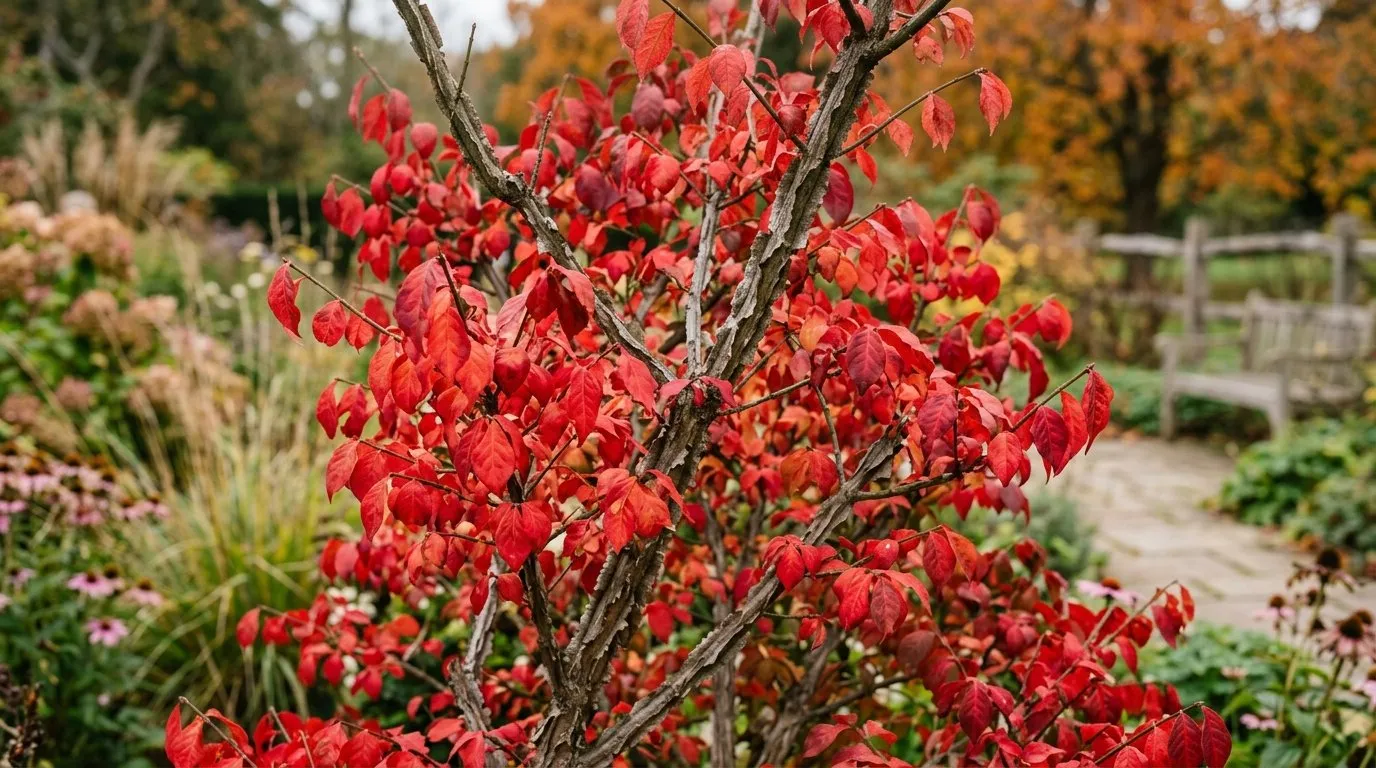 E. alatus in mid-October. The leaves turn scarlet; the winged stems provide structural interest all winter.
How to prune euonymus
Pruning needs vary by type, but none of them is fussy.
Evergreen Euonymus fortunei
Lightly prune in April after the worst frosts, removing:
- Any stems damaged or killed by winter cold
- Reverted all-green shoots on variegated varieties
- Wayward growth spoiling the shape
A second tidy in September tightens growth before winter. For ground-cover specimens, shear the whole plant back by one-third every 3-4 years to refresh density. Plants respond well and regenerate within one full season.
Evergreen Euonymus japonicus (hedges)
Two trims per year — first in late May or early June, second in September. Use sharp shears or a powered hedge trimmer. Cut to the desired shape, typically a slight taper wider at the base to allow light to reach the lower foliage. Avoid cutting into thick old wood on formal hedges; renovation is possible but causes bare patches for 2-3 seasons.
Deciduous spindles (E. alatus, E. europaeus)
Minimal pruning. Remove crossing, dead, or weak branches in late winter (February-March) while dormant. Avoid summer pruning — it reduces autumn colour intensity and disrupts seed capsule formation. Renovation pruning of overgrown specimens is best tackled in March; cut old stems to 30-45cm from ground level and new growth emerges vigorously.
How to propagate euonymus
Three methods work reliably. Semi-ripe cuttings are the easiest.
Semi-ripe cuttings (July-August):
- Cut 10-15cm shoots from this year’s growth, just below a node
- Strip the lower leaves, keeping 2-3 leaves at the top
- Dip the cut end in rooting hormone powder
- Insert into a 50:50 mix of John Innes No. 1 and sharp sand
- Cover with a clear plastic bag or place in a propagator
- Roots form in 6-10 weeks; pot on the following spring
Hardwood cuttings (November-December): Works on deciduous spindles. Take 20-25cm lengths of pencil-thick wood, push 15cm into a trench of gritty compost, leave for 12 months. Transplant in the following November.
Layering (April-May): Effective for spreading forms like ‘Emerald Gaiety’. Bend a low stem to the ground, peg it down into soil, leave for 12-18 months. Roots form at the buried section; sever from the parent and lift the following autumn.
Best companion plants with euonymus
With evergreen fortunei types
- Hellebores (Helleborus x hybridus) — February-April flowers at the foot of ‘Emerald Gaiety’
- Snowdrops and crocuses — naturalise between ground-cover spreaders
- Hardy ferns (Dryopteris filix-mas) — textural contrast in shade
- Heucheras — deep purple or lime-green foliage alongside variegated euonymus
With deciduous spindles
- Spring bulbs — tulips and alliums come up through bare branches before the euonymus leafs out
- Grasses (Stipa tenuissima, Miscanthus) — autumn plume-and-fiery-leaf combination
- Sedums (Hylotelephium) — pink autumn flower heads pair with scarlet spindle foliage
- Late asters — September-October flowers alongside peak autumn colour
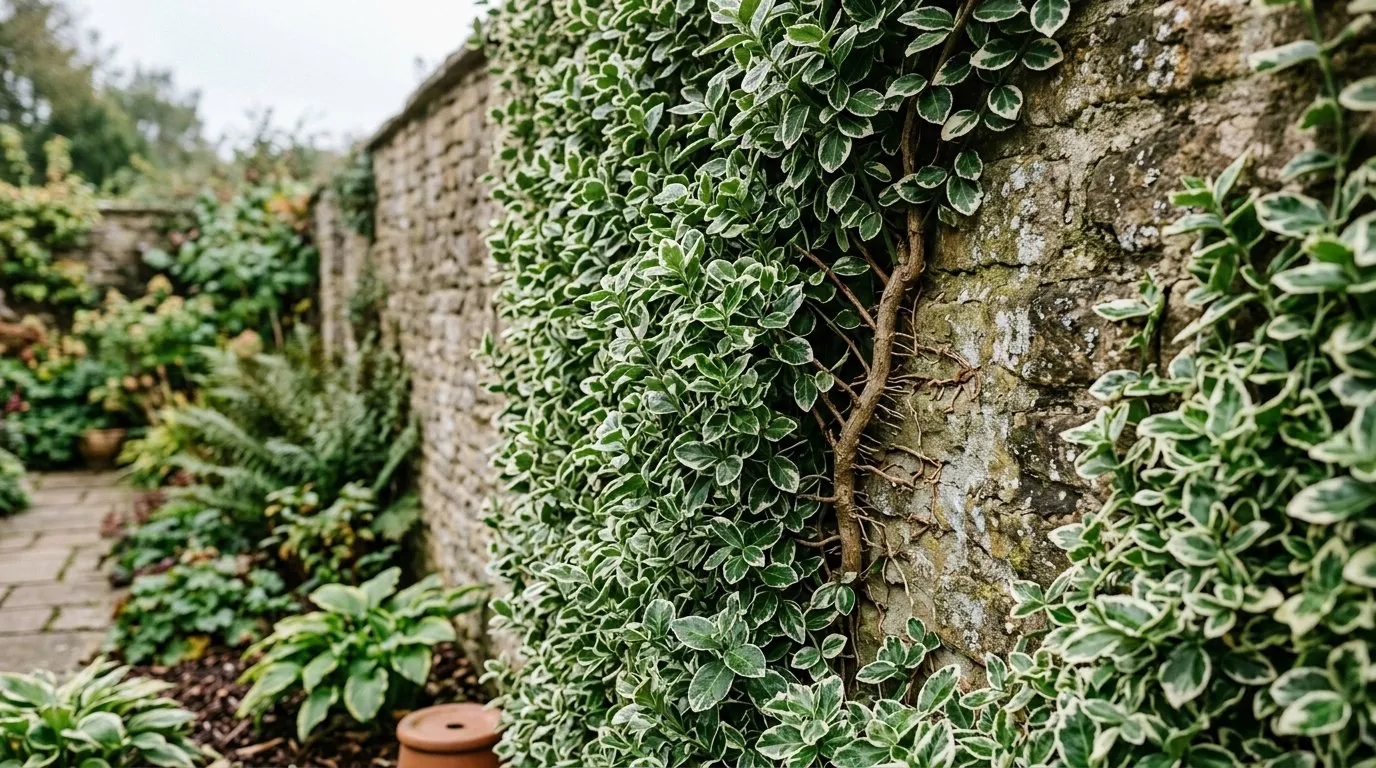 ‘Emerald Gaiety’ on a north wall after 5 years. Aerial roots self-cling up to 3m — a living alternative to ivy.
Common euonymus problems and solutions
Euonymus scale (Unaspis euonymi)
The one pest worth watching. Small armoured scale insects that attach to stems and leaf undersides, producing yellow spotting on the upper leaf surface. Severe infestations cause dieback.
Treatment:
- Apply horticultural oil spray in early March before eggs hatch — most effective timing
- Hand-scrape visible scales with a soft toothbrush for small infestations
- On heavy infestations, cut affected stems back hard in March and destroy the prunings
- Encourage natural predators (ladybirds, lacewings) by avoiding broad-spectrum insecticides
Powdery mildew
White dusty coating on leaves, mostly in dry summers or on poorly ventilated sites. Prevent by mulching to keep roots cool, avoiding overhead watering in the evening, and spacing plants correctly. Affected foliage recovers after a proper soaking; severe cases respond to a fungicidal soap or milk-and-water spray.
Reverted growth on variegated types
Green shoots appear amid variegated foliage. Remove promptly — reverted branches are more vigorous and can take over the whole plant within 2-3 seasons. Cut back to a point where variegation resumes. Do this at any time of year.
Stem rot on waterlogged clay
Yellowing lower leaves and blackened stem bases indicate winter waterlogging damage. Lift and relocate to a drier site or raised bed. If unavoidable, dig sharp grit through the top 30cm of soil and plant on a 15-20cm mound.
Frost damage on E. japonicus
Bronze or black patches on foliage after severe winter cold. Mostly cosmetic — trim affected growth in April and new leaves emerge within 4-6 weeks. E. japonicus is hardy to -15C but suffers foliage damage below that threshold. E. fortunei is the hardier choice for cold inland gardens.
 E. japonicus ‘Aureomarginatus’ as a 1.8m hedge on a Cornish coastal site. Salt-tolerant, evergreen, and winter-bright.
Euonymus maintenance calendar
| Month | Task | Time per plant |
|---|---|---|
| February-March | Apply horticultural oil for scale prevention. Prune deciduous spindles | 15 min |
| April | Main prune of evergreen fortunei types. Remove reverted shoots. Mulch | 20 min |
| May-June | First hedge trim on E. japonicus. Water new plantings weekly | 10 min/week (new plants) |
| July-August | Take semi-ripe cuttings. Watch for powdery mildew | 30 min (cuttings) |
| September | Second hedge trim. Light tidy of fortunei types | 15 min |
| October-November | Plant new specimens. Enjoy deciduous spindle autumn colour | Variable |
| December-January | Take hardwood cuttings of deciduous types | 20 min |
All told, an established plant needs around 1-2 hours of work a year.
Where to buy euonymus in the UK
Garden centres stock the common fortunei variegated forms at £10-£18 for a 3-litre pot. Specialist nurseries (Burncoose, Crocus, Hopes Grove) carry wider ranges of deciduous spindles and less common fortunei cultivars. Expect £18-£35 for 5-litre deciduous spindle specimens.
For hedging, buy 40-60cm bare-root E. japonicus in November-February at £5-£10 per plant — far cheaper than pot-grown equivalents and establishes just as quickly in good soil.
Euonymus reverts readily, so learn how to stop variegated plants turning green.
Frequently asked questions
Where is the best place to plant euonymus?
Plant euonymus in any position except heavy winter waterlogging. Evergreen Euonymus fortunei varieties thrive in sun or shade, against walls, at the front of borders, or as ground cover. Variegated types hold colour best in partial shade. Deciduous spindles (E. europaeus, E. alatus) need at least 4 hours of direct sun for reliable autumn colour. All euonymus tolerate chalk, clay, and sand with equal vigour once established.
How fast does euonymus grow in the UK?
Euonymus growth rate varies by type. Evergreen ground-cover forms like ‘Emerald Gaiety’ add 15-20cm per year. Wall-trained specimens reach 3m in 8-10 years. Deciduous spindles such as E. europaeus put on 30-45cm per year and reach 4-5m in 10-12 years. E. japonicus is the fastest, making 30cm per year — useful for hedging but requires annual trimming.
Is euonymus poisonous to dogs?
Yes, euonymus is toxic to dogs, cats, and humans if eaten in quantity. All parts contain alkaloids and cardiac glycosides. The bright pink and orange seed capsules on deciduous spindle look attractive to children and pets but cause vomiting, stomach cramps, and diarrhoea. Low-level nibbling rarely causes serious harm but do not plant near enclosed dog runs or where toddlers are unsupervised. Seek veterinary advice if ingestion occurs.
How do I stop my variegated euonymus reverting to green?
Remove reverted all-green shoots as soon as you spot them. Cut the reverting branch back to a point where variegated growth resumes, using sharp secateurs. Do this at any time of year — waiting allows green shoots to dominate within 2-3 seasons. Check established plants every spring and autumn. Reversion is most common on ‘Emerald Gaiety’, ‘Emerald ‘n’ Gold’, and ‘Silver Queen’ when plants are stressed by drought or shade.
Does euonymus make a good hedge?
Yes, Euonymus japonicus and its cultivars make excellent low to medium hedges. Plant 40-50cm apart for a 1-1.5m hedge, 60-75cm for taller screens up to 2.5m. Evergreen, hardy, tolerant of coastal salt spray, and clips well. Trim twice a year in June and September. Variegated japonicus like ‘Aureomarginatus’ lifts boundaries in winter when deciduous hedges look bare. Expect 6-8 years to reach final hedge height from 60cm plants.
When should I prune euonymus?
Prune evergreen Euonymus fortunei varieties in April or September, removing reverted shoots, wayward growth, and any dead or diseased stems. Formal hedges of E. japonicus need two trims — June and September. Deciduous spindles are best pruned in late winter (February-March) while dormant, with only light shaping to keep natural form. Hard renovation cuts on overgrown plants can be made in March; they regenerate reliably from old wood.
Can euonymus grow in dry shade?
Evergreen Euonymus fortunei varieties are among the few shrubs that thrive in dry shade under mature trees. ‘Emerald Gaiety’ and ‘Emerald ‘n’ Gold’ tolerate root competition from oak, beech, and sycamore once established. Variegation may be slightly less bright than in brighter positions but plants remain healthy. Water in for the first 12 months to help roots establish past tree-root competition, then they need no further irrigation.
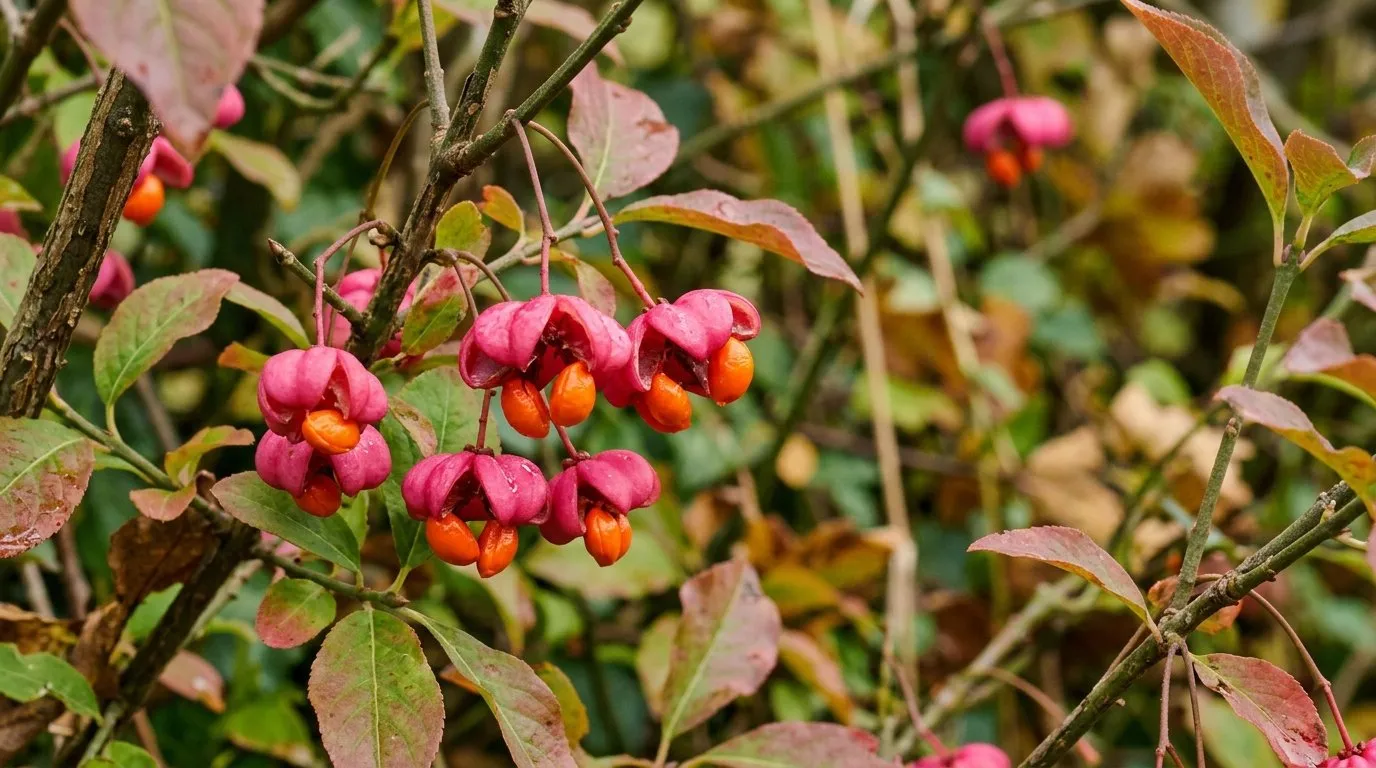 E. europaeus ‘Red Cascade’ in October. Pink capsules split to reveal orange seeds — the native British spindle at its best.
Sources: RHS Euonymus Growing Guide | Wildlife Gardening Forum
Our team produces practical UK gardening guidance from source research, contributor records and established horticultural practice. Editorial standards are overseen by Matt W.