Key takeaways
- Lily of the valley flowers for 3-5 weeks from late April to early June — one of the most fragrant UK garden plants
- Plant pips in autumn or early spring, 2-3cm deep and 10cm apart, in moist humus-rich shade
- The whole plant is toxic — all parts contain cardiac glycosides dangerous to humans, cats, and dogs
- Lily of the valley spreads aggressively by rhizomes once established — contain with root barriers or plant where spread is welcome
- The pink form 'Rosea' is less vigorous than the white type but adds soft colour to shade borders
- Divide congested clumps every 4-5 years in October to refresh flowering vigour
Lily of the valley is the most fragrant flower you can grow in British shade. A single handful brought indoors fills a whole room with a perfume that perfumers have been trying to synthesise for two hundred years. And yet it asks almost nothing of the gardener — plant the pips in decent shade, water them in, and they return every May for decades.
This guide covers the three varieties worth growing, how to plant pips correctly, how to contain the spread if that matters, the slug problem that ruins many first-year plantings, and the other shade plants that work well alongside.
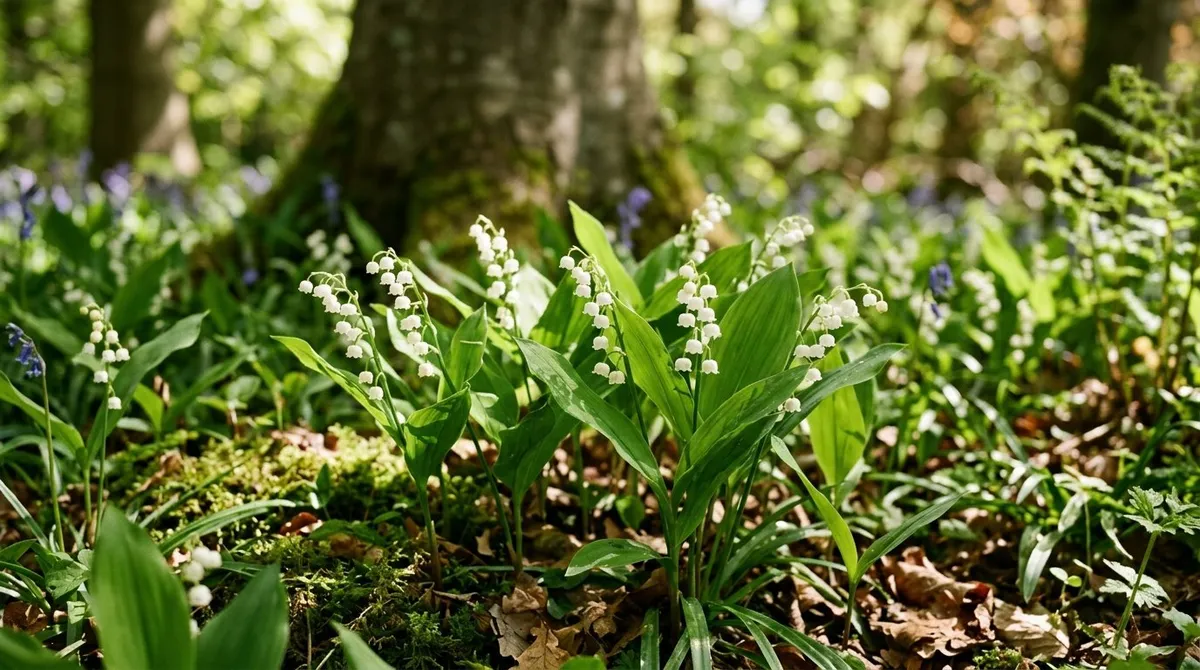
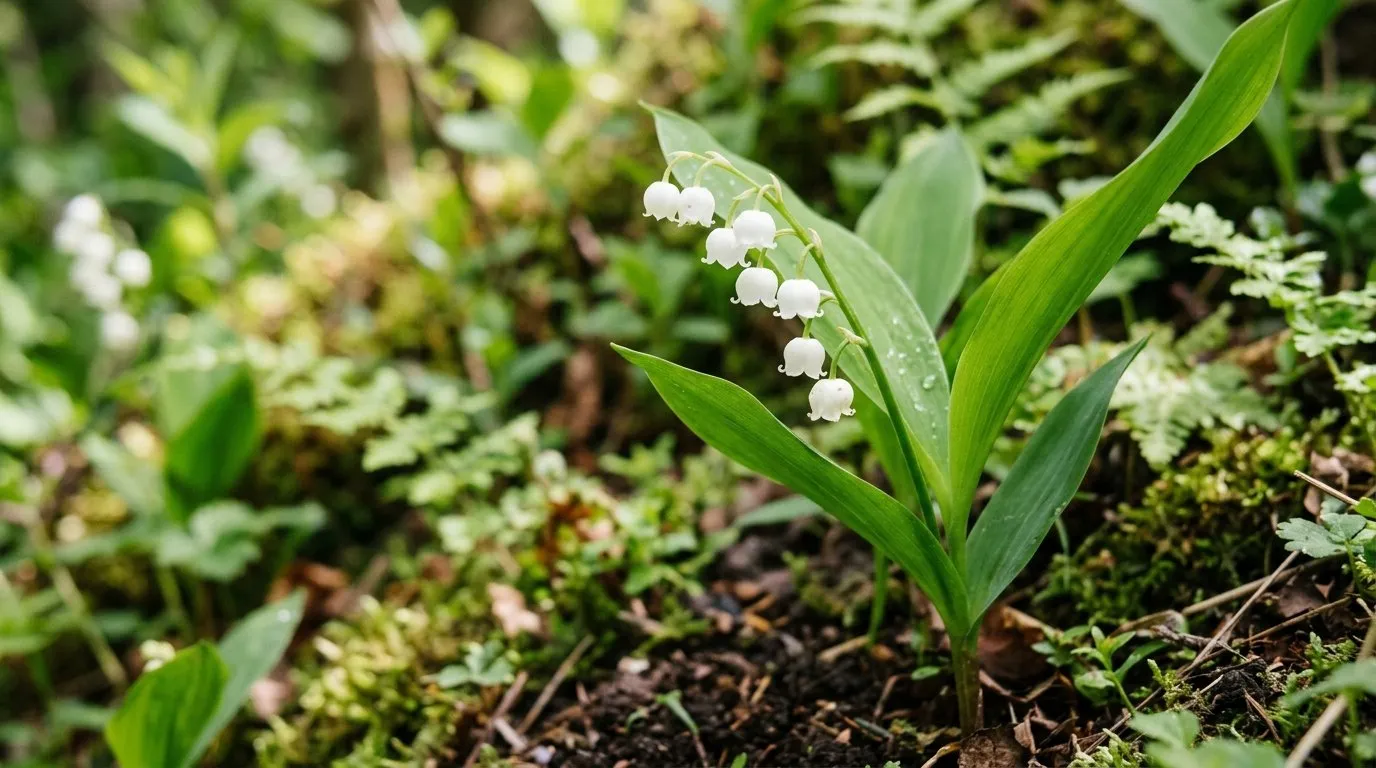 Lily of the valley flowering in mid-May. A mature clump under dappled shade with the intense fragrance carrying 3-4 metres on still days.
What is lily of the valley?
Lily of the valley (Convallaria majalis) is a hardy rhizomatous perennial in the Asparagaceae family, native to temperate woodlands across Europe, including parts of Britain, and extending eastwards through northern Asia. It is a true woodland floor species, evolved to thrive beneath leaf canopy where the soil is moist, humus-rich, and rarely sees direct summer sun.
The plant grows to 20-25cm tall. Each pip (the growing tip of a rhizome) sends up two broad green leaves and, from mature pips only, a single arching flower stem carrying 6 to 12 white bell-shaped flowers in May. After flowering, small orange-red berries form, though UK plants set them erratically.
The fragrance is the real reason to grow this. Lily of the valley contains around 15 different aromatic compounds, including hydroxycitronellal, which gives the characteristic sweet green-floral scent. On still May afternoons, the perfume travels 3-4 metres from the clump. A few stems in a vase will fragrance an entire room for a week.
According to the Royal Horticultural Society, lily of the valley was used medicinally for centuries before its toxicity was properly understood. All parts contain cardiac glycosides and every part should be treated as poisonous.
Which varieties of lily of the valley grow best in the UK?
The straight species Convallaria majalis is what most gardeners grow and is still the best all-round choice. Three named varieties add variety if you want to try something different.
| Variety | Flower | Height | Vigour | Notes |
|---|---|---|---|---|
| C. majalis (type) | White bells | 20-25cm | Very vigorous | The classic, best for naturalising |
| ’Rosea’ | Pale pink bells | 20cm | Moderate | Softer effect, slower spread |
| ’Prolificans’ | Double white | 15-20cm | Moderate | Fuller flowers, mid-May display |
| ’Bordeaux’ | White | 25-30cm | Vigorous | Taller, larger flowers, stronger fragrance |
Convallaria majalis (the type)
The wild form and still the best. White bells, intense fragrance, tough as boots. This is what you want for naturalising in shade or covering a difficult dry-shade bed beneath mature trees. Mature clumps produce 80-120 flowering stems per square metre.
Convallaria majalis ‘Rosea’
Pale pink flowers instead of white. The colour is subtle, almost greyish-pink, and best appreciated up close. Less vigorous than the type, which some gardeners prefer because it stays put. Flowering starts a few days later than the white form.
Convallaria majalis ‘Prolificans’
Double-flowered white variety. Each bell has two rows of petals, creating a fuller, more ornamental look. The fragrance is identical to the single form. Slightly shorter at 15-20cm and less vigorous, making it a better choice for smaller beds.
Convallaria majalis ‘Bordeaux’
A French selection that is taller, larger-flowered, and noticeably more fragrant than the type. If scent matters most to you, this is the one. Vigour matches the wild form.
Where do lilies of the valley grow best?
Think woodland floor and you have it right. Lily of the valley evolved beneath dense leaf canopy, on soil permanently covered in decomposing leaves, where rainfall filters through slowly and summer sun rarely reaches.
Light: Partial to full shade. Dappled shade beneath deciduous trees is ideal. Full shade along a north-facing wall or under evergreens works. Full sun scorches the foliage and reduces flowering by 50-70%. The position should get no more than 3 hours of direct sun daily.
Drainage: Waterlogging in winter kills pips. On heavy clay, plant in a slightly raised bed or add grit to the top 20cm of soil.
Combine with best plants for shade in the UK — hostas, ferns, hellebores, and pulmonarias all partner well with lily of the valley.
How to plant lily of the valley pips
Buy bare-root pips in autumn or early spring from specialist bulb nurseries. A pack of 25 pips costs £8-£12 and covers roughly a square metre after two seasons. Container-grown plants from garden centres in May are also fine but cost more per plant.
Step 1 - Prepare the soil. Dig in a 50mm layer of leaf mould or well-rotted garden compost to the top 20cm of soil. Remove perennial weeds thoroughly, especially couch grass and ground elder, which are impossible to separate from lily of the valley rhizomes later.
Step 2 - Time planting correctly. October-November is best. March is the second choice. Planting in frozen ground or during prolonged winter waterlogging causes rot.
Step 3 - Space the pips. 10cm between pips in a triangular pattern. Plant 5-10 pips per square metre for a naturalised look, or 25 pips per square metre for quick ground cover.
Step 4 - Plant at the right depth. Dig a hole 5cm deep. Place each pip vertically with the pointed growing tip 2-3cm below the soil surface. The roots spread outward from the base.
Step 5 - Water and mulch. Water heavily after planting and cover with a further 30mm of leaf mould. This conserves moisture and mimics the natural woodland floor.
Flowering begins in the second spring after planting. First-year plants produce leaves but rarely flowers. By year three, a planting is typically at full flowering strength.
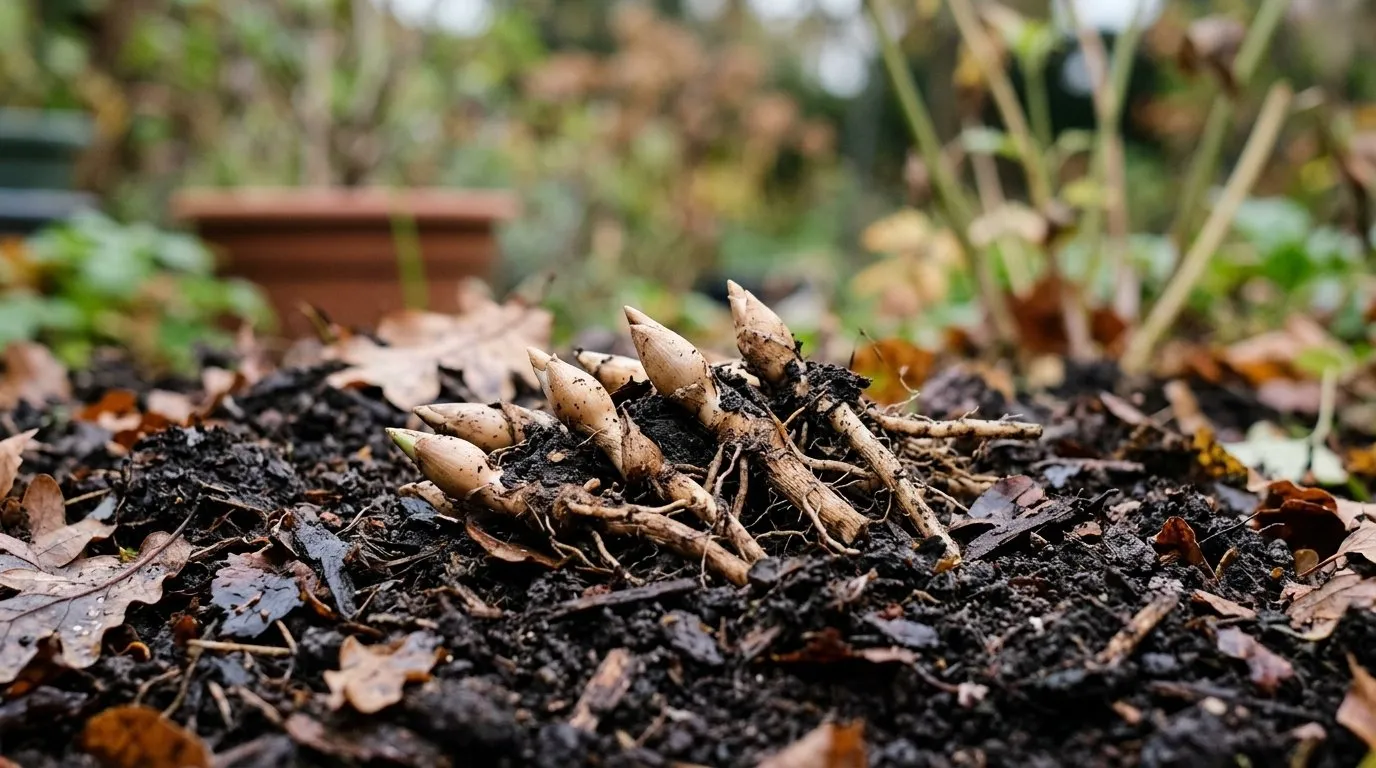 Lily of the valley pips ready for autumn planting. Each pip is set vertically 2-3cm below the soil surface.
How to stop lily of the valley spreading
Established clumps spread aggressively by underground rhizomes. A 1-metre-square planting can double in size within 3-4 years. This is useful where you want ground cover, but a problem in mixed borders where smaller plants get swamped.
Option 2 - Contained bed. Plant in a raised bed with solid walls or a sunken bottomless pot. A 30-litre plastic planter with the base cut out, sunk flush with soil level, contains a clump for 8-10 years before rhizomes find a way out.
Option 3 - Annual edging. Push a sharp spade vertically down around the bed edge every March to sever escaping rhizomes. This takes 5 minutes per square metre of bed edge but must be done every year without fail.
Option 4 - Plant where spread is welcome. The easiest approach. Dry shade beneath mature trees, along shaded walls, or as underplanting for spring-flowering shrubs are all spots where natural spread creates ground cover rather than problems.
Digging out established lily of the valley is possible but exhausting. Every fragment of rhizome left in the ground regrows. Plan to fork over the entire area, remove every piece, then fork it again 4-6 weeks later to catch missed pieces.
How to divide and rejuvenate lily of the valley
Clumps flower best for the first 4-5 years after planting. After that, congestion reduces flowering and patches in the centre may die out. Division restores vigour.
When: October is ideal. March is also acceptable if ground is workable.
How:
- Fork up a quarter of the clump at a time, leaving the rest intact.
- Wash or shake soil from the rhizomes and separate individual pips by hand. A mature clump yields 30-50 pips per square metre.
- Discard weak, damaged, or rootless pips.
- Replant the best pips at 10cm spacing into soil refreshed with fresh leaf mould.
- Water heavily and mulch with 30mm of leaf mould.
Every division replaces 3-4 dense, tired years with a fresh cycle. A well-divided clump returns to full flowering within two seasons.
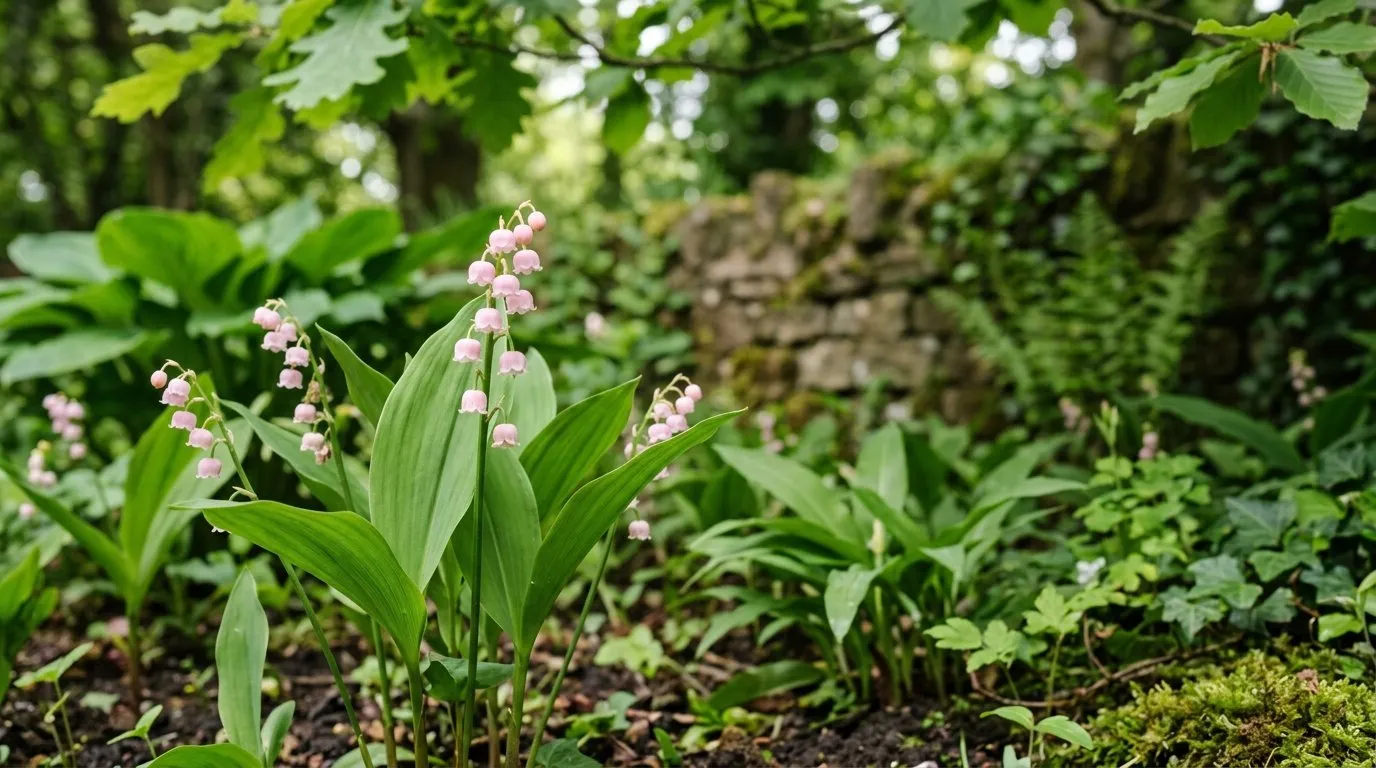 ‘Rosea’ in mid-May. The pink form is less vigorous than the white type but adds soft colour to shade borders.
Lily of the valley companion planting
Lily of the valley peaks in early to mid-May. Combine with plants that either bloom alongside it or take over as the show fades.
Spring partners:
- Epimedium ‘Sulphureum’ - pale yellow flowers in April, fine-textured foliage all summer
- Pulmonaria ‘Blue Ensign’ - deep blue April flowers, silver-spotted leaves
- Helleborus x hybridus - February to April flowers, evergreen foliage
- Dicentra spectabilis (bleeding heart) - arching pink flowers in May
Summer continuation:
- Hostas - dramatic foliage from May, flowers July-August. Plant behind the lily of the valley
- Ferns (Dryopteris, Polystichum) - textural contrast and summer-long interest
- Brunnera macrophylla ‘Jack Frost’ - silver foliage, blue spring flowers
Autumn interest:
- Cyclamen hederifolium - pink September flowers, marbled leaves through winter
- Japanese anemones - late summer to autumn flowers in shade
- Hardy geraniums (G. macrorrhizum) - semi-evergreen aromatic foliage
These combinations build a woodland border that is lovely from February to November, with lily of the valley providing the scented May highlight.
Common problems with lily of the valley
Slug damage to young shoots. Slugs feed heavily on emerging pips in March-April. A ring of sharp grit, copper bands, or a nematode drench in early March gives reliable control.
Non-flowering congested clumps. After 4-5 years, pips become too crowded to flower. Divide in October as described above. Most clumps double their flowering stem count in the spring following division.
Scorched foliage. Leaves turn crispy brown at the edges in dry sunny spots. Move plants to deeper shade or increase mulching to retain soil moisture. Scorched plants recover but often do not flower the following year.
Grey mould (Botrytis). Grey fuzzy coating on flower stems in wet springs. Thin out congested clumps to improve airflow. Remove affected stems promptly and bin (do not compost).
No flowers in first year. This is normal. Newly planted pips produce leaves in year one and flowers in year two. If year two still brings no flowers, either pips were planted too deep or the spot is too dry.
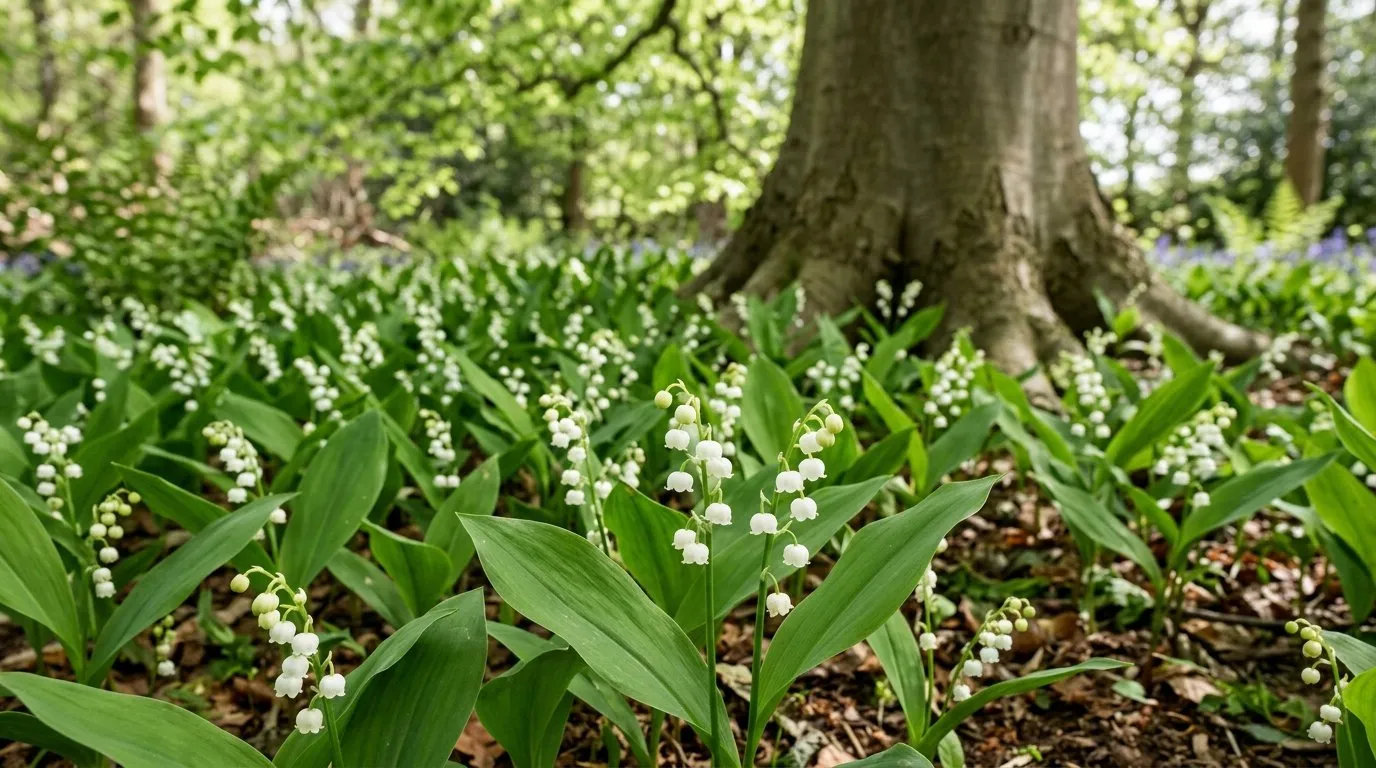 Lily of the valley naturalised as ground cover beneath a mature beech. Dry shade is where this plant outperforms nearly everything else.
Lily of the valley maintenance calendar
| Month | Task | Time per 2m² planting |
|---|---|---|
| February | Rake off fallen tree leaves that might smother emerging pips | 10 minutes |
| March | Slug protection with grit or nematodes. First shoots emerge | 20 minutes |
| April | Growth accelerates. Keep moist if dry | Minimal |
| May | Peak flowering. Cut stems for indoor vases | Enjoy |
| June | Flowering ends. Leaves remain through summer | None |
| July-August | Water if drought. Otherwise leave alone | Minimal |
| October | Divide congested clumps every 4-5 years. Mulch with leaf mould | 1-2 hours (division year) |
| November-January | Dormant. Leave fallen leaves as natural mulch | None |
Total maintenance runs to around 2-3 hours per year in a non-division year and 4-5 hours in a division year. That is significantly less work than most border perennials, which is partly why lily of the valley became a staple of Victorian gardens and has stayed one since.
For more shade-planting ideas, see our guide to best shrubs for shade and shade-tolerant annuals.
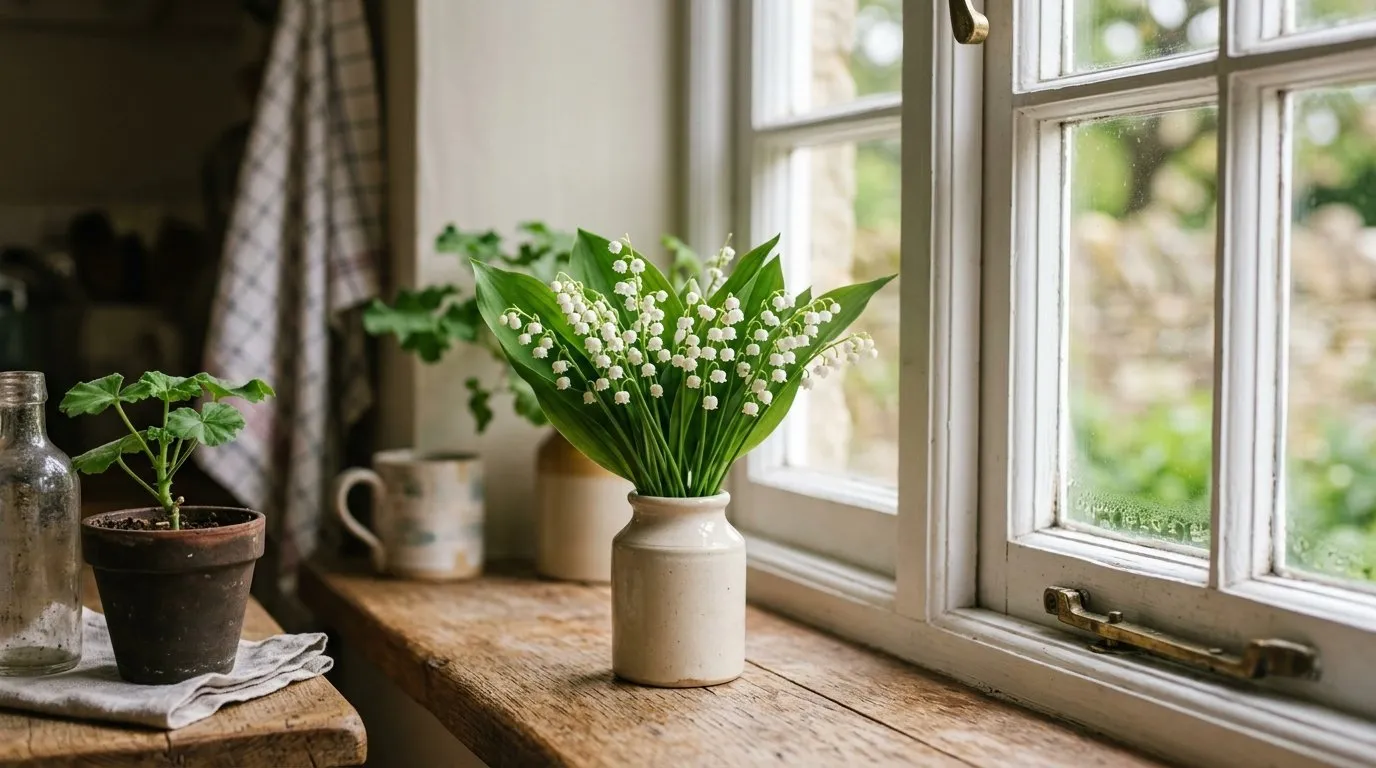 A handful of cut stems indoors fills a whole room with the scent. Three or four sprigs in a small vase will fragrance a kitchen for a full week.
Is lily of the valley safe to plant?
The whole plant is highly toxic. Leaves, stems, flowers, berries, and rhizomes contain around 30 cardiac glycosides, including convallatoxin, convallamarin, and convallarin. These compounds disrupt heart rhythm and can be fatal in sufficient doses.
Risk levels:
- Children: High risk from orange-red berries in late summer, which look edible but are not. Two berries can cause significant symptoms.
- Dogs and cats: High risk. Ingestion of any plant part causes vomiting, weakness, irregular heart rhythm. Contact a vet immediately.
- Horses and livestock: Moderate risk if eaten in quantity. Avoid planting in fields or pastures.
- Gardeners: Low risk during normal handling. Wear gloves when dividing to avoid skin irritation. Wash hands afterwards. Do not cut stems with food-prep tools.
The Wildlife Gardening Forum notes that while many garden plants are mildly toxic, lily of the valley is in the genuinely dangerous category alongside foxglove, monkshood, and yew. Site it accordingly.
Frequently asked questions
When does lily of the valley flower in the UK?
Lily of the valley flowers from late April to early June in UK gardens, with peak bloom in mid-May. The flowering period lasts 3-5 weeks depending on weather. Cool springs extend flowering while warm sunny weeks compress it. In southern England flowering starts a week earlier than in Scotland. Each pip produces one flowering stem with 6-12 bell-shaped white flowers.
Is lily of the valley poisonous to dogs?
Yes, lily of the valley is highly toxic to dogs, cats, and humans. Every part of the plant contains cardiac glycosides including convallatoxin and convallamarin. Symptoms of ingestion include vomiting, irregular heart rhythm, low blood pressure, and in severe cases cardiac arrest. Contact a vet immediately if a pet eats any part. Do not plant where dogs, cats, or small children have unsupervised access.
How do you plant lily of the valley pips?
Plant pips in October-November or March, while dormant. Choose a shaded spot with moist humus-rich soil. Dig a hole 5cm deep and place each pip vertically with the pointed tip 2-3cm below the surface. Space pips 10cm apart in groups of 5-10 per square metre. Water well after planting and mulch with 50mm of leaf mould. Flowering begins in the second spring after planting.
Does lily of the valley spread?
Lily of the valley spreads aggressively by underground rhizomes once established. Established clumps expand outward by 15-30cm per year, easily overtaking neighbouring plants and invading lawns and paths. Contain vigorous spread with a 30cm-deep root barrier around the bed, or plant where unrestricted spread is welcome such as beneath mature trees, along shaded walls, or as ground cover under shrubs.
Why is my lily of the valley not flowering?
The most common cause of non-flowering lily of the valley is congestion. After 4-5 years, clumps become so dense that individual pips do not develop flowering buds. Lift and divide in October, replanting the strongest pips at 10cm spacing in freshly improved soil. Other causes include excessive feeding (encourages leaves at expense of flowers), insufficient winter chilling in southern gardens, and planting too deep.
Can lily of the valley grow in full shade?
Yes, lily of the valley thrives in full shade including dry shade beneath mature trees. It is one of very few UK garden plants that will flower reliably in deep shade below a beech, oak, or sycamore canopy. In full sun it scorches and flowering reduces sharply. The ideal is dappled shade with morning sun, but any position with 3 hours or less of direct sun supports healthy plants.
How do I stop slugs eating lily of the valley?
Slugs cause heavy damage to young lily of the valley shoots in March-April. Protect emerging pips with a 3cm ring of sharp grit around each clump. Beer traps and copper rings also work. Nematode drenches (Nemaslug) applied in March give 4-6 weeks of protection. Established clumps in dry shade suffer less damage than new plantings in damp soil, where slugs are most active.
Sources: RHS Convallaria majalis profile | Wildlife Gardening Forum - poisonous plants
Our team produces practical UK gardening guidance from source research, contributor records and established horticultural practice. Editorial standards are overseen by Matt W.