Types of Flowers to Grow in the UK
Types of flowers to grow in UK gardens. Covers annuals, biennials, perennials, bulbs, climbers, and shrubs with varieties, costs, and bloom calendars.
Key takeaways
- Six flower types suit UK gardens: annuals, biennials, perennials, bulbs, climbers, and flowering shrubs
- Annuals flower in 8-12 weeks from seed and cost under 5p per plant, but last only one season
- Perennials return for 5-20 years, bringing long-term cost below 50p per plant per season
- Planting 3 flower types per season guarantees 8+ months of continuous colour with no bare patches
- UK hardiness zones range from H3 (tender) to H7 (fully hardy), determining which flowers survive winter
- Over 4,000 RHS Award of Garden Merit varieties are tested and proven for British growing conditions
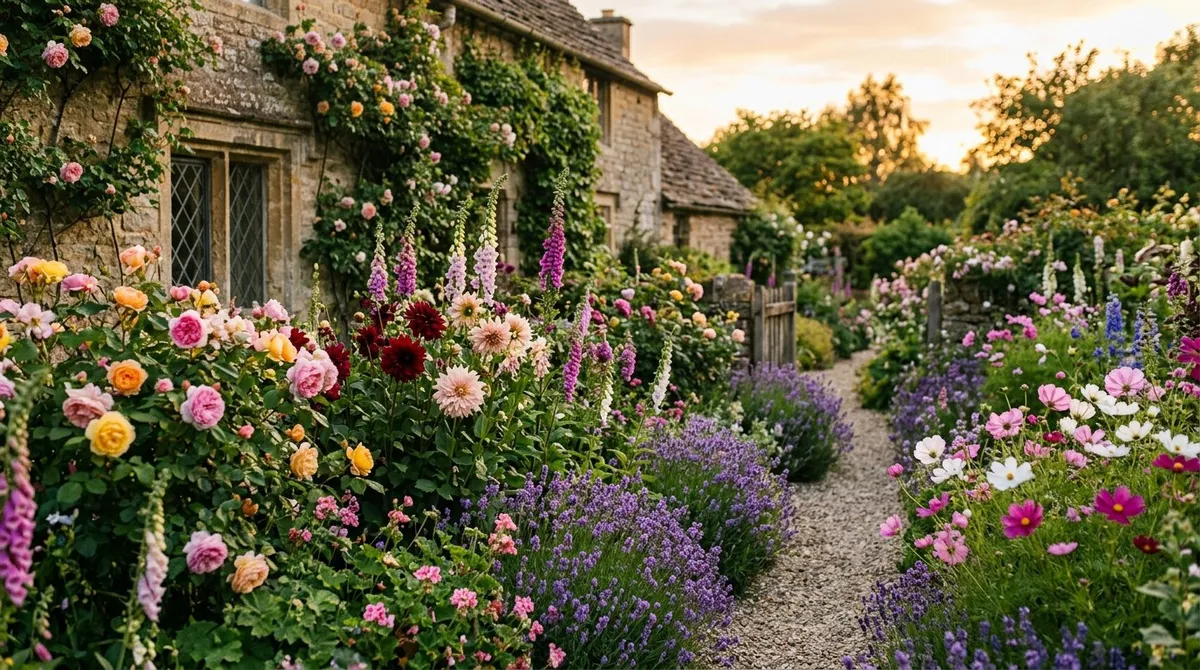
Understanding the main types of flowers available to UK gardeners is the first step toward a garden that blooms from early spring through to late autumn. Each flower type fills a different role. Annuals deliver fast, affordable colour in a single season. Perennials build a permanent backbone that strengthens year after year. Bulbs provide the earliest and latest colour when little else is flowering.
This guide covers six flower types suited to British conditions: annuals, biennials, perennials, bulbs, climbers, and flowering shrubs. Each section includes specific varieties, costs, maintenance needs, and the hardiness zones where they perform best. For monthly sowing timings, pair this guide with our flower planting calendar. If you want to focus on a particular style, our cottage garden planting plan puts many of these flower types into a ready-to-use design.
Technical comparison: UK flower types at a glance
Before choosing what to grow, it helps to compare the six flower types side by side. This table covers the factors that matter most: lifespan, cost, time commitment, and growing requirements.
| Flower type | Lifespan | Cost per year | Maintenance (hrs/month) | Best soil pH | UK hardiness zone |
|---|---|---|---|---|---|
| Annuals | 1 season | Under 5p/plant | 1-2 | 6.0-7.5 | H2-H7 (frost-sensitive types need H4+) |
| Biennials | 2 seasons | Under 10p/plant | 0.5-1 | 6.0-7.5 | H5-H7 (most are fully hardy) |
| Perennials | 3-20 years | Under 50p/plant | 1-3 | 5.5-7.5 (varies by species) | H4-H7 |
| Bulbs | 5-50+ years | Under 30p/bulb | 0.5 | 6.0-7.0 | H4-H7 (tender types H2-H3) |
| Climbers | 10-50+ years | Under 40p/plant | 1-2 | 6.0-7.5 | H4-H7 |
| Flowering shrubs | 15-50+ years | Under 20p/plant | 1-2 | 5.5-7.5 | H4-H7 |
Annuals suit gardeners who want instant results and enjoy changing their displays each year. Perennials and shrubs are the long-term investment, with per-year costs dropping below the price of a seed packet once established. Bulbs offer the highest return for the least effort, many naturalising and multiplying without any intervention at all.
Annuals: fast colour in one season
Annuals germinate, flower, set seed, and die within a single growing season. Their strength is speed. Most flower within 8-12 weeks of sowing, making them the fastest route to a colourful garden. A packet of 200 annual seeds costs between 80p and 2 pounds, making them the cheapest flowers to grow by a wide margin.
Hardy annuals tolerate frost and sow directly outdoors from March, once soil temperature reaches 7-10C. Half-hardy annuals are killed by frost and must start indoors in April, going outdoors only after the last frost in late May. For detailed sowing guidance, see our sweet peas guide, which covers the best annual climbing technique.
Recommended annuals for UK gardens
Cosmos bipinnatus produces airy, daisy-like flowers from July to October on stems reaching 1.2m. It thrives in poor soil and full sun. The variety ‘Purity’ (white) and ‘Dazzler’ (deep pink) both hold the RHS Award of Garden Merit (AGM). Deadhead regularly to extend flowering by four to six weeks.
Calendula officinalis (pot marigold) is one of the hardiest annuals, surviving temperatures down to minus 5C. It self-seeds freely, returning each spring without replanting. Orange and yellow flowers appear from June to October, attracting hoverflies that prey on aphids.
Nigella damascena (love-in-a-mist) produces delicate blue flowers surrounded by thread-like foliage. Sow in September for earlier flowering the following May, or in March for a July display. The seed pods that follow are ornamental and excellent for drying.
Sunflowers (Helianthus annuus) grow from seed to 2m tall in under 12 weeks. Children love them, and they provide valuable late-season food for goldfinches. Multi-headed varieties like ‘Velvet Queen’ produce more flowers than single-stemmed types.
Gardener’s tip: Sow hardy annuals in drifts of at least 20 seeds per variety. Thin groups look patchy. Broadcast the seed thinly over a prepared area, rake in lightly, and water. The natural scatter gives a more convincing display than planting in rows.
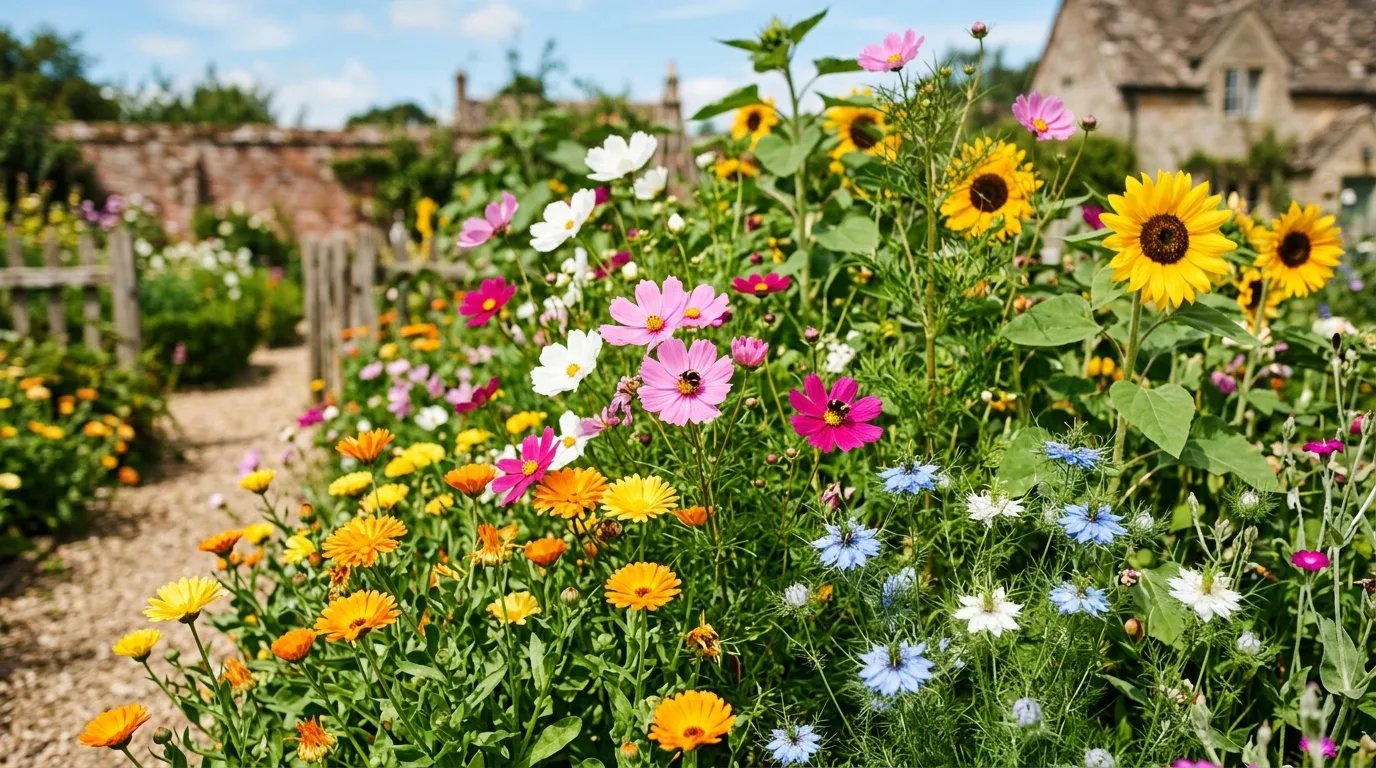 Annual flowers like cosmos, calendula, sunflowers, and nigella create colourful mixed borders from a single season of sowing.
Biennials: the two-year payoff
Biennials take two years to complete their lifecycle. In year one they produce foliage. In year two they flower, set seed, and die. This sounds inconvenient, but once established, biennials self-seed so readily that you have both foliage plants and flowering plants present every year. They are a staple of cottage gardens for exactly this reason.
Sow biennials in June or July and plant them into their final positions by September. Most are fully hardy (H5-H7) and overwinter without protection. They flower earlier than spring-sown annuals, filling the gap between spring bulbs and summer perennials.
Recommended biennials for UK gardens
Foxgloves (Digitalis purpurea) are native to the British Isles and thrive in partial shade. Flower spikes reach 1.5-2m in June and July. They are a critical nectar source for bumblebees, which climb inside the tubular flowers to feed. The species is toxic to humans and pets if ingested.
Wallflowers (Erysimum cheiri) fill spring borders with colour and intense fragrance from April to June. They are traditionally planted alongside tulips for a classic spring bedding scheme. ‘Blood Red’ and ‘Cloth of Gold’ are reliable varieties tested over generations.
Sweet William (Dianthus barbatus) produces dense, flat-topped flower clusters in rich reds, pinks, and whites from May to July. It tolerates alkaline soil well and self-seeds on chalk and limestone sites. Plant in full sun for the strongest scent.
Honesty (Lunaria annua) is grown as much for its translucent silvery seed pods as its purple spring flowers. The seed pods persist through winter and are widely used in dried flower arrangements. It self-seeds prolifically in light shade.
Perennials: the permanent backbone
Perennials are plants that live for three years or more, dying back to their roots in autumn and regrowing each spring. They form the permanent structure of a flower border. The upfront cost is higher than annuals, typically 5-8 pounds per plant from a garden centre. But spread over a 10-year lifespan, the annual cost drops below 50p per plant. Many perennials also divide easily, giving free plants every three to four years.
The UK’s temperate climate, with cold but rarely severe winters and reliable summer rainfall, suits perennials exceptionally well. The RHS Plant Finder lists thousands of perennial varieties rated for British conditions. The key to a good perennial border is choosing plants with different flowering periods so that colour passes through the bed like a relay.
Recommended perennials for UK gardens
Hardy geraniums (Cranesbill) are among the most versatile UK perennials. ‘Rozanne’ (AGM) flowers continuously from June to October, an unusually long season for a perennial. It spreads as groundcover, suppressing weeds, and tolerates sun or partial shade. For the full growing guide, see our rose companion planting advice, where geraniums are the recommended underplanting.
Echinacea purpurea (coneflower) produces sturdy pink or white daisy-like flowers from July to September. The dried seed heads attract goldfinches through winter. It needs full sun and well-drained soil. ‘Magnus’ (AGM) has the largest flowers on stems reaching 1m.
Japanese anemones (Anemone x hybrida) flower from August to October, a period when many other perennials are fading. They thrive in partial shade and slowly colonise their area via underground runners. ‘Honorine Jobert’ (white, AGM) and ‘September Charm’ (pink) are the two standard varieties.
Delphiniums produce towering spikes of blue, purple, or white flowers in June and July, reaching 1.5-2m tall. They need staking, rich soil, and slug protection. The New Zealand hybrid varieties bred for strong stems are increasingly popular. Cut flower spikes back after the first flush for a second, shorter display in September.
Bulbs: the easiest flowers to grow
Bulbs are the lowest-maintenance flower type for UK gardens. Plant them at the correct depth, leave them alone, and most return year after year with zero ongoing care. Daffodils and snowdrops naturalise in grass and multiply freely, eventually forming large drifts. A single planting of 100 daffodil bulbs at 4p each costs 4 pounds and provides spring colour for decades.
Bulbs divide into two planting windows. Spring-flowering bulbs (daffodils, tulips, crocuses, snowdrops) plant in October to November. Summer-flowering bulbs (dahlias, gladioli, lilies, alliums) plant in March to May. Tender summer bulbs like dahlias need lifting in autumn and storing frost-free over winter in most of the UK (hardiness zone H3 and below).
Recommended bulbs for UK gardens
Daffodils (Narcissus) are the most reliable spring bulb for British gardens. Plant 15cm deep in September to November. They tolerate heavy clay, light sand, sun, and partial shade. ‘Tete-a-Tete’ is the most popular dwarf variety for containers. ‘February Gold’ flowers earliest, often from late January in sheltered spots.
Alliums produce dramatic spherical flower heads on tall, bare stems in May and June. ‘Purple Sensation’ reaches 90cm and costs under 50p per bulb. ‘Globemaster’ is larger at 15cm across but costs 3-4 pounds per bulb. Both have AGM status. Plant 10-15cm deep in autumn in full sun and well-drained soil.
Snowdrops (Galanthus nivalis) are native to the UK and among the first flowers to appear each year, often in January. They prefer moist, humus-rich soil in partial shade. Buy them “in the green” (as growing plants) in February or March rather than as dry bulbs, which have lower success rates. Snowdrops naturalise freely under deciduous trees and in lawns.
Crocosmia ‘Lucifer’ is a vigorous summer-flowering bulb producing arching sprays of brilliant red flowers in July and August. Fully hardy (H7), it never needs lifting and multiplies rapidly. Divide congested clumps every three to four years. The flowers are excellent for cutting.
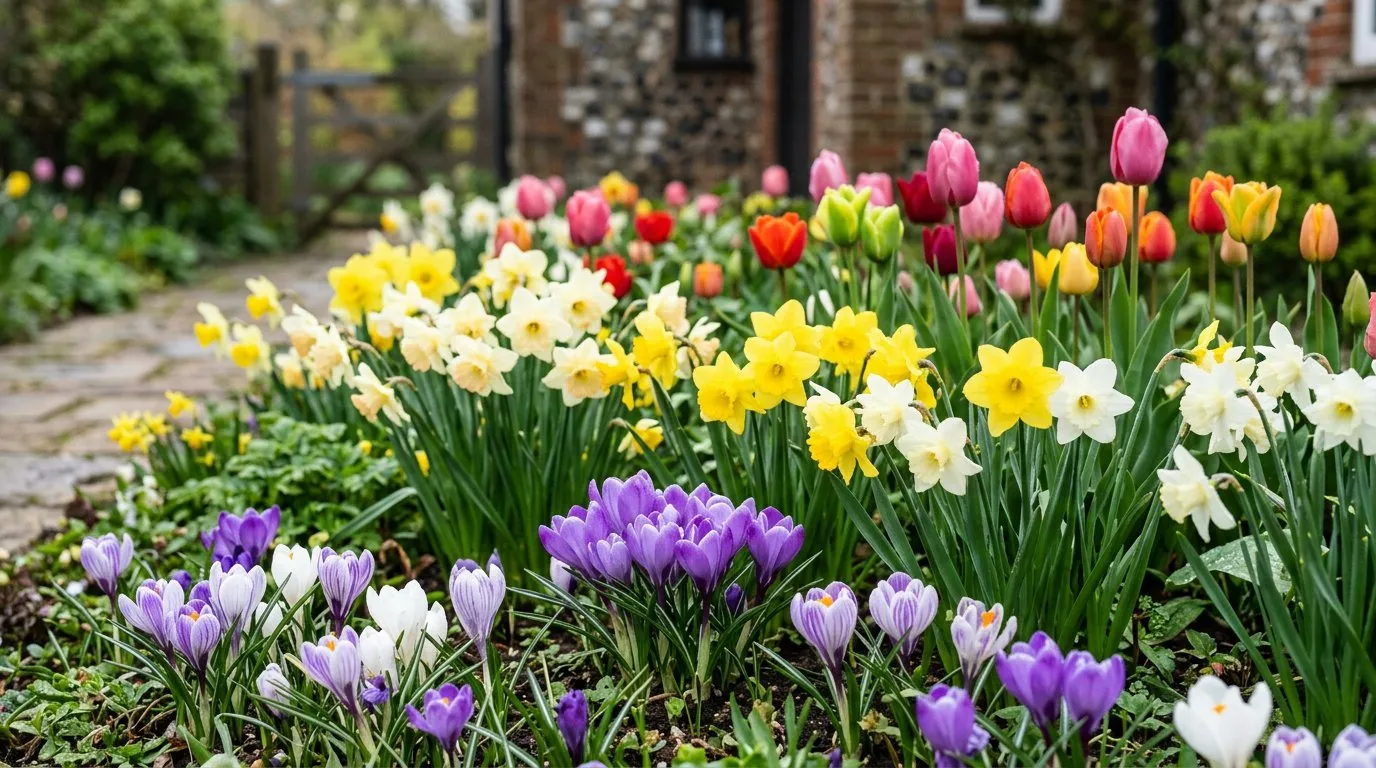 Spring bulbs planted in layers give weeks of colour: crocuses open first at ground level, then daffodils, then tulips at the back.
Climbers: vertical colour for walls and fences
Climbing flowers add height, structure, and colour without using ground space. In UK gardens where average plot sizes are shrinking, climbers turn bare walls, fences, and pergolas into productive planting areas. The RHS reports that climbers can increase usable garden planting area by up to 30 per cent.
Most flowering climbers need a support structure. Twining types like honeysuckle and wisteria wrap around wires or trellis. Tendril climbers like clematis grip fine mesh or netting. Self-clinging types like climbing hydrangea attach directly to brickwork. Match the climbing method to your surface before buying. For a full breakdown, see our climbing plants guide.
Recommended climbers for UK gardens
Clematis is the largest genus of flowering climbers, with varieties blooming from January (C. cirrhosa) to November (C. tangutica). The Group 3 varieties, including ‘Jackmanii’ (purple, AGM) and ‘Etoile Violette’ (violet, AGM), are the easiest to prune: cut all stems to 30cm in February. They flower prolifically on new growth from July to September.
Honeysuckle (Lonicera periclymenum) is a native British climber with intensely fragrant flowers from June to September. ‘Graham Thomas’ (AGM) has creamy-white flowers that age to yellow. The scent is strongest in the evening, drawing in pollinating moths. It thrives in partial shade with its roots in cool, moist soil.
Wisteria produces the most spectacular floral display of any UK climber. Long racemes of scented purple or white flowers cascade in May and June. Buy grafted plants only; seed-grown wisteria can take 15-20 years to flower. It needs a strong support structure and twice-yearly pruning.
Jasmine (Jasminum officinale) is one of the fastest-growing flowering climbers, adding 2-3m per year. White, strongly scented flowers appear from June to September. It is hardy to minus 10C in a sheltered position. Train it over arches and doorways where you can enjoy the fragrance at close range.
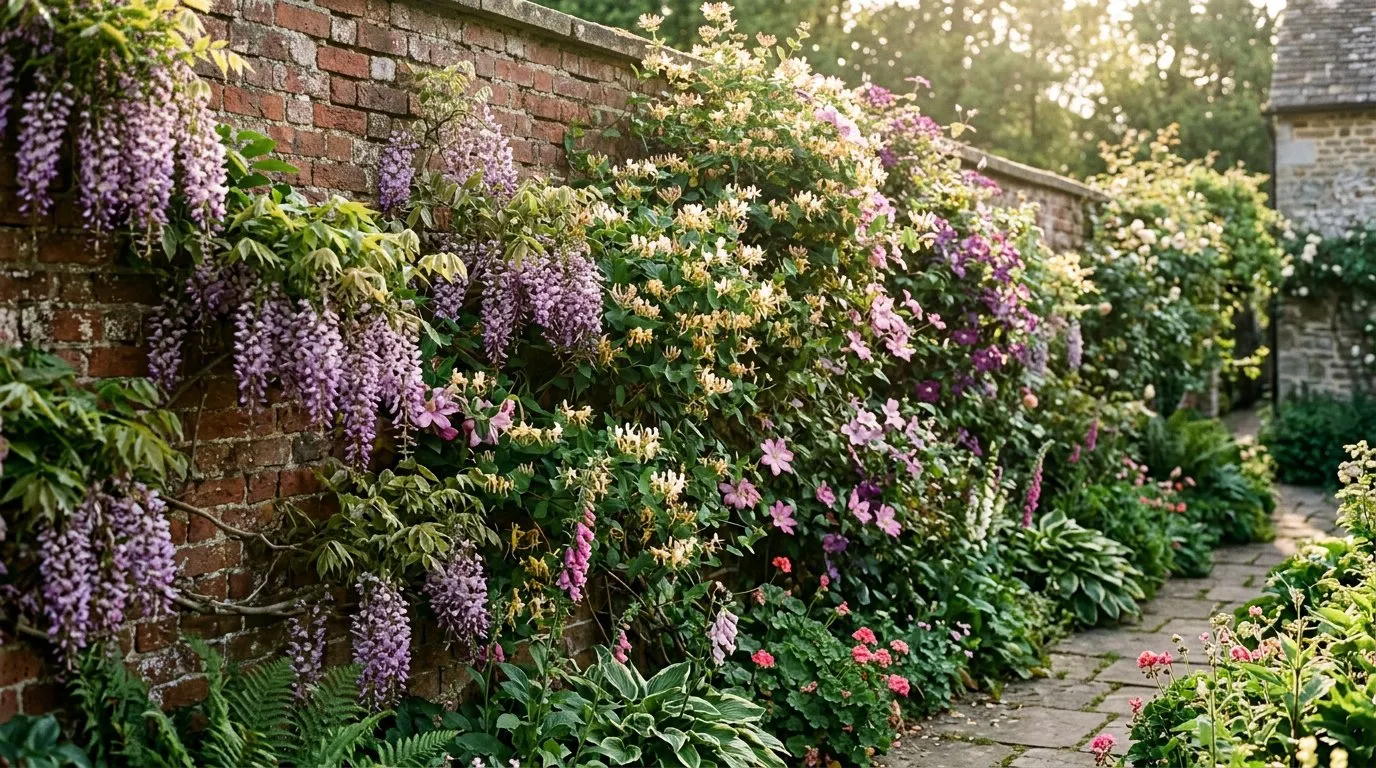 Climbing flowers like wisteria, clematis, and honeysuckle turn a bare brick wall into a vertical flower display.
Flowering shrubs: year-round structure
Flowering shrubs provide permanent structure, seasonal colour, and wildlife habitat with less maintenance than any other flower type. Once established, most shrubs need only an annual prune and a spring mulch. Their woody framework gives the garden shape through winter, when perennials have died back and annuals are long gone.
The key distinction is pruning group. Spring-flowering shrubs (forsythia, ceanothus, deutzia) bloom on the previous year’s wood and are pruned immediately after flowering. Summer-flowering shrubs (buddleja, hydrangea, potentilla) bloom on new growth and are hard-pruned in late February or March. Getting this timing wrong removes next year’s flower buds. For more detail, see our flowering shrubs guide.
Recommended flowering shrubs for UK gardens
Lavender (Lavandula angustifolia) flowers from June to August with strongly scented purple, pink, or white spikes. It attracts over 20 bee species, making it the single most valuable shrub for pollinators. ‘Hidcote’ (AGM) is the most widely planted variety: compact at 60cm, deep purple, and reliably hardy. Lavender demands full sun and free-draining soil. It rots in waterlogged clay.
Buddleja davidii (butterfly bush) produces long conical flower spikes from July to September that attract red admirals, painted ladies, and peacock butterflies in large numbers. It grows 3m in a single season and must be cut hard to 60cm each March. ‘Black Knight’ has the deepest purple flowers. Buddleja grows in any soil, including rubble and poor chalk. The Wildlife Trusts note its particular value for migrating butterflies.
Hydrangea macrophylla flowers from July to September in shades of blue, pink, or white depending on soil pH. Blue flowers appear in acid soil (pH 5.5 or below). Pink flowers appear in alkaline soil (pH 7 or above). ‘Endless Summer’ reflowers on new growth, extending the display into October. Hydrangeas tolerate partial shade and moist soil better than most flowering shrubs.
Philadelphus (mock orange) produces clusters of white, intensely fragrant flowers in June and July. The scent carries across an entire garden on a warm evening. ‘Belle Etoile’ (AGM) grows to 2.5m with single flowers marked purple at the centre. Prune after flowering by removing one in three of the oldest stems at ground level.
Why we recommend Geranium ‘Rozanne’ as the starting perennial: After 30 years of trialling perennials across UK climates, ‘Rozanne’ consistently outperforms every other variety for length of flowering season. In our borders it flowers continuously for 18 weeks from early June to mid-October, roughly twice the average perennial season, and returns reliably for 15 years or more without division.
Bloom succession calendar
This calendar shows when each flower type is in active bloom across the year. Use it to identify gaps in your planting and choose types that fill those months. A garden using all six types maintains colour from January through to November.
| Month | Annuals | Biennials | Perennials | Bulbs | Climbers | Shrubs |
|---|---|---|---|---|---|---|
| Jan | - | - | Hellebores | Snowdrops | C. cirrhosa | Winter jasmine |
| Feb | - | - | Hellebores | Snowdrops, crocuses | C. cirrhosa | Daphne, witch hazel |
| Mar | - | - | Pulmonaria | Daffodils, crocuses | - | Forsythia |
| Apr | - | Wallflowers | Primroses, doronicum | Tulips, daffodils | Clematis montana | Ceanothus |
| May | Sweet peas | Foxgloves, wallflowers | Aquilegia, lupins | Alliums, bluebells | Wisteria, clematis | Ceanothus, lilac |
| Jun | Cornflowers, nigella | Foxgloves, sweet William | Geraniums, delphiniums | Alliums, lilies | Honeysuckle, jasmine | Philadelphus, roses |
| Jul | Cosmos, sunflowers | - | Echinacea, phlox | Dahlias, crocosmia | Clematis, jasmine | Buddleja, hydrangea |
| Aug | Cosmos, zinnia | - | Rudbeckia, anemones | Dahlias, gladioli | Clematis, jasmine | Buddleja, hydrangea |
| Sep | Cosmos, calendula | - | Anemones, sedum | Dahlias, nerines | Late clematis | Hydrangea, abelia |
| Oct | Calendula (late) | - | Sedum, asters | Nerines | - | Abelia |
| Nov | - | - | - | Nerines (late) | - | Mahonia |
| Dec | - | - | - | - | - | Mahonia, viburnum |
Gardener’s tip: Aim for at least two flower types in active bloom during every month from March to October. The calendar above shows that May to August are easy to fill. January, February, and November need deliberate planting of bulbs, hellebores, and winter-flowering shrubs to avoid bare months.
Common mistakes when choosing flower types
Knowing what to avoid saves as much time and money as knowing what to plant. These are the five most frequent errors.
Planting only annuals. Annuals give instant impact but leave a garden completely bare from November to April. Without perennials, bulbs, or shrubs, the garden has no winter structure. The solution: use annuals to fill gaps in a permanent planting of perennials and shrubs.
Ignoring soil pH. Lavender thrives in alkaline soil but rots in acid clay. Hydrangeas turn blue in acid soil and pink in alkaline. Planting without testing the soil leads to poor performance and plant losses. A simple pH test kit costs under 5 pounds and takes ten minutes.
Buying too many of one variety. A border of 50 identical geraniums flowers for eight weeks and then looks bare for ten months. Mixing early, mid, and late-season perennials spreads the colour across six months or more.
Forgetting winter. Most gardeners plan for summer colour and neglect the five months from November to March. Snowdrops, hellebores, winter jasmine, mahonia, and witch hazel all flower during this period. Without them, the garden is dormant for nearly half the year.
Planting tender bulbs too early. Dahlias and gladioli planted outdoors before the last frost in late May are killed overnight. Start them in pots indoors from April and harden off before planting out.
Now you’ve mastered the main flower types, read our guide on cottage garden planting plans to put these varieties into a ready-to-use design.
Frequently asked questions
What are the easiest flowers to grow in the UK?
Hardy annuals are the easiest flowers to grow. Nasturtiums, sunflowers, calendula, and cornflowers all germinate within two weeks of sowing outdoors in May. They tolerate poor soil, need no staking, and flower within eight weeks. For perennials, hardy geraniums and rudbeckia are the most forgiving, surviving neglect and returning reliably each spring.
What flowers come back every year without replanting?
Perennials return every year once established. Reliable UK choices include lavender, hardy geraniums, delphiniums, Japanese anemones, and echinacea. Many bulbs also return annually, including daffodils, snowdrops, and crocuses. Some annuals self-seed freely, appearing each spring without replanting, notably nigella, calendula, and aquilegia.
When should I plant flowers in the UK?
Planting times depend on flower type. Sow hardy annuals outdoors from March when soil reaches 7-10C. Start half-hardy annuals indoors in April and plant out after the last frost in late May. Plant spring-flowering bulbs in October to November. Divide and replant perennials in October or March. See our flower planting calendar for monthly timings.
What is the cheapest way to fill a garden with flowers?
Growing hardy annuals from seed is the cheapest method. A packet of 200 seeds costs 80p to 2 pounds. Nasturtiums, poppies, and cornflowers fill large areas for pennies per plant. For a longer-term investment, perennials cost more upfront but return for years, making them cheaper over a five-year period.
What flowers grow well in shade in the UK?
Foxgloves, Japanese anemones, and astilbe thrive in partial shade. For deep shade, try lily of the valley, cyclamen, and hellebores. Climbing hydrangea covers north-facing walls without direct sun. Most annuals need full sun, but busy lizzies and begonias tolerate shaded positions.
What is the difference between annuals and perennials?
Annuals complete their lifecycle in one growing season and die. Perennials survive winter and regrow each spring for multiple years. Annuals give fast colour from seed in 8-12 weeks. Perennials take longer to establish but provide years of flowers without replanting. Many gardeners use both together for immediate and long-term results.
Which flowers are best for UK wildlife?
Single-flowered varieties are best for pollinators. Buddleja attracts over 20 butterfly species. Lavender supports more than 20 bee species. Native wildflowers including oxeye daisies, red campion, and field scabious feed specialist insects that garden cultivars cannot. The Wildlife Trusts recommend planting native species alongside garden varieties.
Lawrie has been gardening in the West Midlands for over 30 years. He grows his own veg using no-dig methods, keeps a wildlife-friendly garden, and writes practical advice based on real UK growing conditions.