Pond Problems: Algae and Murky Water
Fix pond problems fast: green water, blanketweed, murky water, foam and bad smells. Biological fixes from 12 years and 2 ponds in the West Midlands.
Key takeaways
- Green water is single-celled algae — UV clarifiers fix it in 72 hours; barley straw prevents regrowth
- Blanketweed grows 25cm per day — remove by hand weekly and reduce nutrients with more plants
- Foam means dissolved organic matter — usually a filter problem or overfeeding, not a chemical issue
- Fish gasping at the surface is an emergency: immediately aerate the water with a hose or pump
- 50–60% surface plant coverage is the single most effective long-term pond problem prevention measure
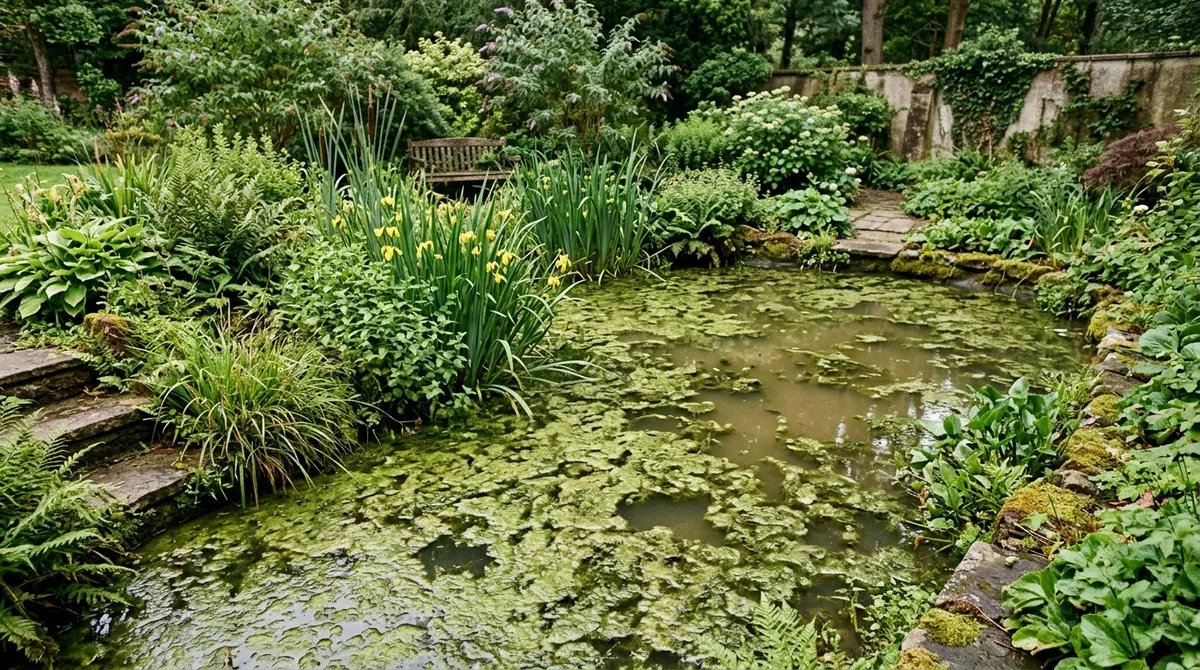
Pond problems are among the most common frustrations in UK gardening, and almost all of them trace back to one of three causes: too many nutrients, too little plant coverage, or an under-performing filter. Understanding which problem you have and what is causing it saves weeks of wasted effort and money.
After 12 years maintaining two ponds — a 2,000-litre wildlife pond and a 4,500-litre fish pond on heavy West Midlands clay — I have dealt with every problem in this guide at least twice. Some of them, like blanketweed, I deal with every summer regardless.
This guide covers the 10 most common pond problems, what causes each one, the best biological fix, when a chemical or mechanical approach is justified, and what to do next time to stop it happening again.
Pond problem quick reference: cause and fix
Before diving into detail, use this table to identify your problem and the fastest proven solution.
| Pond Problem | Root Cause | Fastest Fix | Long-Term Prevention |
|---|---|---|---|
| Green water | Single-celled algae, excess nutrients + light | UV clarifier (72 hours) | 50–60% surface plant coverage |
| Blanketweed | Filamentous algae, high nutrients | Hand removal + barley straw | More submerged plants, less feeding |
| Brown/murky water | Suspended organics, disturbed sediment | Flocculant clarifier | Autumn net, regular vacuuming |
| Foam on surface | Dissolved organic matter, filter overload | Reduce feeding, check filter | Correct stocking, regular filter maintenance |
| Oily film | Iron bacteria (natural) or petroleum | Poke to test, report if petroleum | N/A — natural film is harmless |
| Bad smell | Anaerobic sediment, rotting debris | Pond vacuum + aeration | Regular debris removal |
| Fish gasping | Oxygen crash or low dissolved oxygen | Emergency aeration with hose | Aeration pump, correct plant balance |
| Duckweed invasion | High nutrients, still water entry | Net removal weekly | Reduce nutrient input, move pump outlet |
| Heron damage | Predation | Heron decoy + wire deterrent | Plants at edge providing fish cover |
| Water level dropping | Evaporation or liner leak | Top up with rainwater; leak test | Check liner annually |
Green water: single-celled algae
Green water is the most reported pond problem in the UK. It turns the water the colour of pea soup and makes the pond look completely opaque. The water is not harmful to wildlife — birds, frogs and insects use green ponds happily — but it kills the visual appeal entirely and can be a sign of nutrient excess that will cause other problems.
What causes it. Millions of single-celled algae (phytoplankton) reproduce explosively when two conditions combine: high nutrients (especially phosphate and nitrate from fish waste or garden runoff) and high light levels. This is why green water peaks in spring, when light intensity increases but pond plants have not yet grown enough to shade the surface or compete for nutrients.
Biological fix. Add more submerged oxygenating plants. Hornwort (Ceratophyllum demersum) and rigid hornwort are the most effective UK species — they absorb nutrients directly through their leaves and grow fast enough to outcompete algae. You need a planting ratio of roughly 5 bunches of oxygenators per square metre of pond surface. Combine with floating plants (water lilies, water hawthorn) to shade at least half the surface. This approach takes 4–6 weeks but is permanent.
UV clarifier: the fastest fix. A UV clarifier passes water through an ultraviolet tube that destroys the DNA of single-celled algae. Water typically clears within 48–72 hours. Size the unit to your pond volume — an undersized clarifier runs continuously without fully clearing the water. Match the wattage: at least 1 watt per 1,000 litres is the minimum, 2 watts per 1,000 litres is better for fish ponds. UV clarifiers only affect single-celled algae. They have no effect on blanketweed.
Why biological is better long-term. A UV clarifier treats the symptom. If you switch it off or the bulb fails, green water returns within a week because the underlying nutrient excess is still there. Plants reduce the available nutrients permanently. A pond with correct plant coverage may not need a UV clarifier at all.
Blanketweed forms dense mats in shallow, nutrient-rich water. Hand removal weekly prevents it from blocking pumps and reducing oxygen.
Blanketweed: filamentous algae
Blanketweed (Cladophora and related species) is a different beast from green water. Where green water is microscopic, blanketweed is the stringy, cotton-wool-like mat that coats the sides of the pond, blocks pumps and can cover the entire surface if left unchecked. It grows up to 25cm per day in warm, nutrient-rich water during peak summer. On my fish pond in July, I remove a carrier bag of blanketweed every three days.
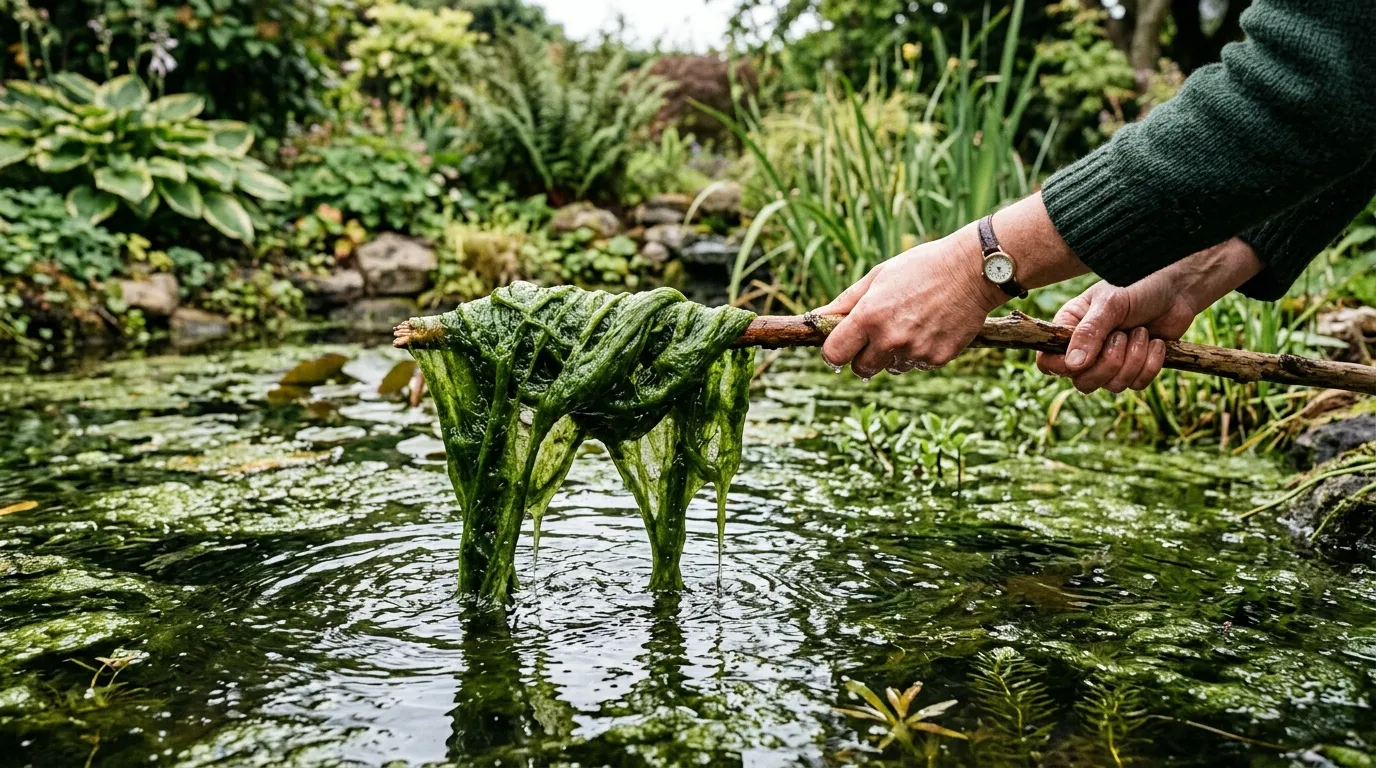
Twist blanketweed out weekly using a stick or cane. Regular removal prevents it building up to unmanageable levels.
What causes it. Same root cause as green water: excess nutrients and light. But blanketweed is particularly aggressive in:
- Shallow ponds (under 60cm at the edges) where sunlight reaches the bottom
- New ponds before plants establish
- Fish ponds with heavy stocking
- Ponds receiving fertiliser runoff from lawns or borders
Biological fix. The most effective approach is combined:
- Remove manually every week. Use a stick or cane and wind the blanketweed off in clumps. Lay it beside the pond for 24 hours before composting — this allows any invertebrates that were living in it to crawl back to the water.
- Add barley straw. As barley straw decomposes in water, it releases hydrogen peroxide and other compounds that inhibit blanketweed growth. Use 50g of barley straw per 1,000 litres of pond water. Place it in a mesh bag or a proprietary barley straw float and position it near the pump intake so water flows through it. Results take 4–6 weeks; start in March before growth peaks.
- Increase plant coverage. See the pond maintenance guide for the correct planting ratios. The more submerged oxygenators competing for nutrients, the less blanketweed can grow.
Chemical fix and why to avoid it. Products containing diquat dibromide (marketed as blanketweed killers) will kill blanketweed rapidly. The problem is that large quantities of dead algae then decompose in the pond, releasing all the nutrients back into the water and causing an oxygen crash that can kill fish. If you must use a chemical treatment, remove as much blanketweed by hand first, use the minimum dose, and run maximum aeration for at least a week afterwards. Avoid chemical treatments entirely in ponds with fish or amphibians. For a wildlife pond, barley straw is always the correct approach.
Murky or brown water
Brown, murky water looks unhealthy but is usually a different problem from green water and far easier to fix. It is caused by suspended particles rather than algae — tannins from decaying leaves or wood, fine clay particles stirred up from the bottom, or suspended sediment from a new pond liner that has not yet settled.
Diagnosing the cause. Fill a clear glass with pond water and hold it up to the light. Brown-tinged water with visible particles: suspended organics or sediment. Genuinely green water: algae. A mix of both: you have both problems and need to address them separately.
Fix: flocculant. A flocculant (pond water clarifier) causes tiny suspended particles to clump together into larger masses that either sink to the bottom or are caught by the filter. Follow the dosage instructions precisely — overdosing can strip beneficial minerals. The water typically clears within 24–48 hours. Most products are safe for fish and wildlife when used at the correct dose.
Prevention. The two main prevention measures are netting the pond in autumn (September–December) to catch falling leaves before they decay, and not disturbing the bottom sediment unnecessarily. If you have a clay-lined pond, the clay particles can be fixed with a liquid pond sealant. Regular pond vacuuming every 2–3 years prevents sediment build-up reaching the point where it disrupts water clarity.
Foam on the pond surface
A little foam at the waterfall outlet is normal — it is caused by the turbulence breaking the water surface. Persistent foam across the entire pond surface, or foam that smells, indicates a problem.
What causes persistent foam. Dissolved organic matter — proteins from fish waste, decaying plant material or uneaten food. When organic levels are high, any surface disturbance traps the molecules into a stable foam. This is the same chemistry as soap bubbles, but it is not the same as detergent contamination.
Fix. Skim visible foam with a fine net. Reduce fish feeding immediately to what they consume in under 3 minutes — uneaten food decays within hours. Check the filter is running correctly; a blocked or bypassed filter allows organic waste to accumulate in the water rather than being processed.
If foam appears suddenly after a period of clear water, suspect a filter problem. Remove the filter media and rinse in a bucket of pond water (never tap water — chlorine kills the beneficial bacteria). Check all pipe connections. Restart and monitor for 48 hours.
Oily film on the surface
An iridescent, oil-like sheen on the water surface alarms most pond owners. The vast majority of cases are completely natural and harmless.
Diagnosing natural vs contamination. Poke the film with a stick or blow on it. Natural iron-oxidising bacterial film breaks into angular, irregular shards and does not reconnect. Petroleum contamination flows back together and smells strongly of fuel. If the film is natural, leave it alone — it causes no harm to pond life. If it is petroleum, stop all water circulation, cover the pond if possible, and contact the Environment Agency pollution hotline.
Pond smells bad
A healthy pond smells mildly earthy, like damp soil. A rotten-egg smell indicates hydrogen sulphide from anaerobic decomposition — organic matter rotting in the sediment without oxygen. This is both unpleasant and potentially harmful to fish in large quantities.
Fix. Use a pond vacuum to remove accumulated sediment from the bottom. Do not drain the pond to do this — remove a third of the water at most and never clean everything in one session. Increase aeration by adding an air pump or positioning the pump outlet to disturb the surface more. Remove any rotting plant material promptly.
The RHS pond care guidance recommends leaving a small area of undisturbed sediment as habitat — do not over-clean. The goal is removing accumulated organic matter, not sterilising the pond.
Barley straw floats work over 4–6 weeks. Use 50g per 1,000 litres and replace every 3 months. This method is safe for fish, frogs and all pond wildlife.
Fish gasping at the surface
Fish repeatedly surfacing and gulping air is an emergency. It means dissolved oxygen levels have dropped to a critical point. Act immediately — fish can die within hours.
Emergency response. Run a hose with a fine spray or rose attachment onto the surface for at least 30 minutes. The spray breaks the water surface and drives oxygen into the water. Switch your pump to maximum flow. If you have an air pump with an airstone, run it at maximum. Oxygen exchange happens at the water surface — anything that agitates the surface helps.
Common causes in UK ponds:
- Algae oxygen crash. A dense algae bloom photosynthesises all day, but at night all the algae consume oxygen and produce CO2. A large bloom can consume all available dissolved oxygen by early morning. This is why fish gasping typically peaks at dawn.
- High summer temperatures. Warm water holds less dissolved oxygen than cold water. At 25°C, water holds roughly 40% less oxygen than at 10°C. UK summers with prolonged heat above 25°C put fish ponds at serious risk.
- Filter failure. A blocked or failed filter stops aerating the water and allows waste products to accumulate, both consuming oxygen and releasing toxic ammonia.
Prevention. A dedicated aeration pump running 24/7 from June to September is the safest approach for fish ponds. The best pond plants for oxygenation include hornwort, elodea and water crowfoot — all of which produce oxygen during daylight hours and should be present in every fish pond.
Duckweed invasion
Duckweed (Lemna minor) is a tiny floating plant that can cover an entire pond surface within days in summer. A single frond divides every 36 hours in warm conditions. On its own, duckweed is not harmful — it is native, wildlife-friendly and ducks genuinely eat it. The problem is when it forms a blanket that blocks all light, killing submerged plants and depleting oxygen.
Control. There is no biological control for duckweed in UK ponds that does not involve other problems. Manual removal with a fine net is the only effective approach. Net across the surface in long strokes, working with any wind direction so the duckweed clumps against one edge. Do this weekly during the growing season.
Prevention. Duckweed enters on equipment, boots, wildfowl and aquatic plants. Inspect all new plants for duckweed before adding them. Position the pump outlet to create gentle surface movement — still water allows duckweed to accumulate. A pond fountain or waterfall outlet that creates surface ripples significantly slows duckweed spread. Reducing nutrients (fish feeding, garden runoff) also reduces duckweed growth rate.
Correct plant coverage — 50–60% of the surface — is the single most effective long-term solution to pond water clarity. Water lilies, water hawthorn and floaters compete with algae for nutrients and light.
Heron damage
Grey herons are a protected species in the UK and cannot be harmed or killed. They are also extremely effective pond predators, capable of taking several fish in a single visit at dawn. A heron can empty a fish pond in a week if left unchecked.
Deterrents that work. A single wire stretched around the pond perimeter at 20cm height is effective — herons land a few metres from the water and walk in, so a low wire barrier they cannot step over deters them without harming them. A heron decoy statue is partially effective at first but herons habituate to static decoys within days. Motion-activated water jets (Scarecrow-type devices) work well when herons return to the same approach path.
Cover is the most effective long-term solution. Dense marginal planting around the pond edges gives fish somewhere to hide and makes wading difficult. Lily pads and floating plants at the surface give fish cover overhead as well.
Water level dropping
A pond losing water has two possible causes: evaporation or a leak. The two behave differently.
Evaporation. Normal summer evaporation in the UK is approximately 3–5mm per day in warm weather — about 2–3cm per week on a sunny pond. Top up with collected rainwater rather than tap water; tap water contains phosphate and chlorine that feed algae and harm the bacterial ecosystem. Using a rainwater harvesting system to collect roof runoff specifically for pond top-ups is the best long-term solution.
Leak test. Turn off the pump and mark the water level with a marker pen or tape. Wait 24 hours. If the level has not dropped, the liner is intact and the pump pipework is leaking. If the level drops 5–10mm or more overnight without the pump running, the liner is cracked or punctured. Leak repair tape and liner patches work well on butyl liners; EPDM liners need the specific adhesive patch designed for that material.
Seasonal pond problem calendar
UK pond problems follow predictable seasonal patterns. Knowing when each is likely helps you prepare before problems appear.
| Month | Common Problem | Preventive Action |
|---|---|---|
| March | First algae bloom, blanketweed starts | Add barley straw, divide overgrown plants |
| April–May | Green water peaks as light increases | Check plant coverage, run UV clarifier |
| June–July | Blanketweed peak, low oxygen in heat | Weekly hand removal, add air pump |
| August | Fish gasping, water level dropping | Top up with rainwater, monitor daily |
| September | Duckweed still active, leaves start falling | Net duckweed weekly, fit pond net |
| October–November | Foam from decomposing leaves, smell | Remove leaf net, pond vacuum if needed |
| December–February | Ice forming, filter slows | Float a ball on surface, reduce pump speed |
Preventing pond problems: the 4 fundamentals
Most recurring pond problems share four root causes. Address these and 90% of issues resolve themselves.
1. Correct plant coverage. 50–60% of the pond surface covered with floating plants (water lilies, water hawthorn) and at least 5 bunches of submerged oxygenators per square metre of pond area. Plants compete with algae for nutrients and light. This single measure prevents more pond problems than any product or treatment. See the water feature ideas guide for design approaches that integrate good plant coverage from the start.
2. Correct stocking levels. Maximum one 15cm fish per 1,000 litres of water for a balanced ecosystem. Overstocking is the number one driver of nutrient excess in UK garden ponds. Wildlife ponds with no fish are naturally much easier to manage — frogs, newts and invertebrates add negligible nutrient load compared to fish.
3. Regular but gentle maintenance. Remove debris before it decomposes. Never do a full pond drain. Clean filters in pond water, not tap water. One thorough session in March, minor maintenance monthly, and the pond manages itself. For a full seasonal breakdown, the pond maintenance guide covers every task month by month.
4. Correct feeding discipline. Feed fish only what they consume in 3 minutes, twice daily during warm weather. Reduce to once per day at 15°C and stop entirely below 10°C. Uneaten food decays within hours, directly feeding algae. This is the simplest and most immediate lever for improving water quality.
Frogs and toads are free biological helpers — they consume insects and their tadpoles graze on algae. A pond that attracts frogs is one step ahead. Read the frog and toad guide for how to make your pond more amphibian-friendly. The create a wildlife garden guide covers the broader habitat context that makes all water features more ecologically productive.
For smaller spaces, a container pond follows the same principles — and is actually easier to manage because the smaller volume responds to plant additions and treatment much faster.
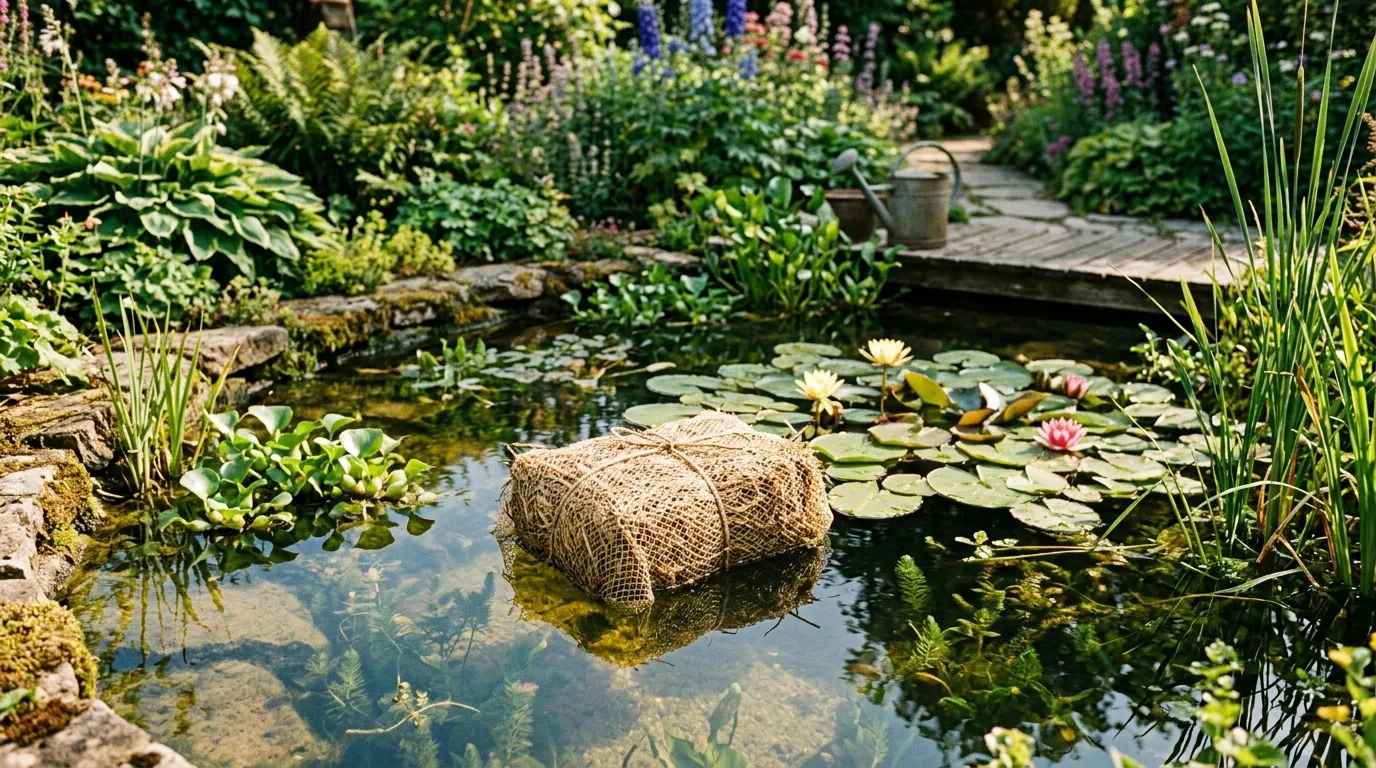
A barley straw mini-bale at 50g per 1,000 litres. It takes 4-6 weeks to start working as it decomposes.
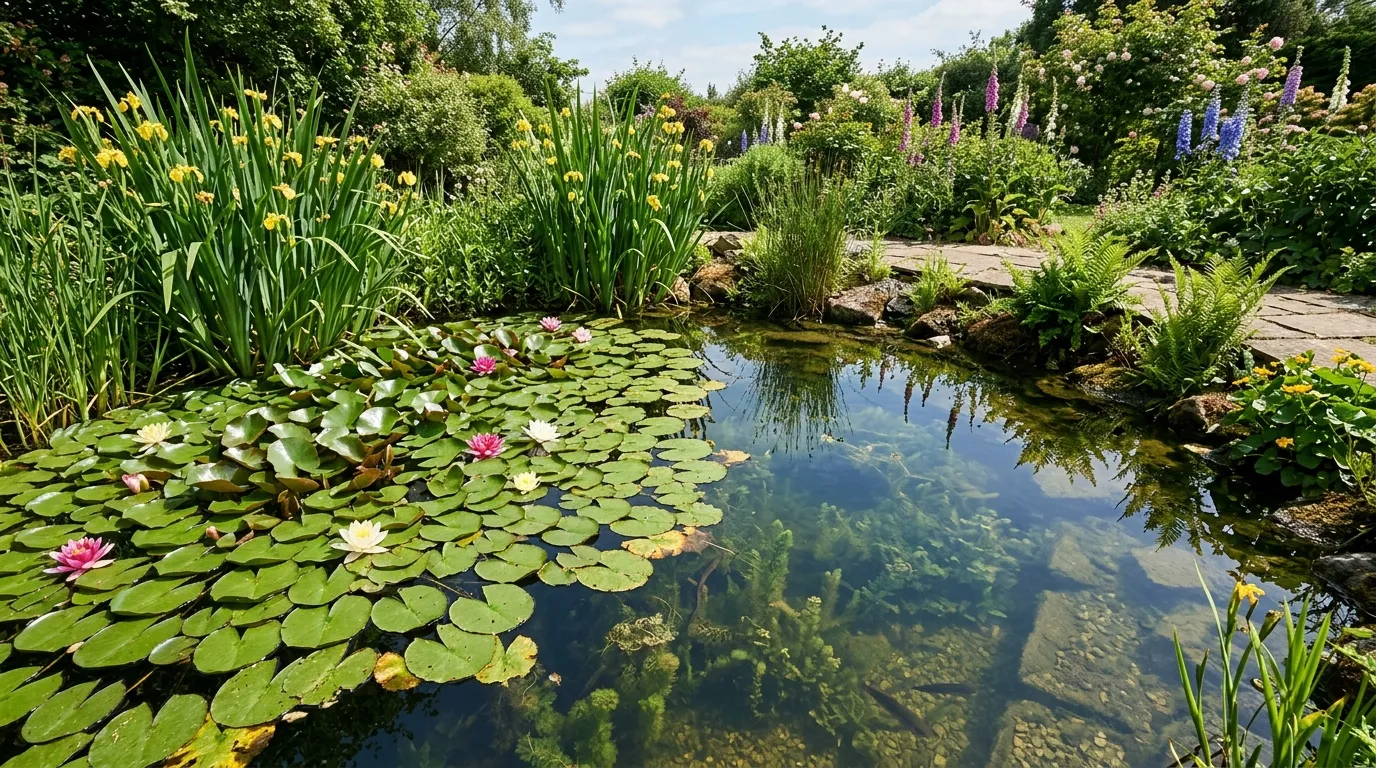
Achieving 50-60% surface coverage with floating plants is the single most effective long-term prevention measure.
Related reading
- How to maintain a garden pond UK — seasonal month-by-month maintenance tasks
- Best pond plants UK — oxygenators, marginals and floaters that prevent algae
- How to build a wildlife pond UK — design the pond right the first time
- Frog and toad garden guide — attracting amphibians that help keep ponds healthy
- Container pond ideas for small gardens — smaller ponds, same principles
Lawrie has been gardening in the West Midlands for over 30 years. He grows his own veg using no-dig methods, keeps a wildlife-friendly garden, and writes practical advice based on real UK growing conditions.