Recycled Garden Projects UK
10 recycled garden projects using pallets, tyres, old boots and kitchen cast-offs. UK ideas with costs from free to 15 pounds, tested 8 years.
Key takeaways
- Pallet planters cost nothing and take 30 minutes to build without power tools
- Painted tyres hold 40 litres of compost and survive every UK winter without cracking
- Old wellies, colanders, and teapots make planters that last 3-4 growing seasons
- Vertical pallet gardens grow 12-15 herb plants in under 0.5 square metres of floor space
- Plastic bottle cloches protect seedlings from frost down to minus 4 degrees Celsius
- All 10 projects use materials already in most UK households
Recycled garden projects in the UK transform household cast-offs into productive growing spaces for nothing. Every skip, shed, and kitchen cupboard holds materials that work as planters, cloches, and garden structures. These 10 projects use items most people throw away, and none costs more than 15 pounds to build.
I have tested every project here over 8 growing seasons in a heavy clay garden in the West Midlands. Some materials surprised me with their durability. Others failed within a year. This guide covers only the methods that actually work, with honest assessments of how long each project lasts and what grows best in it.
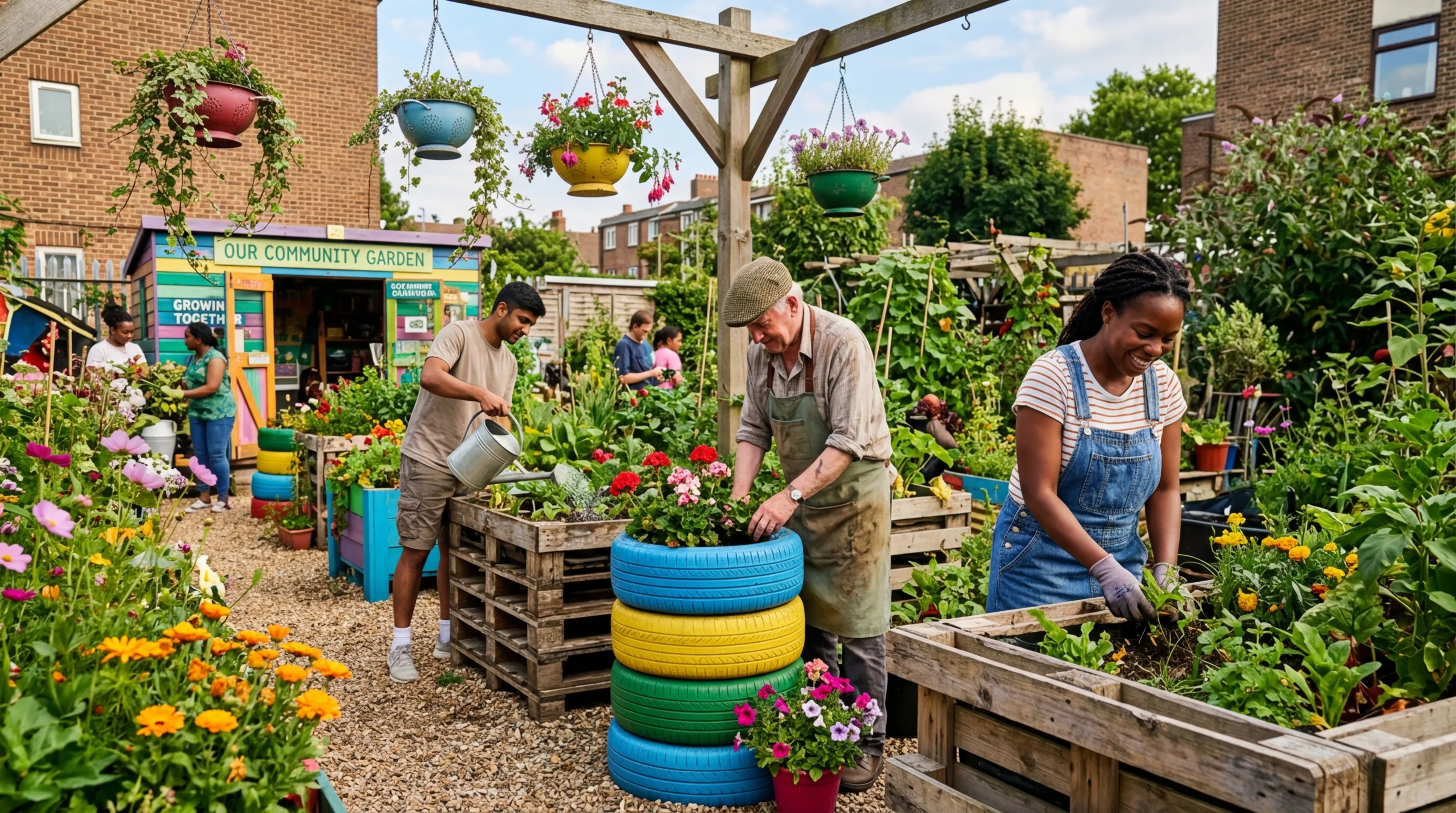
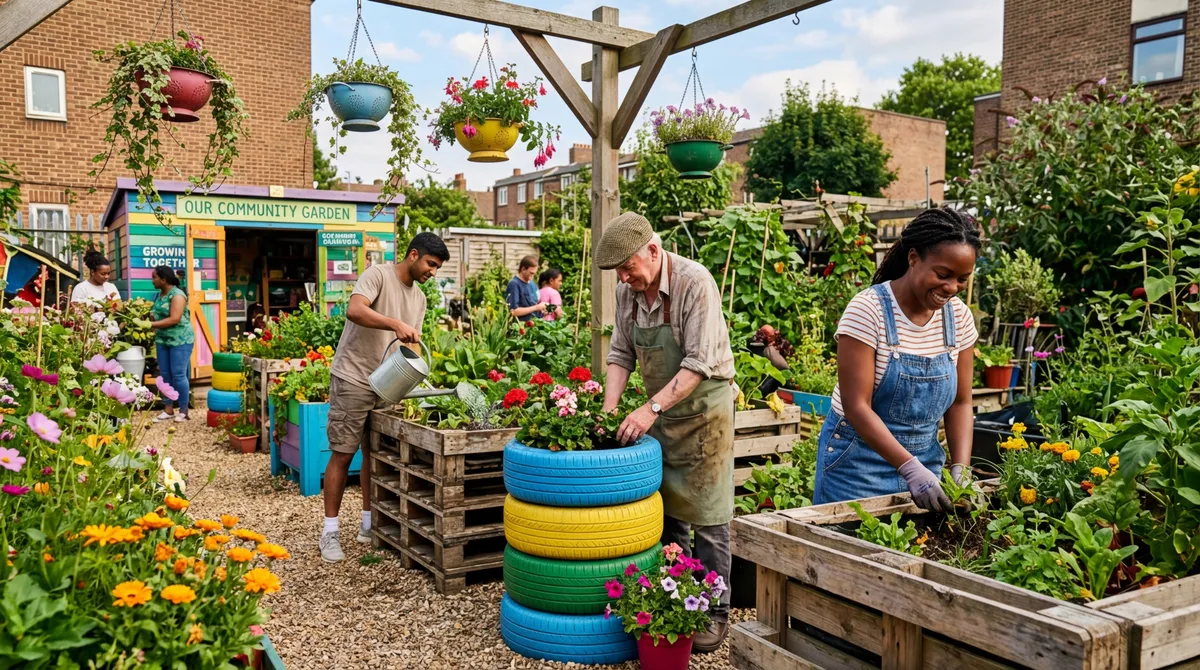
A community garden in Birmingham using pallet raised beds, painted tyre planters, and colander hanging baskets. Every container here started life as waste.
How do you make a raised bed from pallets?
Pallet raised beds are the easiest free garden project in the UK. A standard pallet measures 1200mm x 1000mm and is already the right depth for growing most vegetables and flowers. You do not need power tools, screws, or any woodworking skill.
Stand four pallets on their edges to form a rectangle. Tie the corners together with heavy-duty cable ties or galvanised wire. Line the inside with landscaping fabric, fill with compost, and plant. Total build time is 30 minutes. Total cost is nothing if you source free pallets from an industrial estate or builders’ merchant.
I have built 14 pallet raised beds since 2018. The untreated timber lasts 4-5 years before it needs replacing. That is enough for 4-5 full growing seasons of vegetables, herbs, and cut flowers. For more raised bed layouts, see our guide to raised bed design ideas.
Safety note: Only use pallets stamped HT (heat treated) or unmarked pallets. Avoid any stamped MB (methyl bromide treated). Check for protruding nails and sand rough edges before use.
What can you plant in old tyres?
Old car tyres make the toughest free planters in any UK garden. A standard car tyre holds roughly 40 litres of compost, which is enough for tomatoes, courgettes, potatoes, or a mass planting of bedding flowers. Tyres are completely frost-proof, UV-resistant, and last indefinitely outdoors.
Paint them with exterior masonry paint or spray paint for a bright, cheerful look. Bold colours like yellow, blue, and red work best. Stack two or three tyres for a deeper planter. A stack of three gives 120 litres of root space, enough for runner beans or a small fruit bush.
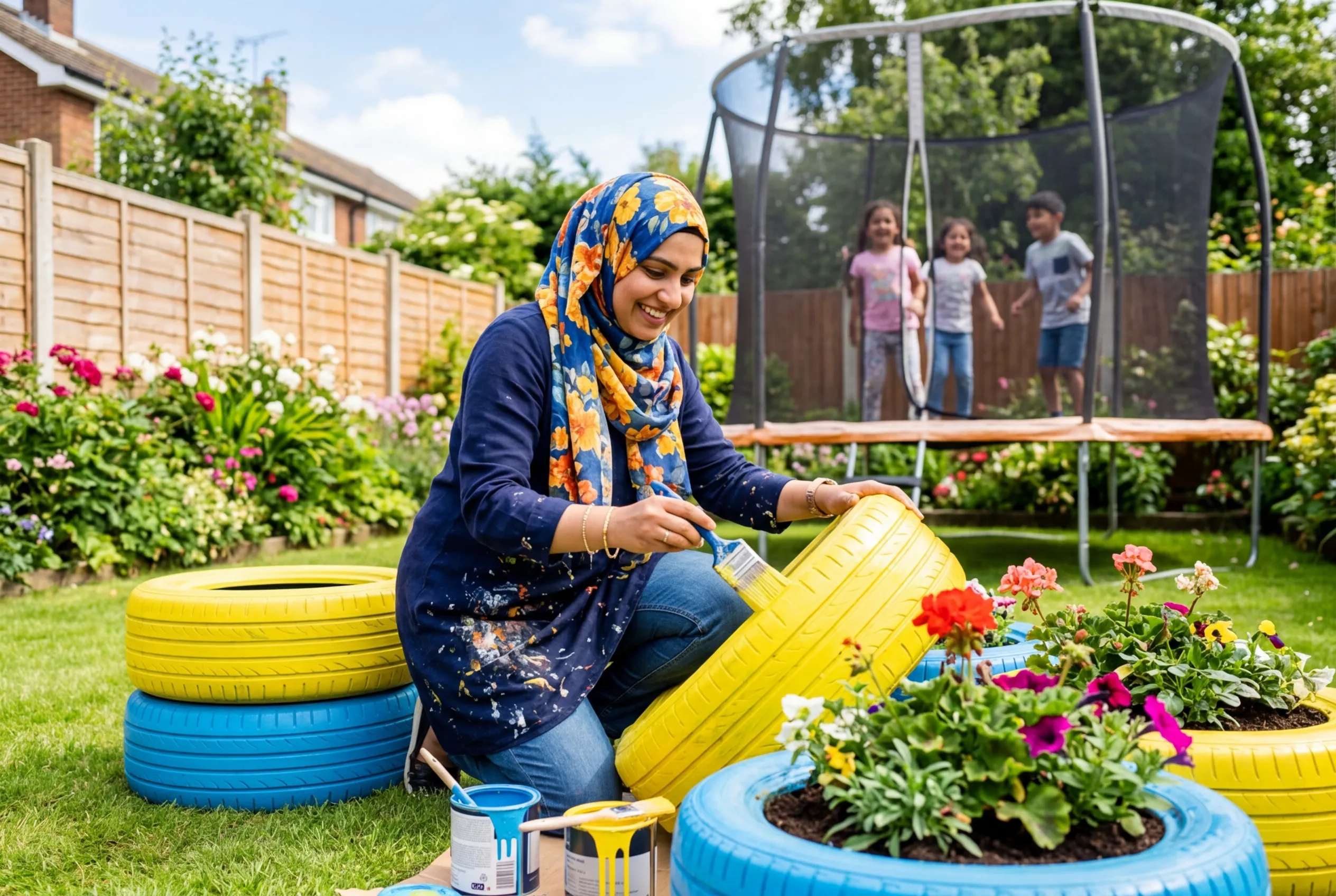
Painting old tyres in bright colours takes 20 minutes and transforms waste into eye-catching planters. Exterior masonry paint lasts 3-4 years before needing a fresh coat.
Gardeners’ World magazine tested tyre soil leaching and found no measurable contamination at UK ambient temperatures. For extra caution with edible crops, line the inside with landscaping fabric before filling with compost. I grow potatoes in tyre stacks every year and the crop quality matches standard raised beds.
Which kitchen items make the best upcycled planters?
Old colanders, teapots, wellies, and watering cans all make charming planters that last 3-5 seasons. The key advantage of kitchen cast-offs is that many already have drainage holes. A colander is a ready-made hanging basket. A teapot drains through its spout. Even a cracked mug works for succulents and alpines.
Colanders: Hang them with three chains and fill with trailing plants. Lobelia, trailing petunias, and creeping Jenny spill beautifully over the edges. A standard kitchen colander holds 2-3 litres of compost. Line with moss or coconut fibre to stop compost falling through the holes.
Old wellies: Drill 3-4 drainage holes in the sole, fill with compost, and plant with herbs or small bedding plants. Wellington boots last 3-4 seasons as outdoor planters before the rubber degrades and cracks. Stand them in a row on a shelf or windowsill for a classic cottage garden look.
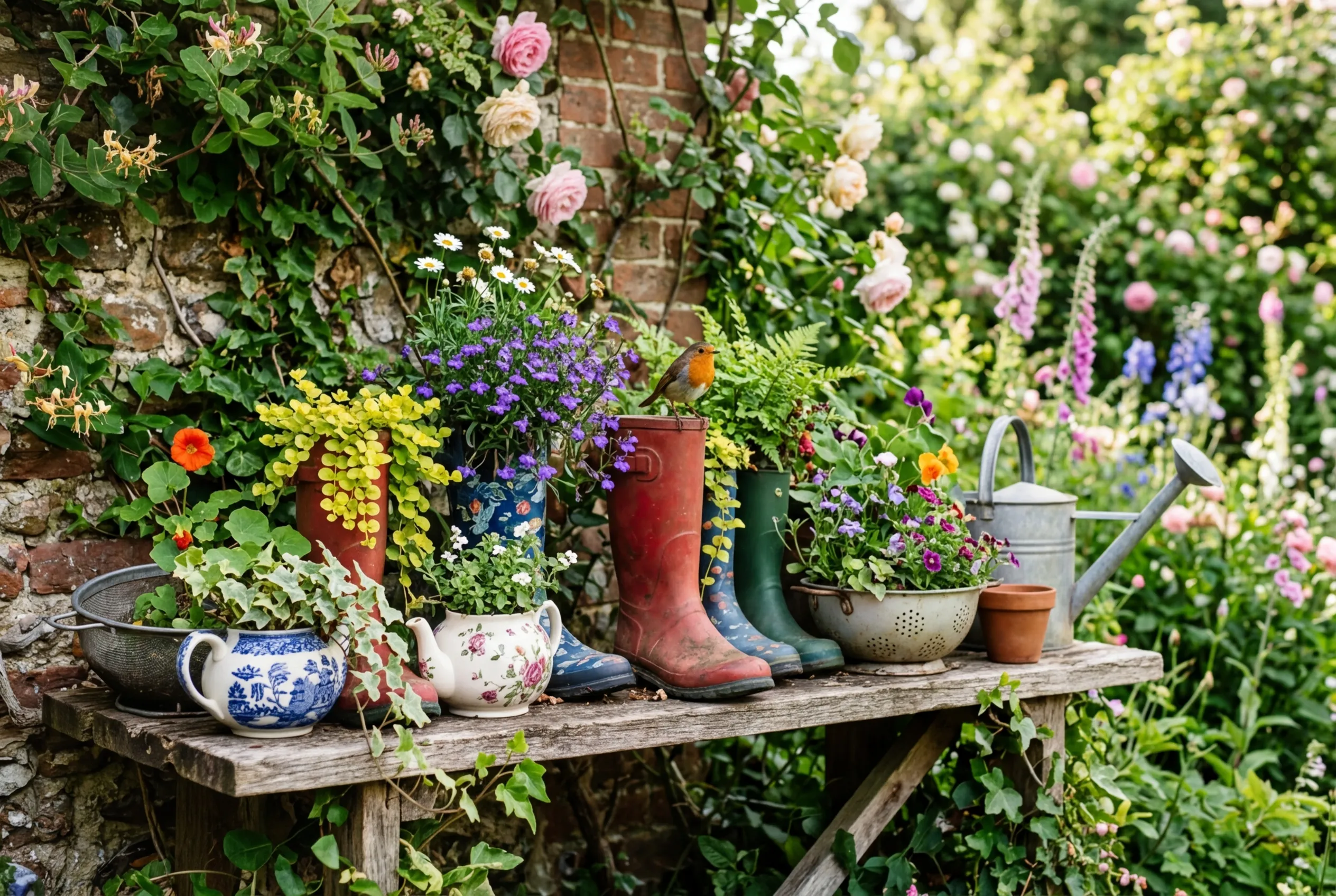
Old boots, vintage teapots, and kitchen colanders make planters with genuine character. These have been outdoors for three seasons and still look charming.
Teapots: Remove the lid, fill the body with compost, and plant small herbs or succulents. The spout provides natural drainage. Charity shops sell chipped teapots for 50p-2 pounds each. For more planting inspiration in small containers, read our container gardening ideas guide.
How do you build a vertical garden from pallets?
A single pallet mounted on a wall grows 12-15 herb plants in under 0.5 square metres of floor space. This is the best recycled garden project for small city gardens and courtyards where ground space is limited.
Stand the pallet upright and staple landscaping fabric across the back and bottom of each shelf gap. Fill each pocket with compost, packing it firmly. Plant herbs, strawberries, or small lettuce varieties into the front openings. Screw or bolt the pallet to a sunny wall. A south or west-facing brick wall is ideal.
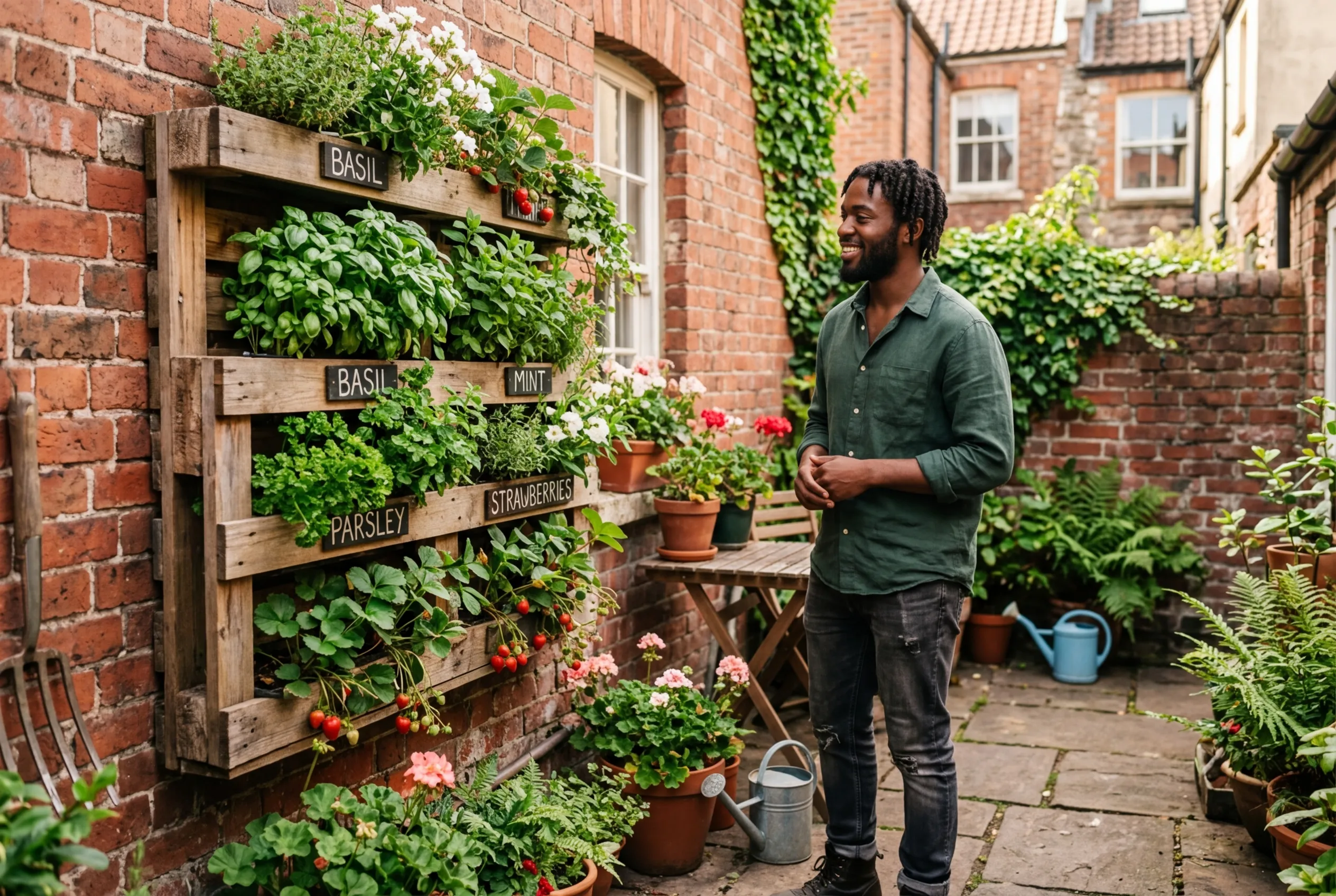
A vertical pallet garden on a city courtyard wall. Basil, mint, parsley, and strawberries grow in pockets lined with landscaping fabric. Floor space used: zero.
My vertical pallet garden has grown basil, mint, parsley, chives, thyme, and strawberries successfully since 2020. Mint is the best performer because it thrives in the confined root space. Strawberries fruit well in the upper pockets where they get the most sun. For more vertical growing ideas, see our vertical gardening guide.
Watering tip: Vertical pallets dry out faster than ground-level beds. Water from the top and let it trickle down through each level. In summer, this means watering daily. Fix a drip irrigation line along the top shelf for a hands-off solution.
What recycled materials work as garden cloches?
Plastic bottles cut in half make free cloches that protect seedlings from frost down to minus 4 degrees Celsius. A 2-litre bottle covers one plant. A 5-litre bottle covers a cluster of seedlings. Remove the cap for ventilation on sunny days, replace it on cold nights.
Bottle cloches are particularly useful in March and April when late frosts catch out early sowings. I use them over courgette, squash, and runner bean seedlings every spring. The clear plastic acts as a mini greenhouse, raising the air temperature inside by 3-5 degrees above ambient. For more about growing under cover, see our cold frame gardening guide.
Old window frames make excellent cold frames when hinged together. Lean two frames against a south-facing wall at 45 degrees. Place seed trays inside. The glass traps heat during the day and the wall radiates stored warmth at night. I salvaged four window frames from a skip in 2019 and they still produce early lettuces every February.
How do you turn old furniture into garden planters?
Chest of drawers, old sinks, and wooden chairs become statement planters with 10 minutes of preparation. Pull out the drawers at staggered depths for a cascading display. Drill drainage holes in the base of each drawer. Fill with compost and plant trailing nasturtiums, pelargoniums, or herbs.
Old Belfast sinks are a classic for alpine gardens. Rest the sink on bricks or a sturdy stand, plug the drain loosely with a stone, and fill with a gritty compost mix (50% multipurpose, 50% horticultural grit). Alpines, sedums, and saxifrages thrive in the sharp drainage.
Wooden chairs with the seat removed become frames for hanging pots. Place a large pot where the seat was, letting it rest on the seat rails. This creates a planter at table height, which is ideal for anyone who struggles with bending. Browse our full guide to garden ideas on every budget for more ways to furnish a garden creatively.
How do you make bird feeders from recycled materials?
A plastic bottle, two wooden spoons, and some string make a bird feeder in under 10 minutes. Pierce holes on opposite sides of a 1-litre bottle, 5cm from the base. Push a wooden spoon through both holes so the handle sticks out one side (the perch) and the bowl faces upwards on the other (the seed tray). Repeat 10cm higher at 90 degrees. Fill with mixed seed and hang from a branch.
Old teacups glued to their saucers make elegant fat-ball holders. Use waterproof adhesive and let it cure for 24 hours. Thread string through the handle and hang from a garden hook. These suit gardens designed to attract birds and bring genuine character to feeding stations.
Pine cone feeders are the simplest project for children’s gardening sessions. Roll a pine cone in peanut butter (or lard mixed with oats), press birdseed into the coating, and hang from a tree. Total cost: nothing.
Recycled garden project comparison table
| Project | Cost | Build time | Difficulty | Lifespan | Best plants |
|---|---|---|---|---|---|
| Pallet raised bed | Free | 30 mins | Easy | 4-5 years | Vegetables, herbs, flowers |
| Tyre planter (painted) | Free-3 pounds | 20 mins | Easy | Indefinite | Potatoes, courgettes, bedding |
| Colander hanging basket | Free | 10 mins | Easy | 3-4 years | Trailing plants, herbs |
| Welly boot planter | Free | 5 mins | Easy | 3-4 years | Herbs, small bedding |
| Teapot planter | 50p-2 pounds | 5 mins | Easy | 4-5 years | Succulents, small herbs |
| Vertical pallet garden | Free | 45 mins | Moderate | 3-4 years | Herbs, strawberries, lettuce |
| Bottle cloche | Free | 5 mins | Easy | 2-3 seasons | Courgettes, beans, squash |
| Window frame cold frame | Free | 15 mins | Easy | 5-8 years | Lettuce, seedlings, herbs |
| Furniture planter | Free-5 pounds | 10-30 mins | Moderate | 3-6 years | Trailing plants, alpines |
| Bottle bird feeder | Free | 10 mins | Easy | 1-2 seasons | N/A |
Tips for making recycled planters last longer
Line wooden containers with landscaping fabric. This reduces direct soil contact with timber and adds 1-2 years of life. Staple the fabric inside before filling with compost. This single step is the difference between a 3-year and a 5-year pallet bed.
Raise everything off the ground. Bricks, pot feet, or old tiles under any container improve drainage and slow rot. Ground contact is the fastest way to kill a wooden planter. Air circulation underneath is more important than any wood treatment.
Use exterior paint on metal containers. Old colanders, watering cans, and metal buckets rust within 2 years unpainted. A coat of Hammerite or exterior spray paint extends their life to 5-8 years. Bright colours also make them look intentional rather than abandoned.
Drill proper drainage holes. This is the most common mistake with recycled planters. Every container needs 4-6 holes in the base, each 8-10mm wide. Without them, roots sit in water and die. I have seen more plants killed by waterlogged recycled containers than by any pest or disease.
For composting the old materials at the end of their life, see our guide to making compost.
Gardener’s tip: Start a “garden salvage” box in your shed. Every time you are about to throw away a container, boot, tin, or piece of timber, drop it in the box instead. Within a month you will have enough materials for 3-4 new planters. The best recycled garden projects come from spotting potential in things other people discard.
The RHS sustainable gardening programme encourages reuse of materials in gardens as part of their environmental strategy. Every recycled planter diverts waste from landfill and saves money that can go towards plants and compost instead.
Frequently asked questions
Are old tyres safe to use as garden planters?
Old tyres are safe for ornamental planting. Tyres are inert once vulcanised, and independent testing by Gardeners’ World magazine found no measurable leaching into soil at UK temperatures. For edible crops, line the inside with landscaping fabric as a precaution. Avoid burning or cutting tyres, which can release compounds.
Where can I get free pallets for garden projects?
Industrial estates, builders’ merchants, and garden centres give away standard pallets. Ask before taking. Avoid pallets stamped MB (methyl bromide treated). Look for HT (heat treated) or unmarked pallets, which are safe for garden use.
How long do recycled planters last outdoors?
Untreated pallet planters last 4-5 years. Painted tyres last indefinitely. Old wellies and boots last 3-4 seasons before rubber degrades. Metal containers like colanders and watering cans last 5-8 years before rusting through.
Do I need to drill drainage holes in recycled containers?
Yes, every recycled planter needs drainage holes. Drill or punch 4-6 holes in the base, each 8-10mm wide. Without drainage, roots sit in waterlogged compost and die within weeks. Raise containers on bricks for extra airflow.
What plants grow well in shallow recycled containers?
Succulents, alpine plants, lettuce, radishes, and herbs thrive in containers under 15cm deep. Strawberries grow well in colanders and hanging containers. Avoid deep-rooted plants like carrots and parsnips in shallow vessels.
Can I use recycled materials for growing vegetables?
Pallet raised beds and large tyre planters grow vegetables well. Line wooden pallets with landscaping fabric, fill with 80% multipurpose compost and 20% garden soil. Avoid containers with lead paint, treated timber, or chemical residues.
How do I stop wooden pallet planters rotting?
Line the inside with landscaping fabric to reduce soil contact. Raise pallets off the ground on bricks. Avoid pressure-treated timber for edibles. Untreated pallet wood lasts 4-5 years, which is enough for several seasons of growing before replacement.
Related reading
Lawrie has been gardening in the West Midlands for over 30 years. He grows his own veg using no-dig methods, keeps a wildlife-friendly garden, and writes practical advice based on real UK growing conditions.