South-Facing Garden: Full Sun Guide
South-facing garden advice for UK full-sun plots. Best plants, soil care, watering strategies, and shade solutions from 30 years of hands-on growing.
Key takeaways
- South-facing UK gardens receive 6-10 hours of direct sun daily in summer, creating ideal conditions for Mediterranean and prairie plants
- Soil at 10cm depth reaches 25-30C in July, so mulching with 50mm gravel cuts watering by 40-60%
- Heavy clay dries and cracks in south-facing plots: add organic matter annually to improve water-holding capacity
- A single multi-stem tree (Amelanchier, birch) creates a shaded sitting area 5-8C cooler than open ground
- South-facing walls reach 35-45C in summer and create microclimates 5C warmer than the open garden
A south-facing garden is the most sought-after aspect in UK property, and for good reason. South-facing plots receive 6-10 hours of direct sunlight daily from April to September, creating growing conditions that suit the widest range of plants, vegetables, and fruit.
But full sun brings real challenges. Soil bakes hard in clay plots. Lawns scorch brown by late July. Sitting areas become uncomfortably hot in the afternoon. This guide covers how to make the most of a south-facing garden in UK conditions, from plant selection and soil management to creating shade where you need it. Whether you are planting a new border or rethinking an established plot, the advice here comes from years of growing on a south-facing clay garden in the Midlands.
How sunlight works in a south-facing garden
Understanding how the sun moves across your garden through the day and through the year is the starting point for every planting and design decision.
At UK latitudes (50-56 degrees north), the sun tracks across the southern sky. A south-facing garden sits directly in the sun’s path. From mid-morning to late afternoon, there is nowhere to hide. In June, the sun reaches a maximum elevation of 62 degrees above the horizon in London and 58 degrees in Manchester. It rises in the north-east around 4:45am and sets in the north-west around 9:20pm.
In winter the picture changes dramatically. The sun barely climbs above 15 degrees in December, casting long shadows even at midday. Day length drops to under 8 hours. South-facing gardens still get more winter sun than any other aspect, which is why they feel warmer in spring and plants emerge earlier. Our companion piece on north-facing garden ideas covers the opposite extreme.
Measuring sun exposure in your plot
Before planting, map the sun across your garden on a clear day in each season. Mark which areas receive full sun (6+ hours), partial sun (3-6 hours), and shade (under 3 hours). The pattern shifts through the year.
| Season | Sun elevation (52N) | Day length | Direct sun hours (south aspect) | Soil temp at 10cm |
|---|---|---|---|---|
| Midsummer (June) | 62 degrees | 16h 30m | 8-10 hours | 25-30C |
| Spring equinox (March) | 38 degrees | 12h | 5-7 hours | 8-12C |
| Autumn equinox (Sept) | 38 degrees | 12h | 5-7 hours | 14-18C |
| Midwinter (December) | 15 degrees | 7h 50m | 2-4 hours | 3-6C |
Buildings, fences, and trees all cast shadows. A 2m fence on the north boundary of a south-facing garden casts almost no shadow into the garden. A 2m fence on the south boundary casts a shadow up to 7m long in winter and 1m in summer. Factor this into your planting plan.
Best plants for a south-facing garden
The right plant selection turns relentless sun from a problem into an asset. Plants that evolved in Mediterranean, prairie, and South African climates perform brilliantly in UK south-facing gardens, provided drainage is adequate.
Top perennials for full sun
These perennials have been trialled in a south-facing border on heavy Staffordshire clay, surviving 8 growing seasons with minimal supplementary watering once established.
| Plant | Height | Flowers | Hardiness | Why it works |
|---|---|---|---|---|
| Lavender (L. angustifolia) | 40-60cm | Jun-Aug, purple | -15C | Silver foliage reflects heat, aromatic |
| Salvia nemorosa ‘Caradonna’ | 50-70cm | Jun-Sep, violet | -20C | Repeat-flowers if deadheaded |
| Echinacea purpurea | 60-100cm | Jul-Sep, pink | -25C | Prairie native, deep roots |
| Agapanthus ‘Headbourne Hybrids’ | 60-90cm | Jul-Aug, blue | -10C | Hardy UK-bred strain |
| Verbena bonariensis | 120-180cm | Jun-Oct, purple | -7C | Self-seeds, airy structure |
| Sedum ‘Herbstfreude’ | 40-50cm | Aug-Oct, pink/rust | -20C | Succulent leaves, pollinators |
| Perovskia ‘Blue Spire’ | 90-120cm | Jul-Sep, blue | -15C | Silver stems, aromatic |
| Eryngium bourgatii | 40-60cm | Jun-Aug, silver-blue | -20C | Architectural, bone-dry tolerant |
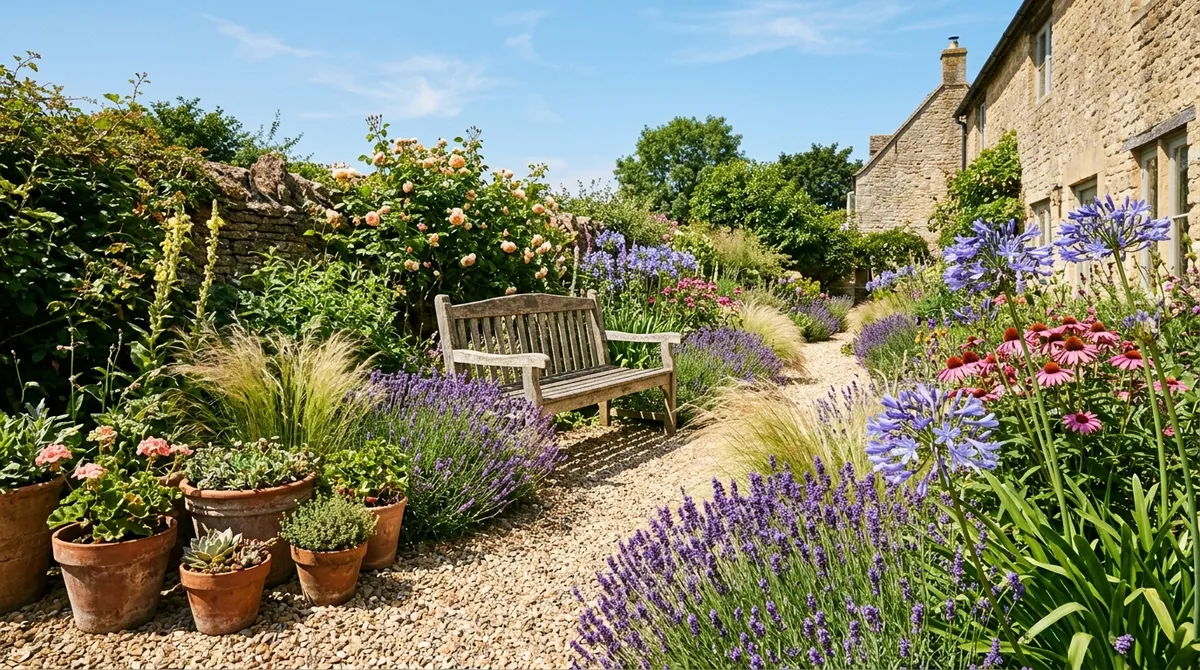
Lavender and salvia form the backbone of most south-facing borders. Both tolerate drought once established and flower for 8-12 weeks. For vertical interest, try climbing plants on south-facing walls and fences, where warmth promotes longer flowering.
Shrubs that thrive in full sun
Shrubs provide structure through winter when perennials die back. South-facing gardens suit an unusually wide range because the extra warmth pushes borderline-hardy species into safe territory.
Cistus (rock rose) flowers for 4-6 weeks in June and July, tolerates poor soil, and needs no pruning. Hardy to -10C. Each papery flower lasts just one day, but dozens open every morning through the flowering season.
Ceanothus (California lilac) produces clouds of blue flowers in May. Wall-trained specimens reach 4m on south-facing walls. ‘Concha’ and ‘Puget Blue’ are the hardiest cultivars for UK conditions, surviving -12C against a warm wall.
Buddleia davidii attracts more butterflies than any other garden shrub. Prune hard in March to keep it compact. Self-seeds freely so deadhead spent spikes before the seeds drop. The RHS guide to buddleia pruning provides detailed timing advice.
Choisya ternata (Mexican orange blossom) is evergreen, fragrant, and tolerates full sun to partial shade. ‘Sundance’ has golden foliage that glows in sunlight. Hardy to -10C in well-drained soil.
Ornamental grasses for movement and texture
Grasses bring a quality that no other plant group offers: movement. Even a light breeze sets them swaying, catching the light in a south-facing garden and creating shadows that shift through the day.
Stipa tenuissima (Mexican feather grass) is the most popular grass for south-facing borders. Fine, wispy foliage reaches 60cm and moves in the slightest air current. Self-seeds generously. Hardy to -15C.
Miscanthus sinensis ‘Morning Light’ reaches 150cm with narrow silver-edged leaves and feathery plumes from September. One of the most drought-tolerant large grasses once established. See our full ornamental grasses guide for more varieties suited to UK gardens.
Pennisetum alopecuroides (fountain grass) produces soft, fluffy seed heads from August. Reaches 80cm. Needs a sheltered spot in northern regions as it is borderline hardy below -10C.
Managing soil in a south-facing garden
Soil management is the difference between a thriving south-facing garden and a struggling one. Full sun intensifies every soil problem.
Clay soil in full sun
Heavy clay is the most common soil type across England and Wales. In a south-facing garden, clay dries fast and cracks hard in summer. I have measured cracks 3cm wide and 30cm deep in my Staffordshire clay by late July. These cracks tear through fine root systems and kill newly planted perennials.
The fix is organic matter. Spread 75mm of composted bark or well-rotted manure over borders every autumn. Worms pull it down through winter. After three years of annual mulching, my clay went from cracking by mid-June to holding moisture through to late July. The soil structure improved at every depth down to 30cm.
Do not dig organic matter into clay. Digging creates a sump that fills with water in winter and bakes into a hard pan in summer. Lay it on the surface and let biology do the work.
Sandy soil in full sun
Sandy soil drains fast, which most sun-loving plants appreciate. The problem is nutrient loss. Water flushes through sand and takes soluble nutrients with it. South-facing sandy borders need feeding more often than shaded ones.
Apply a slow-release granular fertiliser in March and again in June. Mulch with composted bark (not gravel) to add organic matter and slow water loss. Over time, the organic content builds and the sand holds moisture better. Our guide on how to feed garden plants covers feeding schedules in detail.
Chalky soil in full sun
Chalk and limestone soils are free-draining and alkaline (pH 7.5-8.5). Many Mediterranean plants love these conditions. Lavender, cistus, rosemary, and salvias all perform better on chalk than on acid soil. Avoid acid-loving plants like rhododendrons, camellias, and blueberries, which turn yellow and die on chalk.
Watering strategies for full-sun gardens
South-facing gardens lose more water to evaporation than any other aspect. A 10 sq m border in full sun can lose 30-40 litres of water per day in July through evaporation and plant transpiration combined.
When and how to water
Water in the evening. After 6pm, soil temperature drops and evaporation slows. Water applied at midday on a south-facing border loses 30-50% to immediate evaporation. Evening watering soaks in overnight and reaches root depth by morning.
Water deeply and less often. One thorough soaking (20 litres per sq m) twice a week beats a light sprinkle daily. Deep watering encourages roots to grow downward toward reliable moisture. Shallow watering keeps roots near the hot, dry surface.
Drip irrigation is the most efficient method for south-facing borders. A porous hose or drip line laid under mulch delivers water directly to the root zone with minimal evaporation. A basic system costs 30-50 pounds and connects to an outdoor tap. Add a battery timer for 10-15 pounds and the system runs automatically. Read our guide to watering properly for full setup instructions.
Mulching to reduce water loss
Mulching is the single most effective water-saving measure. A 50mm layer of gravel, bark, or composted green waste over bare soil reduces evaporation by 40-60%.
| Mulch type | Cost per sq m | Water saving | Lifespan | Best for |
|---|---|---|---|---|
| Pea gravel (20mm) | 3-5 pounds | 50-60% | Permanent | Mediterranean borders, gravel gardens |
| Composted bark | 2-4 pounds | 40-50% | 2-3 years | Mixed borders, clay soil improvement |
| Leaf mould | Free (homemade) | 40-50% | 1-2 years | Woodland edges, shade areas |
| Slate chippings | 5-8 pounds | 50-60% | Permanent | Contemporary designs, dark contrast |
| Composted green waste | 1-3 pounds | 35-45% | 1-2 years | Vegetable beds, general borders |
For Mediterranean-style planting, gravel mulch is both practical and decorative. It reflects heat upward to foliage, mimicking the plants’ native conditions while keeping roots cool and moist below.
Creating shade in a south-facing garden
Full sun all day sounds ideal until you try to sit outside at 2pm in July. Creating shade where you need it, while keeping the rest of the garden in sun for plants, is a key design skill.
Trees for dappled shade
A single multi-stem tree transforms a south-facing garden. Dappled shade under a tree canopy is 5-8C cooler than open ground. The canopy filters harsh midday sun while allowing enough light for grass and ground-cover plants beneath.
Amelanchier lamarckii is the best all-round choice for south-facing gardens under 15m long. It reaches 4-6m, produces white spring blossom, red-purple autumn colour, and bird-friendly berries. Multi-stem specimens create broad, light shade. Tolerates clay and chalk.
Betula utilis var. jacquemontii (Himalayan birch) has striking white bark and an open canopy that casts the lightest shade of any tree. Reaches 8-12m but can be kept smaller by selecting compact cultivars like ‘Doorenbos’. Suits small garden designs where heavy shade would dominate.
Cercis canadensis ‘Forest Pansy’ has heart-shaped purple leaves and pink spring flowers. Reaches 4-6m. The dark foliage provides dense shade beneath and contrasts with silver-leaved Mediterranean plants around it.
Structures for instant shade
Trees take 3-5 years to provide useful shade. Structures give immediate relief.
Pergolas create a framework for climbing plants. A simple timber pergola over a seating area costs 500-2,000 pounds depending on size and timber quality. Train a grapevine, wisteria, or climbing rose over it for living shade that lets dappled light through. In winter the bare framework allows low sun to reach the house.
Sail shades are the fastest solution. A UV-stabilised sail shade filters 90-95% of direct sun and costs 30-80 pounds. Fix to fence posts, walls, or freestanding poles at 2.5m height. Remove in winter to avoid wind damage.
Designing borders for a south-facing garden
Border design in a south-facing garden follows different rules from shaded plots. The light comes from above and behind the viewer (assuming the house is on the north side), which means colours and textures behave differently.
Colour in full sun
Pale colours wash out in strong sunlight. Whites and pastels that glow beautifully in a north-facing garden look bleached and tired under a July sun. Instead, use bold, saturated colours that hold their intensity.
Deep purples (salvias, lavender, Verbena bonariensis) absorb light and create visual depth. Plant them at the back of the border where they draw the eye into the planting.
Hot oranges and reds (crocosmia, helenium, kniphofia) sing in sunlight. They look gaudy in shade but come alive under full sun. Group them in drifts of five or more for maximum impact.
Silver and grey foliage (artemisia, Stachys byzantina, Convolvulus cneorum) reflects sunlight and provides cool contrast between hot colours. Silver plants belong at the front of the border where they catch the most light.
Planting layout for south-facing borders
Plant in layers from front to back, tall to short, with the border running east to west so taller plants do not shade shorter ones.
- Front row (0-40cm): Sedum, thyme, aubrieta, Stachys byzantina, dwarf lavender
- Middle row (40-80cm): Salvia nemorosa, echinacea, agapanthus, eryngium, standard lavender
- Back row (80cm+): Verbena bonariensis, Perovskia, Miscanthus, Stipa gigantea
Leave 30-45cm between plants. Full-sun perennials spread faster than shade plants because growth is not limited by light. Overcrowding reduces airflow and increases mildew risk, even in dry conditions.
Growing vegetables in a south-facing garden
A south-facing plot is the best possible site for a UK vegetable garden. The extra warmth and light extend the growing season by 2-4 weeks at each end compared to east or west aspects.
What grows best in full sun
Fruiting vegetables need the most sun. Tomatoes, peppers, aubergines, courgettes, and sweetcorn all require 6+ hours of direct light to set and ripen fruit. A south-facing garden delivers this from April through September.
Root vegetables grow faster in warm soil. Carrots sown in a south-facing bed in March are ready 2-3 weeks earlier than those in a north-facing plot. Beetroot develops sweeter flavour when grown in warm, sun-baked soil.
Salad crops are the exception. Lettuce, spinach, and rocket bolt (run to seed) quickly in hot sun. Grow these on the east side of the garden where they get morning sun and afternoon shade, or under the dappled canopy of a fruit tree.
Extending the season
South-facing walls create microclimates 5C warmer than open ground. Train tender fruit and vegetables against them for earliest harvests. Tomatoes against a south-facing wall ripen 3-4 weeks earlier than freestanding plants. Fig trees fruit reliably in the UK only against warm, south-facing walls, where restricted root run concentrates the plant’s energy into fruit production.
A cold frame against a south-facing wall creates a growing environment 8-12C warmer than outside air on sunny days in March. Start seeds here 4-6 weeks before outdoor sowing is safe. This is one of the simplest ways to extend the season without electricity or heating.
Lawn care in a south-facing garden
Lawns suffer most in south-facing gardens. The combination of heavy foot traffic, full sun, and summer drought scorches grass brown by late July in most years.
Choosing the right grass seed
Standard lawn seed mixes contain ryegrass, which greens up fast but browns quickly in drought. For south-facing gardens, choose a mix containing at least 40% fescue. Fine fescues (Festuca rubra, F. ovina) tolerate drought better than ryegrass, stay green longer in dry spells, and recover faster after rain.
Drought-tolerant lawn seed mix recommendation:
- 40% Chewings fescue (Festuca rubra subsp. commutata)
- 30% Strong creeping red fescue (Festuca rubra subsp. rubra)
- 20% Perennial ryegrass (Lolium perenne)
- 10% Smooth-stalked meadow grass (Poa pratensis)
Summer lawn survival
Raise the mowing height to 40mm from June to September. Longer grass shades its own roots and reduces water loss. Never scalp a south-facing lawn below 25mm in summer.
Water lawns in the evening, applying 20-25mm per week during dry spells (equivalent to 20-25 litres per sq m). A sprinkler running for 30 minutes typically delivers 10-15mm depending on water pressure. Measure output by placing a straight-sided container on the lawn while the sprinkler runs.
Accept that a south-facing lawn will turn straw-coloured in a prolonged July heatwave. This is dormancy, not death. The grass recovers within 7-10 days of sustained rain. Watering through a hosepipe ban risks a fine of up to 1,000 pounds.
Month-by-month calendar for south-facing gardens
| Month | Key tasks |
|---|---|
| January | Plan borders, order seeds, prune wisteria side shoots to 2-3 buds |
| February | Cut back ornamental grasses, prune buddleia and perovskia to 30cm |
| March | Mulch all borders with 50mm bark or gravel, sow hardy annuals under glass |
| April | Plant out Mediterranean perennials, start drip irrigation, sow vegetables outdoors |
| May | Plant out tender bedding after last frost, deadhead spring bulbs, thin vegetable seedlings |
| June | Water newly planted specimens weekly, deadhead roses and salvias, harvest salad crops |
| July | Water borders deeply twice weekly, raise mowing height to 40mm, harvest soft fruit |
| August | Continue watering, cut lavender after flowering, sow autumn salad crops |
| September | Plant spring bulbs, divide overcrowded perennials, reduce watering |
| October | Plant bare-root trees and shrubs, spread autumn mulch, clear annual weeds |
| November | Plant tulips, protect borderline-hardy plants with fleece, clean tools |
| December | Plan next year’s planting, check ties on climbers, enjoy winter structure |
This calendar follows the rhythm of a south-facing garden in central England (Midlands, roughly 52N). Adjust timings 1-2 weeks later for Scotland and northern England, or 1-2 weeks earlier for the south coast and London. The RHS monthly gardening advice provides additional region-specific guidance.
Common mistakes in south-facing gardens
Learning from other people’s errors saves years of frustration and wasted plants.
Planting shade-lovers in open sun. Hostas, ferns, astilbe, and Japanese anemones all scorch in full south-facing sun. Their leaves bleach white, crisp at the edges, and the plants weaken over two or three seasons before dying. Reserve these for the shaded spots under trees and on the north side of walls and fences. See our guide to shade-loving plants for correct placement.
Ignoring soil improvement. A south-facing garden intensifies soil problems. Clay cracks. Sand dries out. Chalk bakes hard. Annual mulching and organic matter are not optional on south aspects.
Watering at midday. Up to half the water evaporates before it reaches roots. Always water in the evening. Drip irrigation under mulch is best.
No shade provision. A garden without any shade is unusable on hot summer afternoons. One well-placed tree or a simple pergola creates a sitting area that extends outdoor living from May through September.
Overcrowding borders. Full-sun plants grow fast and compete aggressively. Give each plant its full spread allowance. An overcrowded south-facing border turns into a tangled, airless mass where mildew thrives despite the dry conditions.
-->A south-facing border in July with lavender, Salvia nemorosa, and Stipa tenuissima catching the afternoon light.
South-facing garden design ideas
A south-facing plot lends itself to several distinct design styles. The best choice depends on your soil, budget, and how much time you want to spend maintaining the garden.
Gravel garden
The ultimate low-maintenance option for south-facing plots. Lay a patio or hardstanding area first, then remove surrounding turf, lay woven membrane, spread 50mm of gravel, and plant through the membrane. Total cost for a 4m x 6m area: 800-2,000 pounds including plants. Watering after the first year: almost nil. This style suits Mediterranean planting perfectly.
Prairie-style border
Mass plantings of ornamental grasses, echinacea, rudbeckia, and salvias create a naturalistic look that peaks from July to October. Cut everything to the ground in February. The grasses provide winter structure and seed heads for birds. This style needs space (borders at least 2m deep) but almost no watering once established.
Cottage garden in full sun
The classic cottage garden works brilliantly on south aspects with the right plant choices. Replace shade-loving foxgloves and primroses with sun-loving flowering shrubs, roses, delphiniums, and hollyhocks. Add a seating area with container plants under a rose-covered pergola for the quintessential English garden feel.
-->A gravel garden on a south-facing slope. Cistus, santolina, and Stipa tenuissima planted through woven membrane with 50mm of golden gravel.
South-facing walls: the warmest spots in your garden
A south-facing wall is the most valuable growing space in any UK garden. Brick and stone absorb heat during the day and release it slowly at night, creating a microclimate 5C warmer than open ground. Against a south-facing wall, you can grow plants that would not survive in the open garden.
Wall-trained fruit performs exceptionally. Fan-trained peaches, nectarines, and apricots fruit reliably against south-facing walls in southern England. Fig trees crop heavily when roots are restricted in a 60cm x 60cm lined planting pit against a warm wall.
Tender climbers like Trachelospermum jasminoides (star jasmine), Solanum crispum ‘Glasnevin’, and Campsis radicans (trumpet vine) need the extra warmth a south-facing wall provides. These plants survive -5C against a wall but die at the same temperature in open ground, where wind chill and lack of stored heat make conditions harsher.
Trained roses flower for months on warm walls. ‘Climbing Iceberg’, ‘New Dawn’, and ‘Madame Alfred Carriere’ are proven performers. Tie new growth horizontally to promote maximum flowering along the stem length.
-->Star jasmine (Trachelospermum jasminoides) trained on a south-facing brick wall. The stored heat in the masonry pushes this borderline-hardy climber through mild UK winters.
Frequently asked questions
What are the best plants for a south-facing garden UK?
Lavender, rosemary, salvias, and agapanthus top the list. These Mediterranean and warm-climate species thrive in 6-10 hours of direct sun and tolerate the dry, baked soil common in south-facing UK plots. Ornamental grasses like Stipa tenuissima and Pennisetum villosum add movement and texture. For shrubs, cistus, ceanothus, and buddleia all flower heavily in full sun. Native wildflowers such as ox-eye daisy and field scabious attract pollinators while tolerating hot, dry conditions.
How do you stop soil drying out in a south-facing garden?
Apply 50mm of gravel or bark mulch over all borders. Mulching reduces surface evaporation by 40-60%. On clay soils, work in composted bark or leaf mould annually to improve the soil’s water-holding capacity without waterlogging. Install a simple drip irrigation line on a timer for borders that dry out within 48 hours of rain. Water in the evening after 6pm so moisture soaks in overnight rather than evaporating in daytime heat.
Do south-facing gardens get too hot?
Sitting areas can exceed 35C in direct afternoon sun. Plant a multi-stem tree such as Amelanchier lamarckii or silver birch to create dappled shade that is 5-8C cooler than open ground. A sail shade or pergola provides instant relief and costs from 50 pounds for a basic sail to 2,000 pounds for a timber pergola.
How many hours of sun does a south-facing garden get?
Between 6 and 10 hours from April to September. At UK latitudes (50-56 degrees north), the sun tracks across the southern sky. South-facing gardens receive direct sunlight from mid-morning to late afternoon. In June, sunrise is around 4:45am and sunset at 9:20pm, giving up to 10 hours of unobstructed sunlight on south aspects.
Is a south-facing garden good for growing vegetables?
South-facing gardens are the best aspect for vegetables. Tomatoes, courgettes, peppers, aubergines, beans, and sweetcorn all need 6+ hours of direct sun to crop well. A south-facing plot provides this from April through September. Root vegetables like carrots and beetroot produce faster growth and sweeter flavour in warm, sun-baked soil.
What problems do south-facing gardens have?
Drought, soil cracking, and overheating are the main issues. Clay soils crack and damage roots in sustained heat. Sandy soils lose nutrients faster through increased drainage. Shallow-rooted plants like bedding petunias and busy Lizzies wilt by midday without twice-daily watering. These issues are manageable with mulching, shade planting, and correct species selection.
Can shade-loving plants grow in a south-facing garden?
Yes, in the right position. North-facing walls, fence shadows, and the shade cast by trees all create pockets of shade within a south-facing plot. Hostas, ferns, and astilbe thrive in these sheltered spots. A 4m multi-stem tree casts enough dappled shade for a 3m x 3m underplanting of shade-tolerant species.
Lawrie has been gardening in the West Midlands for over 30 years. He grows his own veg using no-dig methods, keeps a wildlife-friendly garden, and writes practical advice based on real UK growing conditions.