Green Manures: UK Cover Crops Guide
How to use green manures and cover crops in UK gardens. Sowing times, nitrogen fixation rates, and which species suit your soil type and season.
Key takeaways
- Nitrogen-fixing green manures (field beans, crimson clover, winter tares) add 50-200kg N/ha for free
- Sow winter green manures (field beans, grazing rye, winter tares) from September to November
- Summer green manures (phacelia, buckwheat, mustard) fill gaps from March to August in 6-8 weeks
- Cut and incorporate 2-4 weeks before planting the next crop to allow decomposition
- No-dig growers chop and drop green manures as a surface mulch instead of digging in
- Green manures suppress weeds, prevent winter nutrient leaching, and improve soil structure
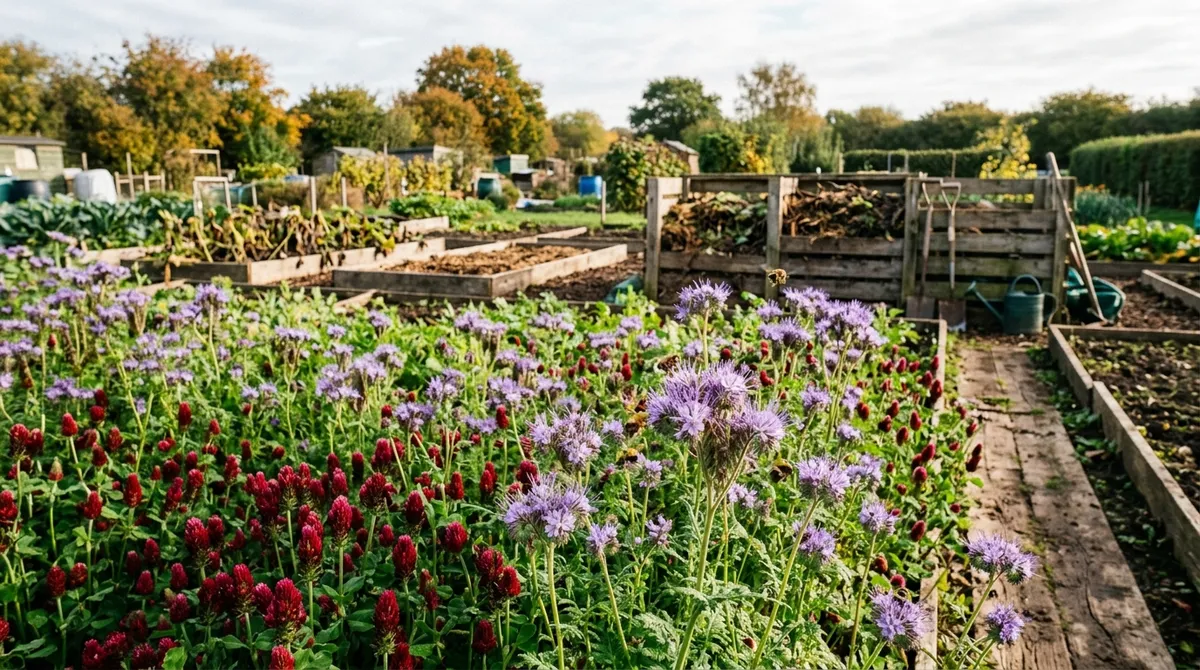
Green manures are among the most underused tools in UK vegetable growing. These fast-growing cover crops protect bare soil, suppress weeds, prevent nutrient loss, and some pump free nitrogen into the ground through their roots. Yet most allotment holders and vegetable growers leave their beds empty over winter, watching fertility wash away with every downpour.
I have grown green manures on my Staffordshire allotment for over a decade. Each October, any bed that is not carrying a winter crop gets a sowing of field beans or winter tares. The difference in soil condition by spring is visible and measurable. This guide covers eight species that work in UK conditions, with specific sowing dates, nitrogen fixation data, and practical advice for both diggers and no-dig growers.
What are green manures and why grow them?
Green manures are crops grown specifically to benefit the soil, not to harvest and eat. You sow them on empty beds, let them grow for weeks or months, then cut and incorporate them before planting your next vegetable crop. They are sometimes called cover crops, though the terms have slightly different origins.
The benefits are well documented by Garden Organic and backed by decades of allotment practice:
- Nitrogen fixation: Legume green manures (field beans, clovers, vetches) host bacteria in their root nodules that convert atmospheric nitrogen into plant-available forms. This adds 50-200kg of nitrogen per hectare, depending on the species and growing period.
- Weed suppression: Dense green manure growth shades out annual weeds. A thick stand of phacelia or mustard leaves no light for weed seedlings to germinate.
- Nutrient retention: Bare soil loses nitrogen, potassium, and other nutrients to leaching during autumn and winter rain. Green manure roots capture these nutrients and hold them in living plant tissue until you are ready to release them.
- Soil structure: Roots open channels in compacted ground. When they decompose, they leave behind organic matter that improves drainage, aeration, and water-holding capacity. This is particularly valuable on heavy clay soil.
The eight best green manures for UK gardens
Choosing the right species depends on your soil type, the time of year, and what you want the green manure to achieve. Some fix nitrogen. Some grow fast to fill short gaps. Some stand through hard frost. Here are the eight species I have tested and recommend.
Field beans (Vicia faba)
Field beans are the workhorse of winter green manures in the UK. Sow from October to November and they stand through temperatures down to -10C. Their deep tap roots break up heavy clay and fix 100-150kg of nitrogen per hectare over a winter growing season. Cut and incorporate in March or April, at least two weeks before planting. Field beans are closely related to broad beans but produce smaller seeds at a fraction of the cost.
Crimson clover (Trifolium incarnatum)
Sow crimson clover from April to August. It fixes 80-150kg of nitrogen per hectare and produces striking red flower spikes that are magnets for bumblebees. It grows to about 30cm and tolerates most soil types except waterlogged ground. Cut before seed sets in late summer. Crimson clover is an annual, so it dies after flowering and will not become a permanent resident of your beds.
Phacelia (Phacelia tanacetifolia)
Phacelia is the fastest-establishing summer green manure. Sow from March to September and expect dense coverage in 6-8 weeks. It does not fix nitrogen, but its dense root system captures existing soil nutrients and prevents leaching. The purple-blue flowers are among the best nectar sources for honeybees and hoverflies. Phacelia is killed by the first hard frost, making it easy to manage as a late-summer sowing that dies off naturally over winter.
White mustard (Sinapis alba)
Mustard grows faster than any other green manure. Sow from March to September and you will have a dense stand in 4-6 weeks. It is a brassica, so never sow it before or after cabbages, broccoli, or other brassica crops as it can harbour clubroot. If you are following a crop rotation plan, slot mustard into the same group as your brassicas. Mustard adds bulk organic matter but does not fix nitrogen.
Winter tares (Vicia sativa)
Winter tares (also called common vetch) are a legume green manure sown from September to November. They fix 60-120kg of nitrogen per hectare and produce scrambling, vine-like growth that covers the soil thickly. They tolerate most soil types and withstand frost down to about -12C. Cut and dig in or chop-and-drop from March onward. Winter tares are often mixed with grazing rye to provide both nitrogen fixation and soil structure benefits.
-->Grazing rye (Secale cereale)
Grazing rye is the toughest winter green manure. Sow from September to November and it will grow through the coldest UK winters. Its dense fibrous root system binds topsoil, prevents erosion, and dramatically improves soil structure. Grazing rye does not fix nitrogen, but its roots capture and hold soil nutrients that would otherwise leach away. Cut in March or early April and allow two weeks before planting. Note that grazing rye can be difficult to incorporate on heavy ground because the root mass is so dense.
Hungarian grazing rye
Hungarian grazing rye is a variety of grazing rye selected for faster autumn establishment and earlier spring growth. It behaves identically to standard grazing rye but tends to produce more top growth before winter sets in, giving better soil coverage from October through December. Sow at the same rate and timing as standard grazing rye. It is increasingly available from UK organic seed suppliers.
Buckwheat (Fagopyrum esculentum)
Buckwheat is a summer green manure sown from April to August. It grows rapidly to 60-90cm and flowers within 4-6 weeks. The white flowers are exceptional for pollinators, particularly hoverflies and short-tongued bees. Buckwheat is killed by frost, so it is strictly a summer crop. It thrives on poor, sandy, or acidic soils where other green manures struggle. It does not fix nitrogen but accumulates phosphorus, making it useful before crops with high phosphorus demands.
Green manure comparison table
This table compares all eight species by season, nitrogen fixation, speed, and soil preference. Use it to choose the right green manure for your situation.
| Species | Sowing window | N-fixing? | N added (kg/ha) | Growth speed | Best soil type | Winter hardy? |
|---|---|---|---|---|---|---|
| Field beans | Oct-Nov | Yes | 100-150 | Moderate | Clay, loam | Yes (-10C) |
| Crimson clover | Apr-Aug | Yes | 80-150 | Moderate | Most except wet | No |
| Phacelia | Mar-Sep | No | 0 | Fast (6-8 wks) | Any well-drained | No (frost kills) |
| White mustard | Mar-Sep | No | 0 | Very fast (4-6 wks) | Any | No |
| Winter tares | Sep-Nov | Yes | 60-120 | Moderate | Most types | Yes (-12C) |
| Grazing rye | Sep-Nov | No | 0 | Moderate | Clay, loam | Yes (very hardy) |
| Hungarian grazing rye | Sep-Nov | No | 0 | Fast autumn start | Clay, loam | Yes (very hardy) |
| Buckwheat | Apr-Aug | No | 0 | Very fast (4-6 wks) | Poor, sandy, acid | No (frost kills) |
When to sow green manures in the UK
Timing is everything with green manures. Sow too late in autumn and winter types will not establish before cold weather stops growth. Sow too early in spring and you waste growing weeks when the bed could be producing food.
Autumn and winter sowing (September to November)
This is the most important window. As you clear summer crops, sow winter green manures immediately. Field beans and winter tares go in from late September through October. Grazing rye can go in as late as mid-November because it germinates at lower temperatures than most crops.
The aim is dense soil coverage before the worst of winter rain arrives. Bare soil loses an estimated 30-60kg of nitrogen per hectare through winter leaching. A green manure crop captures that nitrogen in its roots and foliage, holding it until spring.
Spring and summer sowing (March to August)
Use summer green manures to fill gaps between crops. If you clear an early potato bed in June, sow phacelia or buckwheat immediately. It will establish in 6-8 weeks and can be cut before autumn planting. Mustard fills even shorter gaps, reaching usable bulk in just 4-6 weeks.
If a bed is not needed until autumn, sow crimson clover in April or May. It will grow through summer, fix nitrogen, and provide weeks of pollinator-friendly flowers before you cut it in late August.
-->How to sow green manure seeds
Green manure sowing is simpler than most vegetable sowing. You are growing for soil cover, not a tidy harvest, so precision is not needed.
- Clear crop debris and any large weeds from the bed
- Rake the surface to create a rough tilth (no need for a fine seed bed)
- Scatter seed evenly across the surface at the recommended rate
- Rake lightly to cover the seeds, or simply tread them in on heavy soil
- Water if the soil is dry, though autumn rain usually handles this
Sowing rates vary by species. As a general guide: field beans at 20-30 seeds per square metre, small-seeded species like phacelia and mustard at 1-2g per square metre, and clover at 2-3g per square metre. Most seed suppliers print the recommended rate on the packet.
Buying seed in bulk saves money. A 1kg bag of field beans costs around £3-5 and covers 15-20 square metres. Specialist organic suppliers like Garden Organic and the Organic Gardening Catalogue sell green manure seed by weight.
How to incorporate green manures
The method you use to deal with the green manure before planting depends on whether you dig or follow a no-dig approach. Both methods work. The timing matters more than the technique.
Traditional digging method
Cut the green manure at ground level when it reaches 15-30cm tall (or before it sets seed, whichever comes first). Chop the stems into short lengths with shears or a sharp spade. Dig the chopped material into the top 15cm of soil using a spade or fork. Wait at least 2-4 weeks before sowing or planting to allow the material to decompose.
The waiting period is important. Freshly incorporated green matter temporarily locks up soil nitrogen as microorganisms break it down. Planting too soon after incorporation starves young seedlings of nitrogen. For more on soil health and feeding, allow the full two weeks minimum.
No-dig chop-and-drop method
No-dig growers cut the green manure at ground level and leave the stems on the surface as a mulch. The roots are left in the soil to decompose naturally. Cover the chopped stems with a layer of compost and plant through it.
This method preserves soil structure, avoids disturbing the fungal networks that no-dig gardening depends on, and still delivers the nitrogen and organic matter benefits. The surface mulch breaks down within a few weeks during the growing season.
For tough-stemmed green manures like grazing rye, some no-dig growers cover the cut stems with cardboard and compost rather than trying to plant through the thick residue. This works particularly well on allotments where beds are large enough to rest for a few weeks.
Green manures in crop rotation
Green manures fit naturally into a crop rotation system. They fill the gaps between one crop group and the next, protecting soil and adding fertility during what would otherwise be unproductive months.
The classic approach is to sow a nitrogen-fixing green manure (field beans, winter tares, or clover) before a bed moves into the brassica group. Brassicas are heavy nitrogen feeders, so the free nitrogen from the legume green manure replaces some or all of the fertiliser you would otherwise need.
Avoid sowing mustard before brassica crops. Mustard is itself a brassica and can harbour clubroot, which persists in soil for years.
A practical rotation might look like this:
| Season | Bed activity |
|---|---|
| Spring-Summer Year 1 | Legumes (peas, beans) |
| Autumn-Winter Year 1 | Grazing rye green manure |
| Spring-Summer Year 2 | Brassicas (cabbage, kale) |
| Autumn-Winter Year 2 | Field beans green manure |
| Spring-Summer Year 3 | Roots (carrots, parsnips) |
| Autumn-Winter Year 3 | Winter tares green manure |
| Spring-Summer Year 4 | Alliums (onions, garlic) |
If you are planning your vegetable garden for the first time, building green manures into the rotation from the start saves money on fertiliser and builds soil health faster.
Green manures for problem soils
Different green manures solve different soil problems. Matching the right species to your soil type gives the best results.
Heavy clay
Field beans are the top choice for clay. Their strong tap roots punch through compacted layers, creating drainage channels that persist even after the roots decompose. Follow field beans with grazing rye, whose dense fibrous roots bind the clay topsoil and prevent it collapsing back into dense plates. Together, these two species improve clay structure faster than organic matter alone.
If you are working to improve clay soil, green manures are a powerful addition to the strategy of annual organic matter applications.
Sandy and light soils
Sandy soils drain too fast and lose nutrients quickly. Grazing rye and phacelia produce dense root systems that bind loose particles and add organic matter. Winter-sown grazing rye is particularly valuable because it prevents the nutrient leaching that sandy soils are prone to during winter rain.
Buckwheat thrives on poor sandy ground where other species struggle. It accumulates phosphorus from deep in the soil profile and releases it as the plant material decomposes near the surface.
Acidic soils
Buckwheat tolerates acidic conditions (pH 5.0-6.0) better than most green manures. Crimson clover also copes with mild acidity. Avoid field beans on very acid soils as the Rhizobium bacteria that fix nitrogen in their root nodules are less active below pH 6.0. Testing your soil pH before choosing a green manure ensures you pick a species that will perform well.
Common mistakes to avoid
Green manures are forgiving, but a few errors can reduce their effectiveness or create problems for the following crop.
- Letting green manures set seed. Cut before flowering finishes or you will have volunteer seedlings appearing for years. Phacelia and mustard self-seed aggressively if left too long.
- Planting too soon after incorporation. The two-week minimum is not optional. Decomposing green matter locks up nitrogen and can inhibit germination. Wait, even if it means delaying planting by a few days.
- Sowing mustard before brassicas. Both are in the same plant family. Mustard can carry clubroot spores that infect the next brassica crop.
- Ignoring winter-hardy varieties. Sowing a frost-tender species like phacelia in October is a waste of seed. It will die in the first hard frost and leave the soil exposed for the rest of winter.
- Sowing too thinly. Green manures need dense coverage to suppress weeds effectively. Sow at the recommended rate or slightly above. Thin, patchy growth lets weeds establish in the gaps.
Mixing green manure species
Sowing two or more species together can give better results than a single species. The classic UK mix is winter tares with grazing rye. The tares fix nitrogen while the rye provides structural root mass and prevents the tares from sprawling along the ground.
Other effective mixes include:
- Field beans + grazing rye: nitrogen fixation plus soil structure improvement on clay
- Phacelia + buckwheat: pollinator-rich summer cover for sandy soils
- Crimson clover + phacelia: nitrogen fixation plus fast ground cover in spring and summer
Mix seed in a bucket before sowing. The different growth habits complement each other and create a more diverse root zone in the soil.
Where to buy green manure seed in the UK
Most garden centres stock a limited range of green manure seed, usually phacelia and mustard. For the full range of species, buy from specialist suppliers.
- The Organic Gardening Catalogue carries the widest range of certified organic green manure seed in the UK
- Kings Seeds sells individual species and pre-mixed blends
- Tamar Organics and Real Seeds stock heritage and open-pollinated varieties
- Agricultural merchants sell field beans and grazing rye in bulk at lower prices per kilo
For growing your own vegetables economically, buying green manure seed in bulk is one of the best investments you can make. A few pounds of seed replaces bags of fertiliser and improves soil year after year.
Consider saving your own seed too. Let a small patch of phacelia or crimson clover flower and set seed, then collect and dry the seed heads for next year. This is particularly satisfying and reduces costs to almost nothing. Stored seed stays viable for 2-3 years in a cool, dry place. Adding leaf mould alongside green manures gives your soil the widest possible range of organic inputs.
Frequently asked questions
When should I sow green manures in the UK?
Sowing depends on the species you choose. Winter green manures (field beans, grazing rye, winter tares) go in from September to November. Summer types (phacelia, buckwheat, mustard) sow from March to August. The key is to get seed in the ground as soon as you clear a crop, so bare soil is never left exposed to rain and wind.
Do green manures really add nitrogen to the soil?
Only legume green manures fix atmospheric nitrogen. Field beans, crimson clover, and winter tares host Rhizobium bacteria in their root nodules that convert nitrogen gas into plant-available forms. Non-legume green manures like grazing rye and phacelia do not fix nitrogen, but they do prevent existing soil nitrogen from leaching away over winter.
How do I dig in green manures?
Cut the growth at ground level 2-4 weeks before you need the bed. Chop the stems into short lengths and either dig them into the top 15cm of soil or leave them on the surface as mulch for no-dig beds. Allow at least two weeks for the material to break down before sowing or planting, as decomposing green matter temporarily locks up nitrogen.
Can I use green manures in raised beds?
Green manures work well in raised beds. Scatter seed densely across the surface after clearing summer crops and rake in lightly. Winter tares and phacelia are particularly good choices for small beds because they produce dense, low growth that is easy to cut and remove in spring.
Which green manure is best for clay soil?
Field beans are the best choice for heavy clay. Their deep tap roots penetrate compacted layers and open up drainage channels. When the roots decompose, they leave behind organic matter that improves clay structure. Grazing rye also works well on clay because its dense fibrous roots bind the topsoil and prevent winter waterlogging.
Do I need to buy inoculant for green manure seeds?
Inoculant is not essential in most UK soils. The Rhizobium bacteria that form root nodules on legumes are naturally present in British garden soil, especially if you have grown peas or beans before. If you are sowing on brand-new ground that has never grown legumes, inoculant can speed up nodule formation in the first year.
Can I leave green manures to flower for pollinators?
Phacelia and crimson clover produce outstanding flowers for bees and hoverflies. Letting them flower before cutting adds pollinator value to your plot. Just cut before seed sets to prevent self-seeding. Buckwheat flowers within 4-6 weeks of sowing and is one of the best bee plants you can grow on an allotment.
Lawrie has been gardening in the West Midlands for over 30 years. He grows his own veg using no-dig methods, keeps a wildlife-friendly garden, and writes practical advice based on real UK growing conditions.