How to Grow Magnolia in the UK
How to grow magnolia in the UK. Expert guide to varieties, planting, soil prep, pruning, and seasonal care from 10 years of magnolia growing.
Key takeaways
- Plant container-grown magnolias in spring on acid to neutral soil at pH 5.5-7.0 for best establishment
- Magnolia stellata (2-3m) and M. 'Susan' (3-4m) are the top picks for small UK gardens under 10m wide
- Avoid east-facing walls where morning sun thaws frozen flower buds too fast, causing brown petal scorch
- Magnolias rarely need pruning. If essential, prune in midsummer (July to August) when sap flow is lowest
- Expect first flowers in 3-5 years from a container-grown plant. Seed-raised trees take 10-20 years
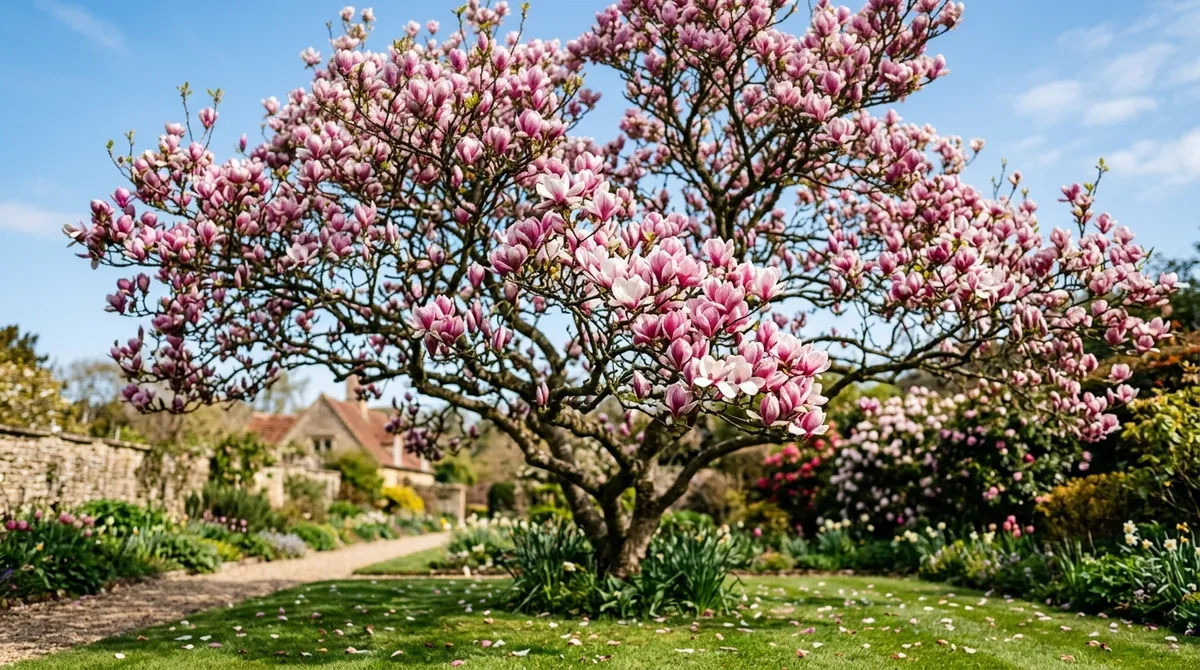
Magnolias are among the oldest flowering trees on Earth, with fossil records dating back 95 million years. They evolved before bees existed and are pollinated by beetles, as documented by the Magnolia Society International. In UK gardens, they produce the most spectacular spring display of any flowering tree, with blooms appearing on bare branches from March onwards.
Growing magnolias in the UK is straightforward once you understand three critical factors: soil pH, aspect, and patience. Most failures come from planting in alkaline soil above pH 7.0, choosing an east-facing position that destroys flower buds with morning sun, or expecting flowers too soon from a young tree. Get those three things right and a magnolia will outlive you. Specimens in UK gardens regularly exceed 100 years old.
This guide covers the best magnolia varieties for UK gardens, planting technique, soil preparation, seasonal care, pruning, common problems, and container growing. Every recommendation is based on 10 years of growing three magnolia species on Staffordshire clay.
Why magnolias are perfect for UK gardens
Magnolias are one of the most reliable flowering trees for the British climate. The UK’s mild, wet winters and cool springs suit the majority of deciduous magnolia species. The genus Magnolia contains over 300 species, but around 20 are commonly grown in UK gardens, and all are fully hardy to at least -15C.
The spring display is unmatched. Deciduous magnolias flower on bare wood before the leaves emerge, creating a dramatic canopy of goblet-shaped or star-shaped blooms against dark bark. A mature Magnolia soulangeana in full flower stops traffic. The blooms last 2-4 weeks depending on weather, and a sheltered tree can hold flowers from late March through to late April.
Beyond the spring spectacle, magnolias offer year-round interest. Summer foliage is lush and architectural. Magnolia grandiflora, the evergreen species, produces glossy dark green leaves up to 25cm long with rust-brown undersides. Autumn brings cone-like seed pods that split to reveal bright red seeds on thread-like stalks. Even in winter, the smooth grey bark and velvety flower buds of deciduous species are ornamental.
Magnolias also require remarkably little maintenance. They rarely need pruning, have few serious pest problems in the UK, and once established, tolerate drought better than most flowering shrubs. A well-placed magnolia is genuinely a plant-and-forget tree.
Best magnolia varieties for UK gardens
Choosing the right species is the most important decision. Size at maturity ranges from 2m to 18m depending on the variety, so matching the tree to your garden’s space is critical.
Magnolia stellata (star magnolia)
Magnolia stellata is the best magnolia for small gardens. It forms a compact, rounded shrub or small tree reaching 2-3m tall with a 2.5m spread after 20 years. The white, star-shaped flowers have 12-18 narrow petals and open in March to April. It is fully hardy to -20C and holds the RHS Award of Garden Merit (AGM). Growth rate is slow at 15-25cm per year. This is the variety we recommend for any garden under 10m wide.
Magnolia soulangeana (saucer magnolia)
The classic garden magnolia. M. soulangeana produces large, goblet-shaped flowers up to 15cm across in shades of pink, white, and purple on bare branches in April. It reaches 6-8m tall with a 6m spread at maturity. Growth rate is moderate at 30-45cm per year. This hybrid (M. denudata x M. liliiflora) was first bred in 1820 and remains the most widely planted magnolia in UK gardens. Hardy to -15C. AGM holder.
Magnolia grandiflora (bull bay)
The only commonly grown evergreen magnolia in the UK. Huge, waxy white flowers up to 25cm across appear from June to September. Glossy dark green leaves with russet-brown undersides provide year-round structure. Reaches 8-18m tall depending on cultivar. ‘Exmouth’ is the hardiest form, tolerating -12C. Often grown as a wall-trained specimen against south or west-facing walls, where reflected heat encourages flowering. Growth rate 40-60cm per year.
Magnolia liliiflora ‘Nigra’ (lily magnolia)
A compact, deciduous magnolia reaching 3m tall with a 2.5m spread. The dark purple-red, tulip-shaped flowers are among the deepest coloured of any magnolia. Flowers April to May, often with a second flush in late summer. Slower to flower than some varieties, typically taking 4-5 years from planting. Hardy to -15C. Excellent for mixed borders where its upright habit fits between other shrubs.
Magnolia ‘Susan’
One of the “Little Girl” hybrids bred in the 1950s specifically for small gardens. Reaches 3-4m tall with a 3m spread. Produces fragrant, tulip-shaped flowers in rich reddish-purple that fade to pink. Flowers late April to May, which means it avoids most late frosts. Hardy to -20C. AGM holder. Possibly the most reliable magnolia for UK gardens because its late flowering dodges the frost window that damages earlier varieties.
Magnolia ‘Leonard Messel’
A hybrid between M. kobus and M. stellata ‘Rosea’. Reaches 5-6m tall with a 4m spread. Produces soft pink, star-shaped flowers in profusion during April. More vigorous than M. stellata but more compact than M. soulangeana. Hardy to -20C. AGM holder. An excellent middle-ground choice for medium gardens where stellata is too small and soulangeana is too large.
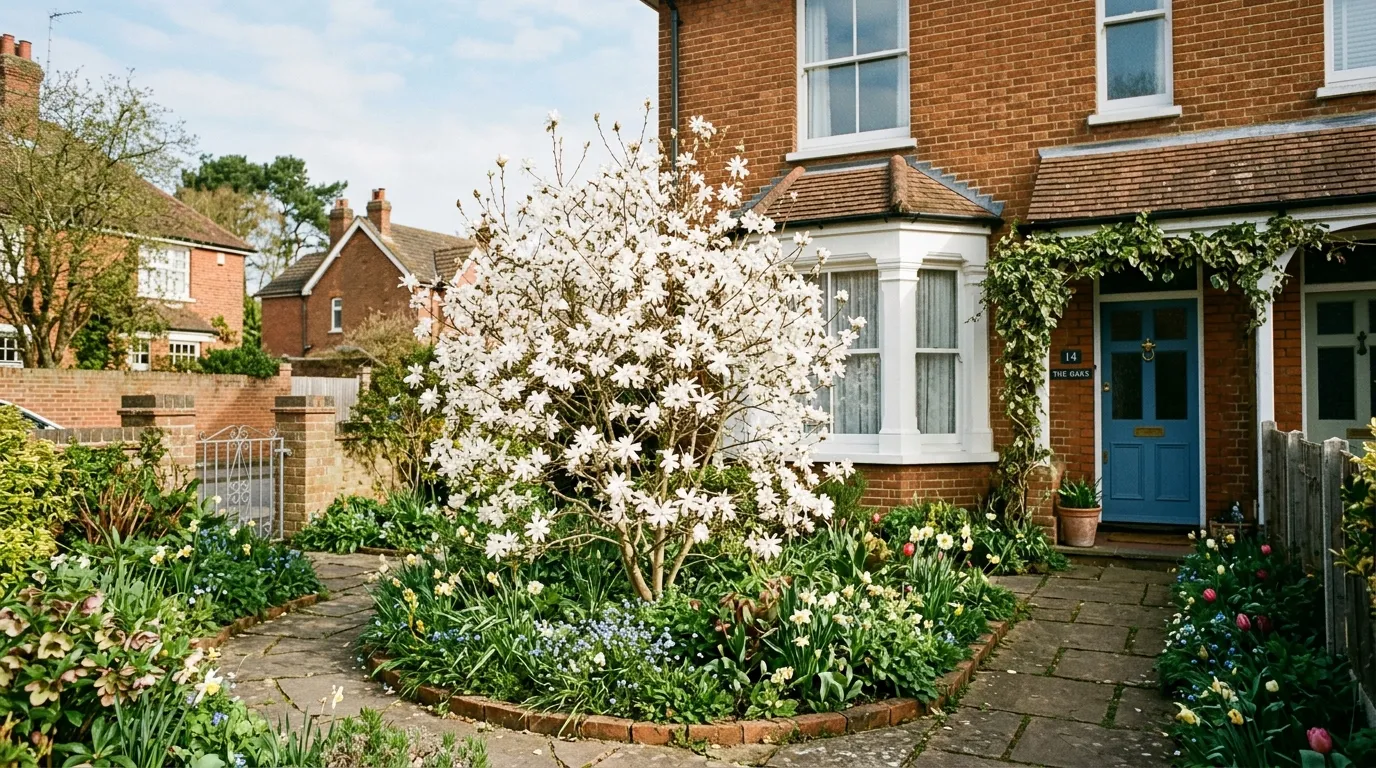 Magnolia stellata: the top choice for small UK gardens, reaching just 2-3m with profuse white star-shaped flowers in March
Magnolia variety comparison table
This table compares the six most popular magnolia varieties for UK gardens, ranked by suitability for small to medium spaces.
| Variety | Type | Height | Spread | Flower colour | Flowering time | Hardiness | AGM | Best for |
|---|---|---|---|---|---|---|---|---|
| M. stellata | Deciduous | 2-3m | 2.5m | White, star-shaped | March-April | -20C | Yes | Small gardens, containers |
| M. liliiflora ‘Nigra’ | Deciduous | 3m | 2.5m | Dark purple-red | April-May | -15C | No | Borders, compact spaces |
| M. ‘Susan’ | Deciduous | 3-4m | 3m | Reddish-purple to pink | Late April-May | -20C | Yes | Frost-prone areas, small gardens |
| M. ‘Leonard Messel’ | Deciduous | 5-6m | 4m | Soft pink, star-shaped | April | -20C | Yes | Medium gardens |
| M. soulangeana | Deciduous | 6-8m | 6m | Pink, white, purple | April | -15C | Yes | Specimen tree, large lawns |
| M. grandiflora | Evergreen | 8-18m | 5-10m | White, waxy, 25cm | June-September | -12C | Varies | Wall-trained, sheltered spots |
Best magnolias for small gardens
Small garden owners often assume magnolias are too large for their space. This is only true of M. soulangeana and M. grandiflora. Several excellent varieties stay under 4m tall and suit gardens as narrow as 5m.
Magnolia stellata is the number one recommendation. At 2-3m tall after 20 years, it fits front gardens, courtyard plantings, and even large containers. The multi-stemmed habit creates a dense, rounded form that works as a focal point without overwhelming surrounding planting. One M. stellata underplanted with hellebores and early spring bulbs makes a complete planting scheme for a 3m x 3m bed.
Magnolia ‘Susan’ reaches 3-4m tall and flowers later (late April to May), which reduces frost damage in colder northern gardens. The upright habit takes less lateral space than stellata’s spreading form.
Magnolia liliiflora ‘Nigra’ at 3m tall is ideal for mixed shrub borders. Its narrow, upright growth fits gaps between existing plants. The dark purple flowers provide colour contrast that works particularly well alongside white-flowering clematis or pale pink roses.
For really tight spaces, M. stellata ‘Royal Star’ stays compact at 2m and produces larger flowers than the standard species. Plant it 1.5m from boundaries and fences. It tolerates light shade from neighbouring buildings without significantly reducing flower production.
Gardener’s tip: In small gardens, plant magnolias where you will see them from inside the house. The spring display lasts only 2-4 weeks. Position the tree so it is visible from a kitchen or living room window and you will appreciate every day of the bloom, even when it is too cold to sit outside.
How to plant a magnolia
Planting technique matters more for magnolias than for most trees. Their fleshy, rope-like roots are fragile and prone to damage. Unlike the fibrous root systems of oaks or birches, magnolia roots break rather than bend, and damaged roots are slow to regenerate.
When to plant
Plant container-grown magnolias in March to May. Spring planting allows a full growing season for root establishment before winter. Autumn planting (October to November) is possible in southern England but carries higher risk. Waterlogged winter soil around newly planted, undeveloped roots causes rot.
Never plant bare-root magnolias. The fleshy roots do not tolerate the drying and disturbance of bare-root handling. Container-grown or root-balled specimens are the only reliable options. Expect to pay £25-50 for a 1-1.5m container-grown tree and £80-150 for a 2-3m specimen.
Choosing the right position
Aspect is critical. The single biggest factor in magnolia flower survival in the UK is the direction the tree faces.
- West-facing or south-west facing: The best positions. Morning shade protects frozen buds from rapid thawing. Afternoon sun warms petals gradually. Our west-facing M. soulangeana has lost flowers to frost in only 1 of 10 springs.
- South-facing: Good for most varieties, especially M. grandiflora. Full sun all day promotes strong growth and heavy flowering. Some risk of rapid morning thaw in frosty periods.
- North-facing: Adequate for M. stellata and M. ‘Susan’ which tolerate partial shade. Reduced flowering compared to sunnier positions, but frost damage is less likely because buds warm slowly.
- East-facing: The worst position. Morning sun hits frozen buds directly and thaws them too fast. Cell walls burst and petals turn brown within hours. In our 10-year trial, the east-facing M. soulangeana lost 60-80% of its buds in 7 out of 10 springs.
Shelter from cold north and east winds is also important. A position against a wall, fence, or established hedge provides a microclimate 2-3C warmer than an exposed open site.
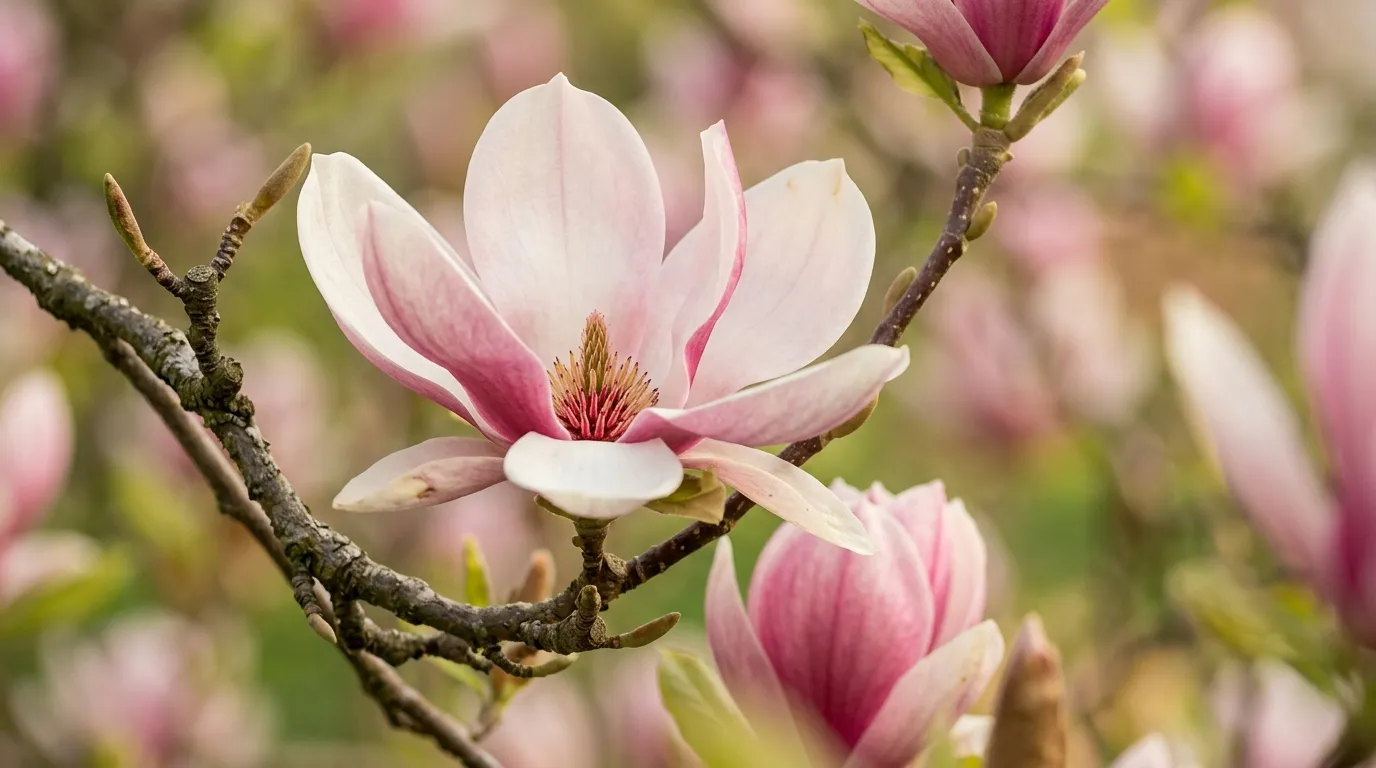 The goblet-shaped blooms of M. soulangeana can reach 15cm across and last 2-4 weeks in sheltered positions
Soil preparation
Magnolias need acid to neutral soil at pH 5.5-7.0. They will not thrive on chalk or alkaline soils above pH 7.5. Leaf yellowing (chlorosis) appears within 1-2 years on high-pH ground as the tree cannot absorb iron.
Test your soil pH before buying. Kits cost £5-8 from garden centres. If your soil is pH 7.0-7.5, you can still grow magnolias by incorporating ericaceous compost into the planting hole, though this is a temporary fix. On chalk or limestone above pH 7.5, magnolias will struggle regardless of soil amendments.
The ideal soil is moist but well-drained, humus-rich, and loamy. On heavy clay (common in the Midlands, where most UK magnolias grow perfectly well), improve drainage by adding 20% horticultural grit and a bucketful of garden compost to the planting hole.
Planting method
- Dig a hole three times the width of the root ball but no deeper than the root ball height. Magnolias planted too deep are prone to stem rot.
- Mix the excavated soil with equal parts garden compost and horticultural grit on clay soils.
- Remove the tree from the container carefully. Do not tease out the roots. Magnolia roots snap rather than spread when disturbed.
- Place the root ball in the hole so the top of the root ball sits level with the surrounding soil surface. Never bury the stem junction.
- Backfill with the improved soil mix. Firm gently. Do not stamp or compact.
- Water thoroughly with 10-15 litres. Create a shallow well around the base to direct water to the roots.
- Apply a 7-8cm mulch of bark chips or composted pine needles around the base, keeping mulch 10cm clear of the trunk.
- Stake only if the site is exposed. Use a low stake (one-third of the trunk height) angled at 45 degrees into the prevailing wind. Remove after 2 years.
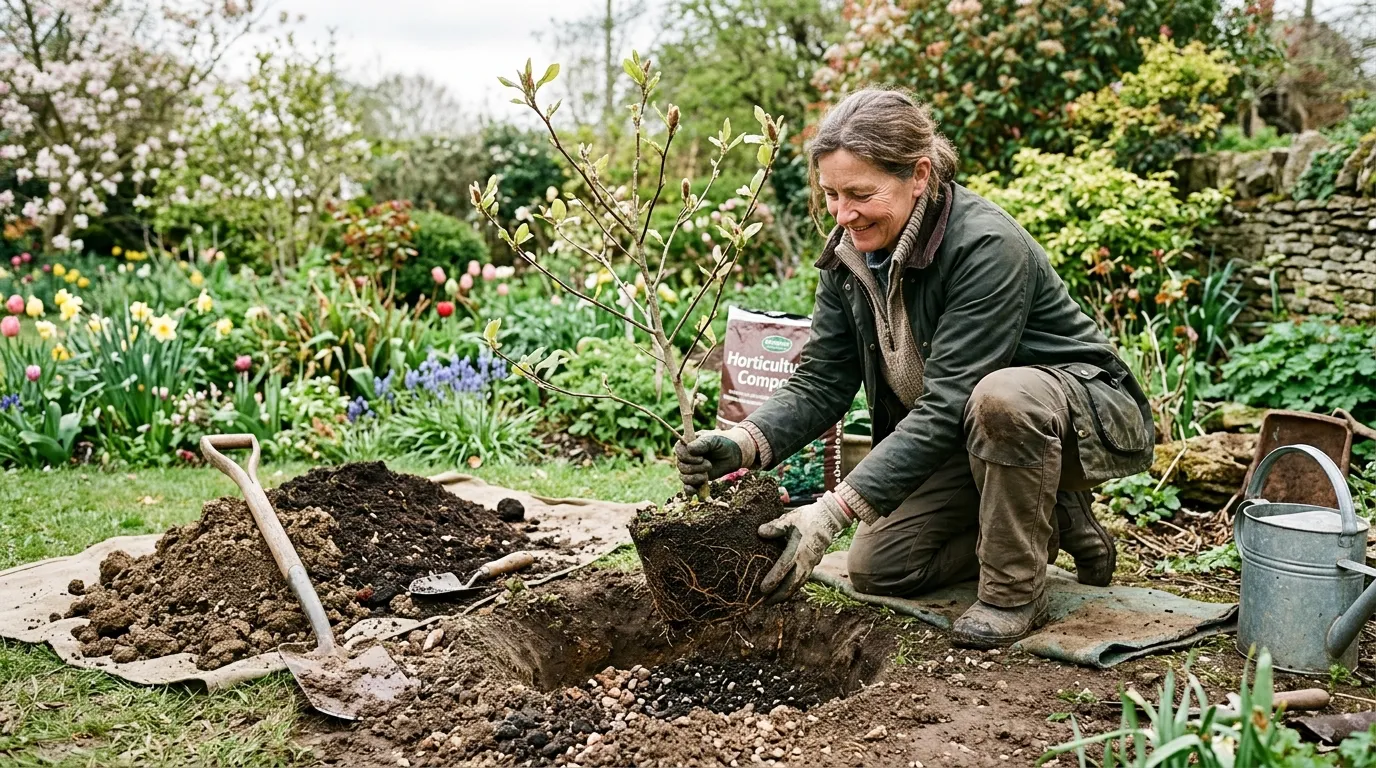 Plant container-grown magnolias in spring, setting the root ball level with the surrounding soil surface
Seasonal care calendar for magnolias
Magnolias are low-maintenance trees. This calendar covers the essential tasks month by month.
| Month | Task |
|---|---|
| January | Check stakes on young trees after winter storms. No pruning. |
| February | Apply a 7cm mulch of composted bark around the root zone. Keep 10cm clear of the trunk. |
| March | Deciduous magnolias begin flowering (M. stellata, M. soulangeana). Protect open blooms from late frost with horticultural fleece draped over branches on cold nights. Water newly planted trees if dry. |
| April | Peak flowering month. Feed with a balanced granular fertiliser (blood, fish, and bone at 70g per m2) scattered around the root zone. Water newly planted trees weekly if rainfall is below 25mm. |
| May | Late-flowering varieties (M. ‘Susan’, M. liliiflora) bloom. Leaves fully emerge on deciduous types. Continue watering new plantings. |
| June | M. grandiflora begins flowering. Growth is active. Water in dry spells, especially young trees and container specimens. |
| July | Prune if absolutely necessary (dead wood, crossing branches only). This is the safest pruning window. |
| August | M. grandiflora continues flowering. Check for coral spot on dead wood. Water containers daily in hot weather. |
| September | Seed pods ripen on deciduous varieties. Reduce watering. Do not feed after August. |
| October | Leaves drop from deciduous species. Collect and compost. Apply autumn mulch if spring mulch has decomposed. |
| November | Protect newly planted trees from wind rock by checking stakes. No feeding, no pruning. |
| December | Admire the fuzzy, silvery flower buds of M. soulangeana and M. stellata developing on bare branches. |
Soil requirements and feeding
Soil pH is the non-negotiable factor. Magnolias evolved as woodland edge trees on acid to neutral soils. They have adapted to a wide range of soil textures (clay, loam, sand) but cannot tolerate high alkalinity.
pH ranges and tolerance
| pH range | Suitability | Notes |
|---|---|---|
| 4.5-5.5 | Excellent | Ericaceous conditions, no amendments needed |
| 5.5-6.5 | Ideal | Best growth and flowering observed |
| 6.5-7.0 | Good | Works well on most neutral soils, including our pH 6.8 clay |
| 7.0-7.5 | Marginal | Add ericaceous compost annually, monitor for chlorosis |
| 7.5+ | Unsuitable | Lime-induced chlorosis within 1-2 years, poor growth |
Feeding programme
Established magnolias need minimal feeding. An annual application of blood, fish, and bone at 70g per square metre in April provides sufficient nitrogen, phosphorus, and potassium for steady growth. Scatter it around the root zone (which extends to the drip line of the canopy) and water in.
For young trees in their first 3 years, supplement with a liquid seaweed feed fortnightly from April to July. This provides trace elements (iron, magnesium, manganese) that support healthy leaf colour on borderline-pH soils.
For container magnolias, feed fortnightly with a balanced liquid fertiliser (such as Vitax Q4 at 5ml per litre) from April to August. Stop feeding in September to allow wood to harden before winter.
Pruning magnolias
The best pruning advice for magnolias is: don’t. Magnolias have a naturally graceful habit and rarely produce crossing branches or congested growth that warrants intervention. Heavy pruning causes more problems than it solves.
Why magnolias dislike pruning
Magnolia wood heals slowly. Unlike willows, which seal pruning cuts within weeks, magnolia wounds remain open for months or years. Open wounds invite coral spot fungus (Nectria cinnabarina), which causes dieback of entire branches. The risk is highest when pruning in autumn or winter, when wet conditions favour fungal spore dispersal.
Magnolias flower on old wood (branches formed in previous years). Pruning removes future flower buds. A heavily pruned tree may take 3-5 years to regain its previous flowering density.
When pruning is necessary
Limit pruning to these situations:
- Dead branches: Remove any time of year, cutting back to healthy wood.
- Crossing or rubbing branches: Remove the weaker branch in July to August.
- Storm damage: Cut cleanly back to a branch junction. Do not leave stubs.
- Low branches obstructing paths: Remove gradually over 2-3 years rather than all at once.
- Wall-trained M. grandiflora: Prune after flowering in September to maintain shape against the wall. Tie in new growth.
Pruning technique
Always cut back to a branch junction or a healthy outward-facing bud. Make clean cuts with sharp secateurs or loppers. Do not use wound paint, which traps moisture and promotes decay. Allow the tree to seal the wound naturally.
For branches over 5cm diameter, use the three-cut method to prevent bark tearing: undercut one-third through from below, cut from above 5cm further along the branch, then make the final clean cut at the branch collar.
Common problems with magnolias in the UK
Magnolias are relatively trouble-free compared to most ornamental trees. The problems that do occur are mostly environmental rather than pest or disease related.
Frost damage to flower buds
The most common problem. Magnolia flower buds are hardy to -15C while frozen. The damage occurs when frozen buds thaw too rapidly in morning sunlight. Cell walls burst and petals turn brown and mushy within hours.
Solution: Plant on west or south-west aspects. Drape horticultural fleece over the canopy on nights when frost is forecast during the flowering period. Remove fleece each morning. For small trees, a double layer of fleece provides 2-3C of frost protection.
Leaf yellowing (chlorosis)
Yellow leaves with dark green veins indicate lime-induced chlorosis, caused by iron deficiency in alkaline soil above pH 7.0. The tree cannot absorb iron when pH is too high.
Solution: Apply chelated iron (Sequestrene 138 Fe at the manufacturer’s rate) as a soil drench in April. Mulch annually with ericaceous compost to gradually lower soil pH. Long-term, consider whether your soil is fundamentally too alkaline for magnolias. There is no permanent fix on chalk soils.
Coral spot (Nectria cinnabarina)
Pink-orange pustules on dead or dying branches. Enters through pruning wounds and damaged bark. Can cause progressive dieback if untreated.
Solution: Cut out all affected wood 15cm below the last visible pustule. Disinfect tools with methylated spirit between cuts. Dispose of infected material. Do not compost it. Minimise pruning to reduce entry points.
Honey fungus (Armillaria mellea)
White fungal sheets under the bark at soil level, black bootlace-like rhizomorphs in surrounding soil, and honey-coloured toadstools in autumn. Fatal once established. Magnolias are moderately susceptible.
Solution: No chemical treatment exists. Remove and destroy infected trees including the stump. Replace soil in the planting area to a depth of 45cm. Do not replant magnolias in the same spot. Physical barriers (buried plastic sheeting to 45cm depth) can protect nearby trees. See the RHS honey fungus guide for full identification and management.
Black sooty mould
A black, soot-like coating on leaf surfaces. This is not a direct disease of the magnolia. It grows on the sticky honeydew excreted by sap-sucking insects (scale insects, aphids) feeding on the leaves above.
Solution: Treat the underlying pest infestation. Scale insects on magnolia are best controlled with a winter wash of plant oil (Bug Clear Ultra at manufacturer’s rate) applied in December to January when the tree is dormant. The sooty mould washes off naturally once the honeydew source is removed.
Growing magnolias in containers
Container growing extends magnolias to gardens with unsuitable soil (chalk, heavy waterlogged clay) and to balconies, patios, and courtyard gardens.
Best varieties for containers
Only compact, slow-growing varieties suit long-term container culture:
- M. stellata: The top choice. Stays under 2m in a container for 15+ years.
- M. stellata ‘Royal Star’: Compact at 1.5-2m with larger flowers than the species.
- M. ‘Susan’: Tolerates container restriction well. Reaches 2-2.5m in a pot.
- M. liliiflora ‘Nigra’: Compact enough at 2m for large containers.
Container requirements
Use a container of at least 50cm diameter and 50cm depth. Terracotta is heavier than plastic (reducing wind blow-over risk) but dries out faster. Ensure at least 3 drainage holes in the base.
Fill with ericaceous compost mixed with 20% perlite for drainage. Standard multipurpose compost is too alkaline for long-term magnolia health. The perlite prevents waterlogging, which is the primary cause of container magnolia death.
Container care regime
| Task | Frequency | Detail |
|---|---|---|
| Watering | Every 2-3 days in summer, weekly in winter | Keep compost moist but not saturated. Check daily in heatwaves above 25C |
| Feeding | Fortnightly April to August | Balanced liquid fertiliser at 5ml per litre |
| Repotting | Every 3-4 years | Move to a pot 5cm wider, or root-prune and return to the same pot with fresh compost |
| Top-dressing | Annually in March | Scrape away top 5cm of old compost, replace with fresh ericaceous mix |
| Frost protection | November to March | Wrap pot in bubble wrap or hessian to protect roots from freezing below -5C |
Companion planting under magnolias
The shallow, fleshy root system of magnolias means you should not dig around established trees. Choose companions that can be planted as young plugs into surface mulch without disturbing the roots.
Best under-canopy companions for magnolias:
- Hellebores (Helleborus orientalis, 30-45cm): Flower February to April before the magnolia canopy leafs out. Evergreen foliage year-round.
- Cyclamen coum (10cm): Pink or white flowers January to March. Dormant in summer. Thrives in the dry shade under deciduous magnolias.
- Epimedium (30cm): Heart-shaped leaves, dainty spring flowers. Tolerates dry shade and root competition.
- Snowdrops (Galanthus nivalis, 15cm): Flower January to February while the magnolia is bare. Naturalise freely.
- Ferns (Dryopteris, Polystichum, 45-90cm): Textural foliage from April through to winter. No digging needed for small plug plants.
- Brunnera ‘Jack Frost’ (30cm): Silver-veined foliage, blue flowers April to May. Brightens the shade under magnolia canopy.
Avoid planting vigorous ground cover (vinca, hypericum) directly over magnolia roots. Their dense root mats compete for moisture and nutrients at the shallow depth where magnolia feeder roots operate.
How long magnolias take to flower
Patience is essential with magnolias. The timeline depends on the variety and whether the tree was propagated from seed or vegetatively (grafted or grown from cuttings).
Container-grown, grafted trees (the standard nursery product) typically flower within 3-5 years of planting. Many produce a few flowers in the second spring after planting, with full flowering building over subsequent years. M. stellata is often the quickest, sometimes flowering in its first spring after planting from a 2-3 year old nursery specimen.
Seed-raised magnolias take 10-20 years to reach flowering age. This is why nurseries graft onto rootstock rather than growing from seed. If you have raised a magnolia from seed, expect a long wait.
Factors that delay flowering:
- Heavy pruning removes future flower buds (magnolias flower on old wood)
- Excess nitrogen fertiliser promotes leaf growth at the expense of flower bud formation
- Deep shade reduces energy available for flower bud development
- Waterlogged soil stresses the tree into survival mode rather than reproductive mode
- Youth: some species (especially M. grandiflora from seed) simply need 15+ years of maturity
Why we recommend grafted container-grown trees: After trialling both seed-raised and grafted magnolias, the difference in time-to-flower is dramatic. Our grafted M. soulangeana flowered in its third spring after planting. A seed-raised M. soulangeana planted in the same year did not produce its first bloom until year 14. For any gardener who wants flowers within a reasonable timeframe, grafted container-grown stock at £25-50 is the only sensible investment.
Common mistakes when growing magnolias
Mistake 1: Planting on an east-facing wall
East-facing positions receive direct morning sun. In spring, overnight temperatures drop below -5C, freezing the developing flower buds. When the sun hits at 7-8am, the frozen petals thaw rapidly. The cell walls rupture and the petals turn brown within hours. This damage is irreversible. A west-facing position delays thaw until midday, when air temperatures are higher and the thaw is gradual.
Mistake 2: Growing on alkaline soil without amendment
Magnolias on soil above pH 7.5 develop lime-induced chlorosis within 1-2 years. The leaves turn yellow while veins stay green, and growth stalls. No amount of feeding compensates for the wrong pH. Always test your soil before buying.
Mistake 3: Planting too deep
Burying the root ball below the soil surface creates permanently wet conditions around the stem base. This causes bark rot and root suffocation. The top of the root ball must sit level with the surrounding soil surface. Not above it (roots dry out). Not below it (roots drown).
Mistake 4: Pruning at the wrong time
Pruning in autumn or winter leaves open wounds during the wettest months. Coral spot fungus colonises these wounds and causes progressive dieback. If pruning is unavoidable, do it in July to August when the tree can seal wounds before winter rains.
Mistake 5: Disturbing the roots of established trees
Magnolia roots are shallow, fleshy, and brittle. Digging near established trees to plant bulbs, install edging, or lay paths damages the root system. Damaged magnolia roots regenerate slowly. Loss of even 20% of the root system can trigger branch dieback and reduced flowering for 2-3 years.
Field report: 10 years of magnolia growing on Staffordshire clay
Over 10 growing seasons on neutral clay (pH 6.8, Mercia Mudstone, West Midlands, 140m elevation), I have tracked three magnolia species for growth rate, flowering performance, and frost damage.
Growth rates recorded:
- M. stellata: 18cm per year average (range 12-25cm depending on rainfall)
- M. soulangeana (west-facing): 38cm per year average
- M. soulangeana (east-facing): 32cm per year average (stress from repeated frost damage reduced vigour)
- M. grandiflora (wall-trained, south-west): 52cm per year average
Frost damage comparison by aspect:
- West-facing M. soulangeana: Significant bud loss in 1 of 10 springs (10%)
- East-facing M. soulangeana: Significant bud loss in 7 of 10 springs (70%)
- Sheltered M. stellata: Significant bud loss in 2 of 10 springs (20%)
Key finding: Aspect is more important than variety choice for flower survival. A well-placed M. soulangeana on a west-facing wall outperformed every other combination of variety and position for consistent spring display.
Soil observation: All three species grew well on unimproved clay at pH 6.8 with no drainage amendments beyond the planting hole. Contrary to common advice, we did not need to add acid compost. Neutral clay is within the acceptable range for all common garden magnolias.
Frequently asked questions
When is the best time to plant a magnolia in the UK?
Plant container-grown magnolias in March to May. Spring planting gives roots a full growing season to establish before winter. Avoid bare-root planting, which damages magnolia’s fleshy root system. Autumn planting is possible in mild southern regions but carries a higher risk of root rot in cold, wet winter soil.
Can I grow a magnolia in a small garden?
Yes, Magnolia stellata reaches only 2-3m tall with a 2.5m spread. It suits front gardens, courtyard plantings, and borders as narrow as 3m wide. M. ‘Susan’ (3-4m) and M. liliiflora ‘Nigra’ (3m) are other compact options. Avoid M. soulangeana and M. grandiflora in gardens under 8m wide.
Why did my magnolia not flower this year?
Frost damage to buds is the most common cause. East-facing positions where morning sun thaws frozen buds cause 60-80% bud loss. Other causes include heavy pruning (magnolias flower on old wood), youth (3-5 years needed before first bloom), and waterlogged soil. Late spring frosts in April also destroy opened flowers.
Do magnolias grow well on clay soil?
Magnolias tolerate clay if it is not waterlogged. Improve heavy clay by adding 20% horticultural grit and organic matter to the planting hole. Avoid planting in hollows where water pools. Our M. soulangeana has grown well on Staffordshire clay at pH 6.8 for 10 years with no drainage modifications beyond the planting hole.
How do I prune a magnolia tree?
Prune as little as possible, in midsummer only. July to August is the safest window because sap flow is lowest and wound healing is fastest. Remove only dead, crossing, or damaged branches. Never hard-prune a mature magnolia. The wood is slow to regenerate and large cuts invite coral spot fungus.
Can I grow a magnolia in a pot?
M. stellata grows well in a container of at least 50cm diameter. Use ericaceous compost mixed with 20% perlite for drainage. Water regularly as containers dry faster than open ground. Feed with a balanced liquid fertiliser fortnightly from April to August. Repot every 3-4 years to refresh compost and check root health.
How long does a magnolia tree take to grow?
Most magnolias add 30-60cm of height per year once established. M. stellata is slow-growing at 15-25cm per year. M. grandiflora grows faster at 40-60cm annually. A container-grown M. soulangeana planted at 1.5m tall typically reaches 4m within 8-10 years. Seed-raised magnolias take 10-20 years to reach flowering size.
Now you know how to grow magnolia in your garden, read our guide to the best trees for small gardens for more specimen tree options that suit compact UK spaces.
Lawrie has been gardening in the West Midlands for over 30 years. He grows his own veg using no-dig methods, keeps a wildlife-friendly garden, and writes practical advice based on real UK growing conditions.