How to Grow Monstera UK: Full Guide
Grow monstera successfully in a UK home with this expert guide. Light, watering, aerial roots, support structures, propagation, and common problems.
Key takeaways
- Monstera needs bright indirect light of 1,000-2,000 lux — leaves without splits signal insufficient light
- Water when the top 3cm of compost is dry: every 7-10 days in summer, every 14-21 days in winter
- Never cut aerial roots — guide them into a moss pole to anchor the plant and boost leaf size
- Propagate by stem cuttings with at least one node, rooted in water or moist perlite in 4-6 weeks
- Monstera deliciosa, adansonii, and Thai Constellation are the three most available UK varieties
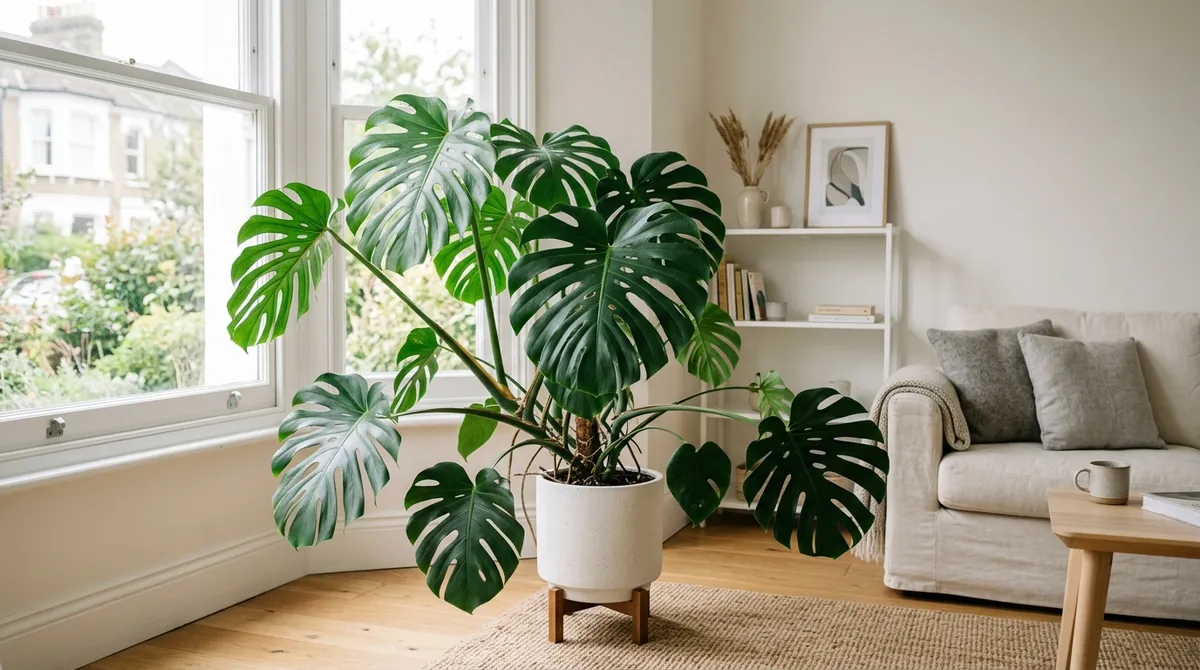
Monstera has overtaken fiddle-leaf fig and rubber plant to become the most searched houseplant in the UK, and for good reason. It is striking, grows fast when conditions are right, and rewards even moderate attention with those iconic split leaves. The challenge is not keeping it alive — monstera is forgiving. The challenge is getting it to thrive: deep splits in large leaves, steady upward growth, and aerial roots gripping a moss pole.
This guide covers everything a UK grower needs. Light levels with real lux figures, the correct watering routine for British homes, how to handle aerial roots, which support structure works best, propagation step-by-step, and a full comparison of the monstera varieties available here.
Monstera deliciosa in peak condition. The deep fenestrations and large leaf size are a direct result of the right light and a well-established moss pole.
Lawrie’s growing note: I spent two years wondering why my monstera never developed splits. Moving the plant from 180 lux to 900 lux near an east-facing window produced fenestrated leaves within one growing cycle. Splits are not a sign of age — they are a direct response to light intensity.
What light does monstera need in a UK home?
Monstera originates from the understory of Central and South American rainforests. It receives bright, filtered light rather than direct sun. In a UK home, that translates to a spot within 1-2 metres of an east- or south-facing window. Measure with a free smartphone lux app: monstera needs 1,000-2,000 lux for active growth and leaf fenestration. Below 500 lux, leaves come out undivided and small. Above 2,500 lux, direct summer sun scorches the leaves.
A position 2 metres from a south-facing window typically reads 800-1,200 lux in summer and 300-600 lux in winter. If you are growing monstera in a UK winter, that is often borderline. Consider moving the plant closer to the glass between October and February. North-facing rooms rarely provide enough light for monstera to produce fenestrated leaves at any time of year.
Signs of insufficient light include: new leaves emerging with no splits, pale green colour, slow growth (fewer than two new leaves per month in summer), and long, leggy stems reaching toward the nearest window.
For a broader overview of houseplant light requirements by room orientation, see our guide to the best indoor plants for UK homes.
How to water monstera correctly
Water monstera when the top 3cm of compost is dry. Push a finger into the compost to check — do not rely on lifting the pot or guessing by colour. In summer, that typically means watering every 7-10 days. In winter, every 14-21 days. UK homes run dry in winter when the central heating is on; the compost may still take 14 days or longer to dry out because growth slows.
When you water, do it thoroughly. Pour slowly until water runs freely from the drainage holes. Empty the saucer after 30 minutes — standing water causes root rot, which is the most common cause of monstera death in UK homes.
The two watering mistakes that kill most UK monsteras are identical to every other tropical houseplant: watering on a fixed schedule regardless of compost moisture, and leaving the pot sitting in a pool of water. Monstera tolerates dry periods far better than it tolerates soggy roots.
Seasonal watering adjustment
Summer: water every 7-10 days. Warm temperatures and active growth increase uptake. Check at day 7.
Winter: water every 14-21 days. Growth slows, central heating dries the air but the compost takes longer to dry because evapotranspiration drops. Check the top 3cm at day 14 — if still moist, wait another 5-7 days.
Monstera varieties available in the UK
Not all monsteras are equal. The four varieties most commonly found in UK garden centres, houseplant shops, and online sellers differ significantly in size, rarity, and price.
| Variety | Leaf size (mature) | Growth rate | Price range | Availability |
|---|---|---|---|---|
| Monstera deliciosa | 60-90cm across | 30-60cm per year | £15-£60 | Widely available |
| Monstera adansonii | 15-25cm across | 20-40cm per year | £10-£30 | Widely available |
| Monstera obliqua | 15-20cm (70% holes) | Very slow | £80-£300+ | Rare, specialist only |
| Monstera Thai Constellation | 40-70cm (cream variegation) | Slow | £60-£200+ | Online specialist sellers |
Monstera deliciosa is the Swiss cheese plant most UK gardeners know. Large, deep green leaves with dramatic fenestrations. The most vigorous grower. Monstera adansonii has smaller, oval leaves with numerous holes rather than marginal cuts — it trails well and suits a shelf or hanging position, making it one of the best hanging houseplants for UK homes. Monstera obliqua is so fenestrated it is largely holes — it is genuinely rare and the vast majority of plants sold as obliqua in the UK are actually adansonii. Thai Constellation is a lab-produced variegated form with creamy-yellow patches; it grows slowly because the variegated tissue cannot photosynthesise. It is the most expensive and the least forgiving of low light.
Left to right: Monstera adansonii (small, oval, multiple holes), Monstera Thai Constellation (cream variegation), Monstera deliciosa (large, deep splits). Each has different care requirements.
How to increase humidity for monstera
UK central heating drops indoor humidity to 30-40% in winter. Monstera evolved in tropical environments at 60-80% humidity. At 30-40%, you will notice brown leaf tips — the first sign of moisture stress. The plant will not die at these levels, but it grows more slowly and the leaf tips become increasingly ragged.
Four practical approaches for UK homes:
Pebble tray: Fill a wide tray with pebbles, add water to just below the surface of the pebbles, and stand the pot on top. As the water evaporates, it raises local humidity around the plant. Refill every 3-5 days.
Regular misting: Mist the leaves every 2-3 days with room-temperature water. Does not raise ambient humidity significantly, but reduces immediate moisture stress at the leaf surface.
Grouping plants: Placing several houseplants together creates a humid microclimate as they transpire collectively. A grouping of three or more plants near a window measurably raises local humidity.
Room humidifier: A small ultrasonic humidifier near the plant is the most effective solution. Set to maintain 50-60% and your monstera will show the difference in leaf quality within one growing season.
Aerial roots — what to do with them
Aerial roots are not a problem or a sign of illness. They are how monstera climbs in the wild. In a UK home, a healthy mature monstera regularly produces thick, rope-like roots from the nodes — the same points on the stem that produce leaves.
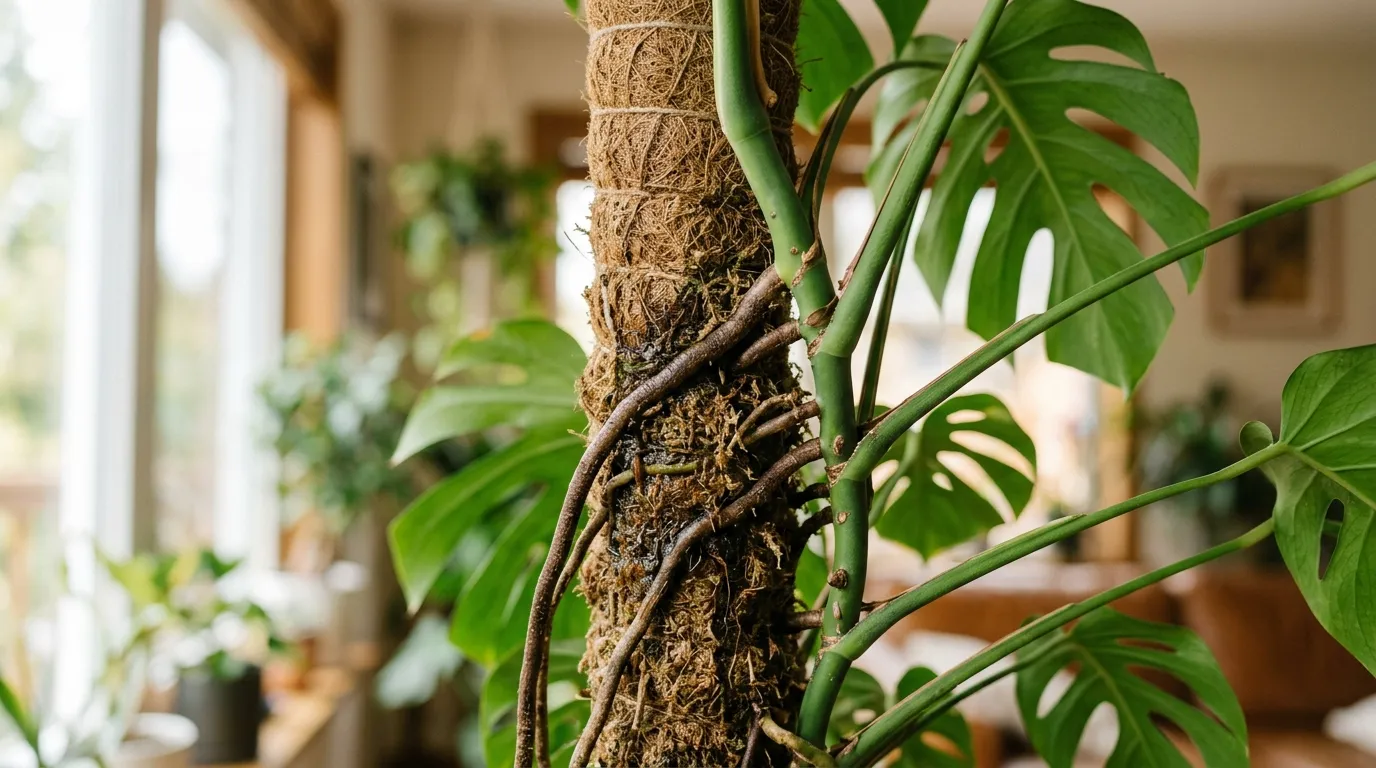
Aerial roots guided onto a damp moss pole. The roots absorb moisture and nutrients, supporting larger leaf growth.
Never cut aerial roots. In the wild, they absorb moisture directly from humid air and anchor the plant to tree trunks. Cutting them removes part of the plant’s water-uptake system and weakens attachment to any support structure.
Instead, guide them into the moss pole or coco coir pole. When an aerial root reaches the pole surface, it will grip the fibres and begin growing into the pole. This attachment is what triggers the production of larger, more fenestrated leaves — monstera produces its best growth when climbing.
If a root is very long and trailing inconveniently across your floor, coil it back into the pot or tuck it into the top of the compost. The root will begin taking up soil moisture, which is beneficial.
Aerial roots gripping a coco coir pole. Once attached, the monstera produces noticeably larger leaves with deeper fenestrations. Do not cut them.
Support structures: moss pole vs coco coir pole vs trellis
The right support changes how a monstera performs over time. Without a climbing surface, the plant sprawls outward and produces smaller leaves. With one, it climbs upward and leaf size increases with each new growth.
Coco coir pole is the best choice for most UK homes. It retains moisture better than sphagnum moss poles, which dry out rapidly in centrally heated rooms. Coco poles are widely available, affordable (£8-£20), and easy to extend by joining sections as the plant grows. Push it deep into the pot before the plant is large — attempting to add a pole once a root ball is established means disturbing roots significantly.
Sphagnum moss pole provides excellent moisture retention when kept consistently damp, but requires daily or every-other-day misting in a UK winter. If you have the discipline to maintain it, sphagnum gives slightly better aerial root attachment than coco.
Bamboo cane — widely available and cheap, but provides no moisture for aerial roots and gives limited grip. Monstera will lean on it rather than climb it. Fine for young plants awaiting their first proper pole.
Trellis or wooden frame — works well for Monstera adansonii allowed to trail and cascade. Not suited for Monstera deliciosa, which grows too tall and heavy for a flat trellis.
Feeding monstera in the UK
Feed with a balanced liquid fertiliser (NPK roughly 20-20-20) once a month from April through August. Dilute to half the label strength — monsteras do not need heavy feeding and salt build-up in the compost from overfeeding causes brown leaf tips. Do not feed from September through March. UK winters provide minimal light, growth effectively stops, and unused nutrients accumulate as salts in the compost.
The Royal Horticultural Society’s guidance on houseplant feeding confirms that overfeeding is significantly more damaging to most tropical houseplants than underfeeding.
If your monstera is in bright light and producing several new leaves per month in summer, you can increase feeding to every three weeks. If growth is slow or the plant is in lower light, stick to once a month or every six weeks.
How to propagate monstera
Monstera propagation is reliable and one of the most satisfying parts of growing the plant. A single healthy specimen can produce several new plants per year at no cost. This is far simpler than propagating houseplants with more complex requirements.
What you need
A sharp, clean knife or secateurs. A node — the raised, brownish bump on the stem from which leaves and aerial roots emerge. You cannot propagate monstera from a leaf alone; without a node, no roots will form.
Step-by-step water propagation
- Identify a healthy stem section with at least one node and one leaf.
- Cut 2-3cm below the node with a clean blade. If there is an aerial root at the node, so much the better — it will speed rooting.
- Remove any leaves that would sit below the water line.
- Place the cutting in a clear jar or glass of water. The node must be submerged; the leaf should sit above the water.
- Position the jar in bright indirect light.
- Change the water completely every 5-7 days to prevent bacterial build-up.
- Roots appear in 3-6 weeks. When roots reach 3-5cm, pot the cutting into a mix of two parts peat-free multipurpose compost to one part perlite.
Soil propagation method
Rooting directly into moist perlite or a 50:50 perlite/compost mix also works well. Cover the cutting loosely with a clear plastic bag to maintain humidity. Keep the medium just moist. Roots form in 4-6 weeks. Soil-rooted cuttings often adapt to compost faster than water-rooted ones, which can struggle during the transition from water to soil.
A monstera cutting with node and aerial root nub in water propagation. The node must be submerged. Roots appear in 3-6 weeks.
Best propagation timing: April to July when growth is fastest. Cuttings taken in autumn or winter root more slowly in lower light and cooler temperatures.
How to repot monstera
Monstera needs repotting every 1-2 years. Signs it is time: roots circling the inside of the pot and pushing out through drainage holes, water running straight through the compost without absorbing, or the plant becoming top-heavy and unstable. Our full guide to how to repot houseplants covers the compost types and techniques in detail.
Move up by one pot size only — typically 3-5cm wider in diameter. An oversized pot holds excess moisture for too long and causes root rot. Use a free-draining mix: two parts peat-free multipurpose compost, one part perlite. Pure peat-free compost retains more moisture than monstera prefers.
Spring is the best time to repot — March to May. The plant enters active growth, roots recover quickly, and there is a full growing season ahead to establish in fresh compost. Do not feed for 4-6 weeks after repotting; fresh compost contains enough nutrients and fertiliser salts will burn damaged roots.
Common monstera problems in UK homes
Yellow leaves
Yellow leaves almost always mean overwatering. Check the compost: if the top half of the pot is wet and the plant has been watered recently, leave it to dry out fully before watering again. If roots are brown and mushy when you unpot, trim the rot with sterile scissors and repot into fresh compost. Reduce watering frequency going forward.
A few lower leaves yellowing on a large, otherwise healthy plant is normal — monstera sheds old leaves as new ones grow.
Brown leaf tips
Brown, dry tips indicate low humidity. UK central heating is the primary cause. Add a pebble tray, increase misting frequency, or use a room humidifier. Brown tips do not reverse once formed; the damage is permanent, but new growth will be healthy if humidity improves.
Brown patches on leaf surface
Dark brown, wet-looking patches indicate overwatering or root rot. Dry, papery brown patches indicate scorching from direct sun. Move the plant away from a south-facing window or filter the light with a sheer curtain.
Leaves not splitting (no fenestrations)
Low light. This is the answer in almost every case. Measure the lux at the plant’s current position. Below 600 lux, move the plant closer to a window. Also check plant age — juvenile monsteras (under 18-24 months) naturally produce entire, uncut leaves regardless of light.
Pests: scale, spider mite, and thrips
Scale appears as brown, shell-like bumps on stems. Wipe off with a cotton bud dipped in rubbing alcohol and treat with neem oil weekly for a month. Spider mite produces fine webbing on leaf undersides in hot, dry conditions — increase humidity and treat with diluted neem. Thrips leave silvery streaks on leaves. Isolate the plant immediately; thrips spread rapidly to nearby houseplants. Treat with insecticidal soap or neem oil weekly. For persistent infestations, see our guide on how to get rid of houseplant flies and pests.
Monstera toxicity — important for pet owners
Monstera deliciosa, adansonii, and all other Monstera species are toxic to cats and dogs. The plant contains insoluble calcium oxalate crystals. If chewed, these cause intense burning and irritation of the mouth, lips, and tongue, followed by drooling, vomiting, and difficulty swallowing. Symptoms are rarely fatal but are painful and distressing.
Keep monstera on a high shelf or in a room your pets cannot access. If your cat or dog chews the plant, contact your vet immediately. If you have pets and want to fill your home with houseplants, see our guide to the best plants for bedrooms and best plants for bathrooms, which includes pet-safe options for every room.
Month-by-month UK monstera care calendar
| Month | Task | Detail |
|---|---|---|
| January | Reduce watering | Every 14-21 days. Check compost before watering. |
| February | Check for pests | Scale and spider mite common in dry, heated rooms. |
| March | Begin feeding | Half-strength balanced liquid fertiliser monthly. |
| April | Repot if needed | Move up one size. Best time for new compost. |
| May | Increase watering | Every 7-10 days as growth resumes. |
| June | Move toward light | South-facing windows — check for scorch in direct sun. |
| July | Propagate | Take stem cuttings. Rooting fastest at this time. |
| August | Feed every 3 weeks | If producing 2+ new leaves per month, increase frequency. |
| September | Taper feeding | Last feed of the season. |
| October | Reduce watering | Every 10-14 days. Growth slowing. |
| November | Increase humidity | Central heating on — add pebble tray or humidifier. |
| December | Reduce feeding | Stop feeding entirely. Water only when top 3cm is dry. |
Getting started: which monstera to buy
For most UK growers, Monstera deliciosa is the right starting point. It is widely available from garden centres, supermarkets, and online sellers. Expect to pay £15-£30 for a small plant in a 12-14cm pot, or £40-£60 for a more established specimen. It is one of the best house plants for beginners in the UK because it tolerates occasional neglect and clearly signals its needs through leaf appearance.
If you have a smaller space or want a trailing plant for a shelf, Monstera adansonii is the better choice. It is equally forgiving, grows well in hanging pots, and costs slightly less than deliciosa.
Avoid Thai Constellation and obliqua until you have successfully grown and propagated a deliciosa. Both demand very consistent care, especially regarding light.
Start with a 12cm pot, place it within 1.5 metres of an east- or south-facing window, and use a free-draining compost mix. Add a coco coir pole from the start. Water only when the top 3cm is dry. Feed monthly from April to August. That is genuinely all it takes to grow a monstera that produces fenestrated leaves year after year.
For more inspiration on building an indoor plant collection, see our guides to low light houseplants and how to care for succulents indoors, which make excellent companion plants for a monstera-centred collection.
Frequently asked questions
How often should I water a monstera?
Water monstera every 7-10 days in summer when the top 3cm of compost feels dry. Reduce to every 14-21 days in winter when growth slows. Push a finger into the compost — if the top 3cm is dry, water thoroughly until it drains from the bottom. Never water on a fixed schedule. Compost dry-out time varies with pot size, temperature, and season.
Why does my monstera have no splits in its leaves?
Insufficient light is the cause of unsplit monstera leaves in nearly every case. Move the plant to within 1-2 metres of an east- or south-facing window. Young plants under two years old also produce uncut juvenile leaves regardless of light — this is normal. Given adequate light, fenestrations begin appearing on leaves produced after the move, typically within 4-6 weeks.
Should I cut off monstera aerial roots?
Never cut monstera aerial roots. They absorb moisture from the air and anchor the plant as it climbs. Guide them into a moss pole or coco coir pole, where they will grip and help the plant produce larger, more fenestrated leaves. If an aerial root is very long and trailing awkwardly, tuck it back into the pot or the moss pole rather than removing it.
How do I propagate a monstera?
Propagate monstera using a stem cutting that includes at least one node and one leaf. Cut 2-3cm below the node with a clean, sharp knife. Root the cutting in a jar of water in bright indirect light, changing the water weekly. Roots appear in 3-6 weeks. Pot into free-draining compost once roots reach 3-5cm long.
How big do monstera plants get indoors?
Monstera deliciosa can reach 2-3 metres tall indoors over several years. Growth rate is 30-60cm per year in good conditions. The leaves also grow larger as the plant matures — mature leaves on a well-lit, supported plant can exceed 60cm across. Monstera adansonii stays smaller, typically reaching 1-1.5 metres.
Is monstera toxic to cats and dogs?
Monstera is toxic to cats and dogs. All parts of the plant contain insoluble calcium oxalate crystals, which cause intense mouth irritation, drooling, and vomiting if chewed. Keep monstera out of reach of pets or choose a non-toxic alternative such as spider plant, calathea, or Boston fern. The toxicity applies to both Monstera deliciosa and Monstera adansonii.
What is the best moss pole for monstera?
Coco coir poles are the best support for monstera in UK homes. They hold moisture better than sphagnum moss poles, which dry out quickly in centrally heated UK homes in winter. Drive the pole into the compost before the roots establish — disturbing a mature root ball to add a pole can cause significant damage. A pole 120-150cm tall suits most home-grown specimens.
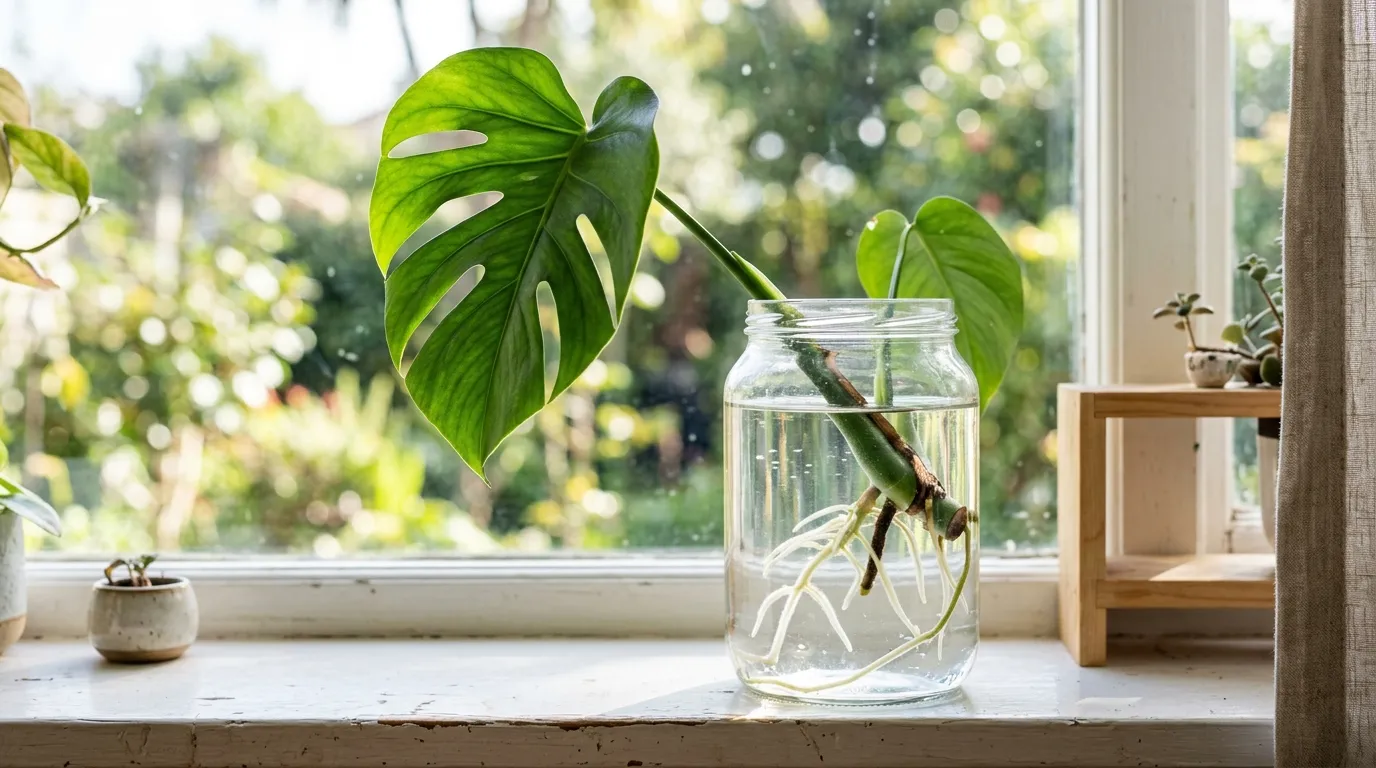
A monstera stem cutting with an aerial root node in water. New roots appear within 2-4 weeks.
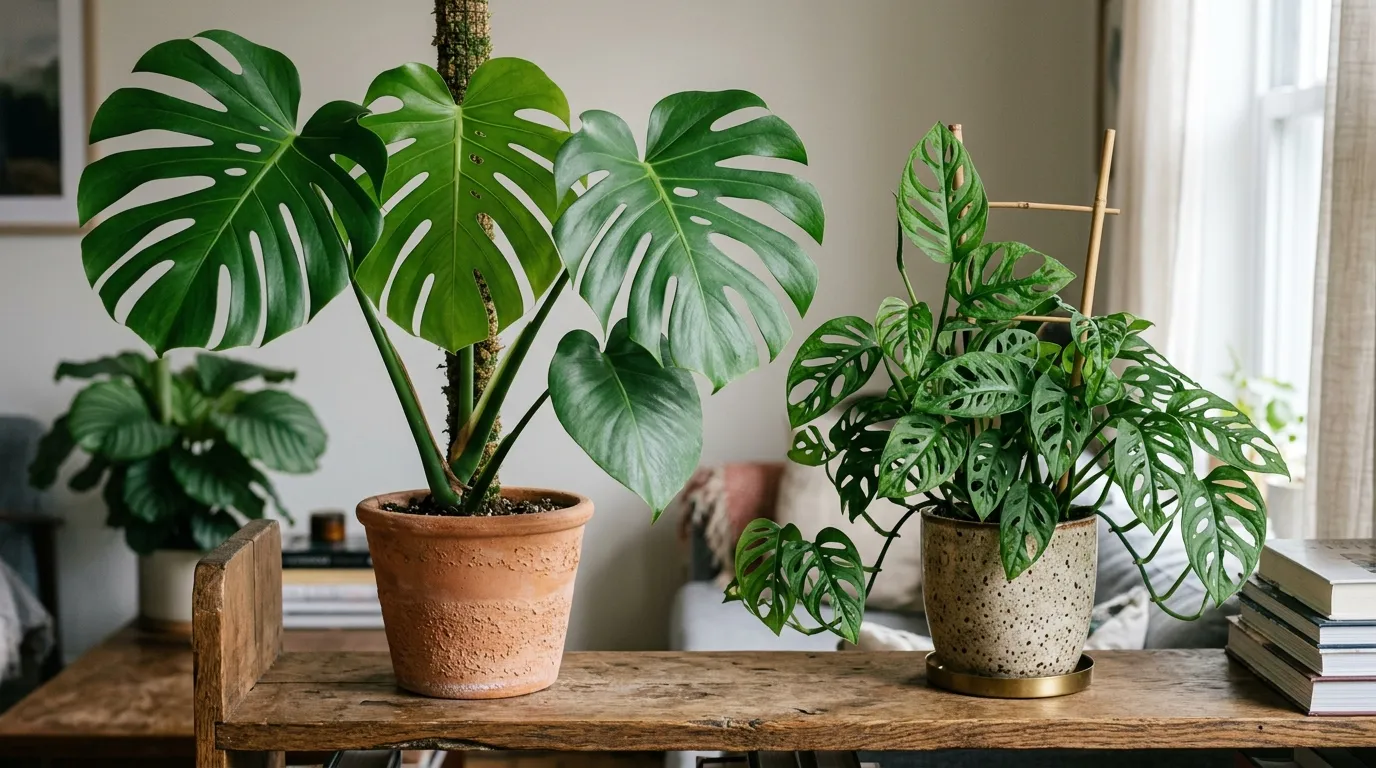
M. deliciosa (left) has larger leaves with splits. M. adansonii (right) has smaller leaves with holes.
Related reading
- Best Indoor Plants for UK Homes — full ranked guide with lux data for every window orientation
- Best House Plants for Beginners UK — five easiest starting points if this is your first houseplant
- How to Propagate Houseplants — step-by-step for stem cuttings, division, and water rooting across ten species
- How to Repot Houseplants — when to repot, compost types, and aftercare
- Best Low Light Houseplants UK — if your home lacks south- or east-facing windows
Lawrie has been gardening in the West Midlands for over 30 years. He grows his own veg using no-dig methods, keeps a wildlife-friendly garden, and writes practical advice based on real UK growing conditions.