Key takeaways
- Over 5,000 community gardens operate across the UK, listed on the Social Farms and Gardens directory
- Public liability insurance costs £150-300 per year and is required before any public gardening activity
- Community Interest Company (CIC) is the simplest legal structure for a new community garden group
- National Lottery Awards for All provides grants of £300-£10,000 for community growing projects
- A basic community garden setup with 8 raised beds, tools, and water supply costs £2,000-£5,000
- Therapeutic horticulture programmes show measurable mental health improvements in clinical studies
Community gardening in the UK has grown sharply over the past decade. Over 5,000 community gardens now operate across the country, from tiny urban growing plots on former car parks to large community orchards on the edges of villages. The movement accelerated after 2020 when demand for outdoor community activity surged.
Whether you want to join an existing group or start your own, the practical steps are straightforward. Finding a local community garden takes minutes online. Starting one from scratch requires land access, basic insurance, and a handful of committed members. Most of the startup costs can be covered by readily available grants.
How do I find a community garden near me?
The Social Farms and Gardens directory at farmgarden.org.uk lists over 5,000 community growing projects across the UK. Search by postcode to find groups within walking distance. The directory includes community gardens, community orchards, city farms, therapeutic gardens, and allotment-based communal projects.
Your local council website is the second-best resource. Most councils maintain a list of community growing projects on their parks, leisure, or communities pages. Some councils actively promote community gardening as part of their green space strategy and have dedicated officers who can connect you to local groups.
Facebook remains the most effective tool for finding informal groups. Search for “community garden” plus your town or district name. Many small projects operate without formal registration and are found only through social media or word of mouth.
The National Allotment Society lists allotment sites, many of which run communal growing areas alongside individual plots. If your local allotment has spare capacity, it may welcome a community growing initiative.
Transition Town networks, often linked to environmental groups, run community food growing in many UK towns. These are good entry points, particularly for people interested in the sustainability and food-security aspects of community gardening.
What does a community garden actually involve?
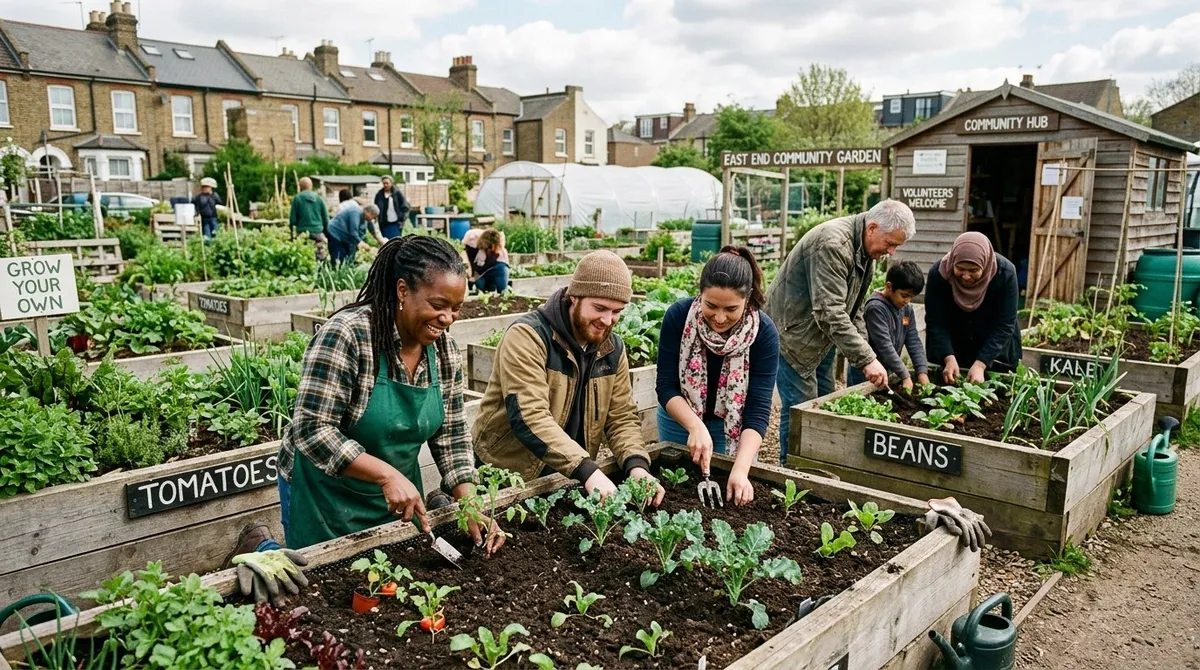
A community garden is any shared growing space where a group of people cultivate food, flowers, or wildlife habitat together. The format varies enormously. Some operate like shared allotments with individual raised beds. Others are fully communal, with everyone working the same beds and sharing the harvest.
Common formats in the UK include raised bed plots allocated to individual families, communal vegetable beds maintained on a rota, community orchards with shared fruit trees, food forests and permaculture gardens, sensory and therapeutic gardens, and school-linked growing projects.
Most groups meet weekly for a shared work session of 2-3 hours. Members can also visit and tend their own beds at any time. The social element is as important as the growing. Many people join community gardens primarily for the company, fresh air, and physical activity rather than the produce.
Produce is typically shared informally or through a produce table. Some groups run structured harvest shares. Others donate surplus to food banks, which is increasingly common since 2022. A few groups sell produce at farmers’ markets to fund running costs.
How do I start a community garden from scratch?
Start with 3-5 committed members, find temporary land, and build something visible within the first month. The biggest mistake new community garden groups make is spending months on paperwork, legal structures, and funding applications before putting a single seed in the ground. People join projects they can see, not projects described in planning documents.
Step 1: Gather your founding group
You need a minimum of 3 committed people willing to meet regularly and do physical work. More is better, but do not wait for a large group before starting. Advertise through local Facebook groups, community noticeboards, and libraries. A simple post asking “Would anyone like to help start a community growing space?” typically generates 10-20 responses.
Step 2: Find land
Council-owned land is the most common starting point for UK community gardens. Contact your local council’s estates, parks, or regeneration department. Many councils have unused or underused green spaces, former garage sites, or derelict plots available for community use.
Land licences from councils are often free for the first year and nominal (£1-£100 per year) thereafter. The council saves on maintenance costs and gains a community asset for its reporting. Expect the approval process to take 2-6 months, which is why you should start small on temporary land while the formal licence is processed.
Private landowners sometimes offer land too. Churches, schools, housing associations, and businesses with unused grounds are all worth approaching. Frame the request around benefit to the local community and offer to maintain the land in good condition.
Step 3: Set up basic infrastructure
A functional community garden needs raised beds, a water supply, basic tools, and somewhere to store them. That is the minimum.
| Item | Cost | Notes |
|---|---|---|
| 8 raised beds (2.4m x 1.2m) | £400-£800 | Scaffold boards or reclaimed timber |
| Topsoil and compost | £300-£600 | Bulk delivery, 1 tonne per 4 beds |
| Water supply | £0-£500 | Rainwater butts (free) or mains tap (plumber cost) |
| Basic tool kit | £150-£300 | Spades, forks, trowels, watering cans, wheelbarrow |
| Storage (lockable) | £200-£500 | Secondhand shed or metal container |
| Paths and access | £200-£400 | Wood chip or gravel, wheelchair-width |
| Signage | £50-£100 | Welcome board, plot labels |
| Public liability insurance | £150-£300/year | Required before public access |
| Total | £1,450-£3,500 | Before any grants |
Most of these costs can be reduced by sourcing reclaimed materials. Scaffold boards from building sites make excellent raised bed sides. Tree surgeons often deliver wood chip free of charge for paths. Local businesses sometimes donate surplus materials.
What legal structure does a community garden need?
A Community Interest Company (CIC) is the most popular and practical legal structure for UK community gardens. It provides limited liability protection for organisers, an asset lock stopping private profit, and credibility with funders. Registration costs £27 online via Companies House.
Three legal structures suit community gardens:
| Structure | Setup cost | Liability protection | Can receive grants | Can claim Gift Aid | Complexity |
|---|---|---|---|---|---|
| Unincorporated association | Free | None, members personally liable | Limited | No | Lowest |
| Community Interest Company (CIC) | £27 | Yes, limited liability | Yes, most funders accept | No | Moderate |
| Charitable Incorporated Organisation (CIO) | Free | Yes, limited liability | Yes, all funders accept | Yes, 25% tax relief | Highest |
For most new community gardens, a CIC is the right choice. It gives you liability protection and grant eligibility without the reporting burden of a charity. You need a minimum of 1 director and a simple set of articles of association (template available from Companies House).
If your group grows large enough to benefit from Gift Aid on donations and charity-specific grants, you can convert to a CIO later. Start simple and formalise as you grow. Our Staffordshire group ran as an unincorporated association for 4 months while the CIC registration was processed. The informal structure worked fine for the early growing phase.
How do I get funding for a community garden?
National Lottery Awards for All is the single best funding source, providing £300-£10,000 for community projects with a simple application process. The application takes 2-3 hours. Decisions are made within 12 weeks. The fund is open year-round and has funded thousands of community gardens across the UK.
Other proven funding sources for UK community gardens include:
- Tesco Community Grants, up to £1,500, voted on by customers in local stores
- Co-op Local Community Fund, up to £3,000 per year, linked to Co-op membership purchases
- Local council community grants, typically £500-£5,000, varies by authority
- Postcode Lottery Trust, larger grants of £2,000-£20,000 for established groups
- Social Farms and Gardens, small grants plus equipment and seed donations for member groups
- Groundwork UK, funding and practical support for community growing in disadvantaged areas
Write your first application to the National Lottery. It has the highest success rate for new groups. Include evidence of community support: photographs of your first growing sessions, a list of 20+ supporters, and letters of support from a local councillor or GP practice.
How do community gardens benefit mental health?
Clinical studies show that regular community gardening reduces anxiety and depression scores by 20-30% over 12 weeks. The combination of physical activity, social contact, exposure to nature, and purposeful work produces measurable mental health improvements.
The Kings Fund 2016 report on gardening and health found that therapeutic gardening programmes in the UK produced outcomes comparable to cognitive behavioural therapy for mild to moderate depression. The NHS now refers patients to community growing projects through Social Prescribing Link Workers.
The physical health benefits are significant too. Gardening burns 250-400 calories per hour depending on the activity. Digging, weeding, and carrying compost are moderate-intensity exercise. Regular attendance at a community garden provides the 150 minutes of weekly moderate activity recommended by the NHS.
Growing and eating your own vegetables also improves diet. Members of our group report eating more fresh vegetables and trying crops they would not buy in shops, including heritage beetroot varieties, chard, and kohlrabi.
How do I run a community produce swap?
Set up a table at your community garden with a “give what you can, take what you need” sign and let it run itself. Formal pricing and record-keeping kill produce swaps. The most successful ones are completely informal.
Place the table near the entrance of your growing site. Members bring surplus produce, courgettes, tomatoes, herbs, jam, eggs, flowers, and leave it on the table. Anyone passing can take what they want. No money changes hands. No records are kept.
This works because most gardeners produce gluts of specific crops at specific times. The courgette grower in August has more than they can eat. The bean grower in July has the same problem. The swap table redistributes this surplus naturally.
Expand the concept to include seeds, plants, and tools. A seed swap in January is one of the best community engagement events a garden can run. Members bring saved seed from last season and swap freely. It costs nothing and builds connections. Our seed saving guide covers the basics of saving seed for swapping.
Some groups extend the produce table to the wider community. Place it where the public can access it, by a gate, outside a community centre, or next to a busy footpath. This builds goodwill and attracts new members.
What is a community orchard and how do I start one?
A community orchard is a shared planting of fruit and nut trees managed collectively by local residents. The UK has over 1,500 registered community orchards, many established on former farmland, churchyards, school grounds, or unused council land.
Community orchards differ from community gardens in their timescale. A raised bed produces food within weeks. An apple tree takes 3-5 years to crop meaningfully. This long-term commitment requires secure land tenure, a minimum 10-year lease is recommended before planting trees.
Start with 10-15 fruit trees. Choose varieties suited to your local conditions and with staggered cropping times to spread the harvest from July to November. Include traditional local varieties where possible.
For UK conditions, the best community orchard selections include apple varieties like ‘Bramley’s Seedling’ (cooking, September), ‘Cox’s Orange Pippin’ (eating, October), and ‘Discovery’ (eating, August). Add pear trees and plums for variety. Our fruit tree growing guide covers planting and care for all common UK fruit trees.
What about therapeutic and school gardens?
Therapeutic gardens provide structured growing activities for people with mental health conditions, learning disabilities, or physical impairments. They operate differently from standard community gardens. Sessions are led by trained facilitators. Activities are adapted to participants’ abilities. The focus is on the process of growing rather than crop yields.
Many therapeutic gardens are linked to NHS trusts, charities like Thrive and Mind, or local authority social care teams. If you want to add a therapeutic element to an existing community garden, contact your local Social Prescribing Link Worker through your GP practice. They can refer suitable participants to your sessions.
The key requirements for therapeutic gardening are: accessible raised beds at wheelchair height (75-80cm), level paths at least 1.2 metres wide, seating areas with shade, adapted tools with ergonomic handles, and a trained session leader. Our accessible gardening guide covers design principles for inclusive growing spaces.
School gardens are another growth area. Over 3,000 UK schools now have growing spaces. The Royal Horticultural Society runs the Campaign for School Gardening, providing free resources, seeds, and support for school growing projects. Community garden groups that partner with local schools often find it easier to secure funding because funders favour projects that benefit children.
Frequently asked questions
How do I find a community garden near me?
Search the Social Farms and Gardens directory at farmgarden.org.uk for your postcode. This is the national network covering England, Scotland, Wales, and Northern Ireland. Your local council website also lists community growing projects. Facebook groups using ‘community garden [your town]’ often reveal informal projects not on official registers. Many allotment sites also run communal growing areas.
How much does it cost to start a community garden?
A basic community garden with 8 raised beds, tools, and water supply costs £2,000-£5,000. Public liability insurance runs £150-300 per year. CIC registration costs £27 online. The biggest variable is land: council land licences cost £0-£500 per year while private land leases vary widely. Most costs are covered by grants from the National Lottery, local councils, or supermarket community funds.
Do I need planning permission for a community garden?
No planning permission is needed for raised beds, paths, and basic growing on existing open land. You may need permission for permanent structures such as sheds, polytunnels, or hard standing over 15 square metres. Check with your local council planning department before building anything permanent. Temporary structures like cold frames and compost bins are usually exempt.
What insurance does a community garden need?
Public liability insurance is essential before any community gardening activity. Cover of £5 million is standard and costs £150-300 per year for a small community garden. Social Farms and Gardens offers group insurance through its membership at reduced rates. Without insurance, organisers are personally liable for any injuries on site.
What legal structure should a community garden use?
A Community Interest Company (CIC) is the simplest and most popular legal structure. Registration costs £27 online via Companies House. A CIC has an asset lock stopping members from profiting privately. Alternatives include unincorporated association (simplest, no legal protection) and charitable incorporated organisation (CIO, for larger groups wanting charity status and Gift Aid).
How do I get funding for a community garden?
National Lottery Awards for All provides grants of £300-£10,000 specifically for community projects. Application takes 2-3 hours and decisions come within 12 weeks. Tesco Community Grants, Co-op Local Community Fund, and local council community funds are also available. Most funders want evidence of community support: a petition with 20+ signatures or a public meeting attendance list strengthens any application.
Can I start a community garden on council land?
Yes, most UK councils have schemes for community use of disused or underused public land. Contact your council’s estates or parks department. Licences for community growing are often granted for free or at nominal rent (£1 per year). The council benefits from reduced maintenance costs and improved community engagement. Expect the process to take 2-6 months.
Many community gardens take referrals; read how gardening on prescription works.
Our team produces practical UK gardening guidance from source research, contributor records and established horticultural practice. Editorial standards are overseen by Matt W.