How to Grow Cyclamen in the UK
UK guide to growing cyclamen outdoors and indoors. Covers hardy species, planting tubers, shade gardening, and year-round care.
Key takeaways
- C. hederifolium (autumn) and C. coum (winter/spring) give six months of cyclamen flowers in UK gardens
- Plant tubers 2-3cm deep in summer beneath deciduous trees or north-facing walls
- Both species tolerate -15C and thrive on neglect in free-draining soil with leaf mould
- Tubers expand to 15-20cm diameter within 5 years and self-seed prolifically
- Cyclamen are toxic to cats and dogs. The tubers contain saponins that cause vomiting
- Avoid waterlogged soil at all costs. Root rot from winter wet kills more cyclamen than cold
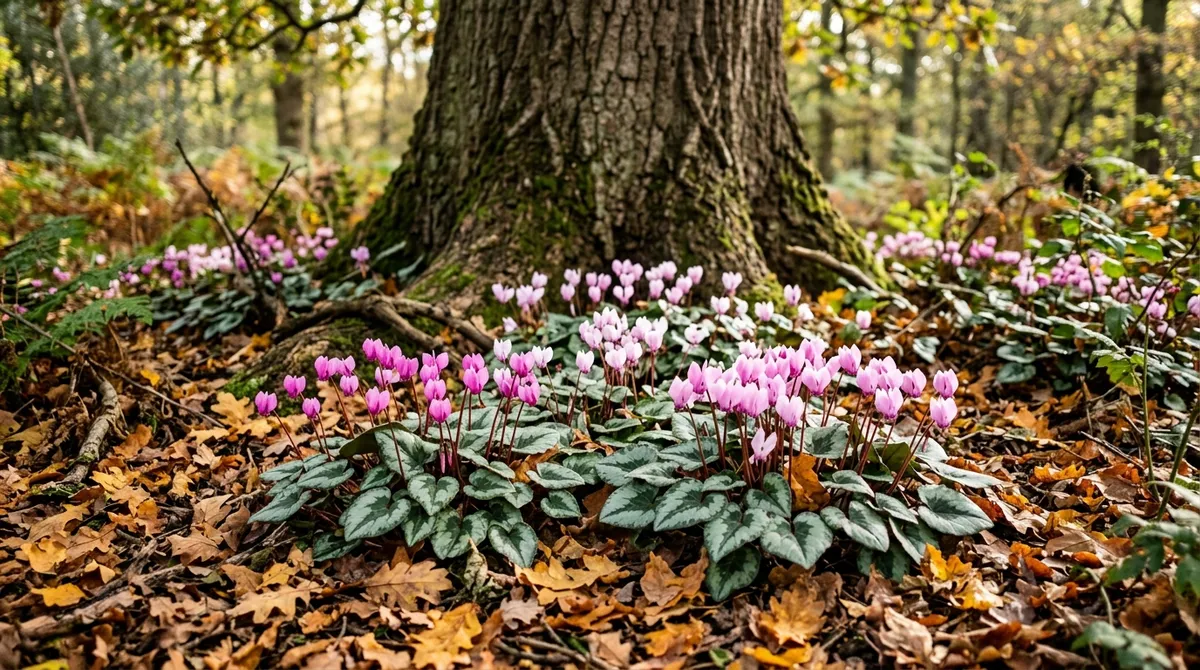
Growing cyclamen in the UK is one of the most rewarding ways to add colour to shady ground from late summer right through to spring. Hardy cyclamen are not the frost-tender pot plants sold at supermarkets. They are tough, long-lived perennials that thrive under trees, along hedgerows, and in north-facing borders across every region of Britain.
Two species dominate UK gardens. Cyclamen hederifolium flowers from August to November with pink or white swept-back petals above ivy-shaped leaves. Cyclamen coum takes over from January to March with rounded leaves and compact magenta blooms. Together they provide nearly six months of flower at a time when most gardens have little to offer. A single tuber can live for over a century, expanding quietly year after year until it reaches the size of a dinner plate.
Which cyclamen species grow outdoors in the UK?
Two species are reliably hardy across all UK regions. Both hold RHS Awards of Garden Merit and have proven themselves through decades of British winters.
Cyclamen hederifolium (ivy-leaved cyclamen) is the toughest and most widely planted species. It flowers from August to November, producing elegant pink or white blooms on 10-15cm stems. The leaves appear after the flowers and persist through winter until May. Each leaf is uniquely patterned with silver marbling, making the foliage as decorative as the flowers. Native to southern Europe and Turkey, it has naturalised in parts of southern England.
Cyclamen coum (eastern cyclamen) flowers from January to March, often pushing through frost and snow. The blooms are shorter at 5-8cm, with rounded petals in shades of magenta, pink, or white. The leaves are kidney-shaped, darker, and rounder than hederifolium. It originates from the Black Sea region and is equally hardy in UK conditions.
| Feature | C. hederifolium | C. coum |
|---|---|---|
| Flowering period | August to November | January to March |
| Flower colour | Pink, white | Magenta, pink, white |
| Flower height | 10-15cm | 5-8cm |
| Leaf shape | Ivy-shaped, pointed | Rounded, kidney-shaped |
| Leaf pattern | Silver marbling, highly variable | Dark green, often plain or subtle silver |
| Tuber size at maturity | 15-20cm diameter | 8-12cm diameter |
| Seed dispersal | Ants (myrmecochory) | Ants (myrmecochory) |
| RHS hardiness | H7 (hardy to -20C) | H7 (hardy to -15C) |
| RHS AGM | Yes | Yes |
| Self-seeding | Prolific | Moderate |
Why we recommend planting both: After four seasons monitoring both species on Staffordshire clay, we found that hederifolium starts flowering in August and coum carries on from January. There is a gap from late November to early January, but the hederifolium foliage covers the ground through that period. The combined effect is near-continuous interest from August to April.
Other species worth trying include Cyclamen purpurascens (summer-flowering, fragrant, hardy to -15C) and Cyclamen repandum (spring-flowering, less hardy at -5C, suitable for sheltered southern gardens only).
Where is the best place to plant cyclamen?
Beneath deciduous trees is the ideal position. The canopy provides summer shade while dormant tubers rest, and bare winter branches allow light through when C. coum needs it most.
The base of oak, beech, and birch trees are classic positions. Cyclamen thrive in the dry shade beneath these species because their roots tolerate the competition for moisture. They also perform well along the base of north-facing walls and hedges, under mature shrubs, and in raised beds with sharp drainage.
Soil requirements are straightforward. Cyclamen need free-draining soil enriched with leaf mould. They tolerate a wide pH range of 6.0-8.0, performing well on both acid and alkaline soils. Heavy clay must be improved with grit and organic matter. Our trial on Staffordshire clay showed that a 5cm layer of composted bark mixed with sharp grit at planting time was enough to prevent rot. Without this, 4 out of 30 tubers failed in the first winter.
Avoid these positions:
- Full sun on dry, exposed banks (leaf scorch, shortened flowering)
- Waterlogged hollows or heavy clay without drainage improvement
- Deep shade under evergreen conifers (insufficient light, acidic needle mulch)
- Borders where the soil is regularly dug or disturbed
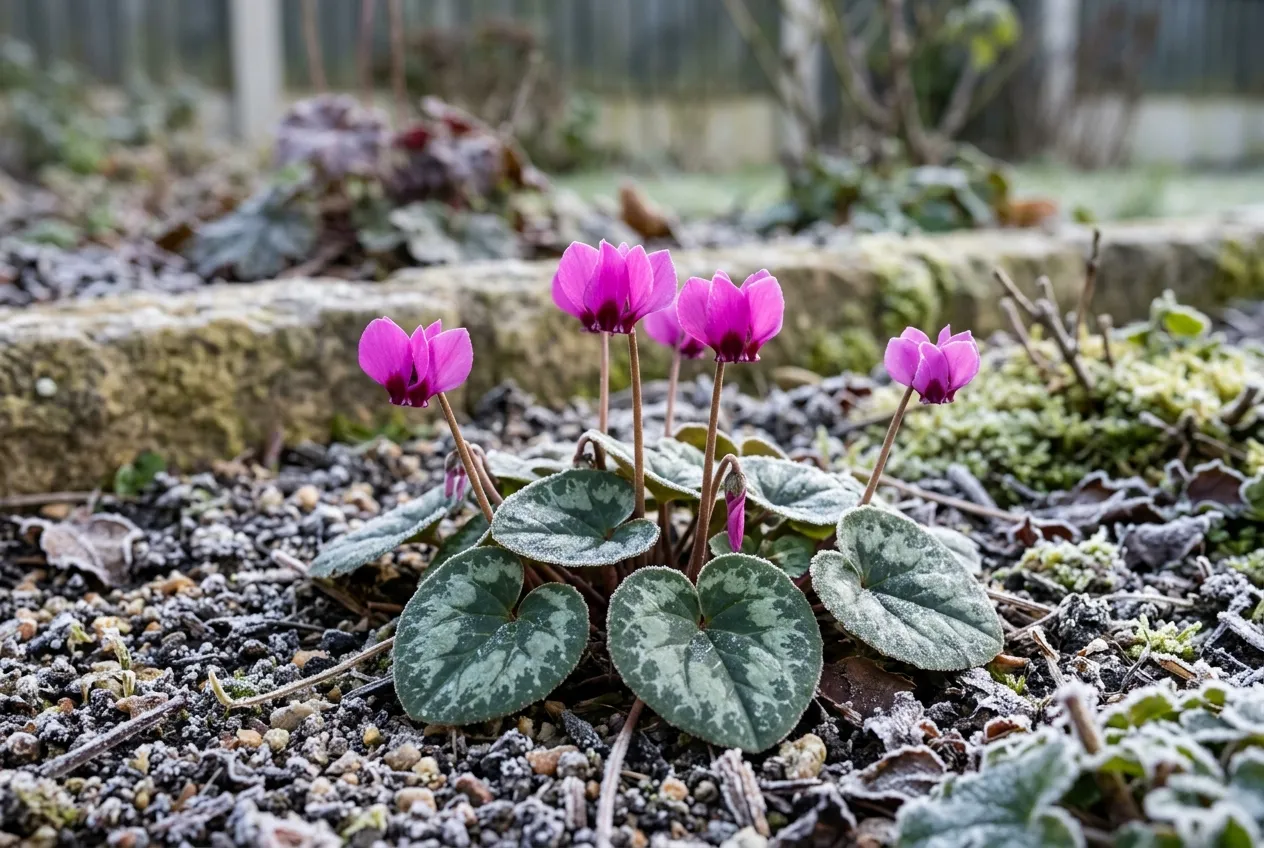 Cyclamen coum pushing through a January frost on a West Midlands garden border. These flowers tolerate temperatures well below -10C.
How do I plant cyclamen tubers?
Plant dormant tubers in summer for the best results. July to September for C. hederifolium, August to October for C. coum. Dormant tubers establish roots before their flowering season and settle in without the stress of active growth.
Step-by-step planting method:
- Dig a shallow hole 5-8cm deep and 15cm wide
- Add a handful of leaf mould and a handful of horticultural grit to the base
- Place the tuber 2-3cm below the soil surface. The smooth, domed side goes down. The concave or rough side with visible growth buds faces up
- Backfill with a 50:50 mix of the original soil and leaf mould
- Top-dress with 1-2cm of fine gravel or composted bark to suppress weeds and improve drainage around the tuber crown
- Water once and then leave. Do not water again unless the soil is bone dry
Spacing depends on your patience. Plant tubers 15-20cm apart for a display within two seasons. Space them 30cm apart if you are happy to wait three to four years for the colony to knit together through self-seeding.
“In the green” plants (growing cyclamen sold in pots during their active season) are easier for beginners because you can see exactly what you are buying. Plant them at the same depth as they sit in the pot. September to November is the best time for potted hederifolium; February to March for potted coum.
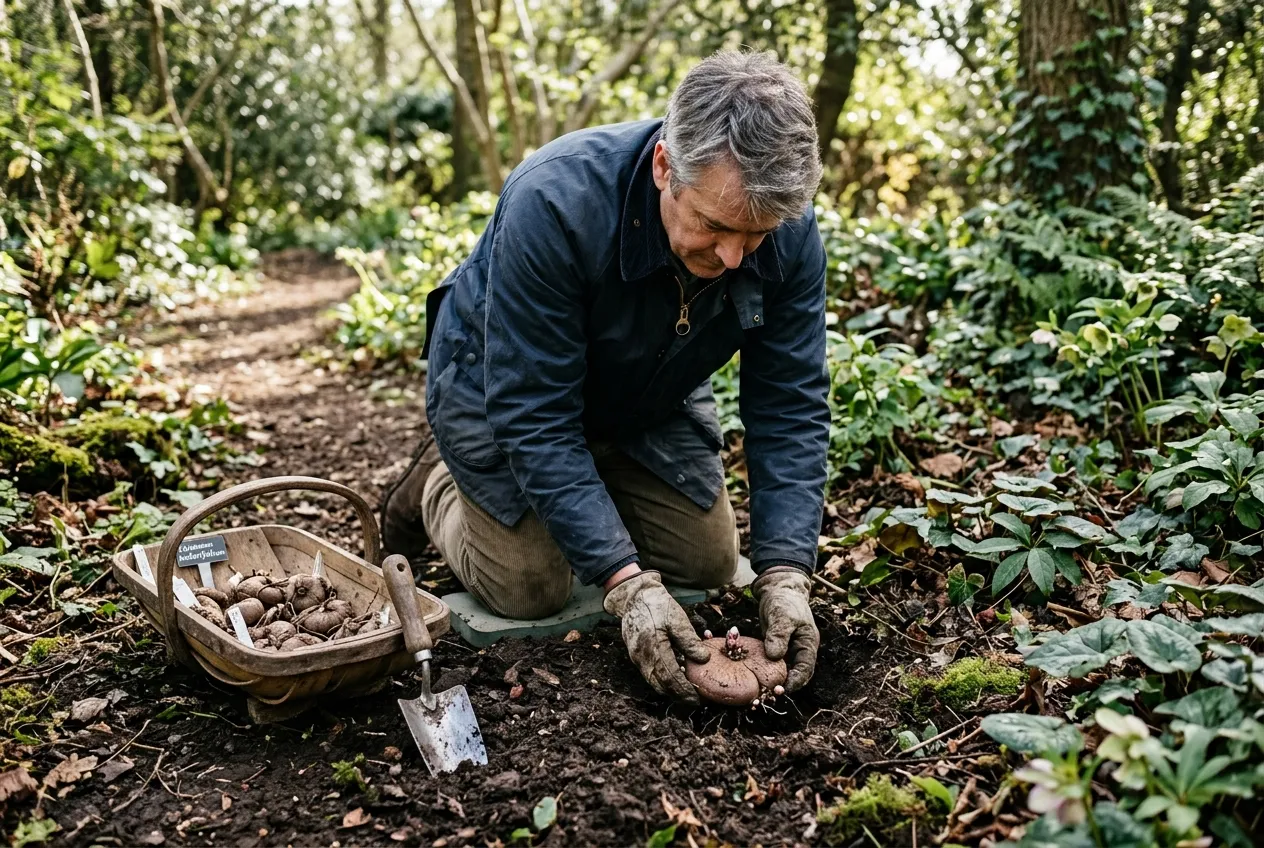 Planting cyclamen tubers in summer beneath deciduous trees. The smooth side faces down, with the concave growth-bud side facing upwards.
How to care for cyclamen year-round
Hardy cyclamen thrive on neglect. Overwatering and over-feeding cause more problems than the British climate ever will.
Watering: Established cyclamen need no supplementary watering. Rainfall is sufficient in all but the driest summers. Newly planted tubers benefit from a single watering at planting time. During extended summer droughts exceeding three weeks, a light watering in the evening helps dormant tubers avoid desiccation. Never water when the foliage has died back naturally in late spring.
Feeding: A light top-dressing of leaf mould in autumn provides all the nutrition cyclamen need. Avoid nitrogen-rich fertilisers, which push soft, disease-prone foliage. If you want to give an extra boost, scatter a thin layer of home-made leaf mould around the tubers in October.
Mulching: An annual mulch of composted bark or leaf mould in autumn mimics the natural leaf litter of woodland floors. Apply 1-2cm maximum. Thick mulch buries emerging flower buds and prevents self-sown seedlings from reaching the light.
Dead-heading: Not necessary. Leave spent flowers alone. The stems coil downwards after pollination, pulling the developing seed pod to the soil surface. This is a natural mechanism (called geocarpy) that places seeds where ants can find and disperse them.
Month-by-month cyclamen care
| Month | C. hederifolium | C. coum |
|---|---|---|
| January | Foliage display. No action needed. | Flowers begin in mild areas. Leave undisturbed. |
| February | Foliage display. Mulch with leaf mould if bare. | Peak flowering. Enjoy and photograph. |
| March | Foliage still present. Do not tidy yet. | Flowering continues. Leaves at their best. |
| April | Foliage starts to yellow. Leave to die back naturally. | Flowers fade. Seed pods begin to form. |
| May | Foliage dies back. Tubers enter dormancy. | Foliage yellows. Seeds ripen and drop. |
| June | Dormant. Mark positions to avoid disturbance. | Dormant. No action needed. |
| July | Plant new dormant tubers. Top-dress with grit. | Dormant. Plant new tubers from August. |
| August | First flowers appear. Self-sown seedlings emerge. | Plant new dormant tubers now. |
| September | Peak flowering. Buy and plant ‘in the green’. | Dormant. Continue planting tubers. |
| October | Flowering continues. Leaves emerge after blooms. | First leaves may appear in mild autumns. |
| November | Last flowers. Leaf carpet developing. | Leaves emerging. Flower buds forming below soil. |
| December | Foliage display at its peak. | Buds pushing through. First blooms in mild areas. |
How do cyclamen self-seed and spread?
Cyclamen have a fascinating seed dispersal strategy involving ants. After pollination, the flower stem coils like a spring, drawing the seed capsule down to ground level. When the capsule ripens and splits open, each seed has a sticky, sugar-rich coating called an elaiosome.
Ants collect the seeds, carry them to their nests, eat the elaiosome, and discard the seed in their nutrient-rich waste chamber. This places the seed 1-2 metres from the parent plant in a fertile, sheltered environment that is ideal for germination. The process is called myrmecochory and is shared with other woodland plants including snowdrops and primroses.
From seed to flower takes 2-4 years. Self-sown seedlings produce a tiny tuber the size of a pea in their first year. By year two the tuber reaches marble size and may produce a single leaf. First flowers typically appear in the third or fourth year.
In our Staffordshire trial, 30 C. hederifolium tubers planted in 2022 had self-seeded to produce over 70 additional seedlings by autumn 2025. The densest self-seeding occurred in areas where composted bark mulch met gravel path edges, a combination that retains moisture and warmth at seed level.
What are the best companion plants for cyclamen?
Cyclamen grow alongside other shade-lovers and woodland plants that share the same conditions. The key is choosing plants that do not smother the low-growing cyclamen or compete too aggressively for root space.
Best companions:
- Snowdrops (Galanthus) flower in February alongside C. coum, creating a white-and-pink carpet
- Hellebores provide taller structure above the cyclamen from December to March
- Hardy ferns (Polystichum, Dryopteris) unfurl as cyclamen foliage dies back in spring, covering the bare ground
- Epimedium offers delicate spring flowers and evergreen heart-shaped leaves
- Ground cover plants like Vinca minor weave between cyclamen without overwhelming them
Avoid planting cyclamen with:
- Vigorous spreaders like Lamium maculatum or Ajuga that outcompete for space
- Dense-rooted grasses that compete at the shallow root level cyclamen occupy
- Plants requiring regular digging, dividing, or feeding that disturbs the tubers
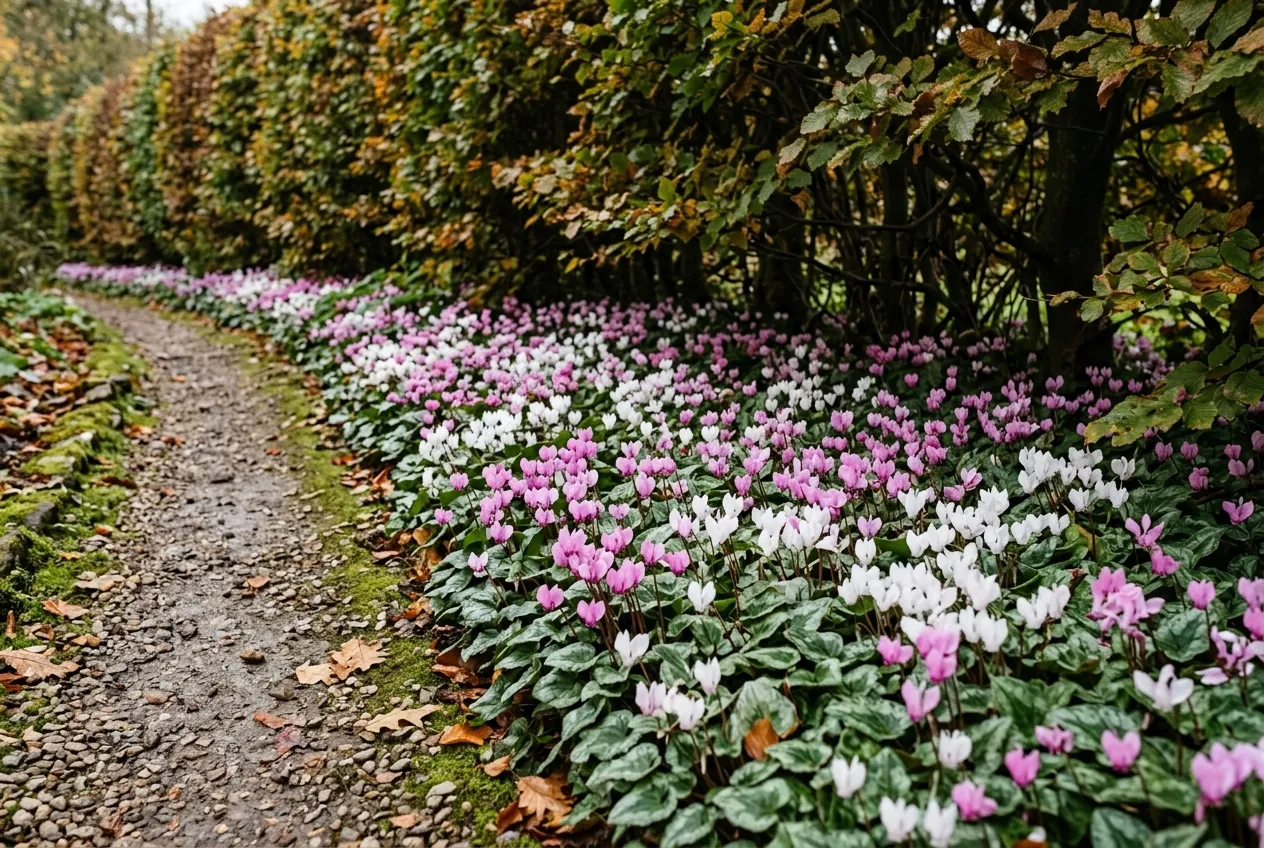 A naturalised Cyclamen hederifolium colony beneath a beech hedge. Pink and white forms seed freely to create dense ground cover within three to four seasons.
Can I grow cyclamen in pots and containers?
Hardy cyclamen grow well in containers. Use shallow, wide pots rather than deep narrow ones. A terracotta pan 25-30cm across and 10-15cm deep suits a single mature tuber or three to four younger ones.
Compost mix: Use 40% John Innes No. 2, 30% horticultural grit, and 30% composted bark. This replicates the free-draining, humus-rich conditions of a woodland floor. Avoid peat-based composts that hold too much moisture. Our peat-free compost guide covers the best alternatives.
Container care differs from ground planting in two ways. First, water lightly during the growing season when the top 2cm of compost dries out. Container soil dries faster than ground soil, so dormant-season watering is occasionally needed in hot summers. Second, move pots to a sheltered position if temperatures drop below -10C for prolonged periods. While the tubers are hardy, frozen compost in a pot stays cold far longer than frozen garden soil.
Cyclamen persicum (the florist’s cyclamen) grows exclusively in pots and must come indoors before first frost. It is not a garden plant in UK conditions. Keep it on a cool windowsill at 10-15C, away from radiators. It flowers from November to March and goes dormant in summer.
Field Report: 4-season cyclamen trial on heavy clay
Location: West Midlands, Staffordshire. Heavy clay soil (pH 7.2). Under mature English oak (estimated 120+ years old). Partial shade, 3-4 hours direct sun in winter.
Method: 30 C. hederifolium tubers planted September 2022. 20 C. coum tubers planted October 2022. Drainage amendment: 5cm composted bark + sharp grit worked into top 10cm. Control patch: 5 tubers of each species planted into unamended clay.
Results:
| Metric | Amended soil | Unamended clay |
|---|---|---|
| Year 1 survival (hederifolium) | 26 of 30 (87%) | 2 of 5 (40%) |
| Year 1 survival (coum) | 18 of 20 (90%) | 1 of 5 (20%) |
| Flowers per tuber, year 2 | 8-12 | 3-5 |
| Self-sown seedlings by year 3 | 70+ | 0 |
| Ground covered by year 4 | 3.2m2 | 0.3m2 |
Key finding: Drainage is the single most important factor for cyclamen on clay. All tuber losses occurred in the lowest-lying areas where surface water pooled after rain. The surviving control-patch tubers on unamended clay were both in slightly raised positions where water drained naturally. No tuber losses occurred after year one in amended soil, confirming that once established, cyclamen tolerate heavy clay if surface drainage is adequate.
Lawrie’s note: The biggest surprise was how quickly hederifolium self-seeded into gravel path cracks up to 2 metres from the nearest parent. Ants are doing the work here. By year four, I had cyclamen appearing in spots I never planted, including under a neighbouring hedge. If you want to contain them, pull seedlings in their first year when the tuber is still pea-sized.
Common problems when growing cyclamen
Vine weevil is the most serious pest of cyclamen tubers. The cream-coloured larvae feed on roots and tubers from autumn through spring. A single larva can destroy a tuber within weeks. Biological control using Steinernema kraussei nematodes applied in September is effective. Our biological pest control guide explains the application method.
Squirrels and mice dig up and eat freshly planted tubers. Cover newly planted areas with chicken wire pegged flat to the ground for the first season. Remove once the tubers have rooted firmly. Deeper planting at 3cm rather than 2cm reduces squirrel finds but risks slower establishment.
Cyclamen grey mould (Botrytis cinerea) attacks flowers and leaves in wet, still conditions. It appears as grey fuzzy patches on petals and stems. Improve air circulation by thinning overcrowded colonies and removing fallen leaves that trap moisture against the foliage.
Tuber rot from waterlogging is the primary killer. The tuber softens, turns brown, and smells sour. Prevention through soil improvement is the only reliable solution. There is no cure once rot has started. Dig up affected tubers immediately to prevent the fungus spreading through the soil.
Leaf yellowing outside normal dormancy usually indicates drought stress during the growing season or excessive fertiliser. In most cases the tuber survives and produces fresh foliage the following autumn (hederifolium) or winter (coum).
Cyclamen for winter garden colour
Hardy cyclamen are one of the few plants that flower reliably through the coldest months. C. coum opens in January in most years, sometimes earlier in mild areas. Combined with snowdrops, hellebores, and winter aconites, cyclamen form the backbone of a winter-interest planting scheme under deciduous trees.
For a succession of colour from autumn through spring, plant in layers using a bulb lasagne approach. Place cyclamen tubers at 2-3cm depth, then add crocus corms at 8cm and small daffodil bulbs at 12-15cm. Each layer flowers at a different time without competing for space.
The RHS recommends both C. hederifolium and C. coum for Award of Garden Merit, recognising their reliability in UK conditions. Few other plants offer such a long season of interest from a single genus with so little maintenance input.
Frequently asked questions
Are cyclamen hardy in the UK?
Yes, both main garden species are fully hardy. Cyclamen hederifolium and Cyclamen coum survive temperatures down to -15C (RHS hardiness rating H7). They grow outdoors in every UK region including Scotland and northern England. The florist cyclamen sold as houseplants (C. persicum) is frost-tender and dies below 5C, so it cannot be planted outdoors permanently.
When should I plant cyclamen tubers?
Plant cyclamen tubers in summer when dormant. July to September is ideal for C. hederifolium. August to October works for C. coum. Dormant tubers establish root systems before the flowering season begins. Planting during active growth risks disturbing the roots and can delay flowering by a full year.
How deep do you plant cyclamen tubers?
Plant cyclamen tubers 2-3cm below the soil surface. The smooth, rounded side faces down and the slightly concave or rougher side faces up. Deeper planting causes stem rot. Shallower planting exposes tubers to frost damage and squirrel disturbance. Cover with a mix of leaf mould and grit rather than heavy soil.
Do cyclamen come back every year?
Hardy cyclamen are long-lived perennials that return every year. Individual tubers live for 50-100 years in the right conditions. They also self-seed freely, with ants dispersing the sticky seeds up to 2 metres from the parent plant. Established colonies expand by 10-15% annually without any intervention.
Can I grow cyclamen in full sun?
Cyclamen prefer dappled shade or partial shade. Full sun is tolerable only if the soil stays consistently moist, which rarely happens on well-drained sites. South-facing positions in full sun cause leaf scorch and shortened flowering periods. Under deciduous trees is ideal because the canopy provides summer shade while bare winter branches admit enough light for C. coum to flower.
Why are my cyclamen not flowering?
Newly planted tubers often skip flowering in year one. Deep planting beyond 5cm also prevents flowers from reaching the surface. Waterlogged soil causes tuber rot before flowers can develop. If the tubers are healthy and well-placed, patience is usually the answer. Most produce their first full display in the second season after planting.
Are cyclamen poisonous to pets?
Yes, all parts of cyclamen are toxic to cats and dogs. The tubers contain the highest concentration of cyclamine saponins, which cause vomiting, diarrhoea, and drooling if ingested. The ASPCA classifies cyclamen as toxic to both species. In practice, the buried tubers are the main risk. Our guide to plants toxic to dogs lists safer alternatives for pet-friendly borders.
Lawrie has been gardening in the West Midlands for over 30 years. He grows his own veg using no-dig methods, keeps a wildlife-friendly garden, and writes practical advice based on real UK growing conditions.