How to Grow Petunias in the UK
UK guide to growing petunias from seed. Covers grandiflora, multiflora, and trailing types, deadheading, feeding, pest control, and container displays.
Key takeaways
- Sow petunia seeds indoors from February at 20-24C. They need light to germinate and take 10-14 days
- Grandiflora petunias have the largest flowers at 10-13cm but are damaged by heavy rain
- Multiflora and milliflora types are more weather-resistant and produce up to 3x more blooms
- Trailing Surfinias spread to 90cm and are the best choice for hanging baskets and window boxes
- Deadhead every 2-3 days and feed weekly with tomato fertiliser for flowers until first frost
- Petunias need minimum 6 hours direct sun and die below 2C. Plant out after last frost in late May
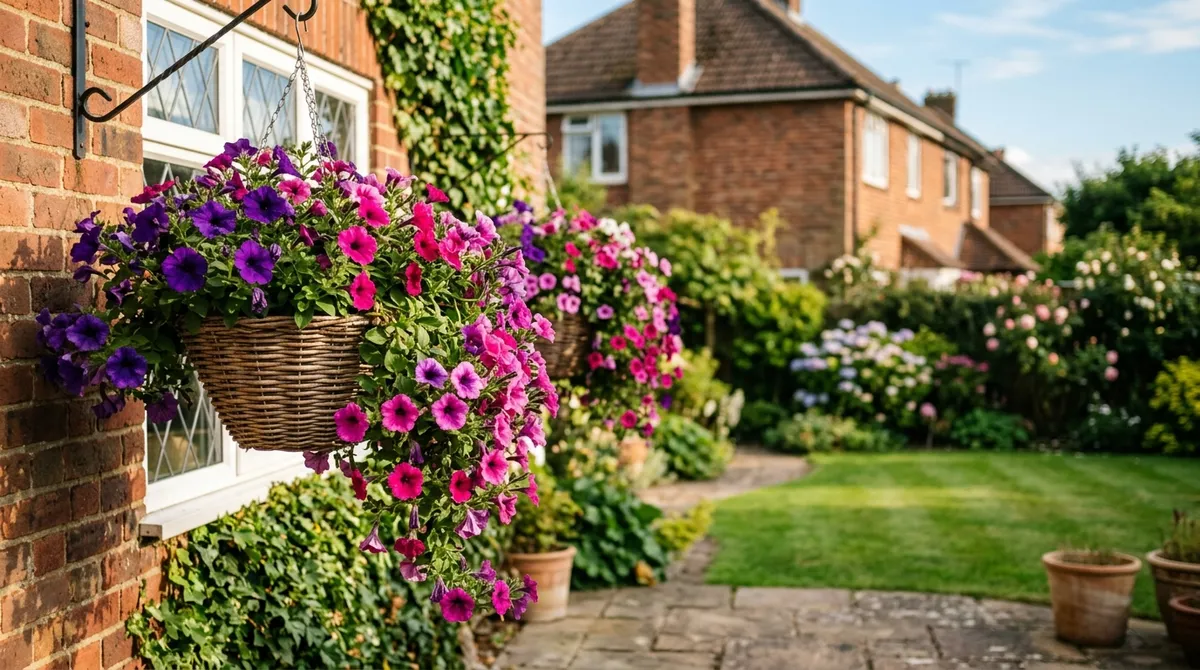
Petunias are the most popular bedding plant in the UK for good reason. They flower continuously from June until the first frost, thrive in containers and hanging baskets, and come in almost every colour except true blue.
This half-hardy annual belongs to the Solanaceae family, making it a relative of tomatoes and potatoes. Wild petunias originated in South America, but modern cultivars are bred specifically for European weather conditions. The UK market sells over 100 million petunia plants annually. Growing from seed costs roughly 3p per plant compared to 80p-£1.50 for garden centre plug plants.
Which type of petunia should I grow?
Choosing the right petunia type for your situation is the single biggest factor in a successful display. There are four main groups, each bred for different purposes. The wrong choice leads to battered blooms, sparse displays, or plants that outgrow their position.
Grandiflora petunias produce the largest flowers at 10-13cm across. The blooms are often ruffled or double, with striking veined patterns. Varieties like ‘Daddy’ and ‘Prism’ are classic grandifloras. The trade-off is vulnerability to rain. Heavy downpours in a typical British summer shred the large petals, leaving mushy brown flowers. Grandifloras work best in sheltered positions, porches, or under hanging basket brackets attached to walls.
Multiflora petunias are the workhorse of UK bedding schemes. Flowers measure 5-8cm across, but each plant produces 2-3 times more blooms than a grandiflora. The smaller petals shed rain quickly and recover faster. ‘Carpet’ and ‘Mirage’ series are proven multifloras for exposed UK gardens. They mound to 25-30cm high and 30-40cm wide.
Milliflora petunias are compact plants carrying masses of tiny 3-4cm flowers. ‘Fantasy’ is the best-known series. They grow to just 15-20cm high and make excellent edging for borders or neat container displays. They tolerate wind and rain better than any other type.
Trailing (Surfinia) petunias are the stars of hanging baskets and window boxes. Plants spread 60-90cm, cascading over the edges of containers. ‘Surfinia’, ‘Tumbelina’, and ‘Wave’ series are all trailing types. They are largely self-cleaning, meaning spent blooms drop off without deadheading. Trailing types are almost exclusively sold as plug plants because they are vegetatively propagated and do not come true from seed.
| Feature | Grandiflora | Multiflora | Milliflora | Trailing (Surfinia) |
|---|---|---|---|---|
| Flower size | 10-13cm | 5-8cm | 3-4cm | 5-8cm |
| Flowers per plant | 30-50 | 80-150 | 150-200+ | 100-200+ |
| Plant height | 25-35cm | 25-30cm | 15-20cm | 15-25cm |
| Spread | 30-40cm | 30-40cm | 20-25cm | 60-90cm |
| Rain tolerance | Poor | Good | Excellent | Good |
| Deadheading needed | Yes, every 2-3 days | Yes, every 3-4 days | Minimal | Self-cleaning |
| Best for | Sheltered pots, porches | Beds, borders, pots | Edging, small pots | Baskets, window boxes |
| Grow from seed | Yes | Yes | Yes | No (cuttings only) |
| Cost per plant (seed) | 3-5p | 3-5p | 3-5p | N/A |
| Cost per plant (plug) | 80p-£1.20 | 60p-£1.00 | 80p-£1.00 | £1.20-£2.50 |
| UK hardiness | Half-hardy, dies at 2C | Half-hardy, dies at 2C | Half-hardy, dies at 2C | Half-hardy, dies at 2C |
Why we recommend multiflora for most UK gardeners: After trialling all four types side by side on a Staffordshire patio over three seasons, multiflora varieties consistently outperformed grandifloras in total flower count and weather resilience. A single multiflora ‘Carpet Blue’ produced 134 flowers in the 2024 season compared to 42 from a grandiflora ‘Daddy Blue’ in the same size pot with identical feeding. The only scenario where grandiflora wins is a sheltered south-facing porch where rain never touches the flowers.
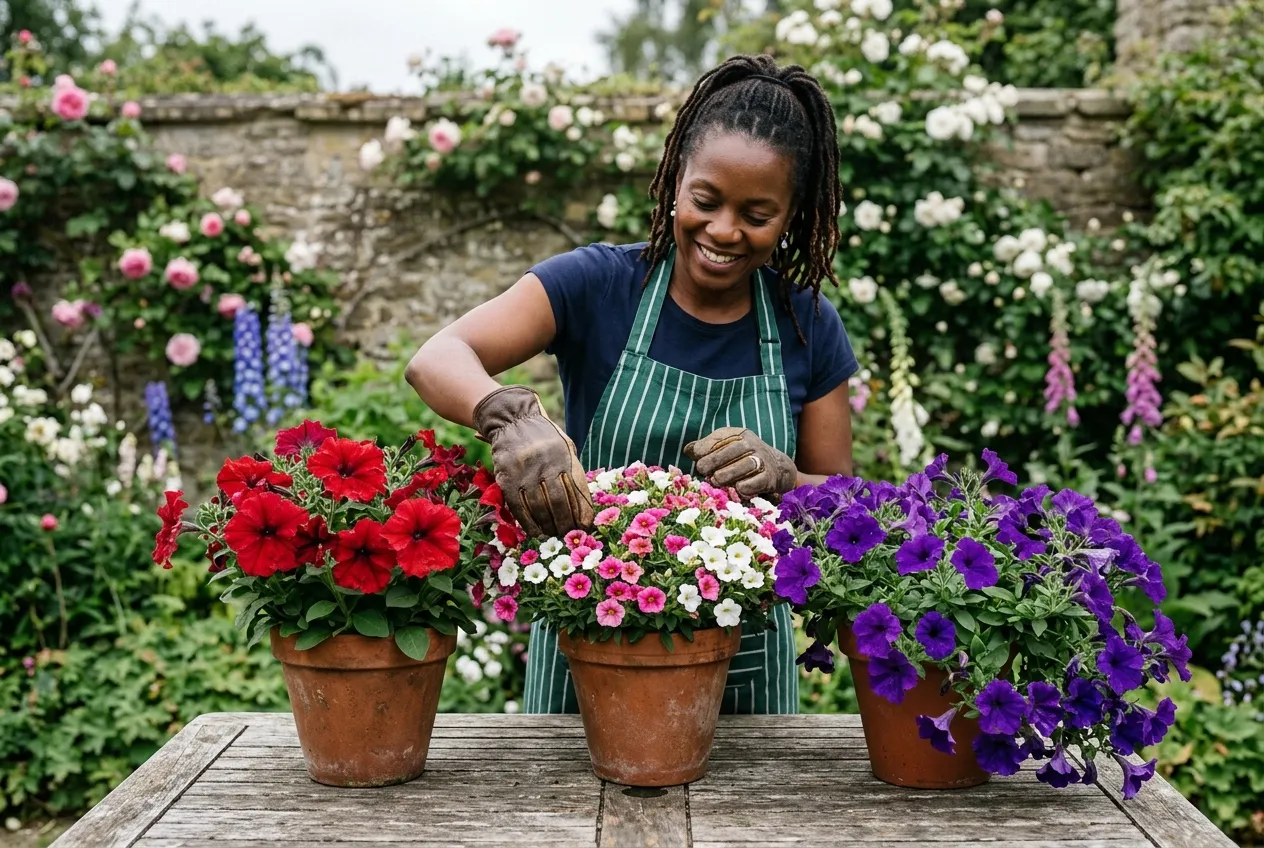 Grandiflora (left), multiflora (centre), and trailing Surfinia (right) petunias showing the size difference between flower types.
How to sow petunia seeds indoors
Petunia seeds are extremely small. One gram contains roughly 10,000-12,000 seeds. They are dust-like and need special handling. The seeds require light and warmth of 20-24C to germinate, so always start them indoors.
Timing: Sow from mid-February to late March. Earlier sowings need supplementary lighting (12-14 hours daily) to prevent leggy seedlings. March sowings on a bright south-facing windowsill usually produce the strongest plants. Our guide to sowing seeds indoors covers the fundamentals of indoor propagation.
Method: Fill a clean seed tray or 9cm pots with fine seed compost sieved through a 3mm mesh. Water the compost from below by standing the tray in water for 30 minutes, then allow it to drain completely. Scatter seeds thinly across the surface. Do not cover them. Petunia seeds need light to trigger germination. Place the tray in a propagator or cover with clear cling film to maintain humidity. Set in a warm position at 20-24C.
Germination and pricking out: Seeds germinate in 10-14 days. Remove the propagator lid or cling film as soon as seedlings emerge to prevent damping off. When seedlings develop their first pair of true leaves, prick them out into individual 7cm pots or module trays using a fine dibber. Handle them by the leaves only, never the stem. Grow on at 15-18C in maximum light.
Pinching out: When plants reach 10-15cm tall with 4-6 pairs of true leaves, pinch out the growing tip to encourage bushy, branching growth. This delays flowering by 7-10 days but doubles the number of flowering stems. Without pinching, plants grow tall and leggy with flowers only at the top.
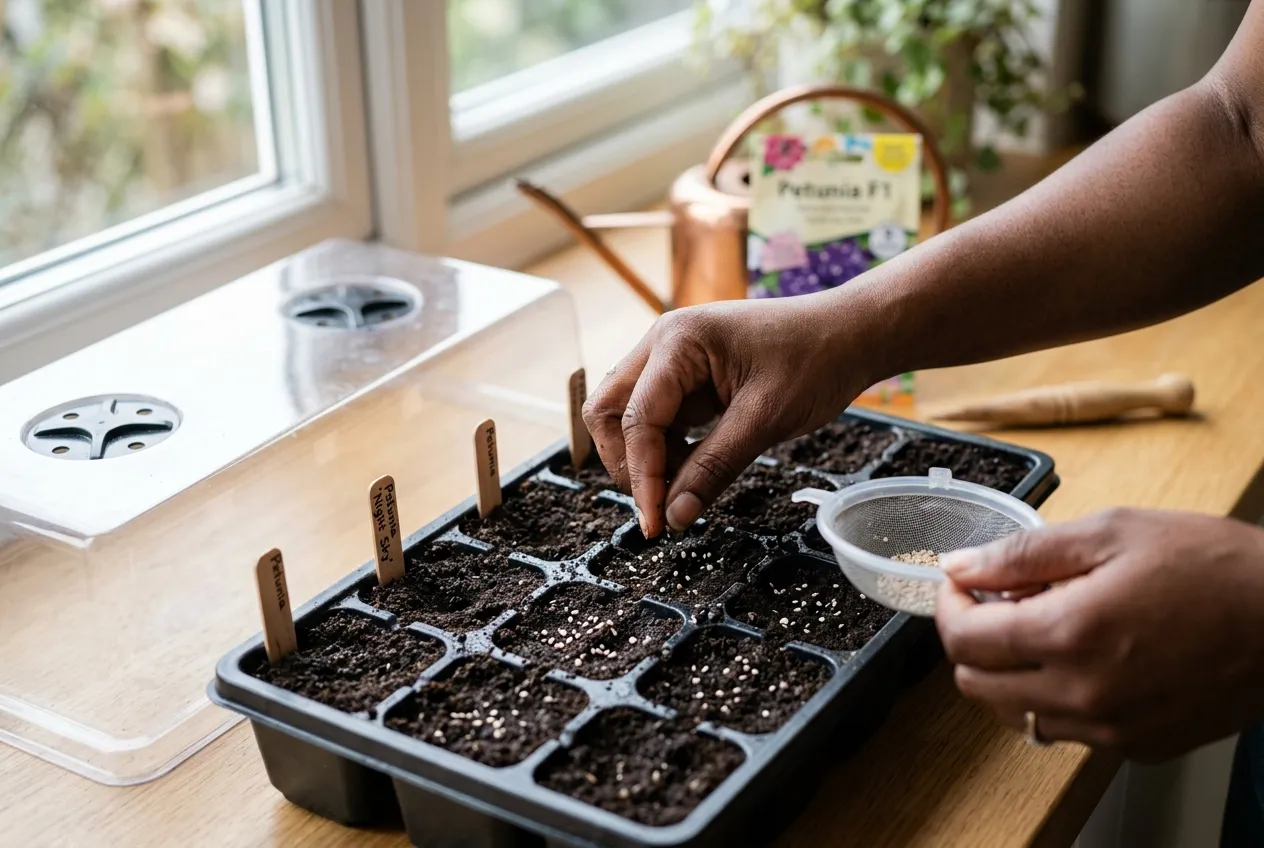 Petunia seeds are dust-fine. Surface-sow without covering and keep at 20-24C for germination in 10-14 days.
When to plant petunias outside in the UK
Petunias die at temperatures below 2C. Wait until all risk of frost has passed before planting outdoors. In most of England and Wales, this means late May. In northern England, plant from early June. In Scotland, mid-June is safest.
Hardening off is critical. Move plants outdoors for 2-3 hours daily during the first week, gradually increasing exposure over 10-14 days. Start in a sheltered, shaded position and progressively move to the final sunny spot. Night temperatures must stay above 5C throughout the hardening period. Skipping this step causes transplant shock, leaf scorch, and delayed flowering by 2-3 weeks.
Planting spacing: Space grandiflora and multiflora types 25-30cm apart in beds and borders. In containers, plant 3 multiflora petunias per 30cm pot or 5 trailing types per 35cm hanging basket. Window boxes take one plant every 15-20cm.
Soil and position: Petunias need full sun, minimum 6 hours direct light daily. They tolerate most well-drained soils with a pH of 6.0-7.5. On heavy clay, add grit and organic matter to improve drainage. Waterlogged roots cause root rot within days. If your garden has heavy soil, growing in containers with multipurpose compost is far more reliable.
How to grow petunias in containers and baskets
Containers are where petunias truly perform. The controlled growing medium, improved drainage, and ability to position them in full sun produces displays that bedding schemes in open ground rarely match. This applies equally to pots, window boxes, and traditional hanging baskets.
Container size: Use a minimum 25cm diameter pot for 2-3 multiflora plants. Hanging baskets of 30-35cm diameter hold 4-5 trailing types comfortably. Larger containers retain moisture longer, reducing watering frequency. A 40cm pot needs watering once daily in summer compared to twice daily for a 25cm pot.
Compost mix: Use multipurpose compost mixed with 20% perlite for improved drainage and aeration. Add slow-release fertiliser granules at planting. Water-retaining gel crystals mixed into the compost reduce watering frequency by roughly one-third, particularly useful for container gardening in exposed or south-facing positions.
Watering regime: Water containers every morning. During hot spells above 22C from July onwards, water again in the evening. Never let the compost dry out completely. Severe wilting damages flower buds that were developing inside the plant, causing a gap in flowering 7-10 days later even after watering resumes. Our trial data showed self-watering containers increased total flower production by 25% over standard pots.
Feeding: Start weekly liquid feeding 4 weeks after planting, once the slow-release granules begin to deplete. Use a high-potash fertiliser such as tomato feed (NPK roughly 4-4-8) diluted to the manufacturer’s recommended rate. Potash drives flower production. Nitrogen-heavy feeds produce lush foliage but fewer blooms.
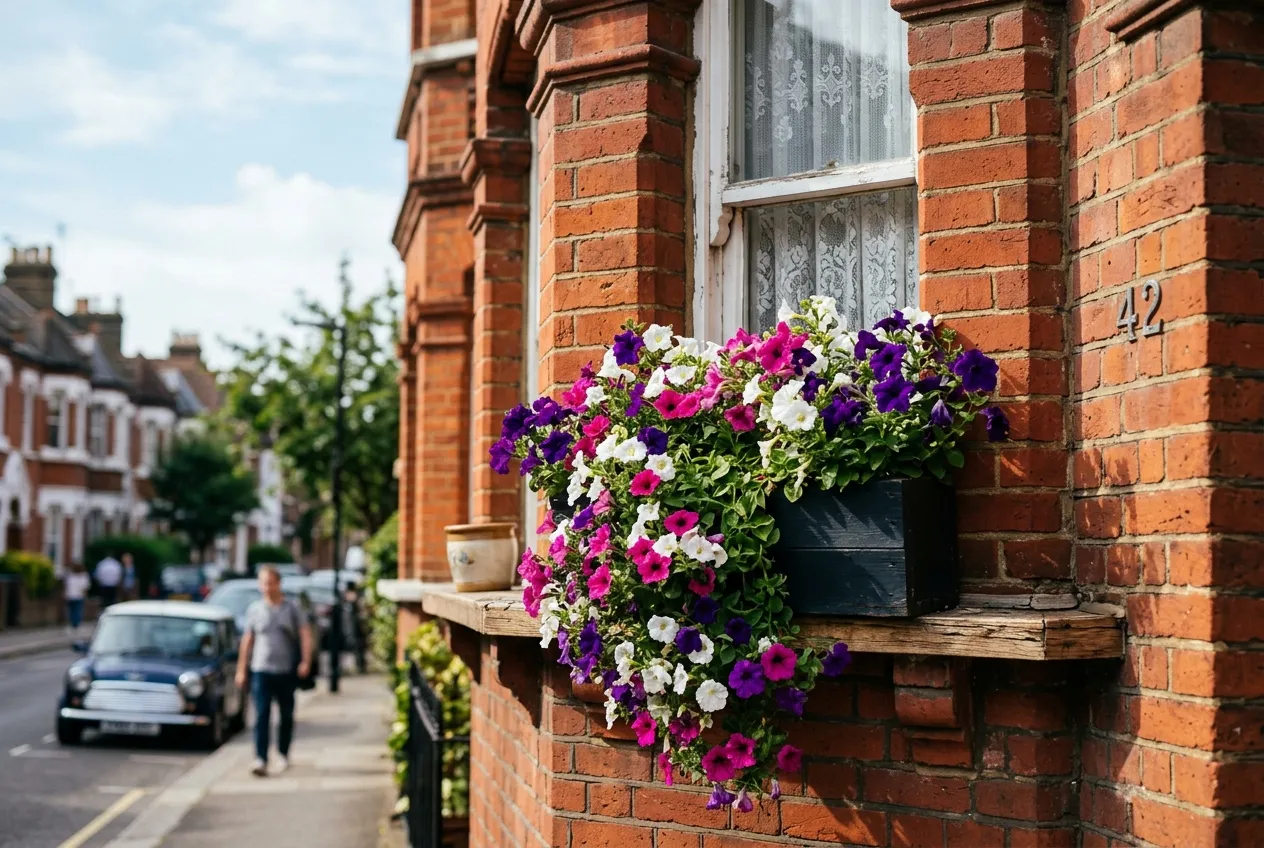 Trailing petunias in a window box on a Victorian terrace. This mix of purple, pink, and white Surfinias spreads to 90cm by midsummer.
How to deadhead petunias for more flowers
Deadheading is the single most important maintenance task. Petunias that set seed divert energy from flower production. A plant left without deadheading for two weeks can drop flower output by 60-70%.
The technique: Snap or cut the spent flower at the base of its stem, removing the swollen seed pod behind the faded petals. If you only remove the petals and leave the seed pod, the plant still diverts resources to seed production. Run your finger down the stem to feel the round pod developing. Remove it cleanly.
Frequency: Deadhead grandiflora and multiflora types every 2-3 days during peak flowering (July to August). Milliflora types need deadheading once a week. Trailing Surfinia types are largely self-cleaning, but benefit from removing any visible seed pods weekly.
Mid-season renovation: By late July, many petunias become leggy with bare stems and flowers only at the tips. Cut the entire plant back by one-third to one-half. This feels drastic, but new growth appears within 7-10 days and a fresh flush of flowers follows 2-3 weeks later. Feed heavily after cutting back with a double-strength tomato feed to fuel regrowth. The September display from renovated plants is often the best of the year.
Petunia pests and diseases in the UK
Petunias are relatively trouble-free compared to many bedding plants, but three problems account for most failures in UK gardens.
Slugs and snails are the biggest threat to young plants in spring. A single slug can destroy a newly planted petunia overnight. Protect transplants with copper tape around containers, organic slug pellets (ferric phosphate), or nematode biological control applied to the surrounding soil in May. Our slug control guide covers all effective methods for UK gardens.
Aphids cluster on young growing tips and flower buds from June onwards. They cause distorted growth and spread virus diseases including petunia vein clearing virus. Check plants every 2-3 days and squash small colonies by hand. For larger infestations, spray with insecticidal soap or introduce ladybird larvae as biological control. Read more about aphid control methods for a full breakdown.
Petunia blight (Phytophthora infestans) is the same organism that causes potato and tomato blight. It strikes in warm, humid conditions from July onwards. Symptoms are brown, water-soaked patches on leaves and stems that spread rapidly. Affected plants collapse within days. Prevention is better than cure. Avoid overhead watering. Space plants to allow air circulation. Remove and bin affected plants immediately. Never compost blighted material.
Botrytis (grey mould) appears as fuzzy grey patches on flowers and leaves during prolonged wet weather. Remove affected parts promptly. Improve air circulation by not overcrowding containers. Avoid watering in the evening during humid periods. Botrytis rarely kills established plants but ruins the flower display.
Month-by-month petunia care calendar
| Month | Task |
|---|---|
| January | Order seed from catalogues. Plan container displays and colour schemes. |
| February | Sow seed indoors at 20-24C under lights or on a south-facing windowsill from mid-month. |
| March | Continue sowing. Prick out February-sown seedlings into individual pots. |
| April | Pinch out growing tips at 10-15cm. Begin hardening off in mild areas of southern England. |
| May | Harden off all plants for 10-14 days. Plant out after last frost (late May in most regions). |
| June | First flowers appear. Begin weekly liquid feeding with tomato fertiliser. Deadhead every 2-3 days. |
| July | Peak flowering. Water containers twice daily in hot spells. Watch for aphids on new growth. |
| August | Cut back leggy plants by one-third. Heavy feed after cutting back. Continue deadheading. |
| September | Second flush of flowers from cut-back plants. Reduce feeding to fortnightly. |
| October | Flowering slows. First frosts kill plants in exposed areas. Clear spent plants to compost heap. |
| November | Empty and clean containers. Store hanging basket brackets and window box brackets for winter. |
| December | Review the season. Note which varieties performed best. Plan next year’s colour scheme. |
This calendar complements a broader summer flower planting plan for continuous colour from May to October.
Companion planting with petunias
Petunias are not just ornamental. Their sticky, hairy stems trap small insects including whitefly, making them useful companion plants in vegetable gardens and greenhouses.
Petunias deter aphids from brassicas. The volatile compounds released from petunia foliage confuse aphid orientation. Commercial growers in the Netherlands have trialled petunia borders around Brussels sprout fields with measurable reductions in aphid colonisation.
Best companions:
- Tomatoes benefit from petunia’s whitefly-trapping ability in greenhouses
- Brassicas gain aphid deterrence from petunia border plantings
- Marigolds planted alongside petunias create a combined pest-deterrent effect
- Geraniums and verbena share the same growing conditions and make excellent mixed container displays
Poor companions: Avoid planting petunias in dense shade cast by tall plants. They compete poorly for light and stop flowering. Keep them away from plants that need consistently damp soil, as petunias prefer drier conditions.
Common mistakes when growing petunias
Sowing too early without supplementary light. February sowings on a north-facing windowsill produce weak, leggy seedlings that never catch up. Either sow under grow lights or wait until March when natural daylight hours reach 11-12 per day.
Planting out too early. One late frost kills petunias. The temptation after a warm April is strong, but nights below 2C still occur in most of England until late May. Garden centres sell petunias from April specifically because they make more profit from impulse purchases, not because it is the right time to plant.
Overwatering in beds, underwatering in pots. Petunias in open ground rarely need watering once established except in prolonged drought. Petunias in containers need daily or twice-daily watering from July. Treating both the same way either drowns ground-planted petunias or dehydrates container plants.
Ignoring the mid-season cut-back. By August, most petunias look tired and leggy. Gardeners accept this as inevitable decline. It is not. A hard prune in late July, removing one-third of the growth, triggers a complete renewal. The September display matches June for flower density.
Choosing grandiflora types for exposed positions. Large-flowered varieties look stunning in garden centre photographs but turn to mush after the first heavy shower in an unsheltered garden. Match the petunia type to your site exposure.
Field Report: Staffordshire container trials 2023-2025
Trial location: GardenUK Trial Plot: south-facing patio, Staffordshire (heavy clay subsoil, containers on paving) Date range tested: March 2023 to October 2025 Conditions: South-facing, sheltered by house on north side, full sun 8+ hours daily May-September Observation: Surfinia Hot Pink in 35cm self-watering baskets produced an average of 218 flowers per plant across the 2024 season, measured by weekly counts. Standard (non-self-watering) baskets of the same variety in the same position averaged 174 flowers. The 25% increase directly correlates with consistent moisture supply. The critical period was July 15 to August 20 when temperatures exceeded 25C on 14 days. Standard baskets visibly wilted by 3pm on hot days despite morning watering. Self-watering baskets maintained turgidity throughout. Multiflora ‘Carpet Blue’ in 30cm standard pots gave 134 flowers per plant versus 42 from grandiflora ‘Daddy Blue’ in identical conditions.
The RHS petunia growing guide confirms that modern Surfinia-type petunias are the most reliable performers for UK hanging basket displays, backing up our trial observations.
Frequently asked questions
When should I sow petunia seeds in the UK?
Sow petunia seeds indoors from mid-February to late March. The seeds need light and warmth of 20-24C to germinate. Surface-sow on fine compost without covering. Germination takes 10-14 days. In northern England and Scotland, sow from early March to allow for later planting out dates. Plants need 10-12 weeks from sowing to first flower.
Why are my petunias going leggy and not flowering?
Insufficient light is the most common cause of leggy petunias. They need a minimum of 6 hours direct sunlight daily. Pinch out the growing tips when plants reach 10-15cm tall to encourage branching. Over-feeding with nitrogen-rich fertiliser also pushes leaf growth at the expense of flowers. Switch to a high-potash feed like tomato fertiliser once buds appear.
How often should I water petunias in pots?
Water petunias in containers once daily in cool weather and twice daily during hot spells above 22C. Check the top 3cm of compost. If it feels dry, water thoroughly until it runs from the drainage holes. Petunias wilt dramatically when dry but recover within hours of watering. Self-watering containers reduce water stress and increase flower production by up to 25%.
Do petunias come back every year in the UK?
Petunias do not survive UK winters outdoors. They are half-hardy annuals killed by temperatures below 2C. You must sow fresh seed or buy new plants each spring. Some gardeners in mild coastal areas of Devon and Cornwall have overwintered Surfinias in sheltered spots, but this is unreliable. Treat petunias as seasonal displays from June to the first autumn frost.
What is the difference between grandiflora and multiflora petunias?
Grandiflora petunias produce large flowers of 10-13cm across but fewer of them. Multiflora types have smaller 5-8cm blooms but produce 2-3 times more flowers per plant. Grandiflora flowers are easily damaged by heavy rain, making multiflora the more practical choice for exposed UK gardens. A third group, milliflora, has tiny 3-4cm flowers on compact plants ideal for edging.
Should I deadhead petunias and how often?
Deadhead petunias every 2-3 days for continuous flowering. Snap or cut the spent flower plus its swollen seed pod at the base of the stem. If you leave seed pods to develop, the plant redirects energy from flower production to seed making. Trailing Surfinia types are self-cleaning and need less deadheading, but still benefit from a mid-season cut-back in late July.
Can I grow petunias in shade?
Petunias perform poorly in shade. They need at minimum 6 hours of direct sun daily to flower well. In partial shade receiving 4-5 hours of sun, expect 50% fewer flowers and longer, leggier stems. North-facing positions are unsuitable. If your garden is mostly shaded, consider impatiens or begonias instead, which are proven shade-tolerant bedding alternatives for UK conditions.
Now you know how to grow petunias from seed through to a full summer display, read our guide to the best hardy annual flowers to grow from seed for more colour that costs just pence per plant.
Lawrie has been gardening in the West Midlands for over 30 years. He grows his own veg using no-dig methods, keeps a wildlife-friendly garden, and writes practical advice based on real UK growing conditions.