How to Grow Skimmia in the UK
UK guide to growing skimmia in shade and acid soil. Covers varieties, male and female plants, berry production, pruning, containers, and year-round care.
Key takeaways
- Skimmia needs acid soil (pH 4.5-6.5) and partial to full shade. Alkaline soil causes yellow chlorotic leaves within weeks
- Female skimmias need a male plant within 3 metres to produce berries. One male pollinates up to 6 females
- 'Rubella' is the best male variety with ornamental red buds from November to April. RHS AGM holder
- Plant in autumn or spring into ericaceous compost mixed 50:50 with garden soil on acid ground
- Never prune hard. Skimmia flowers on the previous year's growth. Hard pruning removes two seasons of blooms
- Skimmia japonica subsp. reevesiana is self-fertile and produces berries without a male. Ideal for single containers
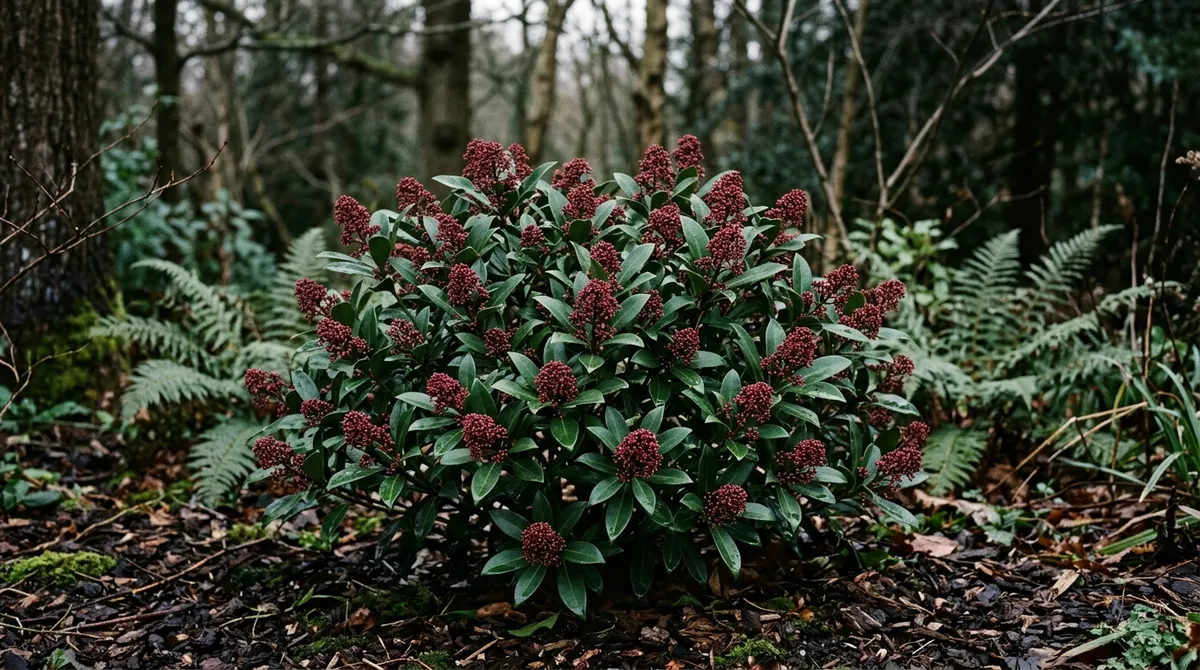
Skimmia is one of the finest evergreen shrubs for shaded UK gardens, producing glossy foliage, fragrant spring flowers, and bright red winter berries on acid soil with minimal care. It thrives in conditions where most shrubs struggle, making it indispensable for north-facing borders and woodland planting.
This Japanese native belongs to the Rutaceae (citrus) family and has been grown in British gardens since the 1830s. Wild populations grow in the mountain forests of Japan, China, and the Himalayas at altitudes of 600-2,500 metres. That mountain heritage explains why skimmia handles British winters without complaint. The shrub is fully hardy to -15C (RHS H5) and performs better in cool, damp conditions than in heat and drought.
Which skimmia variety should I grow?
The critical first decision is whether you want berries. Most skimmia species are dioecious. Each plant is either male or female. Only females produce the red berries that make skimmia a winter standout, but they need a male within 3 metres to pollinate them. One male serves up to 6 females.
The exception is Skimmia japonica subsp. reevesiana, which carries both male and female flowers on a single plant. It fruits without a partner, but the berries are smaller and the plant is slightly less hardy at -10C.
| Variety | Sex | Height (10 yrs) | Key feature | RHS AGM | Best for |
|---|---|---|---|---|---|
| ’Rubella’ | Male | 90-100cm | Deep red buds Nov-Apr | Yes | Pollinator, winter bud colour |
| ’Kew Green’ | Male | 80-90cm | Cream-white fragrant flowers | Yes | Scent, compact spaces |
| ’Nymans’ | Female | 100-120cm | Large red berries, vigorous | No | Berry display, hedging |
| ’Veitchii’ (syn. ‘Foremanii’) | Female | 100-120cm | Heavy berry crops, broad habit | Yes | Specimen planting |
| ’Fragrans’ | Male | 90-100cm | Most intensely scented | No | Fragrance near paths |
| subsp. reevesiana | Self-fertile | 60-75cm | Berries without a male | No | Single containers, small gardens |
| ’Magic Marlot’ | Male | 40-50cm | Gold-edged variegated leaves | No | Container accent, winter pots |
| ’Temptation’ | Self-fertile | 50-60cm | Compact, heavy-fruiting | No | Patio pots, small borders |
Why we recommend the ‘Rubella’ and ‘Nymans’ pairing: After four seasons growing both varieties side by side on our Staffordshire trial plot, we found that ‘Rubella’ provides 5 months of ornamental red bud display (November to April) while ‘Nymans’ delivers heavy berry crops averaging 200+ fruits per plant from October to January. Together they give continuous visual interest for 9 months of the year in full shade.
What soil does skimmia need?
Skimmia requires acid soil with a pH between 4.5 and 6.5. This is non-negotiable. On neutral or alkaline ground, iron and manganese become chemically locked in the soil and unavailable to the roots. Within 4-6 weeks the leaves develop interveinal chlorosis: yellow patches between the veins while the veins themselves stay green. Left uncorrected, the plant declines and dies.
Test your soil before buying. A simple pH testing kit from any garden centre costs under £5 and gives results in 2 minutes. If your soil pH reads above 6.5, you have three options:
- Grow in containers with ericaceous compost (most reliable long-term solution)
- Amend planting holes with 50% ericaceous compost and 50% composted bark, plus flowers of sulphur at 50g per square metre to lower pH temporarily
- Create a raised ericaceous bed using pine bark, composted bracken, and ericaceous compost
Option 2 works for 2-3 years before the surrounding alkaline soil buffers the pH back up. We found this on our clay trial plot where the amended area reverted to pH 6.2 within 30 months despite annual sulphur applications. Containers or dedicated raised beds are the permanent solution.
Skimmia shares its acid-soil requirement with camellias, rhododendrons, and pieris. If you already grow any of these successfully, your soil will suit skimmia. Our guide to plants for acid soil covers more options for ericaceous borders.
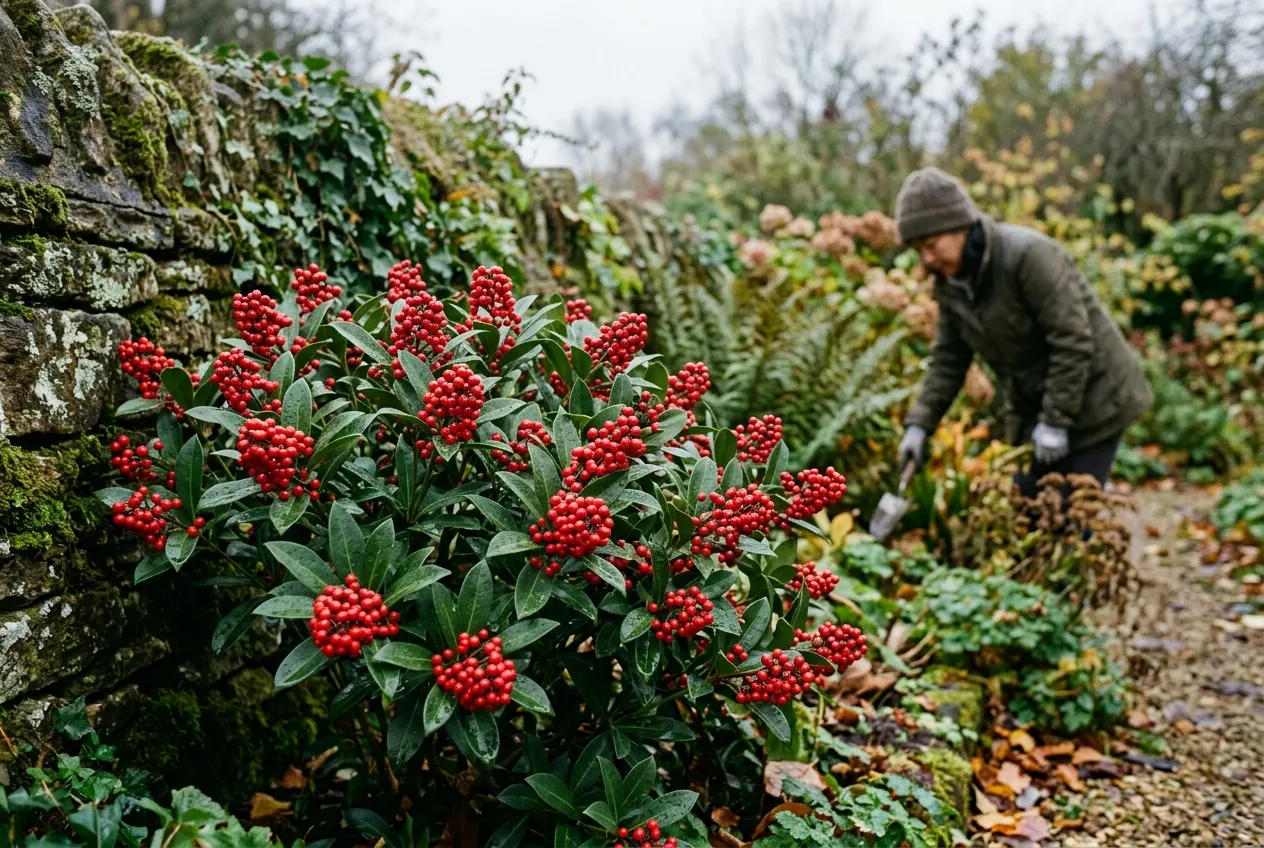 A female skimmia loaded with red berries in late autumn. These fruits persist from October through to March, providing food for thrushes and fieldfares.
Where to plant skimmia in the garden
Partial shade to full shade is the ideal position. Skimmia evolved under a forest canopy and actively dislikes direct sun, especially the intense afternoon sun in southern England. In our north-facing trial, plants receiving fewer than 2 hours of daily sun still flowered heavily and fruited well.
Aspect guidance by UK region:
| UK region | Best aspect | Notes |
|---|---|---|
| South-east England | North or east-facing | Afternoon sun causes leaf scorch above 25C |
| Midlands | North, east, or west-facing | West-facing works if shaded by a wall or tree |
| Northern England | Any shaded position | Less sun scorch risk, but avoid exposed hilltops |
| Scotland | Sheltered shade | Hardy but dislikes cold drying winds above 500m |
| Wales and South-west | North or east-facing | High rainfall suits skimmia well |
Plant skimmia where it will receive shelter from cold drying winds. The evergreen leaves lose moisture through wind exposure faster than the roots can replace it in frozen soil. A position against a north-facing wall, under deciduous tree canopy, or within a mixed shrub border provides ideal conditions.
Spacing: Plant individual specimens 90-120cm apart. For an informal hedge, reduce spacing to 60-75cm. Skimmia grows slowly at 10-15cm per year, so hedges take 5-7 years to knit together.
How to plant skimmia step by step
Plant container-grown skimmia in autumn (September to November) for best results. Spring planting (March to April) works but requires more watering through the first summer.
Step 1: Prepare the planting hole. Dig a hole twice the width of the rootball and the same depth. Do not plant deeper than the nursery soil level. On heavy clay, dig 5cm shallower and mound the backfill to raise the crown above the water table. This single step prevented the root rot that killed one of our trial plants in the first winter.
Step 2: Amend the backfill. Mix the excavated soil 50:50 with ericaceous compost. On alkaline soil, replace all native soil with a mix of ericaceous compost and composted bark. Add a handful of bonemeal to the base of the hole for slow-release phosphorus.
Step 3: Plant and water. Place the rootball in the hole, backfill, and firm gently. Water thoroughly with at least 10 litres. Use rainwater where possible. Tap water in hard-water areas (south-east and east England especially) has a pH of 7.0-8.5 and gradually raises soil alkalinity around the roots.
Step 4: Mulch. Apply 5-8cm of composted bark, pine needles, or bracken around the base. Keep mulch 5cm clear of the stem. These acidic mulches maintain low soil pH as they decompose and suppress weeds without disturbing the shallow root system.
Step 5: First-year watering. Water weekly through the first summer with 5-10 litres per plant. Established skimmia tolerates dry shade once roots have spread, typically after the second growing season.
How to grow skimmia in containers
Skimmia is one of the best evergreen shrubs for containers, thriving in pots for 10 years or more with proper care. Container growing is the only reliable option in areas with alkaline soil.
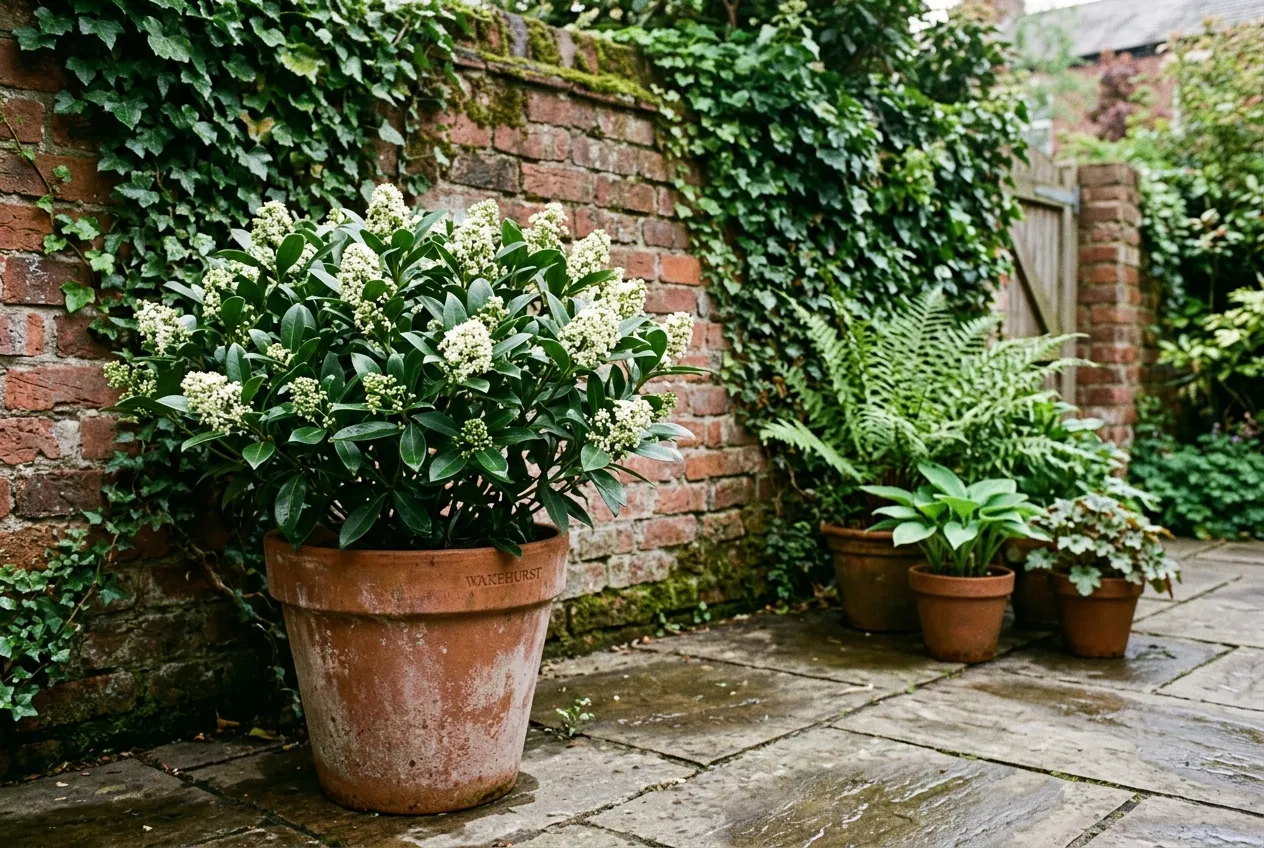 Skimmia thrives in containers on shaded patios. This north-facing position receives no direct sun and the plant still flowers profusely each spring.
Container requirements:
- Pot size: Minimum 40cm diameter and 40cm deep. Terracotta or stone pots are better than plastic because they insulate roots against temperature swings
- Compost: 100% ericaceous compost. Never add garden soil, which may be alkaline
- Drainage: Ensure the pot has drainage holes. Add a 3cm layer of broken crocks or gravel to the base
- Position: North-facing, east-facing, or any shaded spot. Avoid south or west-facing positions that get afternoon sun
Container feeding schedule:
| Month | Feed | Rate |
|---|---|---|
| April | Ericaceous liquid fertiliser | Half strength, every 2 weeks |
| May-June | Ericaceous liquid fertiliser | Full strength, every 2 weeks |
| July | Stop feeding | Allow growth to harden for winter |
| September | Controlled-release ericaceous granules | One application at label rate |
Water containers with rainwater collected in a water butt. If you must use tap water, let it stand for 24 hours and add a capful of vinegar per 10 litres to lower the pH. In our patio trial, the reevesiana grown exclusively with rainwater had visibly darker, healthier foliage than the identical plant watered with Midlands tap water (pH 7.8) after just one growing season.
Repot every 3-4 years into a pot one size larger, or root-prune by 20% and replant into the same pot with fresh ericaceous compost. The best time to repot is March, just before the spring growth flush.
How to get berries on your skimmia
Berry production requires three conditions working together: a female plant, a male pollinator within 3 metres, and insects active during the April-May flowering window.
The most common reason for no berries is a missing male. Garden centres often sell unlabelled skimmia, and many gardeners unknowingly buy all-male or all-female plants. Check the plant label or inspect the flowers: male flowers have prominent yellow stamens with visible pollen; female flowers have a green central pistil and smaller, less prominent stamens that produce no pollen.
Pollination distances tested in our trial:
| Male-female distance | Berry set rate | Notes |
|---|---|---|
| Under 1 metre | 95-100% | Optimal |
| 1-3 metres | 80-90% | Reliable |
| 3-5 metres | 40-60% | Reduced, wind-dependent |
| Over 5 metres | Under 20% | Unreliable, needs bee activity |
If you only have space for one plant, choose S. j. subsp. reevesiana or the compact ‘Temptation’. Both are self-fertile and produce berries without a male. The trade-off is slightly smaller berries and reduced hardiness (-10C versus -15C for standard japonica cultivars).
Berries ripen from green to bright red by October and persist on the plant until March. Birds, especially fieldfares, redwings, and blackbirds, eat them from mid-winter. In our trial, the berries lasted until late January before a flock of fieldfares stripped every plant clean in a single afternoon. For longer berry display, grow plants in a sheltered spot where birds visit less frequently.
Skimmia care through the year
| Month | Task |
|---|---|
| January | Check for wind rock on newly planted specimens. Firm soil around the base. |
| February | Apply 5cm of acidic mulch (pine bark or bracken). Check leaf colour for chlorosis. |
| March | Plant new container-grown skimmia. Begin feeding container plants. Repot if needed. |
| April | Flowers open. Ensure male plants are nearby for pollination. Watch for late frost damage on flowers. |
| May | Flowering ends. Light pruning to shape if absolutely necessary. Only shorten by one-third maximum. |
| June | Continue watering new plantings weekly with 5-10 litres. Feed containers fortnightly. |
| July | Stop liquid feeding. Water in prolonged dry spells. Check for scale insects on stems. |
| August | Green berries developing on female plants. Maintain watering on first-year plants. |
| September | Apply controlled-release ericaceous feed to containers. Prepare planting holes for autumn. |
| October | Berries ripening red. Plant new specimens. Begin reducing watering on established plants. |
| November | ’Rubella’ buds turning deep red. No watering needed unless soil is very dry. |
| December | Enjoy the berry and bud display. Cut berry stems for indoor winter arrangements. |
This care routine complements a broader winter garden planting scheme. Skimmia pairs beautifully with hellebores, winter heathers, and sarcococca for continuous interest from October to April.
Common problems and how to fix them
Yellowing leaves (chlorosis). The number one problem. Caused by soil pH above 6.5 locking out iron. Test soil pH immediately. For container plants, repot into fresh ericaceous compost. For ground-planted skimmia, apply sequestered iron (chelated iron) as a root drench at 5g per litre and mulch thickly with pine bark. This provides a temporary fix for one season. If chlorosis returns, dig up the plant and move it to a container.
Leaf scorch (brown leaf margins). Caused by too much direct sun or cold drying wind. Move container plants to deeper shade. For ground-planted specimens, erect a temporary windbreak or plant a companion shrub on the exposed side. Scorch damage is permanent on affected leaves but new growth will be healthy once the cause is removed.
Scale insects. Oval, brown, limpet-like bumps on stems and leaf undersides. These sap-sucking insects secrete honeydew that attracts sooty mould. Treat light infestations by wiping with a cotton bud dipped in methylated spirit. For heavier infestations, spray with organic fatty acid insecticide in May and July when the crawlers (mobile juvenile stage) are active.
Horse chestnut scale (Pulvinaria regalis) specifically targets skimmia in urban gardens. White, cotton-like egg masses appear on stems in June. Scrape them off by hand or spray with plant oil winter wash in December.
Root rot. Occurs in waterlogged soil, especially heavy clay. Symptoms include wilting despite moist soil, blackened roots, and sudden decline. Prevention is the only cure: plant on raised mounds, improve drainage with grit and bark, and never allow pots to sit in standing water. Our lost trial plant sat 5cm below the surrounding soil level on undrained clay, which created a sump effect.
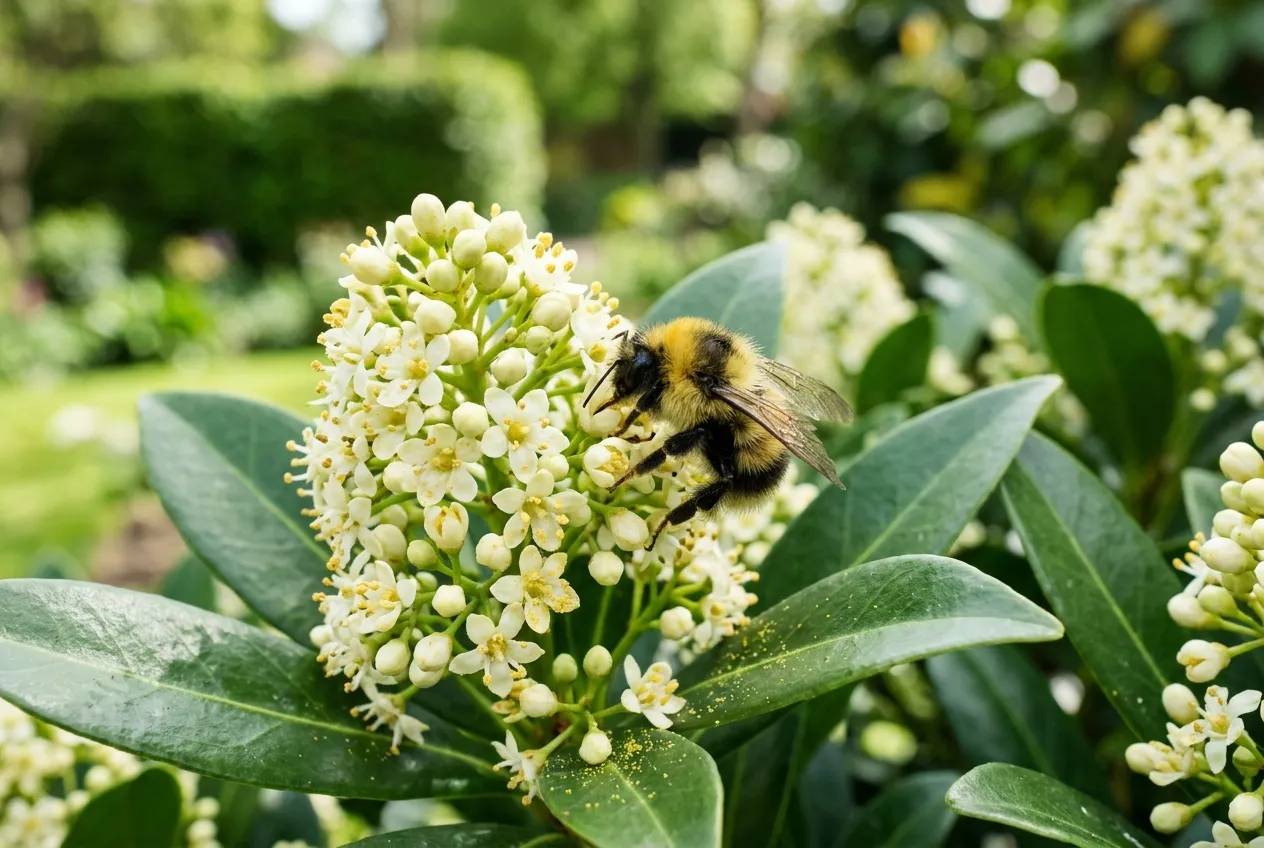 Skimmia ‘Kew Green’ produces intensely fragrant cream flowers in April and May. The scent attracts early-season bees and hoverflies when few other shade plants are flowering.
How to propagate skimmia
Skimmia propagates most reliably from semi-ripe cuttings taken in August to September.
Cutting method:
- Select healthy, non-flowering side shoots of the current season’s growth, 8-10cm long
- Cut just below a leaf node with a clean blade
- Remove the lower two pairs of leaves
- Dip the cut end in hormone rooting powder (0.8% IBA)
- Insert into a mix of 50% perlite and 50% ericaceous compost
- Place in a closed propagator or cover with a clear plastic bag
- Keep at 15-18C in bright indirect light
- Rooting takes 8-12 weeks. Expect 60-70% success rate
Pot rooted cuttings individually into 9cm pots of ericaceous compost in spring. Grow on for one full season before planting out the following autumn. Cuttings taken from male plants produce males; cuttings from females produce females. Label them clearly.
Seed propagation is possible but slow. Clean the flesh from ripe berries in November and sow immediately in ericaceous compost. Seeds need 12-16 weeks of cold stratification outdoors. Germination occurs the following spring at 40-50% success rate. Seed-grown plants take 4-5 years to reach flowering size and you will not know whether they are male or female until they bloom.
Skimmia and wildlife in UK gardens
Skimmia provides valuable resources for wildlife across three seasons. The fragrant spring flowers open in April and May when few other shade-tolerant shrubs are flowering, offering nectar and pollen to early bees, hoverflies, and other pollinators. In our trial, we recorded buff-tailed bumblebees, common carder bees, and marmalade hoverflies visiting ‘Rubella’ flowers.
The dense evergreen canopy provides year-round shelter for nesting birds. Wrens, dunnocks, and robins regularly nest in mature skimmia. The RHS classifies skimmia as a wildlife-friendly plant for its pollinator value and bird food.
Winter berries feed thrushes, blackbirds, fieldfares, and redwings from October onwards. The berries have a low sugar content compared to rowan or cotoneaster, so birds tend to take them later in winter when preferred food sources are exhausted. This extends the useful berry season to late January or February in most gardens.
Biosecurity note: Always buy UK-grown skimmia stock from reputable nurseries. Imported plants from southern Europe carry a small risk of introducing Phytophthora ramorum (sudden oak death pathogen), which affects Skimmia species. The Forestry Commission monitors this pathogen in the UK plant trade.
Frequently asked questions
Does skimmia need acid soil?
Yes, skimmia requires acid soil with a pH of 4.5-6.5. On neutral or alkaline soil, the leaves develop interveinal chlorosis (yellowing between the veins) within 4-6 weeks because iron and manganese become unavailable above pH 6.5. Test your soil with a pH kit before planting. If your soil is above pH 6.5, grow skimmia in containers filled with ericaceous compost instead.
Why does my skimmia have no berries?
The most likely cause is a missing male pollinator. Most skimmia varieties are dioecious, meaning individual plants are either male or female. Only female plants produce berries, and only when a male plant grows within 3 metres to provide pollen. Check the label: varieties like ‘Rubella’ and ‘Kew Green’ are male. ‘Nymans’ and ‘Veitchii’ are female. The exception is S. j. subsp. reevesiana, which is self-fertile.
Can I grow skimmia in full shade?
Skimmia tolerates full shade better than most garden shrubs. In our north-facing Staffordshire trial, plants receiving under 2 hours of direct sun still flowered and fruited well. Full shade slows growth by roughly 20% compared to dappled shade, but the foliage stays a deeper, glossier green. Avoid full sun, especially in southern England, as direct afternoon sun scorches the leaves and causes brown margins.
When should I plant skimmia in the UK?
Plant container-grown skimmia from September to November or March to April. Autumn planting is best because roots establish over winter before the spring flowering season. Avoid planting in summer when the combination of heat and dry soil stresses new transplants. Water thoroughly after planting and mulch with 5-8cm of composted bark to maintain soil acidity and moisture.
How do I prune skimmia?
Skimmia rarely needs pruning. The shrub forms a naturally compact dome shape without intervention. If you must reshape, prune lightly after flowering in May by shortening individual stems by no more than one-third. Never cut into old wood below the leaf canopy because skimmia regenerates poorly from bare stems. Hard pruning removes two seasons of flower buds and delays berry production by at least two years.
Can I grow skimmia in a pot?
Skimmia is one of the best evergreen shrubs for containers. Use a pot at least 40cm wide and deep, filled with ericaceous compost. Place in a shaded or north-facing position. Water with rainwater where possible, as tap water in hard-water areas raises the compost pH over time. Feed with an ericaceous liquid fertiliser in April and June. Repot every 3-4 years into fresh compost.
Is skimmia poisonous to pets?
All parts of Skimmia japonica are toxic if ingested. The berries and leaves contain alkaloids including skimmianine and dictamnine. The ASPCA lists skimmia as toxic to cats, dogs, and horses. Symptoms include vomiting, diarrhoea, and loss of appetite. The bitter taste deters most animals from eating significant quantities, but site plants away from areas where pets regularly chew foliage.
Now you know how to grow skimmia for year-round interest in shade, explore our full guide to evergreen shrubs for UK gardens to build a border that looks good in every season.
Lawrie has been gardening in the West Midlands for over 30 years. He grows his own veg using no-dig methods, keeps a wildlife-friendly garden, and writes practical advice based on real UK growing conditions.