How to Prune Hydrangeas in the UK
Learn when and how to prune hydrangeas by type. Covers mophead, paniculata, climbing, and oakleaf with a UK month-by-month calendar.
Key takeaways
- Mophead and lacecap hydrangeas flower on old wood. Only remove spent flower heads and one-third of the oldest stems in March to April
- Paniculata and smooth (Annabelle) hydrangeas flower on new wood. Prune hard to 30-45cm in late February to March
- Climbing hydrangea flowers on old wood. Prune lightly after flowering in July to August
- Never cut all stems to the ground on mophead or lacecap types. You will lose an entire season of flowers
- The old wood vs new wood distinction determines everything. Get this wrong and no amount of feeding fixes it
- Sharp bypass secateurs and loppers are the only tools needed for most hydrangea pruning
Knowing when and how to prune hydrangeas correctly is the difference between a shrub covered in blooms and one that produces nothing but leaves. The timing depends entirely on which type you grow, because some flower on old wood and others on new.
I have been growing and pruning eight hydrangea varieties in my West Midlands garden since 2017. The advice in this guide comes from nine seasons of hands-on experience on heavy Staffordshire clay, not from theory. For the full picture on planting, soil, feeding, and changing flower colour, see our companion guide on how to grow hydrangeas in the UK.
Why does pruning timing matter for hydrangeas?
Hydrangeas fall into two groups based on where flower buds form. This single fact controls everything about when and how you prune. Get it wrong and you lose a full season of flowers.
Old wood flowerers (mophead, lacecap, climbing, oakleaf) produce their flower buds on stems that grew the previous year. If you cut these stems off in winter, you remove every bud and get no flowers the following summer. These types need light, targeted pruning only.
New wood flowerers (paniculata, smooth/Annabelle) produce their flower buds on the current season’s growth. You can cut them hard in late winter because fresh stems will grow and flower the same year. These types actively benefit from hard pruning, which produces larger flower heads on stronger stems.
This distinction matters more in the UK than in milder climates. Our late frosts in April and early May can damage exposed buds on old-wood types, making it doubly important to keep protective growth in place over winter. The RHS pruning guide for hydrangeas confirms this grouping approach.
How to prune mophead and lacecap hydrangeas
Mophead and lacecap hydrangeas (both Hydrangea macrophylla) are the most commonly grown types in UK gardens. They flower on old wood, which means the buds for this summer’s flowers formed on last year’s stems. This is where most pruning mistakes happen.
When to prune mopheads and lacecaps
Prune in late March to mid-April. Wait until you can see fat green buds swelling on the stems. These buds tell you which wood is alive and where to cut. Pruning earlier risks frost damage to exposed buds. Pruning later wastes the plant’s energy on growth you are about to remove.
Leave the old flower heads on all winter. They act as frost protection for the buds sitting just below. I tested this directly in my garden in 2020. Six stems where I removed dead heads in November lost their top buds to a minus 8 frost in January. Adjacent stems with dead heads intact came through undamaged.
Step-by-step mophead pruning
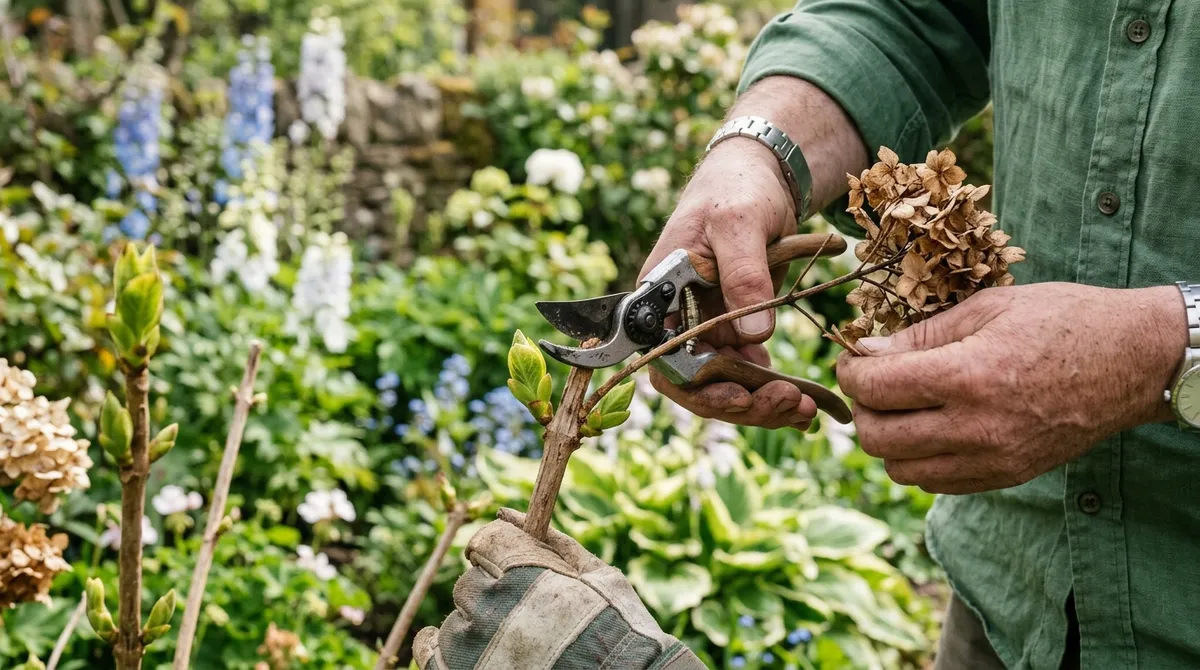
1. Remove spent flower heads. Cut each old flower head back to just above the first strong pair of fat buds below it. This is usually 15-20cm below the old bloom. Use sharp bypass secateurs for a clean cut.
2. Cut out dead and damaged wood. Follow any brown, dead stems down to where you find live wood (green under the bark) or to ground level. Remove the entire dead stem. After a hard winter, you may need to remove several.
3. Remove one-third of the oldest stems. Identify the thickest, woodiest stems growing from the base. These are the oldest. Cut them right down to 5-10cm above ground level. This opens up the centre of the plant and stimulates fresh basal growth that will flower the following year. Our guide to pruning shrubs in the UK explains this one-third renewal approach in detail.
4. Thin crossing branches. Where two stems rub against each other, remove the weaker one. Rubbing creates wounds that invite disease.
5. Shape lightly if needed. Step back and assess the overall outline. Remove any stems that spoil the shape, but resist the urge to cut hard. Less is more with mopheads.
-->Cut each spent flower head to just above the first strong pair of green buds. The buds should be swelling and clearly visible in late March.
How to prune paniculata hydrangeas
Paniculata hydrangeas (Hydrangea paniculata) are the easiest type to prune because they flower on new wood. Popular UK varieties include Limelight, Vanilla Fraise, and Little Lime. They produce large, cone-shaped flower heads from July to September on the current season’s growth.
When to prune paniculata types
Prune in late February to early March, before new growth starts. You have a wider window than with mopheads because you are not protecting existing buds. The aim is to cut back last year’s growth hard, which forces strong new stems that carry bigger flowers.
Step-by-step paniculata pruning
1. Cut all stems back hard. Reduce every stem to 30-45cm above ground level, or to a strong framework of two or three buds above the main branch structure. This feels brutal, but paniculata types respond with vigorous new growth.
2. Remove dead and weak stems entirely. Thin, spindly stems will not carry full-sized flower heads. Cut them to the base. Keep 5-8 strong stems on a mature plant for the best display.
3. Create an open framework. The finished plant should look like a short, open goblet with 5-8 evenly spaced stems. Each stem will produce one or two large flower heads. More stems means more, smaller flowers. Fewer stems means fewer, larger flowers. I prefer fewer stems and bigger blooms.
In my garden, a Limelight paniculata pruned to 40cm every March produces flower heads 30cm long. The same plant left unpruned for two years produced heads barely 15cm long on congested, weak stems. Hard pruning is not optional for this type. It is the entire point.
-->A paniculata hydrangea after hard pruning in March. The framework of 6 stems at 40cm will produce large flower heads by July.
How to prune climbing hydrangea
Climbing hydrangea (Hydrangea petiolaris) is a self-clinging climber that produces flat, white lacecap flowers in June and July. It flowers on old wood, so timing is critical. It is one of the best plants for shaded walls and north-facing fences where few other climbers thrive.
When to prune climbing hydrangea
Prune immediately after flowering in July to August. This gives the plant the full growing season to produce the new shoots that will carry next year’s flowers. Never prune in winter or spring. You will remove the flower buds for the coming season.
How to prune climbing hydrangea
Climbing hydrangea needs very little pruning in its first 3-5 years. It is famously slow to establish. Once it begins flowering, prune as follows.
1. Cut back flowered shoots. After the blooms fade, shorten each flowered shoot to a pair of healthy buds. This keeps growth tight against the wall or fence.
2. Remove outward-growing stems. Climbing hydrangea throws out long stems that grow perpendicular to the support. Cut these back to the main framework to keep the plant flat and tidy.
3. Control spread. If the plant is outgrowing its space, cut back side shoots to the main framework. You can remove entire branches if necessary, but do this gradually over two or three seasons rather than cutting back aggressively in one go.
4. Leave self-clinging roots alone. The aerial roots that attach to the wall are harmless on sound masonry. Do not try to scrape them off old wood.
How to prune oakleaf hydrangea
Oakleaf hydrangea (Hydrangea quercifolia) has large, lobed leaves that turn deep burgundy in autumn and cone-shaped white flowers in summer. It flowers on old wood and needs minimal pruning.
When and how to prune oakleaf types
Prune lightly after flowering in August, or in early spring to remove any winter-damaged wood. The approach is simple:
1. Remove dead or damaged stems at any time of year.
2. Cut out crossing branches that rub or create congestion in the centre.
3. Shorten overly long stems to maintain shape, cutting to a healthy outward-facing bud.
4. Do not prune hard. Oakleaf hydrangeas grow slowly and do not respond well to heavy cutting. They rarely need size reduction. If yours is too large, it was planted in the wrong spot. Consider moving it rather than fighting it with annual hard pruning.
In nine years, I have pruned my oakleaf hydrangea a total of three times. Twice to remove frost-damaged tips and once to take out a crossing branch. It flowers reliably every year without intervention.
How to prune smooth hydrangea (Annabelle)
Smooth hydrangea (Hydrangea arborescens), most commonly the variety Annabelle, produces huge white snowball flower heads up to 30cm across. It flowers on new wood, making pruning straightforward.
When and how to prune Annabelle
Prune in late February to early March, using the same approach as paniculata types.
1. Cut all stems to 15-30cm above ground. Annabelle responds to very hard pruning with fewer but enormous flower heads. Left unpruned, it produces many smaller blooms on weaker stems that flop.
2. Remove weak and dead stems at ground level. Keep 4-6 of the strongest stems on a mature plant.
3. Support may be needed. Hard-pruned Annabelle produces single stems carrying very large, heavy flower heads. In exposed or windy positions, these need support. Insert a grow-through ring in March before growth covers it. Alternatively, prune to 45cm instead of 15cm for slightly shorter stems that support themselves better but carry smaller flowers.
A reader recently asked why their Annabelle flops after rain. The answer is almost always that the plant was not pruned hard enough. Cut it lower and the stems come back thicker and more self-supporting. This is one type where harder pruning gives better results every time.
-->Annabelle hydrangea after hard pruning to 20cm in March. The stems regrew strongly and each carries a single large flower head by July.
Hydrangea pruning comparison table
This table summarises the key differences between all five types. Print it or save it to your phone so you have it to hand in the garden.
| Hydrangea type | Flowers on | When to prune | How hard | What to remove |
|---|---|---|---|---|
| Mophead (H. macrophylla) | Old wood | Late March to mid-April | Light: dead heads + one-third oldest stems | Spent flower heads, dead wood, oldest thick stems |
| Lacecap (H. macrophylla) | Old wood | Late March to mid-April | Light: dead heads + one-third oldest stems | Spent flower heads, dead wood, oldest thick stems |
| Paniculata (H. paniculata) | New wood | Late February to early March | Hard: cut to 30-45cm | All stems shortened, weak growth removed entirely |
| Climbing (H. petiolaris) | Old wood | July to August (after flowering) | Light: flowered shoots only | Flowered shoots, outward growth, spread control |
| Oakleaf (H. quercifolia) | Old wood | August or early spring | Minimal: only if needed | Dead or damaged wood, crossing branches |
| Smooth/Annabelle (H. arborescens) | New wood | Late February to early March | Very hard: cut to 15-30cm | All stems shortened, weak stems removed |
UK month-by-month hydrangea pruning calendar
Knowing what to do each month removes the guesswork. This calendar covers all types grown in UK gardens.
January: No pruning. Leave old flower heads on mopheads and lacecaps for frost protection. Check for wind damage after storms and remove any broken branches cleanly.
February (late): Prune paniculata and smooth (Annabelle) types hard. Cut stems to 30-45cm (paniculata) or 15-30cm (Annabelle). Remove dead and weak wood. This is also a good month to sharpen your secateurs and loppers before the busy pruning season.
March (late): Prune mophead and lacecap hydrangeas. Wait until buds swell so you can see where live wood begins. Remove dead heads, cut out dead wood, take out one-third of the oldest stems at the base. Late March is also the right time to prune roses, so plan both jobs for the same weekend.
April: Finish any remaining mophead and lacecap pruning by mid-month. After this point, new growth is too advanced to prune without damaging developing shoots.
May to June: No pruning. All types are in active growth. Flower buds are forming or opening.
July to August: Prune climbing hydrangea after flowering. Prune oakleaf hydrangea lightly if needed after flowering. The best flowering shrubs for UK gardens all have specific post-flower pruning windows like this.
September to December: No pruning on any type. Leave all growth and dead flower heads in place over winter. Feeding with a potash-rich fertiliser in September helps harden growth before cold weather arrives.
What tools do I need to prune hydrangeas?
You need very few tools. Hydrangea wood is soft compared to trees and tough shrubs.
Bypass secateurs handle stems up to 15mm diameter. This covers most hydrangea pruning. Use bypass (scissor-action) secateurs rather than anvil types. Anvil secateurs crush soft hydrangea stems instead of cutting cleanly.
Loppers are needed for stems between 15mm and 35mm. On a mature mophead that has not been regularly thinned, the oldest basal stems can reach 25-30mm thick. Long-handled loppers give the leverage to cut these cleanly.
A pruning saw is occasionally needed for very old, thick stems on neglected plants. A folding pruning saw with a 15cm blade fits into the centre of congested shrubs where loppers cannot reach.
Clean your tools between plants. Wipe blades with methylated spirit to avoid spreading diseases like honey fungus and coral spot. The RHS plant disease guide highlights honey fungus as one of the most destructive UK garden pathogens. Hydrangeas are susceptible to several fungal problems, and dirty tools are one of the main transmission routes.
Common hydrangea pruning mistakes
These are the errors I see most often in the gardens I visit. Every one of them is easily avoided.
Pruning mopheads in autumn or winter
This is the most frequent mistake. Gardeners tidy the garden in November and cut back mopheads along with everything else. The result is no flowers the following summer, because every bud has been removed. Leave the dead heads on. They protect the buds through winter and look attractive covered in frost.
Cutting all stems to the ground
Only paniculata and Annabelle types tolerate this. On a mophead, cutting everything to the ground means no flowers for at least one full year, sometimes two. The plant has to grow entirely new stems and then form buds on those stems before it can flower again.
Not pruning paniculata types hard enough
The opposite mistake. Gardeners treat paniculata types gently because they are nervous about cutting hard. The result is a congested plant with dozens of small, disappointing flower heads on weak stems. Cut hard to 30-45cm and you get fewer, bigger, showier blooms on stems strong enough to hold them upright.
Removing too many stems at once on old-wood types
If your mophead or lacecap is overgrown, resist the temptation to cut it all back in one go. Remove no more than one-third of stems per year. Spread renovation over three years. The plant keeps flowering throughout the process and you avoid the shock response that produces masses of foliage but no blooms.
Using blunt or dirty tools
Blunt secateurs crush hydrangea stems rather than cutting them. Crushed tissue dies back further than a clean cut and creates entry points for disease. Clean tools with methylated spirit between plants, especially if you have been cutting out any diseased material.
Field Report: 9 years of hydrangea pruning trials
Location: Sheltered west-facing border, heavy clay, South Staffordshire. Period: 2017-2026. Plants tested: 2 mophead (Nikko Blue, Endless Summer), 2 lacecap (Lanarth White, Bluebird), 1 paniculata (Limelight), 1 climbing (H. petiolaris), 1 oakleaf (Snow Queen), 1 Annabelle.
Mophead timing test (2020): I removed dead flower heads from one Nikko Blue in November and left them on the second until March. A minus 8 frost on 7 January 2021 killed roughly half the exposed buds on the November-stripped plant. The March-stripped plant flowered normally. I have not removed dead heads before March since.
Paniculata severity test (2019-2022): I pruned the Limelight to 40cm in March 2019 and 2020, producing flower heads averaging 28cm long. In 2021, I left it unpruned as a comparison. Flower heads that year averaged 14cm and the stems flopped sideways. Hard pruning resumed in 2022 with immediate improvement to 30cm heads on upright stems.
Annabelle height test (2023): I pruned one side of the Annabelle to 15cm and the other to 45cm. The 15cm side produced 4 flower heads averaging 28cm diameter but needed staking. The 45cm side produced 7 flower heads averaging 18cm diameter on self-supporting stems. Both approaches work, depending on whether you want bigger blooms or a tidier, unsupported plant.
Climbing hydrangea establishment (2017-2020): The petiolaris produced no flowers for three years after planting. It covered 2 square metres of wall before flowering in year four. Pruning in those first three years was limited to removing stems growing away from the wall. Patience is essential with this climber.
Soil note: All eight plants grow in heavy clay soil with organic matter worked into the planting holes. Hydrangeas tolerate clay well. The moisture retention suits them, though drainage at the base must be adequate to prevent root rot over winter.
How to renovate a neglected, overgrown hydrangea
An overgrown hydrangea is not a lost cause. Unlike lavender, which cannot regrow from bare wood, most hydrangea types push new shoots from old stems and from ground level.
Renovation plan for mophead and lacecap types
Year 1 (March): Remove one-third of the oldest, thickest stems at ground level. Remove all dead wood. Keep the remaining two-thirds untouched so the plant still flowers.
Year 2 (March): Remove half of the remaining old stems. The plant now has a mix of old flowering stems and strong new growth from year one’s cuts.
Year 3 (March): Remove the last batch of original old stems. The plant is now entirely renewed with vigorous growth no more than three years old. Resume normal annual pruning.
Renovation for paniculata and Annabelle types
These are simpler. In late February, cut the entire plant to 15-30cm above ground. It will regrow completely in one season. No phased approach needed.
Feed after renovation
Any hard-pruned hydrangea benefits from feeding. Apply a balanced fertiliser (such as Growmore at 70g per square metre) around the base in April after pruning. Mulch with garden compost to 8cm depth, keeping it away from the main stems. Water well through the first summer after renovation.
-->Year one of renovation pruning. One-third of the oldest stems removed at ground level. The remaining stems will flower normally while new growth fills the gaps.
Frequently asked questions
When should I prune mophead hydrangeas in the UK?
Late March to mid-April is the best window. Remove spent flower heads by cutting to just above the first strong pair of buds below the old bloom. At the same time, cut out one-third of the oldest stems at ground level to encourage fresh growth from the base. Never prune mopheads in autumn or winter. The old flower heads protect developing buds from frost.
Can I cut my hydrangea right back to the ground?
Only if it is a paniculata or smooth type. These flower on new wood and regrow vigorously after hard pruning. Mophead and lacecap hydrangeas flower on stems formed the previous year. Cutting them to the ground removes every flower bud and you get foliage only the following summer.
Why did my hydrangea not flower this year?
Wrong pruning timing is the most common cause. If you pruned a mophead or lacecap in autumn or winter, you removed the buds that would have flowered. Late spring frost can also kill exposed buds, particularly on plants where protective old flower heads were removed too early. Leave old blooms on until late March.
How do I know if my hydrangea flowers on old or new wood?
Check the type. Mophead, lacecap, climbing, and oakleaf flower on old wood (stems from the previous year). Paniculata and smooth (Annabelle) flower on new wood (current season’s growth). If you are unsure of the type, leave the plant unpruned for one season and note where flowers appear.
Should I remove dead hydrangea flower heads in autumn?
No, leave them on over winter in the UK. Old flower heads insulate the developing buds underneath from frost. Remove them in late March to mid-April when the risk of hard frost has passed. In sheltered southern gardens you can remove them slightly earlier, but there is no benefit to autumn removal.
When should I prune a climbing hydrangea?
Prune immediately after flowering in July or August. Cut back flowered shoots to a pair of healthy buds. Remove any wayward growth or stems growing away from the supporting wall or fence. Climbing hydrangea flowers on old wood, so pruning before flowering removes that season’s blooms.
How do I prune an overgrown hydrangea that is too big?
Spread renovation pruning over two to three years. In year one, remove one-third of the oldest, thickest stems at ground level. Repeat in years two and three. This gradually reduces size while keeping some flowering stems each year. Avoid cutting everything back at once on mophead and lacecap types.
Lawrie has been gardening in the West Midlands for over 30 years. He grows his own veg using no-dig methods, keeps a wildlife-friendly garden, and writes practical advice based on real UK growing conditions.