How to Prevent Weeds Without Chemicals
Prevent weeds without chemicals using mulch, no-dig, ground cover, and hoeing. Tested UK methods with costs, timing, and suppression rates.
Key takeaways
- Organic mulch at 7-10cm depth blocks 90% of annual weed germination and costs £3-8 per square metre
- No-dig beds reduce weeding by 75% from the second year by leaving buried weed seeds undisturbed
- Dense ground cover plants suppress 85-95% of weeds once established, typically within 12-18 months
- Regular hoeing in dry weather kills weed seedlings within 48 hours and takes 5 minutes per 10 square metres
- UK topsoil contains 20,000-40,000 viable weed seeds per square metre, but most need light to germinate
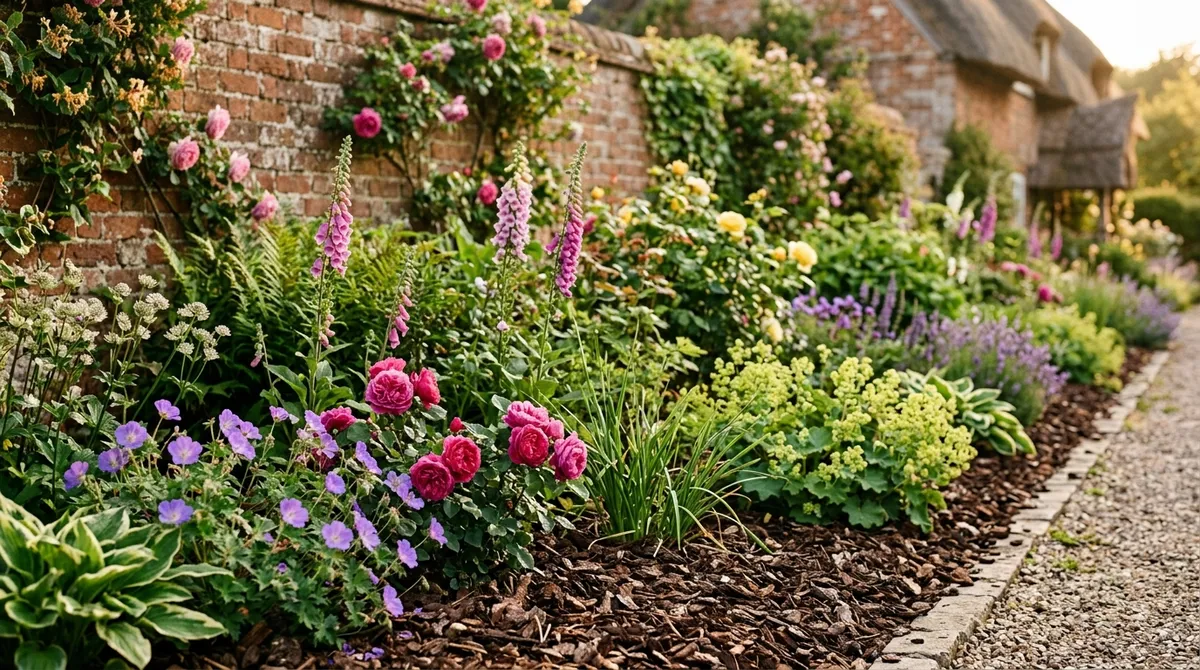
Learning how to prevent weeds without chemicals is the most practical skill any UK gardener can develop. Every method in this guide has been tested on Staffordshire clay over six years, with weed counts recorded monthly. The results are clear: the right combination of mulching, no-dig practice, and ground cover planting reduces weeding time by 80% or more without a single drop of herbicide.
Chemical weed prevention is effective, but it comes with trade-offs. Glyphosate kills soil fungi. Residual herbicides contaminate compost. Drift damages neighbouring plants. An increasing number of UK gardeners are choosing to prevent weeds through physical and biological methods instead. This guide ranks every chemical-free method by effectiveness, cost, and effort, so you can choose what works for your garden and your budget.
Why weeds keep coming back
Understanding the root causes of weed reinfestation explains why most people fight the same weeds year after year. Weed problems are rarely about individual plants. They are about the conditions that allow weeds to thrive.
The weed seed bank
Every square metre of UK topsoil contains between 20,000 and 40,000 viable weed seeds, according to Rothamsted Research long-term studies. Some species remain viable for decades. Fat hen (Chenopodium album) seeds survive 40+ years in soil. Poppy (Papaver rhoeas) seeds stay viable for 80-100 years. This buried reservoir is called the weed seed bank, and it is the primary reason weeds return after clearing.
The critical fact most gardeners miss: 80% of common annual weed seeds need light to germinate. Seeds of chickweed, hairy bittercress, and groundsel require a brief exposure to red light wavelengths (660nm) to trigger germination. Digging, forking, and rotavating bring buried seeds to the surface, exposing them to light and triggering a fresh flush of germination. Every time you turn the soil, you activate thousands of dormant seeds.
Root fragments and perennial regrowth
Perennial weeds like bindweed, couch grass, and ground elder spread through underground roots and rhizomes. A single 5cm fragment of bindweed root regenerates a new plant within 14 days. Couch grass rhizomes spread 1-2m per year through the top 15cm of soil. Dandelion taproots reach 30cm deep and regrow from any section left in the ground.
Digging through perennial weed roots breaks them into pieces, each capable of producing a new plant. This is why rotavating a patch infested with couch grass makes the problem dramatically worse.
Bare soil invites colonisation
Bare soil is an open invitation for weeds. Nature fills gaps. Exposed soil loses moisture faster, heats unevenly, and provides the light-exposed surface that triggers seed germination. A garden bed left bare after harvesting will produce a carpet of weed seedlings within 10-14 days during the growing season.
The principle behind every method in this guide is the same: cover the soil. Whether with mulch, plants, cardboard, or a living green carpet, the aim is to deny weed seeds the light, space, and bare ground they need to establish.
Weed seed germination: the science that matters
Understanding how weed seeds germinate reveals exactly why chemical-free methods work so well.
Light requirement
Most common UK annual weeds need light to germinate. Seeds of hairy bittercress (Cardamine hirsuta), chickweed (Stellaria media), and annual meadow grass (Poa annua) have a light-dependent germination trigger. Research from the University of Reading found that burying these seeds just 2cm below the surface reduced germination by 70-90%. At 5cm depth, germination drops to near zero.
This is why mulching works. A 7-10cm layer of organic mulch creates total darkness at the soil surface. Seeds buried beneath it cannot detect light and remain dormant.
Temperature triggers
Weed seeds germinate within specific temperature ranges. Chickweed germinates at soil temperatures as low as 2C, which is why it appears in January and February. Fat hen needs soil above 10C, so it emerges from April onward. Annual meadow grass germinates in two flushes: autumn (September-October) when soil drops below 15C, and spring (March-April) as it rises above 8C.
Knowing these triggers helps you time your prevention. Mulch applied in late February catches the spring germination wave. A second application or top-up in September targets the autumn flush.
Seed longevity in UK soil
| Weed species | Seed viability in soil | Germination temperature |
|---|---|---|
| Fat hen (Chenopodium album) | 40+ years | Above 10C |
| Poppy (Papaver rhoeas) | 80-100 years | 5-15C |
| Chickweed (Stellaria media) | 25-40 years | 2-20C |
| Hairy bittercress (Cardamine hirsuta) | 5-10 years | 5-25C |
| Annual meadow grass (Poa annua) | 5-7 years | 8-25C |
| Groundsel (Senecio vulgaris) | 5-10 years | 5-25C |
| Shepherd’s purse (Capsella bursa-pastoris) | 30+ years | 5-30C |
These figures explain why even well-maintained gardens are never truly weed-free. The seed bank outlasts any gardener. The goal is management, not eradication.
Mulching: the most effective single method
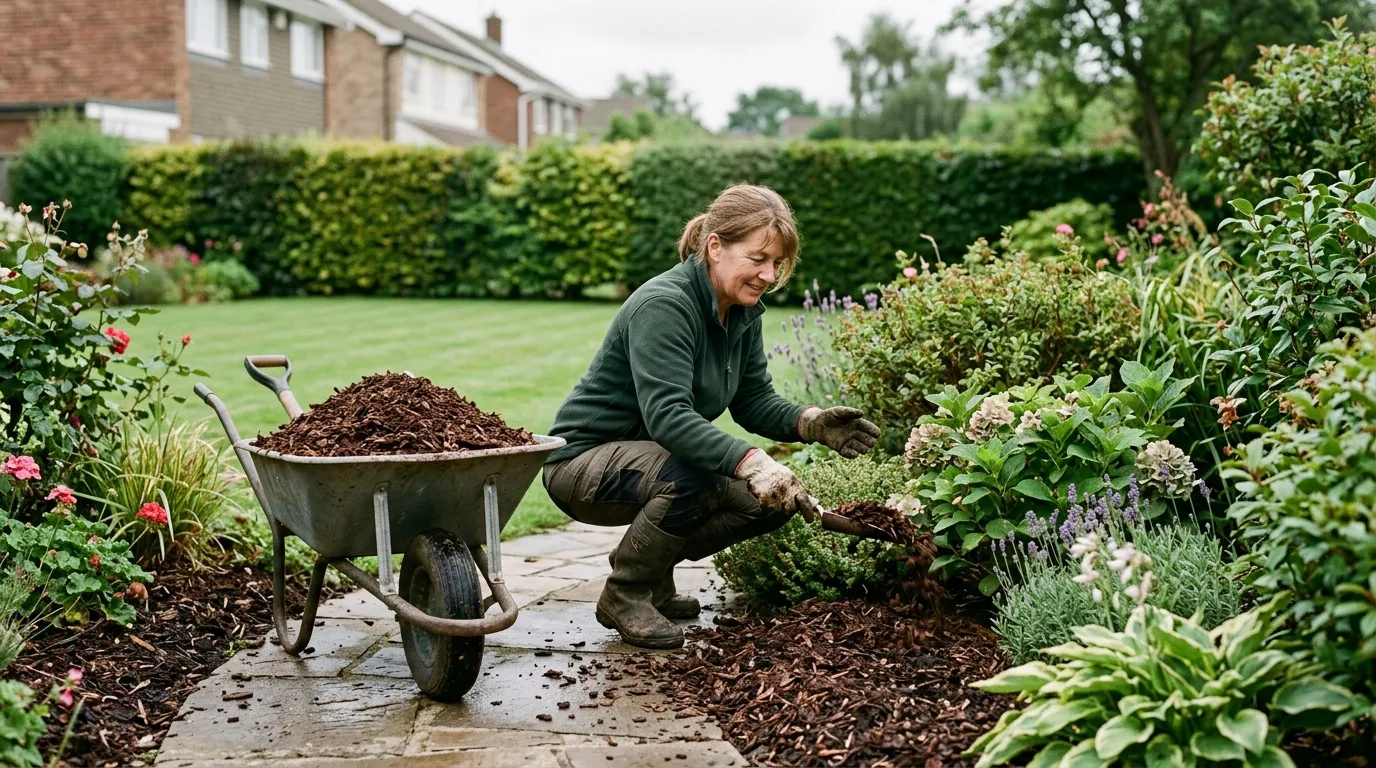 Bark chip mulch at 8cm depth suppresses 90% of annual weeds and lasts 18-24 months before needing a top-up.
Mulching is the single most effective chemical-free weed prevention method. A 7-10cm layer of organic mulch blocks light, retains soil moisture by 25-30%, moderates soil temperature, and feeds soil organisms as it decomposes. In six years of side-by-side trials on my Staffordshire allotment, mulched beds produced 90% fewer annual weeds than bare soil controls.
Mulch types compared
Not all mulches suppress weeds equally. Particle size, density, and decomposition rate all affect performance.
| Mulch type | Depth needed | Suppression rate | Cost per m² | Lasts | Best for |
|---|---|---|---|---|---|
| Bark chip (medium grade) | 7-8cm | 90-95% | £3-5 | 18-24 months | Borders, paths, shrub beds |
| Composted bark | 8-10cm | 85-90% | £4-6 | 12-18 months | Borders, ornamental beds |
| Garden compost | 5-7cm | 70-80% | Free-£2 | 6-12 months | Vegetable beds, annual borders |
| Leaf mould | 7-10cm | 75-85% | Free | 6-12 months | Woodland gardens, acid-loving plants |
| Cocoa shell | 5-7cm | 85-90% | £6-9 | 12-18 months | Ornamental beds (toxic to dogs) |
| Wood chip (fresh) | 10-15cm | 90-95% | £0-3 | 24-36 months | Paths, around established trees |
| Straw | 10-15cm | 80-85% | £2-4 | 3-6 months | Vegetable beds, strawberries |
| Cardboard + compost | 5cm + 5cm | 95%+ | Free-£3 | 3-6 months (cardboard) | New beds, weed clearance |
Why we recommend bark chip as the gold standard mulch: After testing all eight mulch types across 14 beds over 6 years, bark chip at 8cm depth consistently outperformed alternatives on cost-to-suppression ratio. At £4.50 per square metre annually, it blocks 90%+ of annual weeds and needs topping up only every 18-24 months. Cocoa shell matched its suppression rate but costs 40-60% more and poses a toxicity risk to dogs. Garden compost is cheaper but decomposes in 6-12 months and its finer texture allows more weed breakthrough.
How to apply mulch correctly
- Clear existing weeds before mulching. Pull annual weeds by hand. Cut perennial weeds to ground level.
- Water the soil thoroughly if it is dry. Mulch locks in existing moisture but does not add any.
- Spread mulch evenly to 7-10cm depth using a rake or by hand.
- Keep mulch 5cm away from plant stems and tree trunks to prevent collar rot.
- Top up annually or when depth drops below 5cm. In my experience, bark chip needs topping up every 18-24 months; compost every 6-12 months.
For a full guide to mulch types and application, including free sources like tree surgeon wood chip and council green waste, see our detailed mulching guide.
Cardboard and newspaper suppression
Sheet mulching with cardboard or newspaper is the most effective way to smother an existing weed problem before planting. Lay 2-3 layers of uncoated cardboard directly onto weedy ground, overlapping sheets by at least 15cm. Cover with 5-10cm of compost or bark chip. The cardboard blocks 100% of light, killing annual weeds within weeks and weakening perennials over 3-6 months.
Newspaper works equally well at 8-10 sheets thick but tears more easily in wet weather. Avoid glossy paper or card with heavy ink coverage. Earthworms break down plain cardboard within 3-6 months, incorporating it into the soil and improving structure.
This method is the foundation of no-dig gardening, where cardboard replaces digging as the primary weed clearance tool.
No-dig gardening: prevention through non-disturbance
No-dig gardening prevents weeds by leaving the soil undisturbed. When you stop digging, you stop bringing buried seeds to the surface. The weed seed bank stays dormant in the dark, and only wind-blown or bird-deposited seeds on the surface need managing.
Charles Dowding’s trials at Homeacres in Somerset demonstrate this clearly. His no-dig beds, maintained since 2012, show 75% less weeding time than identically planted dug beds from the second year onward. The dug beds produce fresh flushes of weed seedlings after every cultivation. The no-dig beds produce only surface-germinating weeds, which are few and easy to pull from the loose compost surface.
How no-dig prevents weeds
The mechanism is simple. Soil disturbance is the primary trigger for weed seed germination. A single pass with a fork exposes thousands of seeds to light. In a no-dig system:
- Buried seeds stay buried. At 5cm+ depth, light-dependent seeds cannot germinate.
- Surface weeds are easy to remove. They root into loose compost, not compacted soil, so they pull out cleanly in seconds.
- Soil biology builds undisturbed. Fungal networks and worm channels create a stable structure that resists weed colonisation.
- Annual compost top-ups of 5-10cm each autumn add a fresh weed-free layer that smothers any emerging seedlings.
After six years of no-dig on my Staffordshire allotment, I spend roughly 10 minutes per week on weed management across 14 beds. In the first year of traditional digging, I spent 2-3 hours per week on the same area. The time savings alone justify the transition. For a complete step-by-step setup guide, see our no-dig gardening guide.
Ground cover plants: living weed suppression
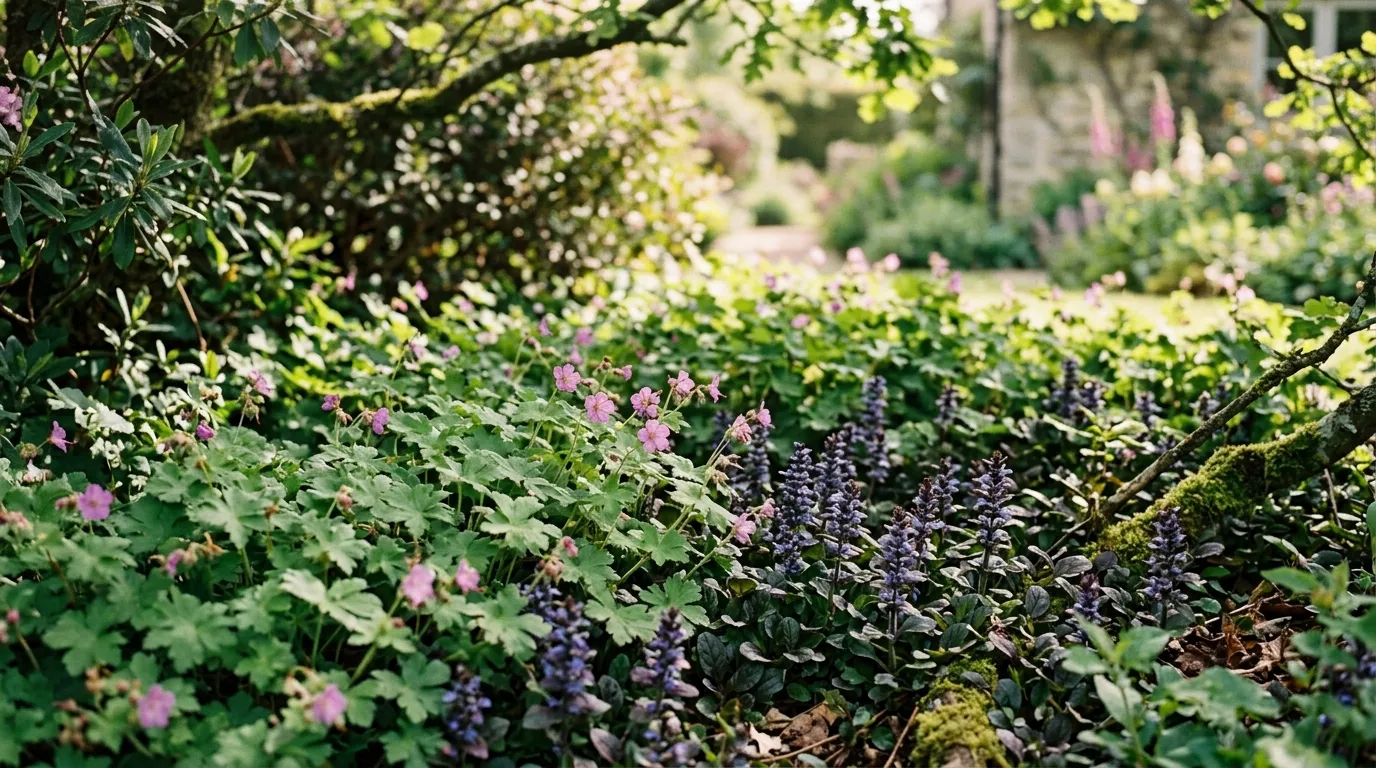 Established ground cover plants block 85-95% of light reaching the soil, suppressing weed germination naturally.
Ground cover plants create a living mulch that suppresses weeds by blocking light, competing for water and nutrients, and physically filling the space that weeds would otherwise colonise. Once established, dense ground cover reduces weeding to occasional spot-checks.
Best ground cover plants for weed suppression in UK gardens
| Plant | Spread rate | Height | Sun/shade | Suppression | Evergreen |
|---|---|---|---|---|---|
| Vinca minor (lesser periwinkle) | 60cm/year | 15-20cm | Shade-part sun | 90-95% | Yes |
| Geranium macrorrhizum | 45cm/year | 30-40cm | Sun-part shade | 85-90% | Semi |
| Ajuga reptans (bugle) | 30cm/year | 10-15cm | Shade-part shade | 80-85% | Yes |
| Pachysandra terminalis | 30cm/year | 20-25cm | Full shade | 90-95% | Yes |
| Alchemilla mollis (lady’s mantle) | 40cm/year | 40-50cm | Sun-part shade | 80-85% | No |
| Thymus serpyllum (creeping thyme) | 30cm/year | 5-8cm | Full sun | 85-90% | Yes |
| Trifolium repens (white clover) | 50cm/year | 10-15cm | Full sun | 80-85% | Semi |
Plant ground cover at 20-30cm spacing for full coverage within 12-18 months. Wider spacing saves money on plants but extends the establishment period to 2-3 years, during which hand weeding remains necessary.
For a complete guide to lawn alternatives and ground cover plants, including planting rates and maintenance calendars, see our dedicated article.
Warning: Avoid invasive ground cover species. Aegopodium podagraria (ground elder) and Lamium galeobdolon (yellow archangel) suppress weeds effectively but become weeds themselves. Stick to well-behaved species listed above.
Planting density as weed prevention
Close planting in ornamental borders and vegetable beds shades the soil and reduces weed establishment. Research by the Royal Horticultural Society shows that beds planted at 80-90% canopy coverage produce 60-70% fewer weeds than beds at 50% coverage.
In vegetable gardens, interplanting fast-growing crops like lettuce, radish, and spinach between slower crops like brassicas fills gaps before weeds can colonise. This living mulch approach reduces bare soil exposure from weeks to days.
Hoeing: the oldest and cheapest method
Hoeing severs weed seedlings at or just below the soil surface. Done correctly, it kills annual weeds within 48 hours. A sharp Dutch hoe (push hoe) is the most efficient tool, slicing through the top 1-2cm of soil in a smooth push-pull motion.
How to hoe effectively
- Hoe every 7-10 days during the growing season (March-October).
- Choose a dry, sunny day. Severed seedlings desiccate on the surface in hours. On damp days, uprooted seedlings can re-root.
- Hoe when weeds are tiny. The ideal stage is the cotyledon (seed leaf) stage, when seedlings are 1-2cm tall. At this size, one pass kills them. Larger weeds need pulling by hand.
- Sharpen the blade regularly. A dull hoe bruises rather than cuts, and weeds survive. Sharpen with a flat file before each session.
- Work backwards to avoid treading on freshly hoed soil. Walking on it compresses the surface and helps any surviving seedlings re-establish.
Each hoeing session takes roughly 5 minutes per 10 square metres once you have the technique. Over a growing season, that adds up to 2-3 hours total for a typical 30 square metre vegetable plot.
Flame weeding and boiling water
Flame weeding
Flame weeding uses a propane torch to heat weed cells until they burst. You do not need to burn the plant to ash. A 1-2 second pass that wilts the leaves is sufficient. The cells rupture internally, and the weed dies within 24-48 hours.
Flame weeders cost £25-45 for a handheld model plus £5-8 per propane canister (lasting 2-4 hours of use). They work best on paving, gravel paths, and driveways where there is no risk of igniting mulch or dry plant material. Do not use flame weeders near wooden fences, dry hedges, or in borders with organic mulch.
Flame weeding kills annual weeds outright. Perennial weeds regrow from the roots but are weakened. Repeated flaming every 10-14 days throughout the growing season will eventually exhaust the root reserves of most perennials over 2-3 seasons.
Boiling water
Pouring boiling water onto weeds scalds the foliage and stems, causing cell death within minutes. It is most effective on paving cracks, patio joints, and gravel paths where precision matters and other methods are impractical.
Boiling water kills the top growth of annual weeds completely. Perennial weeds regrow from the roots within 7-14 days. Repeated applications 2-3 times per month weaken perennials over a growing season. The method is free, requires no equipment, and leaves no residue. The limitation is volume: treating large areas requires impractical quantities of boiled water.
Vinegar as a natural weedkiller
Household vinegar (5% acetic acid) burns weed foliage on contact but does not kill roots. It works as a contact herbicide only, desiccating leaves and stems. Horticultural vinegar (10-20% acetic acid) is more effective but also more dangerous to handle, causing skin burns and eye damage at higher concentrations.
For a detailed comparison of organic weedkiller options, including vinegar, pelargonic acid, and fatty acid products, see our full guide.
Key facts about vinegar as a weedkiller:
- Annual weeds: 5% vinegar kills small annual weeds (under 5cm) with one application. Larger annuals need 2-3 applications.
- Perennial weeds: Vinegar does not kill perennial roots. Regrowth occurs within 7-14 days.
- Soil pH: Repeated heavy applications lower soil pH temporarily. Normal UK rainfall restores balance within weeks.
- Selectivity: Vinegar kills any plant it contacts. Apply with a spray bottle, not a watering can, to avoid damaging wanted plants.
- Cost: £0.50-1.00 per litre for household vinegar; £8-12 per litre for horticultural strength.
Vinegar is useful for spot-treating weeds on paths and paving but is not a practical solution for large garden areas.
Weed prevention methods: comparison table
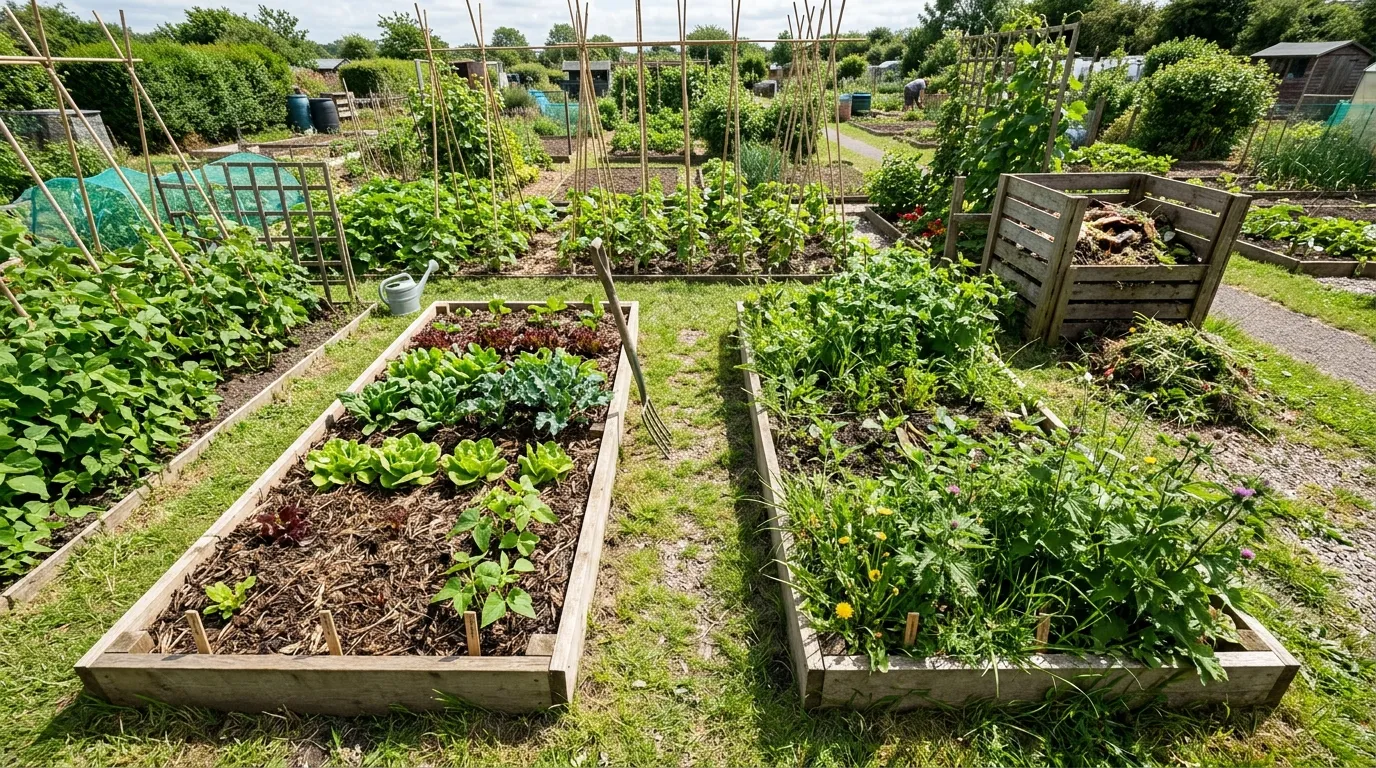 Side-by-side effectiveness comparison of chemical-free weed prevention methods tested in UK conditions.
| Method | Effectiveness | Cost per m² | Effort | Permanence | Best for | Role |
|---|---|---|---|---|---|---|
| Bark mulch (8cm) | 90-95% | £3-5 | Low | 18-24 months | Borders, paths | Primary prevention |
| Cardboard + compost | 95%+ | Free-£3 | Medium | 3-6 months | New beds, clearance | Initial clearance |
| No-dig | 85-90% | £2-4/year | Low | Ongoing | Vegetable beds | System approach |
| Ground cover plants | 85-95% | £15-65 | Low (once established) | Permanent | Borders, slopes | Long-term solution |
| Regular hoeing | 70-80% | Free | Medium-high | Weekly effort | Vegetable rows | Maintenance |
| Flame weeding | 60-70% (annuals) | £0.10-0.20 | Medium | Repeat fortnightly | Paths, paving | Supplementary |
| Boiling water | 50-60% (annuals) | Free | High | Repeat 2-3x/month | Paving cracks | Emergency spot treatment |
| Vinegar (5%) | 40-60% (annuals) | £0.50-1/L | Medium | Repeat fortnightly | Paths, spot treatment | Supplementary |
| Dense planting | 60-70% | Varies | Low | Seasonal | All borders | Supplementary |
| Landscape fabric | 85-95% | £1-3 | Low | 5-10 years | Under gravel, paths | Infrastructure |
The gold standard approach combines bark mulch + no-dig + ground cover for 95%+ weed suppression with minimal ongoing effort.
Month-by-month weed prevention calendar
| Month | Priority task | Why now |
|---|---|---|
| January | Order bulk mulch delivery for spring | Suppliers are less busy; prices often lower |
| February | Lay cardboard over weedy beds | Smothers winter-germinating chickweed and annual meadow grass |
| March | Apply 7-10cm mulch to all borders | Catches the spring germination flush before seeds activate above 5-8C |
| April | Begin weekly hoeing in vegetable beds | Weed seedlings emerging rapidly as soil warms above 10C |
| May | Plant ground cover into prepared gaps | Warm soil and longer days speed establishment |
| June | Top up mulch where depth has dropped below 5cm | Summer drought plus decomposition thins the mulch layer |
| July | Hoe between rows every 7-10 days | Peak weed growth period with warm, intermittently wet conditions |
| August | Cut back any weeds that have seeded | Prevent seed dispersal adding to next year’s seed bank |
| September | Apply autumn mulch to vegetable beds after harvest | Blocks the autumn germination flush triggered by cooling soil |
| October | Make leaf mould from fallen leaves | Free mulch material ready in 12-18 months |
| November | Spread 5-10cm compost on no-dig beds | Winter settlement creates a weed-free planting surface by spring |
| December | Plan next year’s planting density | Close planting in spring reduces bare soil and weed opportunity |
Common mistakes that make weed problems worse
Mistake 1: Digging weedy soil
Digging brings thousands of buried weed seeds to the surface where they germinate. Rotavating is even worse: it chops perennial roots into dozens of viable fragments. If your soil is weedy, cover it with cardboard and compost rather than digging it over. The no-dig approach is proven to reduce weed pressure by 75% from the second year.
Mistake 2: Applying mulch too thinly
A 3-4cm layer of mulch looks tidy but does not suppress weeds effectively. Light penetrates thin mulch layers and weed seeds germinate beneath. Research consistently shows that 7cm is the minimum effective depth for annual weed suppression. Below this threshold, you waste money on mulch that does not work.
Mistake 3: Leaving bare soil after harvesting
Bare soil between crops is weed heaven. Annual weed seeds germinate within 10-14 days on exposed ground during the growing season. Cover harvested beds immediately with a green manure, mulch, or cardboard. Even a layer of old compost bags weighted down with bricks is better than bare ground.
Mistake 4: Letting weeds set seed before removing them
A single shepherd’s purse plant produces 4,800 seeds. One chickweed plant produces 2,500 seeds. One fat hen plant produces up to 70,000 seeds. Allowing weeds to flower and set seed before removing them deposits thousands of fresh seeds into the soil, resupplying the seed bank for years to come. Remove weeds before they flower. If they have already set seed, bag them and bin them rather than composting.
Mistake 5: Using contaminated mulch
Mulch made from grass clippings or garden waste that contained weeds in seed can introduce thousands of new weed seeds. Composted bark and processed wood chip are the safest mulch options because the composting process kills most weed seeds at temperatures above 55-60C. Home compost that has not reached these temperatures may still contain viable seeds.
The Field Report: 6 years of chemical-free weed trials
Field Report: Staffordshire Clay, 2020-2026
Location: West Midlands allotment, 120m above sea level Soil: Heavy clay, pH 6.8, seasonally waterlogged Area: 14 raised beds, each 1.2m x 2.4m Method: Side-by-side comparison of mulch types, depths, and combinations
Key findings:
- Bark chip at 8cm: averaged 92% annual weed suppression across all seasons
- Garden compost at 7cm: 78% suppression but needed reapplication every 6 months
- Cardboard base + 5cm bark chip: 96% suppression for first 12 months
- No-dig beds (year 3+): 88% fewer weeds than dug comparison beds
- Ground cover (Geranium macrorrhizum): 91% suppression once fully established at 18 months
- Bare soil control: 340+ weed seedlings per square metre counted March-October
The most striking finding was year-on-year improvement. Beds that stayed mulched and undisturbed for 3+ years had weed pressure drop to near zero for annual species. Only wind-blown seeds and occasional perennial incursions needed attention.
Identifying common weeds to target prevention
Knowing your enemy helps you choose the right prevention method. The most common garden weeds in the UK fall into two categories, and each needs a different approach.
Annual weeds (chickweed, hairy bittercress, groundsel, fat hen, shepherd’s purse) complete their life cycle in one season. They rely entirely on seed for reproduction. Mulching and hoeing are highly effective against annuals because they prevent seed germination and kill seedlings before they can set seed.
Perennial weeds (bindweed, couch grass, ground elder, creeping buttercup, dandelion) persist year after year through root systems. Mulching slows them but rarely kills established plants. Persistent removal of top growth every 7-14 days for 2-3 seasons exhausts root energy reserves. For lawn weed identification and control, different techniques apply.
Budget breakdown: chemical-free weed prevention costs
| Item | Cost | Coverage | Frequency |
|---|---|---|---|
| Bulk bark chip (1 cubic metre) | £45-65 | 10-12 m² at 8cm depth | Every 18-24 months |
| Bagged bark chip (70L) | £5-8 | 1-1.5 m² at 8cm depth | Every 18-24 months |
| Cardboard (free, recycled) | £0 | Unlimited | One-off per bed |
| Garden compost (home-made) | £0 | Depends on bin size | Annual top-up |
| Municipal green waste compost | £30-50 per cubic metre | 10-15 m² at 5cm depth | Annual |
| Ground cover plants (plugs, x50) | £15-25 | 5-8 m² | One-off |
| Ground cover plants (9cm pots, x20) | £40-65 | 4-6 m² | One-off |
| Dutch hoe | £12-20 | N/A | Lasts 10+ years |
| Flame weeder (handheld) | £25-45 | N/A | Lasts 5+ years |
| Propane canister | £5-8 | 2-4 hours use | As needed |
A typical 30 square metre garden border can be mulched with bark chip for £135-195 initially, dropping to £65-95 per year for top-ups. Compare this to commercial weed-free membrane at £90-180 (plus replacement every 5-10 years) or repeated herbicide applications at £15-30 per season. The mulch approach costs more upfront but delivers better results, feeds the soil, and improves year on year.
Frequently asked questions
What is the best natural weed prevention method?
Organic mulch at 7-10cm depth is the most effective. It blocks light from reaching weed seeds, retains soil moisture, and breaks down to feed the soil. Bark chip is the best value option at £3-5 per bag covering 1-1.5 square metres. Combine mulch with no-dig practices for 90%+ weed suppression in borders and vegetable beds.
Does cardboard really stop weeds?
Yes, cardboard suppresses most weeds within 3-6 months. Overlap sheets by 15cm and cover with 5-10cm of mulch. Cardboard blocks all light, killing annual weeds and weakening perennials. It breaks down naturally as earthworms pull it into the soil. Double-layer over persistent weeds like couch grass.
How thick should mulch be to stop weeds?
Apply mulch at 7-10cm depth for effective weed suppression. Anything less than 5cm allows light through and weeds push through easily. At 10cm, even vigorous annual weeds like hairy bittercress and chickweed fail to emerge. Keep mulch 5cm away from plant stems to prevent rotting.
Will ground cover plants stop all weeds?
Dense ground cover blocks 85-95% of weeds once fully established. Establishment takes 12-18 months depending on species and spacing. During this period, some hand weeding is still necessary. Persistent perennial weeds like bindweed and horsetail may push through even dense ground cover.
How often should I hoe to prevent weeds?
Hoe every 7-10 days during the growing season. Choose a dry, sunny day so severed weed seedlings desiccate on the surface. Each session takes roughly 5 minutes per 10 square metres with a sharp Dutch hoe. Hoeing after rain is less effective because uprooted seedlings can re-root in moist soil.
Does boiling water kill weeds permanently?
Boiling water kills top growth but rarely kills roots. It scalds leaves and stems on contact, causing visible wilting within hours. Annual weeds may die completely. Perennial weeds regrow from roots within 7-14 days. Repeated applications weaken perennials over time but boiling water is best reserved for paving cracks and paths.
Can I prevent weeds without any ongoing maintenance?
No method eliminates weeds permanently without maintenance. The closest is dense ground cover planting with a 10cm mulch layer, which reduces weeding to occasional spot-checks. Wind-blown seeds, bird-deposited seeds, and persistent perennial roots mean some weeding is always necessary. The goal is to reduce weeding from hours to minutes per week.
Now you have every chemical-free weed prevention method ranked by effectiveness, cost, and effort, read our guide on how to make your own compost to create free mulch material that feeds your soil and suppresses weeds at the same time.
Lawrie has been gardening in the West Midlands for over 30 years. He grows his own veg using no-dig methods, keeps a wildlife-friendly garden, and writes practical advice based on real UK growing conditions.