Common Garden Weeds UK: Visual ID Guide
Identify 20+ common garden weeds UK with photos, Latin names, removal difficulty ratings, and organic control methods from experienced gardeners.
Key takeaways
- 20 most common UK garden weeds identified with Latin names, spread method, and removal difficulty
- Annual weeds produce 800-5,000 seeds per plant — remove before flowering to break the cycle
- Perennial weeds like bindweed and horsetail have roots reaching 2-5m deep and need multi-year control
- Hoeing annual weeds in dry weather kills 95% on contact — the cheapest and fastest control method
- Japanese knotweed is the only UK garden weed with specific legal obligations under the Wildlife and Countryside Act 1981
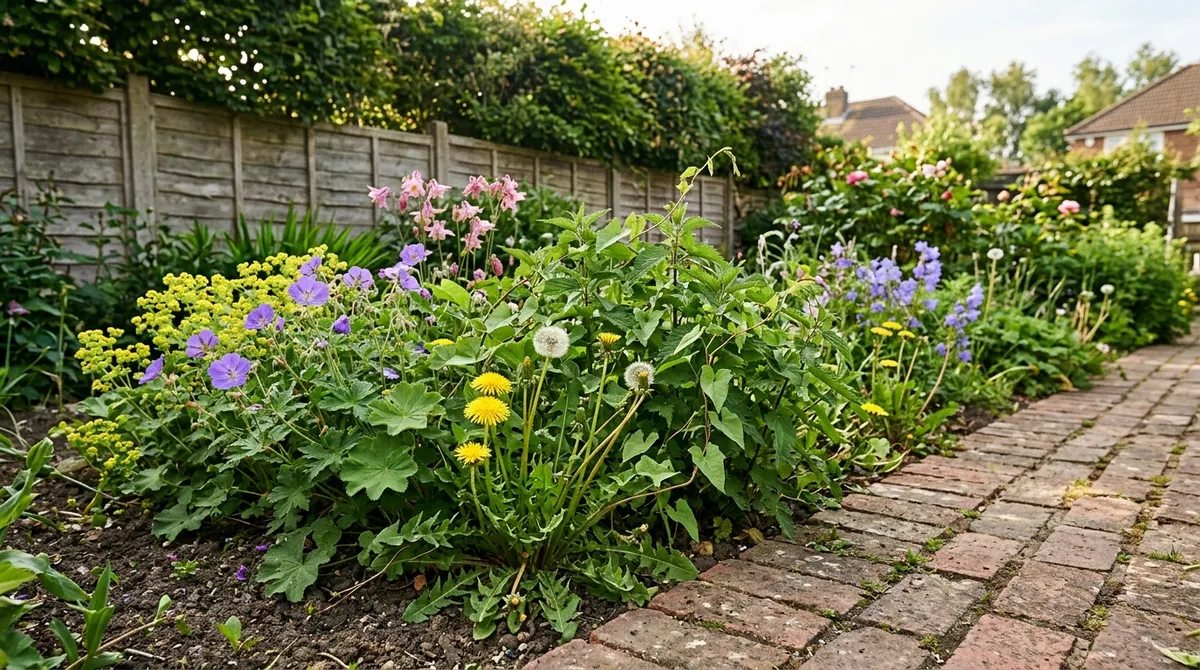
Common garden weeds UK gardeners encounter range from easy-to-pull annuals like chickweed to near-indestructible perennials like horsetail, and learning to tell them apart is the first step toward controlling them. Over 100 weed species colonise British gardens, but around 20-25 are responsible for 90% of the problems.
This identification guide covers the weeds you will actually encounter in borders, lawns, vegetable plots, and paths across Britain. Each entry includes the Latin name, key identification features, how the weed spreads, and a difficulty rating from 1 (easy) to 5 (near-impossible) for removal. Whether you want to hoe them, pull them, mulch them, or simply learn what they are, this is your field reference.
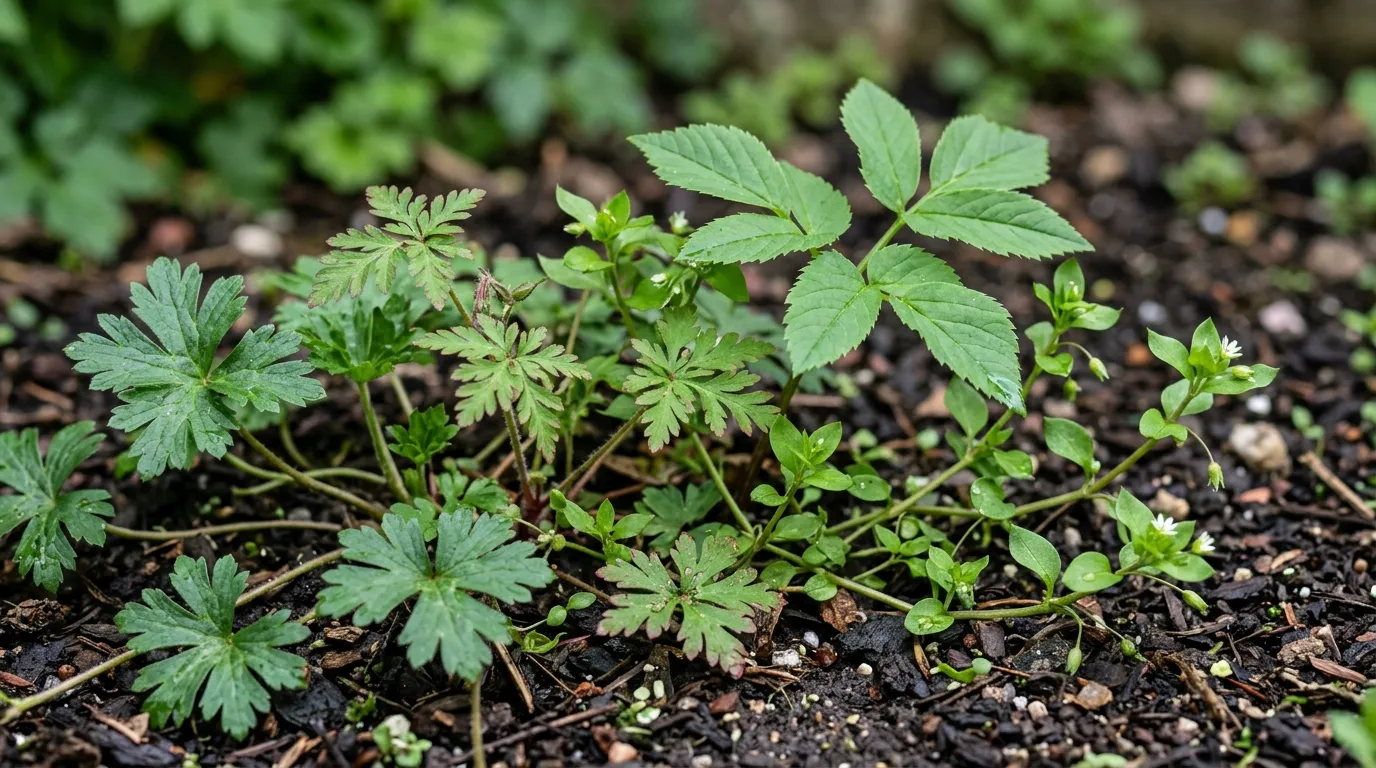
A typical UK garden border with dandelions, clover, and annual weeds competing for space
What are the most common annual weeds in the UK?
Annual weeds complete their life cycle in one season, germinating, flowering, setting seed, and dying within weeks or months. Their strategy is speed and volume. A single chickweed plant produces 2,500 seeds. A fat hen plant can release 70,000. The seeds persist in soil for decades, waiting for disturbance to bring them to the surface.
The good news: annual weeds are easy to control if you act before they flower. Hoeing on a dry day severs stems below the soil surface and kills them within hours. The RHS weed identification pages cover many of these species with photographs. The critical rule is timing. Once an annual weed flowers and sets seed, you have already lost that battle.
Chickweed (Stellaria media)
Identification: Low, sprawling stems with small, oval, pale green leaves in opposite pairs. Tiny white star-shaped flowers with five deeply split petals (appearing as ten). A single fine line of hairs runs along one side of the stem, switching sides at each leaf node. This hair line is the surest identification feature.
Spread method: Seed (2,500 per plant) and rooting at stem nodes. Germinates year-round, including winter.
Difficulty: 1/5. Pull or hoe. Shallow roots come out easily.
Groundsel (Senecio vulgaris)
Identification: Upright stems 10-25cm tall with deeply lobed, irregularly toothed leaves. Small yellow flower heads with no ray petals, just tubular disc florets. Produces fluffy dandelion-like seed heads. Often mistaken for ragwort when young, but groundsel stays much shorter.
Spread method: Wind-dispersed seed (1,000-1,700 per plant). Completes a full life cycle in 5-6 weeks.
Difficulty: 1/5. Pull or hoe before flowering. Very shallow roots.
Hairy Bittercress (Cardamine hirsuta)
Identification: Rosette of small, rounded leaflets arranged in pairs along a central stalk. Tiny white four-petalled flowers on slender stems 10-20cm tall. The key identification feature: ripe seed pods explode when touched, firing seeds up to 1m away. Leaves have a peppery taste if nibbled.
Spread method: Explosive seed pods (600-800 seeds per plant). Seeds germinate in autumn and overwinter as rosettes.
Difficulty: 1/5. Easy to pull. Remove before seed pods ripen — the explosion spreads seeds across a wide area.
Fat Hen (Chenopodium album)
Identification: Upright, branching stems reaching 30-150cm. Diamond-shaped leaves with a mealy, greyish-white coating, especially on young growth. Tiny green flowers in dense clusters at stem tips. The mealy white coating on the leaf undersides is the surest identification feature.
Spread method: Seed (up to 70,000 per plant). Seeds remain viable in soil for 40+ years.
Difficulty: 1/5. Pull or hoe when young. Large plants have a sturdy taproot but still come out cleanly.
Annual Meadow Grass (Poa annua)
Identification: Tufted grass 5-20cm tall with bright green, soft, slightly folded leaf blades. Triangular flower heads on slender stems. Flowers and seeds in every month of the year, even winter. The most common grass weed in UK lawns and borders alike.
Spread method: Seed (up to 2,250 per plant) year-round. Also spreads by tillering (new shoots from the base).
Difficulty: 2/5. Regular hoeing controls it in borders. In lawns, encourage stronger grasses through overseeding and correct mowing height (minimum 3cm).
Shepherd’s Purse (Capsella bursa-pastoris)
Identification: Rosette of deeply lobed basal leaves. Slender flowering stems 10-40cm tall with tiny white four-petalled flowers. The unmistakable feature: heart-shaped or triangular seed pods arranged along the stem, resembling the purses carried by medieval shepherds.
Spread method: Seed (4,500 per plant). Completes 3-4 generations per year.
Difficulty: 1/5. Pull or hoe. Shallow taproot.
What are the worst perennial weeds in UK gardens?
Perennial weeds survive from year to year through persistent root systems, rhizomes, bulbs, or runners. Removing the top growth alone does not kill them. Some, like bindweed and horsetail, have root systems reaching metres deep, making complete eradication a multi-year commitment.
The distinction matters because perennial weeds require fundamentally different strategies from annuals. Hoeing a dandelion merely trims its haircut. Hoeing chickweed kills it stone dead.
Dandelion (Taraxacum officinale)
Identification: Rosette of deeply toothed, hairless leaves radiating from a central crown. Bright yellow composite flower heads on hollow, milky-sapped stems. The familiar white “clock” seed head disperses seeds by wind. Thick, fleshy taproot exudes white latex when cut.
Spread method: Wind-dispersed seed (up to 15,000 per plant, travelling up to 8km) and taproot regeneration. Any 2cm root fragment regrows.
Difficulty: 2/5. Lever out the full taproot with a daisy grubber. Regular removal prevents seeding. For detailed strategies, read our lawn weed identification guide.
Dock (Rumex obtusifolius — broad-leaved dock)
Identification: Large, broad, wavy-edged leaves up to 25cm long on stout stalks. Tall flower spikes reaching 60-120cm with clusters of small, reddish-brown, papery-winged seeds. The thick, yellow taproot can reach 90cm deep and is extremely tough to extract whole.
Spread method: Seed (up to 60,000 per plant) and taproot regeneration. Seeds viable for 50+ years in soil.
Difficulty: 3/5. Dig out the entire taproot. Snapping it off below ground guarantees regrowth within weeks.
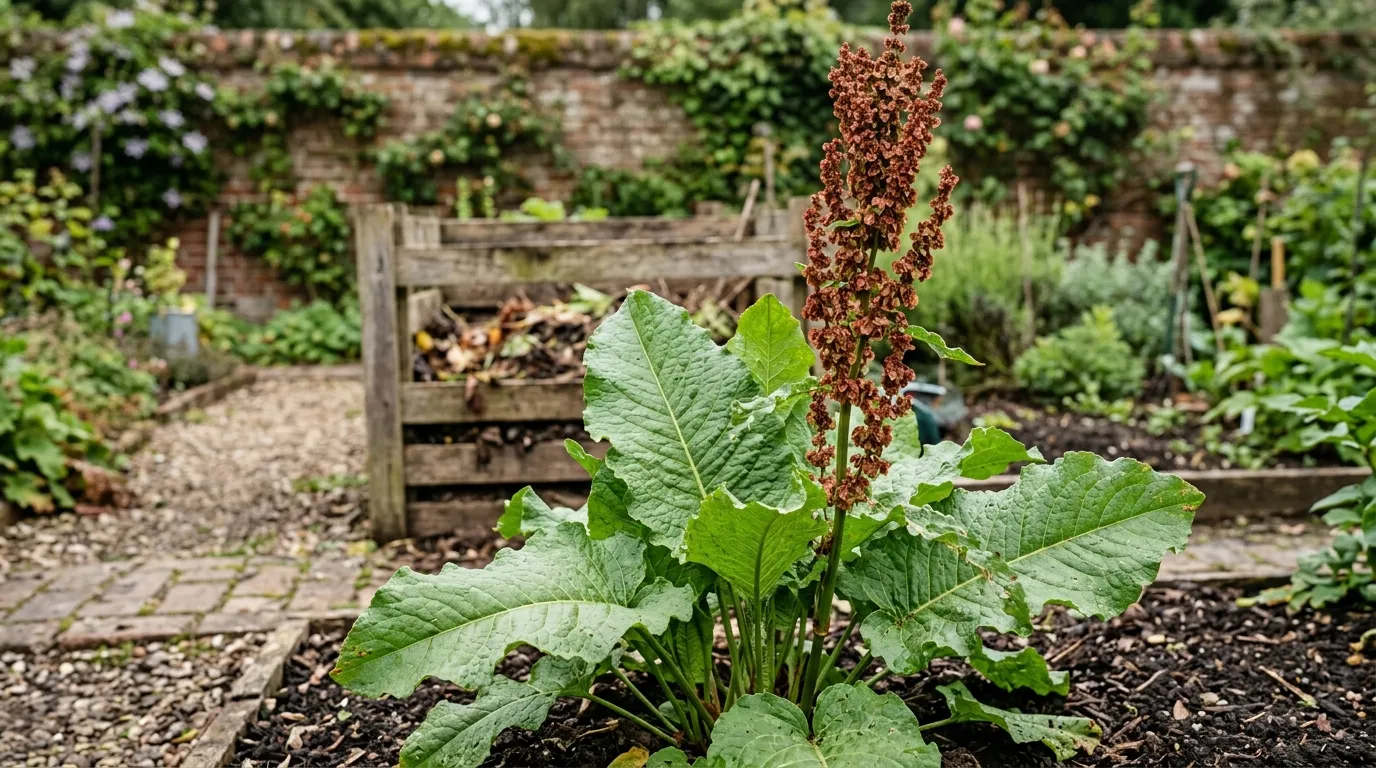
Broad-leaved dock showing the characteristic wavy-edged leaves and stout taproot
Bindweed (Convolvulus arvensis and Calystegia sepium)
Identification: Twining, climbing stems reaching 2-3m. Arrow-shaped leaves. Trumpet-shaped flowers — white or pink-striped in field bindweed (2-3cm across), large pure white in hedge bindweed (5-7cm across). White, fleshy, brittle underground roots that snap easily when pulled.
Spread method: Root fragments (5cm piece regrows in 14 days) and lateral root spread reaching 3-4m. Seeds viable for 50 years.
Difficulty: 5/5. The hardest weed to eradicate in UK gardens. Multi-year strategy essential. Read our complete bindweed removal guide for detailed methods.
Ground Elder (Aegopodium podagraria)
Identification: Triangular, toothed leaflets in groups of three on long stalks, resembling elder tree leaves. Flat-topped clusters of small white flowers in June-July, similar to cow parsley but shorter at 30-60cm. Extensive network of shallow, white, wiry rhizomes just below the surface. Crushed leaves have a distinctive, slightly unpleasant smell.
Spread method: Rhizome network. A single 2cm rhizome fragment regenerates. Rarely sets viable seed in UK gardens.
Difficulty: 4/5. Systematic digging out every rhizome fragment, or total light exclusion with black polythene for 12-18 months. Considered by the RHS as one of the three most difficult garden weeds.
Couch Grass (Elymus repens)
Identification: Coarse grass with flat, dull green leaf blades 6-10mm wide. Spear-pointed, tough, white underground rhizomes running horizontally through the top 10-15cm of soil. Rhizome tips are sharp enough to pierce through potato tubers and cardboard. Flower spikes resemble perennial ryegrass but are stiffer and more upright.
Spread method: Aggressive rhizome network. Each node on the rhizome produces a new shoot. Rarely spreads by seed in gardens.
Difficulty: 4/5. Fork out every piece of rhizome. Any fragment left behind regrows. Rotavating couch grass multiplies it catastrophically.
Creeping Buttercup (Ranunculus repens)
Identification: Dark green, three-lobed, toothed leaves often with lighter patches. Bright yellow, glossy, five-petalled flowers on branching stems. Long surface runners (stolons) that root at each node, forming new plants. Unlike bulbous buttercup, the petals are not reflexed back.
Spread method: Stolons rooting at nodes and seed. Thrives in heavy, poorly drained, compacted soil — its presence is a reliable indicator of wet conditions.
Difficulty: 3/5. Fork out entire plants including all runners. Improving clay soil drainage removes the conditions it prefers.
Horsetail (Equisetum arvense)
Identification: Unmistakable. Upright, jointed, hollow green stems with whorls of thin, needle-like branches at each node, resembling a miniature Christmas tree. Separate brown, cone-tipped fertile stems appear in March-April before the green growth. No flowers or seeds — reproduces by spores, like a fern. Roots extend 2m deep or more.
Spread method: Deep rhizome network and spores. Has survived essentially unchanged for 350 million years. Contains silica, making stems rough to the touch.
Difficulty: 5/5. The hardest weed in British gardens alongside bindweed. No herbicide is reliably effective because the waxy stems repel sprays. Repeated cutting and deep mulching reduce vigour over 3-5 years but rarely achieve full eradication.
Japanese Knotweed (Fallopia japonica)
Identification: Hollow, bamboo-like stems up to 3m tall with distinctive zigzag growth between nodes. Large, heart-shaped leaves 10-15cm long with a flat base. Clusters of small creamy-white flowers in August-September. Reddish-purple shoots emerge in spring, growing up to 20cm per day.
Spread method: Rhizome network extending up to 7m from visible growth and 3m deep. A 0.7g rhizome fragment can produce a new plant. Does not spread by seed in the UK.
Difficulty: 5/5. The only UK garden weed with specific legal obligations. Causing it to spread is a criminal offence under the Wildlife and Countryside Act 1981, carrying fines up to £5,000. Professional treatment costs £2,000-£5,000. See our full Japanese knotweed identification guide for legal responsibilities and treatment.
Which weeds are most common in UK lawns?
Lawn weeds exploit any gap in the grass canopy. Thin, stressed, or closely mown lawns are the most vulnerable. Many lawn weeds are actually wildflowers that support pollinators, and an increasing number of UK gardeners now tolerate or even encourage them. The choice is yours — but identification helps you make an informed decision.
White Clover (Trifolium repens)
Identification: Three-lobed leaves, each leaflet with a pale V-shaped chevron marking. Round white or pinkish flower heads on short stalks. Low, creeping stems that root at nodes. Leaves fold upward at night or in cold weather.
Spread method: Stolons and seed. Fixes atmospheric nitrogen, thriving in nitrogen-poor lawns.
Difficulty: 2/5. Selective herbicides containing fluroxypyr control it. Alternatively, feed the lawn with nitrogen to give grass the competitive edge. Many gardeners now keep clover deliberately for its pollinator value and drought tolerance.
Daisy (Bellis perennis)
Identification: Flat rosettes of small, spoon-shaped leaves pressed tight to the ground (below mowing height). White ray petals with pink-tipped undersides surrounding a yellow centre disc. The quintessential British lawn wildflower.
Spread method: Seed and short creeping rhizomes. Tolerates very close mowing.
Difficulty: 1/5. Hand removal with a daisy grubber, or selective herbicide. Increasing mowing height to 4cm shades out many seedlings.
Broadleaf Plantain (Plantago major)
Identification: Rosette of broad, oval leaves with prominent parallel veins running lengthwise. Tough, fibrous roots. Short flower spikes with tiny greenish flowers on stiff stems. Leaves lie flat, surviving mowing. Very common on compacted ground and path edges.
Spread method: Seed (up to 14,000 per plant). Its presence indicates soil compaction.
Difficulty: 2/5. Lever out individual plants or use selective herbicide. Scarifying and aerating the lawn reduces compaction and discourages regrowth.
Speedwell (Veronica filiformis)
Identification: Tiny, kidney-shaped, scalloped leaves on slender, creeping stems. Small, four-petalled flowers in bright sky blue with a white lower petal. Forms dense mats that smother grass. Extremely common in damp, shaded lawns.
Spread method: Stem fragments. Mowing actually spreads speedwell by scattering stem pieces that root wherever they land.
Difficulty: 3/5. No selective herbicide is fully effective. Improve drainage and reduce shade. Rake before mowing to lift stems for a cleaner cut.
Self-Heal (Prunella vulgaris)
Identification: Low, creeping stems with opposite pairs of oval, slightly hairy leaves. Dense, stubby, oblong flower spikes bearing violet-purple, two-lipped flowers. Stems square in cross-section (it is a member of the mint family). Forms dense patches in damp, acidic lawns.
Spread method: Stolons and seed. Thrives in low-fertility, acidic, damp conditions.
Difficulty: 2/5. Selective herbicide or improve conditions: raise mowing height, feed the lawn, and improve drainage. Soil testing reveals whether lime is needed to raise pH.
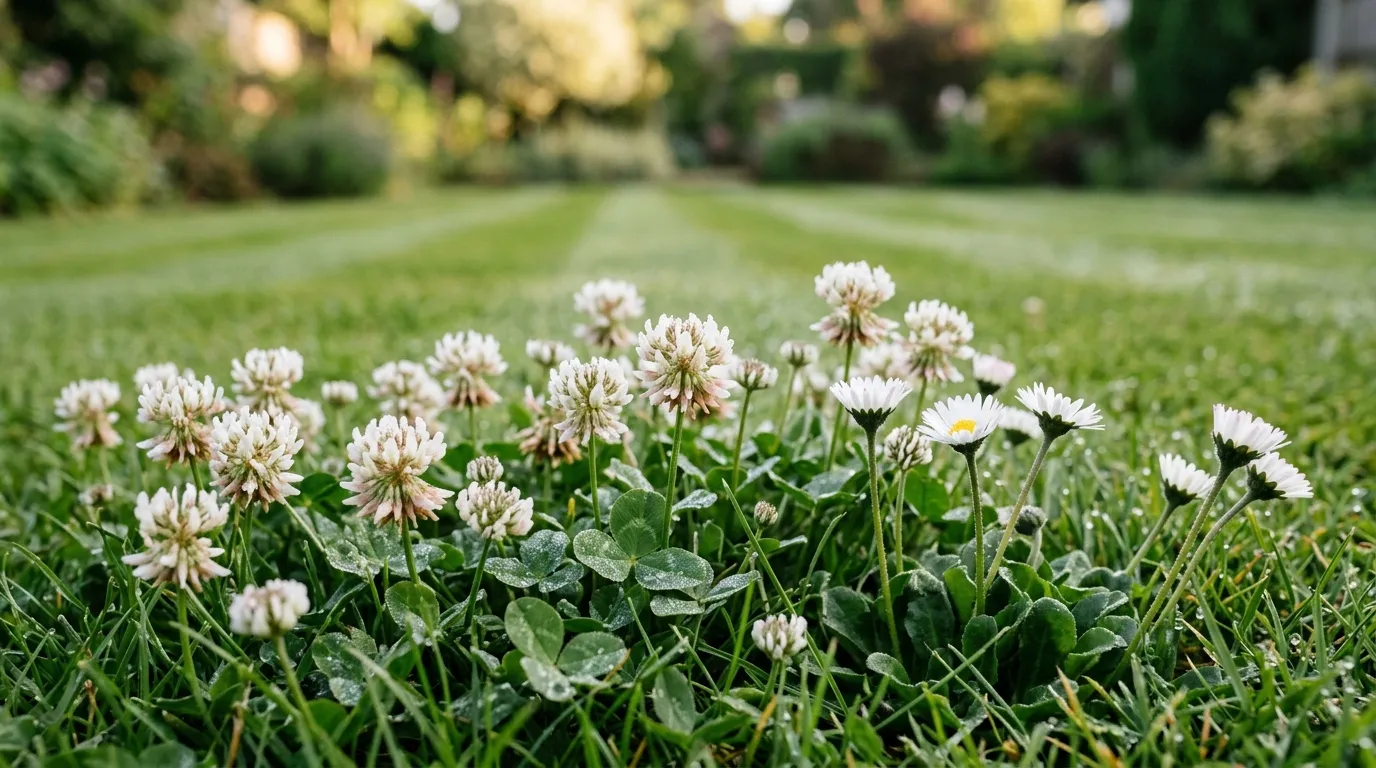
White clover and daisies in a UK lawn — both support pollinators and are increasingly tolerated
Yarrow (Achillea millefolium)
Identification: Finely divided, feathery leaves that are aromatic when crushed. Flat-topped clusters of small white or pale pink flowers on tough, wiry stems 20-60cm tall. In lawns, the foliage stays low and tight, surviving close mowing. Extremely drought-tolerant.
Spread method: Rhizomes and seed. Thrives in dry, nutrient-poor lawns.
Difficulty: 2/5. Selective herbicide or hand removal. Feeding the lawn gives grass a competitive advantage. Yarrow is increasingly valued in wildflower lawns for its drought tolerance and pollinator appeal.
How to Identify Weeds: The Complete Comparison Table
This table compares all 20 weeds at a glance. Use it as a quick field reference when identifying weeds in your garden.
| Weed | Latin Name | Type | Height | Leaves | Flowers | Spread | Difficulty |
|---|---|---|---|---|---|---|---|
| Chickweed | Stellaria media | Annual | 5-15cm | Small, oval, pale green | Tiny white stars | Seed (2,500/plant) | 1/5 |
| Groundsel | Senecio vulgaris | Annual | 10-25cm | Deeply lobed, toothed | Yellow tubular | Seed (1,700/plant) | 1/5 |
| Hairy bittercress | Cardamine hirsuta | Annual | 10-20cm | Paired round leaflets | Tiny white, 4 petals | Explosive pods (800/plant) | 1/5 |
| Fat hen | Chenopodium album | Annual | 30-150cm | Diamond, mealy coating | Tiny green clusters | Seed (70,000/plant) | 1/5 |
| Annual meadow grass | Poa annua | Annual | 5-20cm | Soft, folded, bright green | Triangular heads | Seed (2,250/plant) | 2/5 |
| Shepherd’s purse | Capsella bursa-pastoris | Annual | 10-40cm | Lobed rosette | Tiny white, 4 petals | Seed (4,500/plant) | 1/5 |
| Dandelion | Taraxacum officinale | Perennial | 10-30cm | Deeply toothed rosette | Bright yellow heads | Wind seed (15,000/plant) | 2/5 |
| Dock | Rumex obtusifolius | Perennial | 60-120cm | Broad, wavy-edged | Reddish-brown spikes | Seed (60,000/plant) | 3/5 |
| Bindweed | Convolvulus arvensis | Perennial | 2-3m | Arrow-shaped | Pink/white trumpets | Root fragments | 5/5 |
| Ground elder | Aegopodium podagraria | Perennial | 30-60cm | Triangular, groups of 3 | White flat-topped | Rhizome network | 4/5 |
| Couch grass | Elymus repens | Perennial | 30-90cm | Flat, dull green, 6-10mm | Stiff spikes | Sharp rhizomes | 4/5 |
| Creeping buttercup | Ranunculus repens | Perennial | 15-50cm | Three-lobed, toothed | Glossy yellow, 5 petals | Stolons + seed | 3/5 |
| Horsetail | Equisetum arvense | Perennial | 30-60cm | Whorled needle-like | Spore cones (no flowers) | Deep rhizomes + spores | 5/5 |
| Japanese knotweed | Fallopia japonica | Perennial | Up to 3m | Heart-shaped, 10-15cm | Creamy-white clusters | Rhizome (7m spread) | 5/5 |
| Clover | Trifolium repens | Perennial | 5-15cm | Three-lobed, V marking | White/pink rounds | Stolons + seed | 2/5 |
| Daisy | Bellis perennis | Perennial | 5-12cm | Small, spoon-shaped | White rays, yellow centre | Short rhizomes + seed | 1/5 |
| Plantain | Plantago major | Perennial | 10-20cm | Broad oval, parallel veins | Green spikes | Seed (14,000/plant) | 2/5 |
| Speedwell | Veronica filiformis | Perennial | 2-5cm | Tiny, kidney-shaped | Sky blue, 4 petals | Stem fragments | 3/5 |
| Self-heal | Prunella vulgaris | Perennial | 5-15cm | Oval, slightly hairy | Violet-purple spikes | Stolons + seed | 2/5 |
| Yarrow | Achillea millefolium | Perennial | 20-60cm | Feathery, aromatic | White/pink flat-topped | Rhizomes + seed | 2/5 |
How do you remove annual weeds from a garden?
Annual weeds are straightforward to control because their entire survival strategy depends on producing seed. Prevent seeding and you break the cycle. The soil seed bank diminishes over 3-5 years of consistent prevention, reducing the annual weed burden year on year.
Hoeing
The fastest and cheapest method. A sharp Dutch hoe sliced through the top 1-2cm of soil on a dry, sunny day severs annual weed roots and kills 95% of them within hours. The key requirement is dry weather — hoed weeds left on damp soil re-root overnight. Hoe every 7-10 days from March to October and annual weeds never reach flowering stage.
Cost: £8-£15 for a Dutch hoe. Time: 10-15 minutes per 10m of border.
Hand Pulling
Effective for weeds growing too close to plants for hoeing. Grasp the stem at soil level and pull when the soil is moist. Annual weeds have shallow roots and come out cleanly. Add pulled weeds to the compost bin unless they have already set seed — in which case, bin them in council green waste to avoid introducing seeds into your compost.
Mulching
A 5-8cm layer of organic mulch such as bark chips, composted woodchip, or garden compost suppresses 90% of annual weed germination by blocking light. Apply after clearing existing weeds in spring. Mulching is particularly effective in borders and around fruit trees. It also retains soil moisture, reducing watering by up to 70%.
Flame Weeding
A gas-powered flame weeder passes a brief, intense flame over weed foliage, rupturing cell walls. The weed does not need to catch fire — a 1-2 second pass is enough. Annual weeds die within 24-48 hours. Effective on paths, patios, and gravel areas. Cost: £15-£30 for a hand-held flame weeder plus butane refills.
How do you control perennial weeds permanently?
Perennial weeds demand a different approach. Their root systems store enough energy to regrow repeatedly after top growth is removed. Control means either removing the entire root system, starving the roots by preventing all photosynthesis, or using a systemic herbicide that translocates from leaves into roots.
Digging Out Entire Roots
For tap-rooted perennials like dandelion and dock, lever out the full root with a daisy grubber or narrow-bladed trowel. For rhizomatous perennials like ground elder and couch grass, fork through the soil methodically and extract every piece. This is painstaking work. A single 2cm rhizome fragment of ground elder regenerates a new plant within weeks.
Best conditions: Moist soil in spring or autumn. Dry, hard soil causes roots to snap.
Repeated Cutting to Exhaust Root Reserves
Cutting perennial weed top growth every 7-10 days forces the plant to use root energy reserves without replenishing them through photosynthesis. After 2-3 growing seasons of relentless cutting, roots eventually exhaust their energy stores and die. This is the primary organic control method for bindweed and ground elder.
Critical rule: Miss a single cutting window and the weed replenishes weeks of depleted reserves in days.
Total Light Exclusion
Covering ground with heavy-duty black polythene, old carpet, or thick cardboard topped with mulch blocks all light and kills most perennial weeds after 12-18 months. This is effective for clearing areas infested with ground elder, couch grass, or bindweed. A no-dig approach using thick cardboard and compost layers combines weed suppression with soil improvement.
Systemic Herbicides
Glyphosate-based weedkillers (Roundup, Gallup) are absorbed through leaves and translocated into root systems. Apply when weeds are in active growth with plenty of leaf area, typically June-August. Glyphosate kills all plants it contacts, so apply with precision near desirable plants. See our guide to organic alternatives if you prefer chemical-free methods.
What are the best organic weed control methods?
Organic weed control relies on prevention, physical removal, and suppression rather than synthetic chemicals. Garden Organic has promoted these methods for over 60 years, and their trial data confirms that for annual weeds, organic methods are just as effective as chemical ones. For established perennial weeds, organic control takes longer but achieves the same result with persistence.
| Method | Best For | Effectiveness | Cost | Time Investment |
|---|---|---|---|---|
| Hoeing | Annual weeds in borders | 95% kill rate on dry days | £8-£15 (hoe) | 10-15 min per 10m |
| Hand pulling | Tap-rooted perennials | 80-90% if full root removed | Free | 30-60 min per 10m² |
| Mulching (5-8cm) | Preventing annual weeds | 90% suppression | £3-£8 per m² | 20 min per 10m² |
| Black polythene | Clearing perennial weeds | 95%+ after 12-18 months | £0.50-£1 per m² | Lay once, wait |
| Flame weeding | Path and patio weeds | 100% kill on annuals | £15-£30 + gas | 5 min per 10m |
| Boiling water | Cracks and crevices | 100% kill on annuals | Free | 5 min per treatment |
| Cardboard + compost | No-dig bed creation | 85-90% suppression | Free-£5 per m² | 30 min per 10m² |
The most effective organic strategy combines methods. Mulch borders thickly in spring. Hoe between rows every week. Pull perennial weeds by hand when the soil is moist. Use boiling water or flame weeding on hard surfaces. For ground elder and bindweed, total light exclusion is the most reliable long-term approach.
When Chemical-Free Methods Are Not Enough
Organic methods struggle with three specific weeds. Bindweed roots extend 5m deep and regrow from tiny fragments, making complete manual removal effectively impossible in established infestations. Horsetail has a waxy coating that repels organic sprays, and its rhizomes run too deep for digging. Japanese knotweed is legally classified as controlled waste and requires professional treatment in most cases. For these three, many otherwise organic gardeners accept glyphosate as a targeted, last-resort tool.
What weeds tell you about your soil
Weeds are not random. They colonise conditions that suit them, which makes them useful diagnostic tools. Before reaching for the weedkiller, consider what the dominant weeds in your garden reveal about the soil beneath.
| Weed Present | What It Indicates | Action |
|---|---|---|
| Horsetail | Waterlogged, acidic soil | Improve drainage, test pH |
| Creeping buttercup | Compacted, poorly drained clay | Aerate, improve drainage |
| Nettles | High nitrogen, fertile soil | Reduce nitrogen inputs |
| Docks | Wet, heavy, compacted ground | Aerate, add organic matter |
| Clover | Low nitrogen in soil | Feed with nitrogen-rich fertiliser |
| Chickweed | Fertile, moist, nitrogen-rich soil | No soil problem — easy to control |
| Plantain | Compacted soil, foot traffic | Aerate the affected area |
| Self-heal | Acidic, low-fertility, damp soil | Test pH, apply lime if below 5.5 |
| Annual meadow grass | Compacted, overwatered lawn | Aerate, reduce irrigation |
| Fat hen | Fertile, recently disturbed soil | Hoe regularly, mulch thickly |
Addressing the underlying soil condition is often more effective than repeatedly removing the symptom. A garden on heavy, waterlogged clay will grow horsetail and buttercup no matter how often you pull them. Improve the drainage and those weeds lose their competitive advantage.
Are there any legal requirements for weeds in UK gardens?
Most UK garden weeds carry no legal obligations. You can leave dandelions, docks, and nettles growing without breaking any law. Three specific situations create legal responsibilities.
Japanese Knotweed
Causing Japanese knotweed to spread in the wild is a criminal offence under the Wildlife and Countryside Act 1981, punishable by fines up to £5,000 or two years’ imprisonment. All knotweed plant material and contaminated soil is classified as controlled waste under the Environmental Protection Act 1990, requiring disposal at a licensed landfill. Major UK mortgage lenders refuse loans on properties with untreated knotweed within 7m.
You must declare known knotweed on the TA6 property information form when selling. Failure to disclose is actionable misrepresentation. Full legal detail and treatment costs are covered in the knotweed entry above.
Nuisance Weeds and Overgrowth
Under the Anti-social Behaviour, Crime and Policing Act 2014, local councils can issue Community Protection Notices requiring landowners to cut back vegetation that causes a nuisance to neighbours. This includes bramble encroachment, overhanging branches, and severely overgrown gardens that attract vermin.
Injurious Weeds on Agricultural Land
The Weeds Act 1959 covers five species: common ragwort, spear thistle, creeping thistle, broad-leaved dock, and curled dock. DEFRA can order removal from agricultural land. This does not apply to domestic gardens, but ragwort seeds blowing onto neighbouring farmland can cause complaints.
Seasonal Weed Calendar: When to Act
Timing your weeding to the growth cycle of each weed type dramatically improves results.
| Month | What Is Happening | Priority Action |
|---|---|---|
| January-February | Hairy bittercress and chickweed overwintering | Pull any visible annual weed rosettes |
| March | Annual weed germination begins. Perennials start sending up new shoots | Begin hoeing fortnightly. Mulch borders before weed growth accelerates |
| April-May | Peak germination of annuals. Perennials growing strongly. Horsetail shoots appear | Hoe weekly. Pull perennial weeds while roots are soft in moist soil |
| June-July | Annual weeds flowering and seeding. Bindweed and ground elder at peak growth | Remove all flowering annuals immediately. Apply glyphosate to perennials if chemical control is chosen |
| August | Second flush of annual weeds. Perennial weeds diverting energy to roots | Continue hoeing. Second glyphosate window for perennials |
| September-October | Autumn germination of chickweed, hairy bittercress, and annual meadow grass | Hoe or pull autumn-germinating annuals. Apply or renew mulch |
| November-December | Most weeds dormant. Chickweed still active in mild weather | Lay black polythene on cleared perennial weed areas. Plan next season |
Lawrie’s Top Tip: Build a weed-resistant garden
The gardens with the fewest weed problems share three features: thick planting, regular mulching, and good soil health. Bare soil is an open invitation. Every square centimetre of ground left uncovered will be colonised by something.
Plant borders densely so the leaf canopy shades the soil surface. Mulch any remaining gaps with 5-8cm of bark or composted woodchip each spring. Feed the soil with home-made compost to encourage strong plant growth that outcompetes weeds. Healthy soil also supports natural pest predators that keep the wider garden in balance. In lawns, mow at 3-4cm height and overseed thin patches every autumn.
I have gardened the same plot for years and the annual weed burden drops measurably each season when you stick to these basics. The first year of consistent hoeing and mulching is the hardest. By year three, the soil seed bank is depleted and you are maintaining a largely weed-free garden with minimal effort.
Weeds are not a sign of failure. They are simply the first colonisers of bare ground, and their presence tells you something useful about your soil. Identify them, understand their strategy, and choose your response accordingly.
Further Reading
- How to Get Rid of Bindweed — multi-year control strategies for the UK’s most persistent climbing weed
- How to Get Rid of Brambles — clearing established bramble thickets from garden borders
- Japanese Knotweed Identification Guide — legal obligations, treatment costs, and mortgage implications
- Organic Weedkillers: UK Guide — pelargonic acid, vinegar, flame weeding, and manual methods compared
- Common Lawn Weeds: Identification and Control — detailed guide to weeds in UK lawns with treatment calendar
Lawrie has been gardening in the West Midlands for over 30 years. He grows his own veg using no-dig methods, keeps a wildlife-friendly garden, and writes practical advice based on real UK growing conditions.