Key takeaways
- Modern geums flower continuously from April to October — 20-26 weeks of colour, longer than any other hardy perennial
- 'Totally Tangerine' is the single best variety for UK gardens: sterile, non-seeding, 75cm tall, flowers non-stop without deadheading
- Divide clumps every 2-3 years in March — undivided plants flower poorly and rot in the centre
- Geums self-seed to revert to yellow wild forms — pull seedlings out or choose sterile hybrids to keep named colours true
- The hardiest UK geums tolerate -20C and need no winter protection, even in Scottish Highland gardens
- Plant geums with alchemilla, hardy geraniums, and ornamental grasses for classic cottage border combinations
This guide covers the best geum varieties for UK conditions, the clay-soil trick that keeps them flowering for six months, when and how to divide to prevent the dead-centre problem, and the cottage garden combinations that make geums sing alongside hardy geraniums, alchemilla, and grasses.
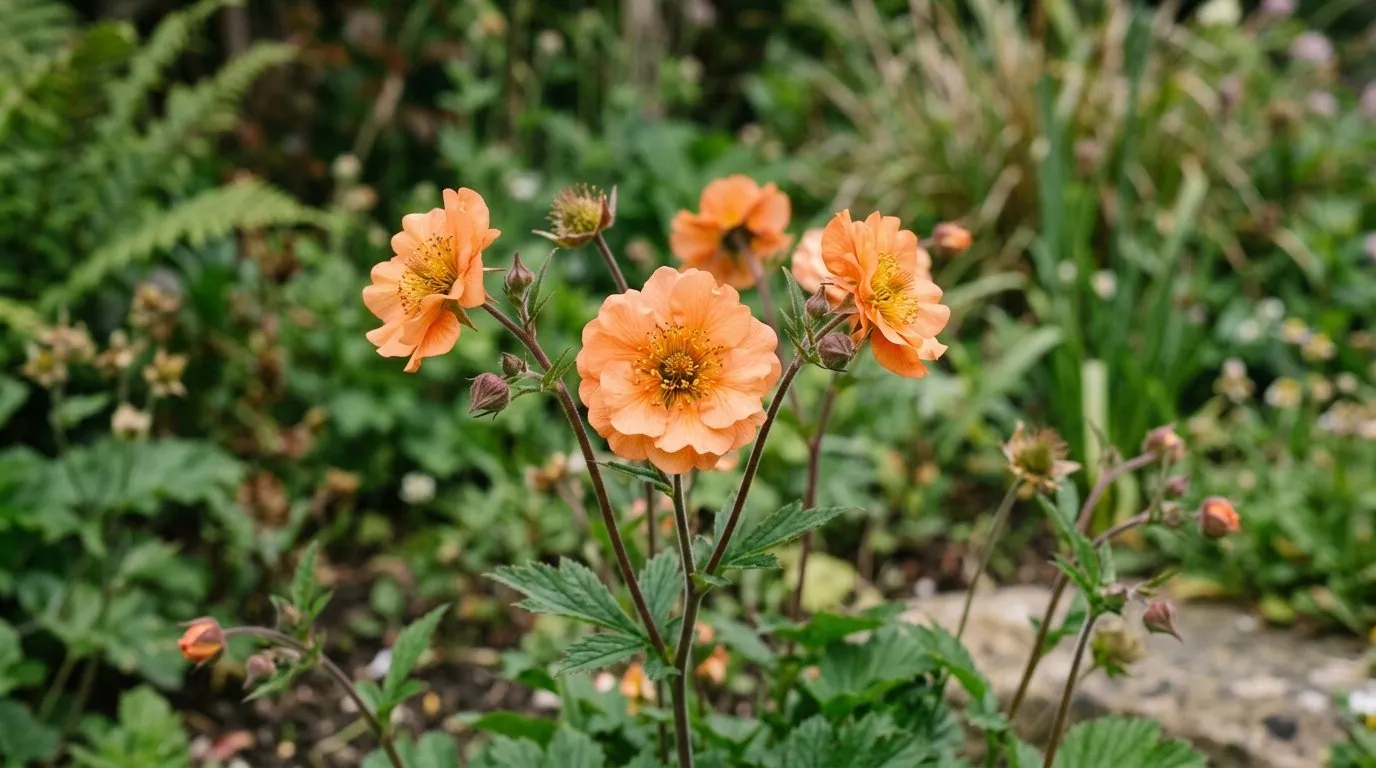 ‘Totally Tangerine’ flowering in late May. This sterile hybrid blooms from April to October without deadheading.
What is geum and where does it come from?
Geum (avens) is a hardy herbaceous perennial in the Rosaceae family, the same group as roses, strawberries, and potentillas. Around 50 species occur worldwide, native to temperate woodland edges, damp meadows, and stream banks across Europe, Asia, and the Americas. Two species, Geum rivale (water avens) and Geum urbanum (wood avens), grow wild in British hedgerows and damp grassland.
Garden geums are almost all hybrids between the South American Geum chiloense (tall, orange-red flowered) and various European species. The breeding programme that gave us ‘Mrs J. Bradshaw’ began in the 1920s, but the real revolution came between 2000 and 2015, when breeders produced sterile triploid hybrids that flower for six months without setting seed. ‘Totally Tangerine’ (launched 2010) was the breakthrough; ‘Mai Tai’, ‘Cooky’, and ‘Scarlet Tempest’ followed.
Compared with a traditional cottage border perennial like salvia or a summer stalwart like agapanthus, geums have a fundamentally different flowering rhythm. Salvias peak, rest, then repeat. Agapanthus flower hard for four to six weeks. Geums trickle. One or two buds open daily through spring, summer, and autumn, never putting on a single massed display but never pausing either.
Which geum varieties grow best in UK gardens?
Geum ‘Totally Tangerine’ (the one everyone should grow)
Geum ‘Mrs J. Bradshaw’ (the classic)
The 1920s original scarlet geum. Large semi-double red flowers from May to August, 60cm tall. The drawback is prolific self-seeding, and all the seedlings revert to dull yellow wild-form flowers. Either pull seedlings ruthlessly or plant a sterile modern replacement like ‘Scarlet Tempest’.
Geum ‘Mai Tai’ (for pots and front of border)
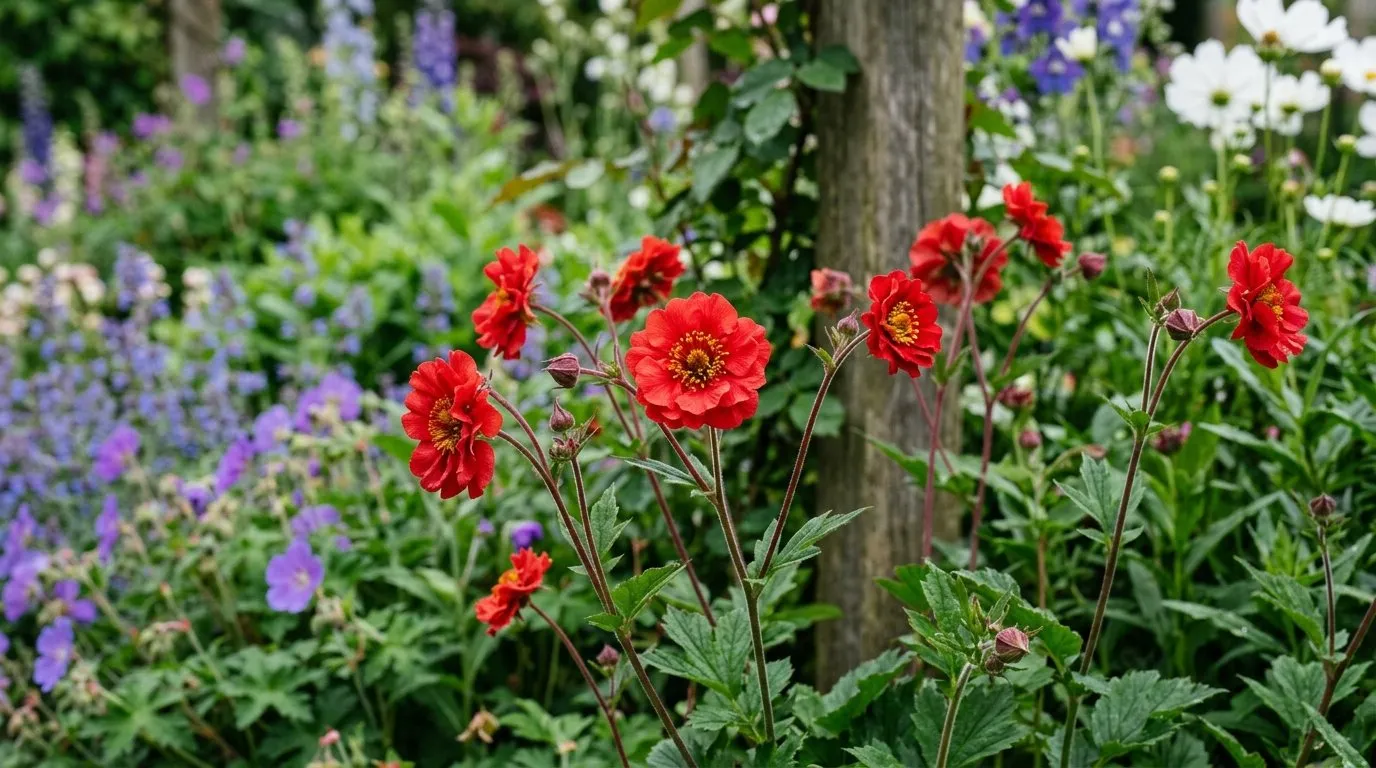 ‘Mrs J. Bradshaw’, the 1920s classic. Scarlet semi-double flowers from May to August, though seedlings revert to wild yellow.
Where do geums grow best in a UK garden?
Geums tolerate a wider range of conditions than most cottage perennials, but they reward the right placement with an extra six to eight weeks of flowering.
Light: Full sun for 6+ hours daily gives the longest flowering season and the most intense flower colour. In southern England, afternoon shade from 2pm onward prevents scorching on the hottest summer days. In Scotland and northern England, plant in full sun. Deep shade cuts flowering by around 30% but does not kill the plant.
Drainage: The contradiction: they need moist soil but rot in waterlogged winter ground. On heavy clay, plant on a slight slope or raise the bed 10-15cm. Waterlogging between December and February kills more geums than any pest or disease.
How to plant geums
Plant bare-root divisions in March or container-grown plants any time from March to October. Spring planting gives roots a full season to establish before the first winter.
Step 1 - Prepare the soil. Dig in a bucket of garden compost or well-rotted manure per square metre. On heavy clay, add a bucket of sharp horticultural grit to the planting area to improve drainage. Skip both amendments on naturally loamy soil.
Step 2 - Space correctly. Plant short varieties (30-45cm tall) at 30cm spacing. Taller varieties (60-75cm) need 45cm between plants. Closer planting creates poor airflow and invites mildew.
Step 3 - Plant at the original depth. Set the crown (where stems meet roots) level with the surrounding soil. Planted too deep, geums rot; planted too shallow, they dry out.
Step 4 - Water in heavily. Soak the planting hole before placing the plant, then again after backfilling. Water weekly for the first six weeks if rainfall is low.
Step 5 - Mulch. Spread 50mm of garden compost over the soil surface, keeping it 3cm clear of the crown. Mulch conserves moisture, suppresses weeds, and feeds the soil through the season.
According to the Royal Horticultural Society, geums are among the most forgiving perennials to establish, with losses typically below 5% from spring planting in decent soil.
 Geum division in March. The outer growth replants well; the woody centre goes to the compost heap.
How to divide geums
Division is the single most important maintenance task for geums. Skip it and your plants decline to the point where they flower for three weeks instead of six months. Do it every two or three years and they perform indefinitely.
The signs a geum needs dividing:
- Flowering period shortens by more than 20% compared to previous years
- The centre of the clump produces no new shoots in spring
- The leaf crown looks woody or hollow when lifted
- Flowering stems flop outward, leaving a bare middle
When to divide: Mid to late March is ideal. New shoots are visible at the crown, showing where to slice, but soft enough to handle without damage. Autumn division is possible but risks winter losses on clay.
How to divide:
- Dig up the whole clump with a garden fork, going wide to keep the root ball intact.
- Wash or shake soil from the roots so you can see the crowns clearly.
- Slice the clump into sections with a sharp spade or old kitchen knife. Each section needs 3-5 vigorous shoots and a decent root system.
- Discard any woody, rootless, or rotting central material.
- Replant divisions immediately at the original depth. Space them per the planting guide above.
- Water heavily and mulch with garden compost.
The outer ring is always the most vigorous. Replant those pieces into the original spot and give the middle divisions to friends or plant them in a new border.
For broader guidance on trimming and managing herbaceous perennials, see the Chelsea chop for perennials.
How to deadhead geums and extend flowering
Deadheading matters for fertile varieties but is unnecessary for sterile hybrids.
Fertile varieties (‘Mrs J. Bradshaw’, ‘Lady Stratheden’, ‘Prinses Juliana’): Cut spent flowers and their stems down to the basal foliage with secateurs. Do this every 3-5 days during flowering. Removing seed heads triggers a second flush of blooms 3-4 weeks later and prevents yellow-flowered seedlings swamping the parent clump. Skipping deadheading cuts total flowering from 14 weeks to around 8.
End-of-season care: Leave all foliage standing through winter. The evergreen basal leaves protect the crown from frost. In late February, cut back any brown or tattered old foliage to reveal the fresh new shoots emerging beneath. Compost the trimmings.
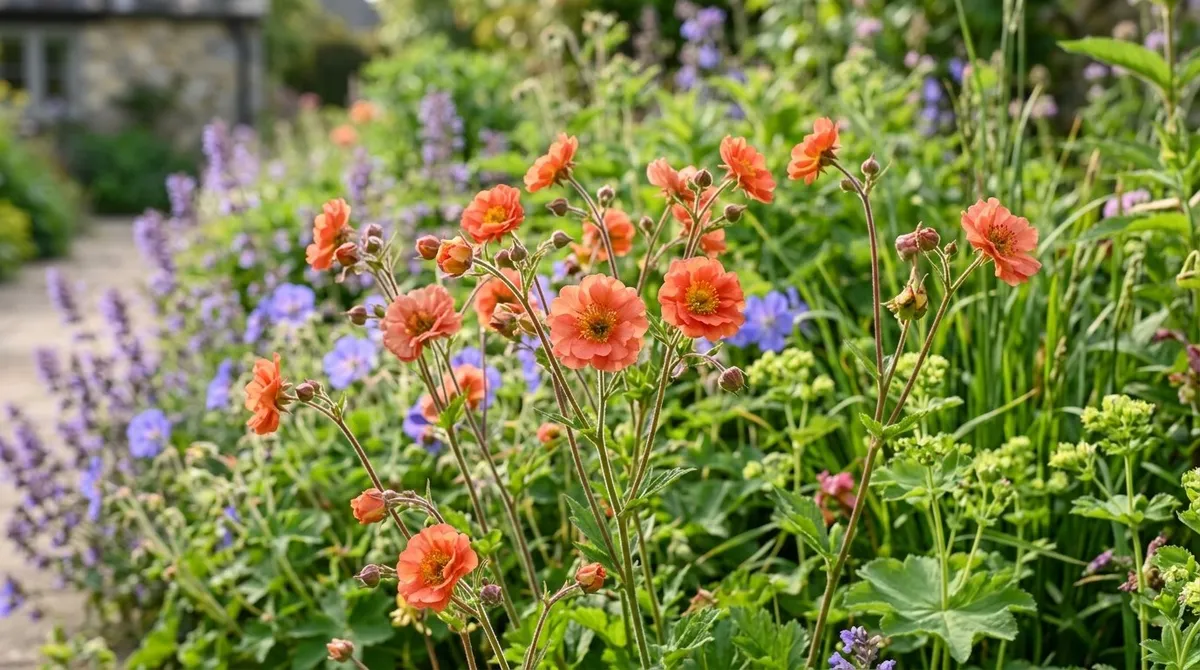
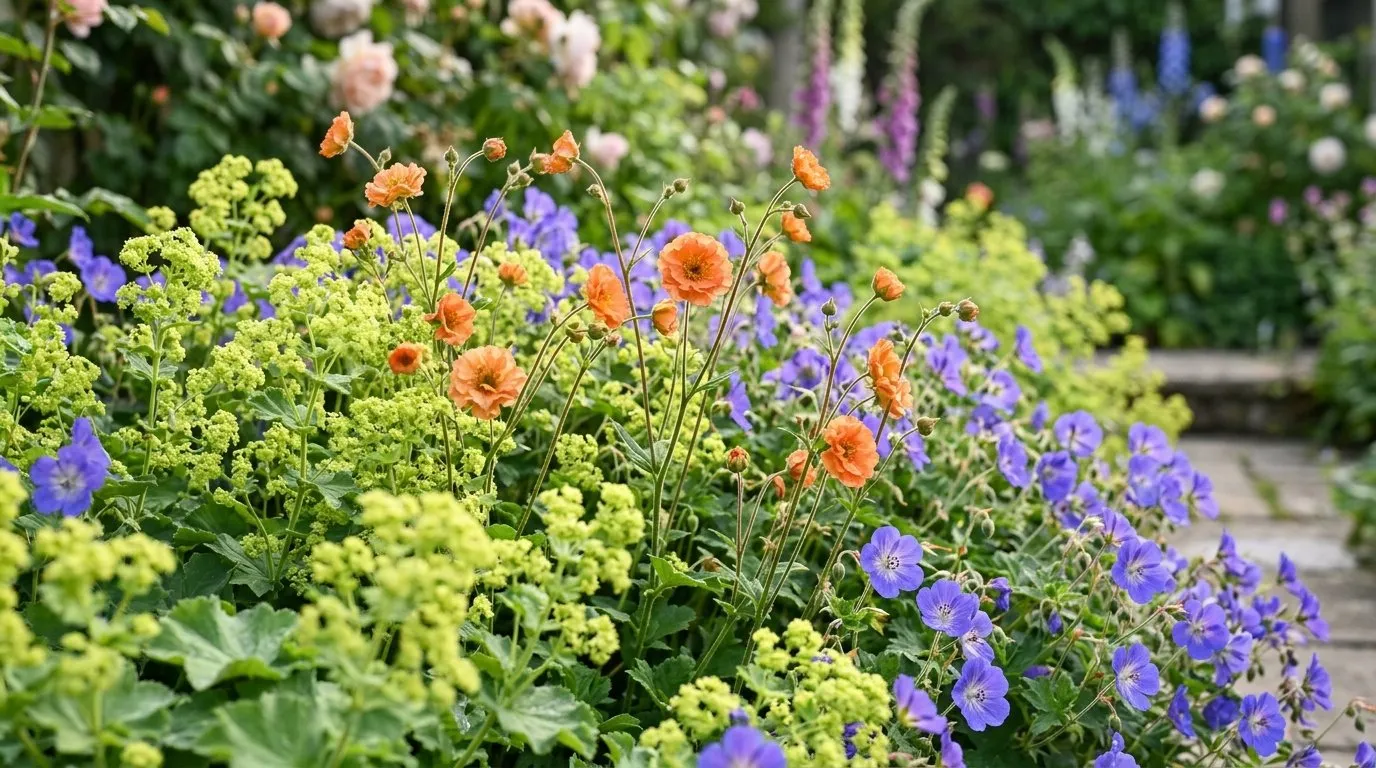 ‘Totally Tangerine’ with alchemilla mollis and hardy geranium ‘Rozanne’. A classic cottage combination that flowers for six months.
Best cottage garden combinations with geums
Geums excel as middle-border filler plants. They knit other specimens together with airy, long-flowering spikes that never draw too much attention but never disappear either.
Classic orange combinations
‘Totally Tangerine’ with alchemilla mollis and hardy Geranium ‘Rozanne’. The chartreuse flowers of alchemilla and the blue of the geranium set off the coral geum perfectly. All three flower from May to October, giving six months of continuous colour.
Red and white cottage
‘Mrs J. Bradshaw’ with white Astrantia major, Alchemilla mollis, and purple alliums. Peak display in June, carrying on into August after deadheading. Plant in groups of three or five per variety.
Hot border
‘Scarlet Tempest’ with Crocosmia ‘Lucifer’, Helenium ‘Moerheim Beauty’, and Stipa tenuissima. A fiery combination that peaks in July-August. The stipa grass softens the hot flower colours and adds vertical movement.
Shade-edge planting
Geum rivale ‘Bell Bank’ with hostas, ferns, and Brunnera macrophylla. This dusky-pink water avens thrives in the same damp shade that suits hostas, and all four flower or foliage-peak in early summer.
For more combination ideas, see our guide to best plant combinations for UK borders and cottage garden planting plans.
Common geum problems and solutions
Powdery mildew. White dusty coating on leaves in hot dry spells. Prevent by mulching to keep roots cool, avoiding overhead watering, and spacing plants 45cm apart for airflow. If it appears, cut affected foliage back to the crown and water the roots deeply. Fresh growth emerges mildew-free within 2-3 weeks.
Reverting yellow seedlings. Named varieties (except sterile hybrids) produce yellow-flowered offspring that swamp the parent. Pull every seedling in April-May before they establish, or choose sterile cultivars that cannot seed.
Dead centres. Untreated, this kills clumps within 5-6 years. Prevent by dividing every 2-3 years in March. Recover a dying clump by splitting the outer ring, discarding the middle, and replanting in fresh compost-enriched soil.
Crown rot on wet clay. Roots blacken and the plant collapses in February-March. Caused by winter waterlogging. Replant on a slight mound or raised bed with added grit. Once roots are above the waterlogged zone, recovery is reliable.
Slug damage to young foliage. Minor but possible on new spring shoots. A morning inspection with hand removal clears most colonies. For persistent problems, see how to get rid of slugs.
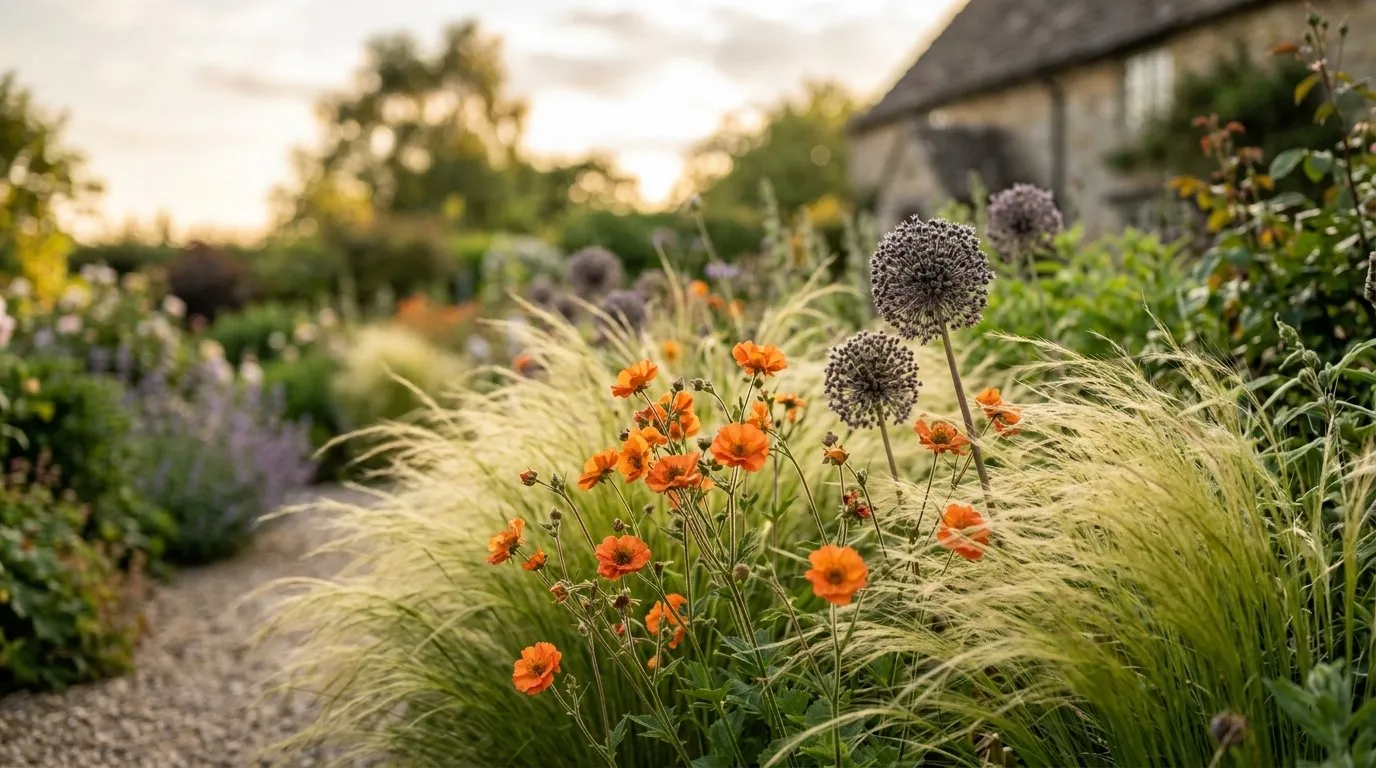 A mixed cottage border with geum, allium ‘Globemaster’, and stipa grasses in early June.
Geum maintenance calendar
| Month | Task | Time per 5 clumps |
|---|---|---|
| February | Cut back tattered winter foliage to fresh basal shoots | 15 minutes |
| March | Divide clumps every 2-3 years. Mulch new and existing plants | 2 hours (division year) |
| April-May | Pull seedlings from fertile varieties. Stake tall varieties if exposed | 30 minutes |
| May-June | First flush begins. Deadhead fertile varieties every 3-5 days | 20 minutes per week |
| July-August | Continue deadheading. Water weekly if rainfall below 20mm | 15 minutes per week |
| September-October | Late flowering continues on sterile hybrids. Collect seed from species | Minimal |
| November-January | Leave foliage standing. No cutting back | None |
Total annual maintenance per clump runs to around 3-4 hours in a division year and 2 hours in other years. For comparison, a dahlia clump demands 10-12 hours including lifting and storage.
Where to buy geums in the UK
Buy in 9cm or 1-litre pots from RHS Plant Finder nurseries, Claire Austin Hardy Plants, or Hardy’s Cottage Garden Plants. Expect to pay £6-£9 for a 9cm pot and £12-£15 for a 2-litre specimen. Bare-root divisions sold mail-order in March run at £4-£6 each from specialist perennial nurseries.
Small plants establish faster than larger ones in most soils. A 9cm pot planted in April will flower in its first summer and be ready to divide by its third March. A 2-litre specimen buys you one season of immediate impact but costs double for little long-term advantage.
For a full rundown of reliable border perennials to partner with your geum, see our guide to best perennial plants for UK gardens.
Frequently asked questions
How long do geums flower in the UK?
Modern geum cultivars flower from April to October in UK gardens. That is 20-26 weeks of continuous bloom, longer than any other hardy herbaceous perennial. ‘Totally Tangerine’ and ‘Mai Tai’ are the longest flowerers, producing fresh buds daily without deadheading. Older named varieties like ‘Mrs J. Bradshaw’ flower for 12-16 weeks from May to August and benefit from deadheading to extend the season.
Do geums need full sun?
Geums prefer full sun but tolerate partial shade, particularly in southern England where summer heat can scorch flowers. In Scotland and northern England, plant in full sun for best flowering. On hot, dry sites give afternoon shade. Shade-tolerant species such as Geum rivale (water avens) and Geum urbanum (wood avens) thrive under trees. Flowering reduces by roughly 30% in deep shade compared to full sun.
When should I divide geums?
Divide geums every 2-3 years in March, just as new growth emerges. Lift the entire clump with a fork, slice through the crown with a spade or old knife, and replant vigorous outer sections at the original depth. Each division needs 3-5 shoots. Discard any woody central material. Undivided clumps develop dead centres, flower for shorter periods, and are more prone to rot in wet winters.
Why are my geum seedlings a different colour?
Seed-raised geums revert to their wild yellow or pink forms. Almost every named variety is a hybrid or cultivar, so their seeds do not come true. A clump of ‘Mrs J. Bradshaw’ will produce yellow-flowered seedlings around its base. Pull these out before they swamp the parent or choose sterile hybrids like ‘Totally Tangerine’, ‘Mai Tai’, and ‘Cooky’ that cannot self-seed.
Do geums need staking?
Short varieties under 45cm need no support. Taller geums such as ‘Totally Tangerine’ at 75cm and ‘Mrs J. Bradshaw’ at 60cm flop in exposed sites but not in sheltered borders. Twiggy hazel pea sticks pushed around emerging foliage in April provide invisible support. Avoid thick bamboo canes, which look ugly against the airy flowers. The wiry stems are naturally flexible and rarely snap in UK wind.
Are geums good for pollinators?
Can geums grow in pots?
Geums grow well in pots of 30cm diameter or larger. Use John Innes No. 3 compost with 20% added grit for drainage. Water daily in summer and feed fortnightly with tomato feed from May onward. Compact varieties such as ‘Mai Tai’ (40cm) and ‘Cooky’ (30cm) suit containers best. Repot or divide every 2 years to prevent root congestion. Move pots to a sheltered spot in extreme winter cold to protect root balls.
Sources: RHS Geum Growing Guide | Plant Heritage Geum Collection Holder
Our team produces practical UK gardening guidance from source research, contributor records and established horticultural practice. Editorial standards are overseen by Matt W.