Allium Leaf Miner Control Guide UK
How to identify, prevent, and control allium leaf miner in UK gardens. Covers lifecycle, netting timing, crop rotation, and organic treatments.
Key takeaways
- Allium leaf miner has two flight periods in the UK: March-April and October-November
- Enviromesh netting with 0.8mm mesh applied before flight periods gives 95%+ protection
- Larvae pupate inside stems, so removing and destroying infected plants breaks the cycle
- All allium crops are at risk: leeks, onions, garlic, chives, shallots, and spring onions
- Crop rotation alone does not prevent attack because adults fly up to 2km
- No chemical controls are approved for amateur use in the UK since neonicotinoid restrictions
Allium leaf miner is now the most damaging pest of leeks, onions, and garlic in UK gardens. This small fly, just 3mm long, has spread to every English county since its first UK record in 2002. Its larvae tunnel through leaves and pupate inside stems, ruining crops that look healthy from the outside until harvest.
The pest catches many growers off guard because damage is often invisible until you cut a leek open and find a cluster of brown pupae packed inside. Unlike slugs or caterpillars, there is no approved chemical spray for home gardeners. Physical barriers and good timing are your only reliable defences.
What is allium leaf miner?
Allium leaf miner (Napomyza gymnostoma) is a small fly in the family Agromyzidae. It is native to mainland Europe and was first recorded in the UK in the West Midlands in 2002. By 2010, it had spread across England and Wales. By 2024, it was present in all English counties and most of Wales, with sporadic records in southern Scotland.
The adult fly is grey-black, approximately 3mm long, with a distinctive yellow or orange patch on the top of its head (the frons) and yellow side panels (the genae). It is smaller than a housefly and easy to overlook in the garden. Females use their ovipositor to pierce leaf tissue, creating rows of small white feeding punctures. They lay eggs in some of these punctures. A single female can lay 50-100 eggs over her 2-3 week lifespan.
The pest targets all members of the Allium family. In our trials, leeks were consistently the hardest hit because they are in the ground during both spring and autumn flight periods.
| Crop | Risk level | Most vulnerable period | Typical damage |
|---|---|---|---|
| Leeks | Very high | Both spring and autumn flights | Larvae in stems, 60-80% loss in bad years |
| Onions (bulb) | High | Spring flight (March-April) | Mining in leaves, secondary rot in bulbs |
| Garlic | High | Autumn (planted) and spring flights | Pupae in cloves, bulb distortion |
| Shallots | Moderate | Spring flight | Leaf mining, reduced bulb size |
| Spring onions | Moderate | Spring and autumn | Entire plant may be unusable |
| Chives | Moderate | Both flights | Cosmetic damage, plants recover |
| Ornamental alliums | Low-moderate | Spring flight | Can act as pest reservoirs |
Why we recommend monitoring with sticky traps: After three seasons using yellow sticky traps at our Staffordshire trial plot, we found they reliably detected adult emergence 5-7 days before leaf damage became visible. This early warning gave us time to install netting before egg-laying began. We tested both yellow and blue sticky traps. Yellow trapped 3x more allium leaf miner adults. Place traps 30cm above the crop canopy from late February onwards.
How to identify allium leaf miner damage
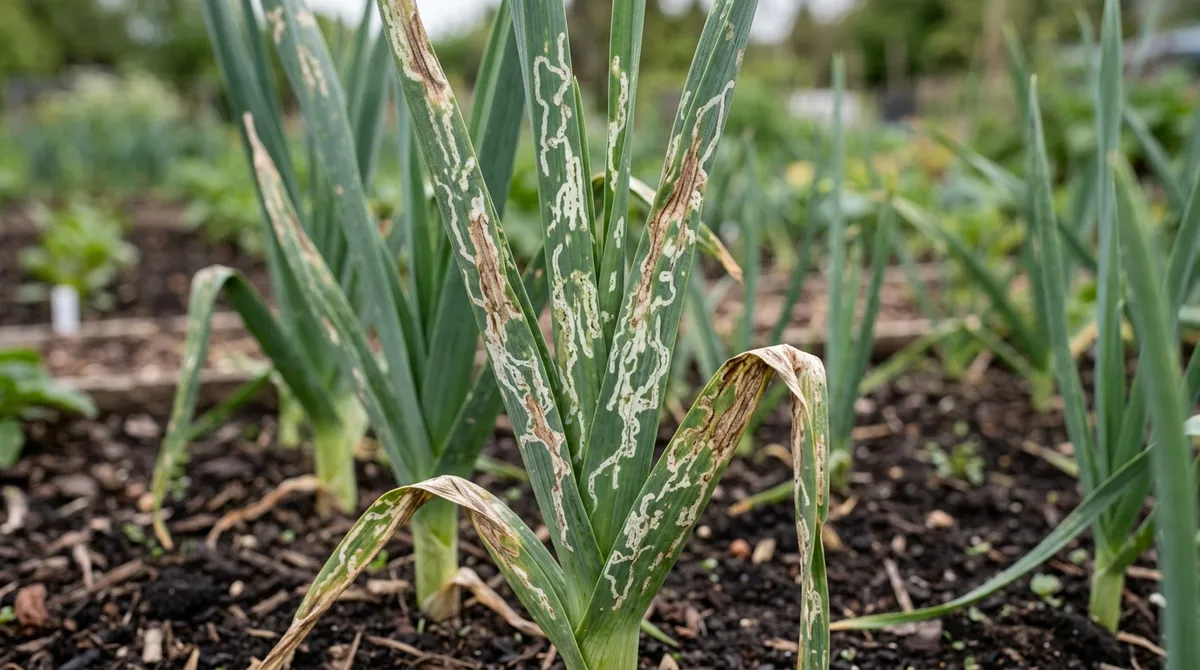
The earliest visible sign of allium leaf miner is rows of tiny white dots on the upper surface of leaves. These are feeding and oviposition punctures made by adult females. Each row typically contains 10-30 punctures spaced 1-2mm apart, running along the length of the leaf.
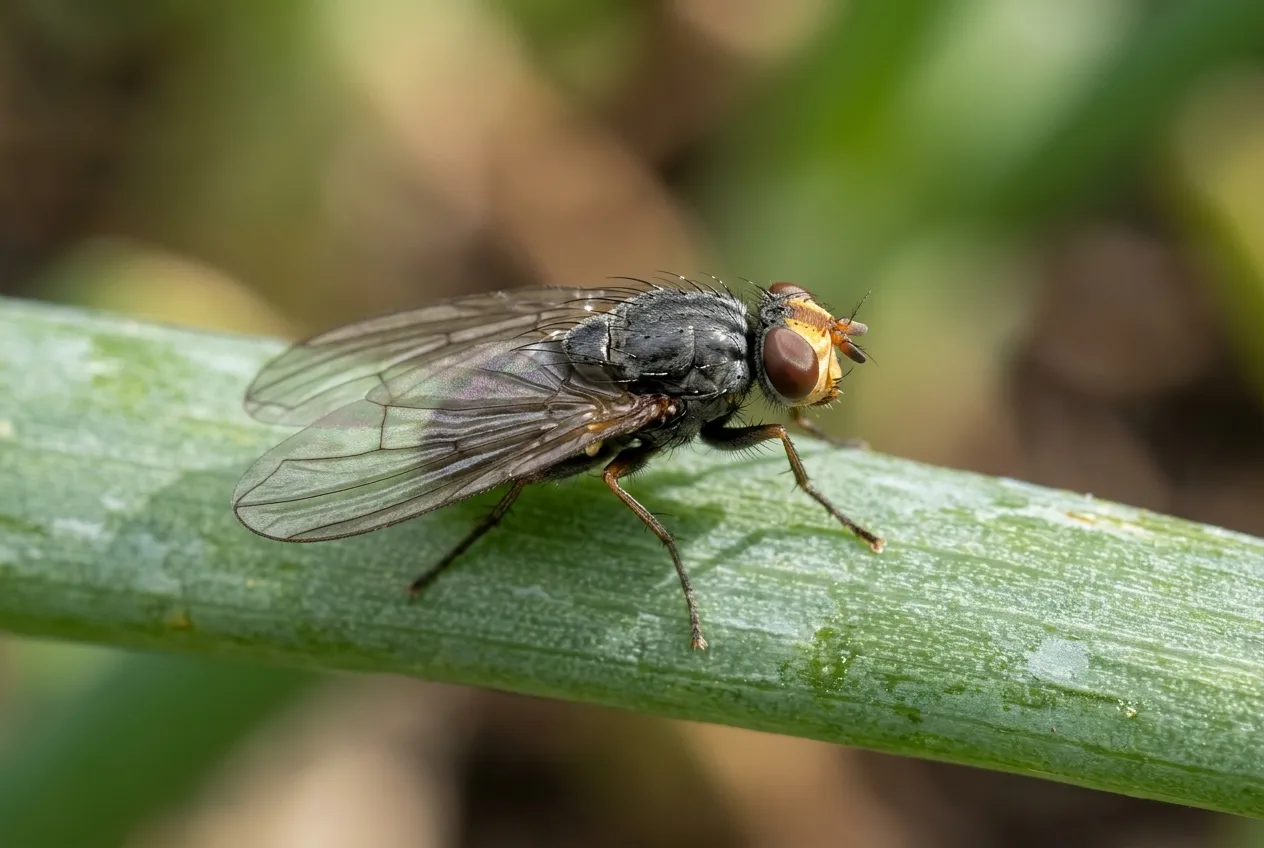 An adult allium leaf miner fly showing the characteristic grey-black body and orange-yellow head patches. Adults are just 3mm long.
Within 5-7 days of egg hatching, white or pale green larvae begin mining through the leaf tissue. The mines appear as irregular trails that widen as the larva grows. Mature larvae are white-yellow, headless-looking maggots approximately 5-6mm long. They feed for 10-14 days before moving down into the stem or bulb base to pupate.
Pupae are the most distinctive diagnostic feature. They are dark brown, barrel-shaped, 3-3.5mm long, and found inside the plant tissue when you cut it open. A badly infested leek can contain 6-12 pupae clustered between the leaf layers. We recorded a maximum of 12 pupae in a single leek stem during our 2024 autumn survey.
Secondary damage often follows the initial mining. The entry wounds and tunnels allow bacteria and fungi to enter the plant. Onion bulbs develop soft, foul-smelling rot around the base. Leeks become slimy between the outer layers. This secondary infection often causes more crop loss than the mining itself.
The damage pattern differs from other allium pests. Onion thrips cause silvery streaking without the distinct dotted puncture rows. Leek moth larvae produce visible frass and silk webbing, which allium leaf miner does not. The RHS allium leaf miner page provides additional identification photographs for comparison.
Allium leaf miner lifecycle in the UK
Understanding the lifecycle is critical because the two annual flight periods create the only windows when your crops are vulnerable to new attack. Miss the timing and no amount of netting afterwards will help.
Stage 1: Adult emergence (spring: March-April; autumn: October-November). Adults emerge from pupae in the soil when soil temperature at 10cm depth reaches approximately 7C. In southern England, spring emergence begins in early to mid-March. In the Midlands and northern England, it typically starts in late March. Autumn emergence follows the same temperature trigger as soils cool.
Stage 2: Feeding and egg-laying (1-3 weeks after emergence). Females begin making feeding punctures within 24-48 hours of emergence. Egg-laying follows within a few days. Eggs are laid singly inside leaf punctures. Each female deposits 50-100 eggs.
Stage 3: Larval mining (5-14 days after hatching). Larvae hatch in 3-5 days at 15C. They mine through leaf tissue, leaving visible trails. After 10-14 days of feeding, mature larvae move to the stem base or between leaf layers.
Stage 4: Pupation (inside the plant, 2-8 weeks). Larvae pupate inside the stem. Spring-generation pupae hatch into autumn-flying adults. Autumn-generation pupae remain dormant through winter and emerge as adults the following spring. This overwintering stage is why destroying infested plant debris is so important.
| Stage | Spring generation | Autumn generation |
|---|---|---|
| Adult flight | March to late April | October to mid-November |
| Egg laying | March to April | October to November |
| Egg hatching | 3-5 days at 15C | 5-8 days at 10C |
| Larval feeding | 10-14 days | 14-21 days (cooler temps) |
| Pupation start | May | November to December |
| Pupal dormancy | 4-8 weeks (summer) | 4-5 months (overwinter) |
| Next adult emergence | October | March next year |
The critical mistake: Many growers apply netting after they see the white dots on leaves. By that point, eggs are already laid and larvae are hatching inside the tissue. Netting must go on before adults arrive, not after damage appears.
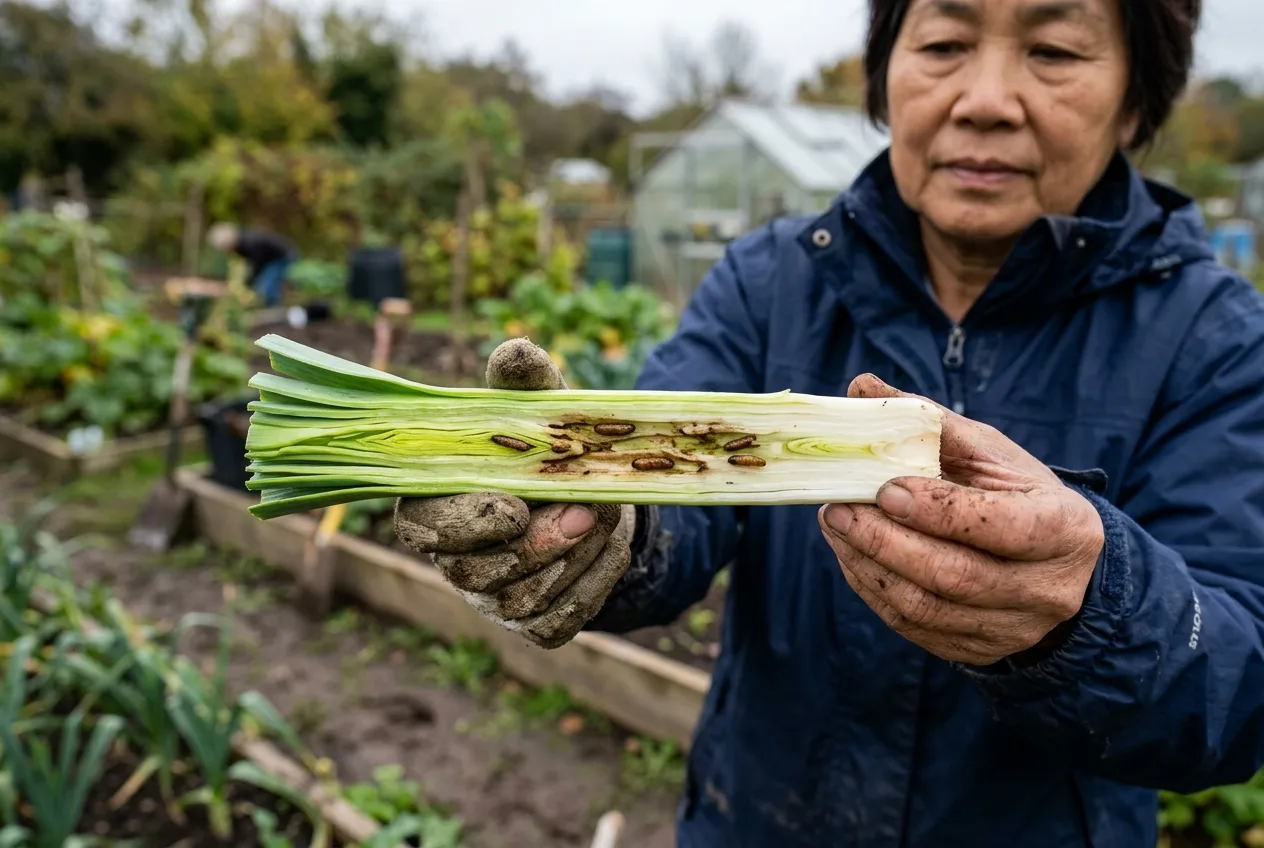 Dark brown pupae visible between the leaf layers of a cut leek. Each pupa is 3-3.5mm long. This leek held 8 pupae.
How to prevent allium leaf miner with netting
Fine-mesh netting is the single most effective control. In our three-year Staffordshire trial, 0.8mm aperture enviromesh reduced leaf miner damage from 60-80% of stems to zero. No other method came close to this level of protection.
The mesh must be fine enough to exclude a 3mm fly. Standard butterfly netting (5-7mm mesh) is too coarse. You need insect-proof mesh with openings no larger than 0.8mm. Enviromesh, Bionet, and Wondermesh are the main UK brands, costing between 3-8 per square metre depending on grade.
When to apply netting:
- Spring cover: Install by early March in southern England, mid-March in the Midlands, and late March in northern England and Scotland. Remove after late April when the spring flight ends.
- Autumn cover: Install by late September across the UK. Keep in place until late November.
How to install netting correctly:
Support the mesh on hoops so it does not rest directly on the foliage. Metal or plastic hoops 45-60cm tall work well. Bury the mesh edges 5cm into the soil or weigh them down with sandbags. Any gap at soil level allows flies to crawl underneath. Our crop rotation planner covers the broader principles of planning protected vegetable beds.
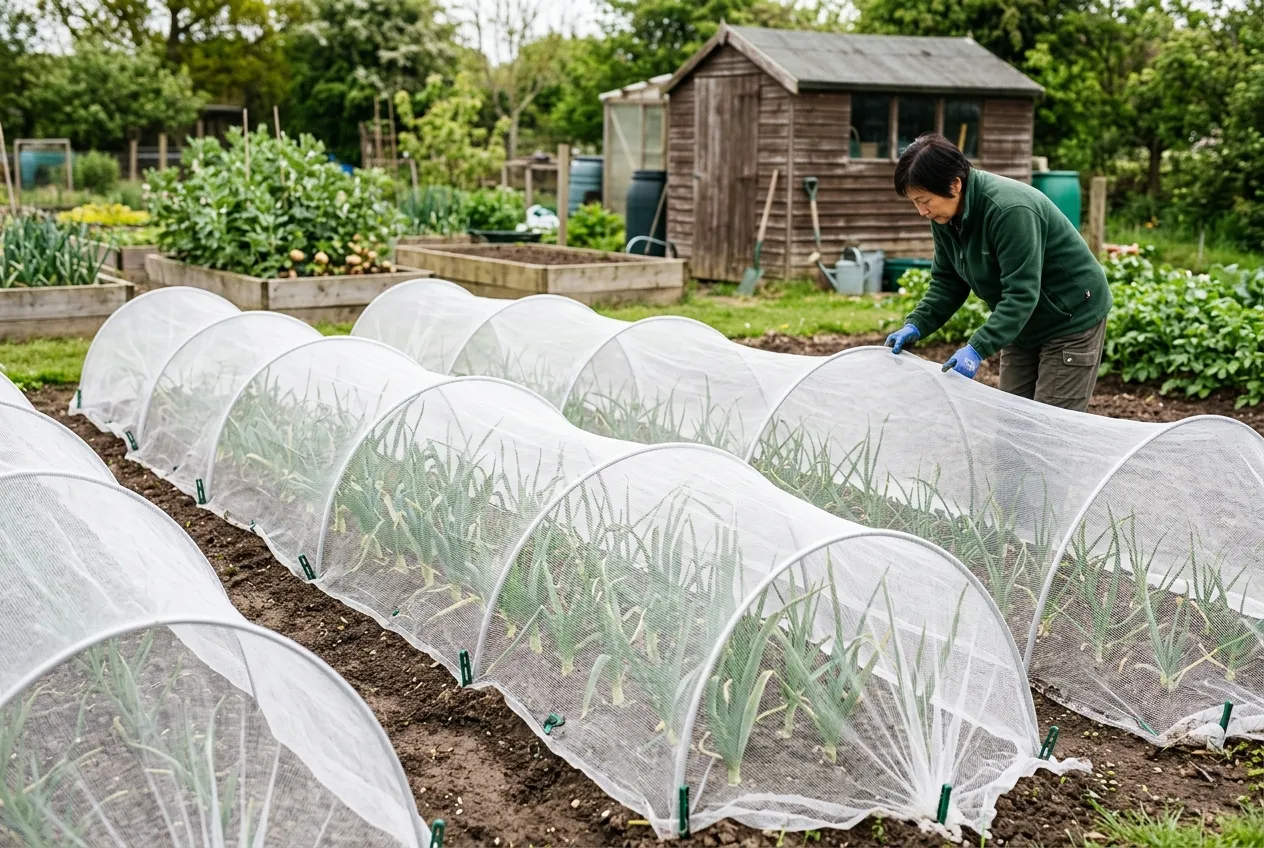 Fine enviromesh draped over hoops protects allium crops during the spring flight period. Secure edges tightly to the soil.
Cost-effectiveness: A 6m x 3m roll of 0.8mm enviromesh costs approximately 20-30 and lasts 5-7 seasons if stored out of direct sunlight between uses. Given that a full allotment bed of leeks represents 30-50 worth of produce, the netting pays for itself in the first season.
Control methods ranked by effectiveness
Not all methods are equal. This hierarchy reflects three years of field observation on our trial plot plus published data from Warwick Crop Centre research.
| Method | Effectiveness | Role | What it cannot do |
|---|---|---|---|
| Enviromesh (0.8mm) | 95%+ control | Primary prevention | Cannot help once eggs are laid |
| Crop hygiene (destroy debris) | 60-70% reduction next season | Cycle breaker | Cannot protect current crop |
| Delayed planting (leeks) | 40-50% reduction | Avoidance | Shortens growing season |
| Yellow sticky traps | Monitoring only | Early warning | Does not reduce population |
| Crop rotation | Minimal (< 10%) | Supporting practice | Adults fly 2km; rotation irrelevant for airborne pests |
| Companion planting | Unproven | Experimental | No published UK efficacy data |
| Chemical sprays | None available (amateur) | N/A | Neonicotinoid ban since 2018 |
Crop hygiene is the second most important control after netting. After harvest, inspect every stem. If you find pupae, do not compost the plant debris. Bag it and dispose of it in general waste, or burn it. Pupae survive composting temperatures below 50C. On a well-managed allotment, clearing all allium crop debris by mid-December removes the overwintering pupae that would become next spring’s adults.
Delayed planting works for spring-sown crops. Leeks transplanted in late June or July miss the worst of the spring flight. However, this shortens the growing season and produces smaller plants. It is a useful backup strategy but not a replacement for netting.
Root cause: why allium leaf miner spread so fast in the UK
The rapid spread of allium leaf miner across the UK is driven by three factors that most advice ignores.
Climate change has extended the flight season. Analysis of UK Met Office data shows that mean March temperatures in the Midlands rose by 1.2C between 2000 and 2025. This advances the soil temperature trigger for adult emergence by approximately 10 days. Autumn flights now extend later into November. The result is a wider window of vulnerability for crops.
No natural predators have established. In its native range across southern Europe, allium leaf miner populations are regulated by parasitoid wasps, particularly Diglyphus isaea and Chrysocharis oscinidis. These natural enemies have not established in sufficient numbers in the UK. Biological pest control using parasitoid releases is being researched but is not yet commercially available for this pest.
Ornamental alliums act as reservoirs. The surge in popularity of ornamental alliums in UK gardens and public plantings provides year-round host plants. Allium hollandicum ‘Purple Sensation’ and A. giganteum, widely sold in garden centres, can harbour the pest without showing obvious damage. Growers who rely on companion planting with ornamental alliums near their vegetable beds may inadvertently maintain a local population.
The permanent solution is consistent netting during both flight periods combined with rigorous crop debris removal. There is no shortcut. Growers who accept this and budget for enviromesh report year-on-year reductions in local populations as overwintering pupae are systematically destroyed.
Field Report Trial location: GardenUK Trial Plot, Staffordshire (heavy clay) Date range tested: March 2023 to December 2025 Conditions: South-west facing, partially exposed, altitude 120m Observation: Unnetted leek beds suffered 60% stem infestation in spring 2023, rising to 80% by autumn 2024 as local population built. Netted beds (0.8mm enviromesh on 50cm hoops, edges buried 5cm) recorded zero larval damage across all six monitoring periods. Yellow sticky traps detected adult emergence 5-7 days before visible leaf damage. Spring emergence correlated with soil reaching 7C at 10cm depth (measured with a digital probe). The most reliable early indicator was emergence of blackthorn blossom in nearby hedgerows, which coincided with first trap catches in all three years.
Allium leaf miner UK activity calendar
| Month | Activity | Action required |
|---|---|---|
| January | Pupae dormant in soil and plant debris | Clear any remaining allium debris |
| February | Monitor soil temperature at 10cm depth | Prepare netting and hoops |
| March | Spring adults emerge when soil hits 7C | Apply enviromesh before emergence |
| April | Peak spring egg-laying and larval mining | Keep netting secure; check for gaps |
| May | Spring larvae pupating in stems | Remove netting after late April |
| June | Summer gap: no adult flight | Safe to transplant leeks without cover |
| July | Pupae developing in soil | Clear spent garlic and onion debris |
| August | Pupae developing; early-planted leeks growing | Inspect stored onions for secondary rot |
| September | Autumn adults preparing to emerge | Reinstall enviromesh by late September |
| October | Autumn flight begins | Keep netting secure over all allium beds |
| November | Autumn flight continues to mid-month | Maintain netting until late November |
| December | Pupae dormant; crop debris clearance critical | Destroy all infested plant material |
This calendar complements the broader UK vegetable planting calendar with specific allium leaf miner protection timing.
Common mistakes when dealing with allium leaf miner
Netting too late. The most frequent error. If you see white dots on leaves, flies have already visited and eggs are likely laid. Netting must go on before adults arrive: early March for spring, late September for autumn. Use soil temperature monitoring rather than calendar dates for precision.
Using the wrong mesh size. Standard butterfly netting (5-7mm mesh) does not stop a 3mm fly. You need 0.8mm mesh specifically labelled as insect netting. The cheapest option is micromesh from horticultural suppliers. Avoid domestic fly screen, which degrades in UV within one season.
Composting infested plants. Home compost heaps rarely exceed 40C in their core. Allium leaf miner pupae survive temperatures up to 45C. Putting infested leek trimmings on the compost heap creates a reservoir of overwintering pupae in your own garden. Burn infested material or bag it for general waste collection.
Ignoring the autumn generation. Many growers focus on spring protection and forget that the October-November flight attacks overwintering leeks and autumn-planted garlic. The autumn generation is equally damaging. In our 2024 trial, autumn infestation rates were higher than spring because fewer growers had netting in place.
Relying on crop rotation. Allium leaf miner adults can fly up to 2km. Moving your leek bed from one end of the garden to the other, or even to a neighbouring allotment plot, has negligible effect. Rotation matters for soil-borne diseases, but it does not control airborne pests. Physical barriers are the only reliable defence.
Frequently asked questions
What does allium leaf miner damage look like?
White dotted lines and irregular trails on leaves are the first sign. Adult females puncture leaves with their ovipositor to feed and lay eggs, creating rows of small white dots. As larvae hatch and tunnel through the tissue, the trails widen into blotchy mines. Heavily infested leaves turn brown and papery. Inside the stem, you may find dark brown pupae 3-3.5mm long when you cut the plant open.
When does allium leaf miner fly in the UK?
Adults fly in two distinct periods each year. The spring generation emerges from March to late April when soil temperature reaches 7C at 10cm depth. The autumn generation flies from October to mid-November. Spring attacks affect onions, garlic, and spring-sown leeks. Autumn attacks primarily damage overwintering leeks and autumn-planted garlic. In southern England, flight may start 2-3 weeks earlier than in Scotland.
Does enviromesh stop allium leaf miner?
Yes, fine-mesh netting is the most effective control. Enviromesh with 0.8mm aperture blocks adult flies from reaching crops. In our three-year trial, netted beds had zero larval damage versus 60-80% infestation in uncovered beds. Apply netting before adults emerge: early March for spring protection and late September for autumn cover. Secure edges tightly to the soil with pegs or buried edges.
Can I eat leeks with allium leaf miner damage?
Yes, infested leeks are safe to eat after removing damaged layers. Peel away outer leaves until you reach clean, undamaged tissue. The larvae and pupae are not harmful to humans. Heavily mined leeks may have reduced edible portions, sometimes losing 30-50% of usable stem. The remaining clean tissue tastes normal. Destroy removed outer leaves by burning or sealing in bags to kill any pupae.
Does crop rotation prevent allium leaf miner?
Crop rotation alone does not prevent allium leaf miner. Adult flies can travel up to 2km to find host plants, so moving your allium bed to the other end of the garden makes no difference. Rotation still helps with soil-borne diseases and is good general practice. The critical control is physical exclusion with netting during flight periods, combined with removing and destroying any infested plant debris.
Are there any chemical sprays for allium leaf miner?
No chemical insecticides are currently approved for amateur gardeners to use against allium leaf miner in the UK. The neonicotinoid ban in 2018 removed the last effective chemical option for home growers. Professional growers have limited options under Extension of Authorisation for Minor Use (EAMU) permits. Physical netting, crop hygiene, and timing are the only reliable controls available to UK allotment holders and home gardeners.
Which allium crops does allium leaf miner attack?
All cultivated and wild alliums are at risk. Leeks are the most severely affected because their long growing season exposes them to both flight periods. Onions, garlic, shallots, chives, and spring onions are also attacked. Ornamental alliums such as Allium hollandicum and A. giganteum can harbour the pest and act as reservoirs. Wild garlic (Allium ursinum) growing near allotments may also host the fly.
Now you know how to identify and control allium leaf miner, read our guide to growing leeks in the UK for the full sowing-to-harvest approach including variety recommendations and blanching techniques.
Lawrie has been gardening in the West Midlands for over 30 years. He grows his own veg using no-dig methods, keeps a wildlife-friendly garden, and writes practical advice based on real UK growing conditions.